
Key Takeaways
- The #1 reported scam is the Mount of Olives Vendor-Crowd Pickpocket.
- 2 of 6 scams are rated high risk.
- Use app-based ride services (Uber, Careem) or official metered taxis instead of unmarked vehicles.
- Never accept unsolicited offers from strangers near tourist sites in Jerusalem.
⚡ Quick Safety Tips
- In the Old City markets, never accept a 'free' tour from shopkeepers — it always ends at their store with aggressive sales pressure.
- Use only licensed taxis with meters or book through Gett app — unlicensed drivers near Damascus Gate routinely overcharge tourists.
- At the Western Wall plaza, ignore anyone offering to write prayers for you for a 'donation' — it's a common hustle targeting visitors.
- Be cautious of guides who offer to take you to rooftop viewpoints in the Muslim Quarter — some demand payment after and the locations may be unsafe.
Jump to a Scam
The 6 Scams
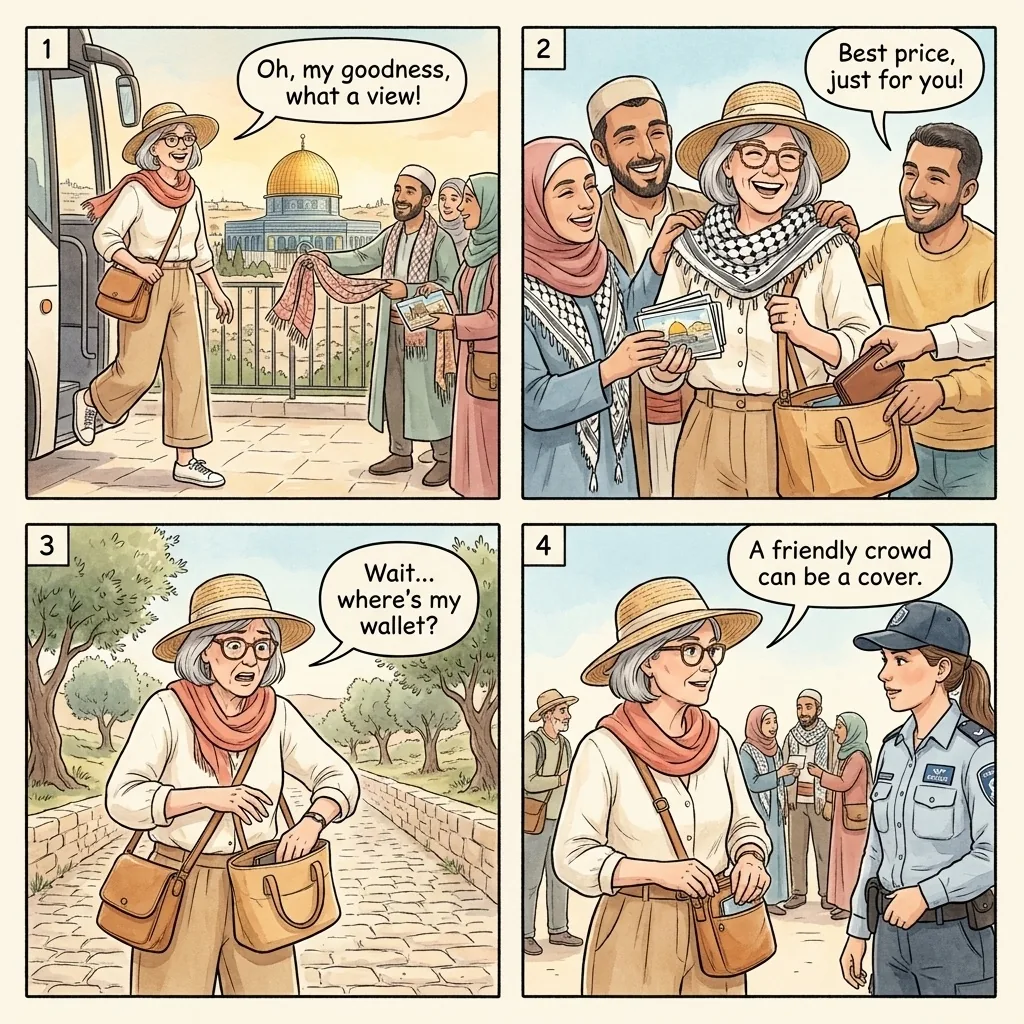
You step off the tour bus at the Mount of Olives lookout, the panoramic view of the Old City and the Dome of the Rock unfolds in front of you, and within seconds three vendors close around you with scarves, postcards, and small olive-wood crucifixes.
One drapes a keffiyeh-pattern scarf over your shoulder; another presses a stack of postcards into your hand; a third gestures toward a camel waiting at the railing for the iconic photo. The pitch is loud, friendly, layered. Your attention splits between the view, the vendors, and the camera you have just unzipped from your bag. While you frame the postcard shot of Old Jerusalem, a fourth person you have not noticed has stepped slightly behind you to your right.
By the time you politely refuse the scarf, the vendors melt away to the next visitor, and you turn back to your camera. Twenty minutes later, finishing the walk down toward Gethsemane, you reach for your wallet and find it gone. Your back jacket pocket has been worked while your attention was on the scarf. The lift was clean — no contact you registered, no obvious moment.
The Mount of Olives lookout is one of Jerusalem's most consistent pickpocket sites, documented across Reddit, the long-running TripAdvisor Jerusalem forum, and Israel Police tourist-safety advisories. The vendors and the pickpockets are typically not the same operators but they work the same window — the vendor crowd creates the distraction, the pickpocket walks the perimeter. The bus drop-off plaza, the railing photo spot, and the camel-ride corner are the three concentrated incident points.
A second variation involves the camel itself. The camel handler offers a 'free photo' or 'free quick ride,' you climb on, and the price reveals itself when you try to dismount — typically 50–100 NIS ($14–28) for a thirty-second photo perch. The pattern is cousin to the Petra 'free' camel ride, but the Jerusalem version is gentler and the camel handler usually accepts walking away if you refuse firmly.
At the Mount of Olives lookout, keep your wallet and phone in zipped front pockets and your bag worn across your front with the zipper facing your body — never the back jacket pocket where the lift works. Decline scarves and postcards by name with a firm 'la shukran' (no thanks in Arabic) and keep walking past the cluster. For the camel photo, agree on a written price (10–20 NIS for a 30-second photo, no ride) before mounting; refuse 'free' offers entirely. If you are pickpocketed, dial 100 (Israel Police) or call the Tourist Police hotline 1-700-72-22-23 immediately and file a report at the nearest station.
Red Flags
- Vendors crowding around you when you stop for photos
- Unsolicited items placed around your neck or in your hands
- Someone distracting you while another lingers near your bag
How to Avoid
- Keep bags zipped and in front of you at all crowded overlooks.
- Change camera lenses in a corner or inside the nearby cemetery.
- Decline anything placed in your hands without asking.
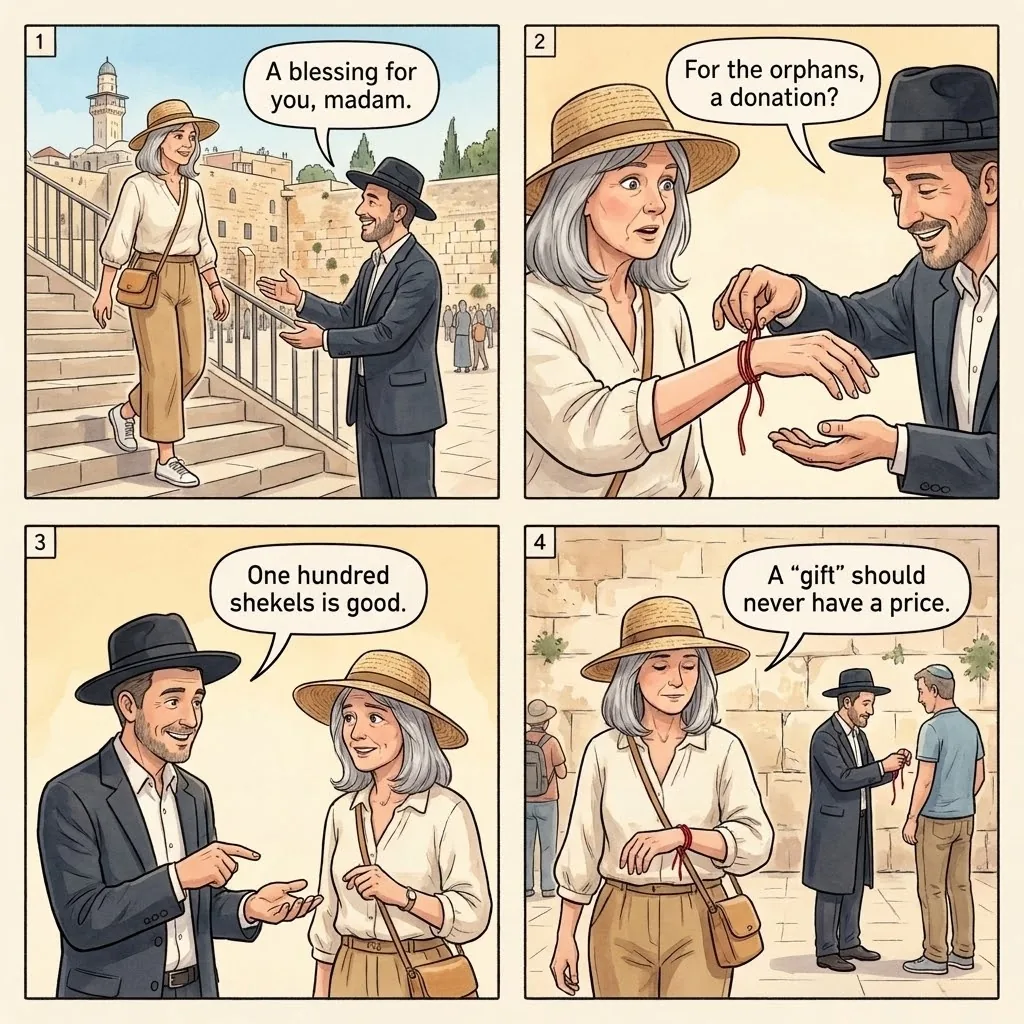
You walk down the stairs from the Jewish Quarter toward the Western Wall plaza, your first morning in Jerusalem, when a soft-spoken man in a dark suit and a wide-brimmed hat steps gently into your path with a smile.
Before you have processed what is happening, he has reached for your right wrist and is looping a thin red string around it, murmuring a Hebrew blessing — fast, melodic, generic. The whole motion takes maybe twelve seconds. Then his hand is out, palm up, and he asks for a 'donation' of 50–100 NIS ($14–28) 'for the yeshiva' or 'for the orphans,' depending on the day.
If you hesitate, a second man often appears two meters away to slow you down with a follow-up question — where are you from, are you Jewish, would you like a photo. Sometimes a third intercepts on the other side. The choreography is mild but unmistakable: enough pressure to push tourists into a quick 50 NIS to disengage at the threshold of one of Judaism's holiest sites, where refusing feels socially loaded.
TravelingIsrael.com's Jerusalem scam guide and the Israel Tourist Police both document this pattern in detail. The red string is associated with Kabbalah mysticism and is sold as a protective talisman, but a pack of identical strings costs about 5 NIS at any Judaica shop on Ben Yehuda Street, and the 'blessing' is recited word-for-word at every wrist all day long. The same script appears at the Holy Sepulchre approach in the Christian Quarter and the Jaffa Gate corridor.
The 'fake holy men' angle is what makes the scam socially uncomfortable for travelers who do not know Jewish or Christian customs well. Real rabbis do not approach strangers on the street demanding cash; the donations boxes inside the Kotel area are official and clearly labeled. Genuine yeshiva fundraisers work with printed credentials, named institutions, and never tie anything onto your body without permission. Anything else is theatre.
Do not let anyone tie a string to your wrist on the Western Wall approach, in the Jewish Quarter stairs, or near any religious site — pull your hand back, say 'Lo todah' (no thanks) firmly, and keep walking without breaking stride. If a string is already on, you can remove it the moment you are out of sight; you owe nothing for an unsolicited blessing. If you genuinely want a Kabbalah string, buy one for 5 NIS at a Judaica shop, and donate to a yeshiva through their official website. If pressure escalates to physical contact, dial 100 (Israel Police) or 1-700-72-22-23 (Tourist Police).
Red Flags
- Someone reaches for your wrist without asking
- Blessing performed without consent or prior agreement
- Donation requested in a prominent public spot
How to Avoid
- Firmly say 'no thank you' before they can touch your wrist.
- Keep walking and avoid making eye contact with persistent string-sellers.
- If a string is tied before you can stop it, you're not obligated to pay.
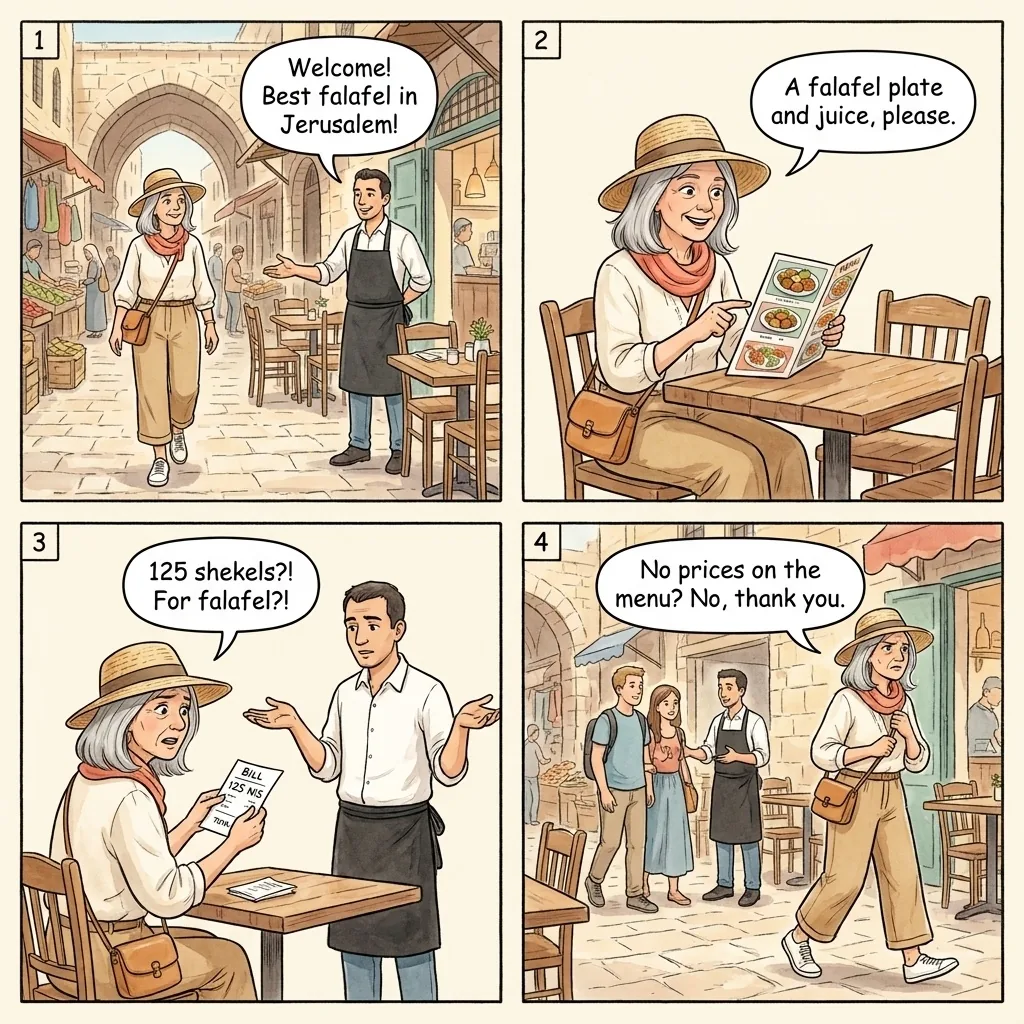
A waiter outside a small restaurant on Via Dolorosa waves you in with a friendly 'come, my friend, best falafel in Jerusalem,' hands you a laminated photo menu with descriptions in five languages but no prices anywhere on the card.
You sit down, the air smells of fresh-baked pita and grilled meat, and the waiter rattles off a list of options. You order what sounds reasonable: a falafel plate with hummus and a glass of fresh-squeezed pomegranate juice. The food arrives quickly. The plate is decent, the juice is good, the view of the Via Dolorosa just outside is exactly the postcard atmosphere you came for.
When the bill arrives, the falafel plate is 90 NIS ($25) and the pomegranate juice is 35 NIS ($10). The same dishes at a normal Jerusalem hummus shop would be 25–35 NIS for the plate and 12–15 NIS for the juice. When you protest, the waiter shrugs and explains you ordered the 'special' or the 'full plate,' not the sandwich version, and that the juice was 'large,' not 'small.' There is no menu with prices to dispute against, no itemized receipt, and no recourse beyond paying.
The Old City no-prices menu trap is the most consistently reported Jerusalem restaurant scam, documented across Reddit, the long-running TripAdvisor Jerusalem forum, and the Israeli Consumer Protection Authority's tourist advisories. Israeli law requires restaurants to display prices, but enforcement in the Old City alleys is uneven, and a meaningful fraction of the cafés along Via Dolorosa, Jaffa Gate corridor, and the Damascus Gate strip operate on a flexible 'price-after-the-fact' model.
A second variation runs the dual-menu trick: the printed menu in Hebrew posted in the window shows fair prices, but the English-language laminated card the waiter brings to the table omits prices entirely or shows different (higher) numbers. This is technically illegal under Israeli consumer law but persists at restaurants whose business model depends on one-time tourists.
Never order from a menu without prices listed in the Old City — leave immediately if the price card has photos but no numbers, regardless of how good the food smells. Reputable hummus stops in Jerusalem (Lina Restaurant in the Christian Quarter, Abu Shukri near the Eighth Station, Ja'far Sweets nearby for desserts) all post prices clearly. Confirm prices explicitly before ordering: 'How much is the falafel plate? How much is the small juice?' and demand an itemized printed receipt. If a restaurant adds undisclosed surcharges, photograph the menu and bill, dispute via your card issuer, and file a complaint with the Israeli Consumer Protection Authority at 1-800-30-30-21.
Red Flags
- Menu has no prices listed
- Waiter doesn't confirm which version of a dish you want
- Restaurant located in a heavy tourist corridor
How to Avoid
- Never order from a menu without prices — leave if prices aren't displayed.
- Explicitly confirm: 'I want the falafel in pita, how much is that exactly?'
- Check Google or TripAdvisor reviews for price complaints before sitting down.
Like what you're reading? Get a full Jerusalem itinerary with safety tips built in.
Browse travel-safety books →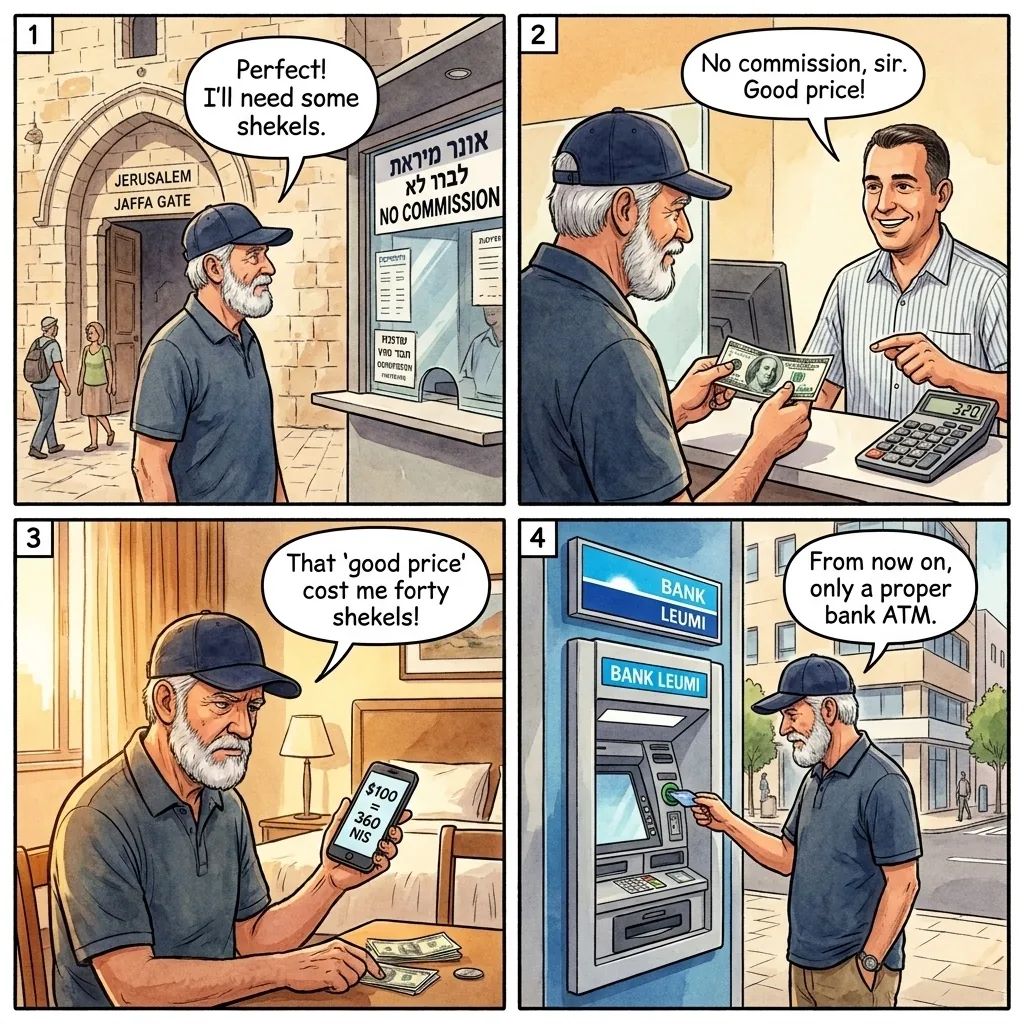
You arrive at Jaffa Gate at the start of your Old City day, realize you need shekels for the souks, and a money changer right at the gate has a 'NO COMMISSION' sign in the window with USD and EUR rates posted on a digital board.
You hand over $100, the teller punches numbers into a calculator, and slides 320 NIS across the counter. The transaction feels clean, the math looks plausible. You count the bills, thank her, and walk through the gate. Back at the hotel that evening you check the actual USD/NIS interbank rate on Wise — $100 should have given you about 360 NIS. You have just lost roughly 40 NIS (about $11) on a single exchange.
The 'no commission' sign was technically true: there was no separate commission charge. The fraud lives in the spread between the kiosk's posted exchange rate and the interbank rate, and that spread runs 8–12% at Jaffa Gate kiosks even with the 'no commission' framing. The honest changers in central Jerusalem (a few blocks deeper into the New City near Mamilla and along Ben Yehuda Street) typically run within 1–2% of the interbank rate.
A separate problem is the free-standing ATMs at Jaffa Gate operated by private companies rather than Israeli banks. These ATMs charge a 25–40 NIS access fee on top of an unfavorable Dynamic Currency Conversion rate (5–10% spread) when they offer to charge you in your home currency. The 'helpful' framing of the home-currency option masks the worst exchange rate of the entire transaction. The Israeli banking authority has issued advisories about both kiosk and ATM practices in the Jaffa Gate area.
A third variation runs at street-corner exchange offers — particularly along the Damascus Gate corridor — where individuals offer 'special rates for friends' on the sidewalk. These transactions are unregulated, frequently include counterfeit Israeli shekel notes mixed into the stack, and have no recourse. Real Israeli money changers operate from licensed booths with posted business hours and transparent digital rate boards.
Skip the Jaffa Gate money changers and free-standing ATMs entirely — walk five minutes deeper into the New City to a Bank Hapoalim, Bank Leumi, or Discount Bank ATM on Jaffa Road or near Mamilla, where rates are honest and fees minimal. Always decline Dynamic Currency Conversion at every ATM and card terminal in Israel — choose to be charged in NIS. For cash-heavy days, exchange a larger amount once at a reputable changer (Mamilla Avenue, Ben Yehuda Street) rather than topping up at tourist gates. Use Wise or Revolut for the closest-to-interbank conversion automatically.
Red Flags
- Money changers shouting rates near tourist entry points
- ATMs at tourist hotspots often operated by private companies with high fees
- Rate offered verbally is better than the rate on the paperwork you sign
How to Avoid
- Avoid the ATMs directly at Jaffa Gate — use bank ATMs inside the city.
- Use your bank card at a legitimate bank ATM and decline 'dynamic currency conversion.'
- Exchange money at your hotel or a reputable bank before arriving at the Old City.
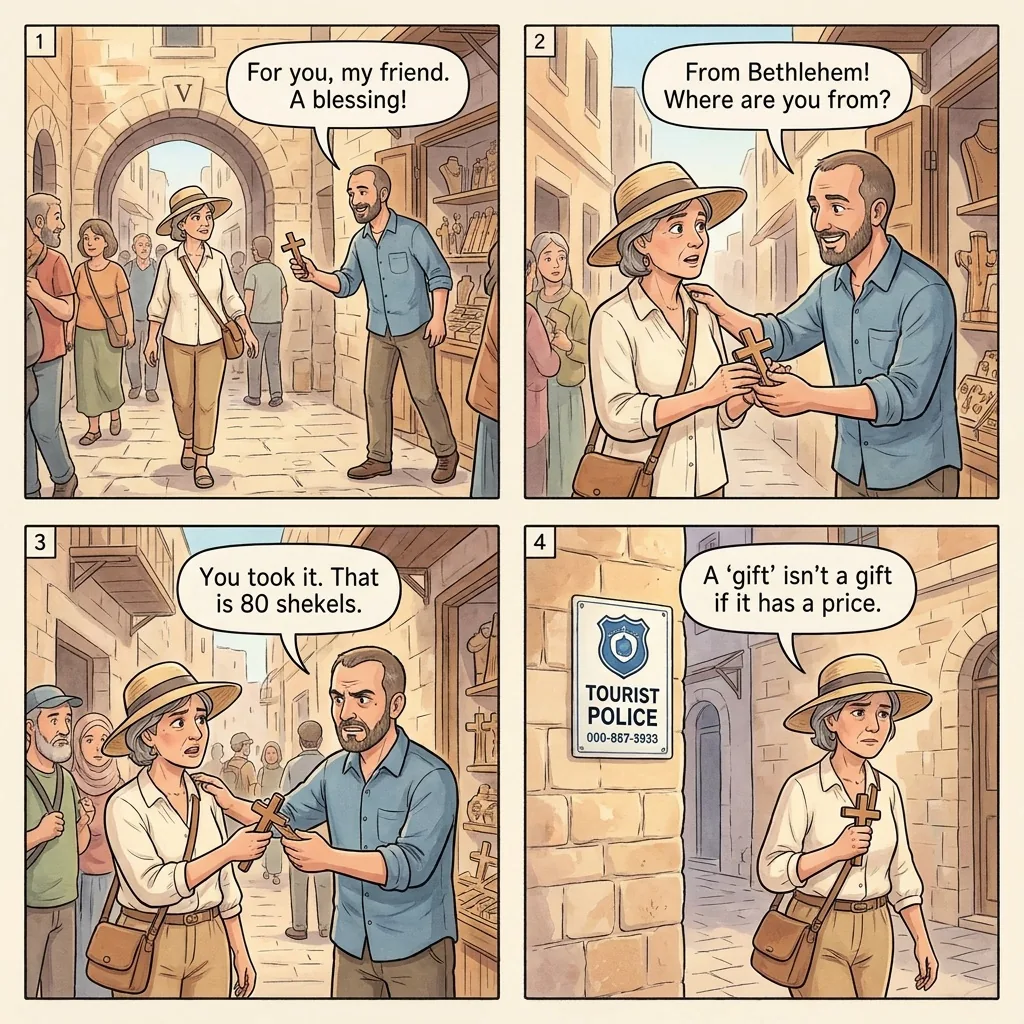
You walk the Via Dolorosa trying to follow the Stations of the Cross, the path is barely three meters wide between rows of stalls, and every few meters a shopkeeper calls out or steps from a doorway holding up a wooden cross, an icon, or a string of olive-wood prayer beads.
One particularly persistent shopkeeper steps directly into your path and presses an olive-wood crucifix into your hand, smiling broadly and saying 'just look, my friend, blessed in Bethlehem, very special.' You take it instinctively. He asks where you are from, what country, what church, holds your shoulder lightly with his other hand, and keeps the conversation going while the cross stays in your fingers.
When you try to hand the cross back, his tone shifts subtly. He tells you the price is 80 NIS ($22), that you have already 'taken it,' and that this is now a transaction. He blocks the doorway back to the path. The narrow alley behind you has a small queue of pilgrims waiting to pass. The social cost of refusing — making a scene at a Christian holy site — is calibrated to push you into the purchase.
The hand-off sale at Via Dolorosa and through the Muslim Quarter souks is documented across Reddit, the long-running TripAdvisor Jerusalem forum, the Israeli Tourist Police consumer-protection materials, and most updated guidebooks. The same pattern runs in souks in Marrakech, Istanbul, and Cairo, but the Jerusalem variant adds the religious-site emotional pressure that makes refusing feel inappropriate. The olive-wood crucifix sells for 15–25 NIS at honest shops in Bethlehem itself, where most are actually carved.
A second variation involves blessing services. Some shopkeepers offer to 'bless' a souvenir before you buy, then increase the price after the blessing on the grounds that the item is now sacred. The blessing is theatre, the markup is the play. Real Christian Quarter shops with honest pricing (the Franciscan-run gift shops near the Holy Sepulchre, the licensed Bethlehem cooperative outlets) post prices clearly and never use hand-off tactics.
Walk Via Dolorosa with purpose, hands in pockets or on your bag, and make eye contact only if you genuinely want to enter a shop. If a shopkeeper presses an item into your hand, set it down firmly on the nearest surface — counter, floor, doorway — and walk on; you have no obligation to buy something pressed on you unsolicited. A polite but firm 'la shukran' (no thanks in Arabic) ends most encounters. For genuine olive-wood souvenirs, buy from the Franciscan gift shops near the Holy Sepulchre or in Bethlehem cooperatives. If a vendor blocks your path or follows aggressively, dial 100 (Israel Police) or 1-700-72-22-23 (Tourist Police).
Red Flags
- Shopkeeper physically blocks your path
- Item placed directly in your hands without asking
- Vendor follows you down the street after you say no
How to Avoid
- Keep walking with purpose — make eye contact only if you genuinely want to browse.
- If something is placed in your hands, set it down firmly and walk on.
- A polite but firm 'la shukran' (no thank you in Arabic) is respected.
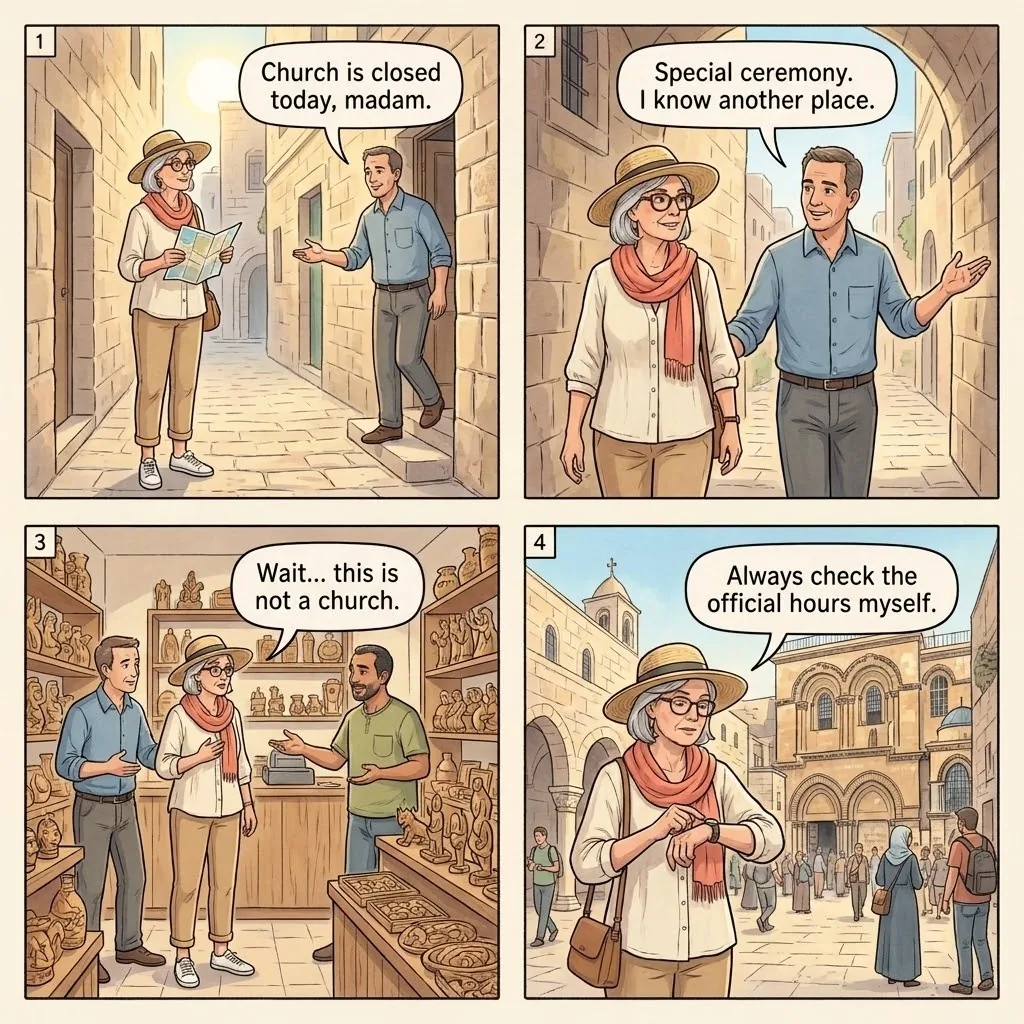
You walk through the Christian Quarter alleys toward the Church of the Holy Sepulchre on the morning of your second day in Jerusalem when a man steps out of a doorway and tells you the church is closed today for a special Greek Orthodox ceremony.
He shakes his head sadly, says it's a shame, but offers to take you to a different church 'even more beautiful' that he can guide you to personally. The story sounds plausible — the Holy Sepulchre is shared by multiple Christian denominations and ceremonial closures do happen — and the man is calm and matter-of-fact rather than aggressive. Many travelers follow him.
If you do, he leads you through a few streets to either a smaller chapel of his choice (where he expects a 'guide fee' of 50–150 NIS at the end) or to a cousin's gift shop where the pressure pivots into a souvenir sale. Meanwhile, the actual Church of the Holy Sepulchre is open exactly as scheduled, the ceremony he mentioned does not exist, and you have lost the morning you reserved for the holiest site in Christianity.
The 'closed today' redirect is documented across Reddit, the long-running TripAdvisor Jerusalem forum, and the Israeli Tourist Police materials. The same pattern operates at the Dome of the Rock entrances (where non-Muslims have specific limited entry hours that the scammers exploit), the Western Wall plaza (where claimed 'security closures' are usually fake), and the Garden Tomb forecourt. The Havana 'place is closed' redirect from earlier in this guide runs the same script in a different city.
Real closure information for Jerusalem holy sites is published officially. The Holy Sepulchre's opening hours are listed on holysepulchre.custodia.org, the Western Wall is open 24/7 with rare ceremonial restrictions posted on thekotel.org, and the Dome of the Rock and Al-Aqsa compound have specific non-Muslim visiting hours posted at the entrance kiosks. Any verbal claim that contradicts these official sources is, by default, the redirect scam.
Always walk to the holy site yourself and verify with your own eyes that it is closed before believing any stranger who tells you otherwise. Trust the official websites (holysepulchre.custodia.org, thekotel.org) over any verbal claim. If approached, smile, say 'shukran' or 'thank you' and keep walking; do not engage. The Holy Sepulchre, the Dome of the Rock visiting hours, the Western Wall, and the Garden Tomb have all been the named target of this scam — never accept a 'guided alternative' from a stranger. If pressured aggressively, dial 100 for Israel Police.
Red Flags
- Stranger tells you a major attraction is 'closed today' without you asking
- They offer an alternative and want to guide you there personally
- No official closure notice visible at the site entrance
How to Avoid
- Verify closure claims by walking to the attraction yourself.
- Check official opening hours online before visiting each site.
- Never follow a stranger who claims to know of a 'better' alternative.
🆘 What to Do If You Get Scammed
📋 File a Police Report
Go to the nearest Israel Police (Mishtara) station. Call 100 (Police) or 101 (Ambulance). Get an official crime report — you'll need this for insurance claims. You can also report online at police.gov.il.
💳 Cancel Your Cards
Call your bank immediately. Most have 24/7 numbers on the back of the card (keep a photo saved separately). Block any suspicious transactions before the thieves use your details.
🛂 Lost Passport?
Contact your nearest embassy or consulate. The US Embassy in Jerusalem is at 14 David Flusser Street, Jerusalem 9378322. For emergencies: +972 2-630-4000.
📱 Track Your Device
If your phone was stolen, use Find My (iPhone) or Find My Device (Android) from another device. Don't confront thieves yourself — share the location with police instead.
Frequently Asked Questions
You just read 6 scams in Jerusalem. The full Travel Safety Series has 780+ more across 20+ countries.
Tokyo's Kabukichō ¥130,000 bar trap. Rome's gladiator photo extortion. Paris's gold-ring trick. Bali's ATM skimmer scams. Bangkok's grand-palace closure ruse. Every documented scam across 20+ destinations — with the exact scripts, red flags, and local-language phrases that shut each one down. Drawn from Reddit traveler reports, embassy advisories, and consumer-protection cases.
- 780+ documented scams across Tokyo, Rome, Paris, Bali, Bangkok, Rio & 100+ more cities
- 20+ countries covered, with country-by-country phrase cards for every destination
- Updated annually — buy once, re-download future editions free
- All titles $4.99 each on Amazon Kindle