
Key Takeaways
- The #1 reported scam is the Ben Gurion Rate-2 Meter Run.
- 1 of 6 scams are rated high risk.
- Use app-based ride services (Uber, Careem) or official metered taxis instead of unmarked vehicles.
- Never accept unsolicited offers from strangers near tourist sites in Tel Aviv.
⚡ Quick Safety Tips
- Tel Aviv is one of the safest major cities in the Middle East for tourists — street crime is mostly non-violent and consists of taxi scams, beach theft, and market overcharging rather than muggings or violent robbery.
- Always insist on the meter ('Moneh') in taxis or use the Gett app — from Ben Gurion Airport, the fixed fare to central Tel Aviv should be 170-200 NIS. Note the driver's ID number displayed in the cab.
- Beach theft is the most common property crime — use waterproof pouches for phone and cash, and never leave valuables unattended on the sand while swimming.
- Scams in Tel Aviv are primarily financial rather than dangerous — overcharging, hard-sell pressure, and rental fraud are the main risks. Using reputable booking platforms and confirming prices in advance prevents most issues.
Jump to a Scam
The 6 Scams
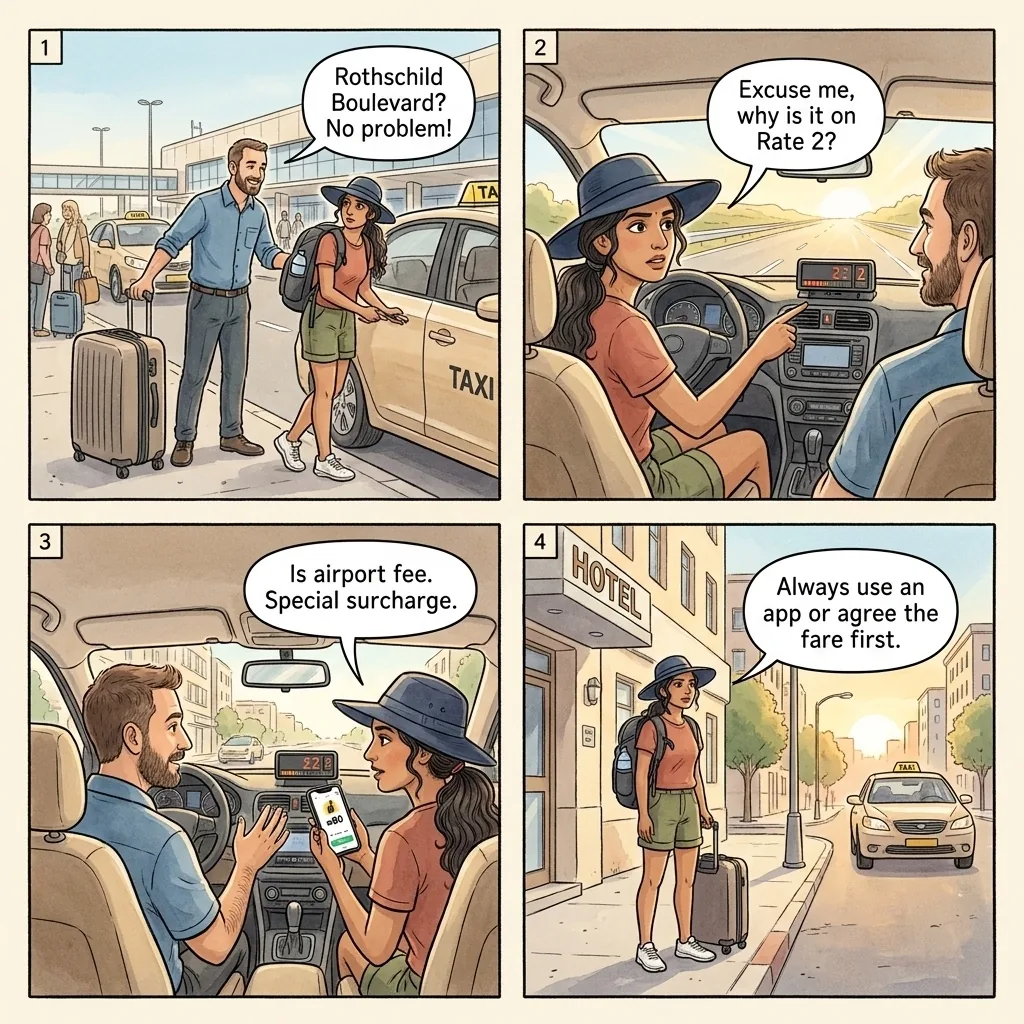
You walk out of the Ben Gurion Airport arrivals hall on a Tuesday afternoon, ignore the train signs, and slide into the first white sherut-cab parked in the queue.
The driver greets you warmly, loads your bag, and asks where you are headed. You say a hotel near Rothschild Boulevard. He nods, taps something on the meter mounted by the windshield, and pulls onto Highway 1. Ten minutes in, you glance up: the meter is running, but the rate indicator shows '2' instead of '1.' By the time you reach the hotel, the meter reads ₪350 for a trip Gett would have priced around ₪170–200. The driver shrugs and points at the screen as if the math is settled.
If you argue, his tone shifts. There is a 'night surcharge' that started at 4 p.m. There is an 'airport fee' that should have been mentioned. There is a 'luggage charge' for the second bag. You did not agree to any of these, but you are tired, the bag is on the curb, and the lobby is two meters away. Most travelers pay, get a hand-scrawled receipt instead of a printed one, and only later realize the meter was on Rate 2 for the entire ride.
Taxi overcharging is the most frequently reported tourist scam in Tel Aviv. Quora threads on Reddit and long-running TripAdvisor forums document drivers charging four to ten times the legitimate fare. Israel-Taxi.com's guide is direct: 'drivers are required by law to activate the meter — called Moneh in Hebrew — unless you have agreed on a fixed fare in advance.' The meter has two legal rates: Rate 1 (daytime, single passenger up to two) and Rate 2 (after 9 p.m., Shabbat, holidays, or three or more passengers). Some drivers quietly run Rate 2 during regular daytime hours, knowing tourists will not notice the small numeral.
BeinHarim Tours' guide specifically tells tourists to 'note the taxi number and the driver's ID number, usually displayed inside the taxi' and to always demand a printed receipt — the receipt button is on the meter and prints automatically when pressed. The official fixed fare from Ben Gurion to central Tel Aviv runs roughly ₪170–200 by day and ₪200–230 at night, with surcharges for additional luggage; anything significantly above that range is a scam. The route should also stay on Highway 1 then Ayalon — circling through Bat Yam or south Tel Aviv is a clear signal of route inflation.
Skip the airport taxi line and book Gett or Uber on the Ben Gurion Wi-Fi before you walk out — both apps show the fare upfront, GPS-track the route, and pin the driver to a rating system. If you must take a street taxi, say 'Moneh, bevakasha' before you sit down, confirm the rate is set to '1' during daytime, photograph the driver's ID card and taxi number on the dashboard, and follow the route in Google Maps the entire ride. If a driver overcharges, refuse to pay the disputed amount, take a photo of the meter and the receipt, and call the Ministry of Transport tourist hotline 1-700-72-22-23 or dial 100 for police.
Red Flags
- The driver does not turn on the meter or claims the meter is broken — by law, the meter must run
- The meter is set to Rate 2 during regular daytime hours (Rate 2 is only for nights after 9pm, Shabbat, holidays, or 3+ passengers)
- The driver takes an obviously circuitous route through neighborhoods that are not on the direct path to your destination
- The driver quotes a flat rate significantly higher than what ride-hailing apps show for the same trip
- The driver refuses to give you a receipt or becomes hostile when you ask for one
How to Avoid
- Use the Gett app (Israel's main ride-hailing service) or Uber, which show estimated fares and GPS-tracked routes.
- If taking a street taxi, insist on the meter (say 'Moneh, bevakasha') and confirm it is set to Rate 1 during daytime hours.
- From Ben Gurion Airport, use the official taxi stand and confirm the fixed fare to your destination before departing — it should be 170-200 NIS to central Tel Aviv.
- Note the driver's ID number and taxi number displayed inside the cab, and always ask for a printed receipt at the end.
- Follow the route on Google Maps during the ride — if the driver deviates significantly, say something immediately.
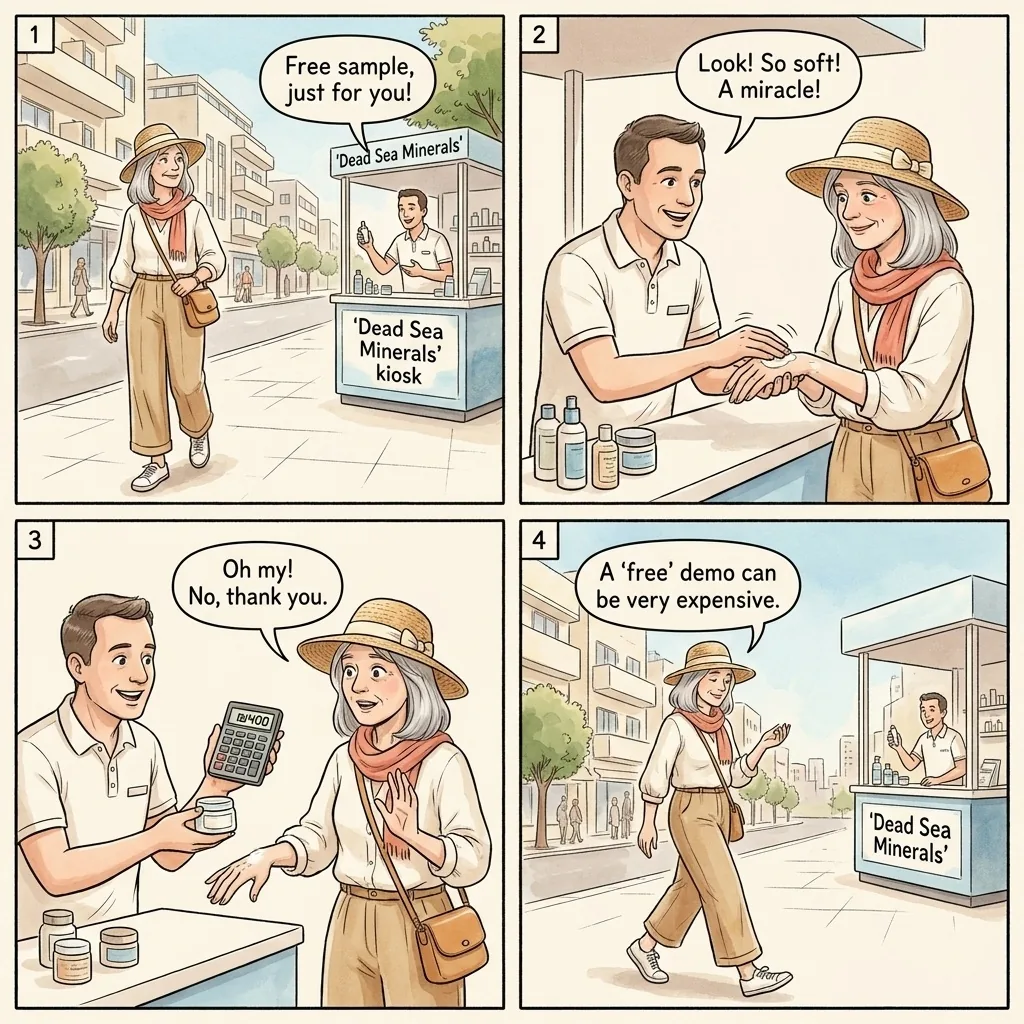
You are walking south on Dizengoff Street, half-watching for a coffee place, when a young salesperson at a glossy little kiosk calls out and offers you a free sample of Dead Sea mineral cream.
Before you decide, they have already taken your right hand and started rubbing a pearl of cream into the back of it, pointing out the difference between the 'before' patch and the 'after' patch and praising your skin in a charming, practiced way. Three minutes later they have moved on to under-eye serum and a salt scrub. The pitch is fluent English, an easy laugh, and a refusal to let the conversation pause long enough for you to step back from the counter.
After the demo comes the price reveal. A small pot of cream that retails online for around $15 is quoted at ₪300–500, roughly $80–140. When you smile and try to leave, the salesperson drops the price to ₪250, then ₪180, then offers a 'package' with a free serum, then claims their manager will fire them if you walk away after such a long demo. Some tourists report being walked to a nearby ATM to 'just see' if a card works. The pitch is built to make refusal feel rude.
The Dead Sea kiosk hard-sell is a globally documented phenomenon rooted in Israel. The Times of Israel published an investigation titled 'Exposed: The International Scandal of Israel's Dead Sea Product Hawkers,' revealing that many kiosks employ aggressive tactics, skirt labor laws, and use workers on expired tourist visas in foreign cities. The Jerusalem Post's feature 'Post-army travelers or Dead Sea scammers?' documents how young Israelis are recruited with promises of $1,500–3,000 per week in commission, paid almost entirely on closing pressure rather than product sales.
Products marketed as 'Dead Sea minerals' are sometimes manufactured in China or Central America rather than the Dead Sea region, and the technique you encounter in Tel Aviv is the same one used in malls in Hawaii, Las Vegas, and Sydney — including a documented Hawaii case where an 82-year-old woman was pressured into a $5,000 skincare order. Real Dead Sea brands like Ahava, Premier, and Sea of Spa are sold without theatrics at Super-Pharm, the duty-free at Ben Gurion, and at the Dead Sea factory shops, at a fraction of the kiosk price.
Do not let anyone apply product to your skin on Dizengoff or Ben Yehuda — say 'Lo todah' (no thanks) and keep walking without breaking stride. You owe nothing for a demo you did not agree to, regardless of how long it took. If you actually want Dead Sea products, buy Ahava or Premier at Super-Pharm or at the Dead Sea factory outlets, never from a street kiosk, and research online prices before your trip so an inflated quote is obvious instantly. Never follow a salesperson to an ATM under any circumstance — if pressure escalates, dial 100 for police.
Red Flags
- A salesperson physically stops you on the sidewalk and begins applying product to your hand or face without asking
- The product has no visible price tag, and the price is only revealed after a lengthy demonstration
- The quoted price is 5-10 times higher than what the same product costs online or at a local pharmacy
- The salesperson becomes aggressive, emotional, or guilt-tripping when you try to leave without buying
- They offer increasingly dramatic discounts — dropping from 500 to 300 to 150 shekels — which reveals the initial price was fabricated
How to Avoid
- Do not let anyone apply product to your skin — politely say 'Lo todah' (no thanks) and keep walking without stopping.
- Remember you have zero obligation to buy anything, regardless of how much time a salesperson has spent demonstrating.
- If you are interested in Dead Sea products, buy them at a pharmacy like Super-Pharm or at the Dead Sea itself at a fraction of the tourist-area price.
- Never follow a salesperson to an ATM or agree to a purchase under pressure — walk away and return only if you genuinely want the product.
- Research prices online before your trip so you can immediately recognize inflated quotes.
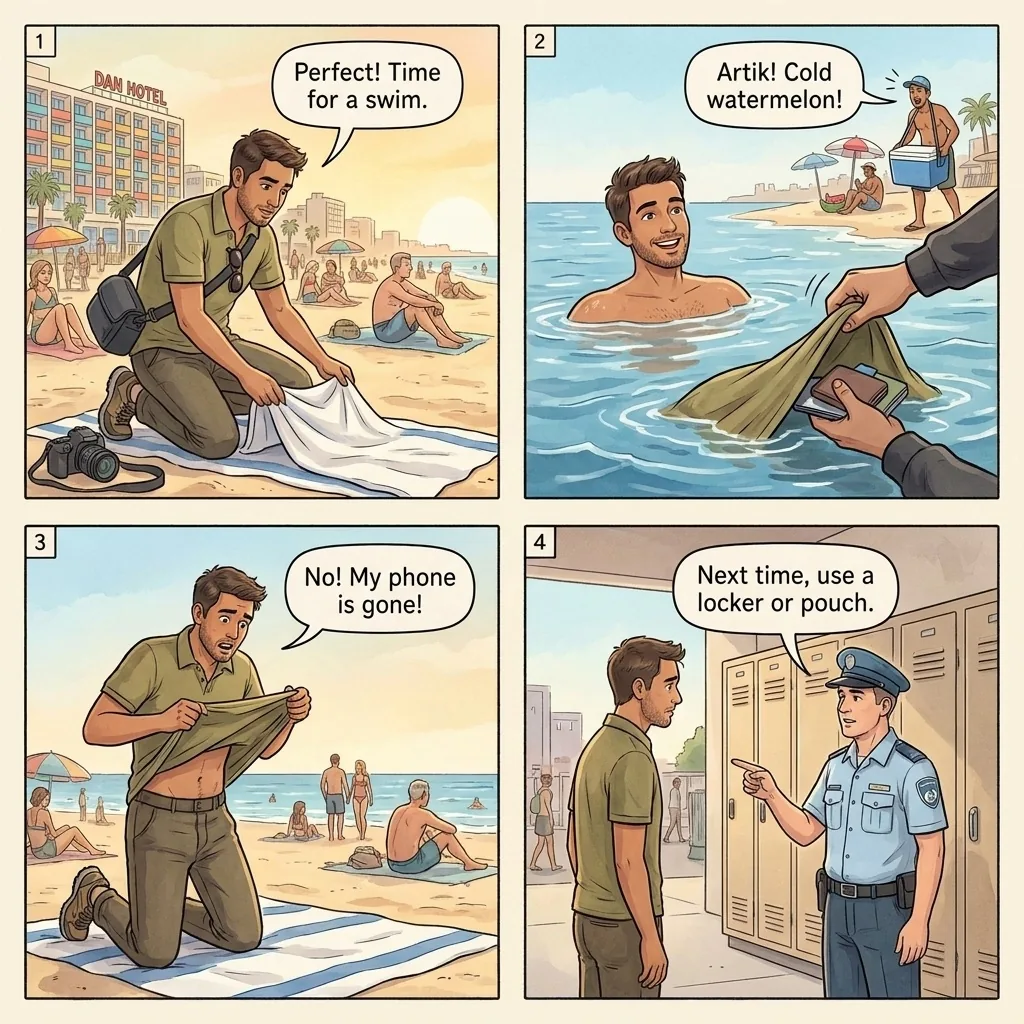
You arrive at Gordon Beach on a perfect Mediterranean afternoon, rent a chair, drop your bag onto the sand, and tuck your phone and wallet under a folded shirt before walking the twenty meters to the water.
The water is warm, the lifeguard is calling out instructions in Hebrew, and you swim out past the breakwater and float for fifteen minutes. When you wade back to your towel, the shirt is exactly where you left it, but the phone and wallet underneath are gone. Your sunglasses are gone too. Your towel has not been moved. The thief knew exactly where to look, lifted the shirt, took the contents in a single motion, and walked on.
Beach theft is one of the most consistent crimes reported by tourists in Tel Aviv. The city's beach culture puts thousands of people on the sand every afternoon, and professional teams work the strip systematically from Hilton Beach in the north down to Charles Clore Park. Quora and Reddit threads describe 'thefts are common at popular and crowded beaches favored by tourists,' and the DIYTelAvivGuide safety page calls it the most persistent petty-crime pattern in the city. The professionalism of the lift is what surprises most victims — the towel is rarely disturbed and the bag is often left untouched.
The standard play is two-person. One watches the water from the promenade or a parked scooter. The second strolls casually along the line of towels, scanning for groups in the surf, and crouches to 'check' a stash when the lookout signals that the owners are far enough out. The lift takes under five seconds. By the time the swimmer turns around, the second person is back on the promenade with the phone in a pocket and a different shirt on. Tel Aviv police run periodic undercover operations during peak summer, but coverage is uneven across beaches.
The financial loss is rarely the worst of it. A stolen iPhone with a SIM card and an unlocked screen exposes hotel addresses, WhatsApp chats, banking apps, and a passport photo most travelers keep on their phone. A stolen wallet with cards and a hotel keycard means an emergency hotel-floor lockout and a 24-hour wait for replacement cards from the Israeli branches of Visa or Mastercard. The hour you save by not bringing a waterproof pouch is the most expensive hour of the trip.
Buy a waterproof phone pouch (₪20–30 at any beach kiosk) and take your phone, cards, and a small amount of cash into the water with you on a lanyard around your neck. Leave your passport, extra cards, and hotel safe key at the hotel — bring only what you need for the beach. Go with a friend and rotate one person watching belongings whenever anyone enters the water, and pick a spot near a manned lifeguard tower or a busy chair-rental concession rather than an empty stretch. If you are robbed, dial 100 for police on the spot — Tel Aviv stations issue a printed report you will need for travel insurance and any phone-tracking process.
Red Flags
- Someone is lingering near your belongings or walking slowly past without their own beach setup nearby
- A stranger offers to 'watch your stuff' and then disappears with your valuables when you go swimming
- You are at a crowded beach with valuables visible on your towel — this is the highest-risk scenario
- Your spot is far from lifeguard stations or other beachgoers where a theft would be less likely to be witnessed
- You notice the same person walking back and forth past various groups' belongings
How to Avoid
- Use a waterproof phone pouch (available at any beach shop for 20-30 NIS) and take your phone and cash into the water with you.
- Leave your passport and extra valuables at your hotel — bring only what you need for the beach.
- Ask the lifeguard station if they offer a secure locker or deposit service — some Tel Aviv beaches have these during summer.
- Go to the beach with a friend and take turns watching belongings — never leave everything unattended.
- Bury your valuables in a ziplock bag under your towel as a last resort — professional thieves look under towels and shirts first, but a buried bag is harder to find quickly.
Like what you're reading? Get a full Tel Aviv itinerary with safety tips built in.
Browse travel-safety books →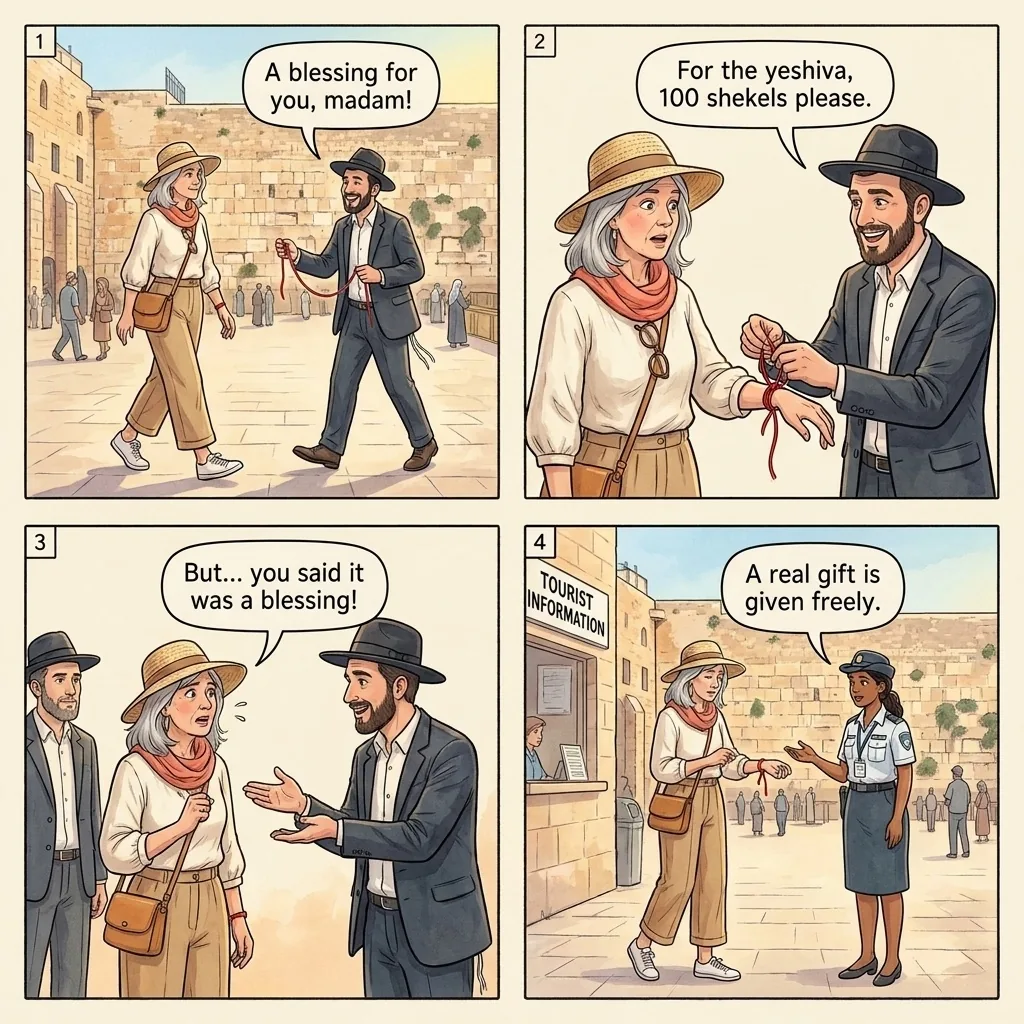
You are walking the approach to the Western Wall plaza on a Jerusalem day-trip from Tel Aviv when a soft-spoken man in a dark suit and a wide-brimmed hat steps gently into your path with a smile.
Before you have time to step around him, he has reached for your right wrist and is looping a thin red string around it. He murmurs a Hebrew blessing — fast, melodic, generic — and ties a small knot. The whole motion takes maybe twelve seconds. Then his hand is out, palm up, and he is asking for a 'donation' of ₪50–100 'for the yeshiva' or 'for the orphans,' depending on the day. If you hesitate, he insists the bracelet is already blessed and cannot come off, and that refusing to pay will bring bad luck.
If you try to walk past, a second man often appears two meters away to slow you down with a follow-up question — where are you from, are you Jewish, would you like a photo. Sometimes a third intercepts on the other side. The choreography is mild but unmistakable: enough pressure to push tourists into a quick ₪50 to disengage, never quite enough to look like coercion to the security cameras at the plaza entrance.
TravelingIsrael.com's Jerusalem scam guide documents this pattern in detail, describing red-string operators who 'pressure others to donate money and it is unclear where the money goes.' The red string itself is associated with Kabbalah mysticism and is sold as a protective talisman, but a pack of identical strings costs about ₪5 at any Judaica shop on Ben Yehuda Street, and the 'blessing' is recited word-for-word at every wrist all day long. The same play appears in Jaffa's flea-market alleys, around the Holy Sepulchre in the Christian Quarter, and on the approach to the Garden Tomb.
The 'fake holy men' angle is what makes the scam socially uncomfortable for travelers who do not know Jewish or Christian customs well. Real rabbis do not approach strangers on the street demanding cash; the donations boxes inside the Kotel area are official and clearly labeled. Genuine yeshiva fundraisers work with printed credentials, named institutions, and never tie anything onto your body without permission. Anything else is theatre, and the polite Hebrew at the start is part of the lure.
Do not let anyone tie anything to your wrist on the Western Wall approach, in the Old City of Jaffa, or near any religious site — pull your hand back, say 'Lo todah' firmly, and keep walking without breaking stride. If a string is already on, you can remove it yourself the moment you are out of sight; you owe nothing for an unsolicited blessing. If you genuinely want a Kabbalah string as a souvenir, buy one for ₪5 at a Judaica shop, and donate to a yeshiva through their official website rather than a stranger on a sidewalk. If pressure escalates to physical contact, dial 100 for police or 1-700-72-22-23 for the tourist hotline.
Red Flags
- Someone approaches you and ties a string or bracelet on your wrist without asking permission
- They recite a blessing or prayer and then immediately demand a 'donation' — the amount is suspiciously specific (50-100 NIS)
- They claim the bracelet is 'blessed' and cannot be removed, or that refusing to pay will bring bad luck
- Multiple people work together near the entrance to a religious site, creating a gauntlet that is hard to walk through
- The person is not affiliated with any visible organization, synagogue, or charity
How to Avoid
- Do not let anyone tie anything on your wrist — pull your hand away and say 'Lo todah' (no thanks) firmly.
- If a string is already tied, you can remove it yourself — there is no obligation to pay or keep it.
- Buy a red Kabbalah string at a Judaica shop for 5 NIS if you want one as a souvenir — do not buy from street vendors.
- Walk with purpose and avoid eye contact with people trying to stop you near the Western Wall entrance.
- Know that this is a well-documented scam, not a genuine religious practice — real rabbis do not approach strangers demanding money.
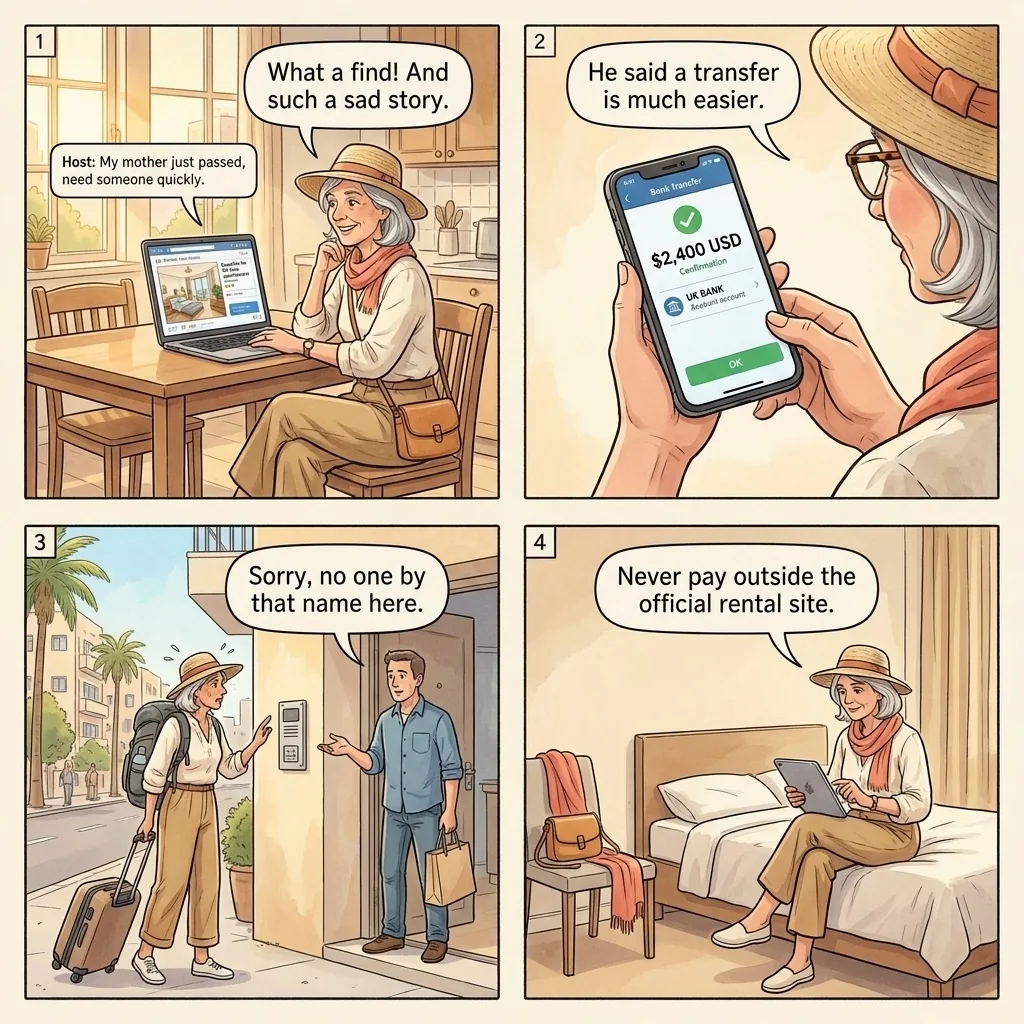
You are scrolling Facebook Marketplace and Craigslist for a month-long stay in Tel Aviv when you find a beautifully shot one-bedroom on Rothschild Boulevard at $80 per night.
The photos are gorgeous: white-tile floors, Bauhaus shutters, a small balcony over a row of ficus trees, a Nespresso on the marble counter. Comparable listings on Airbnb run $150–180 a night, so this one is half-price. You message the host. The reply is in fluent English, warm and immediate, and explains that their Israeli mother recently passed away leaving this apartment, and they are renting it cheaply because they now live in London and want it lived-in rather than empty.
They ask for two months' rent plus a deposit by bank transfer to a UK account, with a promise to send the keys to a neighbor before you arrive. You pay $2,400, receive an address on Rothschild near Allenby, and book the flight. When you reach the door at noon on a Sunday, the buzzer is unmarked, the building's vaad bayit is at lunch, and the neighbor on the second floor has never heard of the host. The apartment in the photos either does not exist at this address, belongs to someone unrelated, or is occupied by long-term tenants who never listed it.
This pattern is documented extensively on the TripAdvisor Israel Forum. A thread titled 'Beware, apartment rental scam by non-Israeli, in Israel' details how scammers run identical scripts targeting Paris, Amsterdam, Copenhagen, Berlin, and Tel Aviv simultaneously, recycling the same photos with only the city and address changed. Tzion Apartments, a legitimate Tel Aviv rental agency, has published a red-flags guide that mirrors the same observations. The Times of Israel reported in a long-form piece that 'with criminals moving online, fraud is now Israel's top illicit cash crop,' with rental fraud one of the fastest-growing categories.
The scam targets travelers searching for deals outside major booking platforms, particularly during peak seasons — Pesach, summer, and the Jewish High Holidays — when Tel Aviv hotel prices spike and Airbnb inventory thins. The bereaved-owner-abroad story is the genre's signature, but variants include 'I'm a diplomat posted to Brussels,' 'my husband is recovering from surgery in Boston,' and 'we're a young couple relocating to Australia.' A reverse-image search of the listing photos on Google Images almost always returns the same shots attached to listings in three other cities.
Book apartments only through platforms with buyer protection — Airbnb, Booking.com, or established Israeli agencies like Tzion Apartments — and pay by credit card so you can chargeback if needed. Never wire money, never use Western Union, and never pay in cryptocurrency for an apartment you have not seen on a live video call. Reverse-search the listing photos on Google Images before paying anything; if the same shots appear on Berlin or Paris listings, walk away. If you have already paid and the apartment does not exist, dial 100 for police, file a chargeback through your card issuer, and report the listing on the platform where you found it.
Red Flags
- The rental price is significantly below market rate — if Airbnb shows similar apartments at $150/night and this one is $80, it is likely fraudulent
- The host claims to live abroad and cannot show you the apartment in person before you pay
- They request payment via bank wire transfer, Western Union, or cryptocurrency — not through a secure booking platform
- The host's story involves a recently deceased relative, relocation abroad, or other emotional narratives designed to explain why they cannot meet
- The same apartment photos appear in reverse image searches linked to listings in other cities
How to Avoid
- Book apartments only through platforms with buyer protection — Airbnb, Booking.com, or established Israeli agencies like Tzion Apartments.
- Never send money via wire transfer or cryptocurrency for accommodation — use credit cards through booking platforms for chargeback protection.
- Reverse-search the apartment photos on Google Images — scammers reuse the same photos across multiple cities.
- If a deal seems too good to be true for Rothschild Boulevard or beachfront Hayarkon Street, it almost certainly is.
- Insist on a video call showing the apartment and the host's government ID before any payment — real hosts will comply.
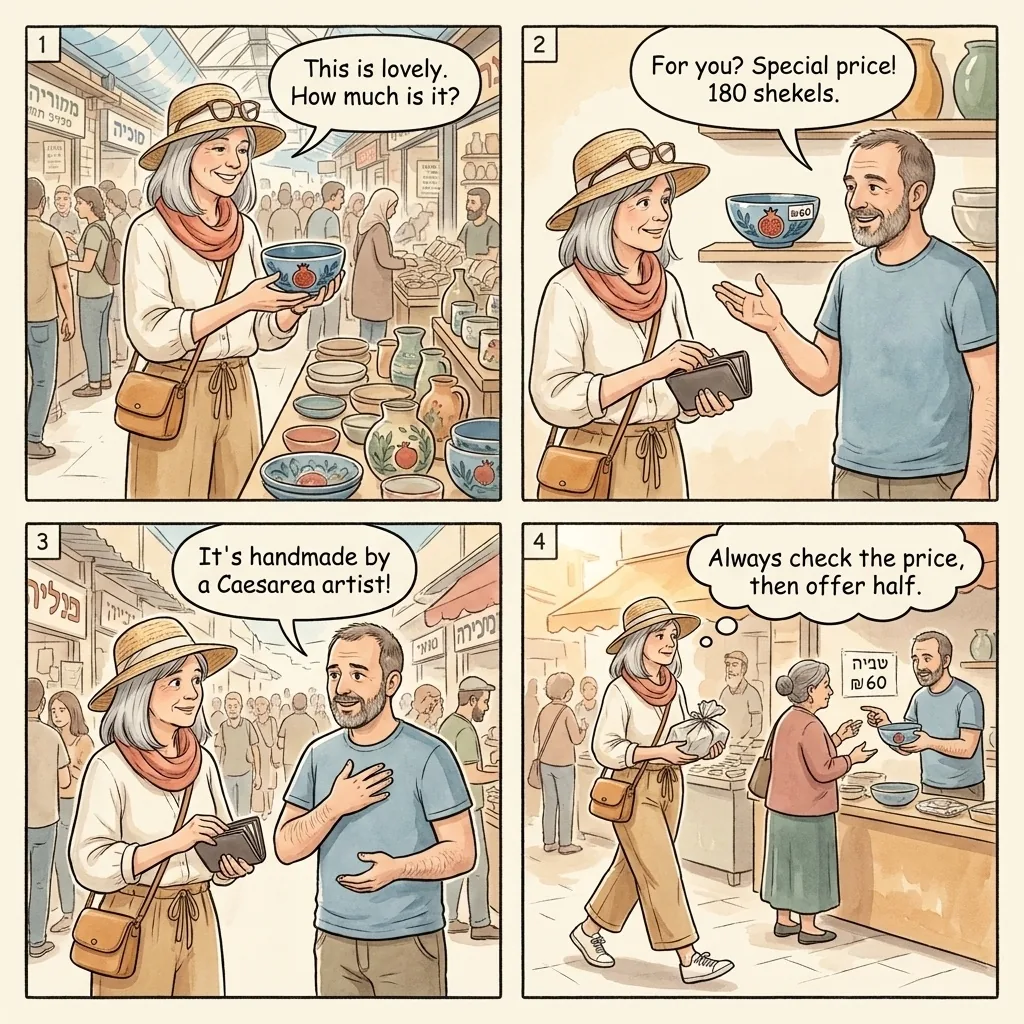
You wander into Shuk HaCarmel mid-morning, drift past the produce stalls, and stop at a ceramics counter where a row of hand-painted bowls is laid out in the sun.
You pick up the bowl you like — cobalt blue glaze, pomegranate motif, the kind of thing that would look right on a kitchen shelf at home. You ask the vendor the price in English. He glances up from his phone, pauses for a fraction of a second, and says ₪180 without hesitation. It feels reasonable for handmade ceramic, you nod, and you reach for your wallet. What you do not see is that the same vendor sold an identical bowl ten minutes earlier to an Israeli grandmother for ₪60 — the price was set the moment you opened your mouth in a foreign accent.
When you make a soft attempt to negotiate, the vendor acts faintly offended. He explains the bowl is hand-thrown by a small studio in Caesarea, that ₪180 is already a 'special price for you,' and that he could not possibly go lower without disrespecting the artist. The framing is sincere enough that most travelers back down and pay full price, often adding a polite extra ₪20 because they feel awkward. The bowl, in fact, is a mass-produced piece sourced wholesale at around ₪25.
Tourist price inflation at Shuk HaCarmel is well-documented. TripAdvisor threads describe the haggling norm clearly: 'bargaining is common for goods, while prices for food items are generally fixed.' Facebook's Secret Tel Aviv group regularly carries warnings from locals about inflated souvenir and spice prices, and HelloGracieMo's Carmel Market guide advises tourists that haggling is 'part of the deal at any Middle Eastern market' and to start counter-offers at roughly half the asking price.
The key distinction is between food and goods. Food prices — fresh juice, falafel, hummus, fruit, baked goods — are generally fair, fixed, and not negotiable, and the same prices apply to locals and tourists alike. Goods are different: souvenirs, textiles, spices by weight, Judaica items, and ceramics are marked up two to three times for visibly foreign customers. The adjacent Nachalat Binyamin Arts & Crafts Fair, open Tuesdays and Fridays, has more honest pricing because individual artisans set the prices, but even there tourists pay more than regulars who shop the same stalls every week.
Walk the entire market once before buying anything — compare prices for similar items across at least three vendors, and use Google Translate's camera mode on Hebrew price tags so you can read the locals' price. For souvenirs and textiles, counter-offer at 40–50% of the quoted price and settle around 60–70%; for spices by weight, only buy from stalls with a fixed scale and visible price tags, or use Shufersal supermarkets for guaranteed pricing. For ceramics and Judaica, the official Israel Museum gift shop in Jerusalem and the Anu Museum shop in Tel Aviv have fixed, fair prices with provenance. Food prices need no haggling; pay what is on the hand-chalked sign and tip in the tip jar if there is one.
Red Flags
- The vendor quotes a price instantly without checking — the price was calculated based on your appearance, not the item
- No price tags are displayed on goods, allowing different prices for different customers
- The vendor becomes dramatic or emotional when you try to negotiate — claiming you are insulting their craft
- Spices are weighed on a small handheld scale rather than a proper fixed scale with visible markings
- You are quoted a price significantly higher for the same item you saw priced lower at a stall 50 meters away
How to Avoid
- Walk the entire market first without buying anything — compare prices for similar items across multiple vendors.
- For souvenirs, start by offering 40-50% of the quoted price and negotiate from there — settling at 60-70% is normal.
- Buy spices by weight at shops with fixed scales and visible price tags, or at supermarkets like Shufersal for guaranteed pricing.
- Ask Israeli friends, your hotel concierge, or check recent TripAdvisor reviews for fair price ranges on specific items.
- Remember that food items at the market — fresh juice, hummus, falafel, baked goods — are generally fairly priced and do not require haggling.
🆘 What to Do If You Get Scammed
📋 File a Police Report
Go to the nearest Israel Police (Mishtara) station. Call 100. Get an official crime report — you'll need this for insurance claims. You can also report online at gov.il/israel_police.
💳 Cancel Your Cards
Call your bank immediately. Most have 24/7 numbers on the back of the card (keep a photo saved separately). Block any suspicious transactions before the thieves use your details.
🛂 Lost Passport?
Contact the US Embassy in Tel Aviv at 71 HaYarkon Street, Tel Aviv. Phone: +972-3-519-7575. For emergencies after hours: +972-3-519-7551. Other nationalities should check their embassy's Tel Aviv location.
📱 Track Your Device
If your phone was stolen, use Find My (iPhone) or Find My Device (Android) from another device. Don't confront thieves yourself — share the location with police instead.
Frequently Asked Questions
You just read 6 scams in Tel Aviv. The full Travel Safety Series has 780+ more across 20+ countries.
Tokyo's Kabukichō ¥130,000 bar trap. Rome's gladiator photo extortion. Paris's gold-ring trick. Bali's ATM skimmer scams. Bangkok's grand-palace closure ruse. Every documented scam across 20+ destinations — with the exact scripts, red flags, and local-language phrases that shut each one down. Drawn from Reddit traveler reports, embassy advisories, and consumer-protection cases.
- 780+ documented scams across Tokyo, Rome, Paris, Bali, Bangkok, Rio & 100+ more cities
- 20+ countries covered, with country-by-country phrase cards for every destination
- Updated annually — buy once, re-download future editions free
- All titles $4.99 each on Amazon Kindle