
Key Takeaways
- The #1 reported scam is The Caleche Bait-and-Switch.
- Most scams in Luxor are low-to-medium risk.
- Use InDrive (Uber does not operate in Luxor) or pre-arranged hotel transport instead of street taxis — always confirm the fare in Egyptian pounds before departure.
- Never accept unsolicited offers from strangers near tourist sites in Luxor.
⚡ Quick Safety Tips
- On the West Bank caleche route between the ferry landing and Hatshepsut, agree the EGP price on paper before boarding — drivers retroactively claim the figure was US dollars at drop-off.
- Inside Valley of the Kings tombs and Karnak's inner chambers, ignore 'guards' offering to unlock side rooms or explain hieroglyphs — paid tips escalate to 200 EGP demands and the 'tour' violates posted no-photo rules.
- Verify Valley of the Kings and Karnak opening hours yourself — 'closed today, but I know a beautiful temple' from a Corniche taxi driver is the documented opener for the alabaster-factory commission detour.
- From Luxor International Airport, use the meter or a ride-share app — 'meter is broken, special price 300 pounds' is the standard line and the metered fare to East Bank hotels is closer to 70–90 EGP.
Jump to a Scam
The 7 Scams

A caleche driver on the Luxor Corniche quotes 20 pounds for a ride to the temple, then on arrival demands 200 — claiming the fare was per person and in US dollars rather than Egyptian pounds.
A caleche driver pulls up alongside you on the Corniche el-Nil between the Winter Palace Hotel and Luxor Temple, the horse decked out in red tassels and brass bells. "My friend! Twenty pounds, ride to the temple, beautiful." It's the kind of round number that sounds like a fixed local rate, and the clip-clop of hooves is exactly what you came to Luxor for. You climb in.
At the temple gate the driver folds his arms and changes the math. "Two hundred pounds, please. The price was per person, four people, plus the tour was in dollars, not Egyptian pounds." None of that was discussed at the curb. Two other caleche drivers waiting at the temple stand pull up to back him: "Yes, this is the normal Luxor price, my friend." You're standing on a busy stretch of the Corniche with your kids hopping down from the carriage and no easy way to walk away.
The bait-and-switch leans on the unspoken ambiguity of the word "pounds" and on the social cost of arguing in front of a child you just helped down from a horse-drawn carriage. Reddit threads name the Corniche stretch outside Luxor Temple as the most-cited spot for the pound-vs-dollar pivot. The defensive move is to type the full price on your phone before stepping into the caleche — "Total ride for [N] people to [destination] in Egyptian pounds: [amount]" — and have the driver photograph it back, then pay only when you've stepped off the carriage onto the curb.
Red Flags
- Driver quotes an unusually low price (20-50 EGP) without being asked
- No discussion of currency — pounds could mean Egyptian pounds, British pounds, or US dollars
- Driver doesn't clarify whether the price is per person or per ride
- The driver insists on a longer route with 'bonus' stops at shops
- Other drivers nearby back up their colleague's inflated price claim
How to Avoid
- State clearly before boarding: 'Total price for everyone to [destination] in Egyptian pounds.'
- A fair rate is 50–80 EGP for a short point-to-point ride, or 150–250 EGP for an hour of sightseeing.
- Carry small denomination Egyptian pound bills so you can pay the exact agreed amount.
- Take a photo of the driver's license plate before getting in as a subtle deterrent.
- Use the InDrive or Uber app to check approximate fair prices for the same distance.

A man in a galabiya and a homemade lanyard inside a Valley of the Kings tomb points out hieroglyphics for ten minutes, then demands a 200-pound "tip" while standing between you and the tomb exit.
You've passed through the Valley of the Kings ticket gate and are inside the tomb of Ramesses VI when a man in a long galabiya and a plastic lanyard with a printed "Ministry" logo steps over. "Welcome — I am the guard for this tomb, let me show you the special paintings the others miss." He moves with confidence, points out hieroglyphics, tells dramatic stories about each pharaoh. It's genuinely interesting, and you assume the tour is part of the entrance you already paid for.
At the tomb exit, the tone shifts. "Now, my tip please. Two hundred pounds is normal." You hesitate, and his voice rises just enough that other tourists glance over. The lanyard isn't a Ministry of Tourism credential — it's a laminated print, and the "guard" is a freelancer who works the tomb interiors specifically because the dim lighting hides the badge details. Refusing in the narrow corridor with your family behind you feels like a fight you can't win.
The hustle works because every interior tomb in Egypt has poor lighting and narrow passages where a confident-looking stranger can pass for staff for ten minutes before the bill lands. Reddit and Reddit threads document the Valley of the Kings tombs and Karnak's inner chambers as the most-cited venues. The defensive move is to refuse all unsolicited "guide" approaches inside paid sites — say "La, shukran" firmly and keep walking — and to hire only Ministry of Tourism-licensed guides who carry photo IDs, booked through the ticket office or your hotel.
Red Flags
- The 'guide' approaches you inside the site rather than at the official guide desk
- They wear a lanyard or badge that doesn't match official Egyptian tourism credentials
- They begin giving information without being asked or agreeing on a price
- They steer you away from the main path toward less-visited areas
- They mention the word 'tip' only after the tour is finished
How to Avoid
- Hire official guides only from the ticket office or through your hotel — licensed guides carry Ministry of Tourism photo IDs.
- Say 'La, shukran' (No, thank you) firmly and keep walking if approached inside a site.
- If someone starts guiding you uninvited, stop them immediately and say you already have a guide.
- Book a licensed guide in advance through platforms like GetYourGuide or Viator for set prices.
- Report persistent fake guides to the Tourist Police stationed at every major Luxor site.

A friendly local at the West Bank ferry landing tells you the Valley of the Kings is "closed for restoration today" and steers you to an alabaster workshop where prices run 500 percent above street rates.
You step off the West Bank ferry near the Hatshepsut taxi rank and a friendly man in clean clothes catches your eye. "Sorry, my friend — the Valley is closed today, restoration work, very dusty. But I know a beautiful temple nearby, very few tourists, my cousin's car is right here." He's warm and unhurried, and the relief you feel at having a backup plan papers over the part where no posted sign or barrier confirms the closure.
Twenty minutes later the "temple" turns out to be an alabaster workshop. A polished demonstrator carves a stone for you, holds a translucent vase up to the light, and walks you into a showroom where a small piece is 1,500 EGP and a "museum-grade" bowl is 8,000. The driver waits patiently outside, earning 30 to 50 percent on whatever you spend. Meanwhile, the Valley of the Kings is open, as it has been almost every day for decades.
The redirect works because most travelers won't double-check a friendly stranger's closure claim against the official ticket office a five-minute walk away. Reddit threads document the West Bank ferry-landing redirect as the single most-cited Luxor scam on the long-tail. The defensive move is to walk past anyone claiming a major Luxor site is closed and verify directly at the ticket office — and to tell your driver before departure that the only stop is the destination, with no shops or workshops on the way.
Red Flags
- A stranger tells you a major attraction is closed, but there are no official signs or barriers
- They immediately suggest an alternative and offer free transport there
- The 'alternative' involves a shop, workshop, or perfumery rather than an archaeological site
- Other tourists are clearly walking toward and entering the supposedly closed attraction
- The person becomes insistent or guilt-trips you when you decline
How to Avoid
- Always verify closures at the official ticket office yourself — walk past anyone claiming a site is shut.
- Know that major Luxor sites rarely close without advance notice posted by Egypt's Ministry of Tourism.
- Politely decline alternative suggestions and continue to the ticket counter.
- Tell your hotel or tour operator your planned itinerary so they can confirm opening hours in advance.
- If redirected to a workshop, understand the guide earns a 30-50 percent commission on anything you buy.

A guard inside a Valley of the Kings tomb whispers that he'll "look the other way" while you photograph the wall paintings, then demands 200 pounds the moment you lower your phone — and threatens to confiscate it if you refuse.
You're deep inside a tomb at the Valley of the Kings, eyes adjusting to the painted ceiling, when a guard sidles over and lowers his voice. "You want photo? I look the other way — go ahead, very fast." The signs at the entrance say no photography but the offer feels conspiratorial, almost generous, and you snap a few quick frames of the cobalt-and-ochre wall art before lowering the phone.
The hand goes out. "Two hundred pounds, please." When you protest that he told you it was fine, his tone hardens: "Photography is forbidden. I can call the inspector now — or you give me two hundred and we forget it." The threat isn't entirely empty — photography in most tombs is genuinely restricted, and you don't want to find out whether the inspector will side with you or him. You hand over the cash.
The shakedown works because the guard manufactured the violation himself and then trades on the asymmetry: he knows the rules, you don't, and the tomb interior is the worst place to push back. Reddit and Reddit threads name Valley of the Kings tombs and Karnak's inner chambers as the most-cited venues. The defensive move is to keep your phone in your pocket inside any tomb where photography is restricted — and if a guard offers a "free pass," say "no thank you" and walk on. The 300-EGP official photography ticket sold at the main Valley of the Kings desk covers the legitimate version.
Red Flags
- A guard proactively offers to let you take photos in a restricted area
- They gesture for you to use your camera even when 'no photography' signs are visible
- The guard positions themselves to block the doorway after you've taken photos
- They whisper or act secretive, creating a sense of shared conspiracy
- The demanded tip is far above the normal 10-20 EGP baksheesh
How to Avoid
- Never accept offers to photograph in restricted areas — the rules exist and violating them puts you at their mercy.
- Keep your phone in your pocket inside tombs where photography is prohibited.
- If you do accidentally photograph something, delete it immediately in front of the guard.
- Purchase the official photography ticket (300-400 EGP) at the main ticket office if you want to take pictures legally.
- Report aggressive guards to the Tourist Police stationed at the Valley of the Kings entrance.

Your West Bank taxi driver suggests a "five-minute stop" at an alabaster workshop on the way to the Valley of the Kings — the demonstration is genuine, but a 200-pound vase is priced at 1,500 and the driver pockets a 30-to-50-percent commission.
Your taxi driver between the West Bank ferry landing and the Valley of the Kings nods toward a low building set back from the road. "Just five minutes — authentic alabaster workshop, free demonstration, no pressure." He's been pleasant for the whole ride and the stop sounds harmless. Inside, a polished demonstrator carves a stone vessel in front of you, holds the translucent piece up to a window, and explains the family-craft history that produced it.
Then the showroom. A small vase that would cost 200 EGP at a Luxor town stall is priced at 1,500. The "museum-grade" bowl is 8,000. The salesman starts high, drops 30 percent, drops another 20, frames each cut as a one-time courtesy because your driver brought you. Your driver waits outside, fully aware that whatever you spend earns him 30 to 50 percent. The pressure isn't aggressive — it's just persistent enough that walking out feels rude after the demonstration.
The con runs on the legitimacy of the workshop: the alabaster is real, the carving is real, only the price is engineered. Reddit threads name the West Bank stretch between Hatshepsut Temple and the Valley of the Kings as the most-cited zone. The defensive move is to tell your driver before departure: "No shops, direct to the site only" — and if you genuinely want alabaster, buy it from a Luxor town stall after comparing prices at three or four sellers, not from any workshop your driver suggests.
Red Flags
- Your driver or guide suggests the stop unprompted and insists it's quick and free
- The workshop feels rehearsed — they've done this presentation thousands of times
- Prices are only quoted verbally with no visible price tags
- The salesman starts high and drops dramatically, making you feel you're getting a deal
- Your driver refuses to leave until you've spent time in the shop
How to Avoid
- Tell your driver firmly before departing: 'No shops. Direct to the site only.'
- If the driver insists, threaten to reduce or withhold his tip — commission shops are how drivers supplement income.
- If you genuinely want alabaster souvenirs, buy in Luxor town where competition keeps prices honest.
- Negotiate aggressively if you do want to buy — starting at 20 percent of the quoted price is reasonable.
- Book transport through your hotel and specify no shopping stops in advance.

A felucca captain on the Luxor Corniche agrees to a 200-pound one-hour sunset sail, then 15 minutes in announces the wind has died and demands an extra 200 for the outboard motor he had already attached before departure.
A felucca captain on the Corniche near the Winter Palace Hotel waves you down to a wooden boat with a tall lateen sail and red trim. "Two hundred pounds, one hour, the best sunset in Luxor." You confirm twice, watch him nod twice, and step aboard. He pushes off, the sail catches, and for fifteen minutes the boat drifts north with the breeze along the East Bank. Exactly what you came for.
Then he kills the sail. "No wind, my friend — we need motor now, two hundred extra for fuel." A small outboard is already bolted to the stern, where it has been the whole time. If you refuse, he says you'll be stuck in the river current for an hour. Other feluccas around you appear to be sailing fine in the same wind. The captain shrugs and waits.
The wind tax works because the captain controls the sail, the boat, and the only way back to the Corniche steps. Reddit threads name the Winter Palace Corniche stretch as the most-cited launch point. The defensive move is to state the price as "for the full trip, wind or no wind, no extra charges, all-in" before stepping aboard, type it on your phone, and pick a boat without a visible motor — real felucca captains rely on the sail.
Red Flags
- The captain agrees to a price that seems surprisingly low without negotiation
- A visible outboard motor is already attached to the felucca before departure
- The captain chooses a departure time when the wind is naturally calm
- Mid-journey, the captain suddenly discovers a 'problem' that requires extra payment
- Other feluccas nearby seem to be sailing fine in the same conditions
How to Avoid
- Before boarding, explicitly state: 'This price covers the full trip, wind or no wind, no extra charges.'
- Sail in the late afternoon when Nile breezes are most reliable in Luxor.
- Choose a felucca without a visible motor — real sailing boats rely on wind.
- Ask your hotel to recommend a trusted felucca captain they've worked with before.
- A fair price for a one-hour felucca ride in Luxor is 150–250 EGP.

A yellow taxi at Luxor International arrivals taps the meter, declares it broken, and quotes 300 pounds to your East Bank hotel — the metered fare is closer to 50 to 80, and a longer route past Karnak Temple is the planned upcharge.
You walk out of Luxor International Arrivals with luggage and a yellow taxi pulls forward from the rank. The driver smiles, takes your bag, and starts the engine before you're settled. You ask him to start the meter; he taps it twice, frowns, and shakes his head. "Broken, my friend — but I give you good price, three hundred pounds to your hotel."
The metered fare to the East Bank tourist strip is 50 to 80 Egyptian pounds. The "broken" meter is functional — drivers turn it off because flat-rate negotiations with disoriented arrivals pay better. If you push back, he begins driving anyway, mentions traffic, and may take a wide loop past Karnak Temple to make the inflated rate feel earned. By the time you're at the hotel door, declining feels harder than paying.
The con depends on the absence of an Uber alternative — Luxor is one of the few Egyptian cities where Uber doesn't operate, and the airport rank knows it. Reddit and Reddit threads document the broken-meter pivot at Luxor International as the most-reported airport scam in Upper Egypt. The defensive move is to install InDrive before your flight lands — it operates in Luxor and shows the local fair-price band — or to pre-book your hotel airport pickup, which most Luxor hotels offer for a fixed 100 to 150 EGP.
Red Flags
- The driver claims the meter is broken immediately upon departure
- They quote a flat rate that's 3-5 times what local ride apps show
- The driver starts moving before you've agreed on a price
- They take a route that seems indirect or loops through side streets
- Other taxis at the same stand quote identical inflated rates
How to Avoid
- Download the InDrive app before arriving — it shows fair estimated prices for Luxor routes.
- Always negotiate and agree on a price before entering the taxi.
- If the meter is broken, get out and find another taxi or use a ride-hailing app.
- Ask your hotel to arrange airport pickup in advance — most Luxor hotels offer this service.
- Keep 50-100 EGP bills ready so you can pay the exact agreed amount with no change disputes.
🆘 What to Do If You Get Scammed
📋 File a Police Report
Go to the nearest Egyptian Police / Tourist Police station. Call 122 (Police) or 123 (Emergency). Get an official crime report — you'll need this for insurance claims. You can also report online at moi.gov.eg.
💳 Cancel Your Cards
Call your bank immediately. Most have 24/7 numbers on the back of the card (keep a photo saved separately). Block any suspicious transactions before the thieves use your details.
🛂 Lost Passport?
Contact your nearest embassy or consulate. The US Embassy in Cairo is at 5 Tawfik Diab Street, Garden City, Cairo. For emergencies: +20 2-2797-3300.
📱 Track Your Device
If your phone was stolen, use Find My (iPhone) or Find My Device (Android) from another device. Don't confront thieves yourself — share the location with police instead.
Frequently Asked Questions
You just read 7 scams in Luxor. The book has 36 more across 7 Egyptian destinations.
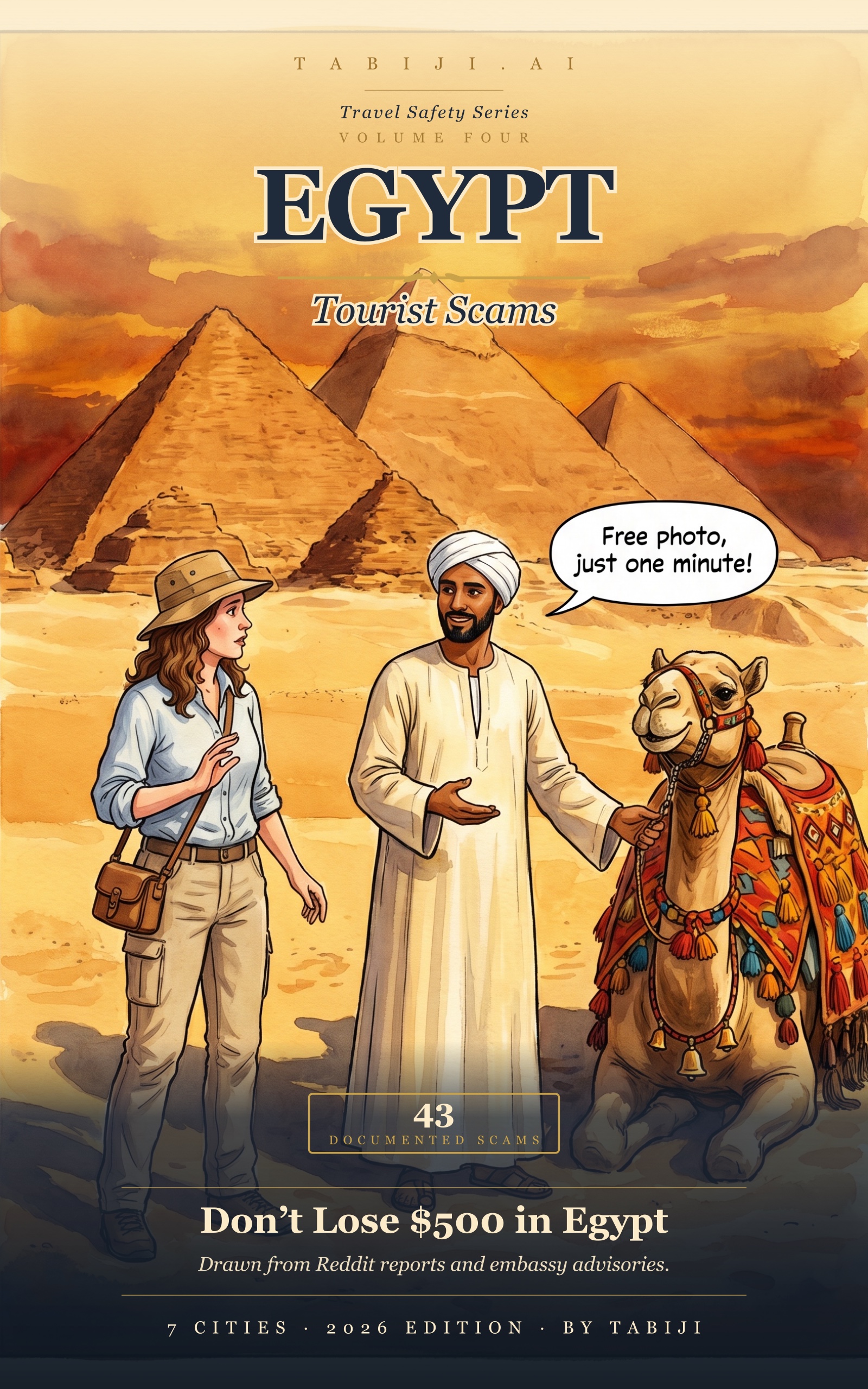
Giza pyramid camel-tout “free photo, just one minute” hostage shakedowns. Khan el-Khalili papyrus “school” markups (plant fiber sold as art). Luxor Valley of the Kings fake-guide tomb lock-ins. CAI airport “official taxi” USD overcharges. Aswan felucca captain price-doubling. Every documented Egypt scam — with the exact scripts, red flags, and Arabic phrases that shut each one down. Drawn from Reddit (Reddit, Reddit), U.S./UK/Canadian Embassy advisories, and Egyptian Tourism & Antiquities Police reports.
- 43 documented scams across Cairo, Luxor, Aswan, Hurghada & 3 more destinations
- An Arabic exit-phrase card you can screenshot to your phone
- Updated annually — buy once, re-download future editions free
- Readable in one flight — $4.99 on Amazon Kindle