
Key Takeaways
- The #1 reported scam is The Kaleiçi Taxi Meter Trick.
- 3 of 6 scams are rated high risk.
- Use BiTaksi or Marti TAG; insist on the meter (Tarife 1 day-rate) before the car moves.
- Never accept unsolicited offers from strangers near tourist sites in Antalya.
⚡ Quick Safety Tips
- Use BiTaksi or Marti TAG app for taxis with tracked routes and pre-estimated fares — Recent traveler accounts; reports confirm 'Always ask to put the meter' is the country-wide rule from AYT airport and in Old Town Kaleici.
- Photograph menus and prices before ordering at any restaurant on Kaleici alleys or Lara Beach strip; check the bill line-by-line per traveler reports — 'If a shop doesn't have price tags, it's likely a tourist scam.'
- Use ATMs inside bank branches (Türkiye İş Bankası, Akbank, Garanti) and enable real-time transaction alerts; never pay cash at bars on Kaleici nightlife strip — 'Let's Have a Drink' scams target solo male travelers.
- Book Antalya day-trips (Pamukkale, Aspendos, Side, Manavgat) only via vetted operators; avoid hotel-concierge bookings under €30/person, which force shopping stops.
- For carpets, Don't buy from a shop you were led to by a street tout; pay by credit card for dispute protection which documents post-purchase value disputes across the Aegean.
Jump to a Scam
The 6 Scams
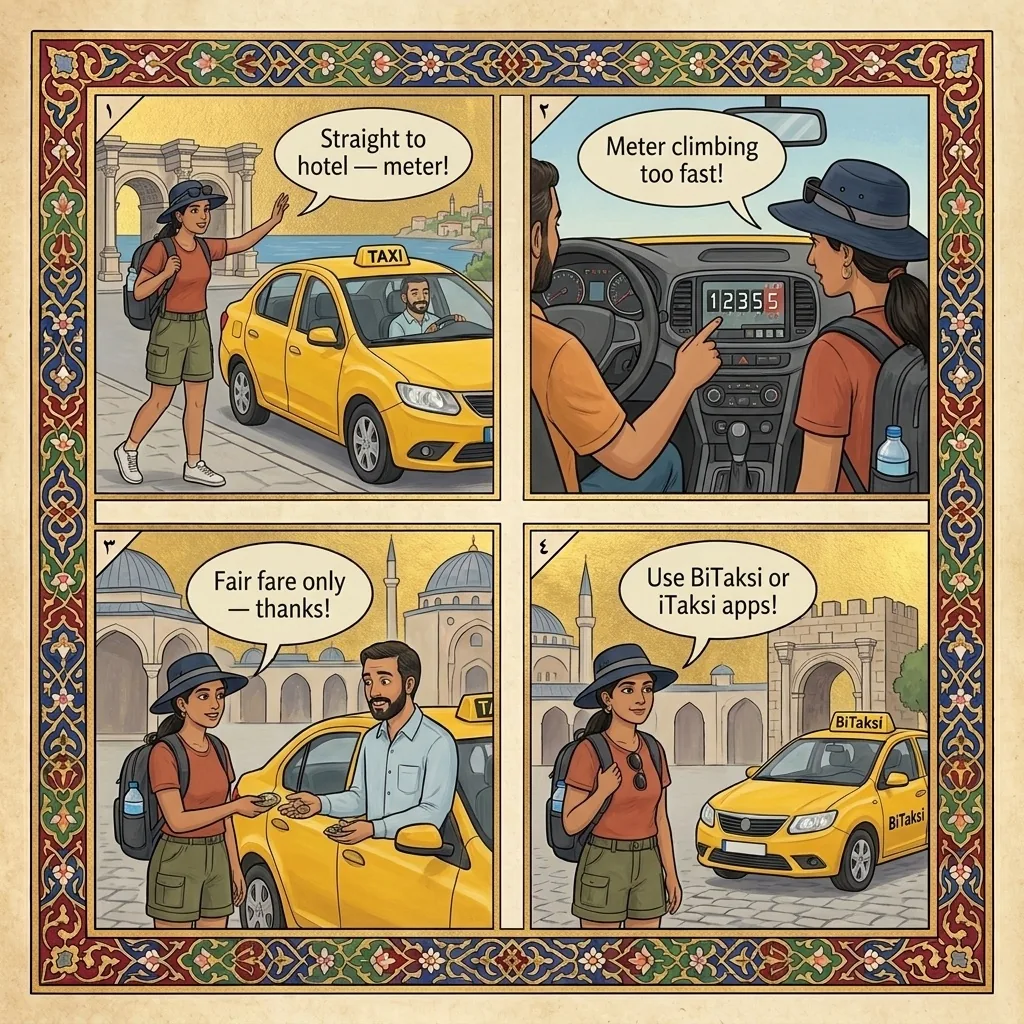
Taxis at Antalya Airport and Kaleici Old Town refuse to run the meter or quote in euros instead of lira, adding 60–120% to the legitimate metered fare — airport to Kaleici costs ₺350–₺500 on the meter, but flat-rate quotes of €25–€40 (₺750–₺1,200) are common at the international arrivals exit.
Antalya Airport processes millions of international charter passengers annually from Germany, Russia, and the UK — arrivals who typically don't know Turkish price levels. Drivers who work the international arrivals hall (rather than the licensed taxi stand outside) approach tourists before they reach the kerb and quote fares in euros, where they control the exchange rate. They operate personal vehicles that can appear indistinguishable from official licensed cabs.
On the meter, airport to Kaleici runs ₺350–₺500 (approximately €9–€13 at 2025 rates). A driver quoting €25–€40 flat adds 60–120% to the legal fare. Common tactics include claiming the meter is 'broken' and must use a flat rate; running the gece tarife (night rate) during daytime hours, which roughly doubles the per-kilometre charge; or routing through residential side streets to inflate the distance recorded on the meter.
The licensed stand is the single most important detail. Use only the official taxi stand outside the arrivals exit and insist the meter runs on the daytime gündüz tarife before the car moves — the BiTaksi app lets you pre-book with a route-tracked, fare-estimated ride from the airport, eliminating all negotiation.
Red Flags
- The driver refuses to turn on the meter or claims it is broken
- The driver quotes the fare in euros instead of Turkish lira
- The driver approaches you inside the arrivals hall instead of waiting at the official taxi stand outside
- The meter is running on the night rate (gece tarife) during daytime hours
- The driver takes an obviously indirect route or drives through deserted side streets
How to Avoid
- Always insist the meter is running and set to the daytime rate (gunduz tarife) before the car moves.
- Use the BiTaksi app to book taxis with tracked routes and pre-estimated fares, or arrange a hotel transfer in advance.
- At Antalya Airport, use only the official taxi stand outside arrivals and reject drivers who approach you inside the terminal.
- Know approximate fares: airport to Kaleici is roughly 350-500 TL, airport to Lara Beach is 250-400 TL in 2025 prices.
- Request a receipt (makbuz) for every trip and report overcharging to local police at 155 or the tourism hotline.
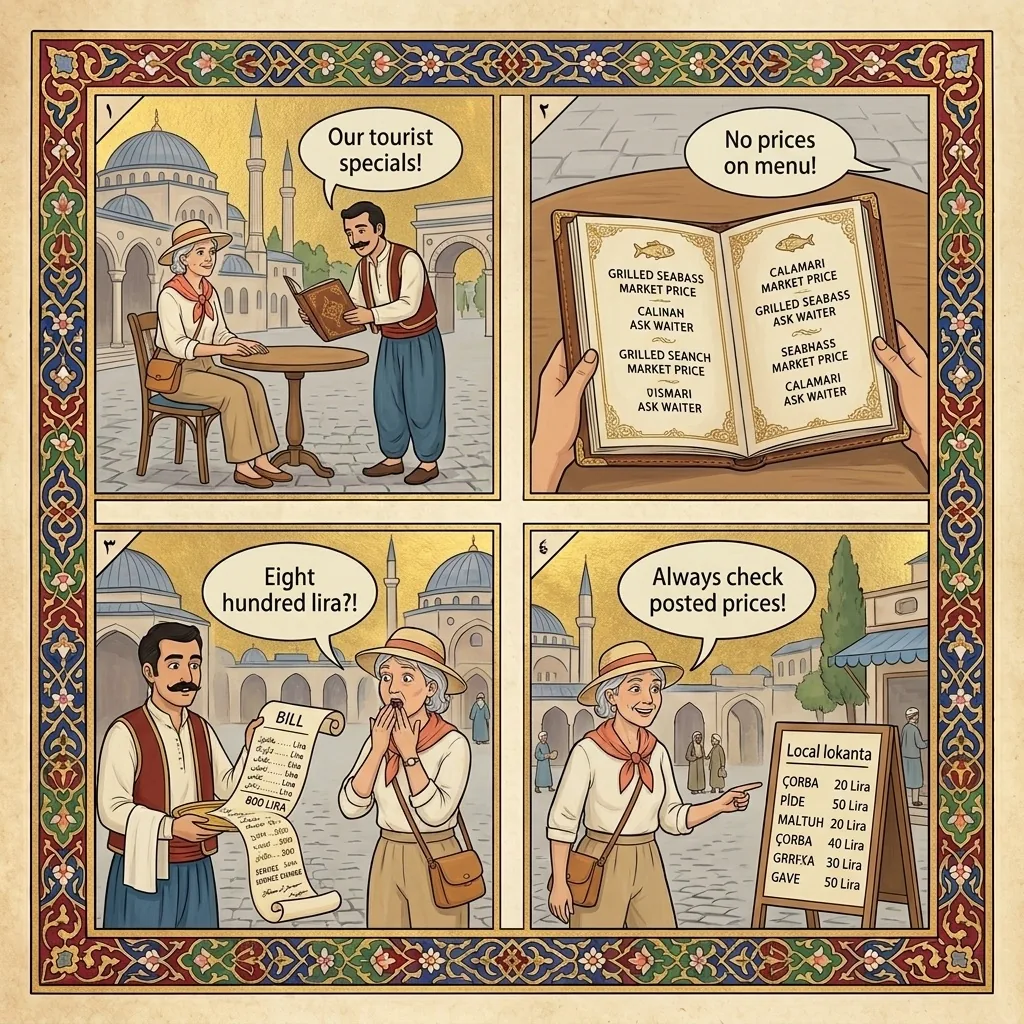
Tourist restaurants in Kaleici's Old Town alleys and along the marina inflate bills by charging 2–3× menu prices, adding fabricated 'service tax' line items, and billing for unrequested bread and water — restaurants with street touts consistently charge 30–50% more than comparable establishments without a hawker at the door.
Kaleici's narrow lanes and the harbor strip concentrate tourist foot traffic. Restaurants post touts at the entrance to wave in passersby with promises of special menus or free drinks, and the menu presented inside shows reasonable prices. The meze, bread, and water that arrive at the table without request appear complimentary until the bill arrives.
When the bill comes, dishes listed at ₺150 on the menu appear at ₺350. A fabricated 15% 'service tax' or 'tourism fee' is added — Turkish restaurant tax is not applied this way and this line item is invented. The bread, water, and extra meze are billed individually at inflated rates. The waiter hovers and pressures a quick settlement before the discrepancies are visible. If challenged, the staff claim a 'calculation error' and correct only part of the overcharge.
The bill is a document; treat it as one before handing over any money. Photograph the menu including prices before ordering and check every line item on the bill against it before paying — if the numbers don't match, refuse to pay the discrepancy; restaurants with touts resolve disputes almost immediately when a call to tourist police on 155 is threatened.
Red Flags
- A tout on the street aggressively invites you into the restaurant with promises of discounts or free items
- The waiter brings bread, water, or meze to the table without you ordering it, then charges for it
- The bill is presented quickly and the waiter hovers while you review it, pressuring a fast payment
- Prices on the bill do not match what was listed on the menu you were shown earlier
- A service charge or tax appears on the bill that was not disclosed on the menu or verbally
How to Avoid
- Photograph the menu including prices before ordering, and compare each item to the bill before paying.
- Avoid restaurants with aggressive touts on the street; choose places where locals eat and check Google reviews first.
- Ask explicitly if bread, water, and service charges are included or extra before sitting down.
- Always check the bill line by line and do not feel rushed; politely insist on time to review each charge.
- If overcharged, refuse to pay the inflated amount and threaten to call the tourist police (155); restaurants often back down immediately.
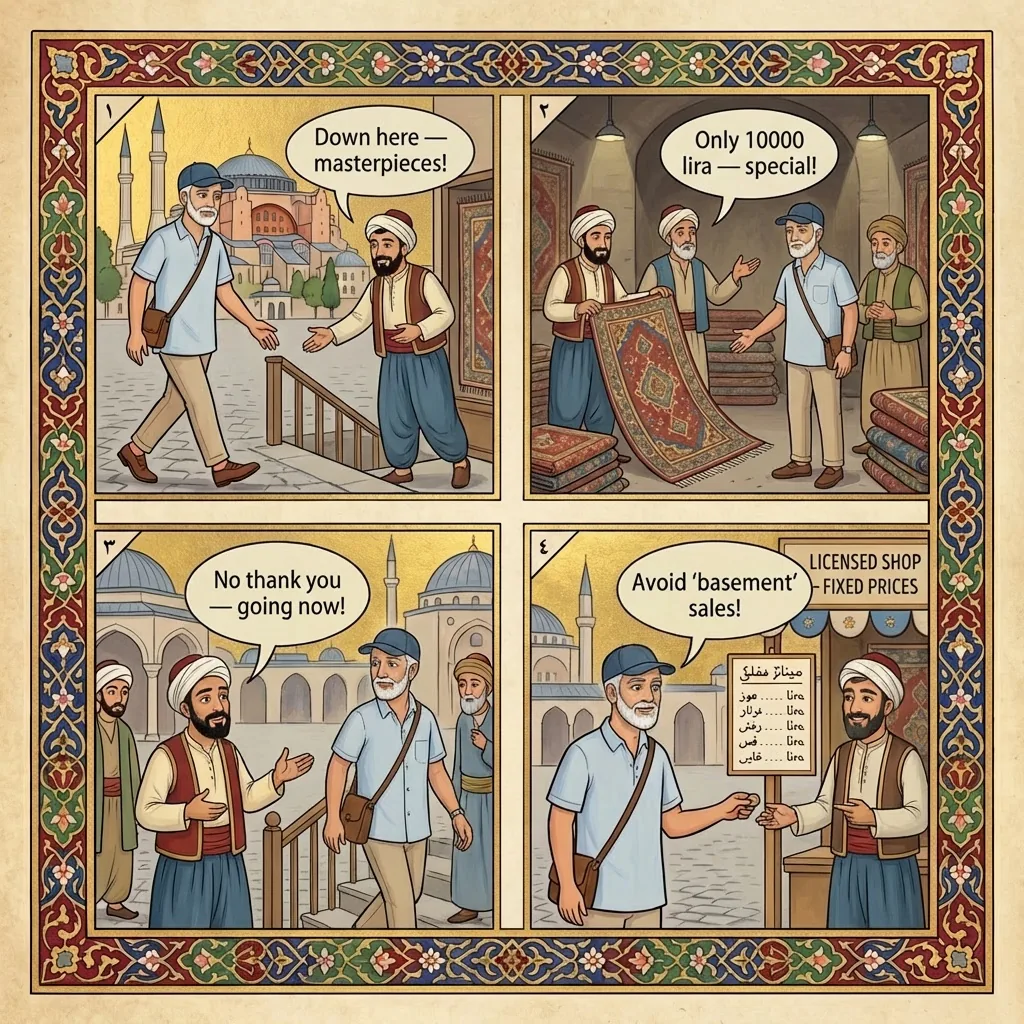
In Kaleici's narrow streets, touts steer tourists into carpet shops selling machine-made reproductions as handwoven silk antiques for $2,000–$5,000 — tea and a multi-hour presentation build social obligation to buy before visitors realize the certificates of authenticity are printed in-house and the carpet was appraised at $100–$300.
Kaleici's medieval alleyways and the streets near Hadrian's Gate concentrate dozens of carpet shops. Touts approach tourists presenting themselves as friendly locals — 'Where are you from? My cousin lives there!' — and invite them to a 'family gallery' or 'private showroom nearby.' Once inside, the formal process begins: chairs are arranged, tea is served, and a host lays out dozens of rugs in sequence while explaining the history, age, and weaving technique of each piece.
Prices start at $5,000–$10,000 for a featured piece and drop rapidly to $1,500–$2,500 as the presentation continues, creating a sense of exceptional value for what is in fact a machine-woven Chinese reproduction. Certificates of authenticity confirming '100% handwoven silk' or 'antique, 125 years' are printed in-house and carry no independent verification. Travelers who purchase and later have the carpet appraised often find it valued at 5–10% of what they paid.
Accepting tea creates no obligation; walking out ends the interaction. Never follow a street tout into a carpet shop — if you want to buy a carpet, identify specific dealers with years of consistent review history before your trip, visit them independently, and pay by credit card for dispute leverage against misrepresentation claims.
Red Flags
- A friendly stranger on the street strikes up conversation and offers to show you their 'family carpet shop'
- You are served tea and made to feel obligated to buy after a lengthy presentation
- The seller claims the carpets are antiques or handmade silk but cannot provide independent verification
- Prices start extremely high and the seller rapidly drops them, making you feel like you are getting a deal
- The shop offers to ship the carpet to your home country, removing your ability to inspect it again before paying
How to Avoid
- Never follow a street tout into a carpet shop; if you want a carpet, research specific reputable dealers with verified reviews beforehand.
- Get any carpet independently appraised before purchasing; do not rely on certificates provided by the seller.
- Understand that feeling obligated after tea and conversation is the entire strategy; you owe nothing for accepting hospitality.
- If you do buy, pay by credit card so you can dispute the charge if the carpet turns out to be fake or misrepresented.
- Set a firm budget and a time limit before entering any shop, and do not let the salesperson talk you past either boundary.
Like what you're reading? Get a full Antalya itinerary with safety tips built in.
Browse travel-safety books →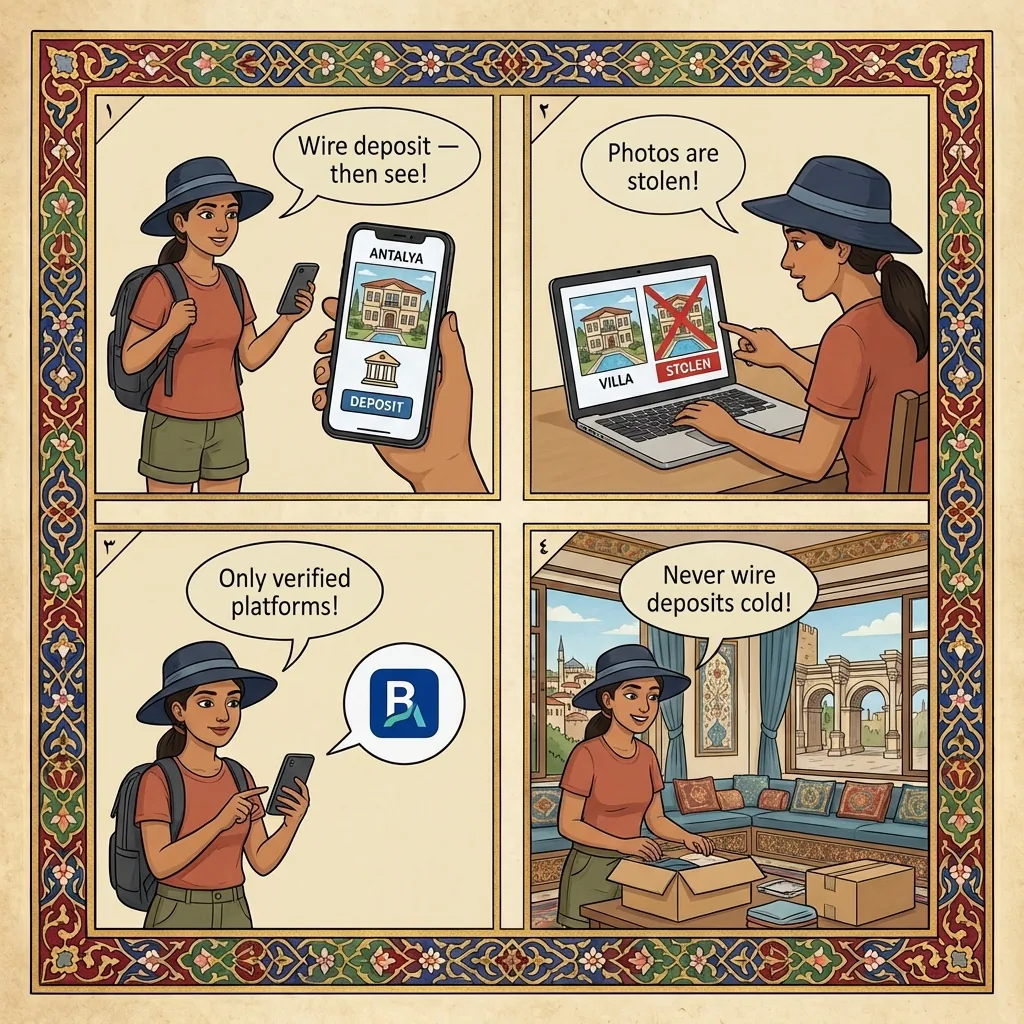
Social media and unofficial booking sites list Kaleici boutique hotels and Lara Beach apartments at 30–50% below comparable properties, request bank transfer payment, and deliver either a nonexistent address, a property already occupied by its actual residents, or a room far inferior to the listing photos.
Kaleici's boutique hotel market and Lara Beach apartment sector attract travelers seeking alternatives to mass-market all-inclusive resorts. Social media posts and unofficial booking aggregators advertise photos of attractive historic-house conversions or sea-view villas at dramatically below-market rates — the discount framing presented as 'direct from owner' or 'no-commission deal.'
The host requests payment by bank transfer, offering an additional discount for 'bypassing platform fees.' The confirmation PDF is convincing but fraudulent. On arrival, the address either doesn't exist, is occupied by its actual residents, or is a significantly inferior property to what was shown. A subtler variant uses a real hotel property: at check-in, the reserved room is 'unavailable due to maintenance' and the guest is downgraded to a lower-category room with no refund for the price difference, which can be €40–€80 per night on a multi-day stay.
Platform escrow is the only protection against both variants. Book Antalya accommodation only through Booking.com, Airbnb, or Hotels.com and never transfer money directly to a host — before booking, verify the property address on Google Maps Street View; if the street view doesn't match the listing photos, the listing is fraudulent.
Red Flags
- The rental price is significantly below comparable properties in the same area
- The host insists on bank transfer payment rather than booking through Airbnb, Booking.com, or another platform with buyer protection
- The host refuses to provide a video call or real-time photos of the property when requested
- The listing has few or no reviews, or reviews that all appear to have been posted around the same time
- The host pressures you to book immediately claiming high demand or a limited-time offer
How to Avoid
- Book accommodation only through established platforms like Booking.com, Airbnb, or Hotels.com that offer verified listings and refund policies.
- Never send money via bank transfer or Western Union for any accommodation booking.
- Cross-reference the property address on Google Maps and Google Street View to verify it exists and matches the listing photos.
- Read recent reviews specifically mentioning the property matching its description; look for multiple reviews across different months.
- Contact the property directly using phone numbers found through independent searches, not just the number provided in the listing.
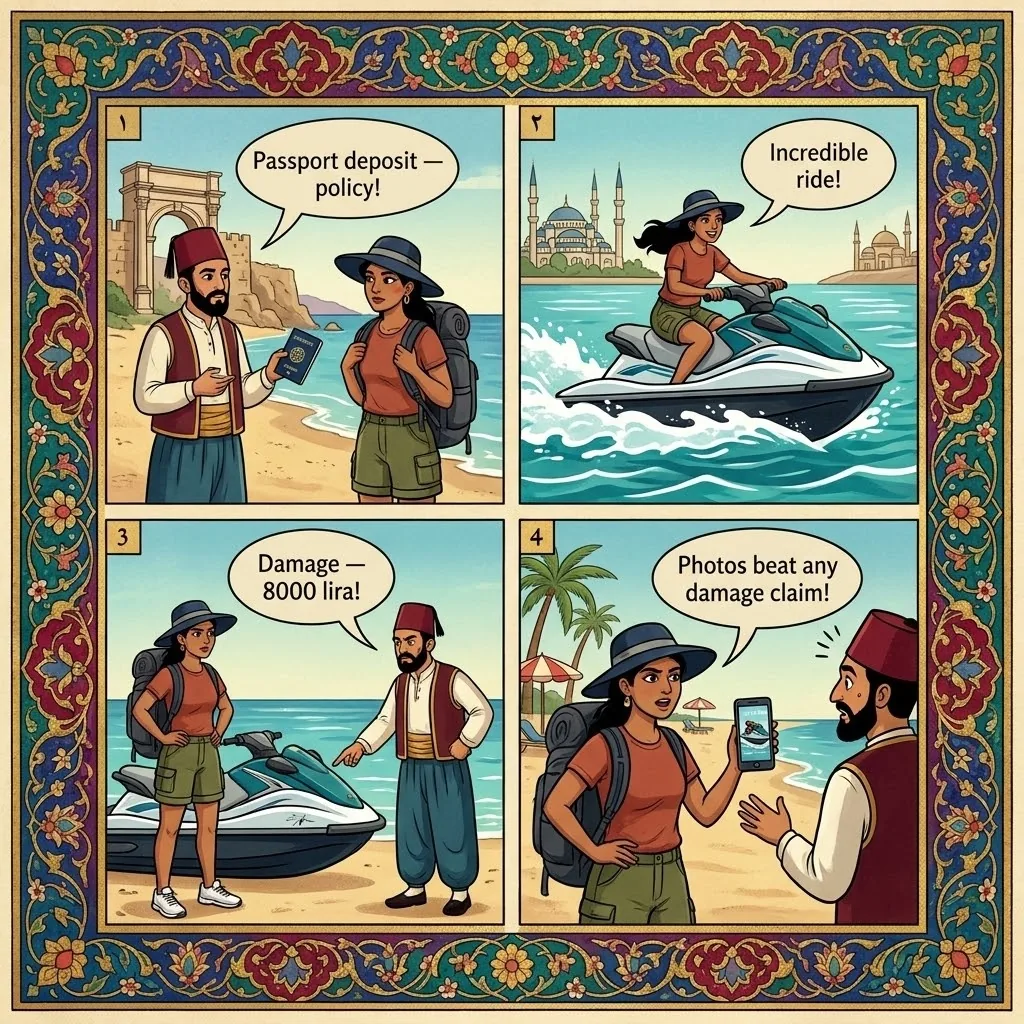
Jet ski and parasailing operators on Konyaalti and Lara beaches quote €50–€80 verbally then add mandatory 'fuel deposits' that are never returned, shorten ride times by starting the clock during the safety briefing, and present post-ride 'equipment damage' claims for €200–€500 in cash — no receipt, no recourse.
Konyaalti and Lara beaches are lined with watersports vendors advertising jet ski, parasailing, and banana boat sessions at competitive prices shouted verbally from the beach. No price board is posted, and operators negotiate personally with each tourist. The quoted price sounds fair; the full transaction almost never is.
After agreeing on a price, the tourist is told about a mandatory €30–€50 'fuel deposit' that will be 'returned at the end' but is never refunded. Timers start during the safety briefing on shore rather than when the rider enters the water, cutting 5–10 minutes from the purchased time. Parasailing sessions end early with operators citing 'wind conditions' and declining to refund the unused portion. At drop-off, operators claim new damage to the equipment — scratches or dents that were already present before use — and demand immediate cash payment of €200–€500.
Documentation before use is the protection against false damage claims. Book watersports through your hotel or a licensed operator with a visible price board and Turkish tourism license, photograph the equipment thoroughly before touching it, get all charges listed in writing before committing, and pay by credit card on a formal receipt rather than cash.
Red Flags
- No visible price board and the operator negotiates verbally without written confirmation
- You are told the activity has no insurance and you must sign a damage liability waiver
- The operator asks for cash payment upfront with no receipt provided
- Additional charges for fuel, safety equipment, or photos are mentioned only after you have committed
- The operator takes your personal camera or phone during the activity and demands payment to return it
How to Avoid
- Book watersports through your hotel or a licensed operator with posted prices and Google reviews rather than beach touts.
- Get a written quote including all charges before committing, and confirm whether fuel, equipment, and insurance are included.
- Pay by credit card when possible for dispute protection; if paying cash, insist on a receipt with the business name and total.
- Photograph any equipment before use so you have evidence against fake damage claims.
- Check that the operator has a Turkish tourism license displayed and carries third-party liability insurance.

On Bar Street in Kaleici, friendly locals — often attractive women — guide solo male tourists to specific bars where bills of €200–€800 arrive after a few rounds, with bouncers blocking the exit until payment is made; a more dangerous variant involves a spiked drink, followed by theft of wallet, phone, and watch.
Bar Street (Barlar Sokağı) runs through Kaleici's Old Town into the marina area and concentrates the highest density of nightlife scam operations in the city. Touts working on commission from participating bars target solo male tourists arriving in the early evening, presenting themselves as friendly locals who 'know the best spot.' The first round at the bar is priced normally to establish trust; subsequent rounds are charged at undisclosed 'bar prices.'
When the bill arrives at €200–€800 for what the tourist thought was a normal evening, bouncers appear and block the exit until payment is made; some bars confiscate phones as collateral. The drink-spiking variant is more dangerous: a drugged beverage — typically a doctored soft drink used as a mixer — is administered when the tourist's glass is unattended. The tourist regains consciousness hours later missing their wallet, phone, watch, and cards.
The protection begins before choosing a bar. Never go to a bar suggested by a stranger you just met on the street — choose your own venue based on Google reviews and visible local foot traffic; check the price menu before ordering, pay for each round as it arrives rather than running a tab, and never leave a drink unattended or accept one you didn't see poured.
Red Flags
- A friendly stranger suggests going to a specific bar they know rather than letting you choose
- The bar has no visible menu with prices, or the menu shown differs from what appears on the bill
- You feel unexpectedly drowsy or disoriented after one or two drinks
- Bouncers or security become involved when you question the bill
- The bar is in a basement or side street with no other visible customers when you arrive
How to Avoid
- Never go to a bar suggested by a stranger you just met; choose your own venue based on Google reviews and visible foot traffic.
- Always check the menu with prices before ordering and keep it at your table for reference when the bill arrives.
- Never leave your drink unattended; order bottled drinks and open them yourself when possible.
- Set a spending limit and pay for each round as it arrives rather than running a tab.
- Go out in groups rather than alone, and let someone know where you are going and when you expect to return.
🆘 What to Do If You Get Scammed
📋 File a Police Report
Go to the nearest Turkish National Police (Emniyet Genel Mudurlugu) station. Call 155. Get an official crime report — you'll need this for insurance claims. You can also report online at Turkish National Police Online Portal.
💳 Cancel Your Cards
Call your bank immediately. Most have 24/7 numbers on the back of the card (keep a photo saved separately). Block any suspicious transactions before the thieves use your details.
🛂 Lost Passport?
Contact your country's nearest consulate; many European countries maintain honorary consulates in Antalya. The nearest US Consulate is in Adana. Carry a photocopy of your passport separately from the original.
📱 Track Your Device
If your phone was stolen, use Find My (iPhone) or Find My Device (Android) from another device. Don't confront thieves yourself — share the location with police instead.
Frequently Asked Questions
You just read 6 scams in Antalya. The full Travel Safety Series has 780+ more across 20+ countries.
Tokyo's Kabukichō ¥130,000 bar trap. Rome's gladiator photo extortion. Paris's gold-ring trick. Bali's ATM skimmer scams. Bangkok's grand-palace closure ruse. Every documented scam across 20+ destinations — with the exact scripts, red flags, and local-language phrases that shut each one down. Drawn from Reddit traveler reports, embassy advisories, and consumer-protection cases.
- 780+ documented scams across Tokyo, Rome, Paris, Bali, Bangkok, Rio & 100+ more cities
- 20+ countries covered, with country-by-country phrase cards for every destination
- Updated annually — buy once, re-download future editions free
- All titles $4.99 each on Amazon Kindle