
Key Takeaways
- The #1 reported scam is the Gladiator Photo Extortion.
- 2 of 6 scams are rated high risk.
- Use app-based ride services (Uber, Bolt) or official metered taxis instead of unmarked vehicles.
- Never accept unsolicited offers from strangers near tourist sites in Rome.
⚡ Quick Safety Tips
- On the Metro A line (Vatican to Termini), keep bags in front of you — it's Rome's busiest pickpocket route.
- Never let anyone place a rosemary sprig, bracelet, or any item in your hand near tourist sites — you'll be aggressively charged.
- Check restaurant bills carefully near the Colosseum and Trevi Fountain — 'coperto' (cover charge) is legal, but surprise extras are not.
- Only take taxis from official white taxi ranks (not touts who approach you) — fares from Fiumicino to city center are fixed at €48.
Jump to a Scam
The 6 Scams
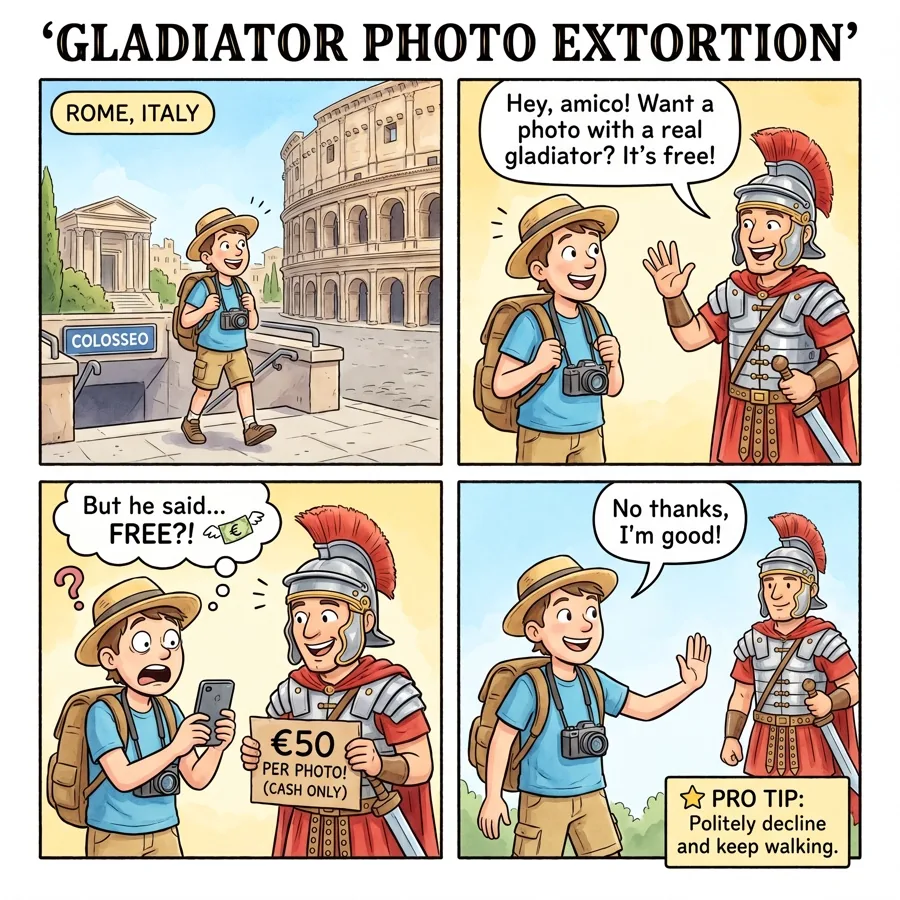
Costumed "centurions" outside the Colosseum and Roman Forum drape an arm around tourists for an unsolicited photo and then demand €20–€50 cash, with two or three friends in costume materializing behind them if you try to refuse.
You step out of the Colosseo Metro station and a man in full centurion regalia — plumed helmet, breastplate, sandals — strides toward you, grins, and puts his arm across your shoulders before you've decided whether you want a photo. Your travel companion snaps one shot. It feels harmless, very Roman. Then the gladiator's smile drops and he says, "Trenta euro." Thirty euros for a photo you didn't ask for.
When you offer €5 he blocks your path. Two more costumed "friends" appear from nowhere — they were already watching from the Forum entrance — and the negotiation tilts hard. The crew has been running this same script outside the Colosseum and along Via Sacra for years, and traveler reports describe the dynamic in nearly identical terms: the men are organized, they target tourists who already have a camera out, and they escalate aggressively the moment they feel owed money. Roman authorities have tried to regulate them with mixed success.
The whole scam depends on one moment — the photo before the price. Don't pose with anyone in costume near the Colosseum or Forum unless you've negotiated a price (€5 is reasonable) before any camera comes out, and if a "centurion" approaches you proactively, keep walking and say "No, grazie" without making eye contact. Photograph the Colosseum from a distance where costumes are background scenery, not posed subjects. If a crew surrounds you and demands payment, the visible Polizia di Stato near the metro and Arch of Constantine are the immediate move — flag an officer, the costumed-extortion racket is well-known to them and the crew will scatter on sight.
Red Flags
- Costumed 'gladiators' or centurions near the Colosseum initiate contact and pose without asking your permission first
- They grab your arm or shoulder for the photo before any price is discussed
- Friends in costume appear once a dispute over payment starts
- They demand far more than you expected — €20–50 per photo is common
- They linger near the Colosseum and Forum entrances specifically during tourist rush hours
How to Avoid
- Do not take photos with or of costumed characters without agreeing on a price first.
- If you do want a photo, negotiate the price before your camera comes out.
- Simply keep walking and say 'No, grazie' — do not make eye contact or smile back.
- Photograph the Colosseum from a distance where the costumes are in the background but no individual posed.
- Know that local authorities have tried to regulate this — if you're pressured aggressively, flag a nearby police officer.
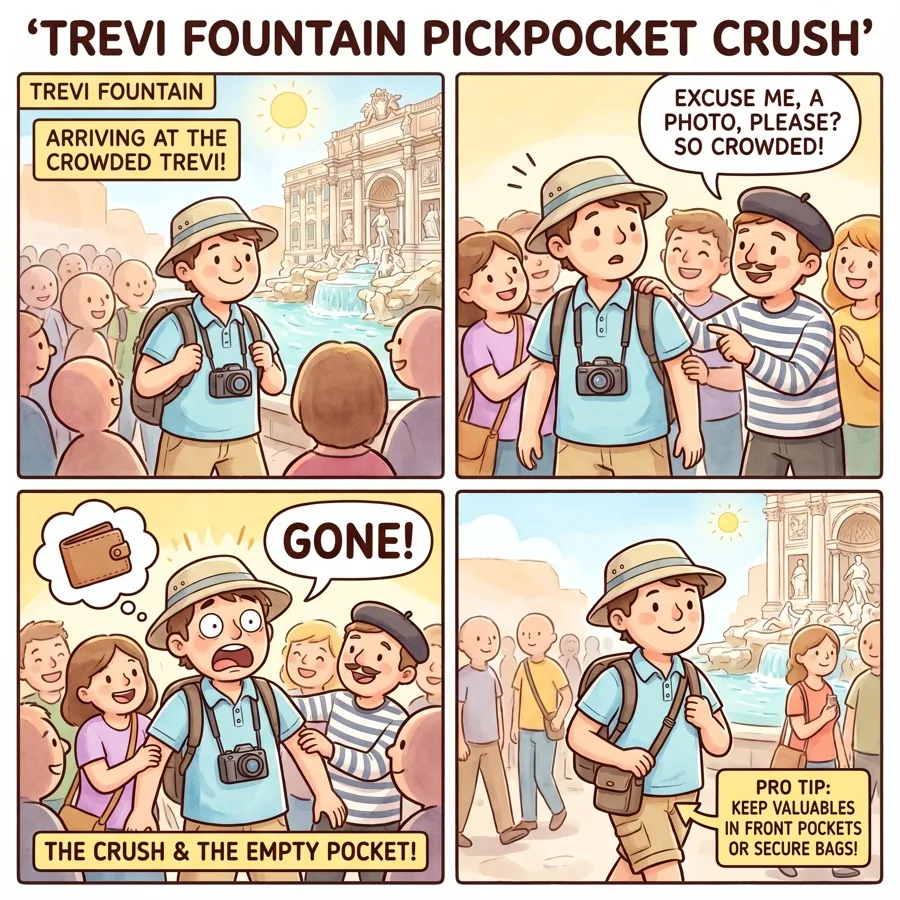
Organized pickpocket teams exploit the shoulder-to-shoulder crowd at Trevi Fountain — one person bumps you from behind while a partner lifts your wallet or phone in three seconds, and the same teams work Piazza di Spagna and the Pantheon at peak hours.
It's mid-afternoon at Trevi Fountain. The crowd is so dense you can barely shift your weight, much less turn around — you're pressed against strangers on three sides just to get a coin-toss view of the Fontana di Trevi. Your phone is in a jacket pocket, your backpack is slung slightly to the side so you can raise the camera. Someone bumps you firmly from the right. You barely register it because the whole crowd is bumping itself.
Ten minutes later at a café on Via del Tritone you reach for your wallet to pay for a coffee. Gone. The bump was the lift, and by the time you noticed the gap, the wallet had passed through two more hands and was already in a bag headed toward Termini. Trevi is one of the most pickpocket-dense locations in Europe — organized teams work it on rotation because the crowd is immovable and tourists are by definition camera-distracted. The same teams also work Piazza di Spagna at peak hours and the Pantheon square at midday. The pattern is consistent: a deliberate stop or push from one direction sets up a lift from the opposite side, and the lifter is usually a third person you never noticed.
The defense is positional. Move your wallet, passport, and primary card to a money belt or front zipped trouser pocket before you enter any major Rome plaza, wear your backpack on your front in dense crowds, and keep your phone in your hand or a deep inner pocket — never an outer jacket pocket. Visit Trevi at 6–7 AM if you want photos without the crush; the fountain is empty and the light is better. Leave spare cards and excess cash at the hotel. If you do get hit, file a denuncia with the Polizia di Stato within 24 hours — the report number is mandatory for travel-insurance and card-issuer fraud claims.
Red Flags
- Extremely dense crowds where movement is difficult — ideal cover for pickpockets
- Someone bumps or pushes you from an unexpected direction
- A person in front of you suddenly stops or crouches, forcing you into someone behind
- Strangers seem overly interested in what you're doing with your phone or bag
- Your bag or jacket pocket is behind or to the side of your body in the crowd
How to Avoid
- Use a money belt or keep cards and passport in a front zipped trouser pocket.
- Visit the Trevi Fountain at 6–7 AM when it's uncrowded and beautiful.
- Wear your backpack on your front in dense crowds.
- Keep your phone in your hand or in a deep inner pocket when photographing.
- Leave unnecessary cards and large amounts of cash at the hotel.
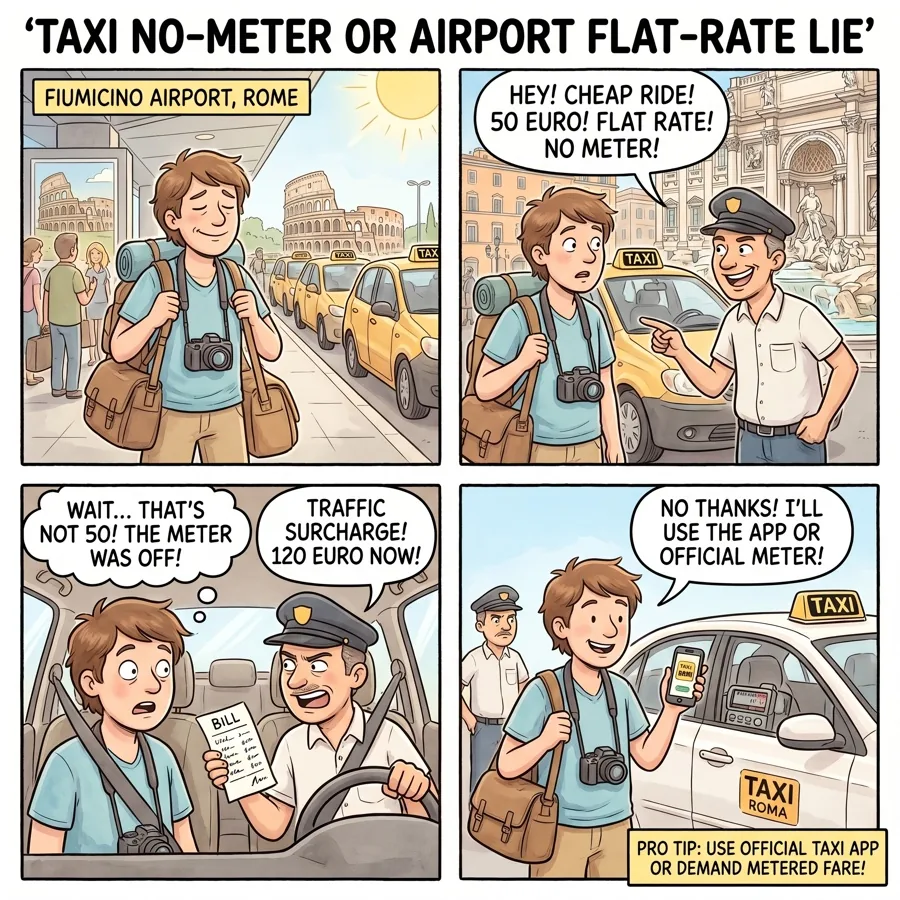
Lanyard-wearing "taxi" touts inside Fiumicino arrivals quote €40 "official flat rate" rides that end at €80+ with no running meter — the real city-mandated FCO→central-Rome flat rate is exactly €50, payable only in licensed white taxis with the "Comune di Roma" logo at the official rank outside.
Your flight lands at Fiumicino late and you're walking through arrivals dragging two suitcases. A man in a dark jacket with a laminated lanyard catches your eye: "Taxi to centro? Forty euros, fixed rate, official." Forty sounds slightly cheaper than the €50 you read about, the lanyard looks legitimate, and you're tired enough to want this over with. You follow him out a side door to a parking deck.
The car has no meter. Halfway through the ride the price is suddenly €60. By the time you're at the hotel it's €80, your bags are in a locked trunk, and the driver won't pop it until you pay cash. The real licensed flat rate from FCO to central Rome (anywhere inside the Aurelian Walls) is exactly €50, set by the city, and €31 from Ciampino — and that rate only applies to the official white taxis at the marked rank outside arrivals, the ones with the "Comune di Roma" municipal logo and a working meter. The men working the arrivals hall with lanyards are unauthorized touts; real licensed drivers never solicit passengers inside the terminal. The same play runs at Roma Termini taxi rank where touts intercept you before you reach the official queue.
The fix is to never get into a car you didn't queue at the official rank for. Walk past every "taxi" offer inside Fiumicino, Ciampino, or Termini and use only the official white taxi queue with the "Comune di Roma" logo — the FCO→centro fare is exactly €50 by law, the Ciampino fare is €31, and any quoted price above or below those numbers is a red flag. The Leonardo Express train (FCO → Termini, €14, every 15 minutes) is faster than a taxi during traffic. Uber and Free Now both operate in Rome with regulated upfront pricing as a third option. If you've already been driven to a hotel and the trunk is being held hostage, photograph the license plate, pay the disputed amount on a credit card (never cash), and dispute the charge the same day.
Red Flags
- Someone approaches you inside the airport terminal or train station offering a taxi
- The car is not white and does not have the 'Comune di Roma' municipal taxi sign
- Driver claims the meter is broken and insists on a cash 'flat rate'
- They quote a price much lower than the official €50 FCO flat rate to entice you
- Driver avoids the official taxi rank and asks you to follow them to a parking area
How to Avoid
- Only use the official white taxi rank outside arrivals — look for the 'Comune di Roma' logo.
- The legal fixed rate from FCO to central Rome is exactly €50 — insist on this or a running meter.
- Book official Italo or Trenitalia Leonardo Express train (FCO → Termini, €14) instead.
- Use the Uber app or free NOW which show prices upfront and are regulated.
- Never follow anyone who approaches you inside the terminal — even with a lanyard.

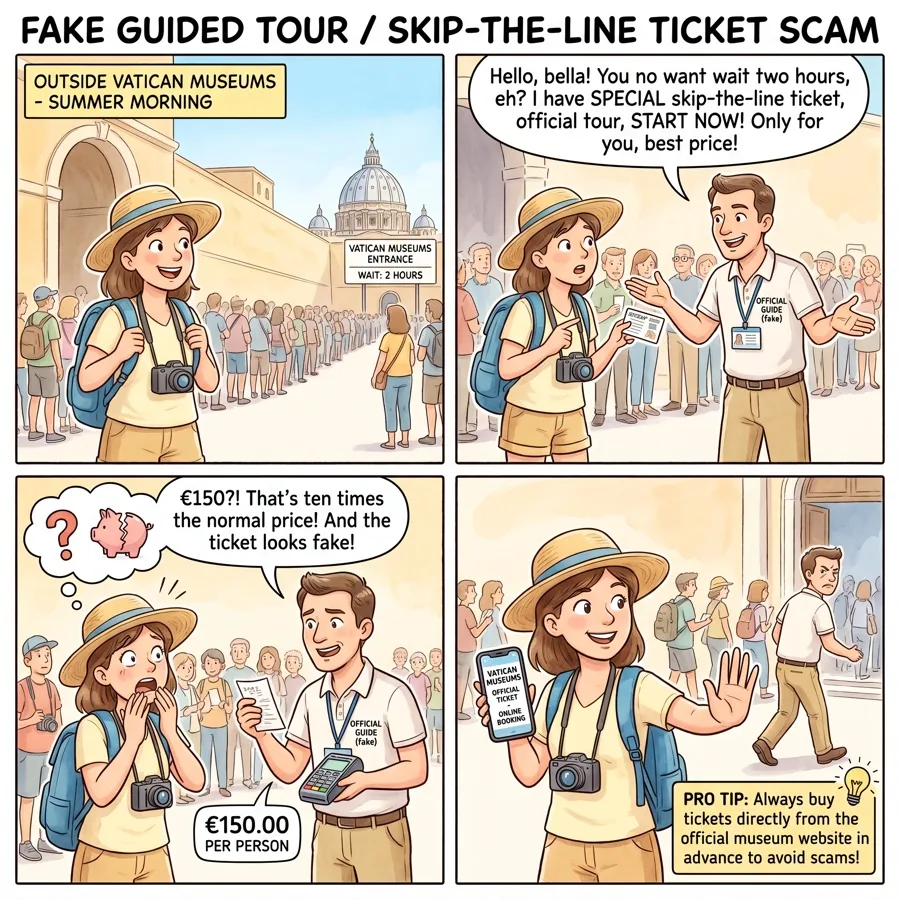
Touts with laminated "guide" badges outside the Vatican Museums, Colosseum, and Borghese Gallery sell €25/person "skip-the-line" tickets for cash that turn out to be blank PDFs with no booking code — the real official tickets are bookable only at museivaticani.va and coopculture.it.
It's August at the Vatican Museums and the entry queue stretches for two hours under direct sun. Your group of four is wilting when a well-dressed man with a laminated "official guide" badge appears at your shoulder: "Skip-the-line tickets, twenty-five euros each, you go in now." A hundred euros cash changes hands, he leads you down a side street to a quieter spot, presses four printouts into your hand, says "show these to the guard," and walks off briskly.
The guard takes one look and laughs. The printouts are blank PDFs with no booking code, no QR, and no record in the museum system. The Vatican approach, the Colosseum's Via dei Fori Imperiali side, and the Borghese Gallery in Villa Borghese are some of the most organized ticket-fraud zones in Europe — the operators use professional-looking tablets, fake "official guide" badges with no organization name, and a perfectly polished pitch. Real licensed Lazio tour guides wear regional government-issued credentials with a clear issuing authority; fake ones laminate generic badges that say "Guide" or "Official." The scam variant pricing tracks the queue length: the longer the line, the higher the markup, and the harder it is to verify before you've handed over the cash.
The Vatican Museums, Colosseum, and Borghese Gallery only sell skip-the-line access through advance online booking — there is no legitimate street-side reseller. Book Vatican Museums at museivaticani.va, Colosseum and Roman Forum at coopculture.it, and Borghese Gallery at galleriaborghese.beniculturali.it directly, days or weeks ahead, and never buy any "skip-the-line" ticket from a tout outside the entrance for cash. Verify the confirmation email on your phone before you leave the hotel — a real booking has a QR code and a printable PDF that opens in your inbox seconds after payment. If you forgot to book, queue at the official ticket desk inside the venue; the wait is real but so is the ticket. Licensed guided tours are bookable through the same official sites and through reputable operators like Walks of Italy.
Red Flags
- Person approaches proactively outside a major attraction offering skip-the-line access
- Tickets are sold for cash only, no receipt or official confirmation email provided
- The badge or ID looks laminated and official but has no clear organization name
- Price seems too good compared to official booking sites
- They ask you to follow them away from the official ticket entrance
How to Avoid
- Book Vatican Museums, Colosseum, and Borghese Gallery tickets only at the official website (museivaticani.va, coopculture.it).
- Never buy tickets from street touts — official skip-the-line access is only via advance online booking.
- Legitimate licensed guides wear a regional guide badge issued by Lazio, not homemade lanyards.
- If you forgot to book, use the official ticket desk inside — the wait is real but so is the ticket.
- Verify any booking immediately on your phone via the official site confirmation email.
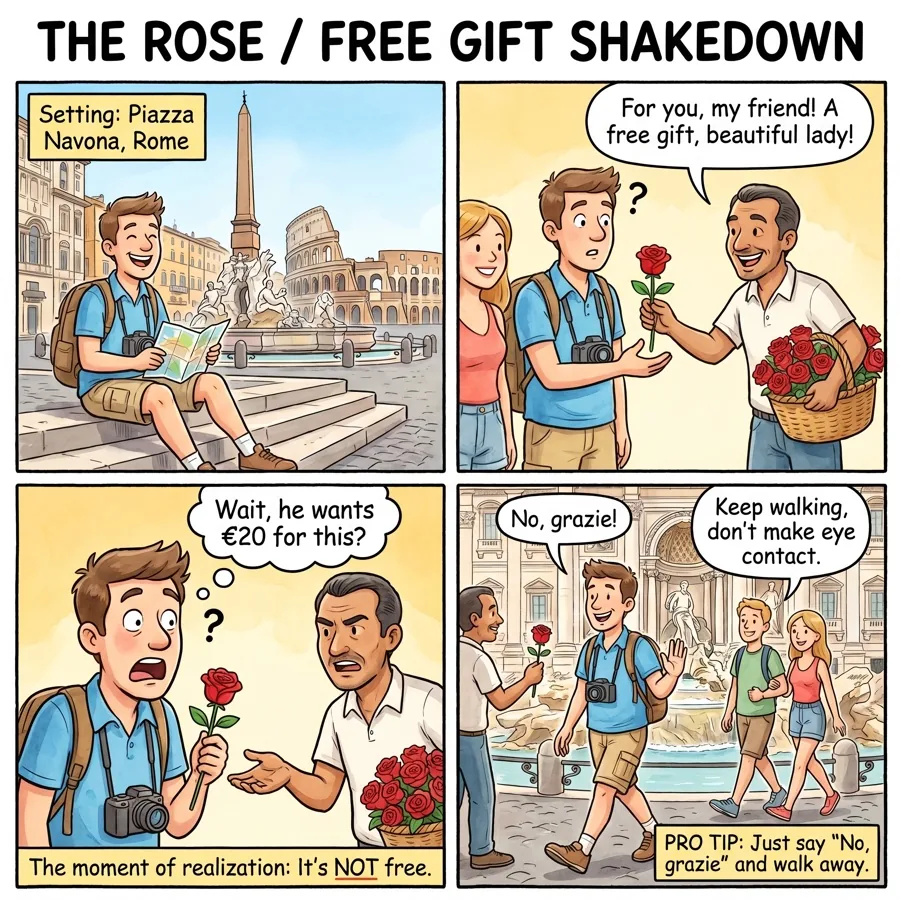
A vendor at Piazza Navona, the Spanish Steps, or Campo de' Fiori presses a "free" rose, friendship bracelet, or trinket into a tourist's hand and then loudly demands €5–€10 in front of the crowd, banking on social embarrassment to extract payment.
It's golden hour at Piazza Navona and you're sitting on the steps near the Fontana dei Quattro Fiumi with a date. A man approaches, places a single red rose in your companion's hands, and says "a gift, beautiful lady" with a warm smile. It feels charming for about three seconds.
Then his face shifts. "Ten euro." He refuses to take the rose back. He raises his voice. People at neighboring tables turn to look. The whole maneuver is engineered for social pressure — vendors target couples specifically because the awkwardness compounds; a "free" item handed to one partner with sustained eye contact at the other turns refusal into a public scene neither of you wants to keep having. The rose variant works at Piazza Navona; the same crews run "friendship bracelet" tie-ons at the Spanish Steps (the bracelet is knotted onto your wrist before you can pull it back) and small trinket pushes at Campo de' Fiori at dusk. It's a low-cost scam — €5 or €10 a hit — but they run it dozens of times an hour and the embarrassment most tourists feel is exactly the product.
The whole play collapses if the item never lands in your hand. Don't accept anything a stranger tries to hand you in any Rome plaza — keep your hands at your sides or in pockets, say "No, grazie" loudly without smiling, and if something is forced into your hand, drop it on the ground and walk away. Couples should be especially alert near the Piazza Navona fountains, the Spanish Steps at sunset, and the Trevi approach lanes — these are the highest-density rose/bracelet zones in Rome. If a vendor escalates or physically blocks you, "Chiamo la polizia" usually ends it; the Polizia di Stato know the racket and the vendors don't want documentation.
Red Flags
- Someone places an item in your hands or your companion's hands without asking
- They step close to couples, especially at romantic-feeling locations
- They make a big emotional show of the gift being 'free' and then immediately demand money
- They refuse to take the item back when you try to return it
- They raise their voice or cause a scene to increase social pressure
How to Avoid
- Do not hold any item a stranger gives you — immediately hand it back or drop it.
- Say 'No, grazie' loudly and clearly; do not smile or engage warmly.
- Walk away — the rose has no value and they will not follow far.
- Couples should be especially aware near Piazza Navona fountains and the Spanish Steps at dusk.
- If they escalate or block you, say 'Chiamo la polizia' (I'll call the police).
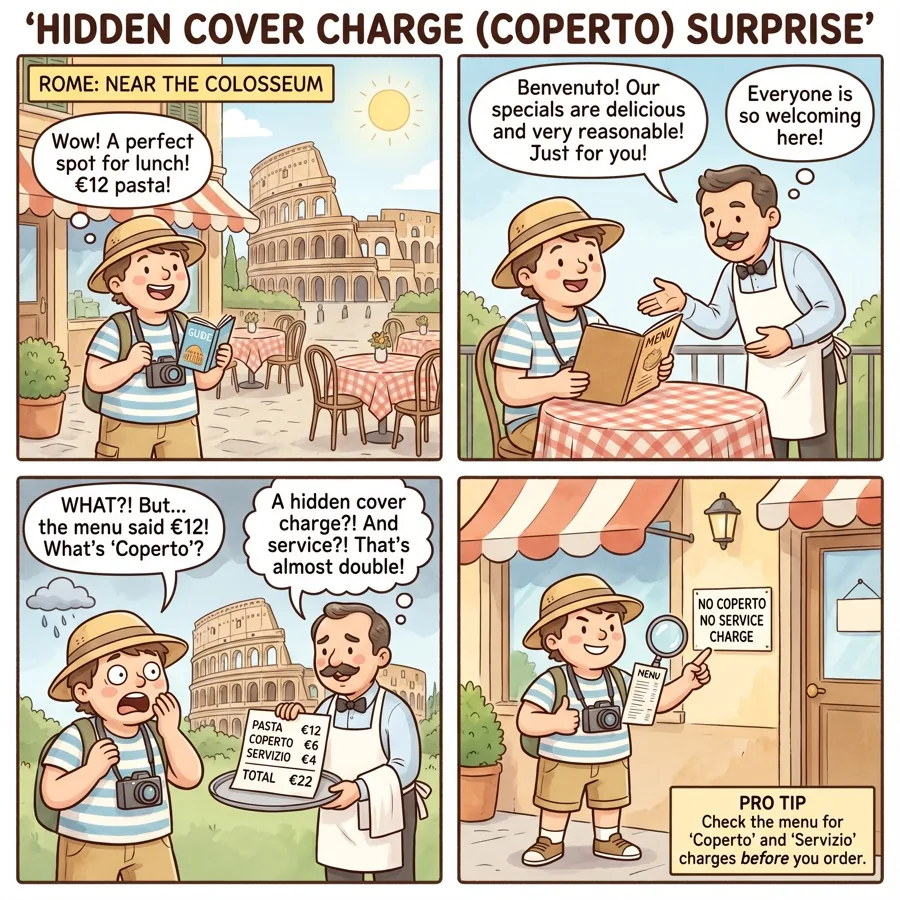
Tourist-zone restaurants near Piazza Venezia, the Colosseum, and the Trastevere strip inflate the legal "coperto" cover charge to €5–€8 per person and stack automatic bread, olive, and amuse-bouche charges on top — turning a €30 dinner into €54+ with no clear disclosure on the outside menu.
You sit down at a trattoria a block from the Colosseum, the menu outside looks reasonable — €12 pasta, €9 secondi — and the waiter is friendly. Bread arrives within thirty seconds. Then a small dish of olives. Then a tiny amuse-bouche of bruschetta. You eat what's in front of you because that's what you do at an Italian restaurant.
The bill is €54 for two when the math on what you ordered says €42. The waiter points to a line at the bottom: "Coperto, €4 a persona — è normale in Italia." The bread, the olives, and the bruschetta each have their own line item. Coperto is technically legal in Italy and €1.50–€2 per person is normal in a real local trattoria, but tourist-zone restaurants near Piazza Venezia, the Colosseum side of Via dei Fori Imperiali, and the Trastevere tourist strip inflate it to €5–€8 per person and pair it with "complimentary" items that turn out to be priced individually. The outside menu displays coperto in font small enough that you didn't notice it before sitting down. None of this is illegal — but the practical effect is a 25–40% surcharge on a meal you thought was a fixed price.
The defense is two minutes of friction before you sit down. Read the bottom of the outside menu for the coperto line before sitting, ask the waiter to confirm the per-person charge in numbers, and decline bread and any "complimentary" small dish explicitly ("niente pane, grazie") so it doesn't appear as a paid line item later. Eat one block away from any major monument — prices drop and quality rises sharply — and look for restaurants where Roman locals are eating at lunch (1–2 PM is the tell). When the bill arrives, check it line-by-line; legitimate restaurants will adjust if you point out an unordered item, and tourist traps will not, which itself is the diagnostic.
Red Flags
- No mention of coperto on the outside menu or it's listed in very small font
- Waiter brings bread immediately without asking if you want it
- Additional small dishes appear unbidden — olives, chips, butter
- The bill is significantly higher than the sum of dishes you ordered
- Restaurant is directly adjacent to a major tourist site with no local clientele
How to Avoid
- Ask about coperto before sitting — a legitimate restaurant will tell you clearly.
- Wave off or decline bread explicitly if you don't want it and the coperto charge.
- Eat one block away from major monuments — prices drop and quality rises dramatically.
- Look for restaurants where local Romans are actually eating (lunch hour 1–2 PM is the tell).
- Check the fine print at the bottom of any displayed menu before entering.
🆘 What to Do If You Get Scammed
📋 File a Police Report
Go to the nearest Carabinieri / Polizia di Stato station. Call 112 (Carabinieri) or 113 (Polizia). Get an official crime report — you'll need this for insurance claims. You can also report online at poliziadistato.it.
💳 Cancel Your Cards
Call your bank immediately. Most have 24/7 numbers on the back of the card (keep a photo saved separately). Block any suspicious transactions before the thieves use your details.
🛂 Lost Passport?
Contact your nearest embassy or consulate. The US Embassy in Rome is at Via Vittorio Veneto 121, 00187 Rome. For emergencies: +39 06-4674-1.
📱 Track Your Device
If your phone was stolen, use Find My (iPhone) or Find My Device (Android) from another device. Don't confront thieves yourself — share the location with police instead.
Sources & further reading
Every scam here is cross-checked against official government advisories, police bulletins, and established reporting. Confirm current details with the primary sources below before you travel.
-
U.S. Department of State — Italy Travel Advisory
Government advisory
“Organized groups of thieves and pickpockets operate at major tourist destinations, in train stations, bars, and cafes.”
-
UK Foreign, Commonwealth & Development Office (GOV.UK) — Safety and security - Italy travel advice - GOV.UK
Government advisory
“Crime levels are generally low but there are higher levels of petty crime, particularly bag-snatching and pickpocketing, in city centres and at major tourist attractions.”
-
The Local (thelocal.it / The Local Europe AB) — How not to get scammed at restaurants and bars in Italy
News report
“If the restaurant charges you a cover charge but does not have the fee clearly and publicly listed, it is not legally valid.”
-
Wanted in Rome — Colosseum Ticket Scam Uncovered
News report
“CoopCulture, which oversaw ticket sales until 2024, failed to block the mass purchase of tickets through automated bots.”
-
World Nomads — 6 Common Travel Scams Travelers Should Know in Italy
Travel-safety guide
“Taxis are regulated throughout Italy – avoid anyone who isn't driving an official metered vehicle.”
Frequently Asked Questions
You just read 6 scams in Rome. The book has 143 more across 20 Italian destinations.
Rome's tre-campanelle shell game. Venice's €2,500-a-day pickpocket ring. Florence's fake-leather trade. Capri's Blue Grotto fee-stack. Sardinia's €3,000 sand-in-your-luggage fine. Every documented Italy scam — with the exact scripts, red flags, and Italian phrases that shut each one down. Drawn from Repubblica, Corriere, Il Mattino, and Carabinieri arrest records.
- 149 documented scams across Rome, Venice, Florence, Milan & 16 more cities
- An Italian exit-phrase card you can screenshot to your phone
- Updated annually — buy once, re-download future editions free
- Readable in one flight — $4.99 on Amazon Kindle