
Key Takeaways
- The #1 reported scam is the Fake Vaporetto Ticket.
- 1 of 7 scams are rated high risk.
- Use app-based ride services (Uber, Bolt) or official metered taxis instead of unmarked vehicles.
- Never accept unsolicited offers from strangers near tourist sites in Venice.
⚡ Quick Safety Tips
- Keep phones and valuables in secure pockets when in crowded areas.
- Use only licensed taxis or app-based ride services.
- Book tours and tickets through verified operators with online reviews.
- Keep a copy of your passport separate from the original.
Jump to a Scam
The 7 Scams
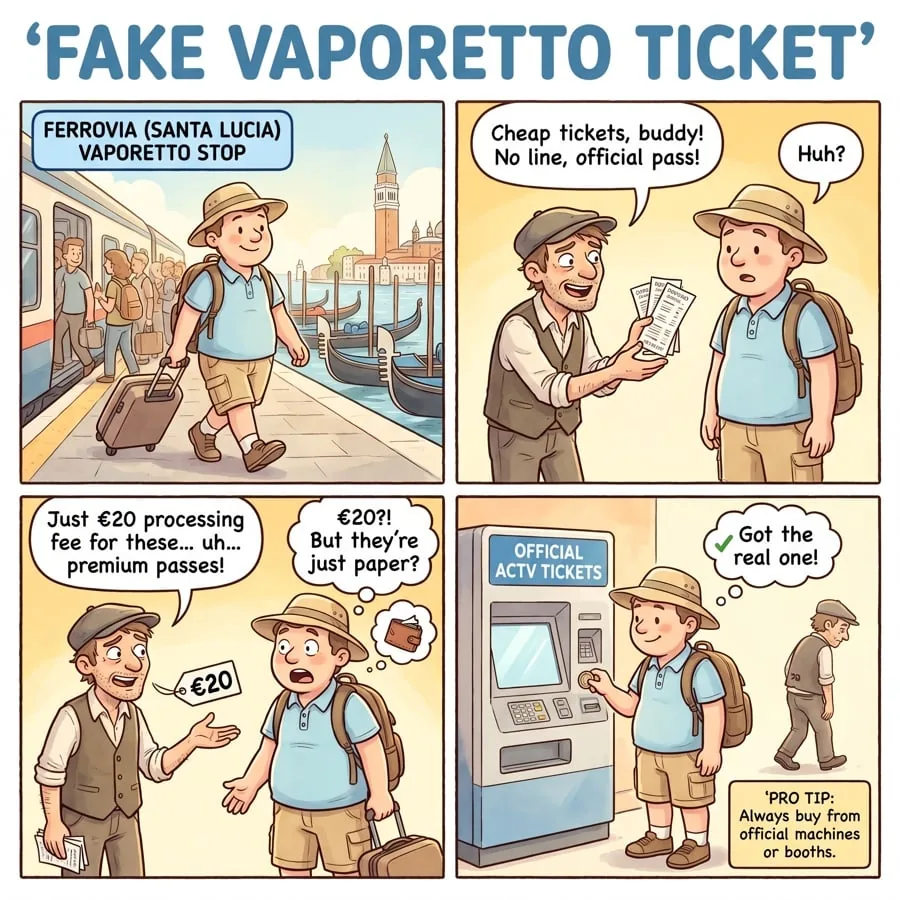
Friendly strangers near Ferrovia (Santa Lucia) and Piazzale Roma vaporetto stops sell "discounted" pre-loaded ACTV cards at €15, demonstrating a valid card on a terminal but handing over an expired or stolen one — the gate beeps red on the 2-line vaporetto to San Marco, and the ACTV inspector hands you a €60 fine; the official single-ride fare is €9.50, sold only at official ACTV booths or the app/website.
You've just dragged your luggage off the train at Santa Lucia station and you're staring at the confusing vaporetto ticket machines when a friendly man sidles up and offers to sell you a pre-loaded transit card at a slight discount. He flashes what looks like a valid ACTV card and even scans it at a terminal to 'demonstrate' it works. You hand over €15 and pocket the card, feeling clever for skipping the queue. The problem? As multiple Reddit users in traveler reports and traveler reports have warned, the card he showed you was valid — but the one he handed you is either a used card with expired credit, a counterfeit, or a card he'll report stolen later. When you tap at the gate for the 2-line vaporetto to San Marco, it beeps red. The inspector gives you a €60 fine, and the helpful stranger has long vanished into the crowded Ferrovia waterfront. Venice's transit scam is particularly insidious because the city's vaporetto system genuinely confuses first-time visitors. Scammers exploit the chaos around ticket machines, especially when lines are long during peak season. ACTV inspectors board boats randomly and are unsympathetic to "I bought it from someone" explanations. Buy vaporetto tickets only at official ACTV ticket booths or via their app/website (the official single-ride fare is €9.50; any "discount" from a stranger is a scam). Look for the blue ACTV logo and official branding on machines, and check the credit balance on a card before walking away. If in doubt, ask station staff (ACTV employees wear yellow/blue uniforms).
Red Flags
- Stranger approaches you unprompted near ticket machines or vaporetto stops
- Offers a 'discount' on transit cards that sounds too good to be true
- Demonstrates the card on a terminal but hands you a different one
- Rushes the transaction and won't let you inspect the card closely
- Card looks slightly worn or has a different logo than official ACTV cards
How to Avoid
- Buy vaporetto tickets only at official ACTV ticket booths or their app/website.
- The official single-ride fare is €9.50 — any 'discount' from a stranger is a scam.
- Look for the blue ACTV logo and official branding on machines.
- Check the credit balance on a card before walking away from any machine.
- If in doubt, ask station staff — ACTV employees wear yellow/blue uniforms.
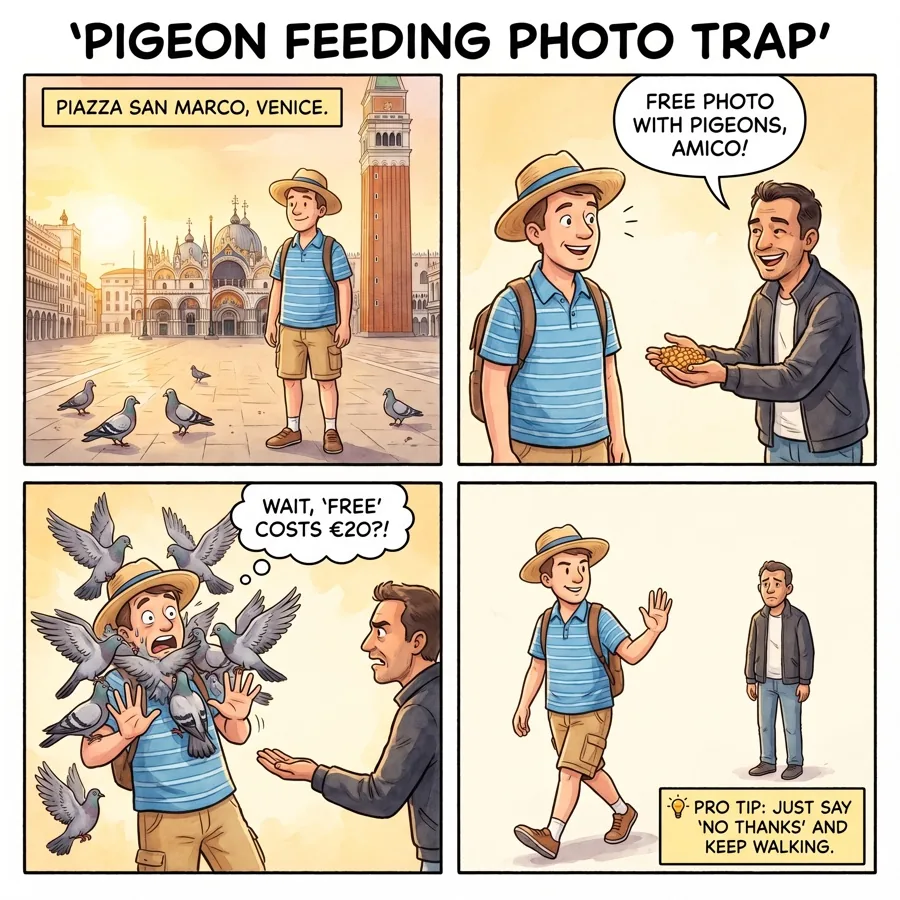
Piazza San Marco "grain men" in white aprons press grain into tourists' hands, encourage photos with pigeons landing on them, then pivot to demand a €20-per-person "fine" because feeding pigeons in Venice has been illegal since 2008 — the fine goes straight into the scammer's pocket; no official would ever collect a fine this way, and refusal is the simplest defense.
You're standing in the golden expanse of Piazza San Marco, taking in the Byzantine domes of the Basilica, when a man in a white apron approaches with a handful of grain and starts pressing it into your hands. 'Take picture! Free! Beautiful!' Before you know it, pigeons are landing on your arms, your shoulders, your head — it's genuinely chaotic and photogenic. Your travel partner snaps a dozen shots. Then comes the pivot. The man's smile flips off like a switch. He tells you that feeding pigeons in Venice is illegal — which it actually is, since 2008 — and that you owe him a fine. He quotes €20 per person. His accomplice is already beside your partner. Reddit users on traveler reports described this exact scenario: 'In Venice, Italians will put birds on your hand, give you feed, let you take a picture and act friendly, then tell you it's illegal and demand 20 euros.' While this scam rarely gets physically aggressive, it relies on social pressure and embarrassment. Tourists who just want the scene to end quietly pay up. The "fine" goes straight into the scammer's pocket — Italian law enforcement is not involved, and no official would ever collect a fine this way. Keep your hands in your pockets or crossed at your chest when walking through Piazza San Marco; firmly say "no, grazie" and keep walking if anyone approaches with bird food. Feeding pigeons has been illegal in Venice since 2008 — no one should be doing it. If caught in the situation, simply refuse to pay and walk toward any nearby police officer or Carabinieri patrol; real fines for tourist violations are issued via official documentation, never by random people on the street.
Red Flags
- Someone hands you grain or food for pigeons without you asking
- Pigeons suddenly land on you after grain is pressed into your hands
- The person mentions illegal activity after the pigeons arrive, not before
- They immediately demand cash payment for the 'fine'
- An accomplice appears to pressure your travel companion simultaneously
How to Avoid
- Keep your hands in your pockets or crossed at your chest when walking through Piazza San Marco.
- Firmly say 'No grazie' and keep walking if anyone approaches with bird food.
- Remember that feeding pigeons has been illegal in Venice since 2008 — no one should be doing it.
- If caught in the situation, simply refuse to pay and walk toward any nearby police officer.
- Real fines for tourist violations in Venice are issued via official documentation, never by random people on the street.
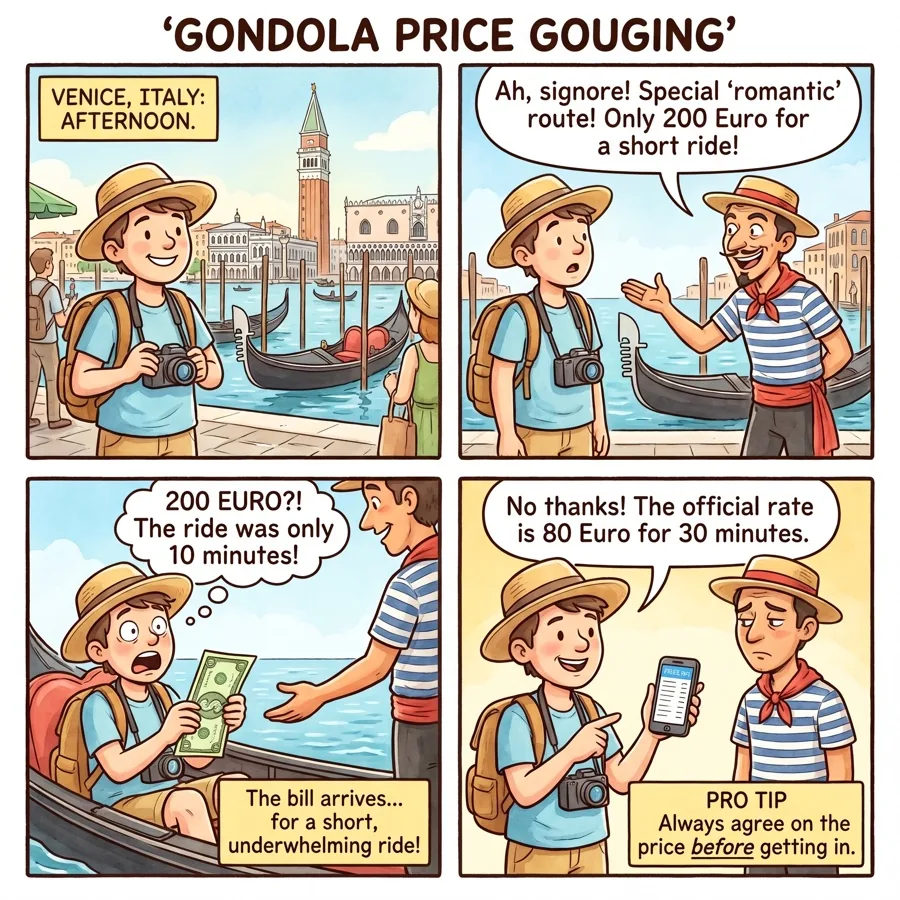
Unlicensed gondoliers off the official yellow/black-striped gondola stations quote €50 "tour" rides that are 20 minutes through a single back canal (the official rate is €80 for 30 minutes / €100 after 7pm, non-negotiable); they also impersonate the public traghetto Canal Grande crossing (real fare €2 at the proper stand) at €10–€15. Embark only from official stations with posted tariff boards and the gondolier's license medallion visible.
You've spent the afternoon wandering Venice's labyrinthine calli and you find yourself on the wrong side of the Canal Grande with no bridge in sight. A gondolier calls out from his bobbing black boat — '€50, I take you across, nice tour, 20 minutes!' He gestures grandly at the palazzi. You think: I'm in Venice, this is the experience. You step in. What he didn't mention clearly is that the official rate for a standard 30-minute gondola ride is €80 (rising to €100 after 7pm), and the 'nice tour' he described is actually a slow meander through a single back canal before he dumps you where you started — not where you wanted to go. Or he mentions a €20 supplement for the 'historic route.' Other Reddit users on traveler reports warned that unlicensed gondoliers sometimes operate near less-touristed areas where official tariff boards aren't posted. Note that the cheap traghetto gondolas that cross the Canal Grande at specific points are totally legitimate and cost just €2 — but scammers sometimes position themselves near these crossing points pretending to offer the same service at €10-15. The traghetto is a public service; pay at the proper stand, not from a man waving from his private gondola. Official gondola rates are fixed: €80 for 30 minutes (€100 after 7pm), non-negotiable. Embark only from official gondola stations identifiable by posted tariff boards and yellow/black-striped pylons; agree on the exact route, duration, and total price in writing before getting in. For a cheap Canal Grande crossing, use the official traghetto service for €2 at the proper stand, and check the gondolier's official license medallion on the boat (licensed gondoliers display their number).
Red Flags
- Gondolier doesn't clearly show you the official price board before you step in
- Price seems lower than the official €80 minimum — likely unlicensed
- No discussion of the route, duration, or any supplements before departure
- Gondolier is not at an official gondola station (identified by yellow/black stripes)
- Supplements for 'music' or 'special route' added after you're already in the gondola
How to Avoid
- Official gondola rates are fixed: €80 for 30 minutes (€100 after 7pm) — non-negotiable.
- Embark only from official gondola stations, identifiable by posted tariff boards.
- Agree on the exact route, duration, and total price in writing before getting in.
- For a cheap Canal Grande crossing, use the official traghetto service for €2.
- Check the gondolier's official license medallion on the boat — licensed gondoliers display their number.

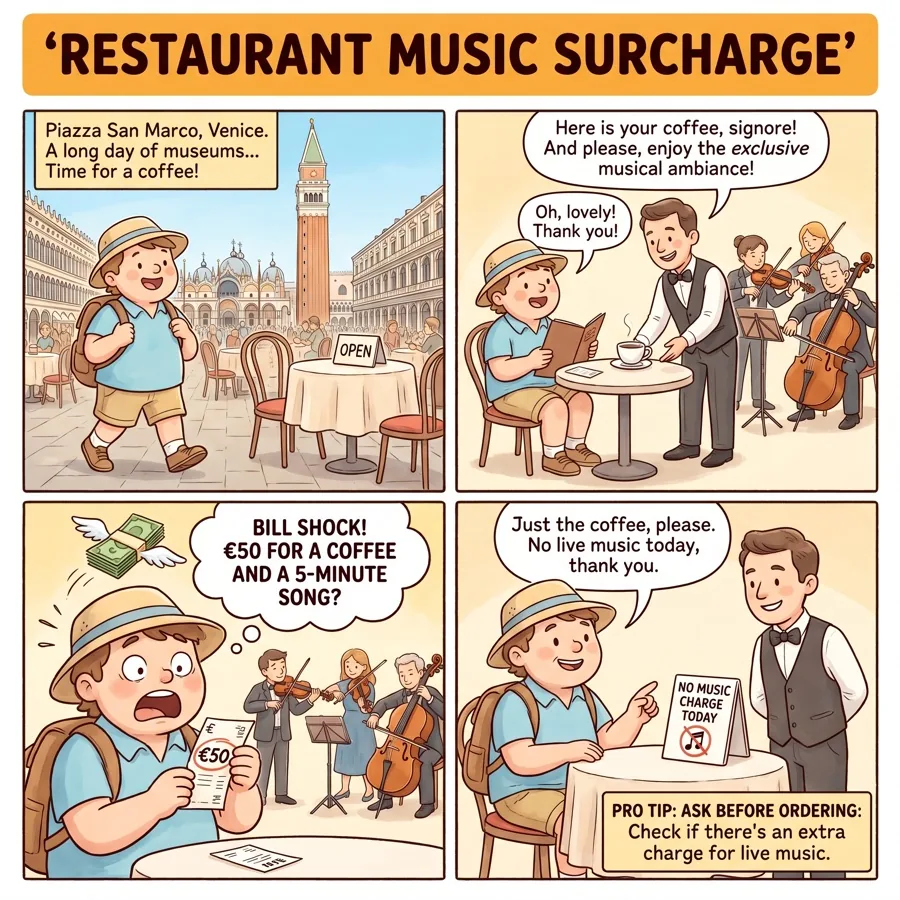
Piazza San Marco cafes (Caffè Florian and surrounding terraces) charge a €6–€10 per-person "music surcharge" for the orchestra (technically legal but in fine print), bring unrequested bread, pastries, and olives that are billable, and add a €3 coperto — turning a couple's espresso break into €30+; ask for the full menu with all charges before sitting, refuse unordered items immediately, and step inside any away-from-piazza bar for €1–€2 espresso.
After a long morning of museums, you collapse into a chair at one of the beautiful outdoor cafes ringing Piazza San Marco. The waiter brings your espresso and a small pastry without you asking. The orchestra is playing Vivaldi. It's romantic, it's Venice, it feels exactly right. Then the bill arrives. Your espresso is €6 (already pricey), but there's a €6 'music surcharge' added on top — for each person at the table. The small pastry you didn't order is €4. Add the cover charge (coperto) of €3 per person, and your couple's coffee break is €30+. Reddit users on traveler reports warned specifically about this: 'Read up on the restaurant scams in Venice. Ask about seating charges, and fish dishes sold by the gram — not always clear on the menu, but it will be on the bill.' The music surcharge at Piazza San Marco cafes is technically legal and disclosed — usually in very small print on the menu. But many tourists don't see it until the bill arrives. The real scam is unordered food that's brought automatically (bread, olives, pastries) that you're expected to pay for. In Italy, anything placed on your table can be charged unless you explicitly refuse it. Ask for the full menu with all charges listed before sitting down at any Piazza San Marco cafe; specifically ask "Is there a music surcharge?" — at Caffè Florian and surrounding terraces it's €6–€10 per person. Push away any food you didn't order immediately (if it reaches your stomach, it reaches your bill); check that menu prices match the bill before paying. For a normal espresso without surcharges, step inside any bar away from the piazza — prices drop to €1–€2.
Red Flags
- Waiter brings bread, pastries, or snacks you didn't order — they are chargeable
- Restaurant doesn't proactively mention the music surcharge when seating you
- No posted menu visible before you sit — or prices inside differ from outside display
- Coperto (cover charge) not disclosed before ordering
- Fish or seafood listed as 'market price' (prezzo al chilo) without a per-gram clarification
How to Avoid
- Ask for the full menu with all charges listed before sitting down.
- Specifically ask 'Is there a music surcharge?' at Piazza San Marco restaurants — it can be €6-10 per person.
- Push away any food you didn't order immediately — if it reaches your stomach, it reaches your bill.
- Check that menu prices match the bill before paying.
- For a normal espresso without surcharges, step inside any bar away from the piazza — prices drop to €1-2.
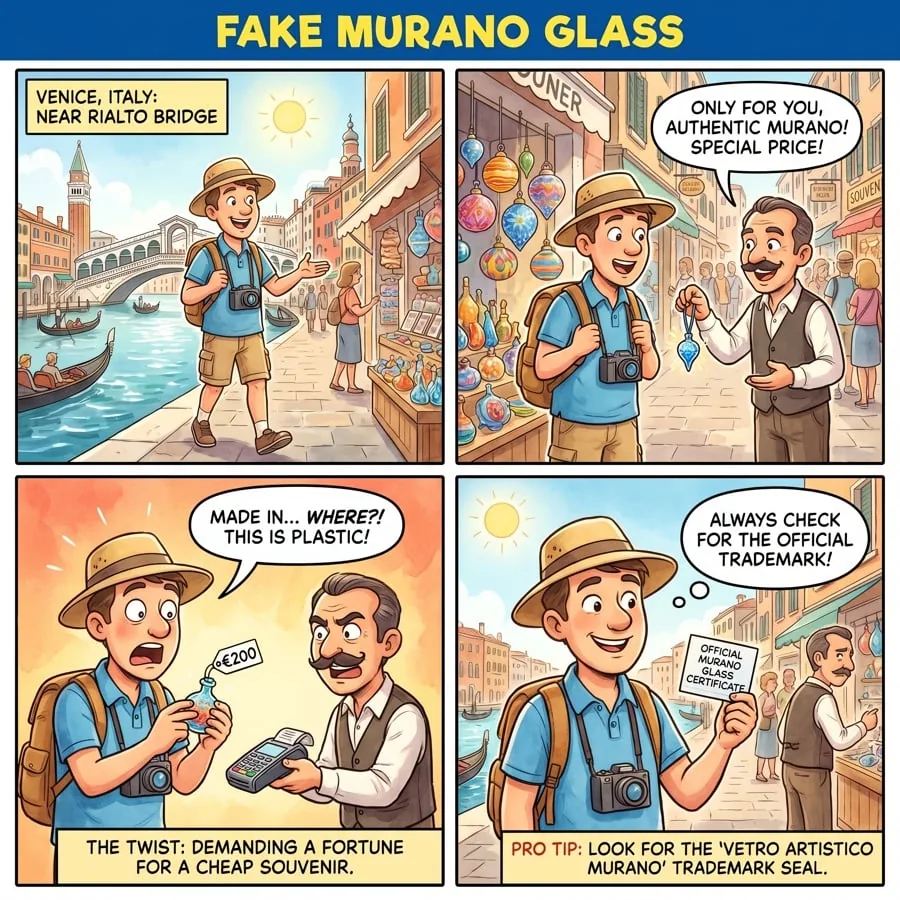
Tourist souvenir shops near the Rialto Bridge and Piazza San Marco sell "Murano Glass, Handmade" pieces at €45 that are mass-produced in China or Eastern Europe — authentic Murano glass costs €80+ minimum and carries the Vetro Artistico® Murano trademark sticker issued by the Consorzio Promovetro Murano (no sticker, no authenticity); take vaporetto Line 4.1 or 4.2 to Murano island and buy directly from glassblowing workshops with live demonstrations.
Murano glass — the handblown, colorful, expensive glass made on the nearby island of Murano since the 13th century — is genuine artisan craft. You spot a gorgeous glass horse in a shop window near the Rialto Bridge, labeled 'Murano Glass, Handmade' at €45. You ask the shopkeeper, who assures you it's authentic. You buy two. Back home, a friend who works in antiques breaks it to you gently: the cheap glass, the uniform bubbles, the slightly rough base — all signs of mass-produced glass from China or Eastern Europe. Authentic Murano glass is produced only on the island of Murano under strict regulations, and most pieces that look like artisan work cost €80 minimum. Reddit users in traveler reports noted wryly: 'Nobody has real Murano glass except me, in every store I went in.' The scam is perfectly legal — shops aren't technically required to prove where their glass is made — but it's a classic tourist trap. Real Murano glass has a 'Vetro Artistico® Murano' trademark sticker issued by the Consorzio Promovetro Murano. No sticker, no authenticity. Buy directly from glassblowing workshops on Murano island — take vaporetto Line 4.1 or 4.2 from Fondamenta Nove. Look for the "Vetro Artistico® Murano" trademark sticker on any piece, ask for a certificate of origin and the name of the Murano factory, and budget €80+ for even small genuine pieces. Watch a live glassblowing demonstration on Murano before buying — workshops that offer this are legitimate.
Red Flags
- Price seems surprisingly affordable for 'handmade' artisan glasswork (under €50 for significant pieces)
- No Vetro Artistico® Murano trademark sticker or certificate of authenticity
- Shopkeeper is vague about which artisan or factory produced it on Murano
- Shop is located far from the island of Murano itself
- Glass looks machine-uniform with no visible handcrafting irregularities
How to Avoid
- Buy directly from glassblowing workshops on Murano island — take the vaporetto Line 4.1 or 4.2.
- Look for the 'Vetro Artistico® Murano' trademark sticker on any piece you buy.
- Ask for a certificate of origin and the name of the Murano factory.
- Genuine Murano pieces cost significantly more than tourist shop prices — budget €80+ for even small items.
- Watch a live glassblowing demonstration on Murano before buying — workshops that do this are legitimate.
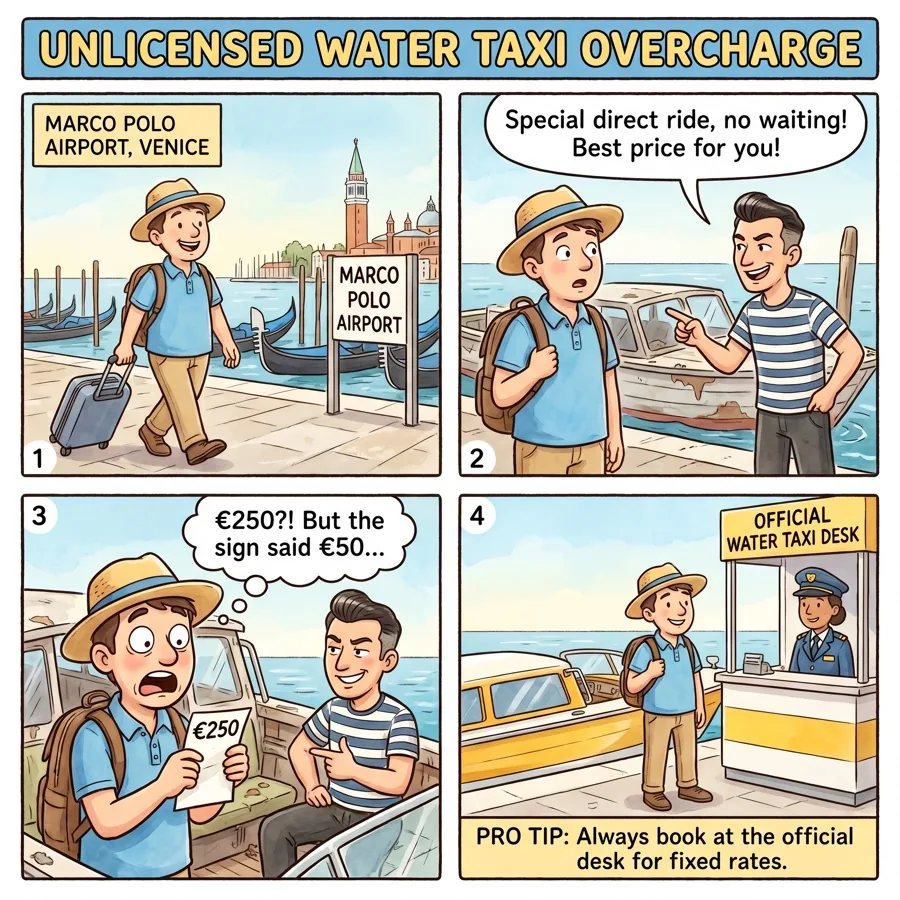
Marco Polo Airport and Ferrovia (Santa Lucia) station unlicensed water-taxi operators approach tourists with "€100 private boat" offers that bill per-person (so €200+ for 2 people) plus baggage fees — official Consorzio Motoscafi Venezia rates are €120–€140 for the entire boat (up to 4 with luggage); the Alilaguna public water bus is €15, and the Marco Polo airport bus to Piazzale Roma is €8 + vaporetto.
A smartly dressed man approaches near arrivals: 'Water taxi? €100, very fast, private boat, beautiful!' You're tired, you think that sounds about right for Venice, and you follow him to a gleaming wooden speedboat on the dock. The official licensed water taxi from the airport to Venice costs approximately €120-140 for the entire boat (up to 4 people with luggage), which is expensive but fixed. But unlicensed operators charge per person — so your 'deal' becomes €100 x 2 people = €200, with baggage fees added. Others report being quoted one price verbally, then handed a bill for double once at their hotel pier with your luggage already off the boat. Multiple travelers on traveler reports explicitly warned: 'I've heard you should avoid water taxis as they'll rip you off. Do NOT go with anyone who approaches you, offering a taxi.' Licensed taxis have a taximeter, display official rates, and operate from designated water taxi stands — the operators who approach you near baggage claim or train station exits are rarely the licensed ones. Use only official water taxis from licensed Consorzio Motoscafi Venezia stands, identifiable by official signage; the Alilaguna public water bus from Marco Polo Airport costs €15 (far cheaper than any taxi). Agree on the total fare in writing before boarding — have the driver show you the official rate card. Cheaper alternative: take the airport bus to Piazzale Roma (€8) then a vaporetto. If a price sounds low for a "private boat," ask why — legitimate drivers won't undercut the regulated minimums.
Red Flags
- Taxi operator approaches you inside the airport or station rather than waiting at the official stand
- No visible taximeter or rate card displayed in the boat cabin
- Price quoted verbally without written confirmation
- Driver quotes per-person rates rather than a flat boat rate
- Boat is not at an official Consorzio Motoscafi Venezia taxi station
How to Avoid
- Use only official water taxis from licensed Consorzio Motoscafi Venezia stands, identifiable by official signage.
- The Alilaguna public water bus from Marco Polo Airport costs €15 and is far cheaper than any taxi.
- Agree on the total fare in writing before boarding — have the driver show you the official rate card.
- Cheaper alternative: take the airport bus to Piazzale Roma (€8) then a vaporetto.
- If a price sounds low for a private boat, ask why — legitimate drivers won't undercut the official regulated minimums.
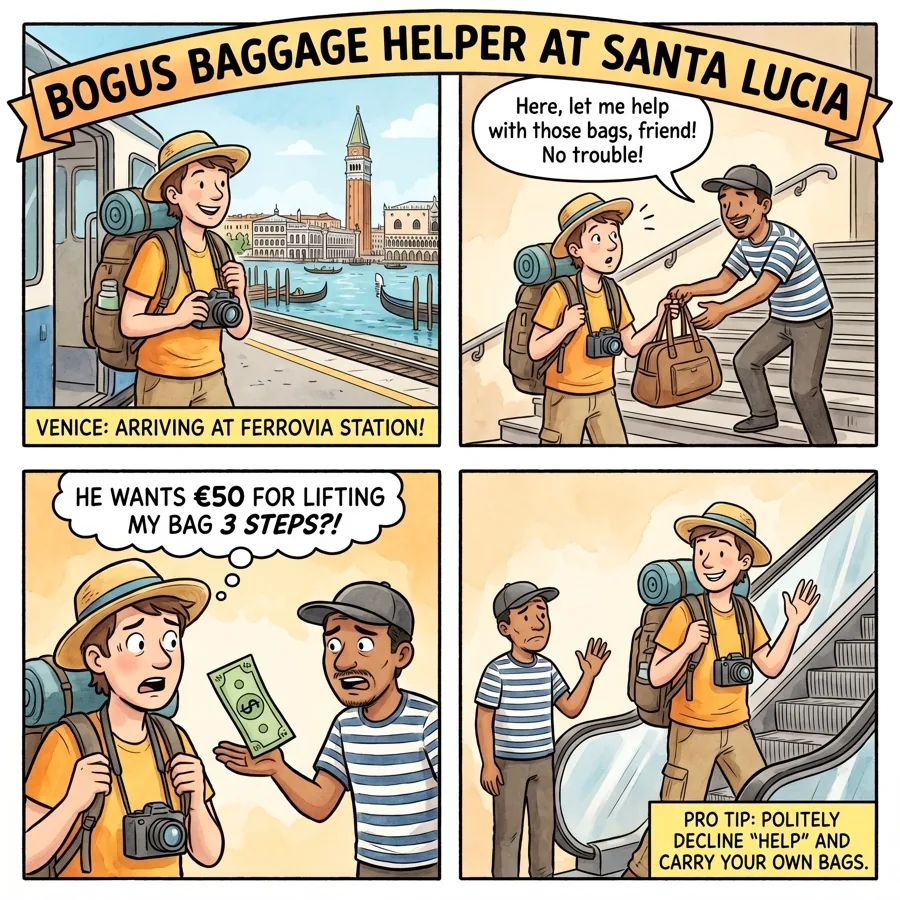
Venice Santa Lucia station "porters" without uniforms grab tourists' bags unsolicited, carry them down the famous station steps to the waterfront, then demand €20+ at the dock — Italian forums have documented this at Milan, Florence, and Venice for years. Official licensed porters wear orange vests with station IDs (Trenitalia uniforms); keep two hands on luggage at all times in and around the station, and say "no, grazie" firmly the moment anyone reaches for your bag.
You step out of Venice Santa Lucia station — and your first sight is the Grand Canal glittering right outside. You're distracted, juggling a map and a rolling suitcase, when someone grabs your bag and starts carrying it toward the exit. 'I help, I help!' They carry it down the famous station steps to the waterfront. It's helpful, it's Venice, you think nothing of it. At the bottom, they turn with an outstretched hand: '€20 tip, please.' You didn't ask for help. The 'service' was unsolicited. But now your bag is in their hands and they're blocking your path. Reddit and travel forums have documented this scam at Italian train stations for years: 'Be aware of scams by people in big train stations like Milan or Florence — they help tourists with luggage without asking permission and when the work is done they ask for money. I've seen American tourists give them €20.' The tactic targets people who look overwhelmed, especially those with multiple bags or elderly travelers. They move fast, grab before you can protest, and the short distance they carry your bag is enough to justify a demand. Station staff at Ferrovia wear official uniforms — these helpers do not. Keep two hands on your luggage in and around Santa Lucia station at all times. Say "no, grazie" firmly and loudly if anyone reaches for your bag uninvited; official licensed porters at Italian stations wear orange vests with official ID, and anyone else is unofficial. Move slowly and deliberately — fast-grab attempts depend on you being startled into compliance. If a "helper" already has your bag, refuse to follow them, plant yourself, and shout "Polizia!" — they\'ll drop the bag and leave rather than face the railway police (Polizia Ferroviaria) on patrol at every Trenitalia main station.
Red Flags
- Someone grabs your bag without asking your permission first
- They start moving quickly without waiting for your response
- No official porter uniform or station ID visible
- They specifically target the station steps where wheeled luggage is difficult
- Immediately after arriving at a destination point, they turn around demanding money
How to Avoid
- Keep two hands on your luggage in and around Santa Lucia station at all times.
- Say 'No grazie' firmly and loudly if anyone reaches for your bag uninvited.
- Official licensed porters at Italian stations wear orange vests with official ID — anyone else is unofficial.
- If someone grabs your bag and won't release it, call for station security (Polizia Ferroviaria) immediately.
- Use wheeled luggage appropriate for cobblestones — or pack light enough to carry yourself up the steps.
🆘 What to Do If You Get Scammed
📋 File a Police Report
Go to the nearest Carabinieri / Polizia di Stato station. Call 112 (Carabinieri) or 113 (Polizia). Get an official crime report — you'll need this for insurance claims. You can also report online at poliziadistato.it.
💳 Cancel Your Cards
Call your bank immediately. Most have 24/7 numbers on the back of the card (keep a photo saved separately). Block any suspicious transactions before the thieves use your details.
🛂 Lost Passport?
Contact your nearest embassy or consulate. The US Embassy in Rome is at Via Vittorio Veneto 121, 00187 Rome. For emergencies: +39 06-4674-1.
📱 Track Your Device
If your phone was stolen, use Find My (iPhone) or Find My Device (Android) from another device. Don't confront thieves yourself — share the location with police instead.
Frequently Asked Questions
You just read 7 scams in Venice. The book has 142 more across 20 Italian destinations.
Rome's tre-campanelle shell game. Venice's €2,500-a-day pickpocket ring. Florence's fake-leather trade. Capri's Blue Grotto fee-stack. Sardinia's €3,000 sand-in-your-luggage fine. Every documented Italy scam — with the exact scripts, red flags, and Italian phrases that shut each one down. Drawn from Repubblica, Corriere, Il Mattino, and Carabinieri arrest records.
- 149 documented scams across Rome, Venice, Florence, Milan & 16 more cities
- An Italian exit-phrase card you can screenshot to your phone
- Updated annually — buy once, re-download future editions free
- Readable in one flight — $4.99 on Amazon Kindle