
Key Takeaways
- The #1 reported scam is the Bracelet Tie Scam near the Duomo.
- 3 of 6 scams are rated high risk.
- Use app-based ride services (Uber, Bolt) or official metered taxis instead of unmarked vehicles.
- Never accept unsolicited offers from strangers near tourist sites in Milan.
⚡ Quick Safety Tips
- Keep phones and valuables in secure pockets when in crowded areas.
- Use only licensed taxis or app-based ride services.
- Book tours and tickets through verified operators with online reviews.
- Keep a copy of your passport separate from the original.
Jump to a Scam
The 6 Scams
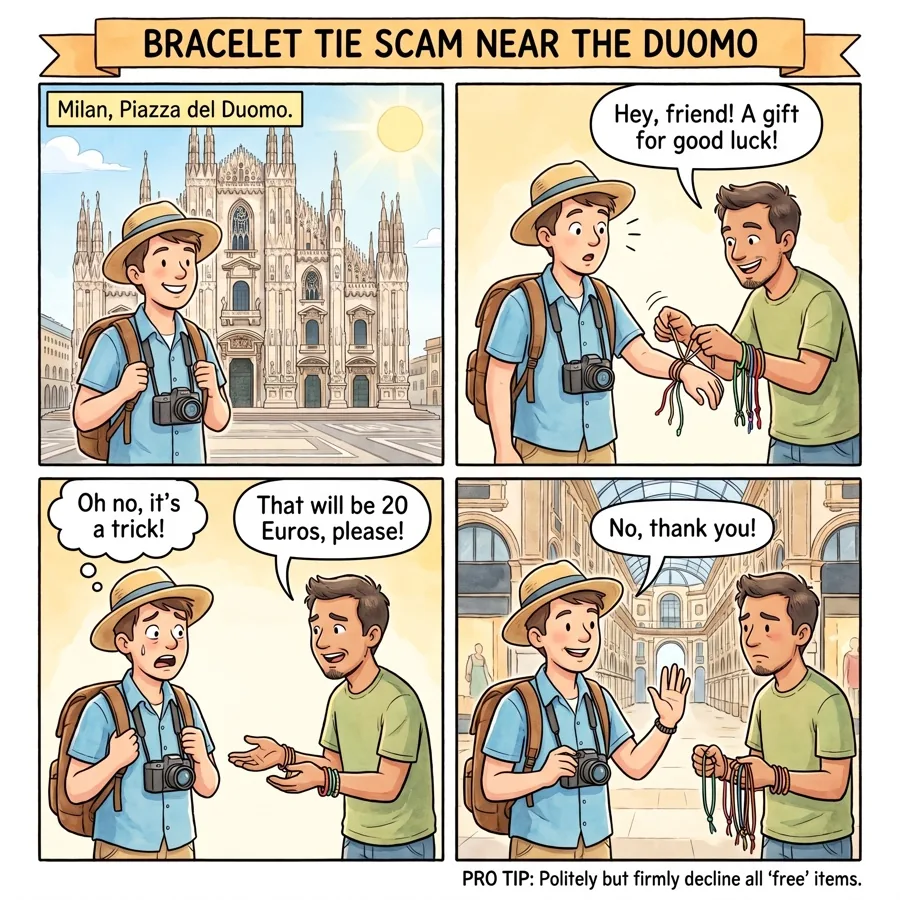
Milan Duomo bracelet-tie touts grab tourists' wrists with 'Gift from Africa! No pay!' then demand €5–€10 once knotted, while accomplices behind work bags during the distraction — Multiple travel safety reports rank the Duomo as one of Milan's highest-concentration pickpocket zones.
You're standing in Piazza del Duomo taking in its thousands of marble spires when a man smiling broadly steps toward you. Before you can react, he's grabbed your wrist and is weaving a knotted string bracelet around it with practiced speed, chatting warmly about where you're from. 'Gift! Gift from Africa! No pay!' He finishes the knot with a theatrical flourish.
Then the smile disappears. 'Just 5 euros,' he says. Then 10. One traveler described the exact scenario: 'A guy came up complimenting me, asked if he could give me a knotted bracelet thing, and by the time he finished, he wouldn't leave me alone — kept asking for a tip. Jokes on him, I only had €2.' The bracelet can't easily be removed quickly, which creates social pressure — you look rude walking away with his work on your wrist.
While the bracelet itself isn't valuable and the amounts demanded are small, the real risk is the accomplice standing behind you while you're distracted. Multiple travel-safety reports rank the Duomo as one of Milan's highest-concentration pickpocket zones, and the bracelet vendor's job is often to keep your hands occupied while a partner works your bag. Keep hands in pockets when walking past groups of vendors near the Duomo, say 'No grazie' firmly without stopping or making eye contact, and if a bracelet has already been tied just untie or cut it — you owe nothing for an unsolicited 'gift.' Wear a cross-body bag clasped in front. Walk with purpose and don't stop near the Duomo's main facade where vendors concentrate.
Red Flags
- Someone touches your wrist or arm without your permission near tourist sites
- They claim the item is a 'free gift' before you've agreed to anything
- Works very quickly, completing the bracelet before you can process what's happening
- Friend or partner stands unusually close behind you during the interaction
- Insists on at least a 'tip' once the bracelet is secured, escalating the amount
How to Avoid
- Keep hands in pockets when walking past groups of vendors near the Duomo.
- Say 'No grazie' firmly without stopping or making eye contact — do not engage.
- If a bracelet has already been tied, simply untie it or cut it — you owe nothing for an unsolicited gift.
- Wear a cross-body bag clasped in front of you to prevent pickpocketing during the distraction.
- Walk with purpose and don't stop near the Duomo's main facade where vendors concentrate.
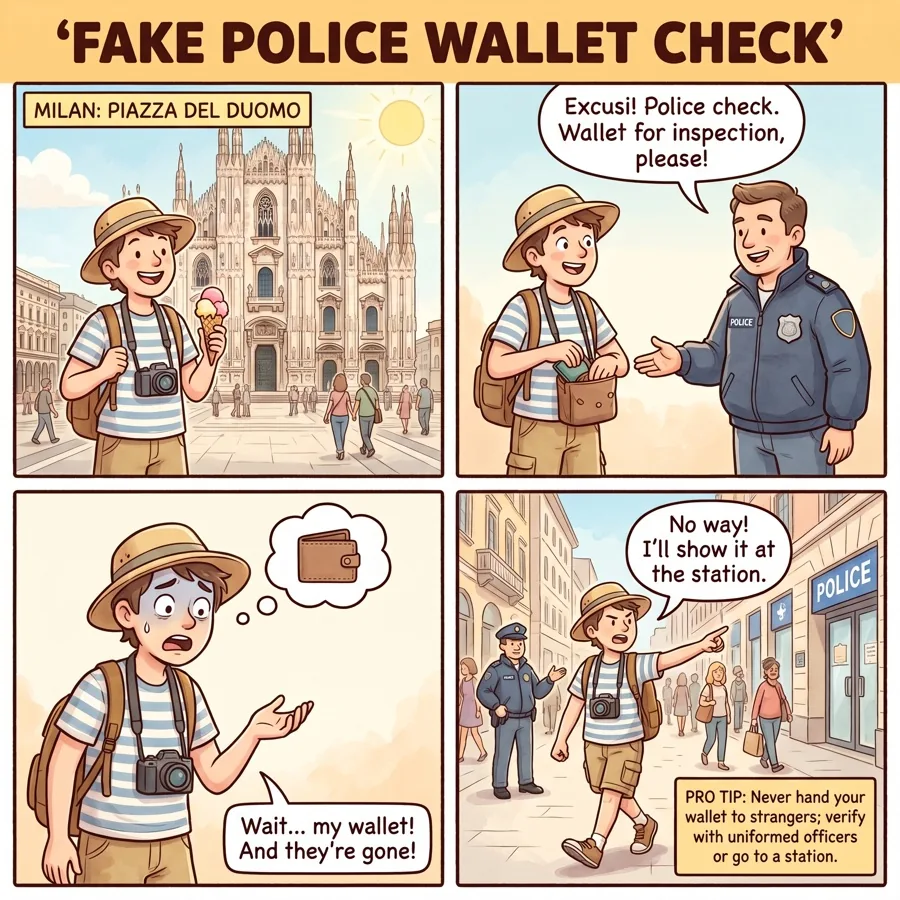
Milan Duomo and Corso Vittorio Emanuele II 'plainclothes police' run a counterfeit-currency wallet-check scam with a 'friendly stranger' accomplice — real Polizia di Stato never inspect tourist wallets on the street, and asking for a badge number plus Commissariato escort dissolves the scam.
You've just had a gelato near the Duomo and you're browsing a souvenir stall when a friendly stranger strikes up a conversation — he's visiting from France, he says, and asks for a restaurant recommendation. Two minutes later, two men in plain clothes appear, flashing what looks like a police badge. 'Polizia. Controllo.' Drug check. Could you show your wallet so they can verify you're not carrying counterfeit euros?
The stranger you were chatting with complies easily — it's part of the setup. You comply too. One officer holds your wallet briefly while the other 'checks your ID.' When you get your wallet back, the cash is gone — not all of it, just enough that you might not notice immediately. One traveler-community thread on Italy scams noted this explicitly: 'Fake police — people who claim to be police and ask to see your wallet to check for counterfeit currency. If you don't hand it over, they may threaten a fine.'
Real Italian police (Polizia di Stato or Carabinieri) wear uniforms or clearly show their badge number and Commissariato. They never ask to inspect your wallet on the street for 'counterfeit checks.' Always ask any plainclothes officer for their badge number (numero di matricola) before showing anything, and insist on going with them to the nearest Commissariato for any check — real officers accept this, and the fake officers walk away. Keep only what you need in your wallet; leave large amounts secured at your hotel. If targeted, don't panic — be firm, ask for ID, and move toward any uniformed police officer nearby.
Red Flags
- Plainclothes individuals claiming to be police approach after you've been chatting with a 'friendly stranger'
- They request to see your wallet or examine your cash rather than just ID
- Unable or unwilling to provide their badge number when asked
- Refuse your request to accompany them to the nearest police station
- The 'friendly stranger' you were talking to cooperates immediately — he's the accomplice
How to Avoid
- Real Italian police never check tourist wallets on the street for counterfeit currency.
- Always ask plainclothes officers for their badge number (numero di matricola) before showing anything.
- Insist on going to the nearest police station (Commissariato) for any check — real officers accept this.
- Keep only what you need in your wallet; leave large amounts secured at your hotel.
- If targeted, don't panic — be firm, ask for ID, and move toward any uniformed police officer nearby.
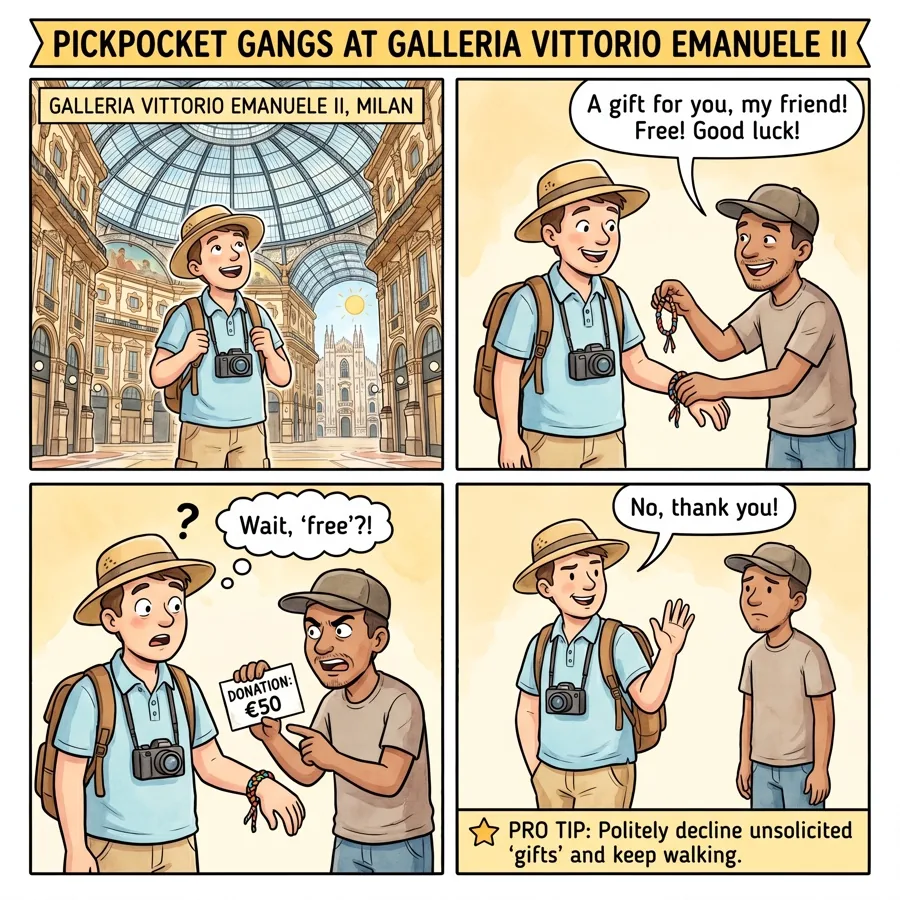
Galleria Vittorio Emanuele II and the Duomo/Cadorna metro stations rank among Italy's highest-theft locations per Euronews's 2024 European pickpocket study — teams of two or three work jostle-extract-handoff sequences, with phone-snatching from on-street users increasingly common.
You're inside the Galleria Vittorio Emanuele II — a 19th-century iron-and-glass arcade connecting the Duomo to La Scala opera house. It's always packed with tourists gawking at the mosaic floors and the luxury boutiques. You're looking up at the octagonal cupola when you feel the slight jostle of someone brushing past you. Nothing. You move on.
An hour later at a café, you reach for your phone to pay and it's not there. Neither is your wallet. Euronews's 2024 study of European pickpocket hotspots ranked the Duomo di Milano and its surrounding Galleria among Italy's highest-theft locations based on travel-review data. Teams of two or three work the crowd: one creates a bump or distraction, one extracts the item, and a third acts as a lookout or receives the stolen goods so the first person is clean if stopped.
The metro stations Duomo and Cadorna, used by most tourists heading to the center, are particularly notorious. Traveler-community reports repeatedly warn: 'Pickpocketing is a bit common in Milan — if you are vigilant you won't land in trouble.' Phone-snatching, where a thief grabs your device while you're using it on the street, is increasingly common. Use a cross-body bag with the zipper facing your body — never back pockets or loose jacket pockets — hold your phone with both hands and put it away completely when not actively using it, and on metro platforms stand with your back to a wall or pillar rather than in the middle of crowds. Avoid wearing expensive visible jewelry or watches in and around the Galleria. Distribute valuables — cash in one place, cards in another, phone secured separately.
Red Flags
- Unusual jostling or bumping in crowded areas of the Galleria or metro platforms
- Someone drops something in front of you and asks you to help pick it up
- Groups of young people surrounding you or blocking your path on a metro platform
- Someone distracts you by pointing at something or asking a question while touching your arm
- Anyone standing unusually close behind you in a non-crowded area
How to Avoid
- Use a cross-body bag with zipper facing your body — never back pockets or loose jacket pockets.
- Hold your phone with both hands and put it away completely when not actively using it.
- On metro platforms, stand with your back to a wall or pillar rather than in the middle of crowds.
- Avoid wearing expensive visible jewelry or watches in and around the Galleria.
- Distribute valuables — cash in one place, cards in another, phone secured separately.

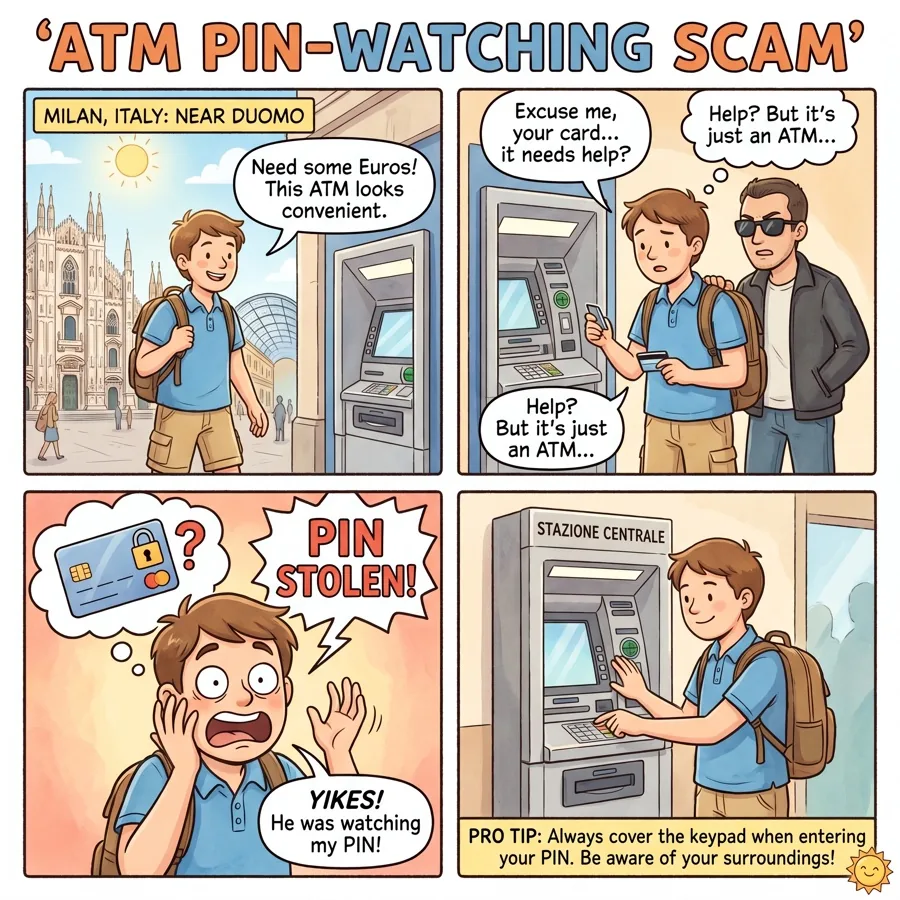
Milan ATMs near Duomo, Stazione Centrale, and Brera attract 'machine-broken, can you help me?' PIN-watching teams plus close-standing 'helpful' strangers who observe from the side — Stazione Centrale is especially targeted because travelers need cash on arrival and are distracted by luggage.
You need cash and you spot an ATM near the Duomo. A group of young women is hanging around the machine looking confused. One approaches you and says the machine is broken and she can't get it to work — could you show her how? She watches carefully as you insert your card and enter your PIN. You help her (she 'can't get it to work' even with your guidance), and you walk away. She's memorized your PIN.
Twenty minutes later, someone bumps into you and takes your wallet. With your card and your PIN, they drain your account before you realize anything has happened. One traveler-community Italy advice post from 2025 explicitly described it: 'One trick is a bunch of girls trying to get cash who tell you the machine is broken. When you try, they watch carefully to see your PIN and also where you keep your card.'
A variant involves a 'helpful' stranger who stands very close while you use the ATM, supposedly waiting for their turn. They observe your PIN from the side and may then bump you or distract you moments later. Stazione Centrale's ATM area is particularly targeted because travelers often need cash immediately upon arrival and are distracted by luggage. Shield the keypad with your entire hand and body when entering your PIN — every time, no exceptions — never help strangers with ATM machines (this is always a setup), and use ATMs inside bank branches or shopping malls rather than street-facing machines. Keep your card and PIN in separate mental compartments — a stolen card is useless without the PIN. Set a daily ATM withdrawal limit with your bank before traveling.
Red Flags
- People loitering around ATMs who aren't queuing normally
- A stranger asks you to help them with the machine before you've completed your own transaction
- Someone stands unusually close behind you while you enter your PIN
- Anyone who claims the machine 'doesn't work for them' and asks you to demonstrate
- Approaching groups near ATMs that seem too interested in other users' transactions
How to Avoid
- Shield the keypad with your entire hand and body when entering your PIN — every time, no exceptions.
- Never help strangers with ATM machines — this is always a setup.
- Use ATMs inside bank branches or inside shopping malls rather than street-facing machines.
- Keep your card and your PIN in separate mental compartments — a stolen card is useless without the PIN.
- Set a daily ATM withdrawal limit with your bank before traveling to minimize potential losses.
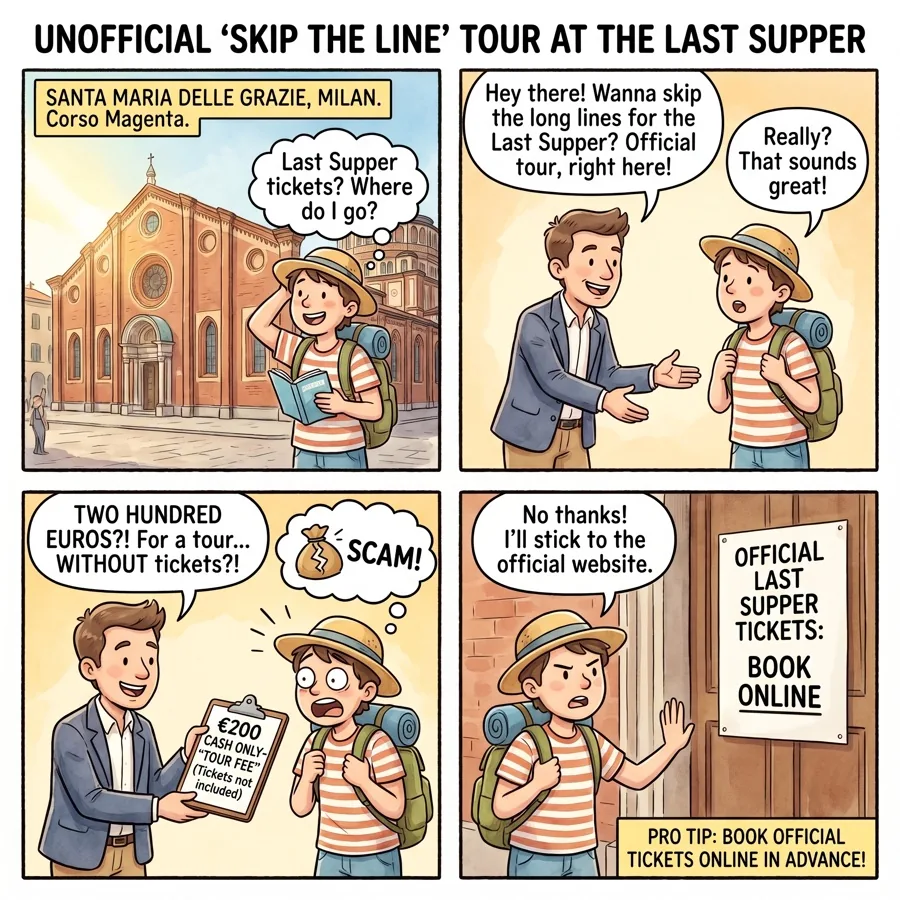
Santa Maria delle Grazie 'private group with two extra spots' touts sell counterfeit or 3× overpriced Last Supper tickets at €45+ when official cenacolo.it tickets are €15 + €2 booking fee — Last Supper sells out months in advance and any door-to-door 'last-minute' offer is fraud.
You're standing outside Santa Maria delle Grazie trying to figure out the booking situation for Leonardo's Last Supper. Tickets online are sold out months in advance — you didn't know. A man in a business-casual outfit approaches: 'I have private group with two extra spots. Last Supper, 30 minutes. €45 per person.' You're desperate to see it. You pay.
In the better version of this scam, you do get inside but pay three times the legitimate ticket price (€15) for access that you could have booked through the official website. In the worse version, the tickets are counterfeit, you're turned away at the door, and the man is gone. Traveler-community sources repeatedly warn: 'Ignore everyone claiming to be a tour guide or selling tickets until you find the actual ticket booth. The Vatican version is the same — everyone outside is overpriced; the rest are scammers.'
Official Last Supper tickets sell out months in advance at cenacolo.it and cost €15 plus a €2 booking fee. Any 'last-minute' ticket at a door-to-door premium is either wildly overpriced (legitimate but unethical resale) or outright counterfeit. Book Last Supper tickets months in advance at the official site (cenacolo.it) — and if tickets are sold out, accept it rather than buying from strangers outside the church. Many excellent guided tours of Milan include Last Supper viewing booked in advance — use these instead. If you must buy at the last minute, verify any ticket at the official entrance before handing over cash.
Red Flags
- Someone approaches you outside the church offering tickets they 'happen to have'
- Price is significantly higher than the official €15 + €2 booking fee
- They won't take you to the official ticket booth and insist on a street exchange
- Claim of 'private group' access or a 'connection' inside — this is never how it works
- Pressure to pay immediately before you can research or compare
How to Avoid
- Book Last Supper tickets months in advance at the official site: cenacolo.it.
- If tickets are sold out, accept it — do not buy from strangers outside the church.
- Legitimate resellers exist but charge premiums of 200-400% — book officially or not at all.
- Many excellent guided tours of Milan include Last Supper viewing booked in advance — use these instead.
- If you must buy at the last minute, verify any ticket at the official entrance before handing over cash.
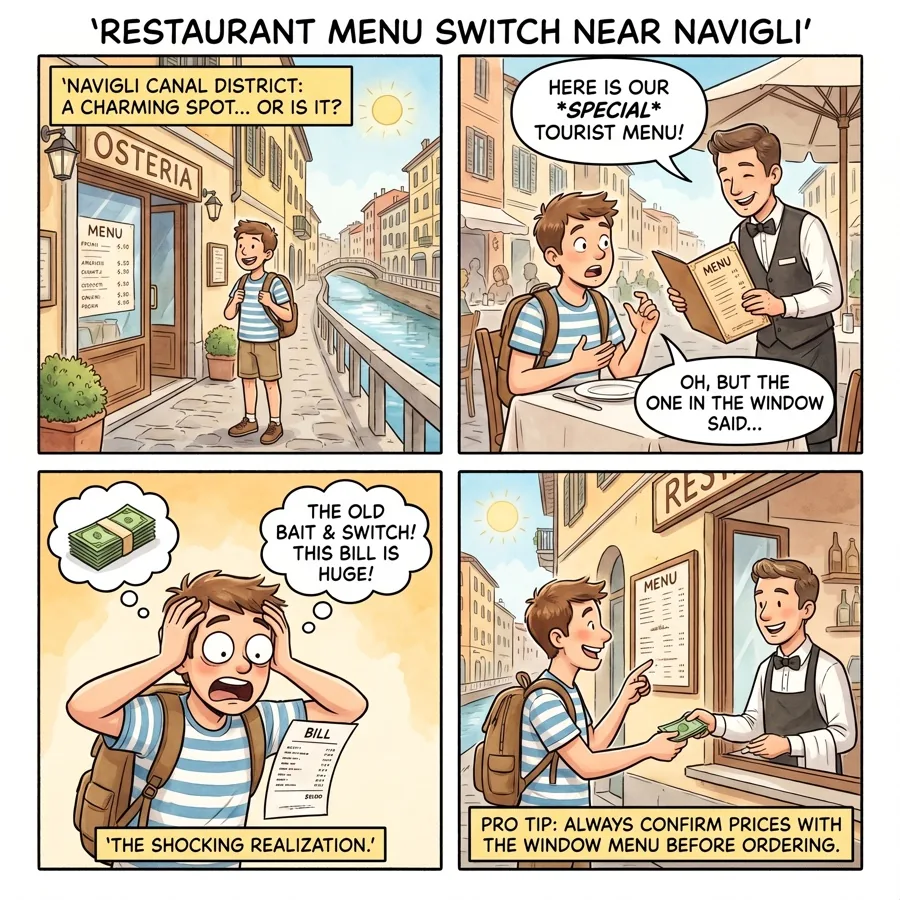
Navigli, Brera, Corso Como, and Duomo-area tourist osterie swap window menus (€12 pasta, €15 carafe wine) for inside menus at €18 and €22, or take orders verbally with no written menu — the coperto must be on the menu by Italian law and bread/water can be refused.
You've found a cute canal-side osteria on the Naviglio Grande and the menu in the window shows pasta at €12 and a house wine at €15 per carafe. You sit down and the waiter hands you a different menu — the inside menu — where the same pasta is €18 and wine is €22. Or perhaps they don't give you a menu at all and just take your order verbally, then present a bill far higher than expected.
One traveler-community commenter described the Florence variant of this classic Italian scam — being charged €15 per gelato after a verbal quote of €4 — and the Navigli has earned a reputation for similar restaurant bill manipulation. The coperto (cover charge) is legal in Italy but must be disclosed on the menu; it typically runs €2–€4 per person. Bread, olive oil, and bottled water placed on the table automatically are also chargeable unless you refuse them.
Not every restaurant in Milan pulls this, and the Navigli has many genuinely excellent spots. But the neighborhoods most heavily trafficked by tourists — including areas around Corso Como and near the Duomo — have a higher concentration of restaurants that optimize for one-time tourist visits rather than repeat local business. Always review the menu with prices before sitting down (the menu outside may not match the menu inside), ask about the coperto explicitly when seated, and refuse bread and bottled water with 'No pane, no acqua' if you don't want to pay for them. Check your bill line by line before paying — math 'errors' and unauthorized items are common. In Navigli, walk a few streets from the canal edge for local-facing restaurants with better prices.
Red Flags
- Menu in window differs from the menu handed to you inside (different prices or items)
- Waiter takes your verbal order without providing a written menu with prices
- Bread, water, and olives placed on the table before you've ordered anything
- Coperto charge not mentioned when you're seated
- Bill arrives with items you don't remember ordering
How to Avoid
- Always review the menu with prices before sitting down — menus outside may not match inside.
- Ask the price of everything verbally if no written menu is provided, and ask about the coperto.
- Refuse bread and bottled water if you don't want to pay for them — say 'No pane, no acqua.'
- Check your bill line by line before paying — math 'errors' and unauthorized items are common.
- In Navigli, walk a few streets from the canal edge for local-facing restaurants with better prices.
🆘 What to Do If You Get Scammed
📋 File a Police Report
Go to the nearest Carabinieri / Polizia di Stato station. Call 112 (Carabinieri) or 113 (Polizia). Get an official crime report — you'll need this for insurance claims. You can also report online at poliziadistato.it.
💳 Cancel Your Cards
Call your bank immediately. Most have 24/7 numbers on the back of the card (keep a photo saved separately). Block any suspicious transactions before the thieves use your details.
🛂 Lost Passport?
Contact your nearest embassy or consulate. The US Embassy in Rome is at Via Vittorio Veneto 121, 00187 Rome. For emergencies: +39 06-4674-1.
📱 Track Your Device
If your phone was stolen, use Find My (iPhone) or Find My Device (Android) from another device. Don't confront thieves yourself — share the location with police instead.
Frequently Asked Questions
You just read 6 scams in Milan. The book has 143 more across 20 Italian destinations.
Rome's tre-campanelle shell game. Venice's €2,500-a-day pickpocket ring. Florence's fake-leather trade. Capri's Blue Grotto fee-stack. Sardinia's €3,000 sand-in-your-luggage fine. Every documented Italy scam — with the exact scripts, red flags, and Italian phrases that shut each one down. Drawn from Repubblica, Corriere, Il Mattino, and Carabinieri arrest records.
- 149 documented scams across Rome, Venice, Florence, Milan & 16 more cities
- An Italian exit-phrase card you can screenshot to your phone
- Updated annually — buy once, re-download future editions free
- Readable in one flight — $4.99 on Amazon Kindle