
Key Takeaways
- The #1 reported scam is the Friendship Bracelet Trap.
- 1 of 6 scams are rated high risk.
- Use app-based ride services (Uber, Bolt) or official metered taxis instead of unmarked vehicles.
- Never accept unsolicited offers from strangers near tourist sites in Florence.
⚡ Quick Safety Tips
- Keep hands in pockets near the Duomo and Ponte Vecchio — bracelet scammers will try to grab your wrist and tie one on before you react.
- Walk one or two streets away from major sights for restaurants — tourist-facing places near Piazza della Repubblica routinely add hidden cover charges.
- On ATAF buses (especially lines 1 and 7), keep phones and wallets in front pockets — organized pickpocket teams work these routes daily.
- Watch your step near the Uffizi — street vendors lay paintings in walkways hoping you'll step on one and pay for 'damage.'
Jump to a Scam
The 6 Scams
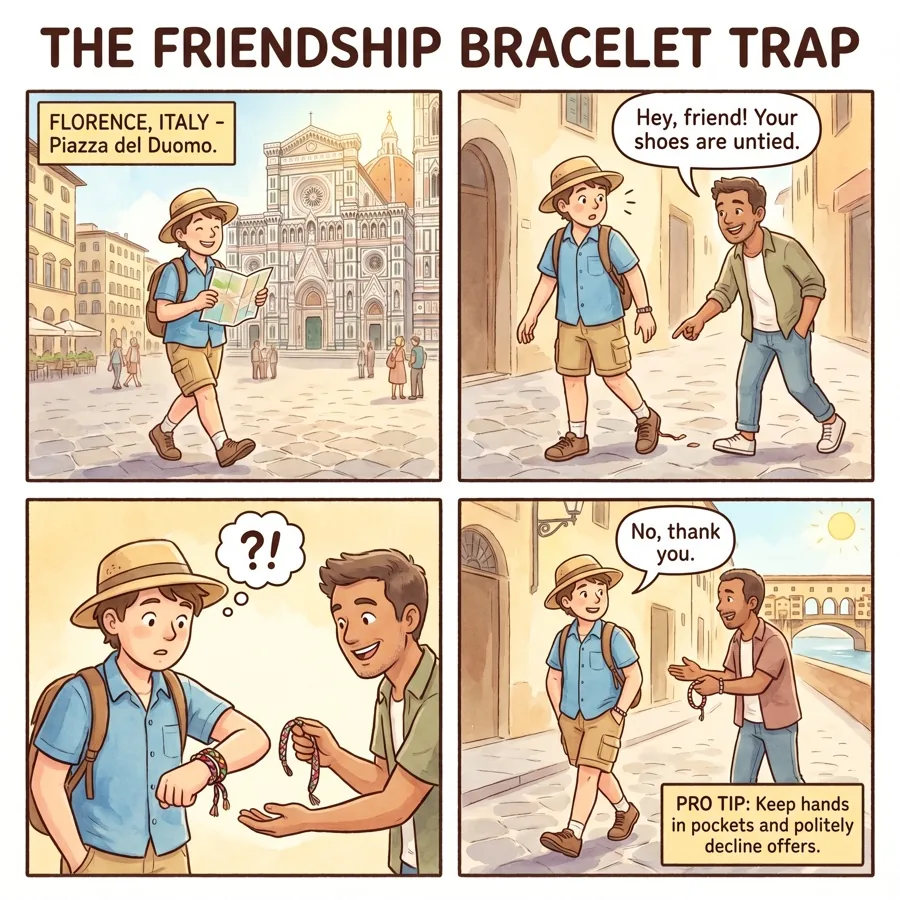
Friendship-bracelet scammers near the Duomo and Ponte Vecchio say your shoes are untied to get you to look down, then slip a woven bracelet onto your wrist as a "gift" and demand €10–€20 — confederates appear if you refuse, and Florence's narrow tourist alleys make exit awkward.
Florence's central tourist corridor — the Piazza del Duomo, Ponte Vecchio, and the streets connecting them — concentrates millions of visitors into a tight pedestrian zone every summer, and the friendship-bracelet scam is the city's most persistent and well-documented tourist scam.
The mechanic: a man approaches with a colorful woven bracelet in hand, often opening with "your shoes are untied" or "do you speak English?" to break your rhythm. As you glance down, he slips the bracelet onto your wrist and calls it a "gift." He then aggressively demands €10–€20 payment and won't let you easily walk away. Confederates often appear from nearby — adding social pressure that makes refusal feel risky. Variants include "free rose for the lady" handed to a partner who feels socially obligated, and "lucky bracelet" pitches at the Ponte Vecchio that escalate if challenged.
For older travelers near the Duomo, Ponte Vecchio, and central Florence, the defensive playbook: (1) keep hands in pockets and walk with purpose through tourist zones — visible pace deters approaches; (2) say "no grazie" firmly without breaking stride; do not engage in conversation; (3) if a bracelet gets put on your wrist, take it off immediately and drop it — they almost never chase; (4) refuse "gift" framings entirely; in Italian street culture, nothing is genuinely "free" from a stranger near a monument; (5) keep your wallet in a front zipped pocket or money belt — the bracelet distraction often pairs with an accomplice's pickpocket attempt; (6) report aggressive harassment to Polizia di Stato (113) or Carabinieri (112). Walk through the Duomo and Ponte Vecchio corridor with hands in pockets and purposeful pace — refuse every "your shoes are untied" or "do you speak English?" opener with a firm "no grazie" without breaking stride. If a bracelet is slipped onto your wrist, IMMEDIATELY remove it and drop it on the ground; do NOT pay. Keep your wallet in a front zipped pocket or money belt — the bracelet pairs with pickpocket accomplices. Report aggressive harassment to Polizia di Stato (113) or Carabinieri (112).
Red Flags
- Unsolicited 'gifts' from strangers
- Overly friendly approach in tourist zones
- Physical contact without consent
How to Avoid
- Keep hands in pockets and walk with purpose near tourist sights.
- Simply say 'no grazie' firmly and keep moving.
- If a bracelet gets put on you, take it off immediately and drop it — they usually won't chase.
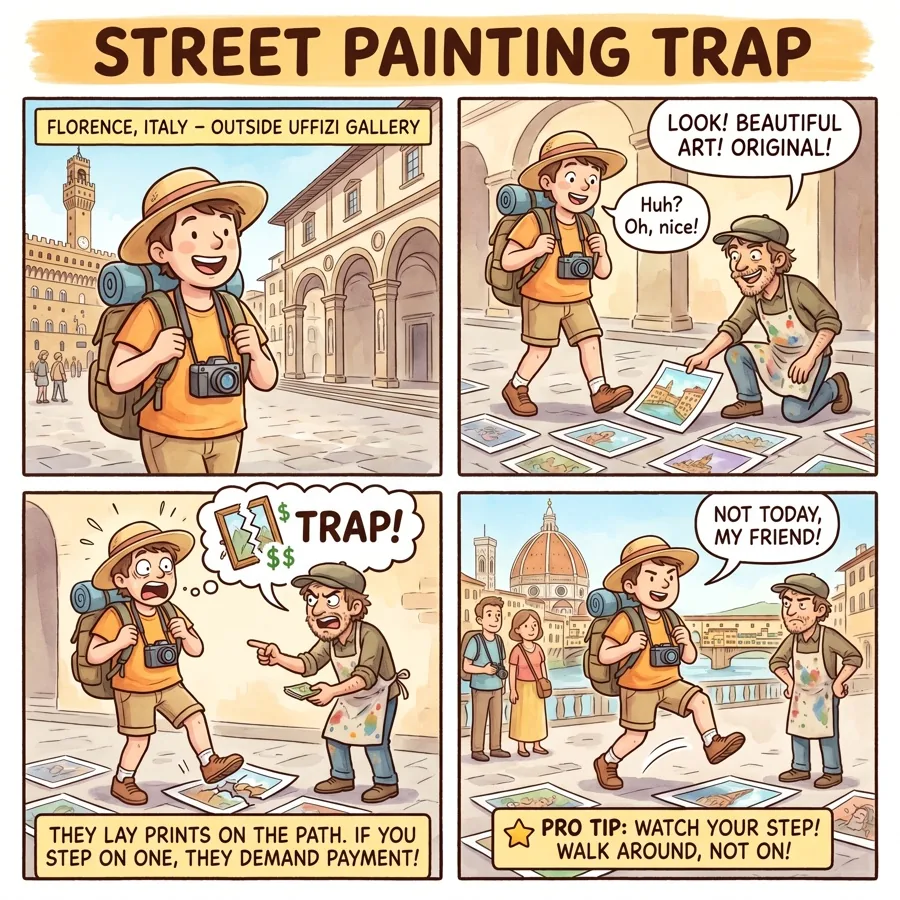
"Street artists" outside the Uffizi and on Piazza della Signoria deliberately place cheap digital prints in walkways, then dramatically accuse older tourists who step on them of destroying "expensive artwork" worth €50+ — the prints cost €1–€2 to produce, and licensed Florence vendors never lay artwork on the ground in foot traffic.
Florence's Piazza della Signoria and the Uffizi Gallery exterior are the city's most heavily trafficked tourist photo zones. The combination — cobblestone surfaces, distracted phone-holding tourists, and dense pedestrian flow — supports a small but consistent street-painting trap industry that targets older visitors specifically.
The mechanic: a "street artist" lays cheap inkjet prints or low-quality paintings on the walkway, deliberately positioned in pedestrian flow. The artist watches from nearby but feigns inattention. If you step on or near one, they rush over yelling about you destroying their "expensive artwork" — demanding €50 or more in cash compensation. The prints typically cost €1–€2 to produce; the entire stack of "destroyed" art is worth less than the demanded payment for one piece. Real licensed Florence street vendors stand at fixed stalls with proper Comune di Firenze permits and never lay artwork on busy walkways.
For older travelers near the Uffizi, Piazza della Signoria, or other Florence tourist plazas, the defensive playbook: (1) watch your step carefully near outdoor "art displays" — the placement is the signal; (2) if accused of destroying artwork, do NOT engage, apologize, or pay — say firmly "no grazie" and walk briskly toward a visible Polizia or Carabinieri patrol; (3) any legitimate artwork claim goes through proper insurance channels with police involvement, never cash on the street; (4) for genuine Florence art purchases, buy from Galleria d'Arte stallholders at the Mercato Nuovo (Loggia del Porcellino) with posted prices, or from licensed Comune di Firenze street artists at the Piazza della Repubblica; (5) report aggressive painting touts to Polizia di Stato 113 or Carabinieri 112. Watch your step near outdoor "art displays" near the Uffizi or Piazza della Signoria — the strategic placement IS the signal. If accused of destroying artwork, do NOT engage, apologize, or pay any cash demand — say "no grazie" firmly and walk briskly toward visible Polizia or Carabinieri. Legitimate artwork claims always go through police and insurance channels, never cash on the street. For real Florence art, buy at Galleria d'Arte stallholders at Mercato Nuovo or licensed Comune di Firenze street artists at Piazza della Repubblica.
Red Flags
- Artwork suspiciously placed in the middle of busy walkways
- Artist watching nearby but seemingly inattentive
- No license or official vendor stall
How to Avoid
- Watch your step carefully near outdoor art displays.
- Don't engage or apologize — just walk away.
- Real licensed vendors don't lay artwork on the ground in foot traffic.
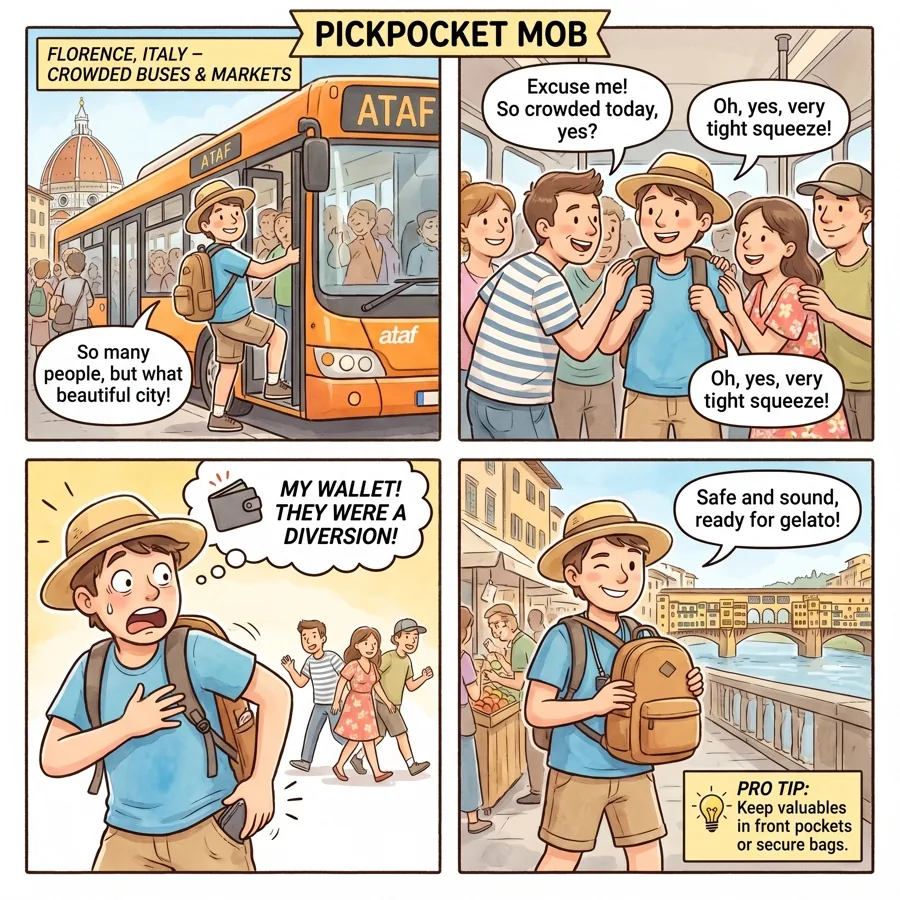
Coordinated 3–5 person pickpocket teams target older travelers on Florence's ATAF buses (especially lines 1 and 7), inside Mercato Centrale, and at crowded tourist sites — one creates a distraction (dropped item, clipboard, shouting) while another lifts wallets and phones from rear pockets and open bags.
Florence concentrates millions of visitors into a compact medieval pedestrian zone, and the resulting density on ATAF buses, in Mercato Centrale, and at major monuments creates ideal conditions for coordinated pickpocket teams. Florence's ATAF lines 1 and 7 — the routes connecting Santa Maria Novella station to the Duomo and back — are particularly notorious.
The mechanic: you're on a crowded bus or squeezing through Mercato Centrale when a group presses against you from multiple sides. One creates a distraction — drops something, waves a clipboard, shouts at a "friend," asks for directions — while another lifts your wallet or phone from a back pocket or open bag. By the time you realize what happened, the group has scattered in different directions, and the lifted items have been passed to a third member who's already off the bus or out of the market. Variants include "child pickpocket" teams where young children work crowds while adult handlers watch, and "cardboard map" gambits where the map shoved in your face conceals the lift below.
For older travelers in Florence's crowded zones, the defensive playbook: (1) wear a money belt or keep valuables in front zipped pockets — never back pockets; (2) carry a crossbody bag with the zip in front of your body, hand on the strap at all times; (3) be EXTRA alert on ATAF bus lines 1 and 7 — these are the documented pickpocket routes; (4) at Mercato Centrale, hold your bag in front in narrow stall aisles; (5) if a group clusters around you in an uncrowded space, that's the signal — step away or move toward a wall; (6) refuse anyone shoving paper, cardboard, or a clipboard in your face; (7) report theft immediately to Polizia di Stato 113 or Carabinieri 112 — a denuncia is required for travel insurance and credit-card chargeback. Wear a money belt or keep valuables in front zipped pockets — never back pockets in Florence. Use a crossbody bag with the zip facing your body, hand on the strap. Be especially alert on ATAF bus lines 1 and 7 (the documented pickpocket routes); at Mercato Centrale, hold your bag in front in narrow stall aisles. If a group clusters around you in uncrowded space, step away immediately. Refuse anyone shoving paper, cardboard, or clipboards in your face — that's always the distraction. File a denuncia with Polizia di Stato (113) or Carabinieri (112) for any theft.
Red Flags
- Groups clustering around you without obvious reason
- Someone getting very close in uncrowded spaces
- Anyone shoving paper or cardboard in your face
How to Avoid
- Use a money belt or keep valuables in front pockets.
- Never put your phone in your back pocket near tourist sights.
- Be extra alert on bus lines 1 and 7 — popular pickpocket routes.

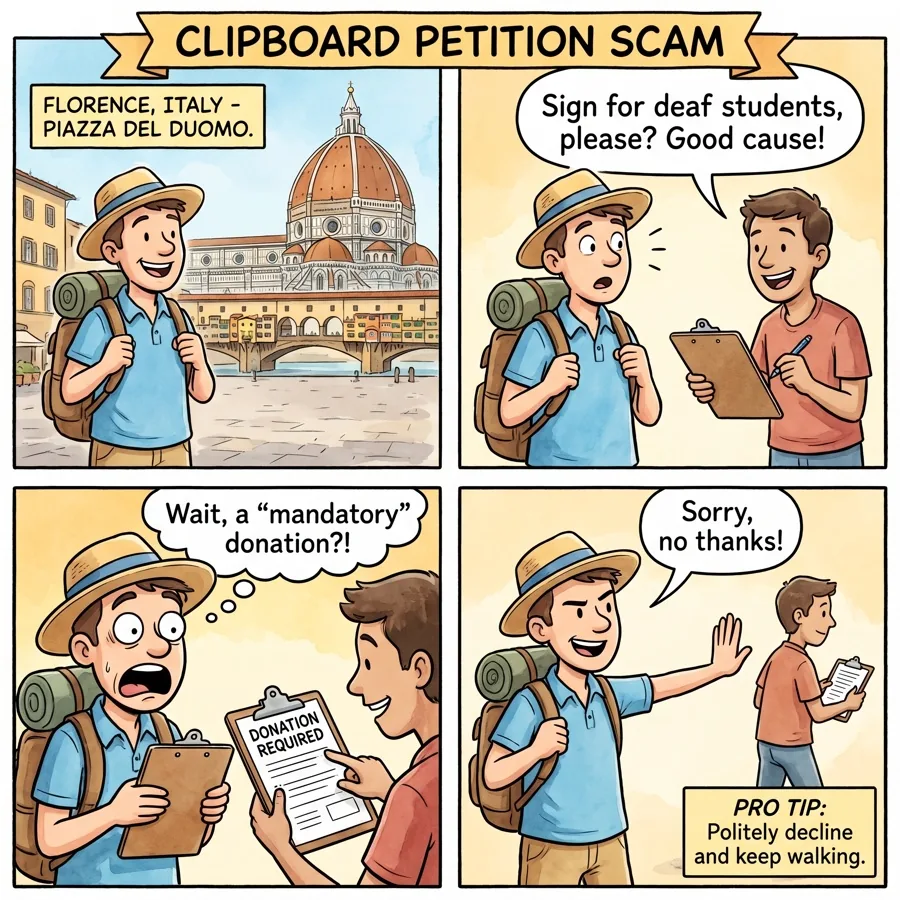
Clipboard "petition" scammers near the Duomo and major monuments distract older tourists with fake "deaf students," "refugee," or "environmental" causes while accomplices lift wallets from rear pockets — many also demand cash "donations" of €10–€50 after signing, becoming aggressive if refused.
Florence's monument plazas — particularly Piazza del Duomo and the area around the Uffizi — host a persistent clipboard-petition scam ecosystem. Real Italian charities never collect signatures or cash on the street near tourist monuments; the entire pretext is a wallet-lift opportunity disguised as social engagement.
The mechanic: someone approaches asking you to sign a petition for a "good cause" — deaf students, refugees, environmental protection, "sick child" appeals. While you're distracted reading the form and deciding whether to sign, an accomplice picks your pocket from behind. Some scammers also demand a cash "donation" after you sign and become aggressive if you refuse. Variants include "petition with photo of injured child" pressing on emotional weight, and groups of 2–3 hovering simultaneously to make you feel surrounded while reading.
For older travelers near Florence's monuments, the defensive playbook: (1) NEVER stop walking to read or sign anything from a stranger near the Duomo, Uffizi, or Ponte Vecchio; (2) say "no" without breaking stride — eye contact lengthens the engagement window; (3) keep your bag in front of you whenever you're stopped or approached; (4) genuine Italian charities (Misericordia, Croce Rossa, Caritas) collect at fixed locations with full uniforms and Italian-language credentials, never via roving clipboards in tourist zones; (5) if you've already engaged and been pickpocketed, file a denuncia at Carabinieri (112) or Polizia di Stato (113) immediately for the insurance reference number. Never stop walking to read or sign anything from a stranger near Florence's monuments. Say "no" without breaking stride and without eye contact — engagement opens the wallet-lift window. Keep your bag in front of you whenever stopped, and refuse all "sick child" or "deaf student" emotional pressure pitches. Genuine Italian charities (Misericordia, Croce Rossa, Caritas) work at fixed locations with full uniforms — never with roving clipboards near tourist sites. File a denuncia with Carabinieri (112) or Polizia di Stato (113) immediately for any theft.
Red Flags
- People with clipboards near monuments
- Multiple people hovering while you read
- Pressure to donate cash immediately
How to Avoid
- Never stop walking to sign anything from strangers.
- Say 'no' without breaking stride.
- Keep your bag in front of you whenever you're stopped.
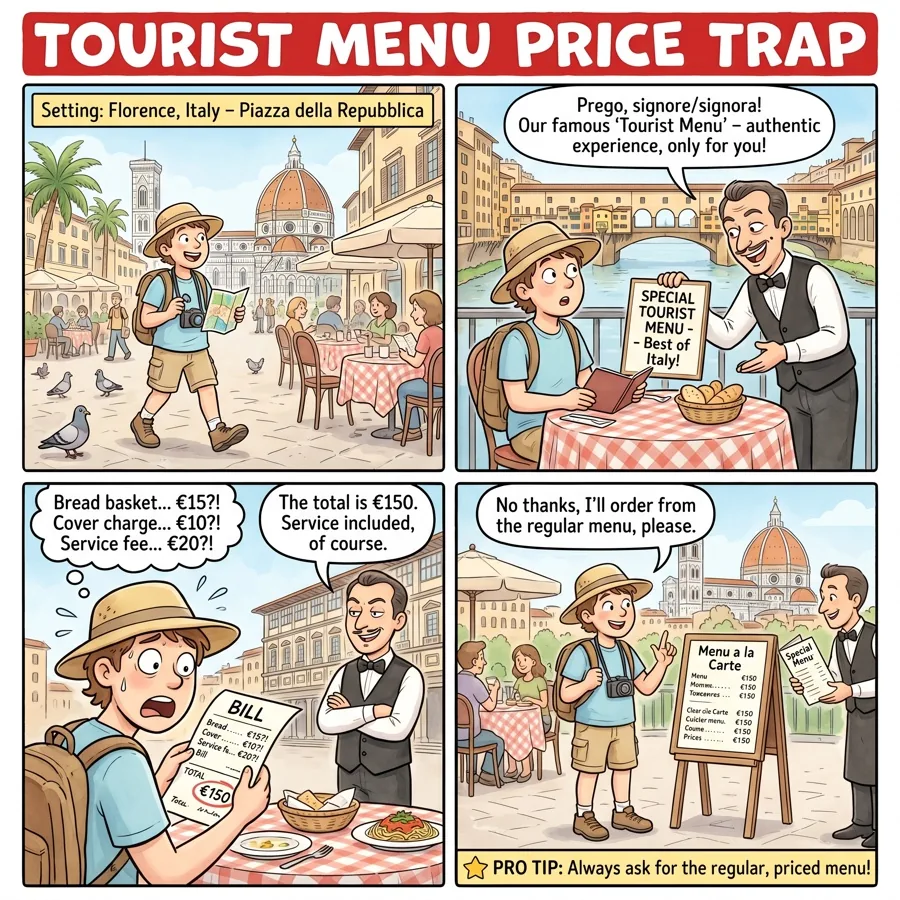
Restaurants near Piazza della Repubblica, Uffizi, and Duomo bring unordered bread, olives, and aperitivo at €5–€10 each "cover" charges, hide undisclosed €3–€5 coperto and 12–15% servizio charges, and post fish "per kg" without portion sizes — bills double after seeing the menu price.
Florence's central restaurant strip — within 200 meters of Piazza della Repubblica, the Uffizi, or the Duomo — operates on day-trip tourist volume rather than repeat local trade. The restaurants closest to the major sights have no incentive for fair pricing and run a documented bill-padding ecosystem.
The mechanic: you sit down at a charming-looking restaurant near a major sight and the waiter brings out bread, olives, aperitivo, and sometimes water without you ordering them. When the bill arrives, you're charged €5–€10 per item as "cover charges" (coperto). The menu prices looked reasonable, but extras — service, bread, tourist surcharges, "view supplement" for outdoor seating — can double your bill. Variants include verbal "fish of the day" quotes priced per kilogram with no portion size disclosed (one fish can produce €80–€150 bills), and post-meal "service charge" of 12–15% added on top of the standard 15% tip expectation.
For older travelers eating near Florence's tourist core, the defensive playbook: (1) check the menu posted OUTSIDE for the coperto (cover charge — Italian law requires this be displayed; legitimate is €1–€3 per person, anything €5+ is tourist-targeting); (2) check the menu for a printed servizio (service charge) — if present, do NOT additionally tip beyond 5–10% rounding; (3) explicitly refuse bread, olives, or aperitivo if you didn't order them ("non l'ho ordinato" — I didn't order it); (4) walk one or two streets AWAY from the Duomo, Uffizi, or Piazza della Repubblica for honestly-priced trattorias — Trattoria ZàZà (Mercato Centrale), Trattoria Mario (Via Rosina), All'Antico Vinaio (Via dei Neri panini), Osteria del Cinghiale Bianco (Borgo San Jacopo) are community-recommended; (5) for verbal fish quotes, demand the price per kg AND portion weight in writing before ordering; (6) photograph the menu before sitting; (7) dispute any unauthorized charges via credit card within 48 hours of the meal. Check the menu posted OUTSIDE before sitting — Italian law requires the coperto (cover charge) be displayed; legitimate is €1–€3 per person (anything €5+ is tourist-targeting). Refuse unordered bread, olives, or aperitivo with "non l'ho ordinato." Walk 1–2 streets AWAY from the Duomo, Uffizi, or Piazza della Repubblica for community-recommended honest trattorias: Trattoria ZàZà (Mercato Centrale), Trattoria Mario (Via Rosina), All'Antico Vinaio (Via dei Neri), Osteria del Cinghiale Bianco. For verbal fish quotes, demand price per kg AND portion weight in writing before ordering.
Red Flags
- Restaurant aggressively hailing tourists from doorways
- Menu without prices listed clearly
- Waiter brings food/drinks you didn't order
How to Avoid
- Check for 'coperto' (cover charge) on the menu before sitting.
- Explicitly refuse bread and starters if you didn't order them.
- Walk one or two streets away from major sights for better-priced, less scammy restaurants.
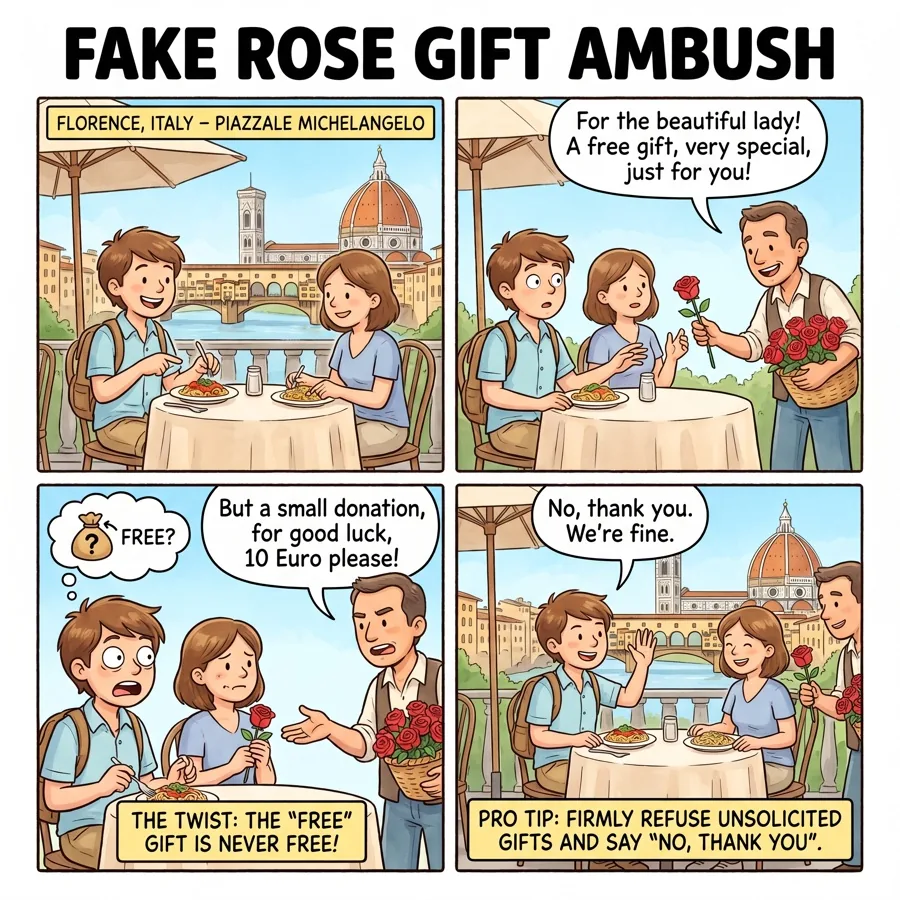
Outdoor-terrace and Piazzale Michelangelo viewpoint vendors hand older couples a "free gift" rose to a partner, then demand €10–€15 the moment it's accepted and hover uncomfortably until paid — the same scam runs with trinkets and selfie-stick "free try" upsells at scenic photo spots.
Florence's outdoor dining areas, terrace restaurants, and scenic viewpoints (especially Piazzale Michelangelo for sunset over the city) host a persistent rose-and-trinket ambush scam targeting older couples on romantic evenings.
The mechanic: you're having a romantic dinner on a terrace or watching sunset at Piazzale Michelangelo when a vendor approaches and hands your companion a rose, saying it's a free gift "for la signora." The moment it's accepted, they demand €10–€15 cash and hover uncomfortably until paid. The same pattern runs with trinkets — wooden bracelets, "lucky" coins, scarf samples — shoved into your hand at scenic viewpoints with the claim that you now owe payment. Variants include selfie-stick vendors offering a "free try," then demanding €20 once your photo is on their phone.
For older travelers at Florence's terrace restaurants and viewpoints, the defensive playbook: (1) do NOT accept anything from a street vendor without asking the price first — a "free" framing is always the scam; (2) hand the rose, trinket, or item back IMMEDIATELY before they walk away — once they're moving, you're paying; (3) say "non voglio" (I don't want it) firmly and turn back to your companion; (4) at outdoor restaurants, ask the waiter to refuse vendors entry to the terrace — most will if you make eye contact; (5) at Piazzale Michelangelo, find a spot away from the central viewing area where vendors concentrate; (6) refuse "free try" selfie-stick offers — every "trial" ends with a payment demand; (7) if pressured aggressively, walk briskly toward visible Polizia or restaurant staff. Do NOT accept anything from a Florence street vendor — a "free gift" framing is always the scam. Hand any rose, trinket, or item BACK IMMEDIATELY before the vendor walks away (once they're moving, you're paying). Say "non voglio" firmly and turn back to your companion. At outdoor terrace restaurants, ask the waiter to refuse vendor entry; at Piazzale Michelangelo, sit away from the central viewing area where vendors concentrate. Refuse all "free try" selfie-stick offers — every trial ends in a payment demand.
Red Flags
- Anyone handing you something you didn't ask for
- Vendor who 'won't take it back' after handing you something
How to Avoid
- Don't accept anything from street vendors without asking the price first.
- Hand it back immediately before they walk away.
- A firm 'non voglio' (I don't want it) usually works.
🆘 What to Do If You Get Scammed
📋 File a Police Report
Go to the nearest Carabinieri / Polizia di Stato station. Call 112 (Carabinieri) or 113 (Polizia). Get an official crime report — you'll need this for insurance claims. You can also report online at poliziadistato.it.
💳 Cancel Your Cards
Call your bank immediately. Most have 24/7 numbers on the back of the card (keep a photo saved separately). Block any suspicious transactions before the thieves use your details.
🛂 Lost Passport?
Contact your nearest embassy or consulate. The US Embassy in Rome is at Via Vittorio Veneto 121, 00187 Rome. For emergencies: +39 06-4674-1.
📱 Track Your Device
If your phone was stolen, use Find My (iPhone) or Find My Device (Android) from another device. Don't confront thieves yourself — share the location with police instead.
Frequently Asked Questions
You just read 6 scams in Florence. The book has 143 more across 20 Italian destinations.
Rome's tre-campanelle shell game. Venice's €2,500-a-day pickpocket ring. Florence's fake-leather trade. Capri's Blue Grotto fee-stack. Sardinia's €3,000 sand-in-your-luggage fine. Every documented Italy scam — with the exact scripts, red flags, and Italian phrases that shut each one down. Drawn from Repubblica, Corriere, Il Mattino, and Carabinieri arrest records.
- 149 documented scams across Rome, Venice, Florence, Milan & 16 more cities
- An Italian exit-phrase card you can screenshot to your phone
- Updated annually — buy once, re-download future editions free
- Readable in one flight — $4.99 on Amazon Kindle