The Deaf-Mute Petition Scam: the same scam, in 4 countries.
From the Eiffel Tower base to the Trevi Fountain to Sagrada Familia to Brandenburg Gate, a clipboard team of 2-3 operators uses a "petition for the deaf" pretext to pin tourists in place while a second member lifts wallet, phone, or passport. The no-petition rule and the bag-front rule defeat every variant.


The deaf-mute petition scam is a two- or three-person pickpocket team: an operator (often a young woman, sometimes claiming to be deaf-mute) approaches a tourist at a major monument with a clipboard listing names and signatures and a "petition for the deaf" header, gesturing for the tourist to sign and donate; while the tourist's attention is on the clipboard and the petitioner positions close in front, an accomplice (or the same petitioner) lifts wallet, phone, or passport from the bag or back pocket. Documented heavily at Paris Eiffel Tower / Trocadero, Rome Trevi Fountain / Spanish Steps, Barcelona Sagrada Familia / Las Ramblas, Berlin Brandenburg Gate, Madrid Plaza Mayor. The universal defenses are two rules: the no-petition rule (never sign anything for a stranger on the street; real deaf charities operate from fixed booths with registered fundraisers and printed receipts), and the bag-front rule (move bag to front of body the moment a clipboard appears; petitioner stands in front, lifter approaches from blind side). Police: France 17, Italy 113, Spain 091 / 092, Germany 110.
"Madame, signature for the deaf, very fast, just one signature."
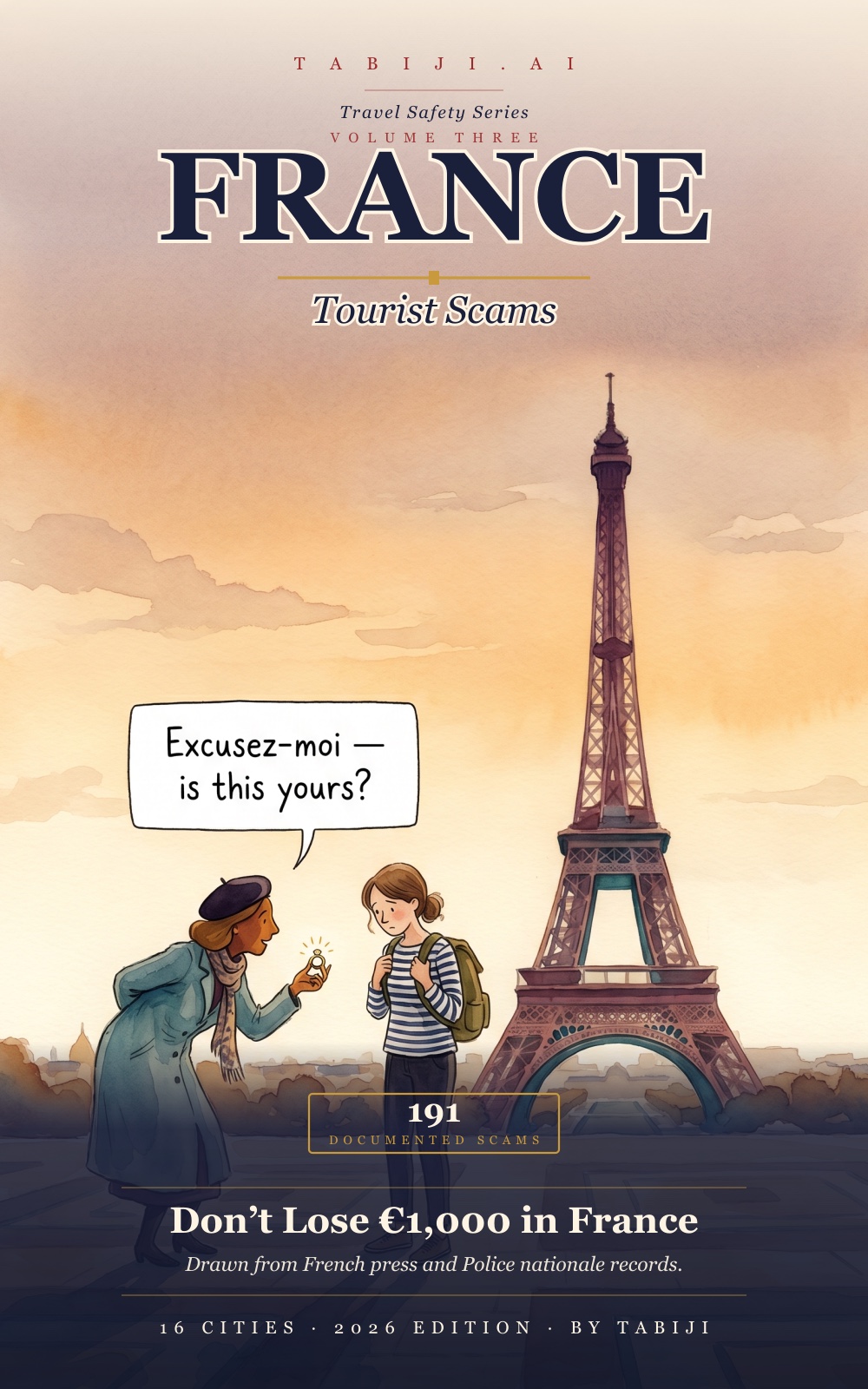
You and your travel partner stand on the Trocadero plaza facing the Eiffel Tower. The afternoon light is good; you are taking the canonical photo. A young woman in her twenties approaches: dark hair, dressed casually, a clipboard held flat against her chest. She gestures at the clipboard with quick hand motions and a small printed badge that reads SOURDS-MUETS, AIDE LES ENFANTS. She makes a brief deaf-mute hand sign and points emphatically at the page.
You hesitate. She steps closer, tilts the clipboard toward your travel partner. You see a list of names with international addresses (a London entry, a Tokyo entry, a Madrid entry) all with what look like genuine signatures. She gestures at a pen taped to the clipboard. Your partner takes the pen to be polite. As your partner bends slightly to read the headers and sign, you feel an almost-imperceptible touch at the back of your bag.
You turn quickly. A second young woman has stepped back two paces; her hand is at her side; she walks away briskly without looking at you. The petitioner is still in front of your partner with the clipboard. You check your bag immediately: the zip is half-open. Your phone is gone. The petitioner is already retreating; the second figure has crossed the plaza toward the Metro entrance.
This is the deaf-mute petition pickpocket, the most-documented Paris monument scam. The Prefecture de Police de Paris issues monthly advisories about Trocadero, Eiffel Tower base, Sacre-Coeur Montmartre, and Place du Tertre. The variant has run continuously for at least fifteen years; the Romani-trafficking ring documented by Europol operates the Paris cluster. Recovery rate for stolen phones is under 5 percent; phones are sold to fences within hours.
The defense is two rules. The no-petition rule: never sign anything for a stranger on the street. Real deaf charities (Federation Nationale des Sourds de France, FNSF) operate from fixed booths with registered fundraisers wearing photo IDs and printed receipts; they do not approach tourists at monuments. Any "deaf charity" fundraiser at a monument fits the variant by definition. The bag-front rule: the moment a clipboard appears, move your bag to the front of your body and place a hand over the zip. The petitioner stands in front; the lifter (second team member) approaches from your blind side. Bag-front denies the angle of attack.
That is the deaf-mute petition variant of the distraction-theft family, executed at the most-documented French monument. The rest of this page is the five-mechanic playbook, the four other places where it runs in different forms (Rome Trevi clipboard, Barcelona Sagrada Familia ring, Berlin Brandenburg Gate, Madrid Plaza Mayor), and the two rules that defeat every variant.
Read the full Paris scam guide →Key Takeaways
The no-petition rule and the bag-front rule
Every variant of the deaf-mute petition pickpocket is defeated by the same two rules. The no-petition rule: never sign anything for a stranger on the street, especially at major tourist monuments. Real deaf charities employ registered fundraisers with photo IDs, fixed booths, and printed donation receipts; they do not approach tourists at monuments with clipboards. The clipboard is the engagement device; declining to engage defeats the variant before it starts. The bag-front rule: the moment a clipboard appears, move your bag to the front of your body and place a hand over the zip or wallet pocket. The petitioner positions herself directly in front; the lifter (a second team member) approaches from your blind side. Bag-front denies the angle of attack.
The first rule addresses the social-pressure asymmetry. The deaf-mute presentation creates social pressure to engage rather than walk away; refusing to sign a "deaf charity" petition feels rude. The structural reality is that real deaf charities do not operate this way; the discomfort of refusal is the operator's lever. Politely refusing without breaking stride is socially acceptable in France, Italy, Spain, Germany, and the UK; cultural norms in all five countries recognize the right to walk past street solicitations.
The second rule addresses the team-positioning asymmetry. The variant uses a 2-3 person team: the petitioner (positions in front, holds clipboard, claims deaf-mute), the lifter (positions behind or to the side, executes the pickpocket), sometimes a spotter / runner (walks a slow circuit nearby, signals when police approach, takes the lifted items away from the team). The petitioner alone cannot operate effectively; identifying the team breaks the engagement. Bag-front specifically denies the lifter's preferred angle.
The third defense is gait. Operators target tourists who slow, stop, or make eye contact. Walking at normal pace through monument plazas with neutral gaze defeats most clipboard approaches before they begin. The petitioner needs at least 30 seconds of stationary attention; walking past 20 meters before stopping for any reason denies the window.
The fourth defense is the multi-language refusal. Each language has a clipped phrase that the operator hears as a firm refusal: French "non merci, je ne signe pas", Italian "no grazie, non firmo", Spanish "no gracias, no firmo", German "nein danke, ich unterschreibe nicht". Said firmly, the phrase signals "this tourist knows the variant" and the operator team typically scatters within five seconds.
The fifth defense, when the engagement has already landed: inventory check immediately and aloud. "Wallet, phone, passport, sunglasses." If anything is missing, summon police on the spot via 17 (France), 113 (Italy), 091 / 092 (Spain), 110 (Germany). Photograph the petitioner if safely possible; the photo is admissible evidence and operator teams have been arrested based on tourist-supplied photos in Paris and Barcelona.
The five mechanics
The deaf-mute petition pickpocket runs in five regional variants across the major European tourist monuments. The mechanic is identical; the location, language, and operator-shop network differ.
1. Paris Trocadero / Eiffel Tower (France)
Most-documented variant. Operators concentrate at Trocadero plaza, Eiffel Tower base (Champ de Mars side), Sacre-Coeur Montmartre, Place du Tertre, Pyramide du Louvre. Romani-trafficking ring documented by Europol. The Prefecture de Police de Paris issues monthly advisories. Variant peaks during Olympics (2024) and Champions League finals at Stade de France. Defense: no-petition rule and bag-front rule.
2. Rome Trevi / Spanish Steps (Italy)
Operators concentrate at Trevi Fountain, Spanish Steps, Vatican Square (especially the Bernini Colonnade approach), Piazza Navona, Pantheon. The Polizia di Stato 113 and Carabinieri 112 handle dispatch; the variant runs in coordination with the broader Rome distraction-theft operator network. Romani and Albanian operator clusters documented. Variant peaks during Vatican Jubilee events. Defense: walk past at normal pace.
3. Barcelona Sagrada Familia / Las Ramblas (Spain)
Operators concentrate at Sagrada Familia entrance, Park Guell, Las Ramblas, Plaza Catalunya, Barri Gotic. Mossos d'Esquadra (Catalan police, 092) handle dispatch. Eastern European operator ring documented; the variant runs in coordination with the broader Barcelona pickpocket network (Las Ramblas distraction theft, beach bag theft). Defense: walk past Sagrada queue at distance from the wall.
4. Berlin Brandenburg Gate / Alexanderplatz (Germany)
Operators concentrate at Brandenburg Gate, Reichstag area, Pariser Platz, Alexanderplatz, Museum Island. Bundespolizei 110 handles dispatch; the variant is less common in Berlin than in Paris / Rome / Barcelona but documented at scale during Berlinale and Christmas markets. Bulgarian and Romanian operator clusters documented. Defense: especially watch at Brandenburg Gate during peak photo-taking hours.
5. Madrid Plaza Mayor / Puerta del Sol (Spain)
Operators concentrate at Plaza Mayor, Puerta del Sol, Gran Via, Mercado San Miguel adjacent, Royal Palace approach. Policia Nacional 091 handles dispatch. Variant runs at lower volume than Barcelona but with higher-cost extraction (passports, larger wallets). Defense: same as Barcelona.
Where it runs
The deaf-mute petition pickpocket concentrates at major European tourist monuments where high tourist density combines with slow tourist pace. The geography below covers the most-documented locations per country.
- France (canonical hotspot): Paris: Trocadero plaza, Eiffel Tower base (Champ de Mars side), Sacre-Coeur Montmartre, Place du Tertre, Pyramide du Louvre, Notre-Dame parvis, Champs-Elysees Arc de Triomphe approach. Marseille: Vieux Port. Nice: Promenade des Anglais. Lyon: Vieux Lyon.
- Italy: Rome: Trevi Fountain, Spanish Steps, Vatican Square (Bernini Colonnade approach), Piazza Navona, Pantheon, Piazza del Popolo, Castel Sant'Angelo. Florence: Piazza della Signoria, Piazzale Michelangelo, near Duomo. Venice: San Marco. Naples: Piazza del Plebiscito, Spaccanapoli. Milan: near Duomo.
- Spain: Barcelona: Sagrada Familia entrance, Park Guell, Las Ramblas, Plaza Catalunya, Barri Gotic, Plaza Real. Madrid: Plaza Mayor, Puerta del Sol, Gran Via, Mercado San Miguel adjacent, Royal Palace approach. Seville: Plaza de Espana approach, near Cathedral. Granada: Plaza Nueva, Albaicin viewpoints.
- Germany: Berlin: Brandenburg Gate, Reichstag area, Pariser Platz, Alexanderplatz, Museum Island, Checkpoint Charlie. Munich: Marienplatz, near Hofbraeuhaus. Frankfurt: Roemerberg. Cologne: Cathedral plaza. Hamburg: Reeperbahn (lower volume).
- Adjacent (also documented): UK: London Westminster (Houses of Parliament), Buckingham Palace, Trafalgar Square. Austria: Vienna Stephansplatz. Czech Republic: Prague Old Town Square, Charles Bridge. Hungary: Budapest Vorosmarty Square. Portugal: Lisbon Belem Tower. Greece: Athens Plaka, Acropolis approach.
Four more places, four more clipboard variants
Rome Trevi Fountain: the clipboard ring
Trevi Fountain, late afternoon, peak photo hours. You and your travel partner take the canonical coin-toss photo. As you turn to walk back to the steps, three women in their twenties move into formation around you: one approaches from the front with a clipboard, one positions to your right at bag distance, one stands as a spotter ten meters off scanning for police.
The clipboard reads SORDOMUTI, ASSOCIAZIONE ITALIANA, AIUTA I BAMBINI. The first woman gestures emphatically and points at a pen. As your partner reaches toward the clipboard, the second woman makes contact with your bag. You feel the hand at the bag and shout "no!"; she steps back, the first woman takes the clipboard and walks off, the spotter melts into the crowd toward Via del Lavatore. Within ten seconds the team is gone.
Defense: the team formation is the structural setup; recognizing it (front-left-spotter triangle) breaks the engagement. The Polizia di Stato Roma 113 dispatch responds to Trevi within 5-10 minutes; cameras at the Trevi area capture most operator activity. If you see the formation and are not yet engaged, walk perpendicular to the team's formation line; the team will not pivot to a new target while a previous one is still in motion.
Barcelona Sagrada Familia: the entrance queue clipboard
Sagrada Familia, mid-morning. You and your travel partner are in the timed-entry queue, about thirty meters from the Nativity facade entrance. A young woman moves through the queue with a clipboard headed AYUDA SORDOS, NIÑOS DE BARCELONA. She approaches each tourist couple in sequence, asking for signatures and small donations. She reaches you. You decline politely; she moves to the next couple.
Two minutes later, you notice your travel partner's phone is missing from the side pocket of her shoulder bag. You did not feel a contact. The petitioner is two couples down the queue; you recognize a man in a leather jacket who was standing immediately behind you when she approached.
Defense: when in any timed-entry queue at a major monument (Sagrada Familia, Vatican, Eiffel Tower lifts, Anne Frank House), keep bags zipped and at the front of your body throughout the queue. Side pockets are the variant's preferred entry. The Mossos d'Esquadra (092) have a permanent presence at Sagrada during peak hours; reporting on the spot occasionally produces operator arrests because the team works the same queue repeatedly.
Berlin Brandenburg Gate: the Pariser Platz clipboard
Brandenburg Gate, Saturday afternoon. The plaza is dense with tourists and street performers. A young woman with a clipboard approaches your travel partner. The clipboard reads HOERGESCHAEDIGTE BERLIN HILFE, with a list of names. She gestures and points; she has a small badge on a lanyard with what looks like a charity name and registration number.
You decline. She moves to a couple next to you. You watch. Within thirty seconds, the couple has signed; while they are bent toward the clipboard, a man in a navy jacket has walked past behind them and the woman's small backpack is now slightly open. The couple has not noticed.
Defense: photograph the operator if safely possible (the lanyard badge is the operator-shop signature) and signal the targeted couple. The Berliner Polizei dispatch (110) responds quickly to Pariser Platz reports because of the surrounding embassy security; reports do contribute to operator-team arrests. Real Deutscher Gehoerlosen-Bund fundraisers do not operate at Brandenburg Gate without a registered event and city permit; absence of either is the variant.
Madrid Puerta del Sol: the spotter team
Puerta del Sol, early evening. The Tio Pepe billboard glows. You stand at the central plaza taking a photo. A young woman with a clipboard approaches. The clipboard reads SORDOS DE ESPAÑA, AYUDA NIÑOS. You recognize the variant from prior advisories; you politely decline and start walking toward Calle Mayor.
You notice a man in a dark hoodie walking parallel to you, fifteen meters behind, looking at the petitioner and at you. He is the spotter. The petitioner does not pursue; she pivots to another couple at the central fountain. The hoodie man peels off after twenty meters; the team has moved to the next target.
Defense: Madrid operators use the standard team formation but with longer spotter reach (the hoodie man scouts approaches and signals the petitioner). Walking through Puerta del Sol with neutral gaze and at normal pace defeats most approaches. The Policia Nacional 091 at the central Puerta del Sol substation handles dispatch; on-scene response is fast (5 minutes) because of the central tourist-police presence.
Red flags
- Young woman with clipboard at a major monument. The petitioner profile. Real charities do not operate this way.
- Clipboard headed "deaf charity" / "sordomuti" / "sourds-muets" / "sordos". Pretext language for the variant.
- List of international names with signatures already on the clipboard. Social-proof tactic; the names are fabricated or pre-collected.
- Petitioner does not break stride after polite refusal. Real fundraisers accept refusal immediately; persistence is the variant.
- Second figure positioning at bag-side or behind during clipboard engagement. The lifter in formation.
- Spotter walking a circuit nearby. Third team member; signals when police approach.
- Approach at queue-line for timed-entry monument. Sagrada Familia / Eiffel / Vatican lift queues are a documented variant environment.
- Clipboard badge / lanyard without charity registration number visible. Real charity badges have registration numbers and contact info.
The phrases that shut it down
Each language below refuses the clipboard firmly without breaking stride. Said while walking past at normal pace, no eye contact.
If you got hit
If you got pickpocketed during a clipboard engagement: file a police report at the local police office or station within 24 hours (most travel insurance and credit-card protection require this window). Paris: any commissariat (17 emergency); Trocadero / Eiffel substations are the closest. Rome: Carabinieri 112 or Polizia di Stato 113. Barcelona: Mossos d'Esquadra 092 (Catalonia). Madrid: Policia Nacional 091. Berlin: Berliner Polizei 110. Get a written copy of the report (proces-verbal / verbale / denuncia / Strafanzeige); insurers and embassies require it.
Cancel cards immediately via your card issuer 24-hour line. The chargeback corridor applies for any unauthorized transactions; recovery rate for tourist-stolen-card purchases is materially high if reported within 30 days.
Replace stolen passport at the nearest consulate. France: US embassy Paris, UK embassy Paris, Canadian embassy Paris. Italy: US consulates Florence and Naples or embassy Rome. Spain: US consulate Barcelona or embassy Madrid. Germany: US embassy Berlin or consulate Munich. Most issue emergency replacement passports within 1-3 business days; same-day if you have an immediate flight. 24-hour duty officer numbers: US +1 202 501 4444; UK +44 20 7008 5000.
If your phone was stolen: file a remote-wipe via Apple Find My iPhone or Google Find My Device immediately. The IMEI number on your purchase receipt is the carrier-blocking identifier; provide this to your home carrier to block the device on networks honoring IMEI lists. Stolen phone resale value is materially higher in Eastern Europe and North Africa; the IMEI block reduces but does not eliminate resale.
Photograph the operator if you saw them; submit the photo to the local police as evidence. Operator-team arrests have occurred in Paris, Rome, and Barcelona based on tourist-supplied photos; the same teams work the same locations repeatedly, so a photo identification accelerates the broader investigation.
Related atlas entries
Sources & references
- France: Prefecture de Police de Paris monthly Trocadero / Eiffel advisories; Police Nationale 17 dispatch.
- Italy: Polizia di Stato 113, Carabinieri 112; Rome Trevi camera coverage; Vatican Gendarmerie at St. Peter's Square.
- Spain: Mossos d'Esquadra 092 (Catalonia) Sagrada substation; Policia Nacional 091; Madrid Puerta del Sol substation.
- Germany: Bundespolizei 110; Berliner Polizei Pariser Platz patrols.
- Europol: Romani-trafficking ring documentation 2018-2024 covering Paris, Rome, Barcelona operator clusters.
- Real deaf charities: Federation Nationale des Sourds de France (FNSF), Ente Nazionale Sordi (Italy), CNSE (Spain), Deutscher Gehoerlosen-Bund (Germany).
- UK FCO travel advice: France, Italy, Spain, Germany country pages all warn about clipboard pickpockets.
- Tabiji field reports: Paris Trocadero, Rome Trevi, Barcelona Sagrada Familia, Berlin Brandenburg Gate, Madrid Puerta del Sol (2024-2026).
Get the full clipboard-pickpocket playbook for your destination.
Each Travel Safety atlas covers every documented pickpocket, distraction-theft, and confidence scam pattern in one country, plus the full scam catalog: taxi, ATM, restaurant, fake authority, vendor. Buy once, lifetime updates as scams evolve. $4.99 on Kindle.