Aggressive Street Vendor & Hustler Scams: the same scam, in 4 countries.
From Rome Spanish Steps to Marrakech Jemaa el-Fnaa, the same five tactics recur with local accents: a "free" item placed in your hand, a price demand once it has touched you, a small crowd to enforce. The hand rule below shuts every variant down before the gift lands.


Aggressive street vendor scams run five mechanics across 4 countries: forced-gift bracelet (Rome Spanish Steps, Trevi, Paris Sacre-Coeur, Barcelona Las Ramblas, with 20-50 EUR demands), rose-seller restaurant shakedown (Rome Trastevere, Florence Piazza Signoria, Madrid Plaza Mayor, with 20-30 EUR demands at the table), henna grab (Marrakech Jemaa el-Fnaa, Cairo Khan el-Khalili, Istanbul Sultanahmet, with 50-200 EUR price after grab), selfie-stick overcharge (Rome Vatican, Paris Trocadero, with 5 EUR-to-30 EUR price escalation), and trinket placement (Rome Colosseum, Paris Eiffel Tower, with 10-40 EUR demand once the item is in your hand). The universal defense is one rule: do not let anything land in your hand. Walk past with hands closed or in pockets; do not extend your wrist; if a rose enters the restaurant, wave it off before it reaches the table. Local-language phrases shut down each variant before engagement begins.
"For the lady, gift, gift, very lucky, just give me your hand."
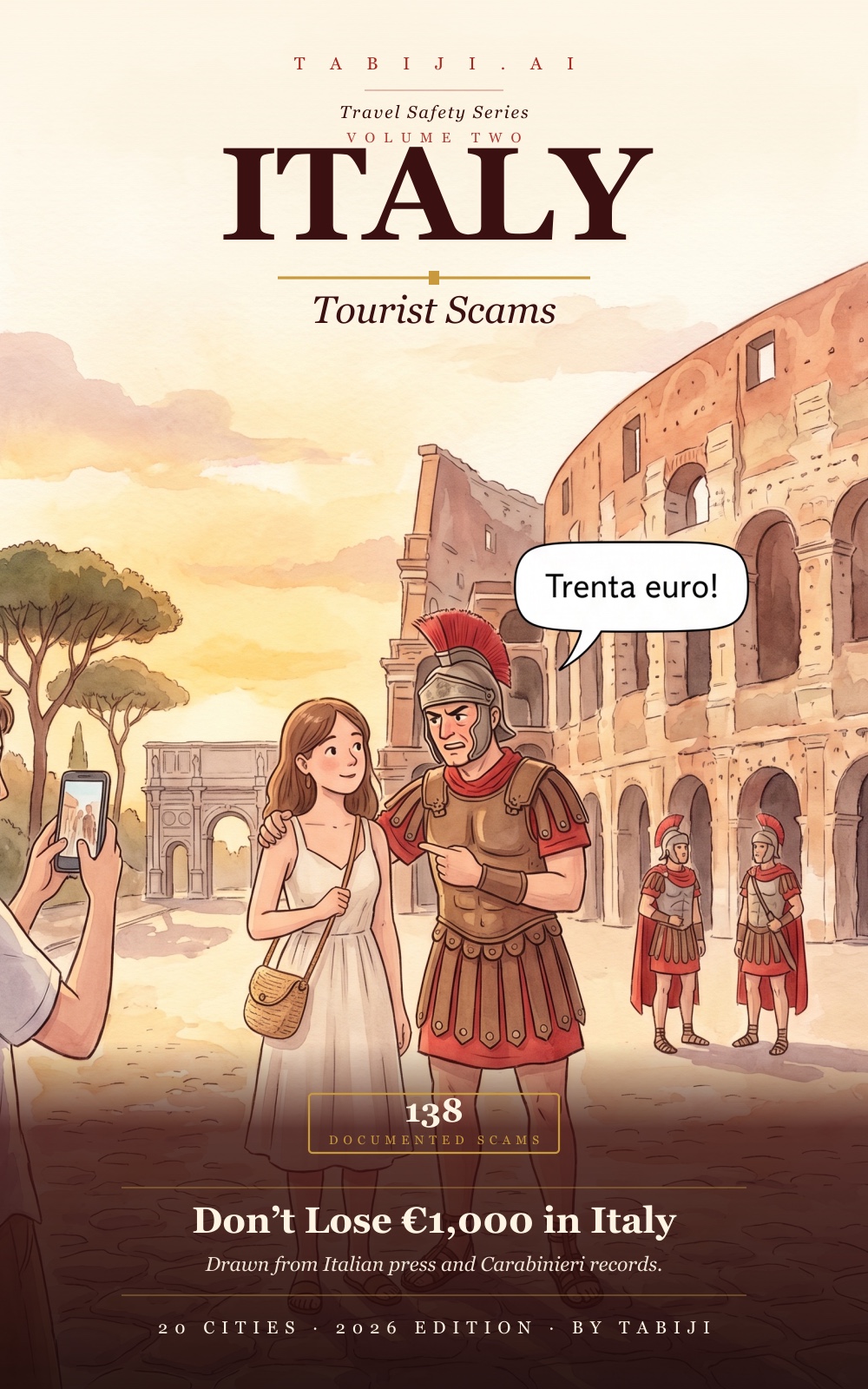
You and your partner walk down Via Condotti toward the Spanish Steps in the late afternoon. The piazza is dense with tour groups, students sketching, gelato eaters. As you reach the base of the steps, two men step out from a small group near the fountain. Each carries a fistful of beaded and string bracelets in red, yellow, green. One holds a small cardboard sign that reads SOUVENIR ROMA — FREE GIFT.
The closer man smiles at your partner. He says in fast English: "For the lady, gift, gift, very lucky, just give me your hand, one second, no money, no money, just for luck." His other hand is open, fingers wiggling, gesturing for her wrist. She hesitates. Before she has answered, he has slipped a string bracelet over her hand and tied it.
Then his face changes. The smile is still there but tighter. "Now ten euro for the gift, twenty for two, you must give for the lucky." His partner has stepped behind you. Two more men in the group have started walking over.
This is the forced-gift bracelet, the most-documented aggressive-vendor variant in Europe. It runs the same way at the Trevi Fountain, at Paris Sacre-Coeur, at Barcelona Las Ramblas. The defense is a single rule: do not let anything land in your hand or on your wrist. Walk past with hands closed or in pockets; do not stop to listen; do not extend your wrist. The variant cannot operate against a moving target with closed hands.
That is the bracelet variant of the aggressive-street-vendor family, executed at one of the most-documented locations in Europe. The rest of this page is the five-mechanic playbook, the four other places where it runs in different forms (Paris Sacre-Coeur, Marrakech Jemaa el-Fnaa, Florence Piazza Signoria, Barcelona Las Ramblas), and the hand rule that defeats every variant.
Read the full Rome scam guide →Key Takeaways
The hand rule
Every variant of this family is defeated by the same single rule: do not let anything land in your hand or on your wrist. Each variant attempts a physical transfer (a bracelet, a rose, a henna pattern, a selfie stick, a trinket) and shifts the negotiation onto you the moment the transfer lands. Keep hands closed or in pockets and the variant cannot operate.
The first defense is gait. Aggressive operators target tourists who slow, stop, or make eye contact. Walking at normal pace through tourist squares with neutral gaze defeats most approaches before they begin. Operators choose easier targets within five seconds.
The second defense is hands-in-pockets. The bracelet variant requires an exposed wrist; the trinket and selfie-stick variants require an open hand. Pockets close both. If you need a hand for a phone or camera, use the strap; do not extend a free hand.
The third defense is decline-before-arrival. The rose seller is the canonical example: the rose enters the restaurant, walks to your table, lands. Wave the seller off at the door before the rose moves. The earlier the decline, the lower the engagement.
The fourth defense is verify-price-first. Selfie sticks and trinkets that do come from legitimate vendors carry visible price tags. A vendor who refuses to write the price on the item is operating the variant. No written price, no transaction.
The fifth defense, when the item has already landed: drop it. Do not return it to the operator's hand (this is treated as a haggle). Drop it on the ground or on a public surface and walk away at normal pace. The operator will retrieve it and move on; you have not paid.
The five mechanics
Aggressive street vendors run five distinct mechanics. Each has a signature region, a signature tactic, and a signature payout shape.
1. Forced-gift bracelet (Rome, Paris, Barcelona)
Operator approaches at a major monument or square; ties a string or beaded bracelet on the tourist's wrist while reciting "free gift, lucky for you, just one second"; demands 20-50 EUR after the bracelet is tied. Documented heavily at Rome Spanish Steps, Trevi Fountain, Piazza Navona; Paris Sacre-Coeur Montmartre, Trocadero; Barcelona Las Ramblas; Madrid Plaza Mayor. Typical demand: 20-50 EUR. Defense: keep wrists out of reach; walk past hands-closed; if the bracelet is tied, do not pay (it is worthless string).
2. Rose-seller restaurant shakedown (Rome, Florence, Madrid)
Rose seller enters a restaurant, walks to a table, hands a "free" rose to the woman seated, demands 20-30 EUR from the man. The variant exploits social embarrassment in front of a partner. Documented heavily in Rome Trastevere, Campo de Fiori; Florence Piazza Signoria, Santa Croce; Paris Quartier Latin; Madrid Plaza Mayor; Barcelona Barri Gotic. Typical demand: 20-30 EUR. Defense: wave the seller off the moment they enter the restaurant; do not let the rose reach the table.
3. Henna grab (Marrakech, Cairo, Istanbul)
In tourist squares, women approach offering "free" henna; if the tourist hesitates, they grab the hand and start painting before consent. The painted design is then "priced" at 50-200 EUR equivalent. Documented heavily in Marrakech Jemaa el-Fnaa, Saadian Tombs; Cairo Khan el-Khalili; Istanbul Sultanahmet (less common). Typical demand: 50-200 EUR. Defense: hands in pockets when crossing the square; if grabbed, pull back firmly and walk away; do not haggle.
4. Selfie-stick overcharge (Rome, Paris, Madrid)
Vendor at a major monument quotes a low price (5 EUR), hands the selfie stick to the tourist to inspect; once it is in their hand the price triples to 15-30 EUR with verbal pressure and physical proximity. Documented at Rome Vatican Square, Colosseum; Paris Trocadero, Eiffel Tower base; Madrid Plaza Mayor; Barcelona Sagrada Familia. Typical demand: 15-30 EUR. Defense: never take the stick into your hand before agreeing on a written price.
5. Trinket placement (Rome, Paris, Cairo, Marrakech)
Operator places a "lucky charm", small carved item, or trinket in the tourist's hand without permission, says "free gift", then demands 10-40 EUR. Documented at Rome Colosseum, Pantheon; Paris Eiffel Tower base; Cairo Pyramids approach; Marrakech Jemaa el-Fnaa. Typical demand: 10-40 EUR. Defense: keep hands closed or in pockets; if an item is placed, drop it on the ground (not back into the operator's hand).
Where it runs
The trap concentrates at high-density tourist monuments and squares where local police presence is light or rotates between sites. The geography below covers the most-documented locations per country.
- Italy: Rome: Spanish Steps, Trevi Fountain, Piazza Navona, Colosseum, Vatican Square, Pantheon, Trastevere. Florence: Piazza della Signoria, Piazzale Michelangelo, Santa Croce. Venice: Piazza San Marco, Rialto Bridge. Naples: Piazza del Plebiscito.
- France: Paris: Sacre-Coeur Montmartre, Trocadero, Eiffel Tower base, Quartier Latin, Champs-Elysees, Place du Tertre. Marseille: Vieux Port. Nice: Promenade des Anglais.
- Spain: Barcelona: Las Ramblas, Sagrada Familia, Park Guell, Barri Gotic, Plaza Catalunya. Madrid: Plaza Mayor, Puerta del Sol, Gran Via. Seville: Plaza de Espana, Cathedral. Granada: Albaicin.
- Morocco: Marrakech: Jemaa el-Fnaa, Bahia Palace approach, Saadian Tombs. Fez: Bab Boujloud, Talaa Kebira. Casablanca: Mohammed V Square. Tangier: Petit Socco.
- Adjacent (also documented): Egypt: Cairo Khan el-Khalili, Pyramids approach, Luxor Temple. Turkey: Istanbul Sultanahmet, Grand Bazaar approach. Greece: Athens Plaka, Monastiraki. Portugal: Lisbon Baixa, Belem Tower. Mexico: Mexico City Zocalo, Cancun beach strip.
Four more places, four more vendor variants
Paris Sacre-Coeur: the bracelet circle
The funicular up Montmartre arrives at the steps below the basilica. As tourists climb the last stairs, a group of three to six men in their twenties move into formation. They are working the same bracelet variant as Rome Spanish Steps, but the topography of the steps lets them split a couple: one man approaches the partner; another approaches the lead; a third positions behind to block retreat down the stairs.
The bracelet ties on the wrist before the tourist has spoken. The demand is 20 EUR per bracelet, 40 if the man wants one too. The Paris Prefecture issues annual advisories about Montmartre bracelet operators; signage at the funicular landing now warns tourists in five languages.
Defense: walk to the basilica via the long staircase on the side (Rue Foyatier funicular alternative), where the group does not work, or take the funicular up at off-peak (early morning). If approached, hands-in-pockets and do not stop.
Marrakech Jemaa el-Fnaa: the henna grab
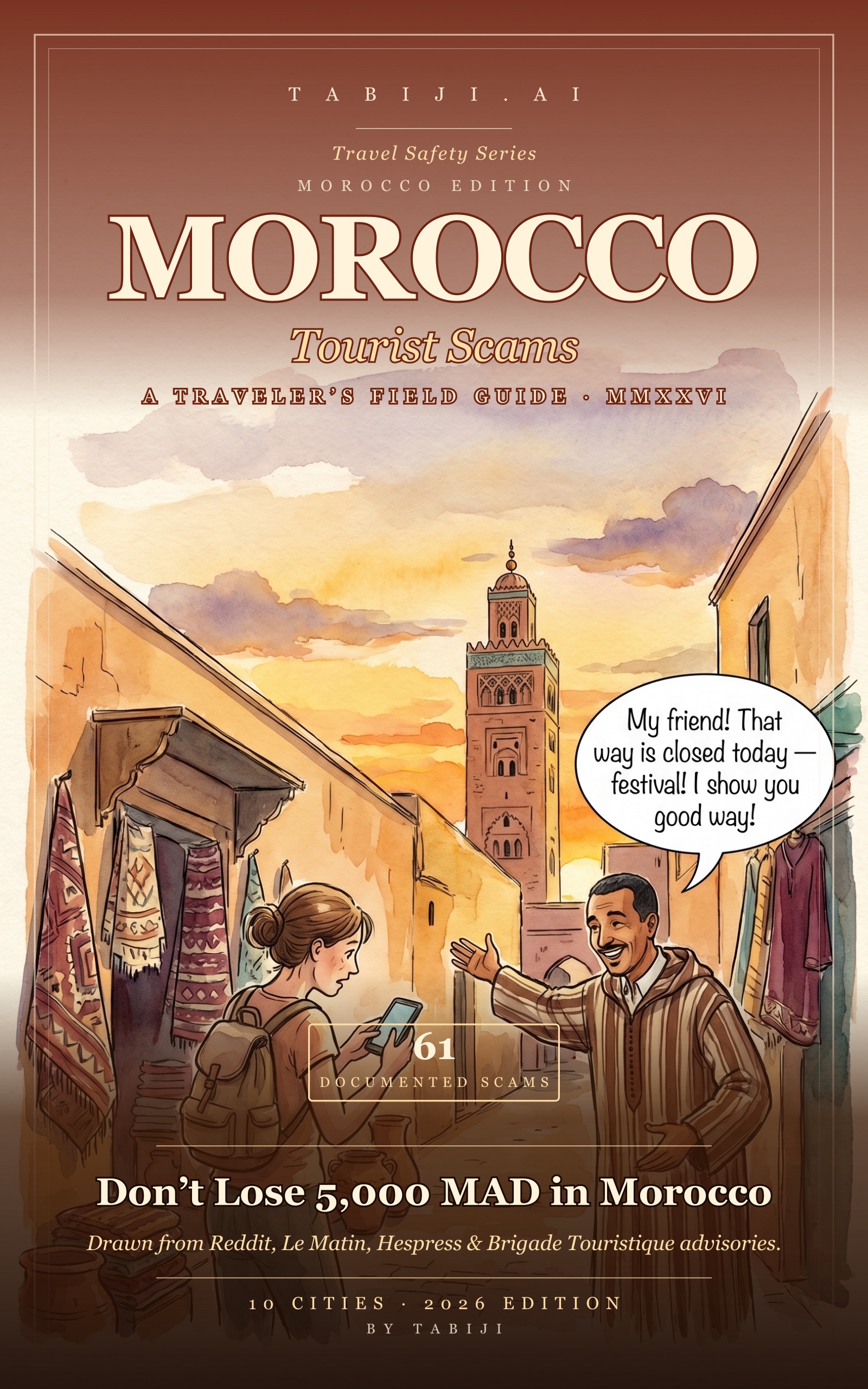
The square at sunset is dense with food stalls, snake charmers, drum circles. Three to five women in long robes circulate among tourists with henna cones already mixed and ready. They approach with "you are beautiful, free henna, just one minute, lucky symbol". If the tourist hesitates a half-second, a hand grabs the wrist and the henna cone is already moving on the skin.
The "free" henna is then priced at 200-500 dirham (20-50 EUR) once complete. Photographs of the design serve as the operator's leverage: the tourist will pay rather than walk through the square with an unfinished half-pattern. The Marrakech tourist police are aware of the variant; phoning 19 (Moroccan police emergency) collapses the demand.
Defense: hands in pockets when crossing the square at any time of day; if grabbed, pull back firmly with a sharp "la shukran, imshi" (no thanks, walk on); walk away even if the design is half-finished; do not negotiate price.
Florence Piazza della Signoria: the rose at the table
Trattoria on Via dei Neri, 9pm. The waiter brings the primi. Two men with armfuls of roses move in single file through the doorway, working the room. The first reaches your table, smiles at the woman across from you, places a single red rose next to her plate before either of you has looked up. He turns to you: "Just five euro for the lady, signore."
This is the rose-seller restaurant shakedown, the canonical Italian variant. The price escalates if you hesitate (five becomes ten becomes twenty), and the operator will linger at the table until you pay or send him off. The Florence Tourist Police issue advisories about the variant in Trastevere-equivalent neighborhoods (Santa Croce, Oltrarno).
Defense: when you see roses entering the restaurant, raise a hand to wave them off before they reach the table; if the rose is already placed, hand it back immediately (do not let it sit on the table even one minute) and say "no grazie, vada via" firmly.
Barcelona Las Ramblas: the trinket placement
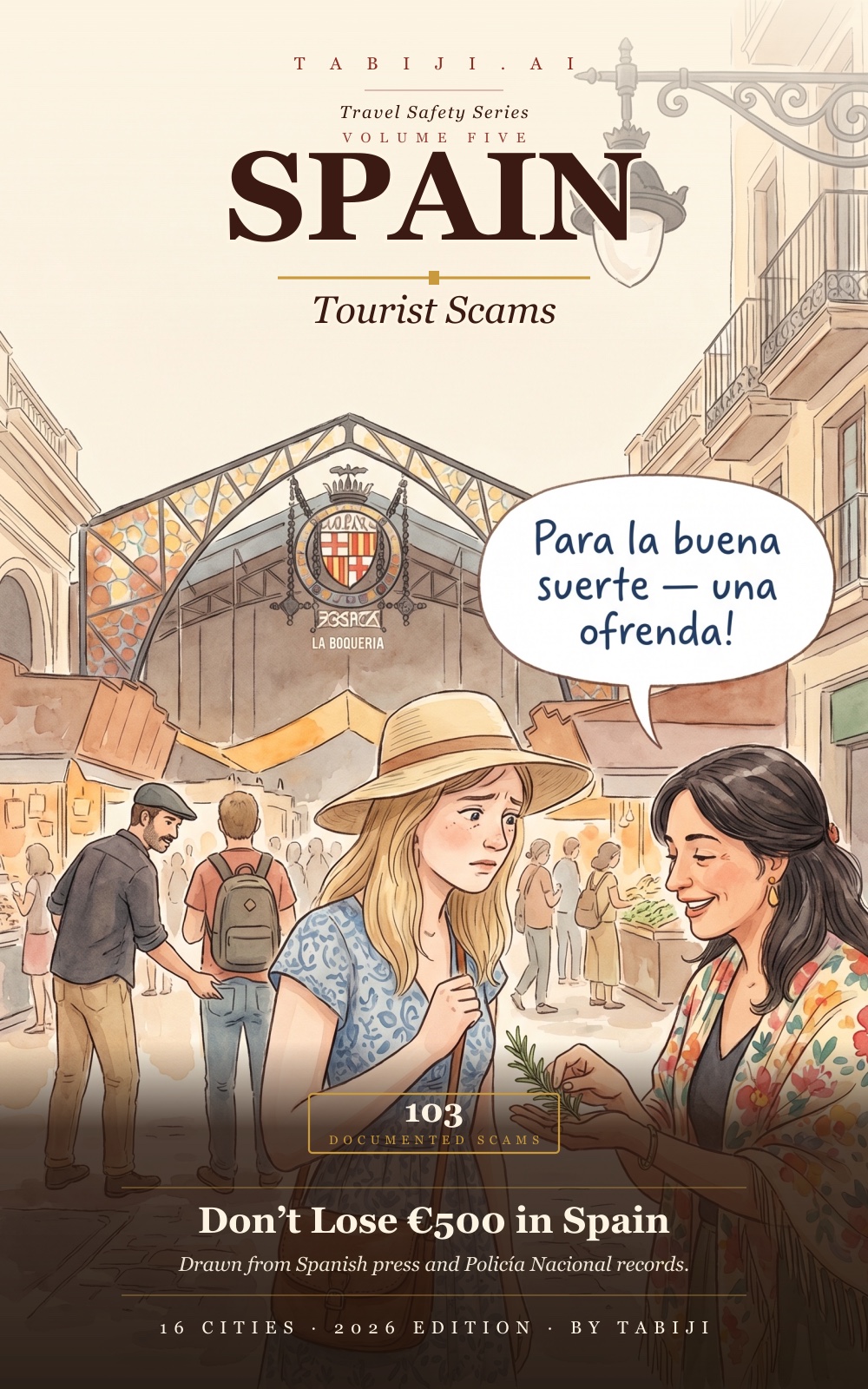
Las Ramblas at the Boqueria market entrance. A man with a small open box of carved wooden figures (camels, owls, small Buddhas) approaches. He says "for you, gift, no money, just look". Before you can decline, he places one in your palm and closes your fingers around it. Then "now twenty euro, very nice, very nice".
This is the trinket placement, the same mechanic as the Roman bracelet but with a small object instead of a string. The defense is identical: hands closed or in pockets when crossing Las Ramblas at any time. If the object lands, drop it on the ground (not back to the operator) and walk away.
The Mossos d'Esquadra (Catalan police) will respond to a 092 call from anywhere on Las Ramblas; phoning typically scatters operators within minutes. The Sagrada Familia and Park Guell entrances are also known sites for the variant.
Red flags
- "Free gift" or "lucky" language. Real vendors price items; "gift" and "lucky" are setup vocabulary for the demand that follows.
- Vendor walks toward you. Legitimate vendors stand at stalls; you walk to them. Approach motion is the variant.
- Item placed in your hand without your asking. The bracelet on the wrist, the rose at the table, the trinket in the palm. Once placed, the demand follows.
- Group of 3-6 men working a square in coordination. Single operators are rare; the group enforces the negotiation through proximity.
- No printed price on the item. Selfie sticks, trinkets, postcards from legitimate vendors carry tags. No tag, walk past.
- Henna artist initiates physical contact. Real henna artists have stalls; aggressive operators move and grab. The grab is the variant.
- Rose seller at restaurant doorway scanning tables. Wave off before they cross the threshold; once inside, the rose is already moving.
- "Just one second" or "just one minute" framing. The compression-of-time language is built to override your stop-and-think reflex.
The phrases that shut it down
Each language below shuts down the local variant before engagement begins. Said firmly while walking past at normal pace, no eye contact.
If you got hit
If you paid: the loss is typically small (20-200 EUR). Itemize the loss for travel insurance, but most policies have minimums above this threshold; the loss is usually unrecovered. The exception is if force or threat was used, in which case file a police report at the local tourist police office (Italy 113, France 17, Spain 091/092, Morocco 19, Egypt 122) within 24 hours and request a copy in English for any insurance claim.
If you were physically grabbed (henna grab, sleeve grab) and felt threatened: phone the local police emergency from the spot. Photograph the operator if safely possible. Most operators scatter at the first phone call. The Marrakech, Cairo, and Istanbul tourist police all have English-language dispatch lines and respond within minutes to major squares.
If a bracelet, rose, or trinket has been transferred to you and you do not want to pay: drop it on the ground and walk at normal pace. Do not return it to the operator (this is treated as a haggle position). Most operators retrieve and move on within 30 seconds.
Related atlas entries
Sources & references
- Polizia di Stato (Italy) tourist-police 113: ongoing advisories about Spanish Steps, Trevi, and Vatican operators.
- Prefecture de Police (Paris): Montmartre bracelet warnings, signage at funicular landings since 2018.
- Mossos d'Esquadra (Catalonia): Las Ramblas operator dispatch line 092.
- Royal Gendarmerie of Morocco: Marrakech Jemaa el-Fnaa henna and trinket advisories, dial 19.
- Egyptian Tourism and Antiquities Police: Khan el-Khalili and Pyramids approach advisories, dial 126.
- Tabiji field reports: Rome Spanish Steps, Florence Piazza Signoria, Paris Sacre-Coeur, Marrakech Jemaa el-Fnaa, Barcelona Las Ramblas (2024-2026).
Get the full street-vendor scam playbook for your destination.
Each Travel Safety atlas covers every documented street-vendor and hustler scam in one country, plus the full scam catalog: pickpocket, taxi, ATM, restaurant, fake authority. Buy once, lifetime updates as scams evolve. $4.99 on Kindle.