The friendship bracelet trap, four ways the string ends up on your wrist.
Two men at the foot of the Sacre-Coeur stairs. A coin trick at Marrakech Jemaa el-Fna. A friendly handshake on Las Ramblas. A group of three at the Spanish Steps. Four mechanics across 14 countries, defeated by the same physical reflex: hands in pockets the moment any stranger approaches with anything in their hand.


The friendship bracelet trap runs four mechanics across 14 countries: tie-first wrap (string on the wrist before refusal is possible), coin-trick lure, friendly-greeting slip, and group-surround. The universal defense is one physical reflex: hands in pockets the moment any stranger approaches with anything in their hand. Pocketed hands cannot be wrapped. The defense in depth is refusing all hand-grab attempts (do not extend your hand for street-magic or palmistry demonstrations) and walking past without stopping. If a string is already on your wrist, do not pay; the string is worthless thread.
"Madame, un cadeau pour la dame, juste un petit bracelet, attends."
You walk up the rue Foyatier stairs from Abbesses metro toward the Sacre-Coeur basilica at 6pm on a Saturday. The basilica's white dome glows in the early evening light above you. The stairs are crowded with tourists and locals returning from Pigalle. Halfway up, two men in their twenties step out from a small landing, smiling, holding what look like colored strings braided into thin bracelets.
The first one calls out: "Madame, un cadeau pour la dame, juste un petit bracelet, attends une seconde, un cadeau, c'est gratuit, vraiment, viens." (Ma'am, a gift for the lady, just a little bracelet, wait one second, a gift, it's free, really, come.) He is already extending the string toward your wife's hand which she has at her side. She instinctively pulls back; he steps closer, smiling, mouth wide. The second man has come up behind you, casually blocking the path back down the stairs.
The first man's hand has the string in a loop. He is moving toward your wife's wrist with practiced speed. She raises both hands to chest height; he changes target, reaches for yours. Your hands are still at your sides. The string loops over your wrist and his hand pulls, knotting it tight in two seconds.
"Voila, c'est pour toi mon ami, c'est un bracelet d'amitie, juste vingt euros pour aider, oui?" (There, it's for you my friend, it's a friendship bracelet, just twenty euros to help, yes?)
You shake your head. You step around the second man and walk up the stairs without stopping. The first man calls after you: "Vingt euros, c'est rien, pour les enfants, pour la famille." You keep walking. He does not follow. At the top of the stairs you stop, take out a small pocket knife, and cut the string off your wrist. It is woven cotton thread, the kind that costs about thirty cents per ten meters at a wholesale shop. The whole interaction took ninety seconds.
That is the canonical tie-first variant of the friendship-bracelet family, executed at the most-documented bracelet-tout location on Earth. The rest of this page is the four-mechanic playbook, the four other cities where it runs in different forms (Rome, Barcelona, Marrakech, Athens), and the hand-in-pocket reflex that defeats every variant.
Read the full Paris scam guide →Key Takeaways
The hand-in-pocket reflex
The friendship bracelet scam depends on access to your wrist or fingers for the two seconds it takes to wrap. Pocketed hands cannot be wrapped. The defensive routine is a single trained reflex: the moment any stranger approaches with anything in their hand, your hands go to your front pockets. The play falls apart instantly because the operator has nothing to wrap.
- Hands in pockets the moment any stranger approaches with anything in their hand. Anyone approaching with colored string, a coin, a flower, a sprig of rosemary, or any small object in a tourist zone is the cue to put both hands in your front pockets and keep walking. The string scam depends on access to your wrist; pocketed hands cannot be wrapped.
- Refuse all hand-grab attempts categorically. If a stranger asks "can I show you something" or extends a hand toward yours, do not extend yours. Step around them. Real demonstrations of magic, palmistry, or "free gifts" do not require your hand. The hand-grab is the scam; refuse the precondition.
- Cut and walk away if the bracelet is already on. If a string is already wrapped or knotted on your wrist before you can refuse, do not pay. The string is worthless thread; cut it off with your fingernail or wait until you are away. Most touts move on within 30 seconds when the target does not pay.
- Walk through iconic locations with hands occupied. Sacre-Coeur stairs, Spanish Steps, Trevi Fountain perimeter, Las Ramblas, Plaza Catalunya, Marrakech Jemaa el-Fna are the most-documented bracelet-tout locations. Walk through with phone in front pocket, hands holding bag straps or in pockets, not at your sides.
- Watch for the group-surround at corners and stairs. Two or three men converging simultaneously at a stair or pinch-point are running the group-surround variant: one ties while the others block exit. If you see two operators converging, change direction immediately. The group cannot work a moving target.
The four mechanics
Different cities and operator crews lean on different precipitating actions within the same family. Here are the four sub-variants documented globally. Each has a recognition tell, a primary geography, and the routine step that defeats it.
1. Tie-First Wrap
An operator approaches saying "a gift for the lady" or "a friendship bracelet, just to talk" while extending a colored string. Before the tourist can refuse, the operator wraps the string around an extended finger or a wrist that is hanging at the side, or knots it during what looks like a friendly greeting gesture. Once on, the operator demands 5 to 50 EUR. The variant works because the operator commits to the action faster than the tourist can react.
Defense: hands in pockets when any stranger approaches with anything in their hand. Most reported in: Paris Sacre-Coeur stairs and Place du Tertre; Rome Spanish Steps and Trevi Fountain; Barcelona Las Ramblas; Florence Piazza della Signoria; Athens Plaka.
2. Coin-Trick / Magic Lure
An operator approaches saying "I want to show you something special" or "one minute, magic trick" and asks for the tourist's hand. While performing a coin-disappearance trick, palmistry, or "free gift" demo, the operator weaves a colored string around the tourist's fingers. By the time the trick is done, the bracelet is on and the price is demanded. Most-documented variant in North African and Middle Eastern souk-style markets.
Defense: do not extend your hand for any street-magic or palmistry demonstration. Most reported in: Marrakech Jemaa el-Fna; Fez Bab Boujloud; Cairo Khan el-Khalili and Tahrir; Giza Pyramid perimeter; Istanbul Sultanahmet.
3. Friendly-Greeting Slip
An operator approaches with a friendly "hello, where are you from?" and extends a hand for what looks like a handshake or fist bump. As the tourist's hand meets theirs, the operator slides a pre-prepared colored string or knotted bracelet around the tourist's wrist or finger in the same motion. The variant works because tourists default to accepting friendly greetings in tourist zones.
Defense: do not shake hands or accept fist-bumps from any unknown stranger in a major-tourist-zone street. Most reported in: Rome Trevi and Spanish Steps; Florence Piazza della Signoria; Barcelona Las Ramblas; Athens Plaka and Acropolis stairs; Lisbon Rua Augusta.
4. Group-Surround
Most common at stairs and pinch points. Two or three operators converge on the tourist simultaneously: one ties the bracelet while the other two block sideways escape and stand close enough that walking past requires brushing against them. The variant runs at the same iconic locations as the tie-first variant but at higher operator density during peak hours.
Defense: when you see two or three operators converging at a stair or narrow corridor, change direction immediately. Most reported in: Paris Sacre-Coeur stairs (rue Foyatier); Rome Spanish Steps; Athens Acropolis stairs; Barcelona Sagrada Familia perimeter; Lisbon Castelo de Sao Jorge approach.
Where it runs
Friendship bracelet operators concentrate at iconic, high-photo, high-pedestrian-traffic monuments and stairs. The eight countries below cover the bulk of global tourist exposure.
| Country | Documented variants | Iconic location pattern |
|---|---|---|
| 🇫🇷 France | 8 | Paris Sacre-Coeur stairs and Place du Tertre, Champ de Mars, Pont des Arts; Nice Promenade des Anglais |
| 🇮🇹 Italy | 6 | Rome Spanish Steps, Trevi, Pantheon, Vatican Museums queue; Florence Piazza della Signoria; Naples; Venice San Marco |
| 🇪🇸 Spain | 5 | Barcelona Las Ramblas, Plaza Catalunya, Sagrada Familia perimeter; Madrid Sol and Plaza Mayor; Sevilla Plaza Espana |
| 🇲🇦 Morocco | 4 | Marrakech Jemaa el-Fna; Fez Bab Boujloud; Casablanca Mosque Hassan II; Tangier medina |
| 🇬🇷 Greece | 3 | Athens Plaka, Acropolis approach, Monastiraki; Santorini Oia |
| 🇪🇬 Egypt | 2 | Cairo Khan el-Khalili and Tahrir; Giza Pyramid perimeter |
| 🇹🇷 Turkey | 2 | Istanbul Sultanahmet, Spice Bazaar, Grand Bazaar perimeter |
| 🇵🇹 Portugal · 🇬🇧 UK · 🇮🇪 Ireland | 2 | Lisbon Rua Augusta and Castelo Sao Jorge; London Tower Bridge approach; Dublin Temple Bar |
Bar width is data-bound at 15 pixels per documented variant. France alone accounts for 25% of global exposure, driven by the Sacre-Coeur stairs being a single high-density operator concentration.
Four more cities, four more bracelet variants
The Sacre-Coeur stairs scene above showed the tie-first variant. Here are four more cities where different sub-variants dominate. Each links to the full city scam guide.

You climb the Spanish Steps from Piazza di Spagna toward Trinita dei Monti at 8pm. Halfway up, a man in his thirties greets you with a wide smile and an extended hand: "Ciao, where you from? America? Welcome to Roma." You instinctively extend your hand. As his hand meets yours, you feel a quick pull on your fingers; a colored string is now looped around your index and middle fingers in a knotted bracelet. He smiles wider and says: "Bracelet d'amicizia, ten euro, for friendship." Two more men have appeared from your right and left sides; you are now in a soft surround. The Carabinieri 112 takes English-language reports of the variant, but the Italian penal code threshold for the offense is too low for arrest in most cases; the Polizia di Stato 113 typically advises tourists not to pay rather than report. Defense: do not shake hands or accept fist-bumps from any unknown stranger on the Spanish Steps or Trevi perimeter. The "ciao, where you from" is the cue to step around without stopping. If a string is already on your fingers, do not pay; cut it off at the top of the steps.
Read the full Rome scam guide →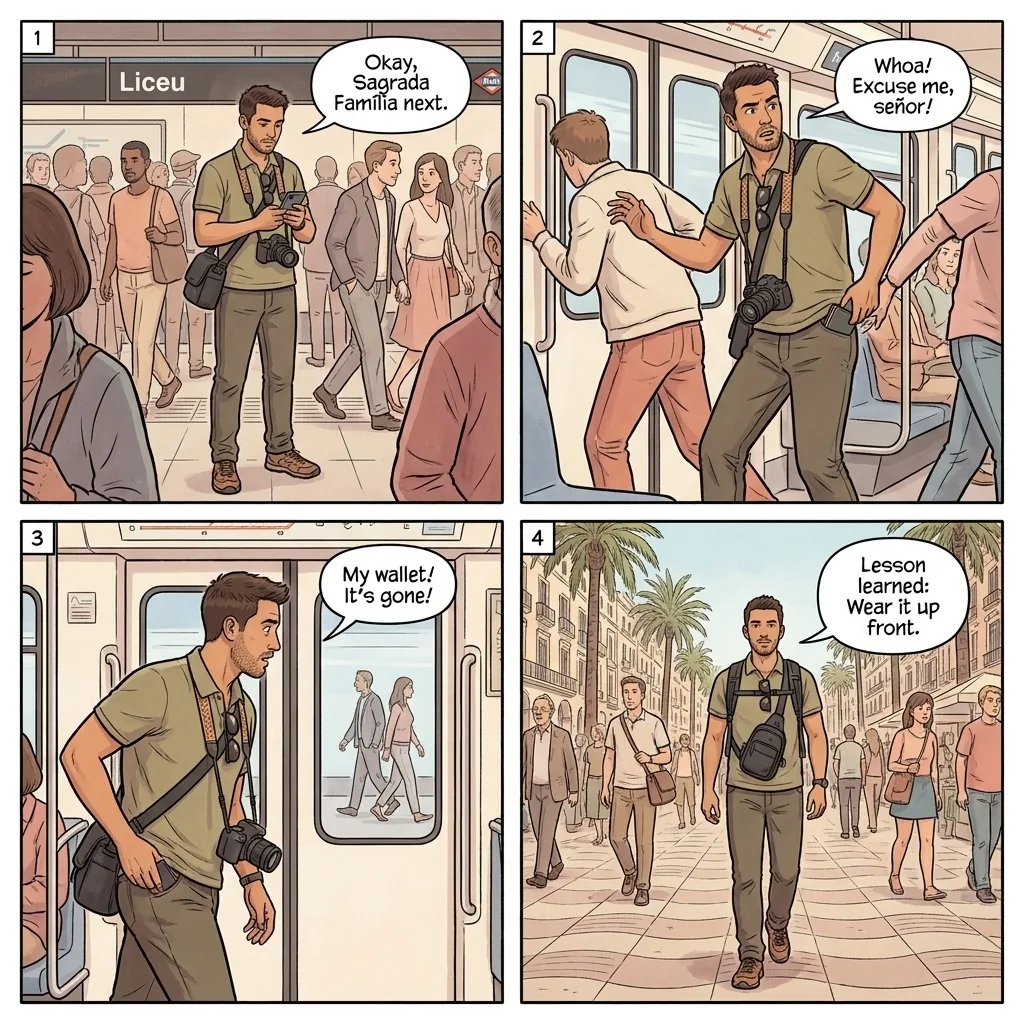
You walk down Las Ramblas from Placa de Catalunya at 1pm on a Tuesday. Near the Liceu metro entrance, two men step out from a small kiosk landing, smiling, holding short braided strings. The first one extends a string toward your wife's wrist while the second moves to block your right side. You pull her hand back; the first one redirects toward your wrist. You step left, the second man matches your step. The whole interaction takes four seconds before you and your wife both put your hands in your front pockets and walk through. They follow for ten meters calling "amigo, just one bracelet, for friendship" then peel off. The Mossos d'Esquadra Tourist Help line at +34 932 903 000 (24/7, English-speaking) accepts complaints about the Las Ramblas variant; the Comune of Barcelona issues annual press releases warning of the variant during peak summer months. The same play runs at the Sagrada Familia perimeter and the Park Guell entrance. Defense: hands in pockets the moment you see anyone with colored string on Las Ramblas or near a Gaudi monument. The Sagrada Familia ticket queue is the highest-density variant location in Spain; walk past with hands in pockets, not down at sides.
Read the full Barcelona scam guide →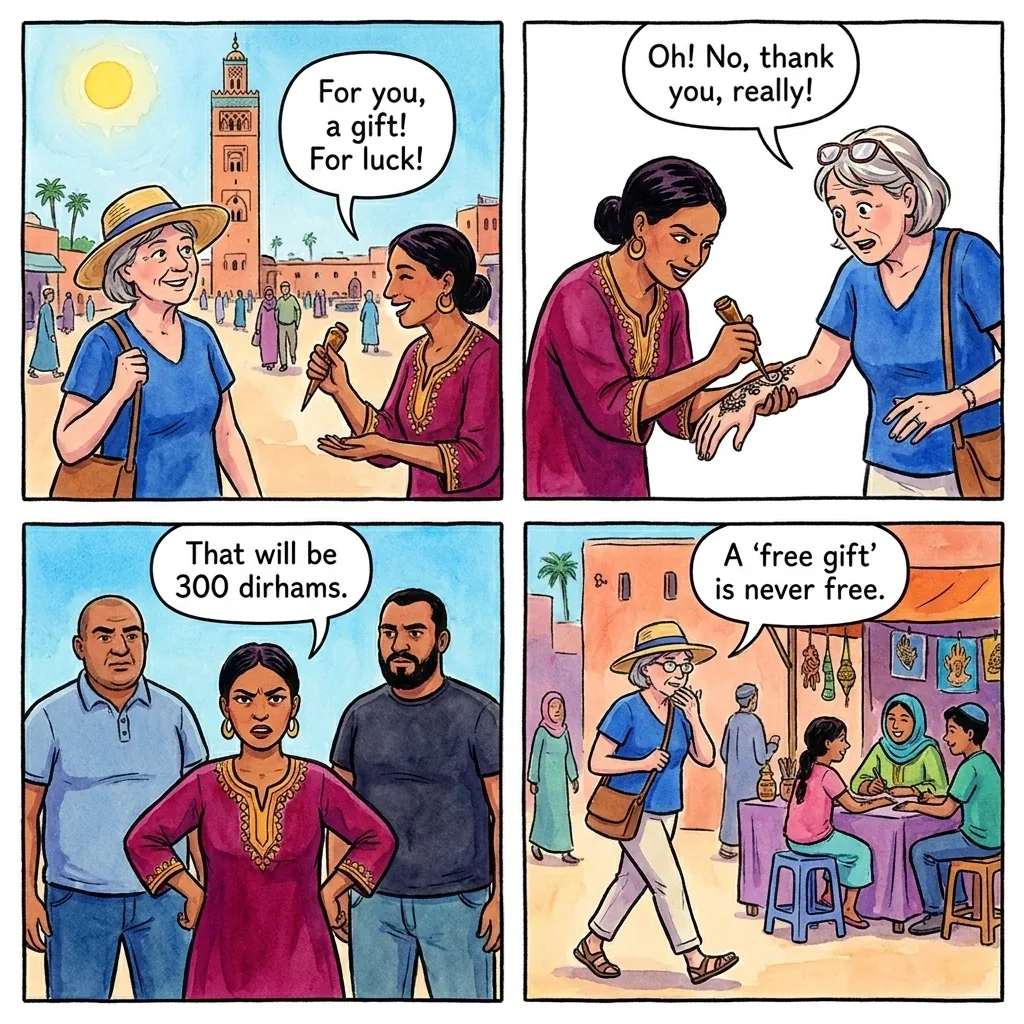
You walk through Jemaa el-Fna at 9pm with the call to prayer ending and the food stalls firing up. A man in a long white djellaba waves at you from a small stall: "Sir, sir, one minute, magic trick, you will love it, free, for tourists." You stop, smile politely. He produces a coin, asks for your hand "just to show, no problem, free." You extend your right hand. He places the coin in your palm, closes your fist, taps the back of your hand, opens it. The coin is gone. While you were looking at your now-empty palm, his other hand wrapped a colored string around your left wrist in a tight knot. He smiles wider: "Now you have friendship bracelet, magic gift, fifty dirham, you give." The Brigade Touristique office at Place Bab Doukkala (24/7) accepts walk-in reports; the Office National Marocain du Tourisme has issued advisories about the Jemaa el-Fna variant during peak season. Defense: do not extend your hand for any street-magic or palmistry demonstration in Jemaa el-Fna. Real performers (the storytellers, the snake charmers) do not need to touch you. The hand-grab is the scam.
Read the full Marrakech scam guide →
You climb the steps from the Plaka neighborhood toward the southern entrance of the Acropolis at 11am. Two men step from a small landing on the path; a third joins from below. They greet you in English: "Welcome to Athens, friend, where you from?" They are all holding colored strings; one steps to your left, one to your right, the third moves close in front. The path narrows here; sideways escape is hard. You stop, you put both hands in your front pockets. You say in clear English: "No thanks, please leave me alone." The first man tries one more time: "Just for friendship, one minute." You shake your head and step around the third man on the right side. They peel off after five seconds. The Tourist Police 1571 (English-speaking dispatch) accepts reports; the Hellenic Tourist Police office at 33 Veikou Street in Plaka takes walk-in complaints. Defense: on the Acropolis approach stairs, watch for men with colored strings standing on small landings. The pinch-point geography is the operator's tool; widen your distance to the rock face on either side and walk past with hands in pockets.
Read the full Athens scam guide →Red flags
If two or more of these signals fire when you are walking through a tourist zone, hands in pockets and walk past without stopping. The compounding rule: a single signal might be a coincidence; two signals are a script.
- A stranger approaches with colored string, woven thread, or knotted bracelet visible
- The stranger says "a gift for the lady" or "just a friendship bracelet"
- The stranger asks "where are you from" while extending a hand
- The stranger asks if you want to see a magic trick, palmistry, or "free demo"
- You are at the Sacre-Coeur stairs, Spanish Steps, Acropolis approach, or similar pinch point
- Two or three men converge on you simultaneously at stairs or a corner
- The stranger blocks your sideways escape route
- A "friendly local" insists on shaking your hand
- You are approached during the first 10 meters of a major monument approach
- The stranger has a small bag or pouch of pre-prepared bracelets visible
The phrases that shut it down
Refusing the friendship bracelet works when you signal you do not want to be touched. The phrase is the same idea in every language: do not touch my hand.
If you got hit
The string is on your wrist and the operator is asking for 20 EUR. Friendship bracelet losses are the smallest in the Atlas (5-50 EUR per incident) but among the most-reported because they happen at iconic locations and feel disproportionately violating. The recovery sequence is short: do not pay, walk away, cut the string, file a complaint only if the variant escalated to physical contact.
If the variant is the standard tie-first, friendly-greeting, or coin-trick: refuse to pay, walk away. The string is worthless; the operator's leverage is the social pressure of the moment. Most operators move on within 30 seconds because they are running through 50-80 tourists per shift and stopping to argue with one is unprofitable.
If the variant is the group-surround and the operators block your physical escape: continue refusing payment but walk persistently in the direction of dense pedestrian traffic. The variant relies on isolation; it does not work in front of witnesses. If the operators escalate to physical contact, file a police report at the nearest tourist-police office (most major tourist hubs have one within 10 minutes' walk of any iconic monument).
- Paris: Prefecture de Police 17 (24/7); SARIJ commissariats including 10 boulevard Strasbourg-Saint-Denis; Sacre-Coeur perimeter is patrolled by the 18e arrondissement police.
- Rome: Carabinieri 112; Polizia di Stato 113; Spanish Steps perimeter Polizia office at Via di San Sebastianello.
- Barcelona: Mossos d'Esquadra Tourist Help, +34 932 903 000 (24/7, English); Las Ramblas patrol is continuous during peak hours.
- Marrakech: Brigade Touristique, Place Bab Doukkala (24/7); English-language reports accepted.
- Athens: Tourist Police 1571 (24/7, English-speaking dispatch); Plaka office at 33 Veikou Street.
- Cairo: Tourist Police 126 (24/7); Khan el-Khalili patrol office.
- Istanbul: Tourist Police 0212 527 4503; Sultanahmet office.
- Lisbon: PSP Tourist Help, Praca dos Restauradores, +351 21 342 1623.
The cash loss (5-50 EUR per incident) is rarely worth pursuing through official channels; the variant is most commonly classified as a low-threshold consumer-protection complaint rather than theft. The actionable response is preventive for the next encounter: hands in pockets at every iconic-monument approach, refuse all hand-grabs, walk past without stopping.
Related atlas entries
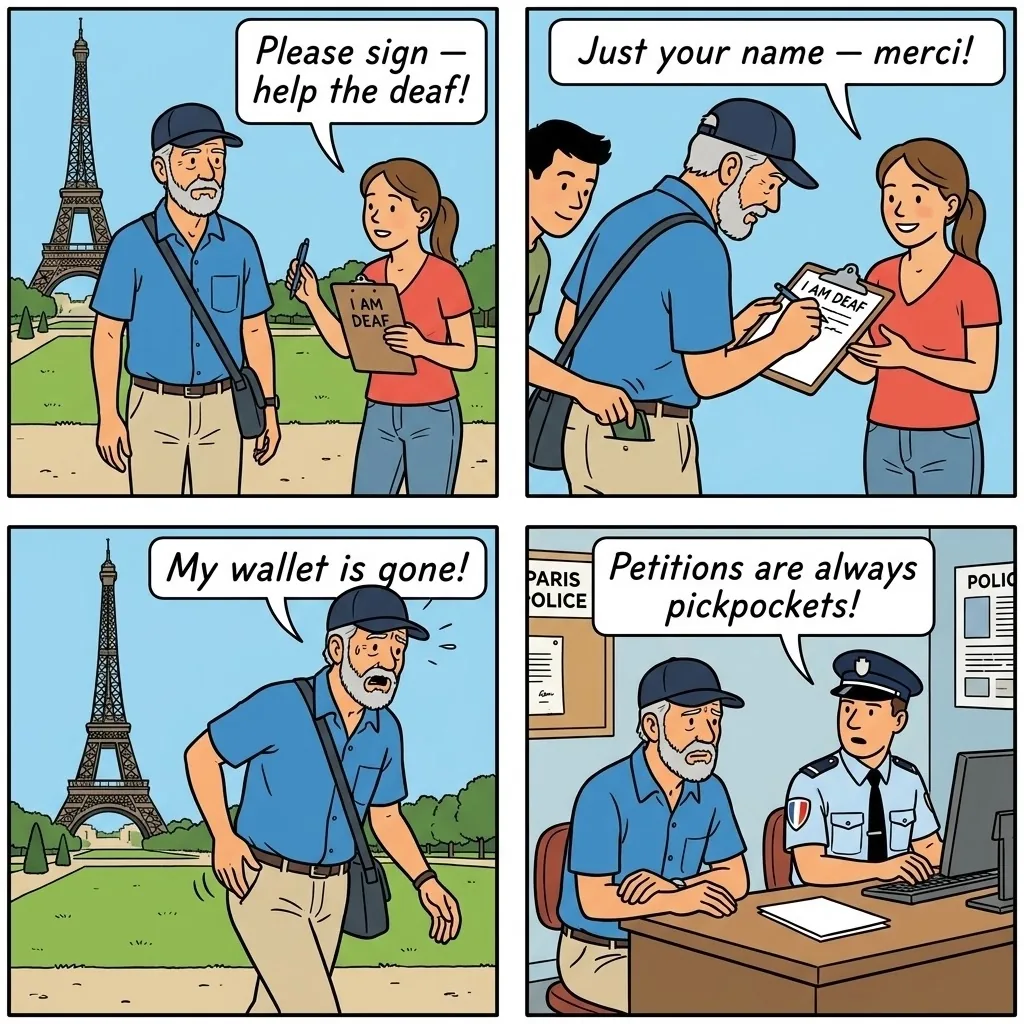
Sister entries in the Scam Atlas. The friendship bracelet trap is a specific named variant within the broader distraction-theft family; the Gold Ring Trick is a sister named scam in the Distraction & Confidence section.
Sources
- Prefecture de Police de Paris, 18e arrondissement Sacre-Coeur perimeter operator-tout enforcement bulletins (Paris, ongoing).
- Le Parisien and Le Figaro, Sacre-Coeur and Champ de Mars friendship-bracelet coverage (Paris, 2018-2025).
- Carabinieri Roma, Spanish Steps and Trevi Fountain perimeter quarterly bulletins (Italy, ongoing).
- La Repubblica, Spanish Steps and Trevi friendship-bracelet arrest reporting (Rome, 2018-2025).
- Mossos d'Esquadra Catalonia, Las Ramblas and Sagrada Familia perimeter bulletins (Barcelona, ongoing).
- Brigade Touristique Marrakech, Jemaa el-Fna coin-trick lure incident logs (Morocco, ongoing).
- Tourist Police Athens 1571, Plaka and Acropolis approach group-surround logs (Greece, ongoing).
- Office National Marocain du Tourisme, Marrakech Jemaa el-Fna advisories (Morocco, peak-season).
- r/travel, r/Paris, r/rome, r/Barcelona, r/Morocco continuing thread monitoring 2018-2026.
Get the full friendship-bracelet playbook for your destination.
Each Travel Safety atlas covers every documented distraction and confidence scam in one country, plus the country's full scam catalog: pickpocket, taxi, ATM, restaurant, fake authority. Buy once, lifetime updates as scams evolve. $4.99 on Kindle.