
Key Takeaways
- The #1 reported scam is the Athens Airport & Piraeus Cruise Port Taxi Overcharge.
- 7 of 8 scams are rated high risk.
- Use app-based ride services (Uber, Bolt) or official metered taxis instead of unmarked vehicles.
- Never accept unsolicited offers from strangers near tourist sites in Athens.
⚡ Quick Safety Tips
- From Athens Airport (ATH), the legal taxi flat rate to the city center is €40 daytime and €54 overnight — posted at the queue; anything else is a scam.
- Book Acropolis tickets only at hhticket.gr, GetYourGuide, Viator, or Tiqets — sites like acropolisticket.com are documented fakes that send invalid QR codes.
- Politely decline any drink invitation from a 'friendly local' in Plaka or Monastiraki — a real Athenian does not recruit tourists for unfamiliar bars.
- If someone with a bracelet or flower approaches at Syntagma or Monastiraki, cross your arms and step back — the item is a distraction for a team pickpocket.
- Save Tourist Police 171 (English-speaking, 24/7) — they mediate bar bills, rental disputes, and taxi overcharges effectively.
Jump to a Scam
- High Athens Airport & Piraeus Cruise Port Taxi Overcharge
- High Fake 'Skip-the-Line' Acropolis Ticket Websites
- High 'Friendly Local' Plaka & Monastiraki Bar Invitation
- High Friendship Bracelet & Rose Distraction Theft
- High Fake Police 'ID Check' Pickpocket
- Medium Plaka & Monastiraki Tourist-Menu Restaurant Overcharge
- High Metro & Tour-Bus Pickpocket Teams
- High Hotel & Booking Off-Platform Payment Fraud
The 8 Scams

A taxi from Athens Airport quotes €160 to Syntagma when the legal flat rate posted at the queue is €40 by day or €54 overnight; Piraeus cruise-port drivers run the same play with claims of broken meters or "motorway closed" detours.
After a long flight or a tiring ferry from the islands, the taxi queue at Athens International Airport feels like the easiest way to reach your hotel. You climb in, the driver nods at your destination — Syntagma, Plaka, Koukaki — and pulls into the Attiki Odos motorway. The meter starts. You don't see the legal flat-rate signs posted at the queue itself.
At Syntagma the meter reads €160. The legal flat rate from the airport to central Athens is €40 between 5 a.m. and midnight, and €54 between midnight and 5 a.m. — those prices are posted on signs at the taxi queue, but exhausted travelers rarely read them. Drivers use three variations: claiming the meter is "broken" and quoting a flat €80–€160; running a tampered meter that climbs unusually fast; or taking surface streets instead of Attiki Odos, doubling the legitimate fare. Piraeus cruise port runs the same playbook on cruise arrivals heading into central Athens.
In July 2025 Greek authorities arrested an Athens taxi driver specifically for overcharging tourists, with Greek City Times reporting the case as part of a broader enforcement push. That's reassuring, but the scam continues because Tourist Police response is hours away from any given moment. The cleanest defense is to bypass the queue: from the airport, Metro Line 3 runs directly to Syntagma for €9 per person (40 minutes), and the X95 express bus runs for €6 (60 minutes). From Piraeus, Metro Line 1 reaches Monastiraki for €1.40 in about 20 minutes. If you do take a taxi, use Uber, Bolt, FreeNow, or Beat — all four show fixed prices before you commit and provide a digital receipt. Photograph the license plate of any driver who tries to overcharge and report to Tourist Police 171.
Red Flags
- From Athens Airport (ATH), driver quotes anything other than €40 flat (5 AM–midnight) or €54 flat (midnight–5 AM)
- Driver claims the meter is broken and offers a 'fixed rate' instead — always a warning sign
- Meter climbs unusually fast, at a pace inconsistent with the distance covered
- Driver avoids the Attiki Odos motorway and takes surface streets that lengthen the journey
- At Piraeus port, driver quotes above €1 per kilometer plus the legitimate port surcharge
How to Avoid
- From Athens Airport, use Metro Line 3 (€9, 40 minutes) or the X95 express bus (€6, 60 minutes) to bypass taxis entirely.
- If you take a taxi, insist on the posted flat rate — €40 daytime or €54 overnight — and point to the sign at the queue.
- Use Uber, Bolt, FreeNow, or Beat apps for all city taxi rides; app prices are fixed and receipts are digital.
- Ask your hotel concierge to arrange a fixed-price airport transfer (€45–€55) before arrival for peace of mind.
- If overcharged, photograph the taxi license plate and report to Tourist Police 171 — 2025 arrests have followed this process.
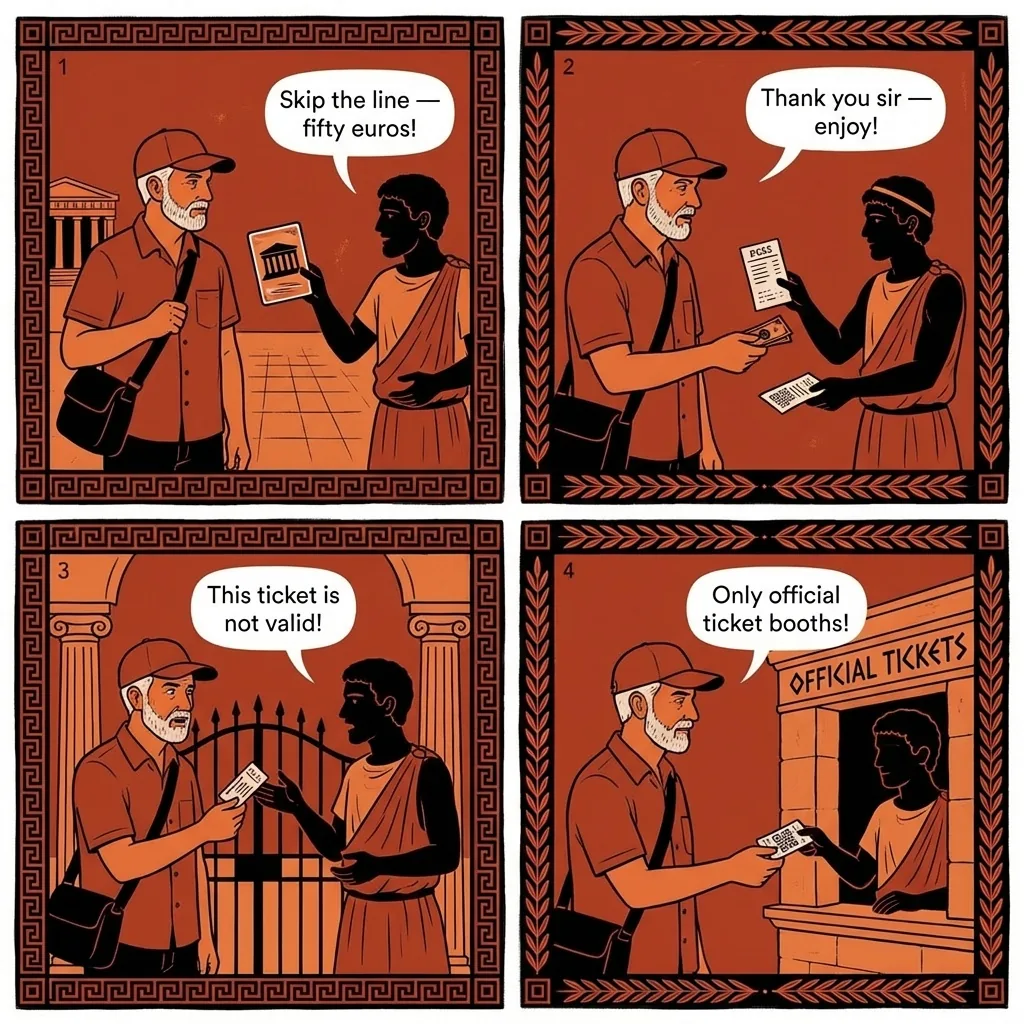
You book "skip-the-line Acropolis tickets" online from a site that looks official but isn't — the QR codes are blank at the gate, and the site (acropolisticket.com or a close variant) is run from outside Greece with no recourse.
Weeks before your trip you search "Acropolis tickets online" and click the first result — a site called acropolisticket.com, athens-acropolis-tickets.com, or a close variant. The design looks professional. The pricing — €45 per person for "skip-the-line tickets" — is roughly twice the official combo price but you assume that's the convenience markup. You pay by card and receive a PDF voucher with a QR code.
At the Acropolis gate on arrival you queue for fifteen minutes, hand over your phone with the QR code, and the scanner beeps red. The staff shake their heads: blank QR, not in our system. The "site" you bought from has no Greek address, no support phone number that picks up, and no resemblance to the real ticket portal. The only official Acropolis ticket site is hhticket.gr, operated by Hellenic Heritage under contract with the Ministry of Culture. You bought from a counterfeiter.
The on-site variant runs in parallel. Touts outside the Acropolis ticket booth and near the Theatre of Dionysus approach tourists in the queue with "skip-the-line passes" for €25–€40 per person — printed vouchers that either fail at the gate or are real combination tickets resold at a markup. The real Acropolis combo (Acropolis plus six ancient sites for five days) costs €30 from April to October or €20 in winter season 2025. The Ministry of Culture and Tourist Police 171 both publicly warn about unauthorized resellers. Book online only through hhticket.gr, GetYourGuide, Viator, or Tiqets — and search any other domain plus "scam" before paying. If you've already been burned, dispute the charge with your credit card within 60 days for a chargeback.
Red Flags
- Online site with 'acropolis' or 'skip-the-line' in the URL that isn't hhticket.gr, GetYourGuide, or Viator
- Site's copyright footer, contact page, or 'about us' has vague language and no real address
- Voucher is emailed as a plain PDF without a scannable QR code that verifies at the gate
- Tout outside the Acropolis ticket booth offers 'skip-the-line' tickets for cash
- Price is significantly below or above the official €20–€30 combo ticket (2025 pricing)
How to Avoid
- Book online only via hhticket.gr (the official Ministry of Culture ticket site) or verified resellers GetYourGuide, Viator, Tiqets.
- Search the domain name plus 'scam' before paying any online Acropolis ticket seller.
- At the Acropolis entrance, buy tickets at the official booth next to the main gate — ignore anyone approaching you in the queue.
- Licensed Greek tourist guides wear a yellow certification badge; ask to see it before hiring a guide on-site.
- If you've already been scammed, dispute the charge with your credit card within 60 days for a full chargeback.
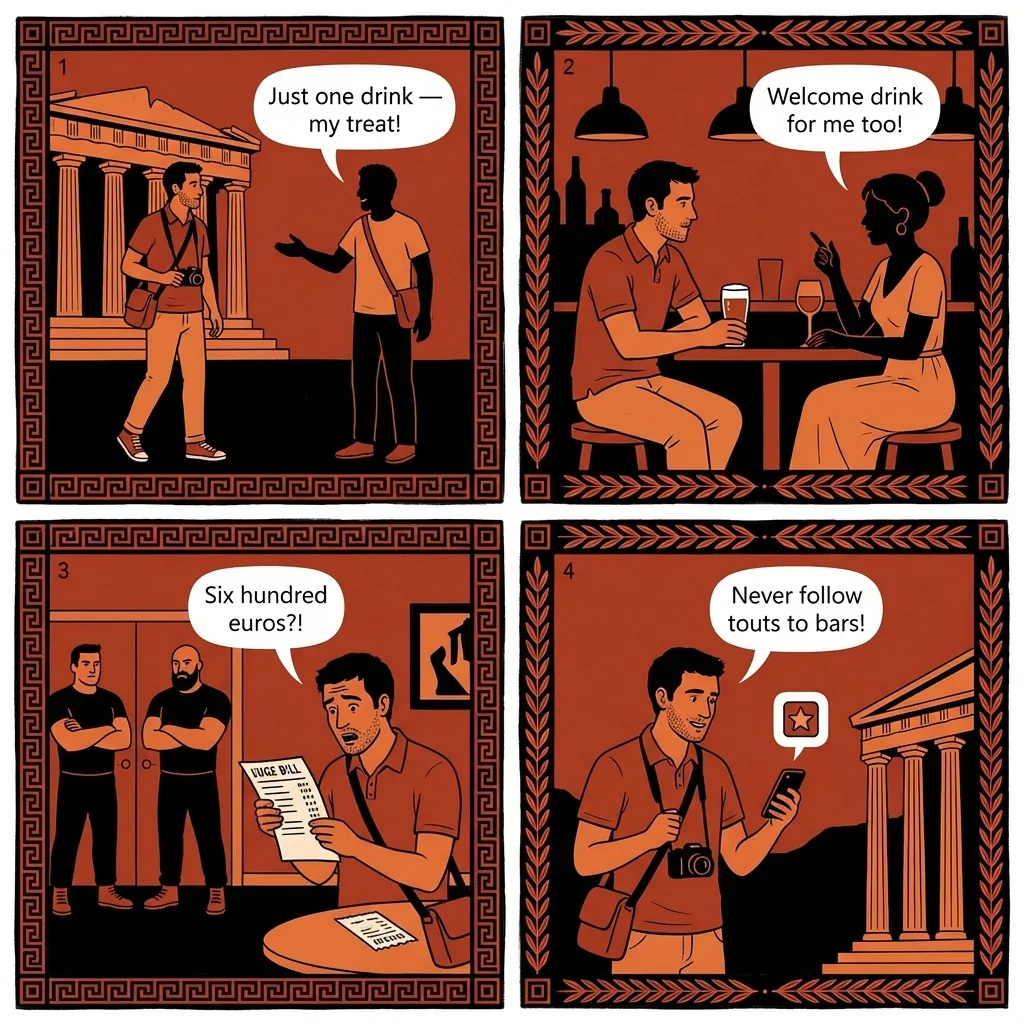
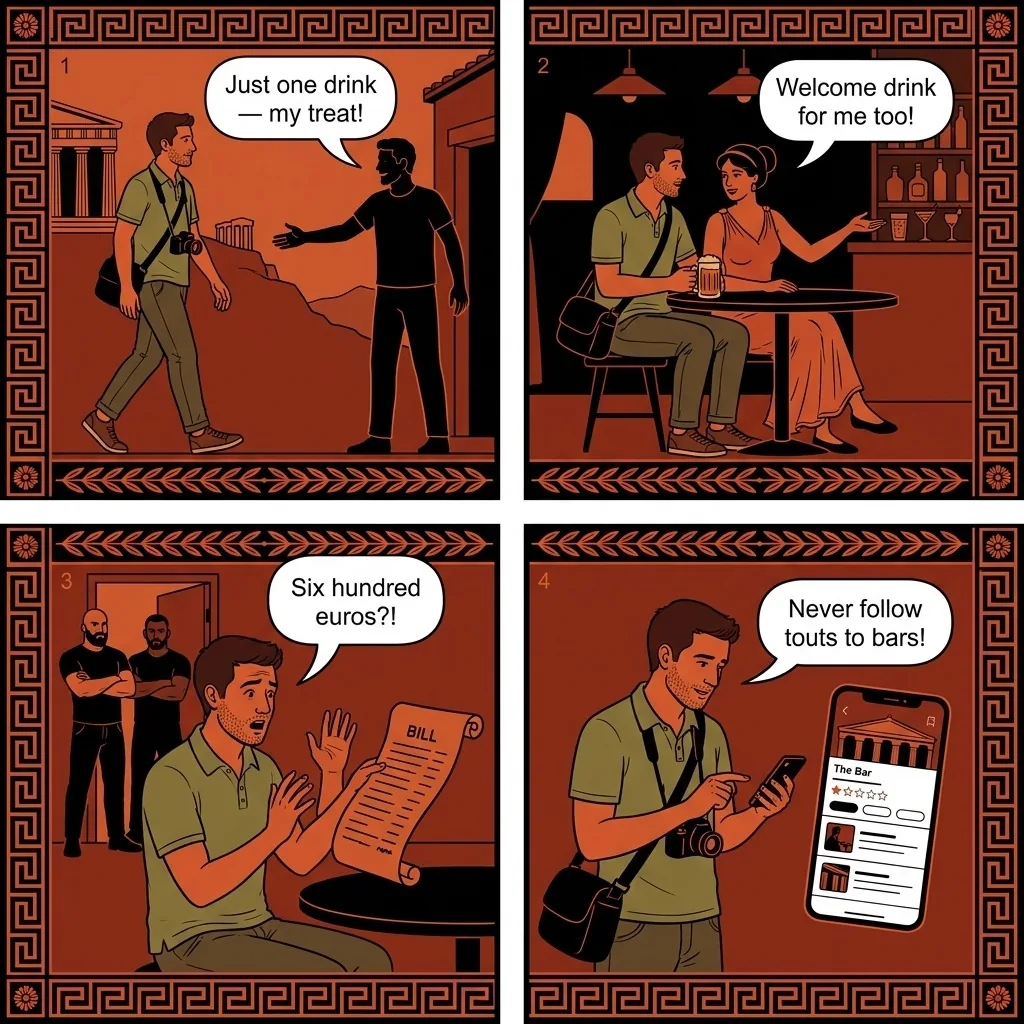
A charming older Greek man strikes up a conversation in Plaka, invites you to "a traditional ouzeri just down the lane," and forty minutes later the bill is €240 for drinks you didn't knowingly order — two men at the door confirm you can't leave until you pay.
You've finished a late-afternoon walk through the Ancient Agora and you're sitting at a Plaka café enjoying the breeze. An older Greek man — warm, charming, speaking good English — strikes up a conversation. He loves meeting visitors. He suggests you join him at "a traditional ouzeri just down the lane" where the prices are right and the atmosphere is real. You follow him.
The bar is dimly lit, tucked on a side street, no menu on the wall, no Google Maps presence. He orders two ouzos for €10 each — fine. Then a round for "his friends" who have just joined the table — fine, you'll cover your share. Then the bar staff start ordering drinks for themselves, and the "ladies" at the table order rounds that appear on your tab. Forty minutes later the bill is €240 and climbing. Two men at the door make it clear you cannot leave until you pay. Some travelers report the final bill at €400+ before negotiating down to €200 to escape.
Reddit has documented the escalation pattern: a first round of ouzo-orange-juice "special" mixers for €10 each, then €20 cocktails, then bar staff and "ladies" piling drinks onto your tab until bouncers move toward the exit. The "friendly local" is always a recruiter paid on commission per victim delivered, which is why he can be elegantly dressed and well-spoken. The bars have no posted menu and no Google reviews because the few that exist are one-star scam warnings. A real Athenian never invites a visitor for drinks at an unfamiliar bar — politely decline, walk back to a busy main street, and stick to named ouzeria with posted prices like Brettos, Klimataria, or Ta Karamanlidika tou Fani.
Red Flags
- A friendly Greek stranger in Plaka, Monastiraki, or Psyri offers to take you for a drink at 'a special place'
- Bar is on a quiet side street with no posted menu visible outside
- No prices are announced before drinks arrive; additional 'friends' or 'ladies' sit at your table
- Extra drinks appear at the table without you ordering them
- Exit is obstructed by staff when you ask for the bill, or the bill is drastically higher than expected
How to Avoid
- Politely decline any drink invitation from a stranger — a real Athenian does not invite tourists to unfamiliar bars.
- Stick to named, posted-price ouzeria with Google Maps reviews: Brettos, Klimataria, Ta Karamanlidika tou Fani.
- Ask to see the drink list with prices before ordering, and walk out if the bar cannot produce one.
- Pay for each drink at the bar as you order rather than running a tab.
- If the bill is inflated and staff block you, calmly call Tourist Police 171 — venues fold quickly at the mention of police.
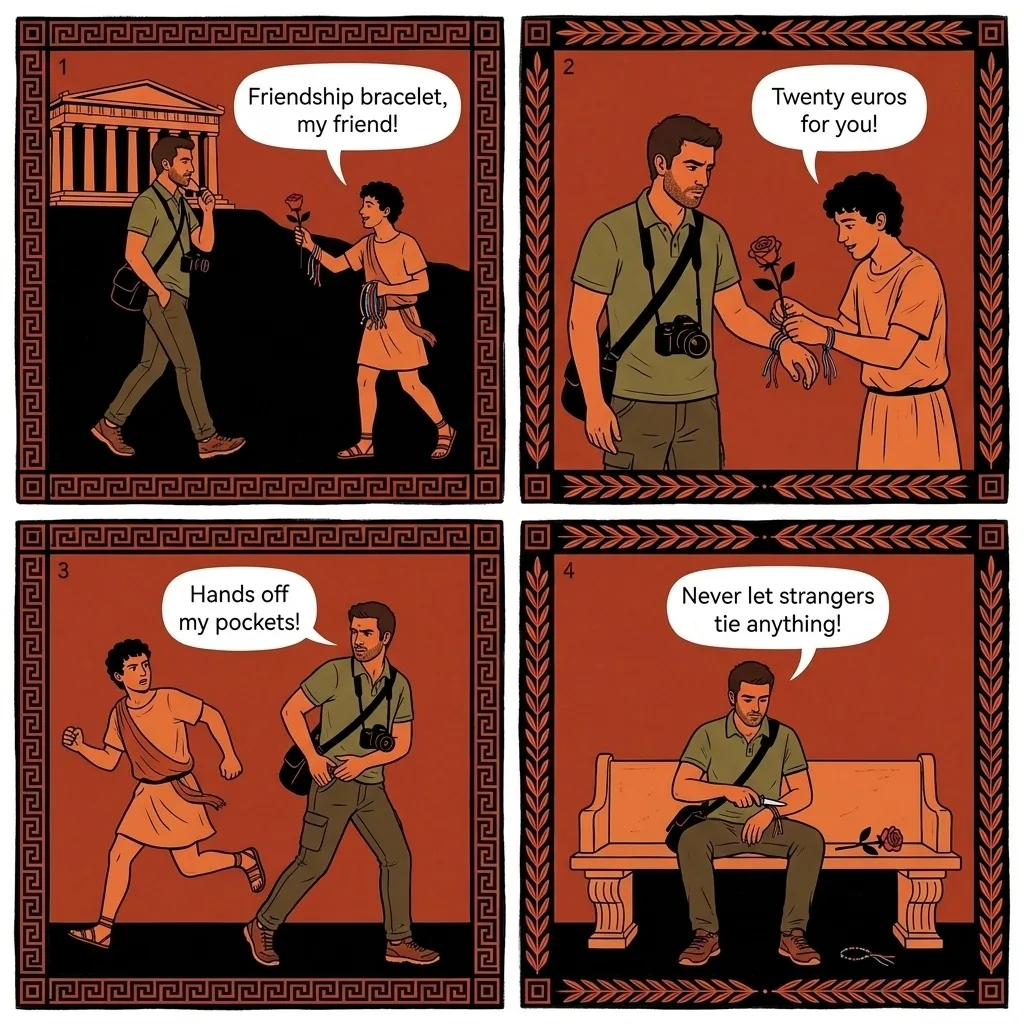
A man at Syntagma metro exit grabs your wrist and ties a "friendship bracelet" before you can pull back, then demands €10–€50 — a 2025 Psyri variant uses a rose handed in a hug-style contact while an accomplice lifts your wallet from your back pocket.
You're crossing Syntagma Square toward the Parliament building when a man steps in front of you, grabs your wrist with warm enthusiasm, and starts looping a colorful "friendship bracelet" before you can pull back. The technique is fast — three or four seconds and the first knot is in. He smiles, gestures at the bracelet, and the price emerges: €10, €20, sometimes €50 for the "good-luck" version.
If you try to return it, he refuses to untie it. If you raise your voice, his partner — who you didn't notice before — drifts in from your blind side. The crew works in teams of two or three: one ties the bracelet, one blocks your retreat, one "confirms" the price is fair. A more alarming 2025 variant in the Psyri area near Little Kook puts a rose in your hand instead of a bracelet — accompanied by a hug-style contact while an accomplice lifts your wallet from your back pocket. The rose costs cents; the wallet typically has €50–€300 plus several cards that need urgent cancellation.
Both variants cluster at Syntagma metro exits, Monastiraki Square, the bottom of Plaka near Hadrian's Arch, and along the Ermou shopping street. In August peak season the crews rotate multiple times a day. Older travelers are targeted preferentially because the "gift" framing makes the interaction feel socially legitimate. Cross your arms and step back the moment anyone with a bracelet or flower approaches you — do not engage in conversation, do not slow your pace. If a bracelet is already on your wrist, walk to a café and cut it off; you owe nothing. Saying "astynomia" (police) loudly disperses these crews instantly during summer Tourist Police foot patrols.
Red Flags
- Stranger at Syntagma metro exit, Monastiraki, or Ermou reaches for your wrist with a bracelet in hand
- Multiple 'friendly' strangers in close proximity — team operation
- Bracelet or flower is placed quickly before any price is mentioned
- Warm hug or hand grasp accompanies the 'gift' — pickpocket hand contact
- Demand of €10–€50 after the item is attached, with refusal to remove it
How to Avoid
- Cross your arms and step back the moment anyone with a bracelet or flower approaches you.
- Do not engage in any conversation — a brief 'no' and continued walking defeats the scam.
- If a bracelet is already on your wrist, walk to a café and cut it off with scissors — do not pay.
- Keep your wallet in a front zipped pocket or a crossbody bag worn in front, not a back pocket.
- Say 'astynomia' loudly if the crew escalates; Syntagma has summer Tourist Police foot patrol.
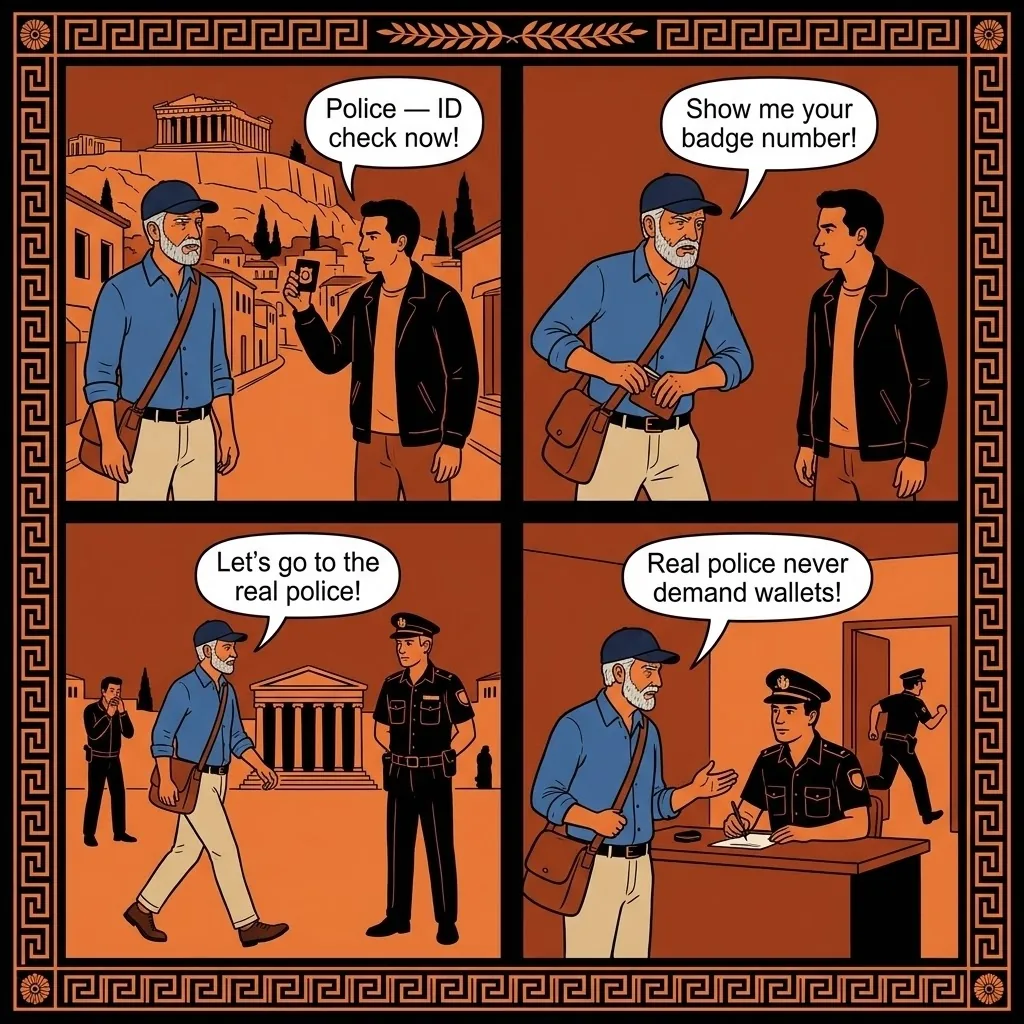
Two men on a Metro platform or on the walk from your Piraeus cruise ship flash fake "police" IDs and ask to inspect your wallet for counterfeit euros — while you fumble for it, one scans the contents and the other photographs your card numbers.
You're on a Metro platform at Omonia, Syntagma, or Monastiraki — or walking from your cruise ship at Piraeus toward the Metro — when two men in plain clothes approach. They flash what looks like a police ID and explain they need to check for counterfeit euros, or to verify your passport. The Greek is fluent. The IDs flash too quickly to read clearly. There are no uniformed officers and no marked vehicle.
While you fumble for your wallet, one of them takes it and starts thumbing through — counting bills, examining cards, holding things up to the light. The second one asks where you're staying, what flight you came in on, distracting eye contact. He's also photographing your card numbers with a hidden phone. Your wallet comes back. An hour later you check it: €150 missing. Three days later your card has unauthorized charges from Bulgaria.
Real Greek police do not stop-check tourist wallets on the street — and if a plain-clothes officer genuinely needs to speak to you, they will invite you to walk to the nearest police station together. Omonia Square Metro has drawn the most concentrated warnings from the US Embassy in Athens since 2023; a parallel variant offers help with luggage at station steps while a partner opens your day-bag pocket. Cruise passengers at Piraeus are targeted specifically because they often carry multiple cards and a passport in a day-bag, and the time pressure of meeting a tour bus makes them comply faster. Refuse to open your wallet on the street — say loudly that you will call 112 (general emergency) or 171 (Tourist Police), and walk to the nearest open shop or café. Fake officers always disperse at the threat of a real phone call.
Red Flags
- Plain-clothes men claim to be 'police' and ask to inspect your wallet, passport, or cash
- ID flashed is not a government-issued photo credential with hologram and serial number
- Request occurs on a Metro platform, escalator, station stairs, or busy street — not at a police station
- Second person is nearby as the 'officer' talks to you — team operation
- Time pressure implied ('we need to move quickly,' 'your ID, please, now')
How to Avoid
- Real Greek police do not spot-check tourist wallets on the street — always refuse and walk away.
- If genuine police stop you, they wear uniforms; offer to walk with them to the nearest police station.
- Avoid Omonia Square at night and in early morning hours when tourist pickpocket activity peaks.
- Keep your passport in the hotel safe; carry a photocopy and minimal cards only.
- If accosted, say loudly 'I am calling 112' — fake officers disperse immediately.
A Plaka taverna with a view of the Roman Agora has no posted menu prices, brings unrequested bread, olives, and tzatziki to your table, and the bill arrives at €95 for what should have been a €45 lunch — the indoor menu lists higher prices than the chalkboard outside.
You sit down at a Plaka taverna along Adrianou or Kydathinaion with a view of the Roman Agora. The chalkboard outside listed moussaka €12, Greek salad €8, glass of house wine €4 — typical Athens prices. You order moussaka, a salad, and two glasses of wine. Bread arrives, then a small bowl of olives, then a "welcome" plate of tzatziki. None of it was requested.
The bill totals €95. When you ask to see the menu again, the printed menu the waiter brings to the table is different from the chalkboard outside: the moussaka is €24, the salad €18, the glass of wine €8. The "welcome" items total €14 — bread €4, olives €5, tzatziki €5. There's a "service" line of €6 added on top. The waiter shrugs. He doesn't speak English when you ask which menu is correct.
Reddit is unambiguous: tourist-row Plaka tavernas overcharge for mediocre food. The mechanism is opaque pricing plus "optional" extras that arrive unordered — bread, olives, tzatziki, sometimes a small ouzo "as a welcome" — each appearing on the bill at €3–€15 per item. The chalkboard outside may show lower prices than the menu at the table, and staff bring items "because it is traditional" without announcing charges. Older travelers with limited Greek are particularly vulnerable because the items feel like generous hospitality rather than upsells. Read the menu at the entrance before sitting, confirm the table menu matches, and decline "welcome" items when they arrive — "ochi, efcharisto" is the polite Greek refusal. Walk one block off the Plaka spine into Koukaki, Pangrati, or Exarchia for honest prices, or stick to community-respected names: Brettos, Klimataria, Ta Karamanlidika tou Fani, Scholarchio, Platanos.
Red Flags
- Restaurant on Plaka's main rows (Adrianou, Kydathinaion), Monastiraki Square, or Acropolis slope has no posted menu outside
- The menu at the table differs from the one shown at the entrance
- Bread, olives, tzatziki, or ouzo arrive unordered and appear on the bill
- Menu prices are hand-written or lack clear euro signs
- Bill includes 'cover charge' or 'service' line items not listed on the menu you ordered from
How to Avoid
- Read the menu at the entrance before sitting, and confirm prices at the table match when the menu arrives.
- Decline 'welcome' items explicitly when they arrive — 'ochi, efcharisto' politely refused.
- Eat one block away from Plaka's main rows — Koukaki, Pangrati, Exarchia have fair-priced authentic tavernas.
- Use Google Maps reviews (4.3+, 200+ reviews) to find honest Plaka options: Scholarchio, Platanos.
- Count the bill line by line and dispute any charge not on the menu you ordered from.
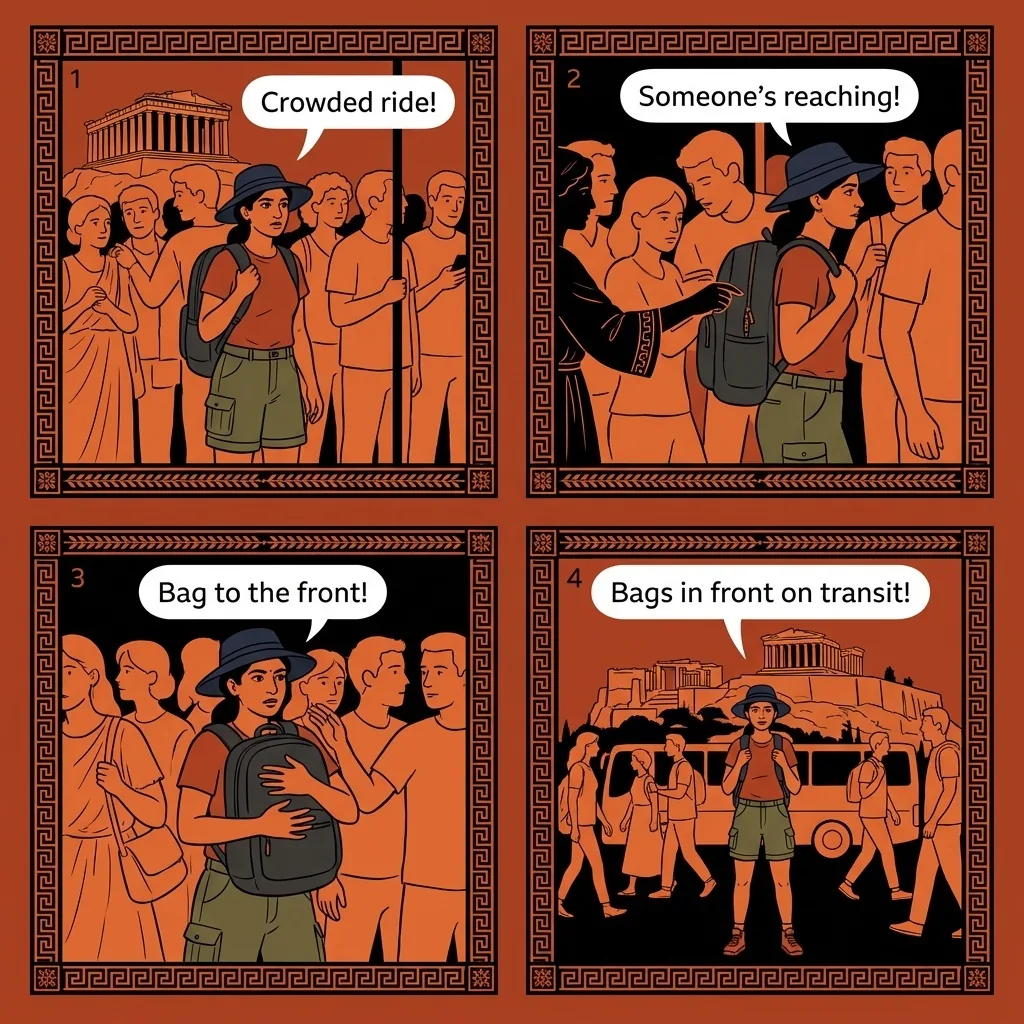
Athens Metro Line 3 between Syntagma and the airport, the Acropolis ticket queue, and tour-bus loading zones at Syntagma all see organized 3-4 person pickpocket teams — one distracts, one lifts, one receives the wallet, one keeps lookout.
You're on Athens Metro Line 3 heading from Syntagma toward the airport — luggage at your feet, phone in hand checking the time before your flight. The carriage is packed because the airport line aggregates four other lines through Syntagma. As the train pulls into Doukissis Plakentias, several people press toward the doors. You take the bump. By the time you reach the airport, your wallet is gone from the inside of your jacket.
The crews work in three- or four-person groups: one distracts (asking directions with a large open map blocking your view of your bag), one lifts (the actual hand work), one receives the wallet (so the lifter has clean hands if confronted), one keeps lookout for police. The most common patterns targeting older travelers are a fake crowd-crush at carriage doors, a "map distraction" that obscures your bag, and an escalator bump where a passenger "falls" into you while a partner lifts. The Acropolis ticket queue (200+ people deep in summer) is another hotspot; tour-bus loading zones at Syntagma are a third — someone helps lift bags while a partner opens day-bags set on the sidewalk.
2024 and 2025 Ekathimerini reporting on organized Athens theft networks confirms the pattern is larger than individual opportunists. Damage is typically a phone (€500–€1,200 replacement for a current iPhone) or a wallet (€50–€300 cash plus several hours of card cancellation calls). For travel-insurance documentation, reporting to Tourist Police 171 within 24 hours is essential. Wear a zipped crossbody bag in front of you in any crowded environment, never use an outer backpack pocket for valuables, and split cash across multiple pockets — some in a money belt or inner jacket pocket, none in a back pocket. Don't pull out your phone on crowded escalators or at carriage doors.
Red Flags
- Dense crowd at Metro carriage doors during boarding — pickpocket trigger environment
- Someone asks for directions with a large open map blocking your view
- At the Acropolis queue or inside the site, strangers stand unusually close in an uncrowded area
- Helper offering to lift your luggage at a tour bus or station — partner may access your day-bag
- Activity peaks April–October and after major football matches or large concerts
How to Avoid
- Wear a zipped anti-theft crossbody bag in front of you in any crowded environment.
- Keep phone in a zipped inner pocket or zipped jacket pocket, never in a back pocket.
- Split cash: €20 in a front pocket, the rest in a money belt or hotel safe.
- Do not pull out your phone on crowded escalators, at carriage doors, or on Line 3 during rush hour.
- Report any theft to Tourist Police 171 within 24 hours for insurance documentation.
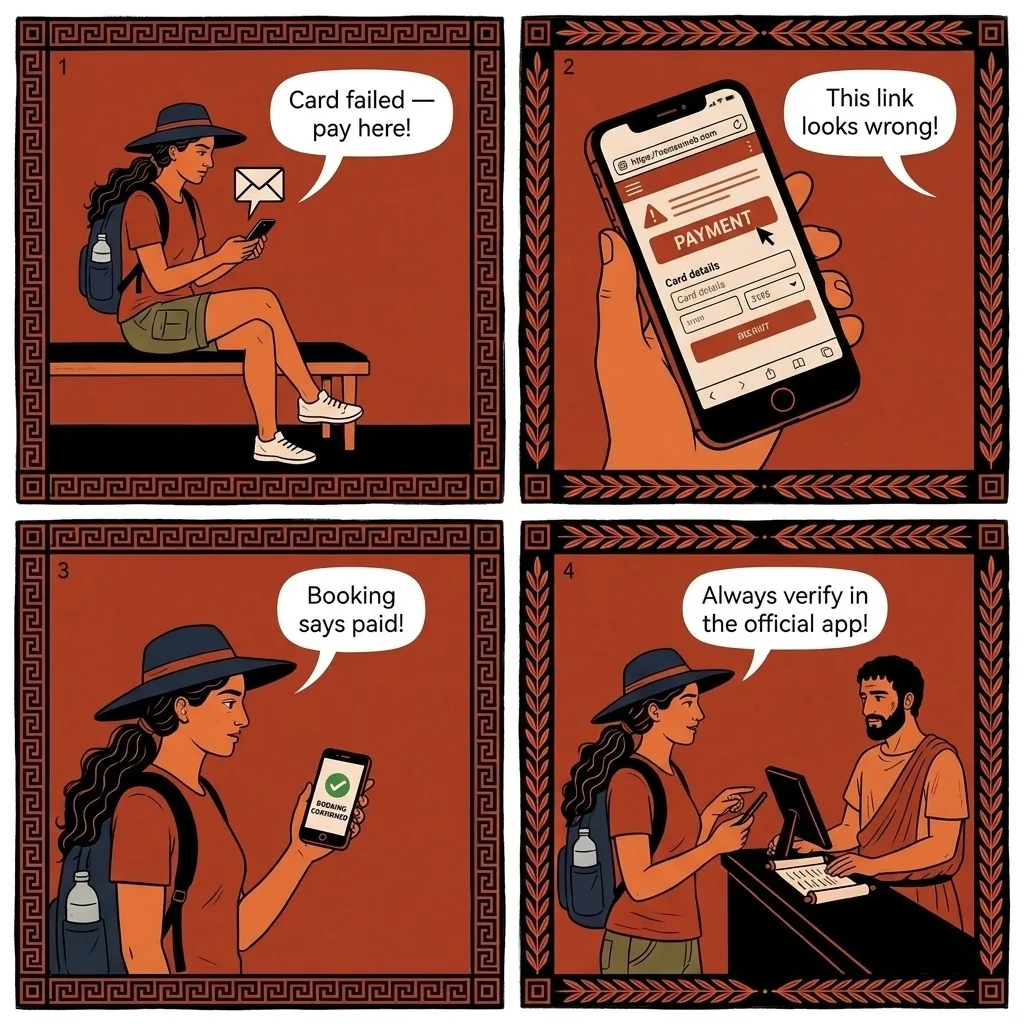
Three days before your Athens trip, a "Booking.com" email asks you to pay your hotel deposit through a "secure link" — the link is fake, your real reservation is canceled when you "pay directly," and the actual hotel has no record of you on arrival.
You book a highly-rated hotel in Koukaki with a clear Acropolis view on Booking.com. The reservation confirms at €180 per night, total €540 for three nights with the standard "pay at property" option. Three days before your trip an email arrives that looks official: "to finalize your booking, please pay the deposit through this secure link." The branding looks like Booking.com, the email address is something like [email protected], and the link goes to a payment page that looks authentic.
You pay €540 by card. The page sends you a confirmation that resembles a Booking.com receipt. On arrival, the actual hotel has no record of your reservation — your original Booking.com booking was canceled the moment you "paid directly," and the hotel never received any of the €540. The URL you paid through (booking-com.net, bookingcom-pay.com, or similar) was a counterfeit. Booking.com support cannot help because the transaction happened off-platform.
The Athens-specific version clusters around Koukaki (Acropolis-adjacent, high demand), central Plaka, and Syntagma — the highest-search-volume neighborhoods. Operators also create lookalike property listings; Reddit has documented the same pattern with photos cloned from legitimate properties. The Athens version runs year-round because demand is constant, and older travelers are targeted specifically because the scammers count on careful planners who book early and respond quickly to official-looking emails. Book only through Booking.com, Hotels.com, Expedia, or the hotel's own verified website; never click payment links in emails — log into your booking account directly and check reservation status. Call the hotel through the Google Maps phone number (not the number in any email) to verify, and pay only by credit card for chargeback protection.
Red Flags
- Email requesting payment via a link outside the original booking platform, even if it looks like Booking.com
- URL in the payment link doesn't match booking.com exactly (watch for booking-com.net, bookingcom-pay.com, etc.)
- Offer is 30–50% below market rates for the Plaka, Koukaki, or Syntagma area
- Hotel's reviews include recent complaints about missing reservations after 'direct payment'
- Requested to pay via WhatsApp, bank transfer, or a different payment processor than where you originally booked
How to Avoid
- Book only through Booking.com, Hotels.com, Expedia, or the hotel's own verified website.
- Never click payment links in emails; log into your booking account directly and check reservation status.
- Call the hotel through the Google Maps phone number (not the email's number) to verify any payment request.
- Pay only by credit card — chargeback is your strongest protection.
- For peak season (April–October), book eight or more weeks ahead through official channels.
🆘 What to Do If You Get Scammed
📋 File a Police Report
Go to the nearest Tourist Police (Τουριστική Αστυνομία) station. Call 171 (Tourist Police, English-speaking, 24/7) or 100 (General Police). Get an official crime report — you'll need this for insurance claims. You can also report online at astynomia.gr.
💳 Cancel Your Cards
Call your bank immediately. Most have 24/7 numbers on the back of the card (keep a photo saved separately). Block any suspicious transactions before the thieves use your details.
🛂 Lost Passport?
For passport replacement, contact the US Embassy Athens at 91 Vassilisis Sophias Avenue, 10160 Athens (+30 210-721-2951, 24/7 emergency). The UK Embassy is at 1 Ploutarchou Street, Athens (+30 210-727-2600). The Australian Embassy is at Level 6, Thon Building, Kifisias & Alexandras Avenues, Athens (+30 210-870-4000). Always call Tourist Police 171 first — they speak English and will file the police report you need for passport replacement and insurance claims.
📱 Track Your Device
If your phone was stolen, use Find My (iPhone) or Find My Device (Android) from another device. Don't confront thieves yourself — share the location with police instead.
Frequently Asked Questions
You just read 8 scams in Athens. The book has 57 more across 10 Greek destinations.
Athens's Plaka "friendly local bar" clip-joint. Mykonos's DK Oyster €836 seafood bills. Santorini's "meter is broken" taxi overcharges. Crete's rental-car damage-deposit cycle. Every documented Greece scam — with the exact scripts, red flags, and Greek phrases that shut each one down. Drawn from Kathimerini, eKathimerini, Greek Reporter, Athens Voice, and Tourist Police (171) records.
- 65 documented scams across Athens, Santorini, Mykonos, Crete & 6 more cities and islands
- A Greek exit-phrase card you can screenshot to your phone
- Updated annually — buy once, re-download future editions free
- Readable in one flight — $4.99 on Amazon Kindle