
Key Takeaways
- The #1 reported scam is the Rental Car 'Damage' Fee & Insurance Ambiguity.
- 1 of 7 scams are rated high risk.
- Use app-based ride services (Uber, Bolt) or official metered taxis instead of unmarked vehicles.
- Never accept unsolicited offers from strangers near tourist sites in Heraklion.
⚡ Quick Safety Tips
- Rent cars from major brands at Heraklion Airport (Avis, Budget, Hertz, Europcar, Sixt) — not Heraklion Town storefronts like Abbycar Crete that are community-flagged for damage scams.
- Photograph every panel of a rental car (including underside and wheel wells), get a written damage inspection signed, and pay by credit card for chargeback leverage.
- At Knossos Palace, look for the yellow Greek Federation of Tourist Guides badge — public group tours are €20–€25 per person; 'private tours' quoted at €80–€120 are dramatically overpriced for the same content.
- At Elafonissi and Balos beaches, drive past the first few parking attendants — 'the closer lots are full' claims are routinely false (€5 lots redirect you from €3 lots).
- Buy Cretan olive oil at supermarkets (Sklavenitis, AB Vasilopoulos) — Leventakis and Sitia Co-op at €6–€10 per 500ml; tourist shops charge €25+ for 250ml of the same quality.
Jump to a Scam
- High Rental Car 'Damage' Fee & Insurance Ambiguity
- Medium Heraklion Airport & Cruise Port Taxi Overcharge
- Medium Knossos Palace 'Official Guide' Private Tour Pressure
- Medium Elafonissi Beach Parking Scam
- Medium Sunbed Mafia & Unofficial Beach Operators
- Low 'Authentic' Cretan Olive Oil & Souvenir Shop Markup
- Low Shell Petrol Station Short-Change at Souda
The 7 Scams
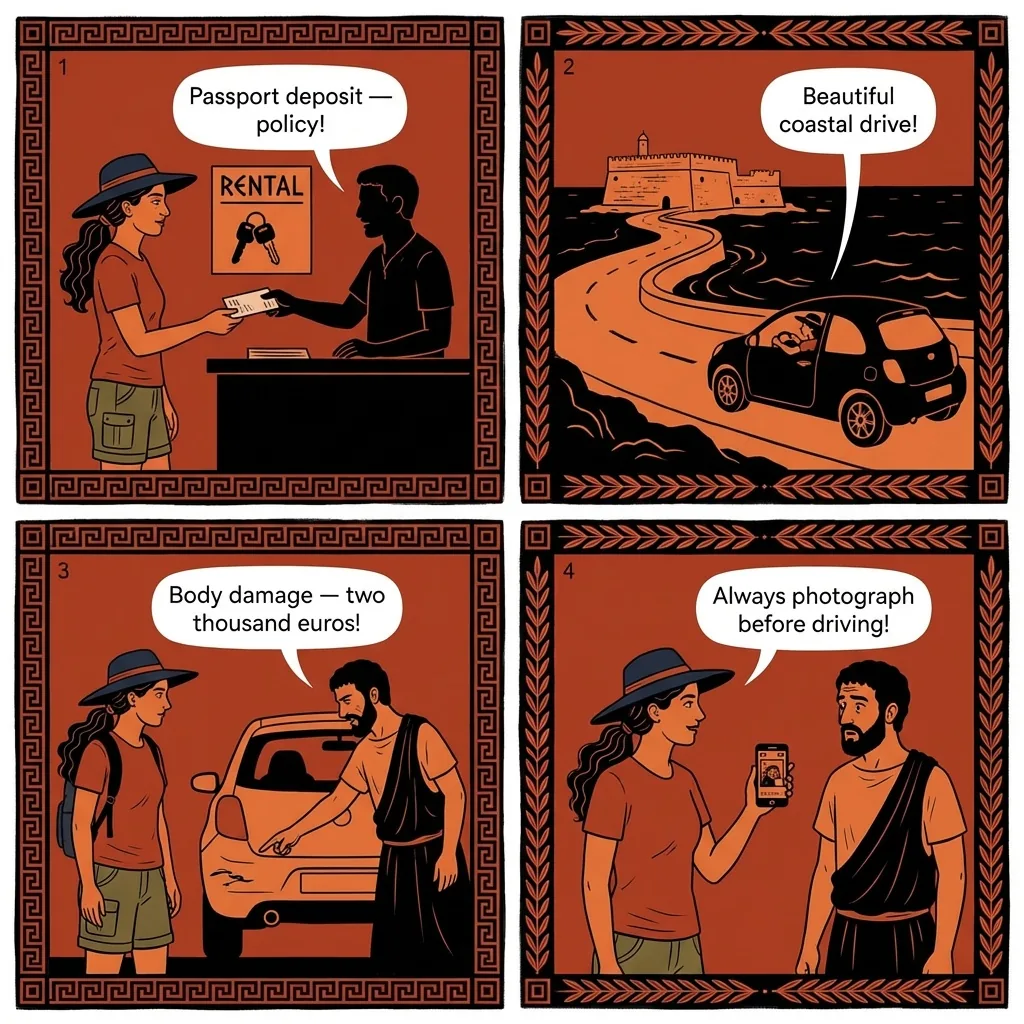
Crete rental car shops at Heraklion Airport (HER) and small Heraklion Town storefronts charge €500+ for minor pre-existing paintwork marks "discovered" on return — and "full insurance" pitches at pickup often have €1,000 hidden excess clauses, leaving even comprehensive-buyers exposed to fabricated damage claims. Community-named the #1 scam of small Crete rental companies.
A canonical traveler thread documents one renter charged €500 for a minor mark on the paintwork; the top-voted comment reads "This is actually the number one scam of small rental car companies." Multiple 2024–2025 victim accounts confirm this is an active and ongoing pattern across Heraklion-area operators.
The mechanic has two layers. First, operators rent cars with pre-existing cosmetic damage, 'discover' it on return, and charge five to ten times the real repair cost. Second — and this is the older-traveler-specific trap — the "full insurance" offered at pickup often has hidden exclusions. The community-vetted definition: "100% full (aka comprehensive) with zero excess (aka zero deductible)" — but some Crete agencies advertise "full insurance" that actually has a €1,000 excess, which the agency charges on even minor scratches.
Your protection: rent from the major international brands at Heraklion Airport (HER) — Avis, Budget, Hertz, Europcar, Sixt — rather than small storefronts in town. These still have damage disputes but face higher corporate accountability and respond to credit card chargebacks. Photograph every panel of the car including the underside, wheel wells, windshield, and interior with timestamps. Get a written damage inspection form signed by the agent before driving off; include even scratches the agent 'waves off' as insignificant. Pay the rental and any deposit by credit card (never cash) — this gives you chargeback leverage. For insurance, use a premium travel credit card that includes car rental primary insurance (Chase Sapphire, Amex Platinum), which replaces the agency's coverage entirely. If targeted with a false damage claim on return, photograph the claimed damage, refuse to pay beyond the legitimate deposit, and file with Tourist Police 171 — Crete Tourist Police has mediated rental disputes in 2024–2025.
Red Flags
- Shop takes large cash deposit (€500+) with no itemised receipt
- Agent skips or rushes through the pre-rental damage inspection
- Shop's Google reviews include 2024–2025 complaints about 'damage' charges — read the most recent ones
- Advertised 'full insurance' does not specify zero excess/deductible in writing
- Agency is a small storefront on Heraklion Town streets with no Google Maps presence
How to Avoid
- Rent from major brands (Avis, Budget, Hertz, Europcar, Sixt) at Heraklion Airport, not town storefronts.
- Photograph every panel including underside, wheel wells, windshield, and interior with timestamps.
- Get a written damage inspection form signed before driving off — include every existing scratch.
- Pay rental and deposit by credit card only — chargeback is your strongest protection.
- Use a premium travel credit card (Chase Sapphire, Amex Platinum) with primary rental insurance.

Heraklion Airport (HER) and cruise-port taxi drivers quote €40–€60 flat fares for what should be a €15–€20 metered ride to town hotels — claiming the meter is broken or running illegal Tariff 2 (€1.24/km) inside city limits during daytime; the legal Tariff 1 is €1.06/km. The KTEL bus to Knossos at €1.70 every 15–20 min is the cleanest cruise-day alternative.
From Heraklion Airport (HER) to most hotels in town is seven to ten kilometers — a €15 to €20 fare. The scam version: driver claims the meter is broken, quotes a flat €40–€60, or runs the meter on Tariff 2 (suburban, €1.24 per kilometer) inside the city limits during daylight hours. Travelers report the same playbook on Heraklion → port runs for ferries to Santorini and similar mainland transfers. The Heraklion airport scene is less aggressive than Athens but the mechanic is identical.
Cruise port scams matter more for this demographic. When cruise ships dock at Heraklion, passengers step off for shore excursions — typically Knossos, Heraklion Old Town, or a Crete olive oil tour — and face taxi drivers at the port exit quoting €30 to Knossos (real metered fare €15–€18) or €50 to the Archaeological Museum (€10 by walk or €8 metered). Time pressure from "all-aboard" calls on the ship pushes acceptance. The KTEL bus to Knossos costs €1.70, runs every 15–20 minutes from Heraklion bus station, and takes 20 minutes. A walk from the cruise port to Heraklion Old Town's main sites is 10–15 minutes.
Your protection: demand the meter on any Heraklion taxi; refuse if the driver claims it is broken, and try the next one. Use Uber or Bolt where available (both work in Heraklion town). For cruise passengers, take the KTEL bus to Knossos (€1.70, 20 min) rather than a taxi. The Archaeological Museum, Lion Square, and the Venetian walls are all walkable from the cruise port. If you want a guided tour, book through the cruise line's official shore excursion (overpriced but honestly priced) or GetYourGuide with a verified operator. Your hotel concierge can also pre-arrange a fixed-price transfer to the airport for €20–€25. Save Tourist Police 171 for disputes; they have a Heraklion office and respond within 30 minutes to documented overcharges.
Red Flags
- Driver claims the meter is broken and quotes a flat rate
- Meter runs on Tariff 2 (€1.24/km) during daytime urban rides — Tariff 1 (€1.06/km) is legal
- Quote is €30+ for Knossos (real fare €15–€18) or €25+ for Heraklion Old Town sites
- At cruise port or airport, driver pressures acceptance 'because of your timing'
- Cash-only payment demanded with no printed receipt
How to Avoid
- Demand the meter on Tariff 1 for urban rides; refuse if the driver claims 'broken' and try the next taxi.
- Use the KTEL bus to Knossos — €1.70, every 15–20 min, 20-minute ride.
- Walk from the cruise port to Heraklion Old Town — Archaeological Museum, Lion Square, walls all 10–15 min on foot.
- Use Uber or Bolt in Heraklion town for regulated fares.
- Pre-arrange a fixed-price airport transfer through your hotel concierge (€20–€25).
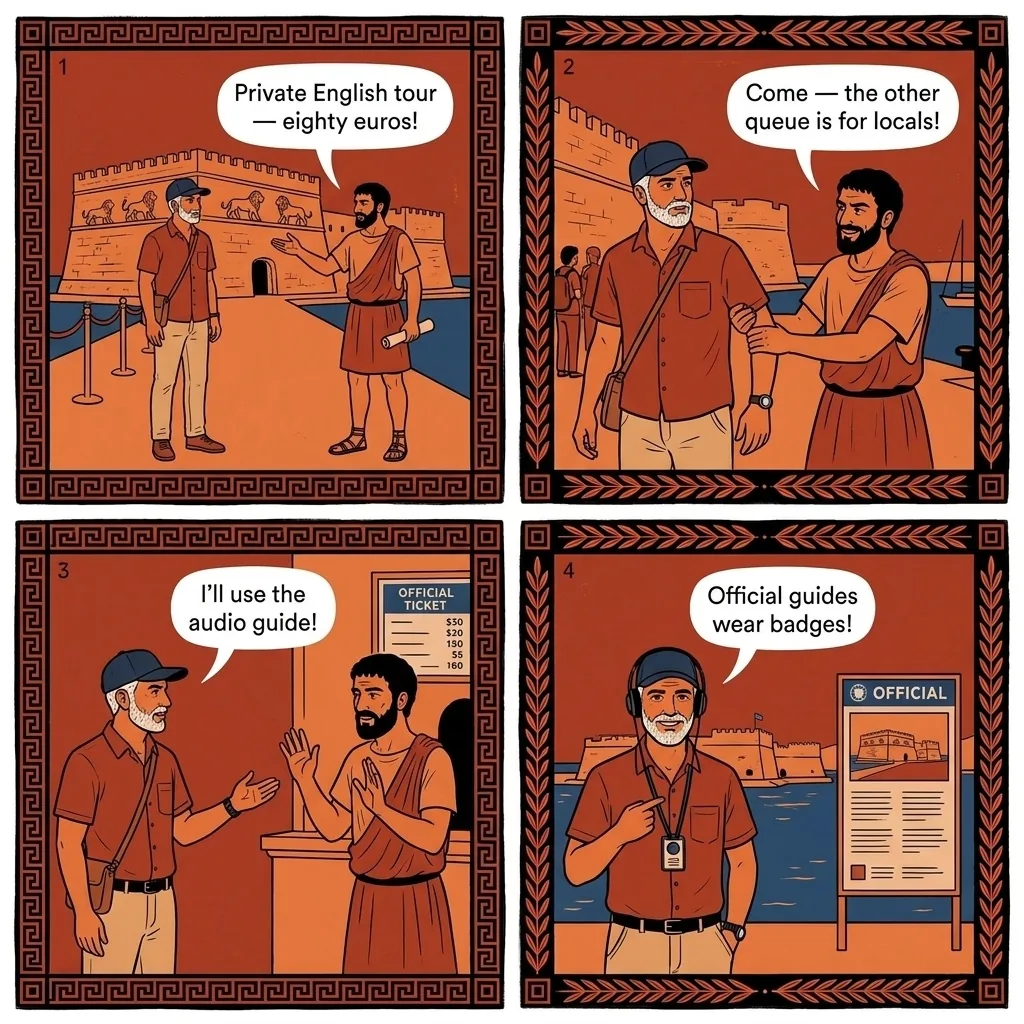
"Official guides" in lanyards at the Knossos Palace entrance pitch cruise-coach arrivals on €80–€120/person "skip-the-line private tours" — same content as the €20–€25/person public group tour but at 4× the price; some "guides" lack the yellow Greek Federation of Tourist Guides certification entirely.
Knossos Palace receives roughly one million visitors a year. At the entrance, "official guides" in lanyards approach new arrivals — particularly cruise passengers arriving by coach — offering "skip-the-line private tours" for €80 to €120 per person. Traveler reports capture the dynamic: "We turned down a private tour offer for 100 euros and accepted a public group offer for 25 euros each, or 20 euros if we waited for the next forming group." The community consensus is consistent: the private tour is dramatically overpriced and usually delivers a guide who is technically licensed but gives the same content the public group gets at a quarter of the price.
There are three tiers of service at Knossos, and older travelers need to know all three. First, the standard entry ticket: €15 in summer (2025 pricing) from the ticket booth. Second, the official public group tour: a licensed Greek guide leads a group of 15–25 visitors through the site for 90 minutes; price is €20–€25 per person, which forms at regular intervals at the entrance. Third, the private tour: €80–€120 per person, same content, but smaller group. The scam version is a 'private tour' that charges private-tier prices but actually walks you through the public sites without meaningful personalisation, and the 'guide' is sometimes a freelancer without a proper license.
Your protection: at Knossos, look for guides wearing the yellow certification badge issued by the Greek Federation of Tourist Guides. Ask to see the badge and the guide's certification number before agreeing to a tour. If you are on a cruise excursion, the group tour is built into the price and you should not pay extra for 'upgrades' on-site. If you want a private tour, book in advance through GetYourGuide, Viator, or your hotel concierge with a written itinerary and guide name — do not negotiate on-site. If you prefer to visit independently, purchase the audio guide (€5) at the ticket booth and follow a printed map; the site is self-explanatory and one of the best-preserved in the ancient Mediterranean. Allow 1.5–2 hours for a comfortable visit; the walk is mostly flat but has some uneven stone surfaces.
Red Flags
- 'Official guide' approaches proactively at the entrance with a laminated credential
- Guide quotes €80–€120 per person for a 'private tour' without written itinerary
- No yellow Greek Federation of Tourist Guides certification badge visible
- Guide cannot produce a certification number when asked
- Pressure to decide immediately 'before the next group starts'
How to Avoid
- Look for the yellow Greek Federation of Tourist Guides badge and ask to see the certification number.
- Take the public group tour (€20–€25 per person) — same content, dramatically lower price.
- Book private tours in advance through GetYourGuide, Viator, or your hotel concierge with written itinerary.
- Purchase the €5 audio guide at the ticket booth for an independent visit.
- Cruise shore excursions should include the guide — do not pay extras on-site.

Approach-road attendants in high-visibility vests at Elafonissi, Falassarna, and Balos beaches flag down cars and direct them into €5–€8 paid lots claiming the closer lots are "full" — usually false — and many of the "attendants" are unlicensed opportunists, not real lot operators.
A 2025 viral traveler thread titled "CRETE ELAFONISSI BEACH PARKING SCAM" details the redirect-and-overcharge pattern (€5 quoted vs €3 actual), with one community member writing: "It's a scam!!! Do not fall for it!!!" Another adds: "Who owns these lots that try to scam people? Are they legally allowed to do this, and if not, why isn't anyone doing something about it?"
The mechanic is simple: approach-road attendants flag down cars heading to Elafonissi and direct them into a paid 'parking lot' for €5–€8, claiming the closer lots are 'full.' The closer lots (often free or €3) are rarely actually full, but drivers accept the redirect because they are carrying beach gear, have children or older passengers, and do not want the uncertainty of driving further. Some of the 'attendants' are acting as legitimate lot operators; others are opportunists using high-visibility vests to appear official. Falassarna and Balos beaches see the same pattern during peak summer.
Older travelers are targeted particularly because the extra walking distance from a paid lot versus a closer free lot matters more — Elafonissi is a 500-metre beach walk already from even the 'close' lots. Your protection: drive past the first few attendants to see the closer options. Many of the 'full' claims are false; if the nearer lot actually has spaces, use it. The truly legitimate parking is run by the municipality and posted with a printed price at the lot entrance. If you do park at a paid lot, confirm the price before handing over money and take a photograph of the attendant and the vehicle spot (useful for complaints). For Balos Beach specifically, the access road has genuinely difficult driving and the last kilometer is narrow and unpaved — many visitors prefer to reach Balos by boat from Kissamos port (€30 round trip, runs daily) to avoid the parking confusion entirely.
Red Flags
- High-visibility vest attendant on the approach road to Elafonissi, Falassarna, or Balos
- Attendant claims closer lots are 'full' and directs you to a pricier further lot
- Price quoted verbally with no printed sign at the lot entrance
- No physical ticket machine or receipt provided
- Attendant lingers at your car window for payment before you see the actual lot
How to Avoid
- Drive past the first few attendants to see closer parking options — claims of 'full' are often false.
- Legitimate municipal parking has a printed price sign at the lot entrance and issues a ticket.
- Confirm the parking price before handing over money; photograph the attendant and spot.
- For Balos Beach, consider the boat from Kissamos port (€30 round trip) to skip the parking chaos.
- Arrive at Elafonissi or Balos before 10 AM in summer — parking fills, crowds thin, and heat is manageable.
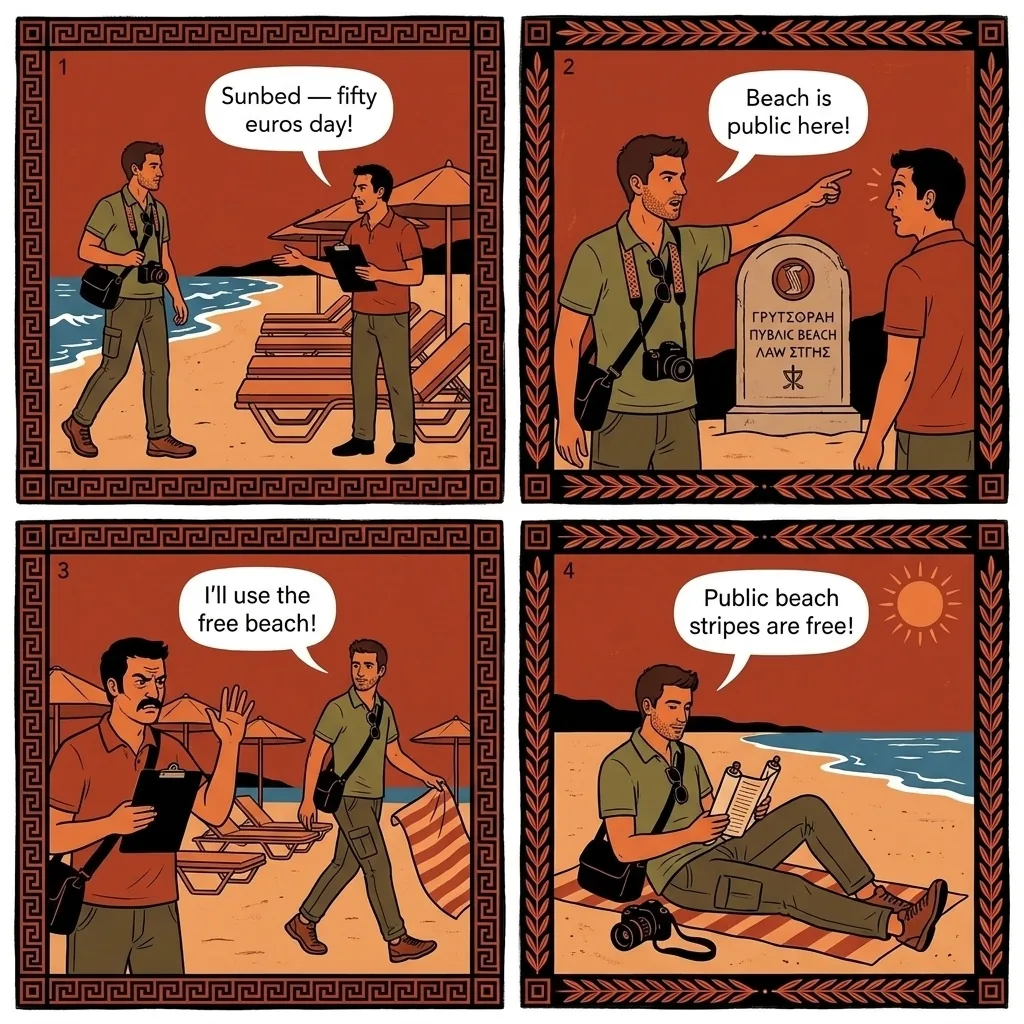
Unlicensed "sunbed mafia" operators on Malia, Amoudara, Stalis, and Agia Pelagia beach strips charge €20–€30 cash for sunbed pairs that licensed operators charge €8–€15 — they operate without municipal license, refuse card payment, set up each morning, and disappear if challenged; 2025 Greek authority enforcement actions are documented but inconsistent.
Legitimate Crete sunbed-rental businesses charge €8–€15 per pair per day with a printed price sign and a municipal license number visible at the kiosk. The scam version operates on beaches where the sunbeds technically exist on public land but the operator charges tourists without a license, refuses to take payment by card, and collects €20–€30 instead. Traveler reports flag this pattern as widespread on Crete's more tourist-heavy stretches — Malia, Amoudara near Heraklion, Stalis, and the Agia Pelagia strip.
The mechanic is ambiguity. Greek law requires the beach itself to be publicly accessible to the high-tide line, and any concession of sunbeds or umbrellas requires a municipal license posted visibly. Unlicensed "sunbed mafia" operators set up chairs each morning, collect cash, and vanish if questioned by authorities. Traveler community guidance: visitors should ask to see the concession license if prices seem high or the operator is evasive. In 2025 Greek authorities launched enforcement actions against unlicensed beach operators across several Cretan municipalities; Greek City Times reporting confirmed fines being levied.
Your protection: arrive at popular Crete beaches before 10 AM when legitimate operators have just opened and prices are posted. Look for a printed price sign and a municipal license number visible at the operator's kiosk. If prices are quoted verbally only and escalate after you sit down, stand up and leave — you have no obligation to pay. Public beaches (Matala, parts of Falassarna, and the entire tidal zone of any Greek beach) do not require a sunbed rental at all; bring your own towel. If targeted with an inflated price demand, refuse, photograph the operator's setup, and file with Tourist Police 171 — Crete Tourist Police have taken action on unlicensed beach operators. For organized beach days, hotel-arranged sunbed reservations at licensed beach clubs (such as Finika Beach Bar in Amoudara or Tsoutsouros Beach in the south) eliminate the ambiguity entirely.
Red Flags
- Beach operator has no printed price sign or visible municipal license number
- Prices quoted verbally only and escalate after you sit down
- Cash-only payment with no receipt or ticket
- Operator sets up chairs each morning with no kiosk or permanent structure
- Charges €20+ for a sunbed pair when other Crete beaches charge €8–€15
How to Avoid
- Arrive at popular beaches before 10 AM when legitimate operators have just opened.
- Look for a printed price sign and municipal license number at the kiosk.
- If prices escalate after you sit, stand up and leave — you have no obligation to pay.
- Bring your own towel to genuinely public beaches (Matala, tidal zones of any Greek beach).
- For organized beach days, reserve sunbeds at licensed beach clubs through your hotel concierge.
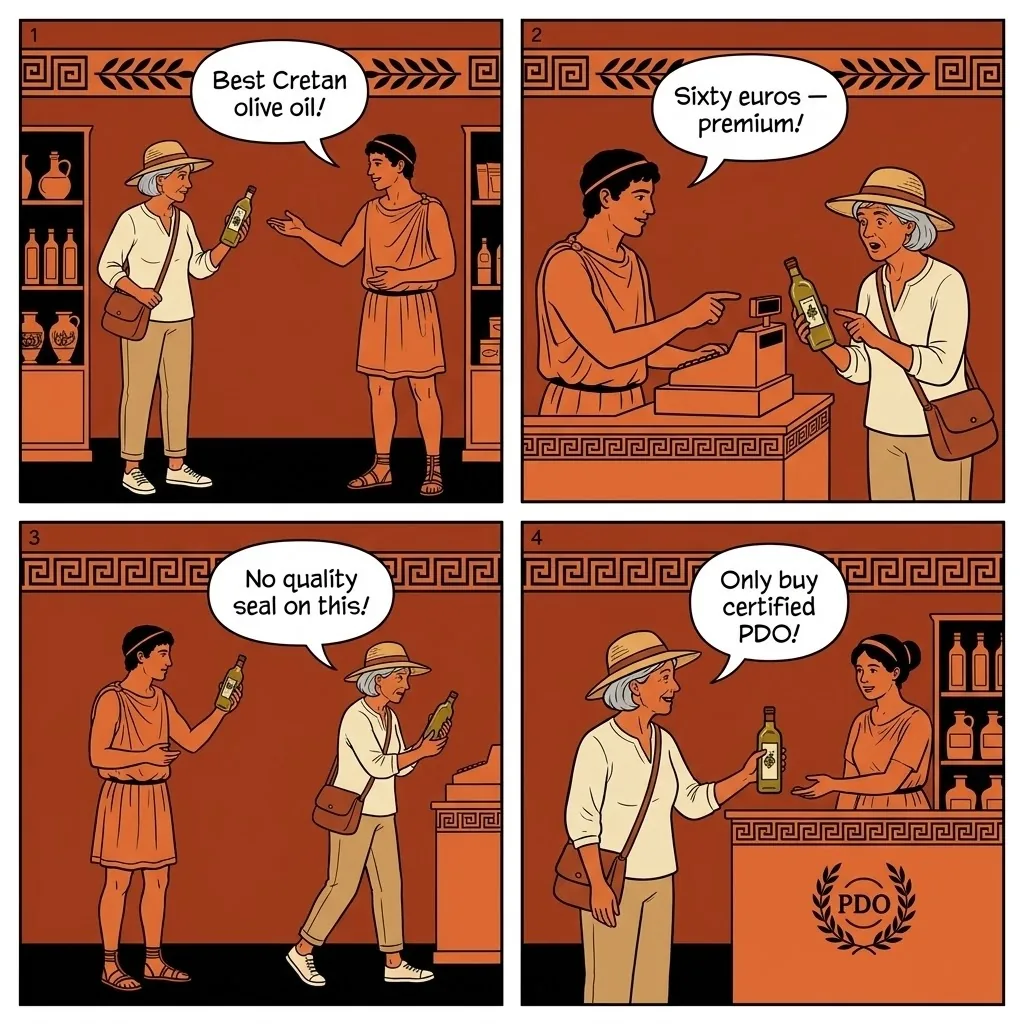
Heraklion Old Town tourist shops and cruise-excursion "olive oil farm" stops sell €20–€35 250ml bottles of "authentic Cretan extra virgin olive oil" that costs €8–€14 from real Sitia producers — and the same shops sell "handmade ceramics" at €80–€150 for €15-wholesale plates, plus "Cretan knives" with fake Koroni hallmarks at €150–€300.
Crete legitimately produces some of the best extra virgin olive oil in the world, and the premium Koroneiki varietal from Sitia and Chania regions is genuinely worth buying. The scam version exploits this reputation at tourist shops and on cruise shore excursions. A 250-millilitre bottle of 'authentic Cretan extra virgin olive oil' in a Heraklion Old Town souvenir shop sells for €20–€35. The equivalent from a proper Sitia producer (Sitia Union Agricultural Cooperative, Agia Triada monastery oil, Pamako Chania) is €8–€14 at the same volume. Cruise excursion 'olive oil farm' visits often include a 'tasting' followed by pressure to buy €50+ bottles, sometimes with labels suggesting awards or protected designations that the oil does not actually hold.
A parallel scam is the 'handmade Cretan ceramics' and 'traditional Cretan knife' shop. Shops on Lion Square (Liontaria) and the pedestrianised streets north of it sell mass-produced ceramics at handmade prices (€80–€150 for a small decorative plate) and 'traditional knives' with fake Koroni hallmarks at €150–€300 that wholesale for €20.
Your protection for olive oil: buy from supermarkets or cooperative-owned shops, not tourist storefronts. Leventakis and Sitia Co-op branded oils in any Cretan supermarket (Sklavenitis, AB Vasilopoulos, Market In) are €6–€10 per 500 millilitres — genuinely excellent and dramatically cheaper. For authentic ceramics, visit Asterousia Ceramics workshop near Heraklion (by appointment, real maker) or the crafts section of the Heraklion Agricultural Market on Odos 1821. For genuine Cretan knives, Armenaki in Chania has been handmaking blades since 1952 with verifiable provenance. If you buy at a tourist shop, the item may be legitimate but the markup is typically 200–400% over supermarket or co-op price — not a scam per se, but not good value.
Red Flags
- Tourist shop in Heraklion Old Town quotes €25+ for 250ml olive oil (supermarket price €6–€10 for 500ml)
- Shop claims 'award-winning' or 'PDO' without a verifiable label or certification number
- 'Handmade ceramics' at €80+ for small plates — mass-produced wholesale at €8–€15
- Cruise excursion 'olive oil farm' pressures €50+ bottle purchases after tasting
- 'Traditional Cretan knife' with unverified Koroni hallmark at €150+ (real hallmarked blades at Armenaki Chania)
How to Avoid
- Buy olive oil at Cretan supermarkets (Sklavenitis, AB Vasilopoulos) — Leventakis and Sitia Co-op oils at €6–€10/500ml are excellent.
- For authentic ceramics, visit Asterousia Ceramics workshop or Heraklion Agricultural Market on Odos 1821.
- For Cretan knives, Armenaki in Chania — handmade since 1952 with provenance documentation.
- Cruise 'olive oil farm' stops are entertainment, not price points — buy at supermarket afterwards.
- Verify PDO (Protected Designation of Origin) labels with certification numbers for any 'premium' claim.
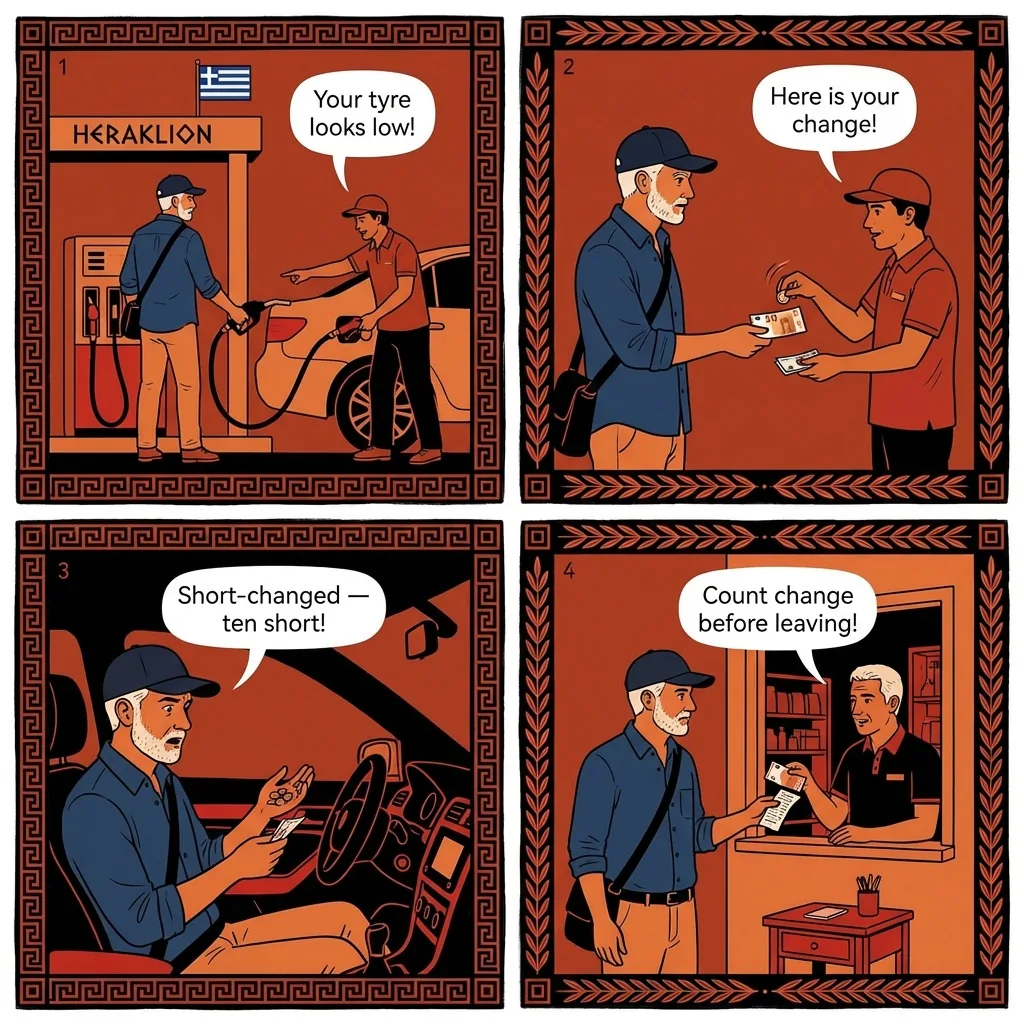
A specific Shell station at the Souda junction near Chania (and similar attendant-service stations on the Heraklion ring road, the Chania-Rethymnon highway, and around HER airport returns) short-changes rental drivers paying with €100 notes — €50 fuel, €100 paid, €50 returned as if it were €100; €5–€10 still missing even after "checking the till."
The Souda Shell station near Chania's main road junction is the most-named example of a pattern affecting petrol-station attendants across Crete. The mechanic: attendant pumps €50 of fuel, takes your €100 note, returns change for a €50 note. When challenged, the attendant "checks the till" with a colleague and produces new change — usually correct, sometimes still short by €5–€10. The traveler thread consensus: "It's defo a scam and I'm just vexed."
The Souda station is the most frequently named, but similar patterns affect petrol stations on main tourist routes across Crete — the Heraklion ring road, the Chania-Rethymnon highway, and stations near the Heraklion Airport car rental returns. Cretan petrol is attendant-service (the attendant pumps for you, you stay in or near the car) — which creates the opportunity. The scam is low-damage per incident (€5–€10) but targets every tourist who pays cash with a large note, rolled across thousands of transactions per summer.
Your protection: pay petrol by credit card whenever possible — this eliminates the short-change opportunity entirely. All major Crete Shell, BP, EKO, and Avin stations accept cards. When you do pay cash, state the note denomination out loud when handing it over ('one-hundred-euro note, yes?') and wait for the attendant's confirmation. Count change in front of the attendant before driving off; if short, stay in place and request the correct amount. If the attendant claims a 'computer error' or insists you gave a smaller note, refuse to leave until the correct amount is provided and photograph the pump and attendant name tag. For rental car returns at Heraklion Airport, fuel up at a station at least three kilometers from the airport to avoid the 'return premium' that nearby stations sometimes charge.
Red Flags
- Attendant takes a large cash note and returns change briefly, without counting out loud
- Short-change appears in the final count — missing €5–€20
- Attendant insists you gave a smaller note than you did, suggests 'computer error'
- Station is on a main tourist route (Souda junction, Heraklion ring road, Chania highway)
- No printed receipt issued automatically — always ask for one
How to Avoid
- Pay petrol by credit card — all major Shell, BP, EKO, Avin stations on Crete accept cards.
- When paying cash, state the note denomination out loud ('one-hundred-euro note, yes?') and wait for confirmation.
- Count change in front of the attendant before driving off.
- Always request a printed receipt.
- Fuel up at least 3 km from Heraklion Airport to avoid 'return premium' pricing.
🆘 What to Do If You Get Scammed
📋 File a Police Report
Go to the nearest Tourist Police (Τουριστική Αστυνομία) station. Call 171 (Tourist Police, English-speaking, 24/7) or 100 (General Police). Get an official crime report — you'll need this for insurance claims. You can also report online at astynomia.gr.
💳 Cancel Your Cards
Call your bank immediately. Most have 24/7 numbers on the back of the card (keep a photo saved separately). Block any suspicious transactions before the thieves use your details.
🛂 Lost Passport?
For passport replacement, contact the US Embassy Athens at 91 Vassilisis Sophias Avenue, 10160 Athens (+30 210-721-2951, 24/7 emergency). The UK Embassy is at 1 Ploutarchou Street, Athens (+30 210-727-2600). The Australian Embassy is at Level 6, Thon Building, Kifisias & Alexandras Avenues, Athens (+30 210-870-4000). Always call Tourist Police 171 first — they speak English and will file the police report you need for passport replacement and insurance claims.
📱 Track Your Device
If your phone was stolen, use Find My (iPhone) or Find My Device (Android) from another device. Don't confront thieves yourself — share the location with police instead.
Frequently Asked Questions
You just read 7 scams in Heraklion. The book has 58 more across 10 Greek destinations.
Athens's Plaka "friendly local bar" clip-joint. Mykonos's DK Oyster €836 seafood bills. Santorini's "meter is broken" taxi overcharges. Crete's rental-car damage-deposit cycle. Every documented Greece scam — with the exact scripts, red flags, and Greek phrases that shut each one down. Drawn from Kathimerini, eKathimerini, Greek Reporter, Athens Voice, and Tourist Police (171) records.
- 65 documented scams across Athens, Santorini, Mykonos, Crete & 6 more cities and islands
- A Greek exit-phrase card you can screenshot to your phone
- Updated annually — buy once, re-download future editions free
- Readable in one flight — $4.99 on Amazon Kindle