Fake skip-the-line tickets, four ways they get you.
A tout outside the Vatican Museums with a laminated badge. A Google Ads clone site charging 80 EUR for a 16 EUR Colosseum ticket. A third-party reseller marking up Sagrada Familia at 3x. An "official-looking" PDF that turns out to be a blank file at the gate. Four sub-variants across 14 countries, defeated by the same one rule: book at the official site, days ahead.

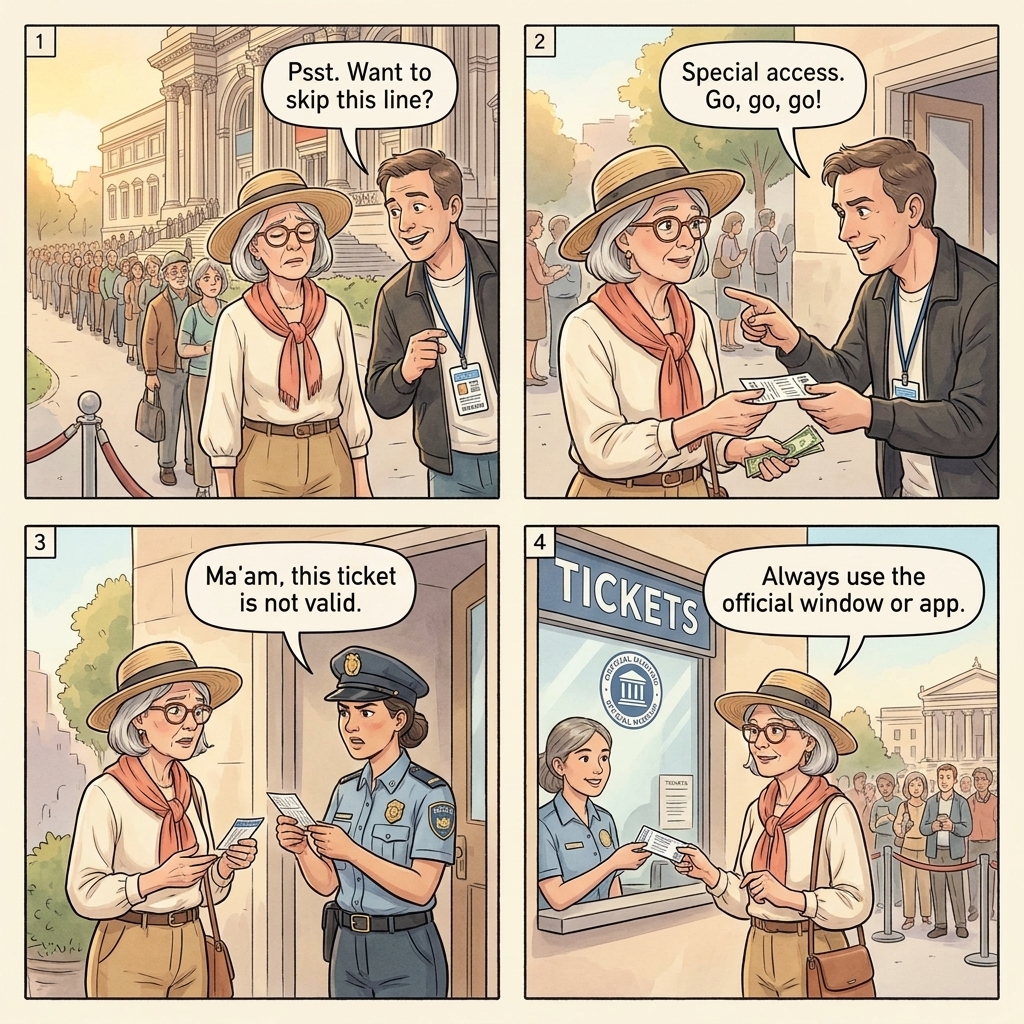
Fake skip-the-line ticket scams run four mechanics across 14 countries: street-tout cash sales (a fake "official guide" with a laminated badge), online checkout clones (Google Ads sites mimicking the venue), third-party reseller markup (real tickets at 2-3x face value), and expired paper PDFs (printouts with no booking code). The universal defense is one rule: book directly at the official venue site, days or weeks ahead, and the QR/PDF arrives in your email within seconds of payment. Vatican Museums: museivaticani.va. Colosseum: coopculture.it. Louvre: louvre.fr. Sagrada Familia: sagradafamilia.org. Hagia Sophia: muze.gov.tr. Real bookings have a QR code; fake ones have a "reference number" or no booking code at all.
"Skip-the-line tickets, twenty-five euros each, you go in now."
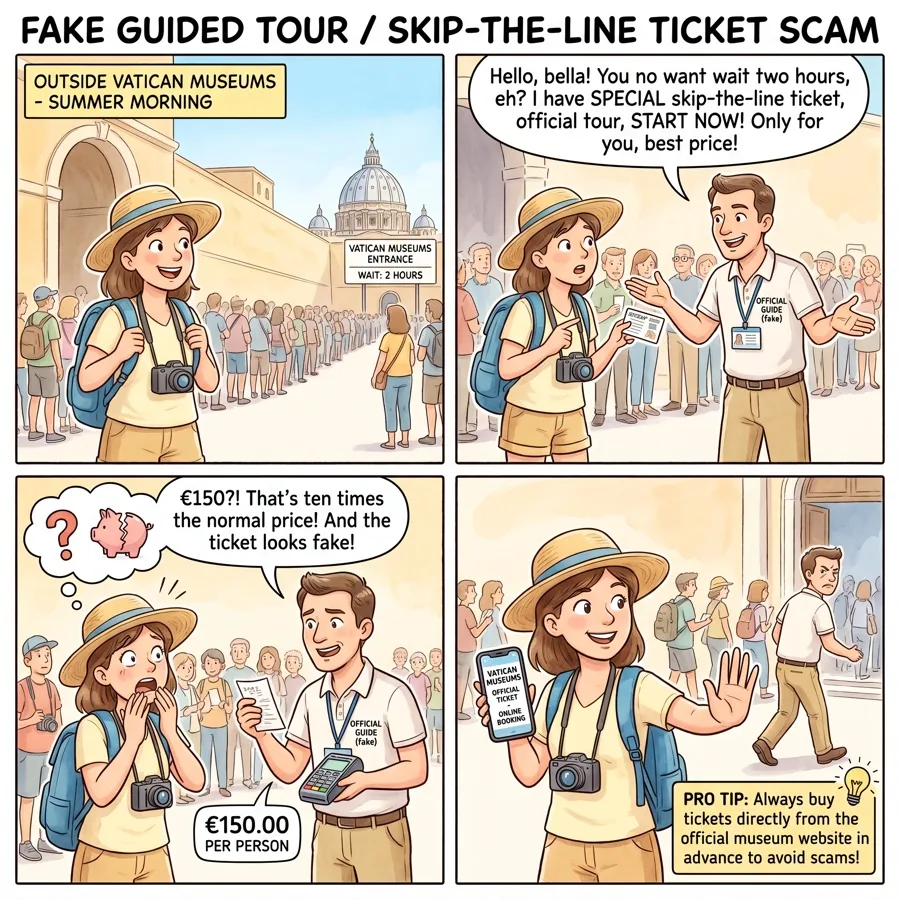
It is August at the Vatican Museums and the entry queue stretches for two hours under direct sun. Your group of four is wilting in the heat when a well-dressed man with a laminated "official guide" badge appears at your shoulder: "Skip-the-line tickets, twenty-five euros each, you go in now."
A hundred euros cash changes hands. He leads you down a side street to a quieter spot, presses four printouts into your hand, says "show these to the guard," and walks off briskly. You walk back to the entrance.
The guard takes one look and laughs. The printouts are blank PDFs with no booking code, no QR, and no record in the museum system.
The Vatican approach, the Colosseum's Via dei Fori Imperiali side, and the Borghese Gallery in Villa Borghese are some of the most organized ticket-fraud zones in Europe. The operators use professional-looking tablets, fake "official guide" badges with no organization name, and a perfectly polished pitch. Real licensed Lazio tour guides wear regional government-issued credentials with a clear issuing authority; fake ones laminate generic badges that say "Guide" or "Official." The scam variant pricing tracks the queue length: the longer the line, the higher the markup, and the harder it is to verify before you have handed over the cash. The Polizia di Stato and the Polizia Municipale di Roma have run continuous tout-sweep operations on the Vatican and Colosseum approaches; La Repubblica publishes monthly arrest counts, but the volume of operators (estimated 200+ active across Rome's major sites) makes enforcement a containment exercise.
The rest of this page is the four-mechanic playbook, the four other cities where the same play runs (Paris, Barcelona, Istanbul, Madrid), and the official-site rule that makes every street-tout encounter end before it starts.
Read the full Rome scam guide →Key Takeaways
The official-site rule
Fake-ticket scams depend on you trying to skip the queue at the venue, not before the trip. The decision to buy from a tout or a clone-Google-Ads site is made in the moment of seeing the line. The defensive routine is one decision made days or weeks ahead, plus four follow-on rules for moments when pre-booking failed.
- Book at the official venue site days or weeks ahead. Vatican Museums: museivaticani.va. Colosseum: coopculture.it. Borghese Gallery: galleriaborghese.beniculturali.it. Louvre: louvre.fr. Eiffel Tower: toureiffel.paris. Sagrada Familia: sagradafamilia.org. Park Guell: parkguell.barcelona. Hagia Sophia: muze.gov.tr. Topkapi: muze.gov.tr. Prado: museodelprado.es. Real bookings produce a QR/PDF in your email within seconds; the QR scans at the venue gate.
- Verify the URL before checkout. Open a new browser tab; type the official domain manually. Do not click Google Ads; clone sites with names like 'colosseo-tickets-rome.com' frequently outbid the venue itself for the top ad slot. The clone takes your card and either delivers nothing or delivers a real ticket at 2-3x markup. Manual URL entry is the entire defense against the online clone variant.
- Refuse street-tout cash sales. Anyone offering "skip-the-line tickets" for cash outside the venue is a tout. Real licensed Lazio and Paris tour guides wear regional government-issued credentials with a clear issuing authority. The pitch tracks queue length: longer line = higher markup. Walk past every tout and queue at the official ticket desk inside the venue if you forgot to book. The street-tout transaction is the highest-loss variant; refuse on principle.
- Verify the booking on your phone before leaving the hotel. Real official-site bookings produce a QR code and printable PDF in your email within seconds of payment. The QR scans at the venue gate. If your booking has only a "reservation number" or asks you to print a paper ticket from a third-party site, it is a reseller markup at best, fake at worst. Check the email subject line for the official venue domain.
- Use Klook, Get Your Guide, or the venue's app for guided tours. Reputable third-party operators (Klook, Get Your Guide, Viator, Tiqets, Headout, Civitatis, Walks of Italy, Context Travel) sell licensed-guide tours that include skip-the-line entry at face value plus a small booking fee. Avoid pop-up resellers without an established review history. Bulk-licensed-guide channels are legitimate; pop-up Google-Ads sites are not.
The four mechanics
Different cities and different operator crews lean on different mechanics within the same family. Here are the four sub-variants documented globally. Each has a recognition tell, a primary geography, and the routine step that defeats it.
1. Street-Tout Cash Sale
A man with a laminated "official guide" badge approaches you in the queue: "Skip-the-line tickets, twenty-five euros each." Cash exchange; he produces a printout. The printout is either a blank PDF (pure fraud, total loss) or a real ticket at 2-3x face value (the operator pocketed the markup). Pricing tracks queue length: longer line = higher quote.
Defense: walk past every tout; book at the official site days ahead. Most reported in: Rome Vatican and Colosseum approaches; Barcelona Sagrada Familia; Paris Louvre Pyramide; Istanbul Hagia Sophia.
2. Online Clone-Checkout Skim
An attacker registers a domain like 'colosseo-tickets-rome.com' or 'sagrada-familia-tickets.org' and runs Google Ads at the top of search results. The site mimics the venue's official look and accepts card payments. Two outcomes: phishing (no ticket delivered, card cloned) or markup (real ticket purchased with your card at 2-3x face value, attacker pockets the difference).
Defense: avoid Google Ads results; type the official domain manually. Most reported in: Italy (Vatican, Colosseum, Uffizi); Spain (Sagrada Familia, Alhambra); France (Louvre, Versailles).
3. Third-Party Reseller Markup
Pop-up reseller sites buy real tickets in bulk and resell at 2-3x face value with no clear booking fee. Unlike the major reputable operators (Klook, Get Your Guide, Viator), these sites have no established review history, churn through domains every quarter, and disappear when complaints accumulate. The ticket is real; the markup is the scam.
Defense: use only major reputable operators or the official venue site. Most reported targeting: Sagrada Familia, Park Guell, Alhambra, Pompeii, Versailles.
4. Tour-Bundle Skip-Line Bait
A "tour" sold by a hotel concierge, Airbnb host, or tour-bundle aggregator includes "skip-the-line entry" as the headline feature. The bundle costs 80-150 EUR. The actual skip-the-line is just face-value advance booking at official-venue prices (16-25 EUR), padded with a generic walking tour, lunch voucher, or souvenir. The markup is in the bundle, not in fraud.
Defense: compare the bundle price to the venue ticket plus a Klook/Get Your Guide guided tour. Most reported in: Rome, Florence, Athens hotel-concierge tour sales.
Where it runs
Fake-ticket scams concentrate at landmarks with three structural conditions: very limited daily entry slots, online ticket sales that frequently sell out 1-2 weeks ahead in peak season, and dense tourist queues that incentivize tout sales. Mediterranean Europe accounts for over 70% of documented variants.
| Country | Documented variants | Iconic location pattern |
|---|---|---|
| 🇮🇹 Italy | 8 | Rome Vatican Museums, Colosseum, Borghese Gallery · Florence Uffizi and Accademia · Venice Doge's Palace |
| 🇫🇷 France | 6 | Paris Louvre, Eiffel Tower, Versailles, Catacombes · Mont Saint-Michel |
| 🇪🇸 Spain | 5 | Barcelona Sagrada Familia, Park Guell, Casa Batllo · Madrid Prado · Granada Alhambra |
| 🇹🇷 Turkey | 3 | Istanbul Hagia Sophia, Topkapi, Basilica Cistern · Cappadocia balloon tickets |
| 🇬🇧 United Kingdom | 3 | London Tower of London, Westminster Abbey, Buckingham Palace |
| 🇬🇷 Greece | 2 | Athens Acropolis · Delphi |
| 🇵🇹 Portugal | 1 | Lisbon Belem Tower · Sintra Pena Palace |
| 🇭🇷 Croatia | 1 | Dubrovnik old-town walls · Plitvice Lakes |
Bar width is data-bound at 10 pixels per documented variant. The eight countries above account for 29 of 30 total variants, or 97% of the global atlas.
Four more cities, four more landmarks
The Vatican Museums scene above showed the street-tout variant. Here are four more cities where different sub-variants dominate. Each links to the full city scam guide.
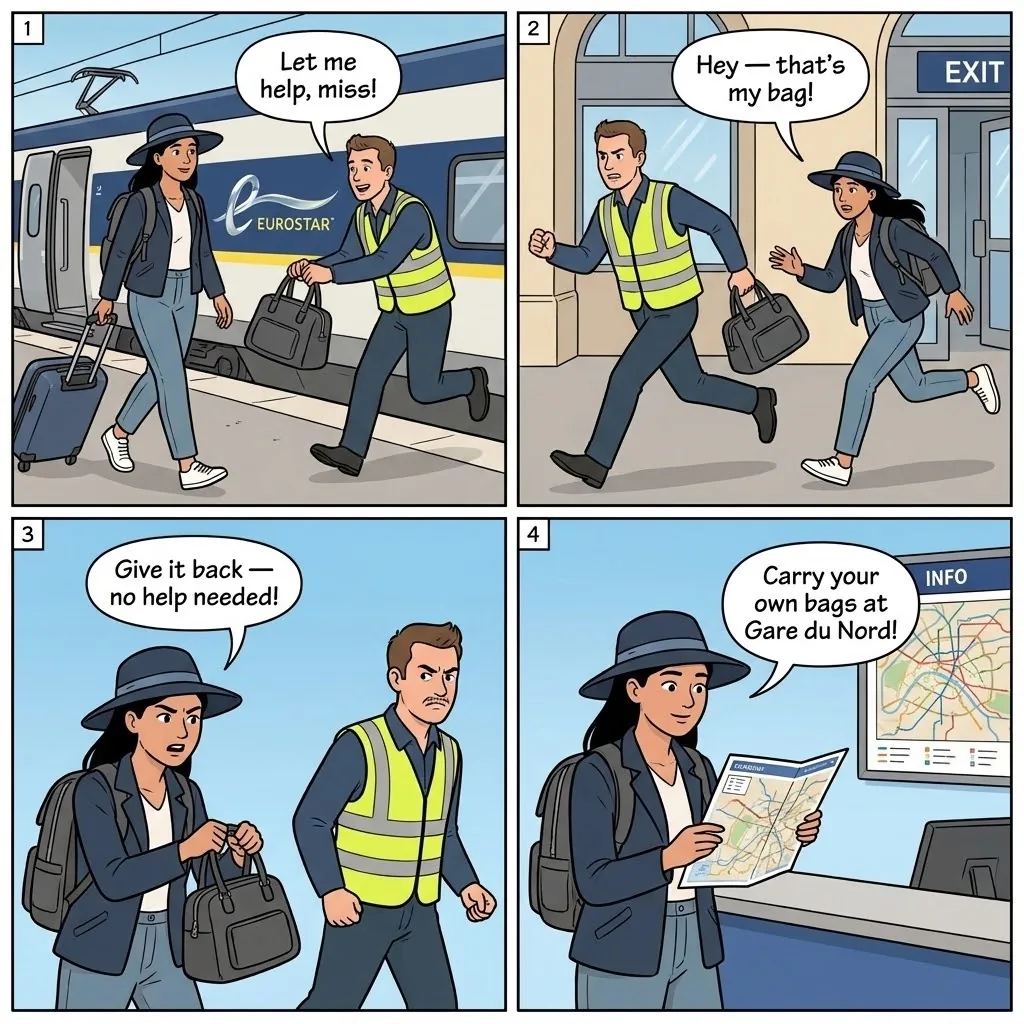
You search "Louvre tickets" on Google at your hotel in the 1st arrondissement. The top three results are sponsored ads. The first is louvre-tickets-paris.com, which looks identical to the real Louvre site, has the official-looking branding, and charges 38 EUR for a "skip-the-line" ticket (the real Louvre ticket is 22 EUR direct via louvre.fr). You click, pay 38 EUR, receive a "reservation number" by email but no QR code. The next morning at the Pyramide, the gate guard scans the printout and shrugs: there is no booking on the Louvre system under your name. The Direction Generale de la Concurrence, de la Consommation et de la Repression des Fraudes (DGCCRF) maintains an active list of fake-Louvre and fake-Eiffel sites and issues quarterly takedown notices, but the operators register new domains every 6-8 weeks. Le Parisien ran a 2024 expose on the Google-Ads bidding patterns. Defense: type louvre.fr and toureiffel.paris manually; ignore Google Ads. The Eiffel Tower app and Louvre app both sell direct same-day inventory when available. The Prefecture de Police 17 takes English-language reports.
Read the full Paris scam guide →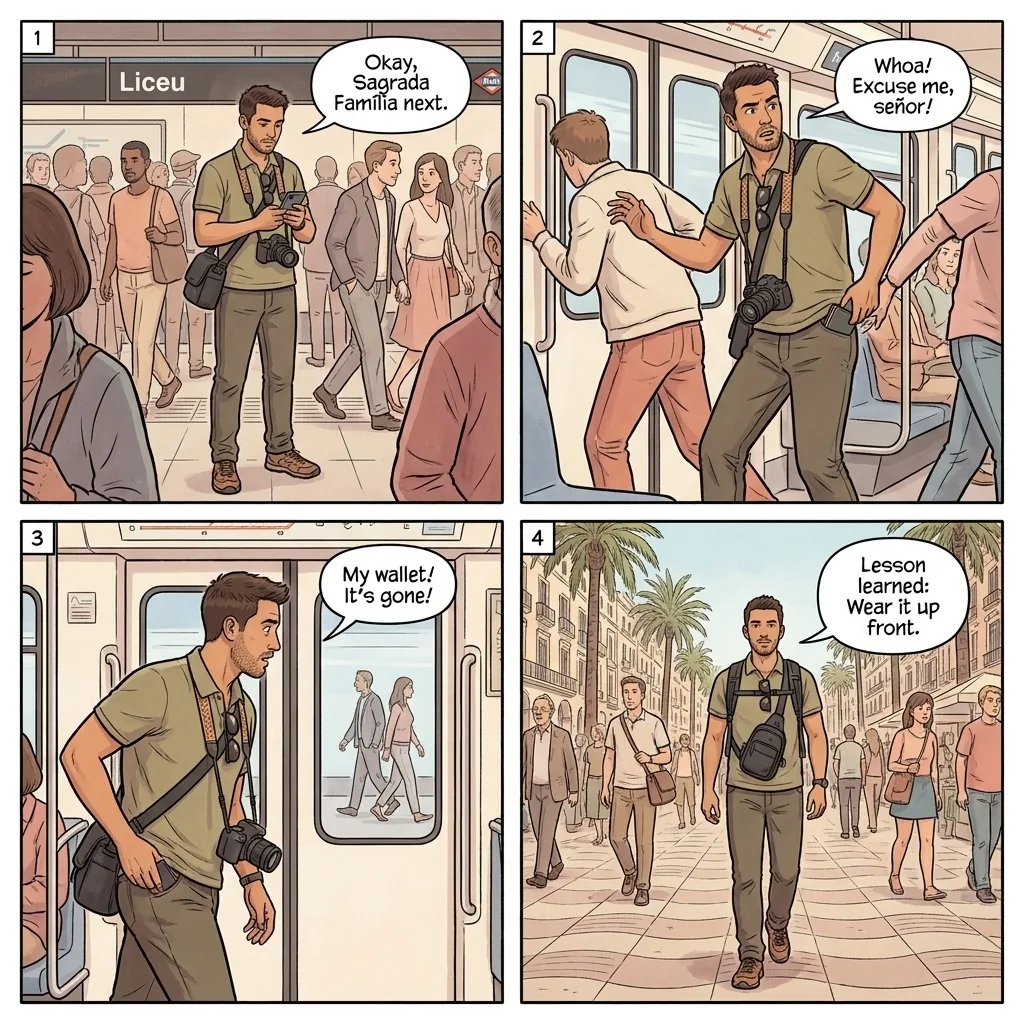
You search "Sagrada Familia tickets" and click a sponsored result for sagrada-familia-tickets.com. The site charges 65 EUR for a "skip-the-line entry" (the real Sagrada Familia ticket is 26 EUR direct via sagradafamilia.org). You receive a real ticket; the operator just bought it from the official site with your card and pocketed the 39 EUR markup. The Mossos d'Esquadra and the Generalitat de Catalunya consumer-protection agency (Agencia Catalana del Consum) have logged the Sagrada Familia and Park Guell reseller-markup pattern continuously since 2022; El Pais and La Vanguardia publish quarterly bulletins. The pattern is identical at Casa Batllo and the Picasso Museum. Defense: type sagradafamilia.org and parkguell.barcelona manually. The Sagrada Familia app provides direct same-day inventory when slots are released. Klook, Get Your Guide, and Tiqets sell licensed-guide tours at face value plus a small booking fee; the markup-reseller variant has no clear booking fee, just an inflated total. The OCU (Spain's consumer agency) accepts complaints in Spanish and English.
Read the full Barcelona scam guide →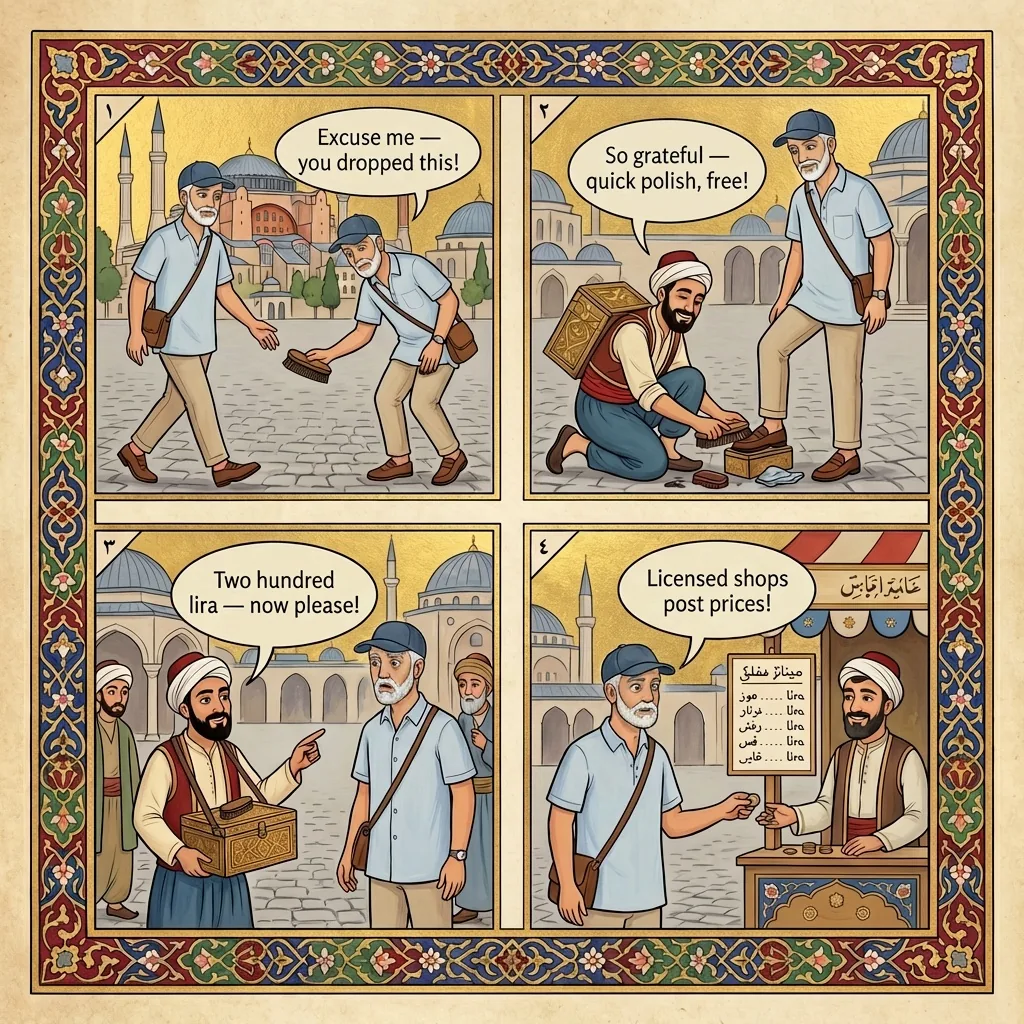
You walk into Sultanahmet Square at 10am. The Hagia Sophia entry queue is 90 minutes deep. A man with a laminated "official guide" badge approaches: "Skip-the-line ticket plus audio guide, 800 lira each." The pitch is professional, the badge looks plausible. You pay; he hands you a printout and a small audio-guide device. At the Hagia Sophia gate, the printout is rejected (it has no QR or government booking code) and the audio-guide device is a generic Bluetooth speaker not synced to any tour. The Hagia Sophia (now a mosque since 2020) is operated by the Diyanet (Turkey's Religious Affairs Directorate); tickets are managed through muze.gov.tr (the Turkish national museums system) for the gallery sections. Topkapi Palace is on the same system. Hurriyet Daily News and Daily Sabah publish quarterly tout-arrest counts at Sultanahmet. Defense: book through muze.gov.tr (or the museum-pass option for multi-site visits). The Polis (Turkish Police 155) takes tourist-fraud reports at the Sultanahmet station off Yerebatan Caddesi.
Read the full Istanbul scam guide →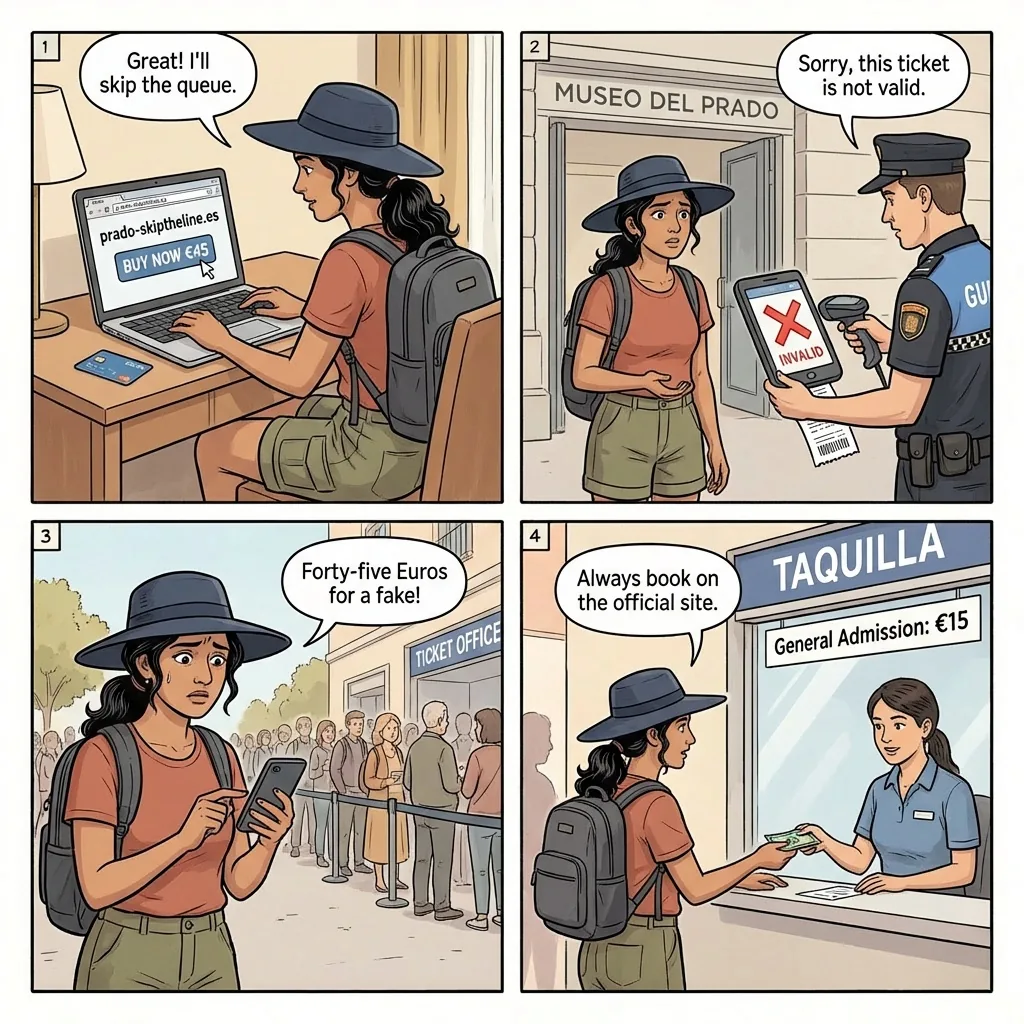
You ask the concierge at your Madrid hotel to book Prado Museum tickets. The concierge offers a "Madrid art bundle: Prado, Reina Sofia, and Royal Palace skip-the-line plus walking tour, 130 EUR per person." You pay 260 EUR for two. On arrival at the Prado, you discover the "skip-the-line" was just standard online pre-booking from museodelprado.es (the real Prado ticket is 15 EUR; museum-pass is 28 EUR for the three-museum combo). The walking tour was a 30-minute generic loop. The bundle markup was 200 EUR. The concierge gets a 30% commission from the tour aggregator. The Madrid Comunidad consumer-protection agency (DGC) has issued advisories; the SATE tourist-help office at Calle Leganitos 19 takes English-language complaints. The pattern runs at Madrid, Granada, and Seville hotel concierges and at Airbnb host check-ins. Defense: book directly through museodelprado.es and patrimonionacional.es; for guided tours, use Klook, Get Your Guide, or Walks of Spain. The savings are 100-200 EUR per couple per bundle.
Read the full Madrid scam guide →Red flags
If two or more of these signals fire when you are about to buy a "skip-the-line" ticket, cancel and book at the official venue site. The compounding rule: a single signal might be a coincidence; two signals are a script.
- The seller approaches you in the queue with a laminated badge
- The badge says "Guide" or "Official" with no clear issuing organization
- The price is more than 2x the face value posted on the venue's official site
- Payment is requested in cash on the street
- The site URL ends in .com, .info, or .tickets when you expected .it, .fr, .es, or .org
- The site appears as a Google Ads sponsored result, not in organic search
- The booking confirmation has only a "reservation number," no QR or printable PDF
- Hotel concierge offers a "skip-the-line bundle" 100+ EUR over the venue ticket
- The "skip-the-line" claim is the headline feature of an aggregated tour bundle
- The seller cannot or will not name the issuing authority for their guide credential
The phrases that shut it down
Refusing a tout works when you signal you have already booked online; the tout cannot compete with face-value pre-booking and disengages immediately. The phrase is the same idea in every language: I already have an online ticket.
If you got hit
You arrived at the venue gate, the printout was rejected, and you are out 80-200 EUR. Recovery depends on which variant ran; act fast in the first hour.
If you paid by card on a clone-checkout site: dispute the charge with your card issuer immediately. Visa and Mastercard chargeback rules cover "goods/services not received" for fake tickets and "duplicate processing" for reseller markup beyond a reasonable booking fee. Provide the booking confirmation, the gate denial photo, and a screenshot of the venue's official posted price for context.
If you paid cash to a street tout: cash payments are mostly unrecoverable. File a police report so the tout's description goes into the local-police database; the report number is required for travel-insurance currency-fraud claims (covered up to a per-incident cap on most premium-tier policies).
Within thirty minutes: file a report with the local tourist-police line.
- Rome: Carabinieri 112; Polizia di Stato 113; Termini Polizia Ferroviaria 06-481-661.
- Paris: Prefecture de Police 17 (24/7); SARIJ commissariats including 10 boulevard Strasbourg-Saint-Denis; English-language reports.
- Barcelona: Mossos d'Esquadra Tourist Help, +34 932 903 000 (24/7, English).
- Madrid: SATE (Sala de Atencion al Turista Extranjero), Calle Leganitos 19, +34 91 548 8537.
- Istanbul: Tourism Police, Sultanahmet station off Yerebatan Caddesi; Police 155.
- Florence: Polizia Municipale, Via delle Terme; tourist help desk at Piazza della Repubblica.
- Athens: Tourist Police 1571 (24/7, English-speaking dispatch).
Within one hour: queue at the official ticket desk to actually get into the venue (the wait is real but so is the ticket). Most premium-tier travel cards (Amex Platinum, Chase Sapphire Reserve, Capital One Venture X) include trip-disruption assistance for fraud-related rebooking; check the card directory if a major itinerary item is now in jeopardy.
Related atlas entries
Sister entries in the Scam Atlas. Fake-ticket scams overlap with QR quishing (clone-checkout sites use the same phishing infrastructure) and with fake-police shakedowns (both rely on uniform-looking authority).
Sources
- Polizia di Stato and Polizia Municipale di Roma quarterly tout-arrest reporting at Vatican and Colosseum approaches (2018-2025).
- La Repubblica, ongoing Vatican Museums and Colosseum fake-ticket coverage with monthly arrest counts.
- Direction Generale de la Concurrence, de la Consommation et de la Repression des Fraudes (DGCCRF), French anti-clone-site enforcement notices (2022-2025).
- Le Parisien, 2024 expose on Louvre and Eiffel Tower Google-Ads bidding patterns.
- Mossos d'Esquadra and Agencia Catalana del Consum (Catalonia consumer-protection agency), Sagrada Familia reseller-markup quarterly bulletins (2022-2025).
- El Pais and La Vanguardia, Sagrada Familia and Park Guell reseller coverage (Spain).
- Hurriyet Daily News and Daily Sabah, Sultanahmet and Topkapi tout-arrest reporting (2022-2025).
- OCU (Spain consumer agency) and SATE Madrid tourist-help office complaint data (2023-2025).
- r/travel, r/rome, r/Paris, r/Spain, r/turkey continuing thread monitoring 2018-2026.
Get the full ticket-safety playbook for your destination.
Each Travel Safety atlas covers every documented fake-ticket variant in one country, plus the country's full scam catalog: pickpocket, taxi, ATM, restaurant, fake authority. Buy once, lifetime updates as scams evolve. $4.99 on Kindle.