
Key Takeaways
- The #1 reported scam is the Madrid Barajas (MAD) Airport Taxi Overcharge.
- 5 of 7 scams are rated high risk.
- Use app-based ride services (Uber, Bolt) or official metered taxis instead of unmarked vehicles.
- Never accept unsolicited offers from strangers near tourist sites in Madrid.
⚡ Quick Safety Tips
- From Madrid Barajas Airport (MAD), the legal taxi flat rate to anywhere inside the M-30 ring road is €33 — posted on signs at every taxi queue; anything above is overcharging.
- Metro Line 8 from Barajas to Nuevos Ministerios is €5 (includes €3 airport supplement) — the scam-free alternative to taxis.
- If something wet hits you at Puerta del Sol or Plaza Mayor, walk immediately to an indoor space before cleaning — the 'bird poop' distraction is a team pickpocket.
- Book Prado Museum tickets only at museodelprado.es and Royal Palace only at patrimonionacional.es — 'skip-the-line' third-party sites routinely send invalid QR codes.
- Save Policía Nacional Comisaría de Centro (Calle Leganitos 19) for tourist crime reports within 24 hours for insurance documentation.
Jump to a Scam
- High Madrid Barajas (MAD) Airport Taxi Overcharge
- High Metro Sol + Atocha Pickpocket Teams
- High Bird Poop Distraction Pickpocket
- Medium Puerta del Sol Bracelet & Clipboard Petition Scam
- High Fake Prado Museum & Royal Palace 'Skip-the-Line' Ticket Websites
- Medium Puerta del Sol & Plaza Mayor Tourist-Menu Restaurant Overcharge
- High Hotel & Booking Off-Platform Payment Fraud
The 7 Scams
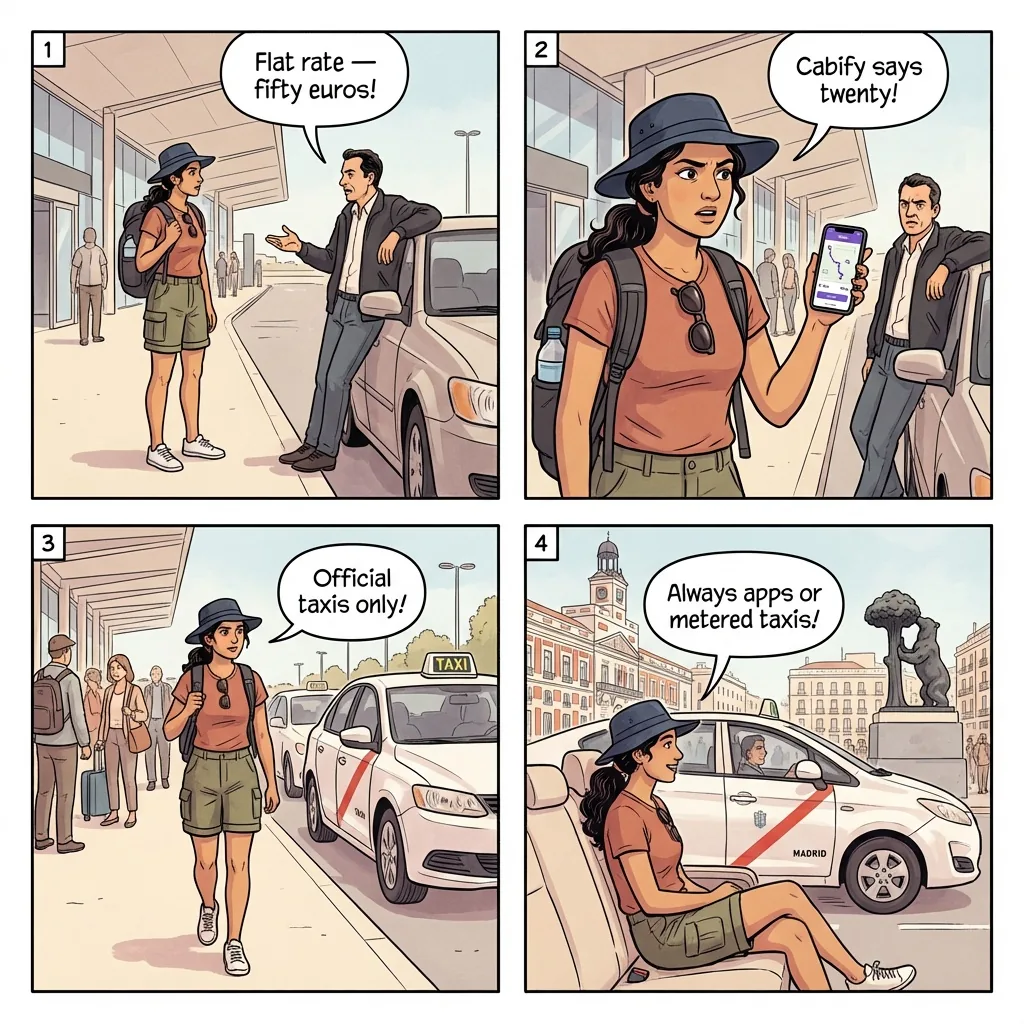
Madrid Barajas Airport (MAD) taxi drivers quote €60–€110 with 'broken meter,' 'luggage fees,' or M-40 indirect routing for runs that should cost the legal €33 flat rate to anywhere inside the M-30 ring (posted at every queue) — Metro Line 8 from any terminal to Nuevos Ministerios is €5 (includes the €3 airport supplement, 30 minutes), Renfe Cercanías C-1 from T4 to Atocha is €2.60, and Bus Express 12 between terminals is free; if you take a taxi, demand the €33 flat rate before bags go in the boot.
You land at Madrid Barajas after a long flight and join the taxi queue outside Terminal 4. The first driver doesn't switch on the meter and quotes €75 to your hotel near Sol — claiming the meter is broken, or that there's a 'luggage fee,' or that 'terminal transfers cost extra.' The legal Madrid airport flat fare to anywhere inside the M-30 ring road (including the city center, Retiro, Salamanca, and Chueca) is €33. Drivers who claim the meter is broken or add 'luggage fees,' 'terminal transfer fees,' or 'night surcharges' are running one of Europe's most-documented airport scams.
The 'legal' variant is especially insidious — drivers obey the meter but take an indirect route via the M-40 ring road instead of the M-11/M-30, adding 20 minutes and €20 to the fare. Terminal-to-terminal taxis at Barajas run a separate shakedown — quoting €30–€50 for what should be €5 or a free shuttle bus. The 2025 community thread consensus is that the M-30 €33 flat rate is the single most effective defensive number to memorize before landing: any quote above it should be challenged before bags leave the trunk.
The Madrid airport flat rate to anywhere inside the M-30 is €33, posted on every Barajas taxi queue sign — anything above is overcharging. Demand the €33 flat rate for any inside-M-30 destination before bags go in the boot, refuse any 'broken meter' or 'luggage fee' add-on, and if the driver refuses to honor the flat rate, walk away to the next vehicle in the queue. Cheaper alternatives: Metro Line 8 from T1/T2/T3 or T4 to Nuevos Ministerios (€5 including the €3 airport supplement, 30 minutes scam-free), Renfe Cercanías C-1 from T4 to Atocha or Chamartín (€2.60, 25 minutes), or Bus Express 12 between terminals (free yellow shuttle). For app fares, Uber, Bolt, FreeNow, and Cabify all work in Madrid with fixed prices and digital receipts.
Red Flags
- Madrid Barajas taxi driver quotes above €33 flat to anywhere inside the M-30 ring
- Driver adds 'luggage,' 'terminal transfer,' or 'night surcharge' beyond the flat rate
- Meter runs with additional 'airport fee' added before departure
- Route goes via M-40 instead of direct M-11/M-30 — adds 20 minutes and €20
- Terminal-to-terminal taxi quoted at €30+ (real: free Bus Express 12)
How to Avoid
- Demand the €33 flat rate for anywhere inside the M-30 — posted on signs at the queue.
- Take Metro Line 8 from Barajas to Nuevos Ministerios (€5, 30 min, scam-free).
- Or Renfe Cercanías C-1 from T4 to Atocha or Chamartín (€2.60, 25 min).
- Between terminals, use the free Bus Express 12 yellow shuttle — not a taxi.
- For app taxis, use Uber, Bolt, FreeNow, or Cabify — all show fixed prices.

Three- or four-person pickpocket teams work Metro Line 1 (Atocha–Sol–Chamartín, the airport-to-center axis) and the Sol station transfer concourse where Lines 1, 2, and 3 meet — distractor + lifter + receiver + lookout, using fake-crowd-crush at carriage doors, large-map direction asks, and escalator-bump tactics; phone replacement runs €600–€1,200, and any theft must be reported at Comisaría de Centro (Calle Leganitos 19) within 24 hours for insurance documentation.
Madrid Metro is otherwise clean and safe, but two corridors see concentrated pickpocket activity: Line 1 (Atocha–Sol–Chamartín, the airport-to-center axis) and the Sol station transfer concourse where Lines 1, 2, and 3 meet. Teams operate in three- or four-person groups — one distracts, one lifts, one receives, one keeps lookout. The pattern is well-documented in 2025 traveler reports.
The most common 2025 patterns: fake crowd crush at carriage doors where someone pushes from behind while another reaches into your outer pocket; 'map distraction' where someone asks for directions with a large open map blocking your view of your bag; escalator bump where a passenger 'falls' into you. One canonical traveler comparison: 'Madrid is much safer than Barcelona. Do not put your valuables in a backpack on your back. Keep your wallet/passport front pocket.' The same thread notes pickpocket teams rotate between Barcelona and Madrid's Gran Vía/Sol stretch seasonally — meaning a quiet month in one city often correlates with a busy one in the other.
The damage is typically a phone (€600–€1,200 replacement for a current iPhone) or a wallet (€50–€300 cash plus card cancellation overhead). For insurance, you need a Policía Nacional report filed at a police station within 24 hours — Comisaría de Centro at Calle Leganitos 19 handles tourist reports. Wear a zipped anti-theft crossbody bag in front of you on Line 1 and at Sol/Atocha/Gran Vía/Callao stations, never use a backpack's outer pocket, keep phone in a zipped inner jacket pocket (not a back pocket), and do not pull out your phone on crowded escalators or at carriage doors. At Atocha train station specifically, keep bags between your knees when seated waiting for trains, and report any theft at Comisaría de Centro (Calle Leganitos 19) within 24 hours — the SATE tourist-assistance unit speaks English and produces the denuncia document insurers require.
Red Flags
- Dense crowd at Metro carriage doors during boarding — pickpocket trigger environment
- Someone asks for directions with a large open map blocking your view
- At Atocha, Sol, or Gran Vía, strangers stand unusually close in a non-crowded area
- Someone bumps you on the escalator and apologises profusely (partner is working)
- Activity peaks April–October and after major football matches
How to Avoid
- Wear a zipped anti-theft crossbody bag in front of you in any crowded environment.
- Keep phone in a zipped inner pocket or jacket pocket; never in a back pocket.
- Split cash across pockets — €20 front pocket, rest in a money belt or hotel safe.
- Do not pull out phone on crowded escalators, at carriage doors, or on Line 1 at rush hour.
- Report thefts at Comisaría de Centro (Calle Leganitos 19) within 24 hours for insurance.

Distraction crews work Puerta del Sol, Plaza Mayor, Gran Vía, and the Bear-and-Strawberry-Tree statue with pocket-bottle squirts of mustard, ketchup, shaving cream, or paint disguised as 'bird poop' — a 'helpful' stranger appears within seconds with tissues already in hand and lifts your wallet while wiping the stain; if anything wet hits you unexpectedly in central Madrid, do NOT stop — walk straight to a café, shop, or hotel lobby before cleaning, and refuse any 'help' from a stranger who arrives within seconds.
You're walking through Puerta del Sol toward the Bear-and-Strawberry-Tree statue when you feel something wet hit your shoulder. You look — it appears to be 'bird poop,' but suspiciously mustard-yellow or cream-colored. A friendly bystander appears immediately with tissues and helps you wipe it off while expressing sympathy. You thank them and walk on; ten minutes later you realize your wallet is gone. As one canonical traveler account describes the mechanic precisely: 'They pickpocket you while they help wipe off the fake bird poop.'
The scam teams operate at Puerta del Sol (the Kilómetro Cero plaza in central Madrid), Plaza Mayor, along Gran Vía, and near tourist photo spots like the Bear and Strawberry Tree statue. The 'poop' is typically mustard, ketchup, shaving cream, or paint — sprayed from a pocket-sized bottle as you pass. The 'helpful stranger' appears within seconds, carrying tissues already in hand — the giveaway that they were expecting this 'accident.' Spain's Ministry of Interior has published warnings about the bird-poop variant specifically, and Policía Nacional's SATE unit has documented arrests in 2024–2025.
If you feel something wet hit you unexpectedly, the urge to stop and examine the stain is exactly the response the scam exploits. Do NOT stop to examine or clean any unexpected wet hit in Puerta del Sol, Plaza Mayor, Gran Vía, or near photo spots — walk immediately to a nearby café, shop, or hotel lobby (a secure indoor space) before dealing with the stain, and refuse help from any stranger who appears within seconds with tissues already in hand. The stain will wash out later; your wallet and phone are the priority. Keep valuables in a zipped front pocket or crossbody bag worn in front, photograph the 'helpers' from a distance if you have time, and if pickpocketed, file the denuncia at Comisaría de Centro (Calle Leganitos 19) within 24 hours for insurance.
Red Flags
- You feel something wet hit your shoulder or back in a tourist area — mustard/ketchup/cream color
- A 'helpful' stranger appears within seconds with tissues already in hand
- The 'stain' is on a hard-to-see area (upper back, shoulder blade) where you need help
- Multiple 'helpful' people converge around you at once
- Occurs at Puerta del Sol, Plaza Mayor, Gran Vía, or photo spots where tourists linger
How to Avoid
- If hit by something wet unexpectedly, walk IMMEDIATELY to an indoor space (café, shop, hotel).
- Do not accept help from any stranger who appears within seconds of the 'accident.'
- Keep valuables in a zipped front pocket or crossbody bag worn in front.
- Photograph the 'helpers' from a distance if you have time — useful for police report.
- File at Comisaría de Centro within 24 hours if pickpocketed for insurance claim.
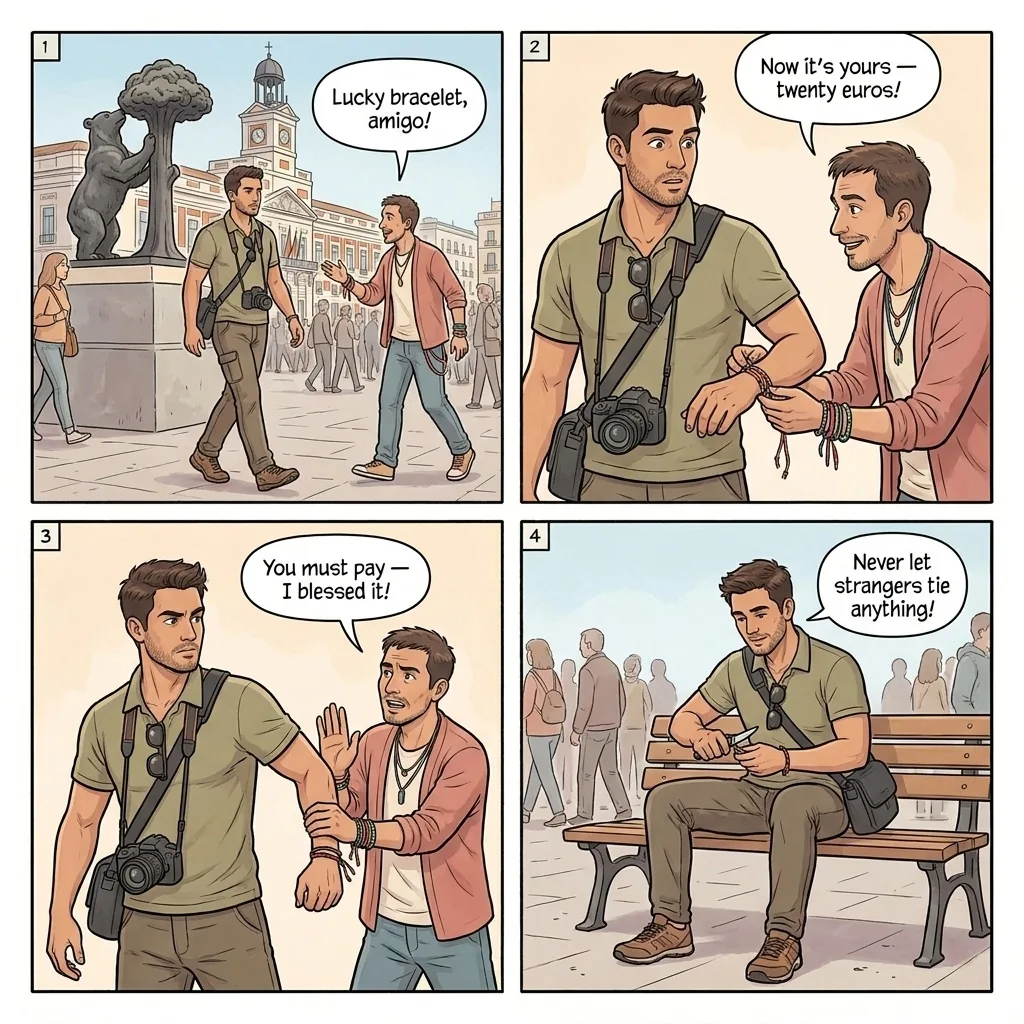
Multi-person petition crews work Puerta del Sol, Plaza Mayor, the Royal Palace (Palacio Real), and the Temple of Debod with 'deaf children' or 'disabled orphans' clipboards while a partner unzips your day-bag and a third accomplice ties a slip-knot 'friendship bracelet' to your wrist — legitimate Spanish charities like ONCE and the Federación de Personas Sordas use uniformed kiosks, never roving clipboard teams; cross your arms, say 'no, gracias,' and keep walking.
A young woman approaches you in Puerta del Sol with a clipboard, gestures at the page, and tells you she's collecting signatures for a petition for deaf children. You stop to listen. She gestures for you to sign. While you hold the pen, a partner opens your day-bag from behind, and a third accomplice tries to tie a colorful 'friendship bracelet' to your wrist. As one canonical traveler account puts it: 'Got approached by 2 girls with clipboards asking for some petition for disabled children — they were a team.' The team operates at Puerta del Sol, Plaza Mayor, the entrance to the Royal Palace (Palacio Real), and the Temple of Debod — all high tourist-foot-traffic zones.
The bracelet component is the same Syntagma/Athens mechanic. One traveler witnessed both halves at once: 'I did witness the bracelet scam where a guy hands someone a bracelet and then won't take it back.' The charity petition adds a social-obligation hook specifically targeting older travelers — the 'deaf children' or 'disabled orphans' framing is designed to make you feel guilty about walking away. No legitimate Spanish charity collects signatures from tourists in Puerta del Sol; the Spanish Federation of Deaf People (Federación de Personas Sordas) and ONCE (the National Organization of the Spanish Blind) use verifiable volunteer kiosks with uniforms, not clipboard teams.
These scams peak April–October, and Policía Nacional's Unit for Tourism Assistance (SATE) patrols Puerta del Sol during summer evenings. Cross your arms and step back if approached with a clipboard or bracelet anywhere in central Madrid — do not stop to read, do not make eye contact, do not slow your walking pace; say 'no, gracias' firmly and keep moving. If a bracelet is already on your wrist, walk to a café and cut it off with scissors yourself — never pay. Keep your wallet in a front zipped pocket and your phone in an inner jacket pocket when walking through Puerta del Sol, Plaza Mayor, the Royal Palace, or the Temple of Debod, and report persistent crews to SATE (the Tourism Assistance police, summer-active in Puerta del Sol).
Red Flags
- Young woman with a clipboard approaches in Puerta del Sol, Plaza Mayor, or Royal Palace area
- Petition subject is 'deaf children,' 'disabled orphans,' or similar charity hook
- Multiple 'signers' already on the clipboard (social proof forgery)
- Partner or partners within arm's reach — team operation
- Offered a 'free bracelet' as thanks for signing
How to Avoid
- Cross your arms and step back if approached with a clipboard or bracelet.
- Say 'no, gracias' firmly and keep walking — do not engage.
- Legitimate Spanish charities (ONCE, Federación de Personas Sordas) use uniformed kiosks, not clipboard teams.
- Keep wallet in front zipped pocket or crossbody bag worn in front at Puerta del Sol.
- Report persistent crews to SATE (Tourism Assistance police) — active summer patrols at Puerta del Sol.

The only official Madrid museum ticket sites are museodelprado.es (Prado, €15 admission, free in the final two hours daily 6–8 PM) and patrimonionacional.es (Royal Palace, €14) — phishing sites with names like myprado-tickets.com or prado-skiptheline.es charge €30–€35 per person and email QR codes that scan as invalid at the gate; verified third-party resellers with chargeback are GetYourGuide, Viator, and Tiqets, and licensed Spanish tour guides wear a Ministerio de Industria yellow credential card.
You plan ahead. Weeks before your trip you search 'Prado Museum tickets' and click the first result — a professional-looking site named something like myprado-tickets.com or prado-skiptheline.es. You pay €35 per person for 'skip-the-line' tickets. At the Prado entrance on arrival, the QR codes scan as invalid. As one traveler reports it: 'The QR keeps asking for a confirmation email address even though I had paid weeks earlier' — fraud sites exploit the real site's technical issues to funnel tourists into impersonated UIs that look identical to museodelprado.es.
The only official Prado ticket website is museodelprado.es. The Royal Palace (Palacio Real) official tickets are at patrimonionacional.es. Tickets outside these two domains from any 'skip-the-line' or 'official Spain ticket' reseller should be treated with suspicion. Legitimate third-party resellers with chargeback guarantees include GetYourGuide, Viator, and Tiqets. Community consensus on Prado and Royal Palace tour quality: tours with licensed Spanish guides (carrying the Ministerio de Industria yellow credential card) are legitimate; 'official skip-the-line' tickets at 2x the posted price are resale scams or outright phishing.
The Prado posted admission is €15 (free for the final two hours daily, 6–8 PM, as of 2025). The Royal Palace admission is €14. If a reseller charges €35 per person for 'skip-the-line' access that should cost €15 or €14, they are marking up 100–130% — and in the worst case producing fake QR codes entirely. Book Prado tickets only at museodelprado.es and Royal Palace tickets only at patrimonionacional.es — verified third-party resellers with chargeback protection are limited to GetYourGuide, Viator, and Tiqets, and any URL not exactly matching those four domains should be treated as phishing. Search the domain plus 'scam' before paying, pay by credit card for chargeback (60–120-day window), and at the museum buy tickets at the official booth if you arrive without an online ticket — ask any 'guide' to show their Ministerio de Industria yellow credential card before hiring.
Red Flags
- Online site with 'prado' or 'palacio-real' in the URL that isn't museodelprado.es or patrimonionacional.es
- Voucher is emailed as a plain PDF with a QR code that fails at the gate
- Site's 'contact' or 'about us' page has vague language and no real Spanish address
- Price is €30+ per person for a Prado ticket that officially costs €15
- Tout outside the Prado or Royal Palace offers 'skip-the-line' tickets for cash
How to Avoid
- Book Prado tickets only at museodelprado.es; Royal Palace only at patrimonionacional.es.
- Verified third-party resellers: GetYourGuide, Viator, Tiqets (credit card with chargeback).
- Search the domain name plus 'scam' before paying any online Madrid ticket seller.
- At the Prado, visit in the free 6–8 PM window if budget is the issue.
- Licensed Spanish tour guides wear a Ministerio de Industria yellow credential card — ask to see it.
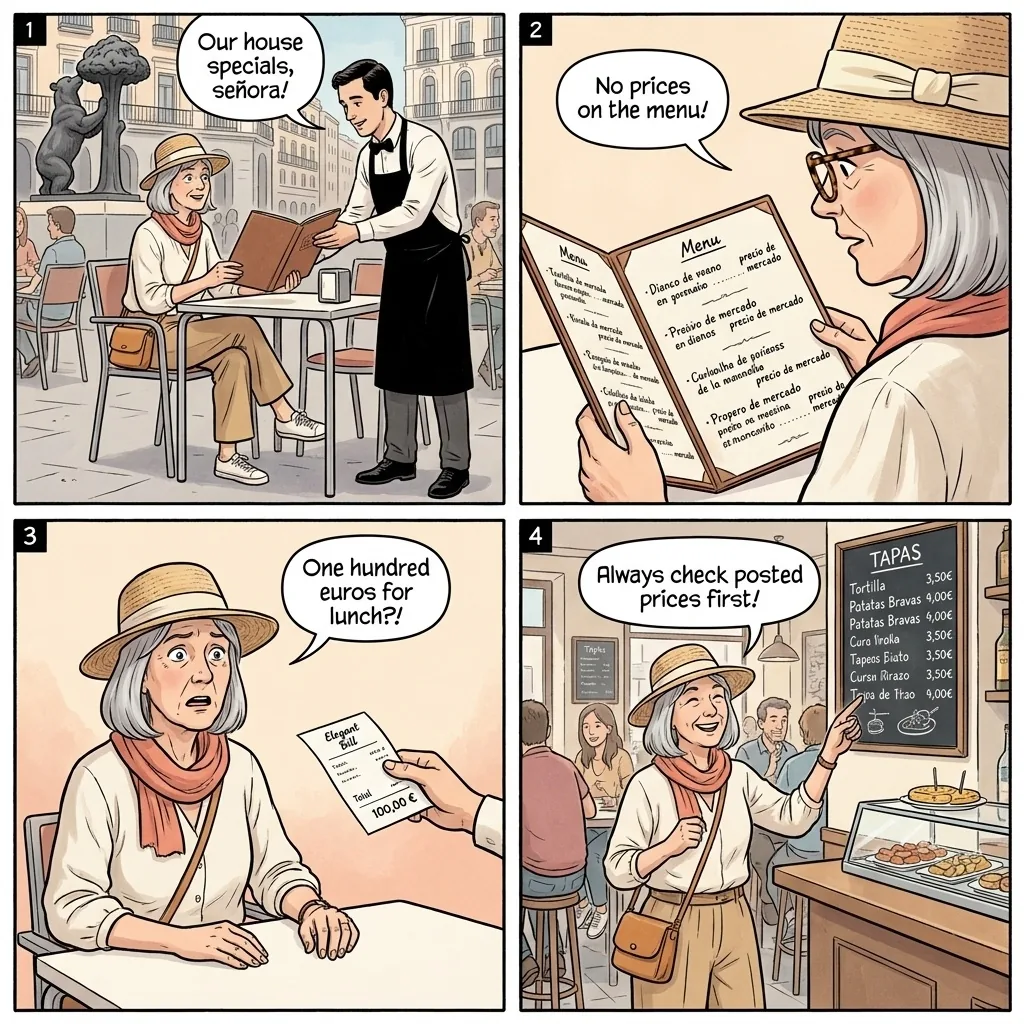
Plaza Mayor arcade and Puerta del Sol perimeter restaurants run a tourist-tier menu where the table version is €5–€15 higher than the entrance posting, 'welcome' bread, olives, and Manchego arrive unrequested at €3–€10 each, and 'menu del día' fine print adds 'bebidas' and 'postre' at premium — walk one block off the tourist spine to La Latina (Cava Baja, Casa Lucio, Casa Labra), Chueca, or Malasaña for the genuine €12–€18 menu del día and honest tapas.
You sit at a Plaza Mayor arcade restaurant for lunch and order paella, a Spanish salad, and two glasses of wine. Bread and olives arrive — unrequested. The bill totals €85. The menu outside showed paella at €18; at the table it was €32. 'Welcome' bread, olives, and a small plate of Manchego added €12 to the bill, with a 'cubierto' cover charge another €4. As one Madrid veteran puts it: 'Avoid places very close to tourist attractions and the classic tourist traps — they all use the same playbook.'
The mechanic is opaque pricing plus 'optional' extras that arrive unordered. Restaurants on Puerta del Sol's perimeter, around Plaza Mayor's arcades, and along Gran Vía's tourist spine often serve bread, olives, and small tapas 'as a welcome' — each appearing on the bill at €3–€10. The menu at the entrance may show lower prices than the one at the table, or the 'tourist menu del día' may have fine print adding 'bebidas' (drinks) and 'postre' (dessert) at premium prices. Spanish consumer law (Ley General para la Defensa de los Consumidores) requires prices to be clearly disclosed; restaurants violating this can be fined, but enforcement on Plaza Mayor is weak.
The 'menu del día' tradition is a Spanish lunch institution — €12–€18 for starter, main, bread, drink, and dessert — but only at restaurants outside the tourist triangle. On Plaza Mayor the same 'menu del día' is often €25–€30 with worse food. Read the menu posted at the entrance before sitting (Spanish law requires it visible to passers-by) and confirm prices at the table match before ordering — decline 'welcome' bread, olives, or Manchego explicitly with 'no, gracias' when they arrive, and check the bill line by line against the entrance menu. Eat one block off Plaza Mayor in La Latina (Cava Baja: Casa Lucio, Casa Labra, Taberna La Concha), Chueca, or Malasaña (Bodega de la Ardosa) for honest €12–€18 menu del día and proper tapas pricing.
Red Flags
- Restaurant on Plaza Mayor arcade, Puerta del Sol perimeter, or Gran Vía has no posted menu visible outside
- Menu at the table differs from the one posted at the entrance
- Bread, olives, tapas, or Manchego arrive unordered
- 'Menu del día' fine print adds 'bebidas' or 'postre' at premium prices
- Bill includes 'cubierto' (cover charge) or 'servicio' not listed on the menu
How to Avoid
- Read the menu at the entrance before sitting; confirm prices at the table match before ordering.
- Decline 'welcome' items explicitly — 'no, gracias' politely waves them off.
- Eat one block away from Plaza Mayor — La Latina, Chueca, Malasaña have fair-priced local tapas bars.
- Community-respected posted-price Madrid options: Casa Lucio, Casa Labra, Bodega de la Ardosa.
- Proper 'menu del día' is €12–€18 at local restaurants — anything above €22 on Plaza Mayor is tourist pricing.

Phishing emails impersonating Booking.com (URLs like booking-com.net or bookingcom-pay.org) target Madrid hotel reservations days before arrival with 'finalize payment via secure link' messages — meanwhile Chueca, Malasaña, and Lavapiés Airbnb listings are cloned with stolen photos and 'water damage' cancellations 48 hours out that funnel guests into off-platform cash deposits; book only via Booking.com, Hotels.com, Expedia, or Airbnb with a credit card, never click email payment links, and verify any host message by calling the hotel via the Google Maps phone number.
A few days before arrival you get an email that looks like Booking.com — same logo, same color scheme, same footer. The message says your payment needs to be finalized through a 'secure link.' The URL is close but not identical: booking-com.net, bookingcom-pay.org, or similar. You pay €450; on arrival, the real hotel has no record of the payment, and your original Booking.com reservation appears to have been canceled. Community traveler threads document that the Booking.com impersonation scam hits Madrid hotels as frequently as Athens or Barcelona — and a related variant uses the Booking.com chat system itself, impersonating hotel staff with messages that appear in the legitimate app inbox.
A Madrid-specific variant targets the Airbnb and short-term rental market in Chueca, Malasaña, and Lavapiés — neighborhoods with high tourist demand and dense apartment conversion. Operators create lookalike listings using photos stolen from legitimate properties, accept deposits, and cancel 48 hours before arrival citing 'water damage' with an offer to relocate you to an 'alternative' that requires off-platform cash payment. Spanish media has reported organized Airbnb fraud rings operating in Madrid, with Policía Nacional making arrests during a May 2025 operation in the Centro and Lavapiés districts.
The two variants share a single tell: any payment instruction that takes you off the booking platform's app or website. Book only through Booking.com, Hotels.com, Expedia, or Airbnb with credit-card payment and screenshot all confirmations — never click payment links in emails (even ones that look identical to the platform), log into the platform directly through a fresh browser tab and check your reservation status. Call the hotel through the Google Maps phone number (not the email's) to verify any payment request, read the most recent 30 days of hotel reviews looking for 'payment link,' 'water damage,' or 'moved to sister property' complaints, and book six or more weeks ahead for peak season (April–October, Christmas markets) to reduce exposure to last-minute 'deal' messages. Pay only by credit card — chargeback (60–120 days) is your strongest recovery route.
Red Flags
- Email 'from Booking.com' with payment link arrives days before arrival
- URL does not exactly match booking.com (watch for booking-com.net, bookingcom-pay.org)
- Host messages asking to cancel the booking and pay directly
- Listing photos reverse-image-search to unrelated properties
- Offer is 30–50% below market for Sol, Gran Vía, Chueca, or Salamanca area
How to Avoid
- Book only through Booking.com, Hotels.com, Expedia, Airbnb with credit card — screenshot confirmations.
- Never click payment links in emails; log into booking account directly in a fresh browser tab.
- Call the hotel through the Google Maps number (not the email's) to verify any request.
- Pay only by credit card — chargeback is your strongest protection (60–120 days).
- Book six or more weeks ahead for peak season (April–October, Christmas).
🆘 What to Do If You Get Scammed
📋 File a Police Report
Go to the nearest Policía Nacional or Guardia Civil station. Call 091 (Policía Nacional) or 112 (emergency). Get an official crime report — you'll need this for insurance claims. You can also report online at policia.es.
💳 Cancel Your Cards
Call your bank immediately. Most have 24/7 numbers on the back of the card (keep a photo saved separately). Block any suspicious transactions before the thieves use your details.
🛂 Lost Passport?
Contact your nearest embassy or consulate. The US Embassy is at Calle de Serrano, 75, 28006 Madrid. For emergencies: +34 91 587-2200.
📱 Track Your Device
If your phone was stolen, use Find My (iPhone) or Find My Device (Android) from another device. Don't confront thieves yourself — share the location with police instead.
Frequently Asked Questions
You just read 7 scams in Madrid. The book has 96 more across 16 Spanish destinations.
Barcelona's La Rambla rosemary-sprig clavel circuit. Madrid's Puerta del Sol three-card trile. Seville's Plaza de España palm-reading gambit. Granada's Alhambra skip-the-line reseller industry. Ibiza and Mallorca scooter deposit-hold cycle. Every documented Spain scam — with the exact scripts, red flags, and Spanish phrases that shut each one down. Drawn from El País, La Vanguardia, ABC, El Mundo, and Policía Nacional and Mossos d'Esquadra records.
- 103 documented scams across Barcelona, Madrid, Seville, Granada & 12 more cities and islands
- A Spanish exit-phrase card you can screenshot to your phone
- Updated annually — buy once, re-download future editions free
- Readable in one flight — $4.99 on Amazon Kindle