
Key Takeaways
- The #1 reported scam is the Fake Alcázar Ticket Websites.
- 3 of 8 scams are rated high risk.
- Use app-based ride services (Uber, Bolt) or official metered taxis instead of unmarked vehicles.
- Never accept unsolicited offers from strangers near tourist sites in Seville.
⚡ Quick Safety Tips
- Book Real Alcázar tickets only at realacazarsevilla.cliqueo.es document fake sites charging double for invalid tickets.
- From Seville Airport (SVQ), use the EA bus (€4) to Plaza de Armas or a licensed taxi (€25 flat to center on weekdays, €27 weekends) warn that app pickups at the rank are routinely overcharged.
- Stand at the bar rather than sitting at a table in Santa Cruz and El Arenal tapas bars — menu prices are lower points to locals-only side streets one block off Calle San Jacinto for honest pricing.
- Never accept rosemary, flowers, or trinkets from women in traditional dress near the Cathedral and Giralda — keep hands in pockets and say 'no, gracias' before any physical contact; Traveler reports document the €10–€20 shake-down pattern.
- Save Policía Nacional Seville (Plaza de la Concordia 1, +34 954 289 300) and the tourist-aid SATE line — file denuncia within 48 hours for insurance and report fake parking-vest collectors at cathedral-area free zones to Policía Local (092).
Jump to a Scam
- High Fake Alcázar Ticket Websites
- Medium Rosemary / Flower Pressing Scam
- High Pickpockets at Utopia and Nightlife Venues
- Medium Overpriced Flamenco Show Packages
- High Three-Card Monte / Shell Game on Tourist Streets
- Medium Unlicensed Horse Carriage 'Tours'
- Medium Tapas Bar Bill Padding
- Low The Fake Parking Collector in Free Zones
The 8 Scams

Lookalike "Alcázar Seville tickets" websites — often the top Google ad result — sell €35 tickets for what costs €14.50 on realacazarsevilla.cliqueo.es, the only legitimate booking site; some confirmations are outright fraud and tourists get turned away at the gate, others charge double for valid entry.
You're planning your Seville trip from home, excitedly booking what you imagine to be one of the most stunning palaces in the world. You search 'Alcazar Seville tickets' and several results appear — some look almost identical to the official site, with similar logos, photos of the stunning Mudéjar arches, and 'secure' payment icons. You book. You pay. You receive a confirmation PDF that looks legitimate. Then you arrive and get turned away. Or you find the receipt charge was €35 for a ticket that costs €14.50 on the official site.
This is one of Seville's most discussed tourist scams, and the Reddit record is long and specific. flags the most common clone: 'This is a FAKE/SCAM company that appears like the website of the actual place you are trying to visit. Somehow they were the first Google result.' confirm entrance tickets 'sold at double than official prices.'
The only legitimate booking site is realacazarsevilla.cliqueo.es (or alcazarsevilla.org). Any other domain — however convincing the design — is a third-party reseller charging vastly inflated prices, or outright fraud. The Alcázar does sell out, which creates the perfect pressure to use the first booking option you find. offers the practical remedy: if you've already paid a fake site, call your credit card's fraud group immediately and request a 'bypass' while you book the official tickets in parallel.
Red Flags
- Ticket price is significantly higher than €14.50 for adults (the official 2024 general admission rate)
- Website URL is not realacazarsevilla.cliqueo.es or alcazarsevilla.org — even slight differences indicate a fake
- Site uses urgency language like 'only 3 tickets left' or 'selling fast' to push rushed purchases
- Payment confirmation receipt has no official Patronato del Real Alcázar branding or QR code format
- Google ads for 'Alcazar Seville tickets' often lead to third-party resellers — scroll past ads to the official site
How to Avoid
- Bookmark the official URL before your trip: realacazarsevilla.cliqueo.es — this is the only legitimate booking source.
- Compare the price you're being charged to the publicly listed official price (€14.50 adult general admission).
- Never click 'Alcazar tickets' Google ads — go directly to the URL typed manually.
- If you've already paid a third party, check whether you can still get official tickets and dispute the extra charge with your bank.
- Book at least 2 weeks ahead — the Alcázar is genuinely sold out during peak season and legitimate tickets go fast.
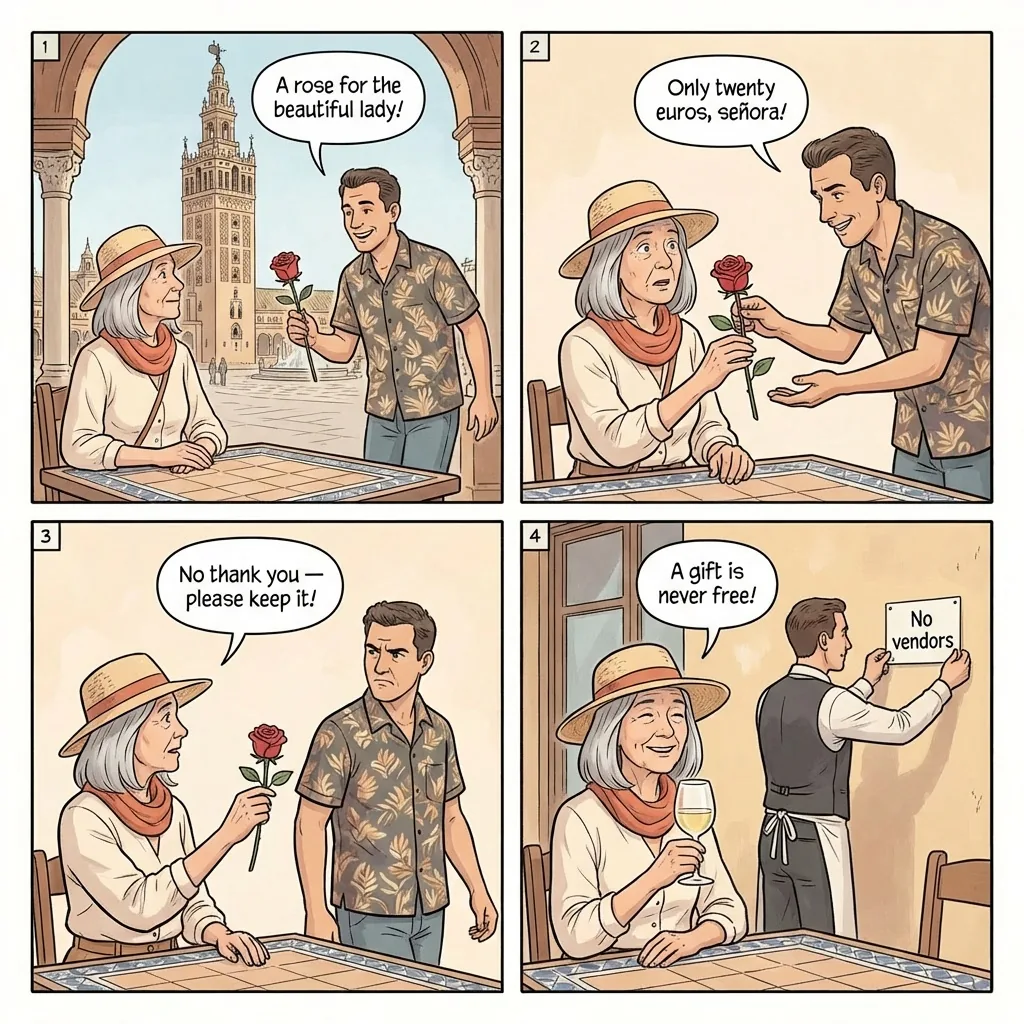
Older women in traditional dress near the Catedral, Giralda, and Plaza de España press a sprig of rosemary into your palm "for luck," then read your palm and demand €10–€20 for the "gift" that was never freely given — refusing to take it back, following you, and turning aggressive if you don't pay.
You're walking toward the Catedral de Sevilla when an older woman in traditional dress steps forward and presses a sprig of rosemary into your palm — 'for luck,' she says, closing your fingers around it with a warm smile. It feels like a cultural moment. It is, in fact, the opening move of one of Spain's oldest tourist scams. Once the rosemary is in your hand, she reads your palm, tells you your fortune with surprising specificity, and then requests payment — often insisting on €10–20 for the 'gift' that was never freely given.
Traveler reports captures the playbook exactly: 'That's a scam — old gypsy lady gives you a rosemary twig, starts telling your fortune and then she will tell that you must pay for her services.' gives the veteran's one-line rule: 'Avoid like the plague anyone trying to hand you flowers, bunches of rosemary or hell-bent on reading your palm.' illustrates the related Paris gold-ring variant, which shares the same 'unsolicited gift' opening. If you try to give back the rosemary or refuse to pay, the encounter can turn aggressive, with the woman following you, calling to companions, or making a scene until you hand over something just to escape.
This is Seville's most iconic street scam, widely discussed across traveler reports and traveler reports. even includes the joke remedy one traveler perfected: 'When they tried to hand me rosemary, I pretended I had Parkinsons, and kept dropping it. They dutifully picked the rosemary up and handing it to' — and eventually gave up. The key is to never let the rosemary touch your hand. Step back immediately, hands at your sides, and say 'No, gracias' clearly and firmly before any physical contact is made.
Red Flags
- An older woman in traditional Romani dress approaches specifically in the tourist zones near the cathedral
- She offers something 'free' — rosemary, a flower, a small trinket — while reaching for your hand
- The interaction begins pleasantly but pivots to a 'reading' or spiritual assessment before demands for money
- Companions hover nearby, closing off easy exit routes
- Following or raised voice when you attempt to return the item or walk away
How to Avoid
- Keep both hands in your pockets or at your sides in tourist-dense areas near the cathedral.
- Step back and say 'No, gracias' firmly the moment anyone reaches toward you with any object.
- If the item lands in your hand anyway, drop it immediately and keep walking without turning back.
- Don't feel guilty — this is a professional operation, not a grandmother giving gifts.
- Walk with purpose and avoid making eye contact with anyone who approaches unsolicited near Seville's major landmarks.

Pickpockets work Utopia and Alameda de Hércules nightlife venues during packed sets — phones and wallets vanish from pockets and bags during dense-crowd dance songs, and the same lift technique hits flamenco-show exits in Santa Cruz and La Macarena where tour groups bottleneck out the door.
In Seville, the Alameda strip buzzes until sunrise, and clubs like Utopia are genuinely fun, sweaty, and full of students and travelers. But the same qualities that make them exciting — dark, crowded, people dancing close — make them a pickpocket's playground. A travelers who returned from Barcelona and Seville specifically mentioned being at Utopia in Seville as the one place a girl in their group was pickpocketed: 'my whole trip only met one girl who was pickpocketed and it was at Utopia (club) in Seville.'
This matches broader warnings about Spanish nightlife venues — the combination of alcohol, crowd density, and distracted tourists means that phones and wallets vanish reliably. — whose top-voted comment is 'They tried to scam me with a fake cop thing'. The technique in clubs is usually simple: during a packed song, someone presses close and unzips a pocket or bag. You don't feel it over the music and movement. You realize an hour later when you reach for your phone.
By then, the thief and your belongings are long gone. For older travelers on cruise or tour excursions that include 'tapas and flamenco' evenings, the same rule applies even at less-dense venues — the crowding around flamenco show exits is a common lift point.
Red Flags
- Someone presses unusually close to you in a crowd when there's clearly space around them
- Your bag or jacket pocket has been unzipped or opened without your knowledge
- People 'dancing' near you seem more interested in your pockets than the music
- You feel a light touch on your clothing in a crowded area that doesn't feel like accidental contact
- Someone creates a distraction (spilled drink, dropped item) immediately before or after pressing close
How to Avoid
- Use a zipped inside pocket or money belt for your phone, cards, and cash in clubs — never loose pockets.
- Leave unnecessary valuables (extra cards, passport, large amounts of cash) secured at the hotel before going out.
- Keep your phone in your front trouser pocket with your hand on it in dense crowd situations.
- Go out with a trusted group and watch each other's backs — solo travelers are more vulnerable in club environments.
- If pickpocketed, report immediately to club security and then to Policía Local (112 in Spain) — some clubs have CCTV that can identify thieves.

Tourist-facing flamenco "dinner and show" packages on Calle Betis and around Santa Cruz run €60–€90/person for B-list performers and mediocre food — the genuine Seville tablaos (Casa de la Memoria, Tablao El Arenal) charge €20–€35 for the show alone and deliver dramatically better artistry. Touts and hotel concierges push the package versions on commission.
Flamenco is Seville's soul — raw, passionate, born in these streets. And because every tourist wants to see it, a parallel economy of overpriced, tourist-caliber shows has grown around the genuine art. Touts and hotel concierges in commission arrangements push 'dinner and show' packages at venues where the food is mediocre, the performers are B-list, and the whole experience feels like a theme-park version of something that should be transcendent.
Multiple Reddit travel threads about Seville note the dramatic quality difference between commercial flamenco packages marketed to tourists and genuine smaller tablaos where local aficionados also attend. delivers the veteran's tip: 'For Flamenco, I caught a show at CasaLa Teatro, a very, very, very tiny theater in the middle of the Mercado de Triana. It wasn't as spectacular' — meaning honestly small, honestly local, and not the packaged hotel-push version. The tourist-targeted packages run €60–90 per person for dinner included; a genuine tablao may charge €20–35 for the show alone but deliver ten times the emotional impact.
In Seville, the names to look for are Casa de la Memoria and Tablao El Arenal — both have genuine artistic reputations. The bright-lit places with touts outside and laminated English menus do not. A recommendation from a street tout, a hotel pushing its 'exclusive partner,' or a flyer handed to you near a tourist site should be immediately discounted. adds a budget-friendly angle: 'My rec would be Seville, Grenada and hill towns of Andalusia' — and the flamenco advice that comes with it is always 'avoid the hotel package.'
Red Flags
- Someone approaches you near a tourist site specifically offering to sell you flamenco show tickets
- The venue advertises primarily in English and the whole audience will clearly be tourists
- Dinner is bundled as mandatory, priced at tourist-restaurant levels, with no option to attend show only
- The 'show' is described as 'authentic traditional flamenco' but the venue has no Spanish audience reviews
- Pressure to book immediately 'because tonight is almost sold out'
How to Avoid
- Book only at venues with strong Spanish-language reviews: Casa de la Memoria, Tablao El Arenal are the benchmarks.
- Attend a peña flamenca — these are members' clubs where locals watch flamenco, open to respectful visitors on certain nights.
- Never book through a tout or hotel package; search directly on the venue's official site.
- A fair price for a quality tablao show in Seville is €20–35 for the performance alone, without a mandatory dinner.
- Ask a local shopkeeper or bar owner for a genuine recommendation — they'll steer you away from the tourist traps.
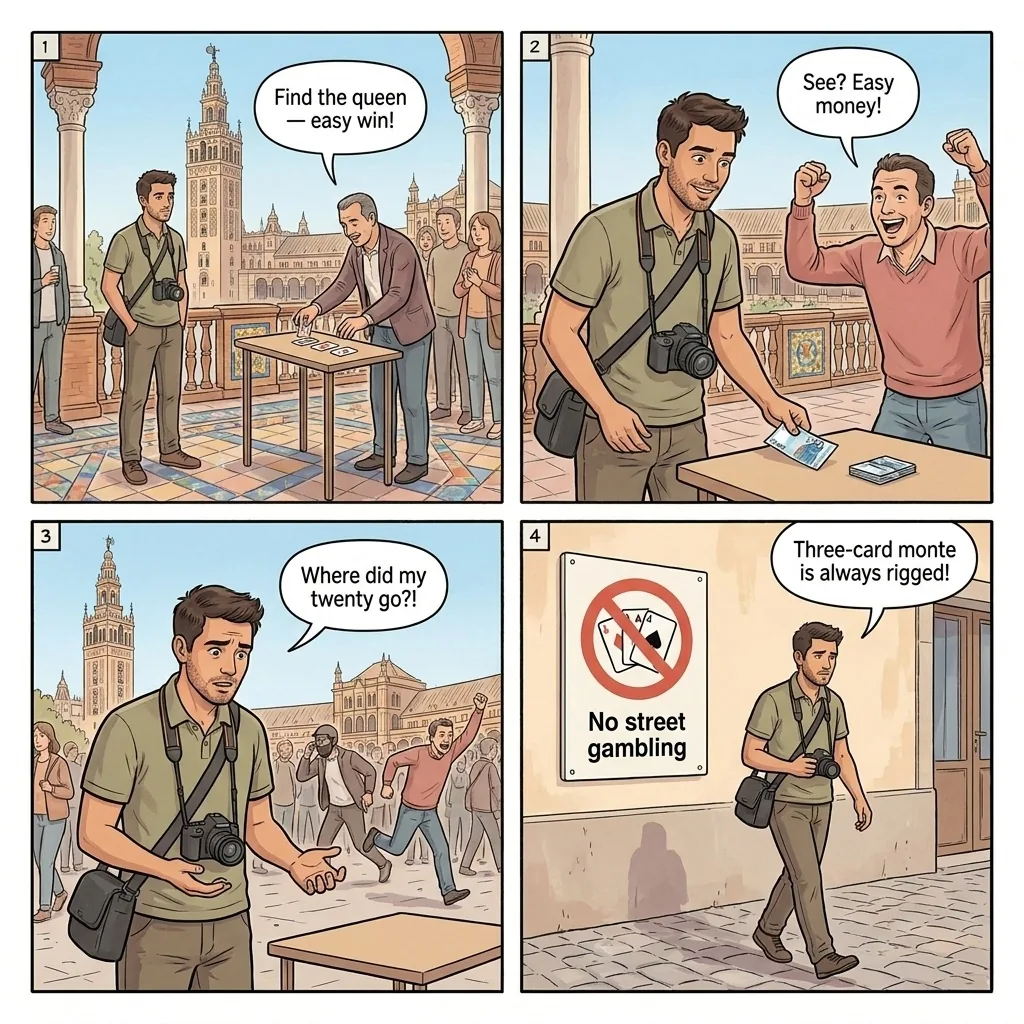
Three-card monte and shell-game crews work Plaza de España, the Triana bridge area, and La Alameda de Hércules with a 5–6 person fake "winning" crowd to lure tourists in — €20+ bets are lost in seconds because the ball is always palmed, and a "police officer" confederate shows up to extort an "illegal gambling fine" if you complain.
A street operator near Plaza de España or the Triana bridge sets up a small folding table — or sometimes just uses a cardboard box on the pavement — and begins moving three cups or cards with practiced ease. A ball disappears under one of them. The crowd that has gathered (all confederates, though you don't know it) seems to keep winning. Someone confidently places €20 on a cup and lifts it to reveal the ball. Easy money, you think.
It is, of course, impossible to win. The ball is palmed, the winning 'stranger' is an actor, and once you've placed a bet — encouraged by the crowd's energy — your money is gone. Worse, once you've lost, a 'police officer' (also a confederate) may approach and warn you that you need to pay a fine for illegal gambling, or you'll simply find your pockets emptied in the scramble to escape when 'police' are announced. — with its top-voted 'They tried to scam me with a fake cop thing'.
This scam operates openly in Seville's tourist zones. Local police periodically disrupt operations, but the operators are mobile and return quickly. The give-away is always the fake crowd — five or six people making the game look legitimate. Any gathering around a street game near Seville's major tourist sites is almost certainly this operation.
Red Flags
- A small group is clustered around a portable table or box with someone manipulating cards or cups
- Bystanders are winning easily and loudly — they're all confederates making the game look beatable
- Someone in the crowd tries to pull you in, 'help you pick,' or bets alongside you to build trust
- The operator makes eye contact and seems specifically interested in engaging you as a player
- When police approach, everyone scatters instantly — this is a rehearsed response, not spontaneous
How to Avoid
- Never stop to watch a street game in any Spanish tourist city — the entire audience is in on it.
- Keep walking, even if you're curious — once you stop, the social pressure to participate begins.
- Don't accept 'help' or 'tips' from any bystander around a street game, as they're working with the operator.
- Remember that these games are mathematically and physically impossible to win — the ball is always palmed.
- Report the location to Policía Local (112) if you witness it operating; while they'll scatter, it helps disrupt repeated operations.

Unlicensed horse-carriage operators near the Catedral de Sevilla, Plaza de España, and Parque de María Luisa quote prices verbally then redefine them per-person at the end of the tour — €30 quoted becomes €60 charged, with route-shortening and aggressive-tip pressure. The licensed Plaza Virgen de los Reyes rate is €45–€55 per carriage (up to 4 people) for 45 minutes.
A horse-drawn carriage clip-clopping through the streets around the cathedral or through the gardens of Parque de María Luisa in golden afternoon light is a Seville signature. But the gap between the photogenic promise and the reality varies enormously depending on who you hire.
Licensed carriage operators have official permits, clearly marked pricing boards, and set routes. Unlicensed operators — who sometimes park near legitimate ones to capture tourist overflow — quote prices verbally, change them at the end of the tour, take routes that are shorter or less scenic than agreed, and may demand tips so aggressively that the experience turns unpleasant. Reddit travelers in Seville have reported being quoted €30 for a tour and charged €60 on return, with the driver claiming the price was per-person rather than per-carriage. if he refuses to tell you, get another' — which applies equally to the carriage rank.
The legitimate carriage rate in Seville for a standard 45-minute tour is roughly €45–55 for up to four people. Any 'special deal' significantly below this, or any quote that seems flexible, is a warning to walk away. Older travelers arriving by cruise tour or hotel concierge should confirm the price-per-carriage (not per-person) in writing before boarding — this is the single most common dispute point.
Red Flags
- Price is quoted verbally rather than shown on a posted rate board on the carriage
- Operator insists on 'per person' pricing that wasn't mentioned when the tour was offered
- No official municipality permit sticker or licensing document visible on the carriage
- Route is cut short due to 'traffic' or 'horse needs a rest' with no partial refund offered
- Driver becomes aggressive or follows you when you try to confirm the price before boarding
How to Avoid
- Only board carriages that display a clear, posted price list — never accept verbal-only quotes.
- Confirm total price for the carriage (not per person), route, and duration in writing or clearly repeated agreement.
- Use licensed operators positioned at the official carriage rank near Plaza Virgen de los Reyes.
- Ask your hotel to recommend a reputable carriage company and book in advance if possible.
- Know the standard rate: €45–55 for a 45-minute tour for up to 4 people is the legitimate range.

Santa Cruz, El Arenal, and cathedral-side tourist tapas bars charge €8–€12 raciones priced as "free tapas," add table-service premiums of €3–€5/person not mentioned upfront, and stack unordered bread baskets — turning what should be €15 (standing at a Triana local bar) into €60 (sitting in tourist Santa Cruz).
In authentic Seville culture, you move from bar to bar standing at the counter, each tapa is priced at €2–3, and the whole experience is gloriously cheap and democratic. In tourist Seville — the Santa Cruz neighborhood's photogenic alleys, the streets near the cathedral — a different economy operates.
Common complaints from Reddit travelers include being seated at a table (rather than the bar) and charged a sit-down premium never mentioned upfront; ordering raciones thinking they were free tapas; being charged for a bread basket that appeared automatically; and receiving a bill that includes items you either didn't order or didn't finish. gives the locals-only rule: 'It's a block away from the more touristy spots that are along Calle San Jacinto. Delicious menu and lots of locals who all know each other.' flags that Andalucía's tourist-restaurant overcharging mirrors Barcelona's Gothic Quarter pattern.
Authentic tapa culture in Seville means standing at a bar, ordering in Spanish, and paying the posted price per item. Sitting down, accepting table service, and ordering from a laminated English menu in the tourist quarter will cost you three to four times more for the same food.
Red Flags
- Host steers you to a table immediately rather than offering bar seating
- Menu is only in English with photos of every dish — no blackboard specials in Spanish
- Bread or snacks appear on the table unasked before you've ordered anything
- Bill includes items you don't recognize or charges that don't match the menu price
- Staff is positioned outside actively recruiting passing tourists rather than waiting for walk-ins
How to Avoid
- Stand at the bar whenever possible — bar prices are always lower than table service.
- Order in Spanish or at least point to items on a Spanish menu — this signals you're not a soft tourist target.
- Ask the price before ordering anything that isn't listed with a clear price tag.
- Walk at least two streets away from the cathedral and Alcázar to find restaurants where locals eat.
- Check your bill against your order line by line before handing over payment.
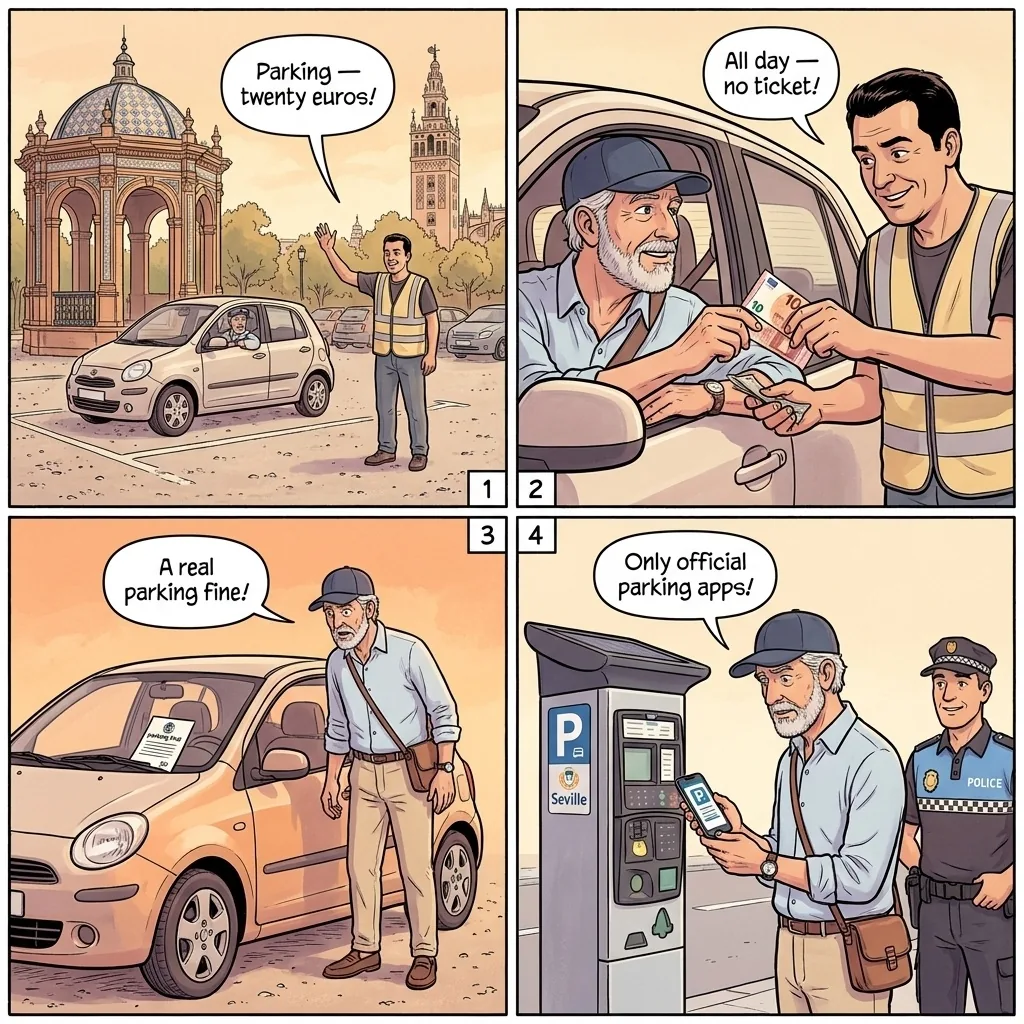
"Reflective-vest" fake parking attendants near the Cathedral, in Triana, and along Alameda de Hércules side streets demand €3–€10 cash to "watch" cars in zones that are actually free on evenings/Sundays — they target rental cars with foreign plates specifically; legitimate Seville parking is paid only at machines or via the AUSSA/Setpark app, never in cash to a person.
You park your rental car on a street near the Cathedral on a Sunday evening. A man in a reflective vest approaches and tells you parking costs 3 euros — he will 'watch your car.' You pay. When you return, a local tells you parking is free on evenings and weekends in that zone. Reddit users on traveler reports have documented fake parking collectors targeting tourists during free-parking periods; the scammers wear vests to look official and specifically target rental cars with foreign plates.
provides the broader context: when victims reported incidents like this to local police, officers reportedly refused to intervene or even listen until a civic campaign pressured the city for more staffing. — with its blunt 'the airport taxis are a scam; judges have ruled many times that it's one big criminal organization' — speaks to the enforcement vacuum that lets fake parking attendants keep operating near the cathedral year after year.
The practical rule is simple: official Seville parking is paid at a machine or through the AUSSA/Setpark app, never to a person. Anyone in a vest asking for cash on the street is running a con. Older cruise travelers who have rented a car for a day trip to Cádiz or Jerez are especially targeted on their return to Seville parking lots.
Red Flags
- A person in a reflective vest approaches your car immediately after you park and demands a parking fee
- They cannot produce an official receipt or point to a parking meter for the zone
- The area has no visible parking meter machines or pay-and-display signs
- Other parked cars nearby do not have any visible parking tickets on their dashboards
- The collector only targets cars with rental company stickers or foreign plates
How to Avoid
- Check the parking sign regulations before paying anyone — look for blue zone markers and posted hours.
- Use the official Sevilla parking app (AUSSA/Setpark) to verify if payment is required in that zone and time.
- Never pay a person who approaches you — legitimate parking in Seville is paid at meters or through apps.
- Park in official garages near tourist areas like Parking Catedral or Parking Nervión for guaranteed security.
- If confronted by a fake collector, say 'No gracias' and walk away — they rely on tourists not knowing the rules.
🆘 What to Do If You Get Scammed
📋 File a Police Report
Go to the nearest Policía Nacional or Guardia Civil station. Call 091 (Policía Nacional) or 112 (emergency). Get an official crime report — you'll need this for insurance claims. You can also report online at policia.es.
💳 Cancel Your Cards
Call your bank immediately. Most have 24/7 numbers on the back of the card (keep a photo saved separately). Block any suspicious transactions before the thieves use your details.
🛂 Lost Passport?
Contact your nearest embassy or consulate. The US Embassy is at Calle de Serrano, 75, 28006 Madrid. For emergencies: +34 91 587-2200.
📱 Track Your Device
If your phone was stolen, use Find My (iPhone) or Find My Device (Android) from another device. Don't confront thieves yourself — share the location with police instead.
Frequently Asked Questions
You just read 8 scams in Seville. The book has 95 more across 16 Spanish destinations.
Barcelona's La Rambla rosemary-sprig clavel circuit. Madrid's Puerta del Sol three-card trile. Seville's Plaza de España palm-reading gambit. Granada's Alhambra skip-the-line reseller industry. Ibiza and Mallorca scooter deposit-hold cycle. Every documented Spain scam — with the exact scripts, red flags, and Spanish phrases that shut each one down. Drawn from El País, La Vanguardia, ABC, El Mundo, and Policía Nacional and Mossos d'Esquadra records.
- 103 documented scams across Barcelona, Madrid, Seville, Granada & 12 more cities and islands
- A Spanish exit-phrase card you can screenshot to your phone
- Updated annually — buy once, re-download future editions free
- Readable in one flight — $4.99 on Amazon Kindle