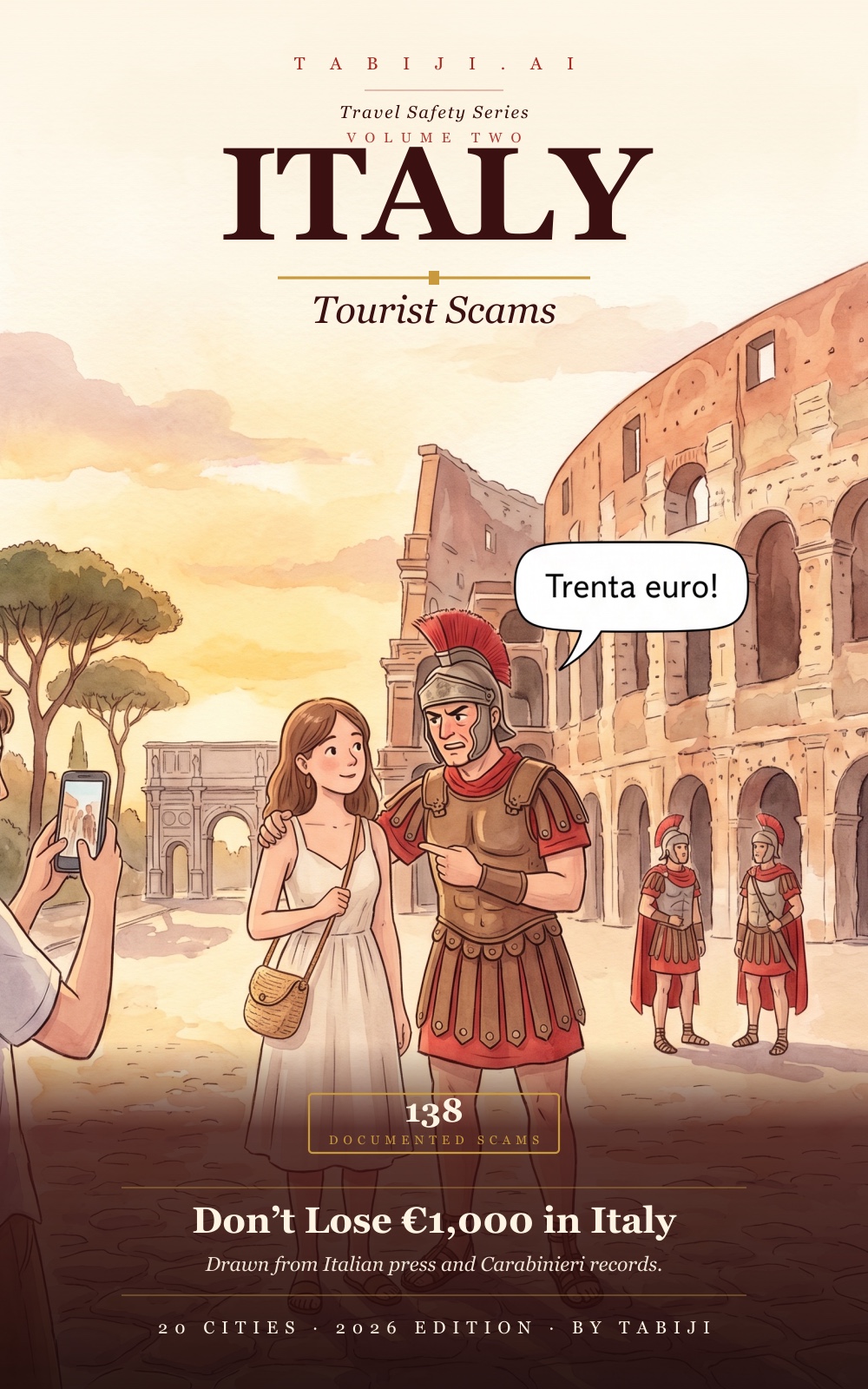
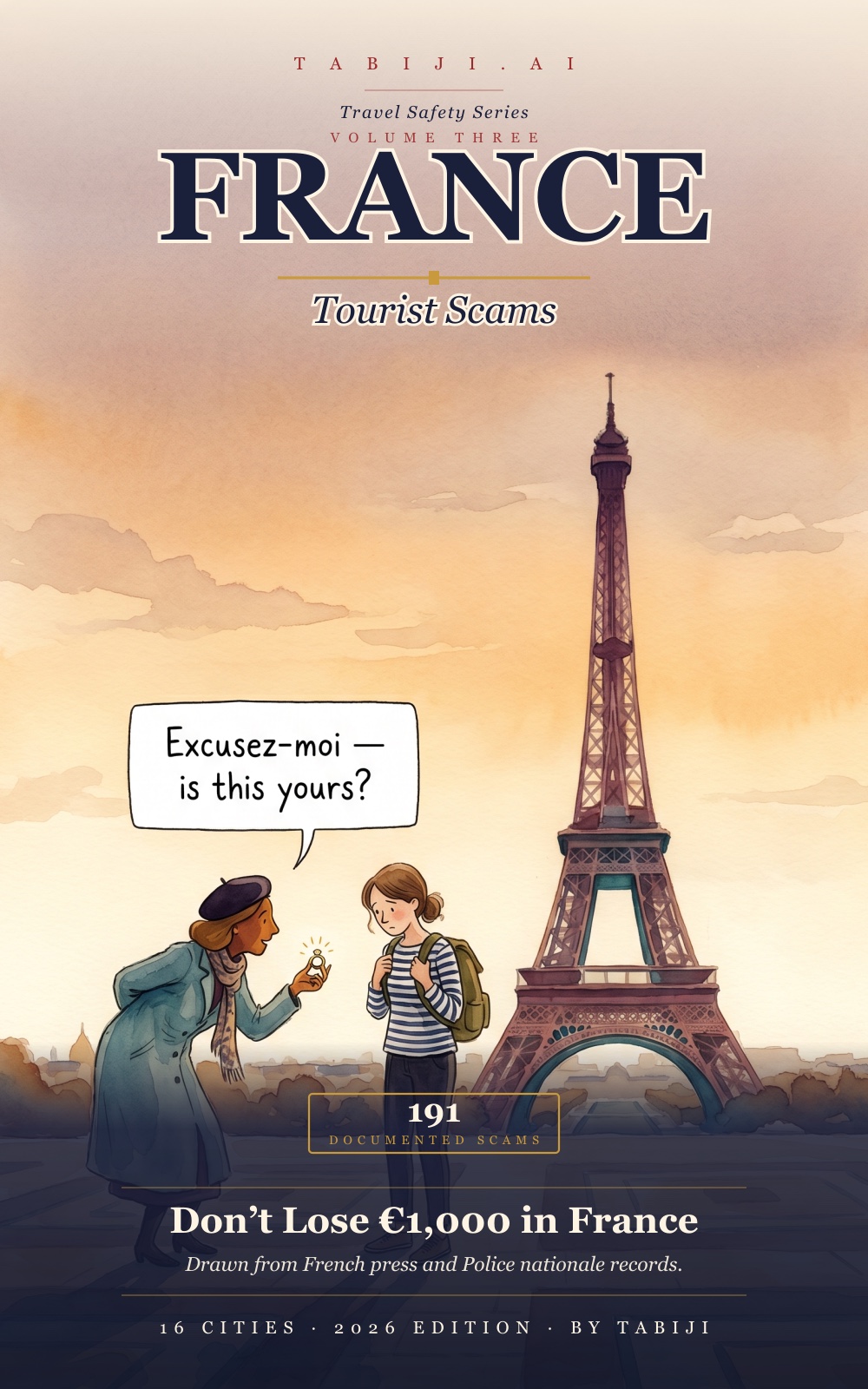
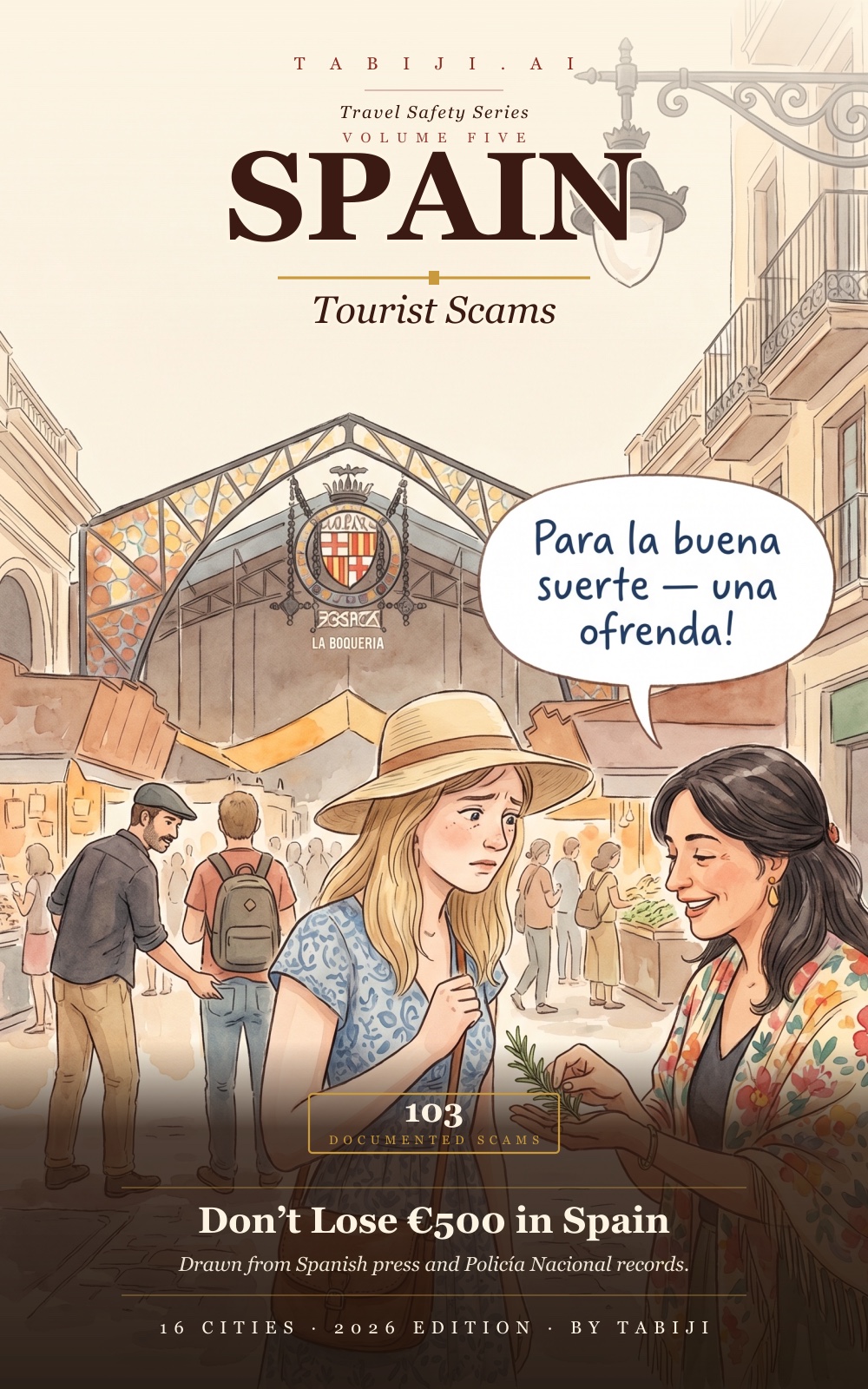
Restaurant bills, padded six ways.
A coperto in Rome you didn't see on the menu. A laminated price-insert in Athens. A "failed" card terminal in Barcelona that ran your card twice. The same six tactics in 42 countries, defeated by the same line-by-line bill review.

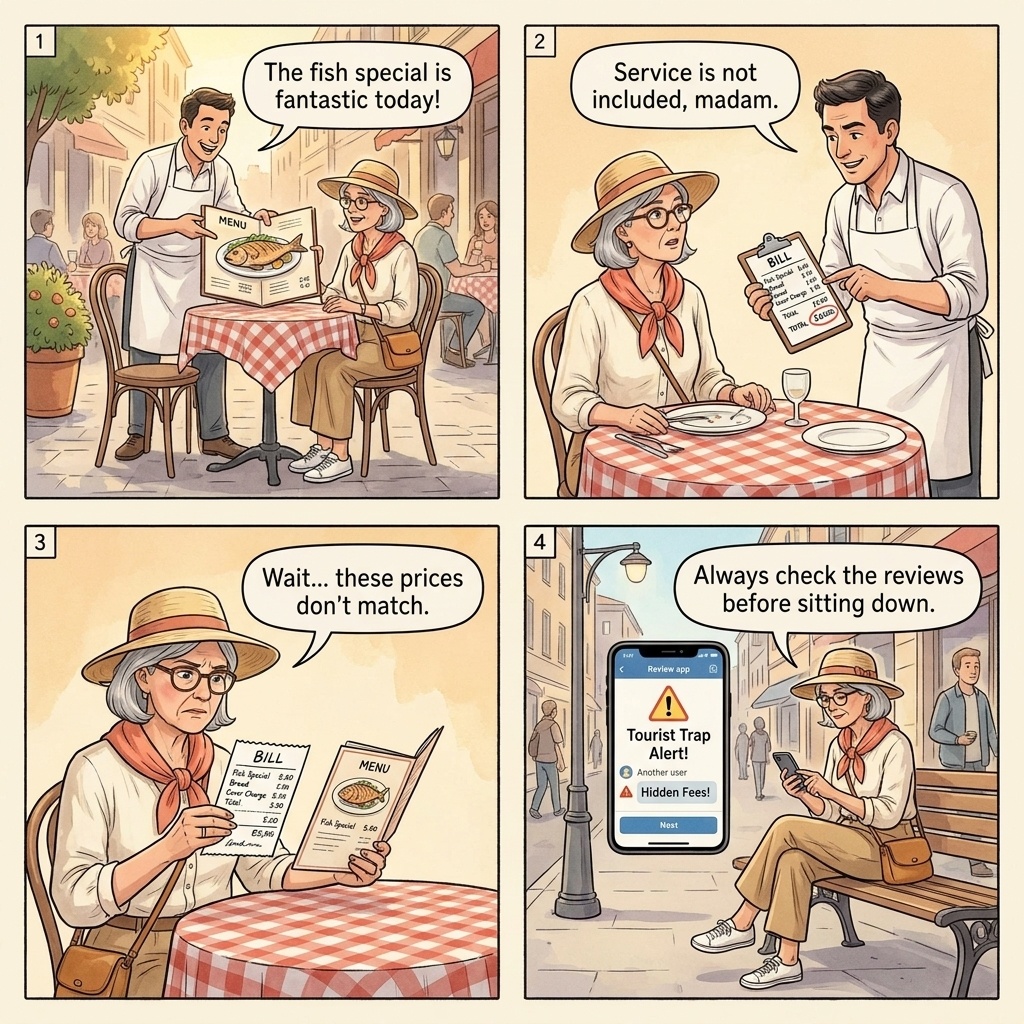
Restaurant bill padding runs six tactics across 42 countries: items not ordered, swapped menu prices, card-retry triple charges, rounding-up cash, forced-tip pressure, and service-charge stacking. The universal defense is a 60-second routine. Photograph the menu before you order. Match every item and price on the printed bill against the photo. Refuse undisclosed charges politely but firmly in the local language. Insist on tableside card payment and watch the terminal screen before approving. The pattern is identical from Trevi to Plaka to Las Ramblas; the routine is the same in every currency.
The €11 carbonara that arrived as a €71 bill.
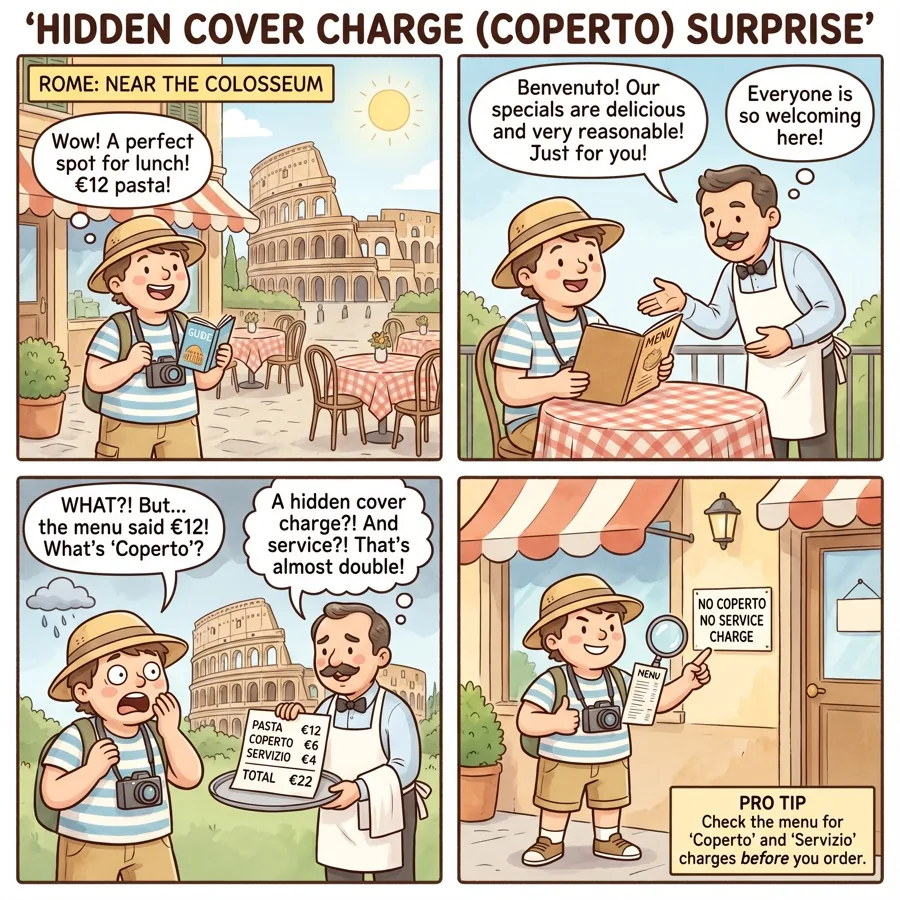
You sit down at a small trattoria three streets back from the Trevi Fountain at 8pm on a Saturday. The waiter hands you a laminated menu in English, smiles, and recommends the carbonara, listed at €11. You order one each, plus a half-liter of house red. He returns with bread and a small bottle of still water you didn't ask for. "Service of the house," he says. The food arrives, the wine arrives, dinner is good. You ask for the bill.
The printed bill is €71.
You read it line by line. Two carbonara at €11 each: €22. Half-liter house red: €8. Then the additions. Coperto: €4 per person, €8 total. the menu listed it at €2. Bread basket: €5, you didn't order one, but you ate it. Bottled still water: €4. same. Service: €15, 22% added, not listed on the menu. Tip suggestion (printed line): €9. 15% on top of service. The math: €22 + €8 + €8 + €5 + €4 + €15 + €9 = €71 from a €30 meal.
The carbonara was real. The carbonara was good. The bill is the scam, and it ran in five separate ways at the same time: undisclosed coperto markup, item-not-ordered (bread, water), forced service charge, suggested tip stacked on service, and a menu insert that didn't match the chalkboard inside. Rome's tourist-zone trattorias have run this stack for decades, Repubblica, La Stampa, and Corriere della Sera have published audit-coverage of the Trevi/Colosseum/Vatican perimeters every summer since 2018, and the FIPE restaurant association explicitly requires every charge to appear on the printed menu in advance.
You took photos of the menu before you ordered. You hand them to the waiter, point to the line that says coperto €2, and circle the printed €4 on the bill. He nods, takes the bill back, and returns three minutes later with a corrected printed bill at €38. The €33 difference is the entire scam, exposed in 90 seconds by one preventive habit. The rest of this page is the universal six-tactic playbook, the four other cities where it runs, and the language phrases that defeat each.
Read the full Rome scam guide →Key Takeaways
The bill-review routine
Restaurant bill padding depends on you not noticing for the seconds it takes to pay and leave. The padding itself is fast. a coperto markup, an unordered bread basket, a service line at 22%, but unwinding it after you've left is nearly impossible. The defensive routine is a 60-second sequence that happens twice: once before you order, once before you pay.
- Photograph every page of the menu before you order. The swapped-menu-prices and the unlisted-coperto variants both fail the moment you can produce the original. Take phone photos of every page including front, back, daily-specials sheet, and any insert. The photo is the entire defense; without it, you have no evidence the bill is wrong. Single most effective preventive move at zero cost.
- Confirm the per-etto price on fish or seafood up front. "Pesce al etto" (per 100 grams) is legal when the price is on the menu and quoted before ordering. Ask the waiter to weigh the fish in your presence and to estimate the total cost in euros before saying yes. The fish-by-weight surprise depends on the price arriving after the fish is already on the table.
- Review the printed bill line by line against your menu photo. Match every item, price, coperto, service charge, and add-on. Coperto/couvert/cubierto must be listed on the menu to be legally chargeable. Bread and water are free or chargeable depending on the country and the venue. if charged, they must be on the menu. Any line that doesn't match the photo is unenforceable.
- Refuse undisclosed charges in the local language, politely but firmly. "Questo non è sul menù" / "cela n'est pas sur la carte" / "esto no está en la carta" / "autó den ítan sto menoú." Hand the bill back with the disputed line marked. Most operators reverse the charge in 90 seconds rather than escalate. Polite anchoring to the menu beats arguing about the amount.
- Pay by card and watch the terminal screen. Insist on tableside processing where you can see the amount entered. Watch the screen before approving. If the operator claims the first charge "failed," demand the printed decline receipt before any second attempt. The card-retry triple-charge collapses the moment you see the original amount go through.
The six tactics
Different cities lean on different tactics within the same family. Here are the six sub-variants we've documented globally. Each has a recognition tell, a primary geography, and the routine step that defeats it.
1. Item Not Ordered
Bread, water, olives, an antipasto plate, or a side dish appears on the bill that you never ordered. The waiter framed it as a complimentary "service of the house" or "specialty." It was billed at €4–€8.
Defense: ask the waiter to; reports confirm "free" before accepting any unprompted bread, water, or appetizer. Or refuse with "no, grazie."
2. Swapped Menu Prices
Two menus exist. A chalkboard or printed menu in the local language lists low prices; a laminated tourist menu in English (or with an insert) lists 30–60% higher. The waiter hands the high-priced menu to anyone who looks foreign. The bill matches the tourist menu; the original is never produced.
Defense: photograph the menu you are handed. Ask if there's a local-price menu. The photo locks the price in.
3. Card-Retry Triple Charge
The waiter takes your card to the back, returns saying "the terminal failed" and asks to retry. The first swipe went through silently; you've now been charged for the same meal twice. By the third "retry," three times. The slips were never printed.
Defense: insist on tableside terminal. Watch the amount entered. Demand printed decline receipts before any retry.
4. Rounding-Up Cash Change
The bill is €37.20; you hand a €50 note. The waiter returns €12, claiming "we don't have small bills" or rounding down by 80 cents to €1+. Per transaction the loss is small; for the operator across a shift it adds up to €40–€80 in pure margin.
Defense: count change before pocketing. Politely ask for the missing 80 cents; refusal is rare once challenged.
5. Forced-Tip Pressure
A 15–20% gratuity arrives pre-printed on the bill, marked "service" or "tip." The waiter waits beside the table while you read. Service compris is included by law in French and most EU restaurants, a separate tip line is not legally enforceable. The pressure is social, not legal.
Defense: if service was included by law, refuse the tip line. Round up small change instead. The waiter cannot enforce a tip you didn't agree to.
6. Service Charge Stacked
Multiple charges appear on the same bill: coperto + servizio + suggested tip + tax. Each is presented as legitimate; together they add 30–40% to the meal. Coperto and servizio in Italy are legal only when listed on the menu. stacking both, with neither posted, is a textbook scam.
Defense: any charge must be on the menu. Refuse the lines that aren't. Most operators reverse rather than argue.
Where it runs
Restaurant bill padding concentrates in three structural conditions: dense tourist foot traffic, language barrier, and weak local-press consumer enforcement. Mediterranean Europe accounts for over 60% of documented variants.
| Country | Documented variants | Iconic location pattern |
|---|---|---|
| 🇮🇹 Italy | 24 | Rome Trevi/Colosseum perimeter · Florence Duomo · Venice San Marco · Naples Spaccanapoli · Cinque Terre coast |
| 🇫🇷 France | 16 | Paris Saint-Michel · Sacré-Cœur terrace · Champs-Élysées · Nice Vieille Ville · Avignon Place du Palais |
| 🇪🇸 Spain | 14 | Barcelona Las Ramblas · Gothic Quarter · Madrid Plaza Mayor · Seville Santa Cruz · Granada Albaicín |
| 🇬🇷 Greece | 12 | Athens Plaka · Monastiraki · Mykonos Little Venice · Santorini Oia · Crete Chania Old Town |
| 🇹🇷 Turkey | 9 | Istanbul Sultanahmet · Bosphorus-view restaurants · Grand Bazaar perimeter · Cappadocia Goreme |
| 🇵🇹 Portugal | 8 | Lisbon Bairro Alto · Alfama · Porto Ribeira · Cascais waterfront · Sintra old town |
| 🇭🇷 Croatia | 6 | Dubrovnik Stradun · Split Diocletian · Hvar harbor · Zadar peninsula |
| 🇲🇽 Mexico | 5 | Cancún Hotel Zone · Playa del Carmen Quinta Avenida · Mexico City Roma/Condesa tourist strips |
Bar width is data-bound at 10 pixels per documented variant. The eight countries above account for 94 of 101 total variants, or 93% of the global atlas.
Four more cities, four more variants
The Trevi scene above showed the service-stack and item-not-ordered tactics together. Here are four more cities where different sub-variants dominate. Each links to the full city scam guide.
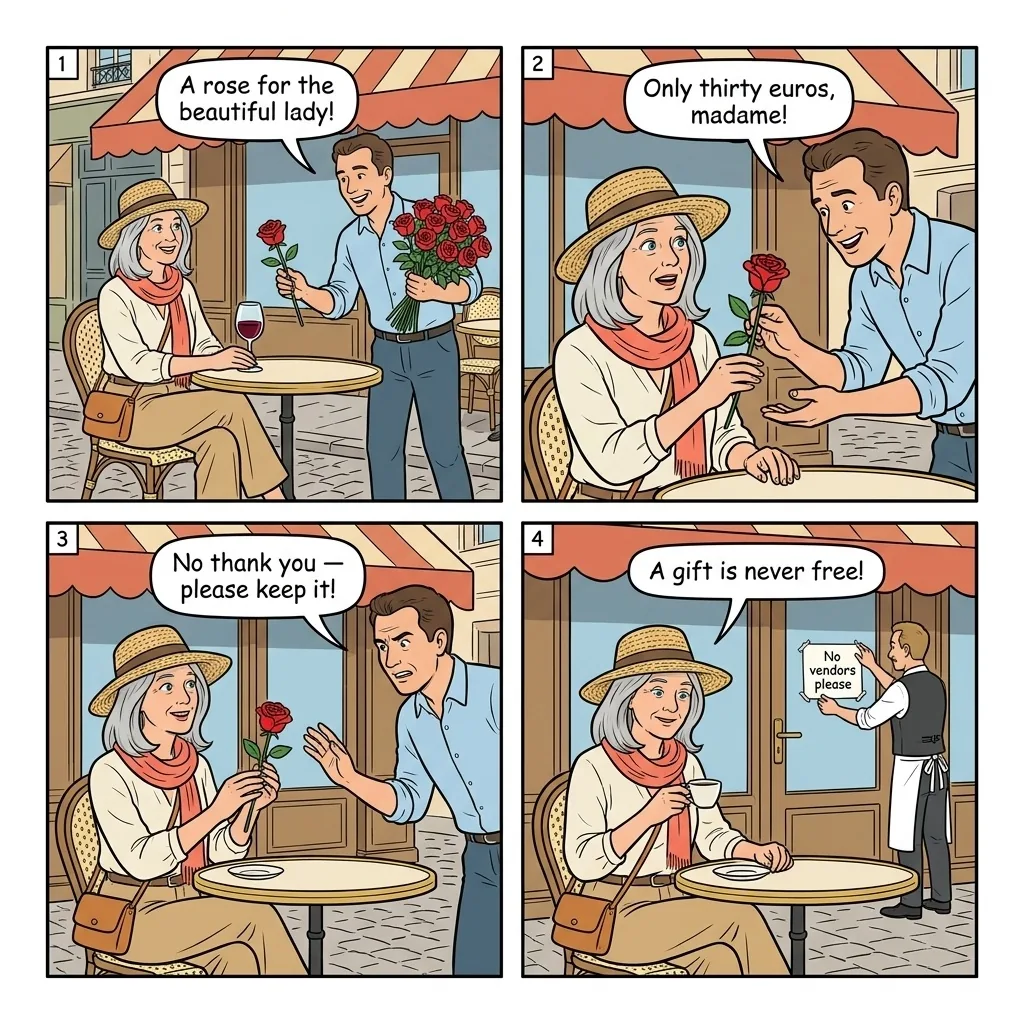
You sit at a terrace café on Boulevard Saint-Michel at 9pm in late spring. The waiter hands you a printed menu with prices listed. You order two croque-monsieur and a half-bottle of wine. the menu shows €14 each and €18 for the wine, total €46 expected. The bill arrives at €68. The lines: croque × 2 = €28; wine = €18; couvert €4 each (€8); service compris listed at €0 (correct under French law); but added below: a "tip suggestion" line at €14 (15% on €92 of subtotal-plus-couvert). The waiter stands beside the table while you read. Paris terrace restaurants run this on the Saint-Michel/Latin-Quarter axis, the climb to Sacré-Cœur, and the perimeter of Notre-Dame and the Eiffel Tower. UMIH, the French restaurant association. publishes that "service compris" is mandatory and a separate tip line is voluntary. The 2024 Île-de-France consumer-protection bulletin documented terrace-pricing and tip-stacking complaints near major monuments at over 1,200 per quarter. Defense: when the waiter waits beside the table, do not feel obliged to pay the suggested-tip line. Cross it out. Round up small change as a real tip if service was good. The Préfecture de Police accepts written complaints at 17 or via online forms.
Read the full Paris scam guide →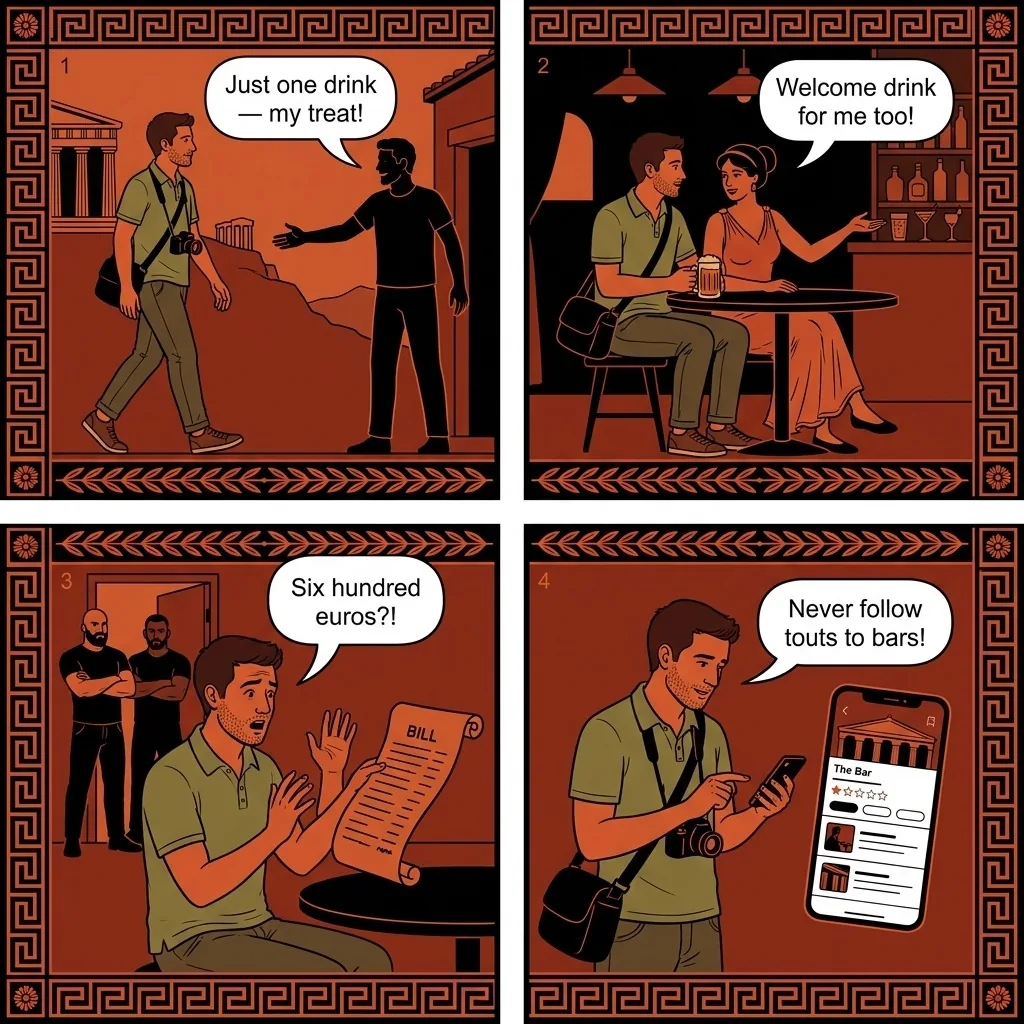
You walk into a taverna on a side street off Adrianou in Plaka at sunset. Acropolis rises above the rooftops. The host hands you a laminated menu in English; a chalkboard inside says "menu of the day" in Greek but you can't read it. You order moussaka and grilled sea bream from the laminated card. The moussaka is €18; the sea bream is listed as "MP" (market price). When the bill arrives, the moussaka rings up at €18 (matches), but the sea bream at 600g costs €54. €9 per 100g, never quoted at the time of order. Plus coperto €4, bread €5, half-liter house wine €12. Total €93 from a €30-feeling meal. The Plaka and Monastiraki tavernas run this on Adrianou, Mnisikleous, and Kydathineon, especially in summer evenings. The Greek tourist-police line 1571 (Athens-area dispatch) accepts English-language complaints; the Athens Chamber of Commerce publishes an annual consumer-complaint summary that flags Plaka restaurants prominently. Defense: ask the per-100g price for any "MP" item before ordering. Photograph both menus if a chalkboard exists. Choose the prix-fixe option when available, it locks the total. The Plaka taverna pattern is decades old; Greek press (Kathimerini, To Vima) covers it every summer.
Read the full Athens scam guide →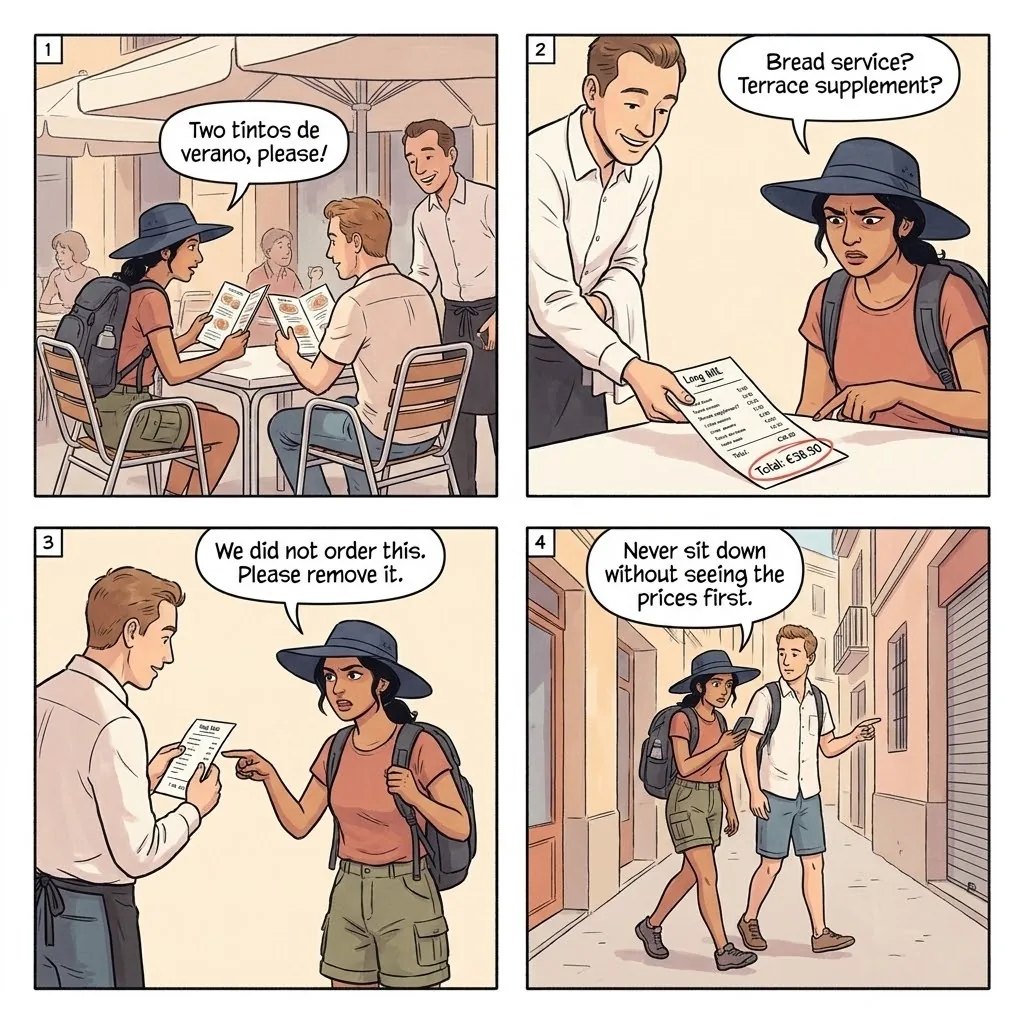
You eat tapas at a Gothic Quarter spot one block off Las Ramblas at 10pm. The bill is €58. You hand over a credit card; the waiter takes it to the back of the restaurant. He returns: "Lo siento, la terminal no funciona. Probemos otra vez." He takes the card a second time. Returns again: "Otra vez, una más." Third try, the printed receipt finally appears. You leave. Your card statement the next morning shows three €58 charges. The first two went through silently; only the third produced a receipt. The Gothic Quarter and Las Ramblas perimeter run this on small tapas spots where the terminal is in the back of the house and out of view. Barcelona's Policía Local and the Mossos d'Esquadra accept tourist-fraud reports; the OCU (Spain's consumer protection agency) publishes annual restaurant-overcharge complaints data with Barcelona consistently in the top three Spanish cities. Defense: insist the card terminal come to the table (most modern POS systems are wireless). Watch the amount on screen. Demand the printed decline receipt before any second attempt. absence of paper is the entire tell. If you've already been triple-charged, dispute via Visa/Mastercard chargeback as "duplicate processing"; the rules favor you.
Read the full Barcelona scam guide →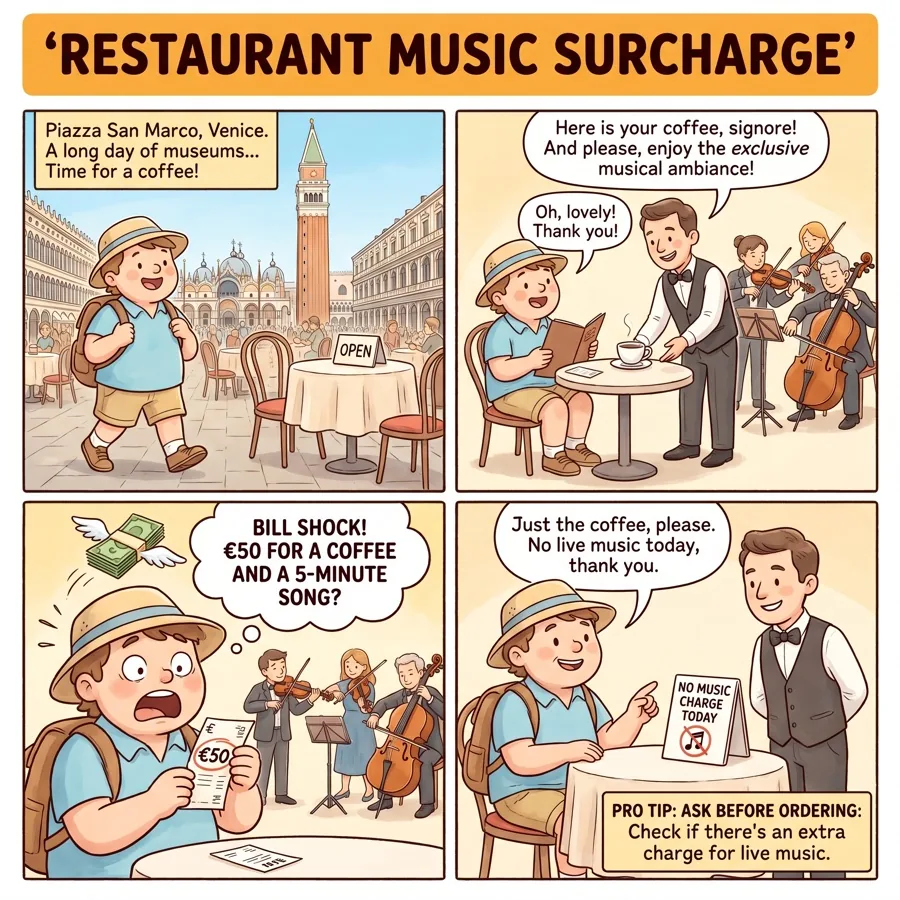
You sit at one of the famous piazza-side cafés on Piazza San Marco at midday. Three coffees and two pastries: the menu shows €8 per coffee, €6 per pastry. Expected total: €36. The bill: €98. Lines added: piazza-seating supplement €15 per person, €45; bottled water €5 (you didn't order); coperto €6 each, €18; servizio 12% of €68 (with the suggested tip on top of that, another 10%). Venice piazza-side cafés legally charge the seating supplement. it is on the menu in tiny print, but the additional coperto, servizio, and tip stacked together is the textbook violation. The Venice Comune and Polizia Municipale have run the "Venezia Sicura" tourist-protection campaign since 2022 specifically targeting San Marco overcharging; the operators reduce volume during enforcement weeks and resume after. Defense: if you sit at a piazza-side café in Venice, accept the seating supplement (it's legitimate when posted) but refuse any further coperto/servizio/tip if not separately on the menu. The 2025 FIPE guidelines explicitly state these charges cannot stack without disclosure. Photograph the menu before sitting. The Polizia Municipale accepts complaints in English at the Ca' Farsetti tourist help desk on Riva del Carbon.
Read the full Venice scam guide →Red flags
If two or more of these signals fire when you sit down or when the bill arrives, photograph the menu before you commit and review the printed bill line by line before you pay. The compounding rule: a single signal might be a coincidence; two signals are a script.
- Menu has no posted prices (chalkboard "ask the waiter" or "MP")
- Two menus exist: one in the local language with low prices, one laminated for tourists
- Restaurant inside a 2-block radius of a major monument or fountain
- Waiter pushes specific dishes ("the chef recommends today's fish") without naming a price
- Bread, water, or olives appear at the table without you ordering them
- Waiter takes your card to the back of the restaurant out of view
- The printed bill is hand-written rather than itemized POS-printed
- "Service" or "tip" line appears pre-printed at 15–20%
- The total seems €30–€50 higher than expected from a quick mental tally
- Waiter waits beside the table while you read the bill
The phrases that shut it down
Refusing a padded bill works when you anchor to the menu, not to the amount. The phrase is the same idea in every language: "this isn't on the menu. I'm not paying for it." Operators with no menu evidence almost always reverse the charge in 90 seconds rather than escalate.
If you got hit
You paid the padded bill and walked out, then realized later it was €30–€80 over what was fair. Recovery is possible in two channels: card chargeback (if you paid by card) and tourist-police complaint. Cash payments are mostly unrecoverable; chalk it up and update your routine for next time.
Within 24 hours: dispute the charge with your card issuer if you paid by card. Visa and Mastercard chargeback rules cover "incorrect amount charged" and "duplicate processing", both apply to bill-padding scenarios. Provide the menu photo, the printed bill, and a brief description; recovery rates are roughly 60–70% with documentation.
Within 48 hours: file a written complaint with the local tourist-police line. The report number is what your card issuer's investigation team often requests as supporting evidence. Most major tourist cities have a dedicated tourist-police line:
- Rome: Polizia Municipale Roma Capitale tourist desk; Carabinieri 112; Polizia di Stato 113.
- Florence: Polizia Municipale, Via delle Terme; tourist help desk at Piazza della Repubblica.
- Venice: Ca' Farsetti tourist help desk on Riva del Carbon; Polizia Municipale via Venezia Sicura program.
- Paris: Préfecture de Police 17; complaint forms at the SARIJ commissariats including 10 boulevard Strasbourg-Saint-Denis.
- Barcelona: Mossos d'Esquadra Tourist Help, +34 932 903 000 (24/7, English).
- Madrid: SATE (Sala de Atención al Turista Extranjero), Calle Leganitos 19, +34 91 548 8537.
- Athens: Tourist Police 1571 (24/7, English-speaking dispatch); Plaka police station off Kydathineon.
- Lisbon: PSP Tourist Help, Praça dos Restauradores, +351 21 342 1623.
- Istanbul: Tourism Police Sultanahmet, off Yerebatan Caddesi.
For credit-card chargeback specifically, contact your card issuer's fraud department immediately and reference the disputed transaction. American Express, Chase Sapphire, and most premium-tier travel cards include extended consumer-protection coverage on travel-related transactions. check the card directory before paying out of pocket. Italian, French, and Spanish restaurant associations (FIPE, UMIH, FEHR) accept consumer complaints via their websites; volume of complaints feeds local-police enforcement priorities the next season.
Related atlas entries
Sister entries in the Scam Atlas. Restaurant bill padding overlaps with currency and counterfeit-return scams (where cash payment exposes you to short-change) and with airport-arrival ground-transport scams (where the same operators run before/after the meal).
Sources
- La Repubblica, multi-year coverage of Trevi/Colosseum/Vatican-perimeter restaurant overcharging (Rome, 2018–2025).
- Corriere della Sera, FIPE coperto-and-service guidelines + tourist-zone enforcement coverage (Italy, 2020–2025).
- La Stampa, Venice San Marco café piazza-supplement and stacking-charge reporting (2022–2024).
- Le Parisien, Saint-Michel and Sacré-Cœur terrace-tip and couvert reporting (Paris, 2023–2025).
- UMIH (Union des Métiers et des Industries de l'Hôtellerie), service-compris guidelines and consumer-complaint framework (France, ongoing).
- El País and La Vanguardia, Las Ramblas and Gothic Quarter restaurant-overcharge coverage (Barcelona, 2021–2025).
- Kathimerini and To Vima, Plaka and Monastiraki taverna menu-swap and fish-by-weight reporting (Athens, ongoing summer features).
- Athens Tourist Police, public guidance on menu-swap complaint reporting via 1571 hotline (verified April 2026).
- r/travel, r/Italy, r/France, r/Spain, r/Greece, r/AskTravel continuing thread monitoring 2018–2026.
Get the full restaurant playbook for your destination.
Each Travel Safety atlas covers every documented restaurant and bill-padding variant in one country, plus the country's full scam catalog: taxi, ATM, distraction, pickpocket, fake authority. Buy once, lifetime updates as scams evolve. $4.99 on Kindle.