The Gold Ring Trick. One ring. Twelve cities.
A brass ring stamped "18K" gets dropped at your feet on the Pont des Arts. The "finder" hands it over as luck. Thirty seconds later they need food money; ninety seconds later your wallet is also gone. The same play has run on the Seine since 2000 and copies itself in every Romance-language tourist zone with foot traffic.

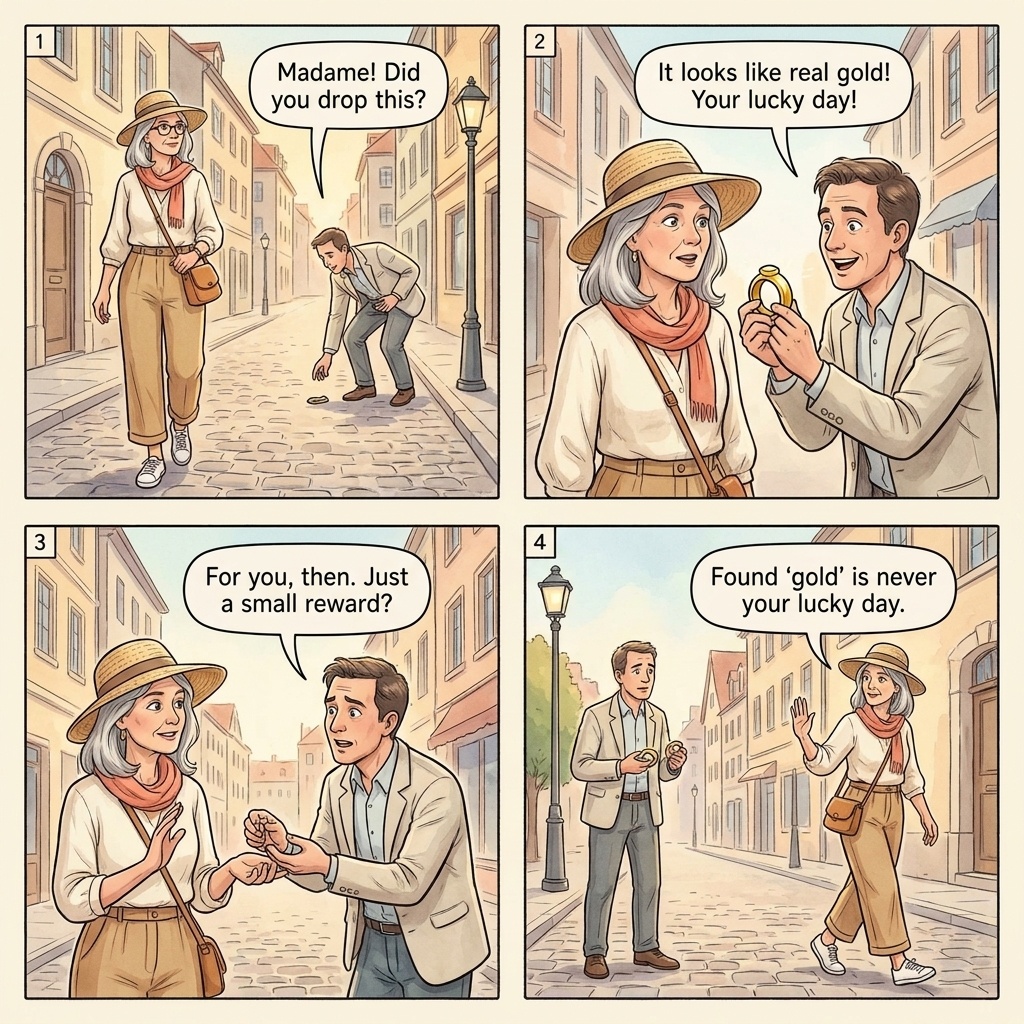
The Gold Ring Trick is a tourist scam where an operator pretends to find a gold ring at your feet, presses it on you as a gift or "finder's luck," then pivots to a hard-luck story asking for €10–€30. The ring is brass plated to look like 18-carat gold; a typical operator buys them by the bag for under €1 each. The play has worked the Pont des Arts and the Seine bridges of Paris since the early 2000s and has spread to Lyon, Avignon, Marseille, Strasbourg, Bordeaux, Nice, Cannes, Toulouse, Montpellier, Annecy, and Chamonix — twelve French cities documented, with rare copies surfacing in Italian Old Towns and Spanish plazas. Refusal in every city is the same: don't break stride, don't accept the ring, keep one hand on your front pocket. The bend at your feet is the entire scam.
A woman bends down ten paces ahead of you and lifts a "gold" ring from the cobbles.
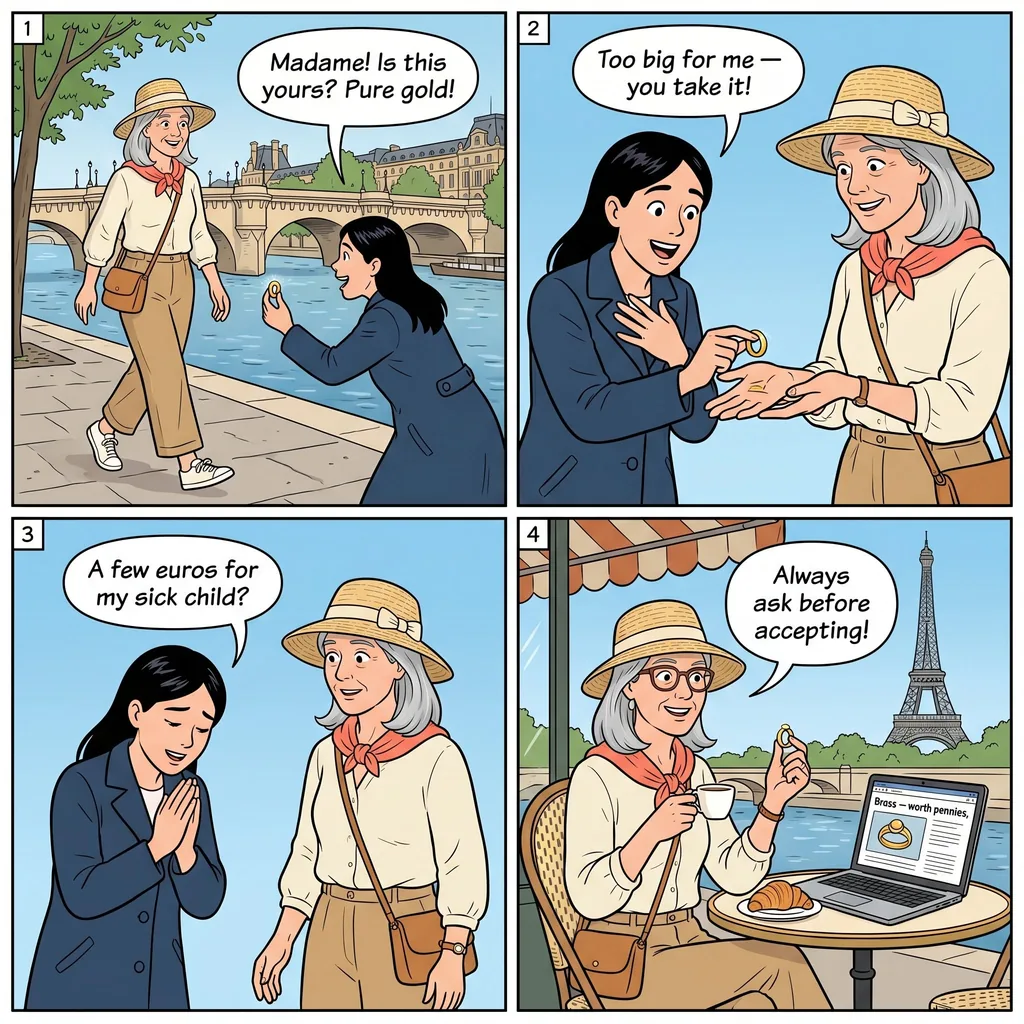
You're walking across the Pont des Arts toward the Louvre on a Tuesday at 6pm in late spring. The bridge is busy but not crushed; couples leaning over the rail, photographers framing Notre-Dame upriver. A woman ten paces ahead of you bends down theatrically and lifts something gleaming off the cobbles. She turns, holding it up to the early-evening light, and steps directly into your path. "Excusez-moi, monsieur — is this yours?"
You shake your head. It's not yours. She's already turning the ring over in her fingers, examining the inside of the band, frowning at it. "Too big for my finger," she says, her hand reaching toward yours. "You take it. Finder's luck." The ring goes into your palm before your brain catches up. It is heavier than you expected. There's an "18K" stamp pressed into the inside.
She holds eye contact for a beat too long, then smiles. Then the script flips. Her child is sick at home. Her husband lost his job last month. Could you spare a few euros? She gestures at the ring still in your palm: you're so lucky, you have a real gold ring, surely you can give back. If you try to return it, she steps backwards with hands raised — it's yours now, she insists. If you walk away, she follows. If you raise your voice, two more people you hadn't noticed appear at the edge of your vision; they were the next "finders," waiting for the next tourist to walk by.
The ring is brass, plated to look like 18-carat gold and stamped by the same crew that drops a fresh batch on the bridge every morning. Euro for Visitors has documented this exact play running on the Pont des Arts continuously since the early 2000s. The same operators rotate between the Champ de Mars below the Eiffel Tower, the Tuileries Garden between the Louvre and Place de la Concorde, and the Quai du Louvre on the Right Bank. Every batch costs under €1 a ring. A team can run the play forty times a day across two bridges and clear €300 to €600 in cash before sunset.
That is the universal version of the play, executed at the global archetype. The rest of this page is the bend-offer-lift mechanic, the two versions of the script, where it really runs in 2026, and the four other French cities where you'll meet it.
Read the full Paris scam guide →Key Takeaways
The bend-offer-lift mechanic
The Gold Ring Trick is a four-second piece of street theater built around forced reciprocity. The bend is the setup. The offer creates the social debt. The pivot leverages it. The lift, when it runs, happens during the engagement window. Each stage is timed so the next one is already starting before you process the last.
- The bend (second 0). The operator walks slightly ahead of you in your line of sight, then bends down theatrically as if seeing something on the pavement. The whole movement is engineered to be visible — the bend is wide, the body language is "surprised find," the ring is held up to the light immediately. The single most important defense fires here: don't slow your pace.
- The offer (seconds 2–8). "Excusez-moi, monsieur, is this yours?" Before you can refuse, the operator has already declared the ring too big for their finger and is reaching toward yours. The ring is in your palm before your brain catches up. The hand-over is the social trap: you are now holding their property, which they have framed as a gift.
- The script flip (seconds 8–25). Within thirty seconds, the operator pivots from "finder's luck" to a hard-luck story. Sick child. Lost job. Food for the kids. The pivot is identical every time, scripted by the same crew. The ring stays in your hand as proof of the gift you've been given. The implicit demand: you owe them.
- The optional lift (seconds 5–25). In roughly half of reported cases, an accomplice has been standing four to eight meters away pretending to read a phone or tie a shoe. While your hands and eyes are on the ring, they step in close and lift the wallet from your back pocket or open daypack. The operator and the lifter rotate roles within a few minutes so the same person isn't the lifter twice in the same hour. Front-pocket placement defeats this layer entirely.
- The rotation (seconds 25+). If you've walked away or refused to pay, the team rotates. The next operator is already walking toward the next tourist, ten paces back. The ring you refused gets picked up and used again on the same bridge within minutes. The crew works the same kilometer of pavement in 90-minute shifts, alternating roles, for as long as the foot traffic holds. Your refusal does not cost them anything — that is why the play is so persistent.
Two versions of the play
The mechanic has two pricing tiers depending on which version of the script the operator runs. Same bend, same ring, different ask. Recognize both before they start.
1. The Gift-and-Pivot Version
The operator hands the ring over framed as a gift — "finder's luck," "you take it," "it's too big for me." Within thirty seconds, the script flips to a hard-luck request for €10 to €30 "for food" or "for my children." The ring stays in your hand as the implicit social debt: you have accepted a gift, now reciprocate. Compliance rate runs 15 to 25% — high enough to keep the play profitable.
What it feels like: a brief warm interaction with a stranger that pivots emotionally faster than your social reflexes can adjust.
Most reported in: Paris Pont des Arts and Champ de Mars; Lyon Vieux Lyon; Strasbourg Cathédrale; Annecy canals.
2. The Sell-as-Discount-Gold Version
The operator skips the gift framing and goes straight to a sale: the ring is "real 18K gold" and they urgently need cash because of a family emergency, so they'll let you have it for €30 to €80, well below market value. The "18K" stamp is the closer. Tourists who suspect a scam still sometimes buy because they think they're getting a deal even if the ring isn't quite worth what's claimed. The ring is worth pennies; any sale is pure profit.
What it feels like: a stranger appearing to be in genuine distress offering you a once-in-a-lifetime favor.
Most reported in: Tuileries · Quai du Louvre · Marseille Vieux-Port; Bordeaux Place de la Bourse; Nice Promenade des Anglais.
Where it runs
The Gold Ring Trick is overwhelmingly a French scam. Twelve cities documented in our 2026 archive; Paris alone accounts for roughly half of all reports. Italian and Spanish copies surface at lower volumes in tourist Old Towns where the Romance-language script crosses borders without translation friction.
| City | Documented variants | Iconic location pattern |
|---|---|---|
| 🇫🇷 Paris | 10 | Pont des Arts · Champ de Mars · Tuileries · Quai du Louvre · Sacré-Cœur stairs |
| 🇫🇷 Lyon | 4 | Pont Bonaparte · Pont Wilson · Vieux Lyon · Place Bellecour · climb to Fourvière |
| 🇫🇷 Avignon | 2 | Place du Palais · Pont d'Avignon approach · Rue de la République |
| 🇫🇷 Marseille | 2 | Vieux-Port quayside · Le Panier alleys · La Canebière |
| 🇫🇷 Strasbourg | 1 | Cathédrale · Petite France · Place Kléber |
| 🇫🇷 Bordeaux | 1 | Place de la Bourse · Saint-Pierre quarter |
| 🇫🇷 Nice | 1 | Promenade des Anglais · Vieille Ville · Cours Saleya market |
| 🇫🇷 Cannes | 1 | La Croisette · Allées de la Liberté · Vieux Port |
Bar width is data-bound at 16 pixels per documented variant. Toulouse, Montpellier, Annecy, and Chamonix each have one further documented case. Italian and Spanish reports run roughly one per Old Town quarter where they exist (Trastevere, Florence Duomo perimeter, Madrid Sol, Barcelona Las Ramblas) but volumes are an order of magnitude below France.
Four more cities, four more bridges
The Pont des Arts scene above is the global archetype. Here are four more French cities where the same play runs the same way on different bridges, plazas, and Old Town pedestrian zones. Each links to the full city scam guide.

You're walking across the Pont Bonaparte from Vieux Lyon toward Place Bellecour at midday when a man bends down in front of you, picks something up off the bridge cobbles, and turns with wide eyes: "Madame, monsieur — did you drop this?" He's holding what looks like a gold ring with a faint "18K" stamp. The play runs the Saône and Rhône bridges (Pont Bonaparte, Pont de la Guillotière, Pont Wilson), the Vieux Lyon pedestrian streets near the Cathédrale Saint-Jean, Place Bellecour, and the long climb to Notre-Dame de Fourvière. Both versions surface in Lyon: gift-and-pivot dominates the bridges; sell-as-discount-gold appears more often on the Bellecour-Fourvière approach where tourists are slower-paced and more isolated. The Police Municipale and Police Nationale 4ᵉ Arrondissement run periodic visible-presence sweeps on the bridges; the activity drops during sweeps and resumes within hours. Real lost-and-found in Lyon goes to the Mairie or Police Municipale; not to whoever is "finding" jewelry in the path of foot traffic.
Read the full Lyon scam guide →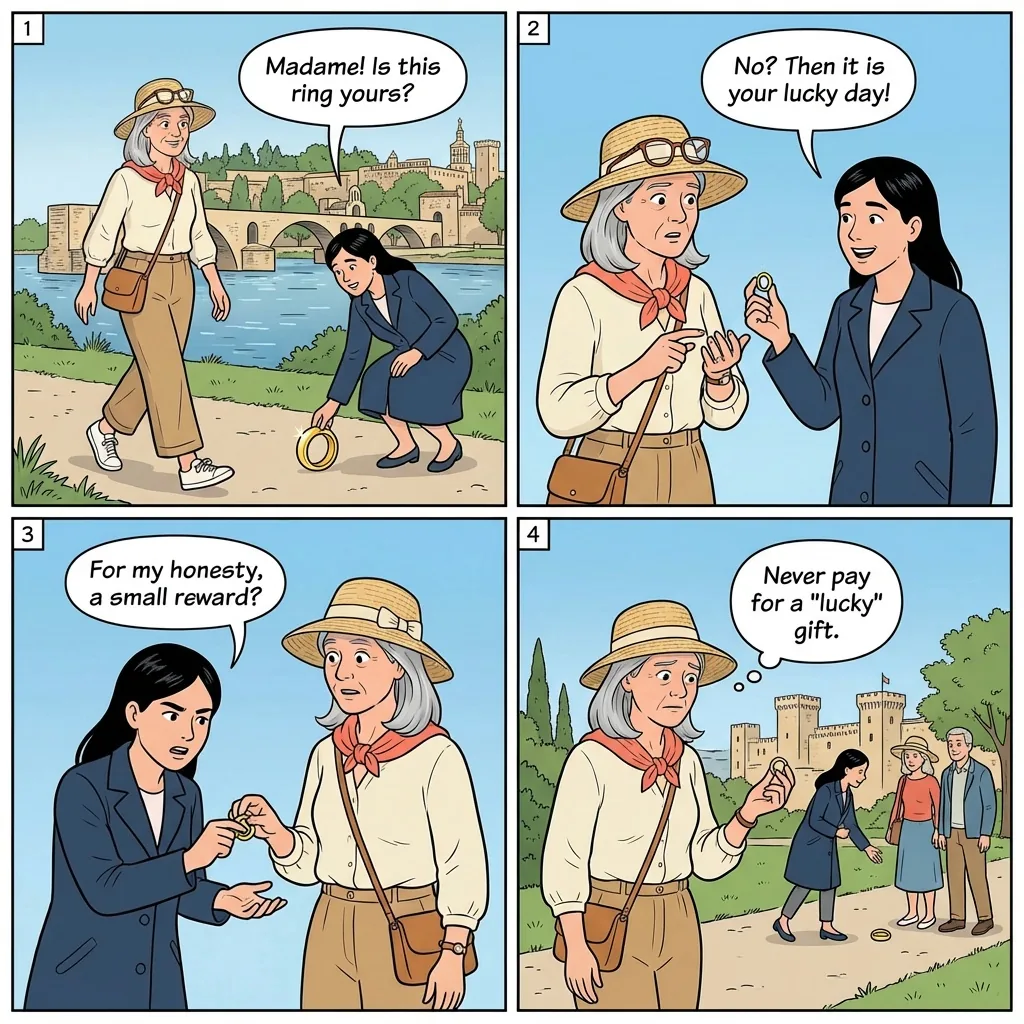
You walk into Place du Palais on a July afternoon during the Festival d'Avignon. The plaza in front of the Palais des Papes is full of theater posters, performers in costume, and tourists drifting between the medieval walls. A woman ahead of you slows, bends, and rises with a "gold" ring in her hand. The Avignon variant leans heavily on festival-season foot traffic: from late June through mid-August, the population of central Avignon roughly doubles, and the operators work a different mark every five to seven minutes. Outside festival weeks, the play runs on the Pont d'Avignon approach, the Rue de la République, and the small plazas around the Palais. The Police Municipale advise reporting to the Hôtel de Ville or to one of the festival's mobile help points if the encounter escalates; in 2026 the festival has dedicated tourist-help kiosks at six points across the medieval city specifically because of distraction-scam volume. Defense: walk through the plaza without slowing for "found" objects; festival-week density makes the bend almost invisible until you're already past it.
Read the full Avignon scam guide →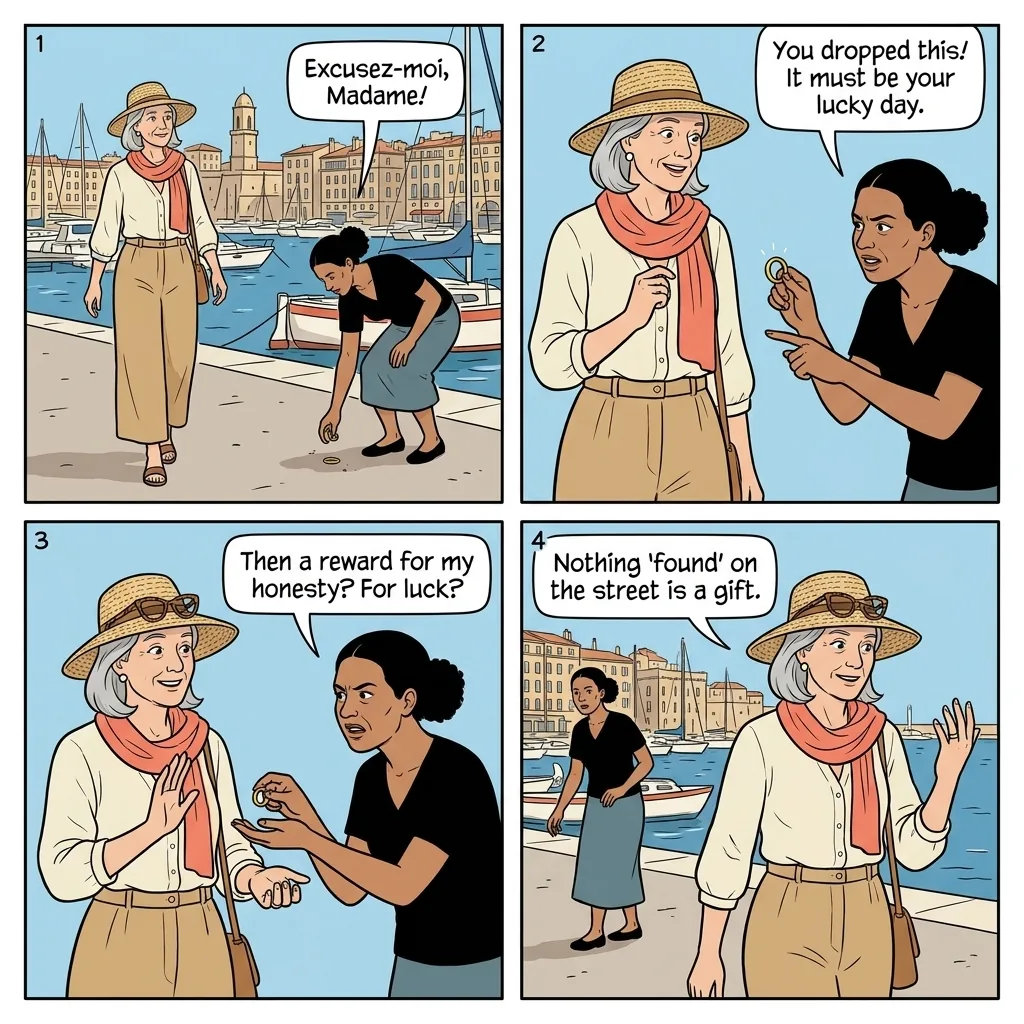
You walk along the Vieux-Port quay at dusk, the sailboats turning amber in the last light, the Notre-Dame de la Garde glowing on the hill above. A man approaches you from the direction of the fish market with a worried face and an open hand. He's holding a "gold" ring, "18K" stamped, and he needs to sell it tonight; his car broke down on the way to Aix and he can't get home without €40. Marseille leans hard on the sell-as-discount-gold version of the play because the Vieux-Port atmosphere supports the cover story: working harbor, tradesmen, plausible cash crisis. The same script runs along La Canebière (the long boulevard from the Vieux-Port inland), in the Le Panier alleys behind the harbor, and around the Cathédrale de la Major. The Police Nationale at the Préfecture de Police on Rue de l'Évêché advise that selling "gold" jewelry without a registered hallmark of the French Bureau de garantie is itself an offense; if you're approached, the legal answer is to walk away. Defense: no street-side ring sale in Marseille is ever a good deal; assume brass and assume scam.
Read the full Marseille scam guide →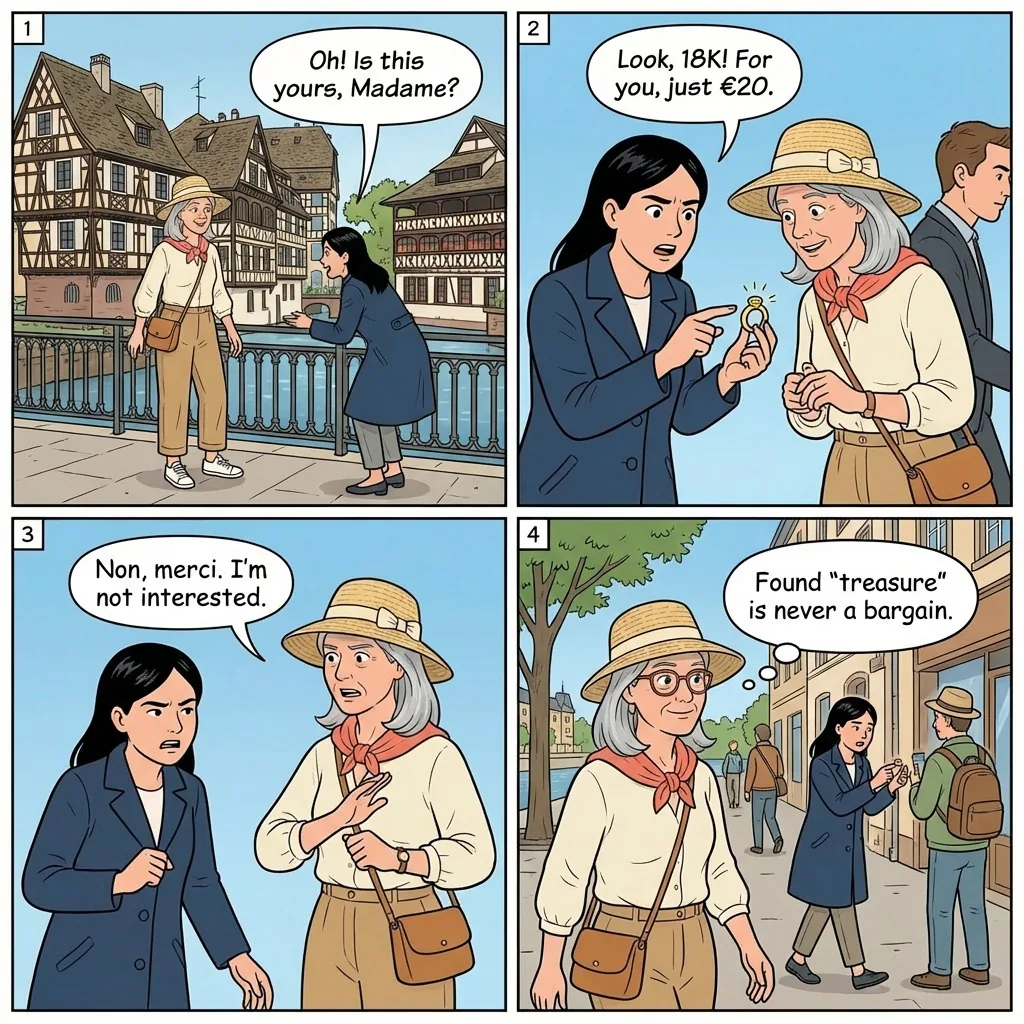
You walk into Place de la Cathédrale at midday in late October, the spire of Notre-Dame rising 142 meters above you, the Maison Kammerzell carved into the corner of the square. The plaza is dense with school-group tours and Christmas-market preview shoppers. A young woman ahead of you bends down on the cobbles and rises with a "gold" ring stamped "18K," already turning to ask if it's yours. The Strasbourg variant works the cathedral square, the Petite France pedestrian zone with its half-timbered houses and small bridges, and the Place Kléber main square — particularly during Marché de Noël season (late November through December 23) when foot traffic doubles and the operators can run three to four marks per hour. The Police Nationale Strasbourg-Centre on Rue de la Nuée Bleue accept tourist scam reports in English and German as well as French; English-speaking tourists are the primary target on the cathedral square, German-speaking tourists more often in Petite France. Defense: the bend is the entire defense — keep walking, keep your hand on your front pocket, and the ring goes back on the cobbles for the next target ten seconds later.
Read the full Strasbourg scam guide →Red flags
If two or more of these signals fire in the first ten seconds of any tourist-zone walk, lock your hand on your front pocket and route around the encounter. The compounding rule: a single signal might be a coincidence; two signals are a script.
- Someone bends down directly in front of you in a tourist zone
- The "find" is a piece of jewelry, particularly a ring
- The operator immediately offers it to you without you asking
- The pivot from "is this yours?" to a money request happens within 30 seconds
- The ring is suspiciously shiny and undamaged for an item supposedly "found"
- The "18K" or "750" stamp is large and centered (real hallmarks are tiny)
- A second person stands four to eight meters away pretending to read a phone
- The operator physically blocks your path if you try to walk past
- The hard-luck story (sick child, lost job, food money) starts before you've spoken
- The location is a Seine bridge, French Old Town pedestrian zone, or Romance-language plaza
The phrases that shut it down
Refusal in the Gold Ring Trick is mostly non-verbal: keep walking, don't make eye contact with the ring, hand on front pocket. But a clean verbal phrase ends the engagement immediately and signals to nearby tourists that something is happening.
If you got hit
You paid the ten euros and walked away embarrassed; or worse, your wallet is gone too. The first hour matters most for two reasons: card-fraud window and CCTV recovery window.
If you only paid the ten euros: there's no recovery action and no need for one. The take is small, the operator has already moved to the next tourist, and the police treat the gift-and-pivot version as a low-priority street-fraud category that almost never produces an arrest. Note the location, log the encounter on r/Paris, r/travel, or r/France, and keep walking.
If your wallet was lifted during the engagement: the response is the same as any pickpocket recovery. Within five minutes, call your bank or card issuer and freeze every card that was in the wallet. Most issuers have a 24/7 international fraud line on the back of every card; keep a photo saved separately on your phone for exactly this moment. Within thirty minutes, log into Find My iPhone or Find My Device from any computer to remote-wipe a stolen phone if applicable. Within one hour, file a police report with the local tourist-police line. The report number is what your travel-insurance carrier requires.
Tourist-police lines for the cities where the Gold Ring Trick runs:
- Paris: Préfecture de Police 17 (24/7); tourist-victim help at the SARIJ commissariats, including 10 boulevard Strasbourg-Saint-Denis (open daily, English-speaking).
- Lyon: Police Nationale 17; tourist-area help via the Office de Tourisme Lyon, Place Bellecour, +33 4 72 77 69 69.
- Marseille: Police Nationale 17; tourist police at Préfecture, Rue de l'Évêché, +33 4 88 77 80 00.
- Avignon: Police Municipale +33 4 32 76 35 35; festival-season help points across the medieval city.
- Strasbourg: Police Nationale Strasbourg-Centre, Rue de la Nuée Bleue, +33 3 88 15 37 37.
- Bordeaux · Nice · Cannes: Police Nationale 17; tourist-help kiosks at central tourism offices accept English-language reports.
For travel-insurance claims, the police report number from any of the above is sufficient. American Express, Chase Sapphire, and most premium-tier travel cards include emergency cash-replacement assistance as a benefit; check the card directory before paying out of pocket.
Related atlas entries
Sister entries in the Scam Atlas. The Gold Ring Trick belongs to the distraction-and-confidence family and overlaps heavily with classic pickpocket tactics on the same Seine bridges.
Sources
- Le Parisien, multi-year coverage of Pont des Arts and Champ de Mars distraction scams (Paris, 2014–2025).
- Euro for Visitors, "The Gold Ring Scam in Paris" — long-running documentation of the Pont des Arts variant since the early 2000s.
- Le Progrès, Lyon Pont Bonaparte and Vieux Lyon street-scam reporting (2020–2024).
- La Provence, Marseille Vieux-Port "fake jewelry sale" coverage (2022–2025).
- La Marseillaise, central-Marseille tourist-zone scam reports (2024).
- Dernières Nouvelles d'Alsace, Strasbourg Cathédrale and Marché de Noël scam coverage (2023–2025).
- Préfecture de Police de Paris, public guidance on Pont des Arts and Sacré-Cœur distraction-fraud activity (verified April 2026).
- r/travel, r/Paris, r/France, r/Lyon, r/Marseille, continuing thread monitoring 2018–2026.
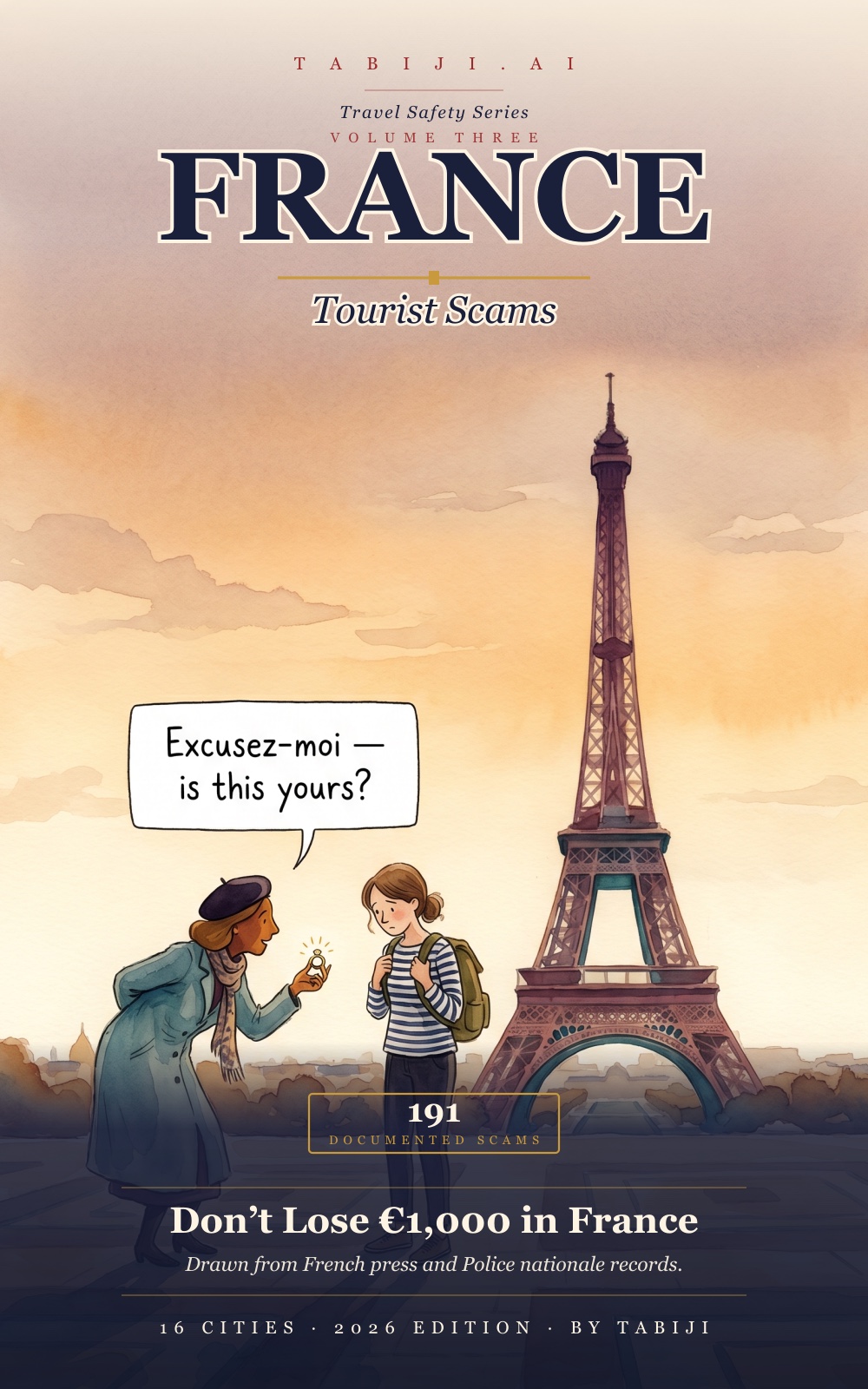
Read the gold-ring playbook for your destination.
Each Travel Safety atlas covers every documented gold-ring variant in one country, plus the country's full scam catalog: pickpocket, taxi, ATM, restaurant, fake authority. Buy once, lifetime updates as scams evolve. $4.99 on Kindle.