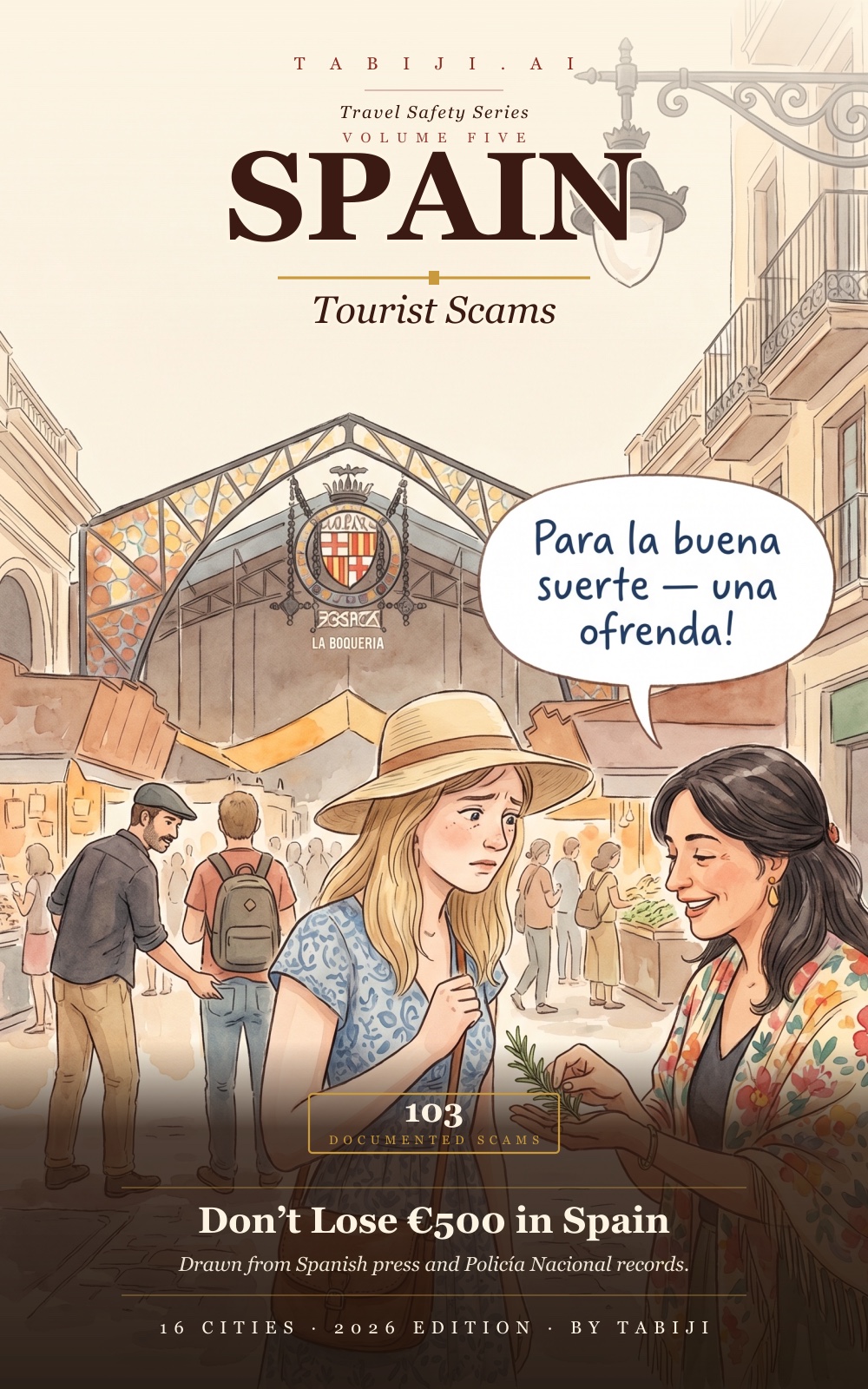
Pickpocketing tactics, plaza by plaza.
One scam family. Five tactics. Forty-four countries. Documented from police arrest records, transit-authority advisories, and a year of plaza-and-platform field reports. The European tourist circuit is the global high-water mark; the rest of the world copies the playbook.

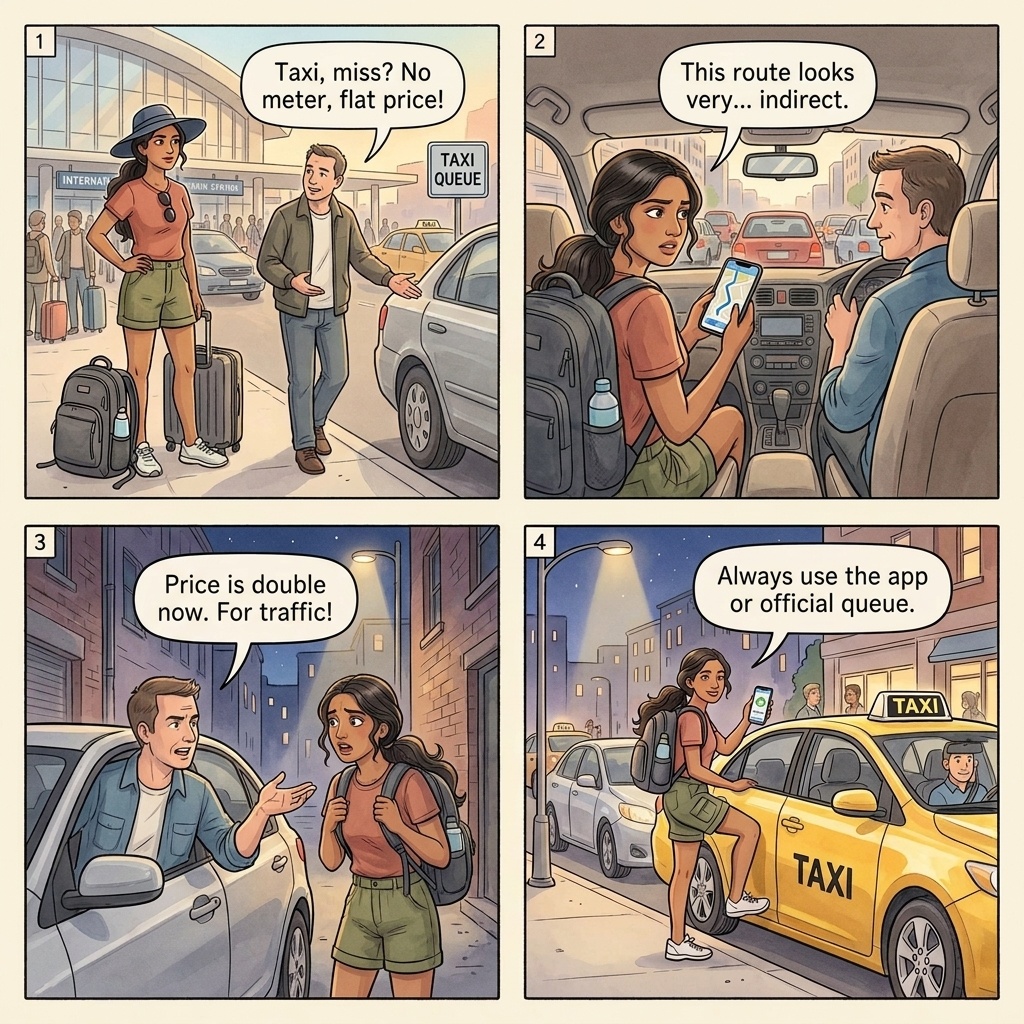
Pickpocketing tactics run in 44 countries across 408 documented variants. Five tactics account for nearly every reported case. Crowd-crush lift on packed metros and tourist plazas. Metro-door snatch as doors close on the platform. Café-bag grab from chairs in tourist-zone restaurants. Festival pickpocket teams working synchronized in concert and event crowds. Distraction-coordination, where one accomplice creates a scene while another lifts. The defense for all five is the same: front-pocket placement before you leave the hotel, daypack on chest in crowds, immediate pocket-check after any bump or unexpected interaction, and cash plus cards in two physically separate places. Placement discipline beats every gear purchase.
Three teenagers, a folded map, and a phone gone in eight seconds.

You're walking down Las Ramblas at 6pm on a Friday in late summer. The street is shoulder-to-shoulder. Three teenagers ahead of you slow down at the same moment one of them unfolds a large paper map and turns to ask a friend a question. The crowd compresses behind them. A woman to your right brushes your arm and apologizes in soft Spanish; you smile and move forward. Eight seconds later, walking down the central rambla toward Plaça Reial, you reach into your back pocket for your phone.
It is gone. So is the wallet that was next to it.
The map was the setup. The compression was the cover. The brush from the right was the lift; she had a thin metal hook and a friend behind her holding a fold of fabric that obscured her hand from the people watching. The team works Las Ramblas in groups of three to five from May through October, rotating up and down the kilometer-long walkway in 90-minute shifts. The Mossos d'Esquadra (Catalan police) have arrested over 1,200 individuals on Las Ramblas pickpocketing charges in 2024 alone, per their public Q1-2025 statistics; the same individuals are usually back on the street within a week.
That is one of five pickpocketing tactics, executed at the iconic global hotspot for the variant. The rest of this page is what just happened to you, the universal placement rule that defeats it, and the four other tactics you'll meet in 43 more countries.
Read the full Barcelona scam guide →Key Takeaways
The placement rule
Pickpocketing depends on you not noticing for the eight seconds that matter. The lift action itself is fast — under two seconds in trained hands. The tactical work is creating the cover: the crowd compression, the asked direction, the spilled drink, the dropped map. The placement decision you make at your hotel before you leave for the day defeats most of the tactical work, no matter how skilled the team.
- Front pocket or money belt for valuables. Wallet, passport, the day's cash, the spare card. Never back pocket. Never the open top of a daypack. Never an unzipped jacket pocket. The placement choice happens once at your hotel and defeats roughly 80% of pickpocket tactics before you leave the room. This single decision matters more than any anti-theft purchase you'll make.
- Daypack on your front in crowds. Metros, festivals, iconic tourist streets (Las Ramblas, Khao San, Tram 28, Camden Market), Christmas markets, concerts. Swing the bag to your chest and keep one hand on the zipper. The pickpocket's setup time depends on you not seeing the bag; reverse the geometry and the setup fails. The wearer who sees their bag has already won the encounter.
- Treat any bump or distraction as the cue. Liquid spilled, sudden crowd surge, unexpected stranger interaction, asked direction, child running into you, music gear dropped at a festival. These are setups, not coincidences. Touch your front pocket, your daypack zipper, your phone pocket immediately. The lift happens in the 10 seconds after the distraction. Beat it by 9.
- Phone in deep front pocket or zipped pouch. Phone-snatch happens at café tables (sliding off the edge while you read the menu), through restaurant terraces (motorcycles passing tables on Calle Mayor), and from back pockets on metro stairs. Deep front pocket or zipped jacket pocket defeats all three. The phone in your hand is the phone the snatcher takes. The phone in your front pocket is the one that's still yours at dinner.
- Cards and cash in two separate places. The accessible front-pocket stash gets one card and the day's cash. The hotel safe gets the rest, the second card, and the passport. If the front-pocket stash is taken, you're out €100 not €1,500. Redundancy beats every worst-case scenario. Adopt the two-place rule and stop worrying about the worst-case.
The five tactics
Different cities lean on different mechanics within the same family. Here are the five tactics we've documented globally. Each has a recognition tell, a primary geography, and the placement defense that defeats it.
1. The Crowd-Crush Lift
Tourist density above ~3 people per square meter creates the pressure cover. Teams of three to five funnel pedestrians into a momentary compression (a slowed walker ahead, a closing metro door, an event-gate bottleneck) and lift during the contact. Nearly invisible if the back-pocket or open-daypack placement gives them an opening.
What it feels like: sudden inability to walk forward at normal pace, a single brush from someone passing, then nothing.
Most reported in: Barcelona Las Ramblas, Rome Termini concourse, London Camden, Paris Métro Line 1, Bangkok Khao San.
2. The Metro-Door Snatch
The doors-closing buzzer is the trigger. A team-member standing on the platform reaches through the closing door, grabs the wallet or phone from a tourist standing near the door, and steps back as the doors complete. The train pulls away with the tourist; the snatch stays on the platform. Almost no recovery option once the train has departed.
What it feels like: a hand at your side as the buzzer ends, doors close, you cannot get out.
Defense: stand AT LEAST 1 meter inside the train, away from the doors. Phone in deep front pocket, never in hand near the doors. Most reported: Madrid Sol, Paris Châtelet, Berlin Hauptbahnhof, NYC Times Square.
3. The Café-Bag Grab
You sit at an outdoor café in a tourist-zone (Trastevere, Plaka, Sol-area), drape your daypack on the back of the chair or set it on the chair next to you. Two people approach pretending to be tourists asking for directions or to share the table. While one engages you, the other slides the bag away under cover of a shopping bag or jacket. The bag is gone before your coffee arrives.
What it feels like: a friendly five-second interaction, then your chair is lighter than it was.
Defense: bag strap looped around your chair leg or your ankle. Or simply on your lap. Never on the back of the chair in a tourist zone.
4. Festival Pickpocket Teams
Synchronized teams of four to eight working music festivals, sport-event entry queues, parade crowds. One creates a fake bottleneck (dropped object, music-gear "drop", small fight), the rest work the compressed audience for 90 seconds before melting into the crowd. Festival-economy: a team can clear 30 wallets in an evening.
What it feels like: a moment of unexplained crowd panic, then resumed flow, then a few people checking pockets.
Most reported in: Notting Hill Carnival, Oktoberfest, Sant Jordi (Barcelona), Sant Joan, Christmas markets across DE/FR.
5. Distraction-Coordination
One accomplice asks for directions in halting English, a second drops keys at your feet and bends to retrieve them, a third lifts during the engagement. Often runs with a friendly "child" who runs toward you for a hug. The team rotates roles so the same person isn't the lifter twice in 30 minutes.
What it feels like: a brief warm interaction with apparent strangers, the kind of thing you might tell at dinner. The lift was 1.5 seconds inside it.
Defense: when ANY stranger initiates with you in a tourist zone, your hand goes to your front pocket. Always. The hand-on-pocket signal alone makes the team move on.
Where it runs
Pickpocketing is the single most-documented theft pattern in our archive. The European tourist circuit is the global high-water mark. The eight countries below account for over 60% of all recorded incidents.
| Country | Documented variants | Iconic location pattern |
|---|---|---|
| 🇫🇷 France | 57 | Paris Métro Lines 1 & 2 · Sacré-Cœur stairs · Eiffel Tower queue · CDG RER B |
| 🇩🇪 Germany | 45 | Berlin U-Bahn U1/U2 · Munich Christmas markets · Hamburg Reeperbahn · Frankfurt main station |
| 🇪🇸 Spain | 33 | Barcelona Las Ramblas · Madrid Metro Sol · Sevilla Triana · San Sebastián Old Town |
| 🇺🇸 United States | 27 | NYC subway 7/E/F · Times Square · Vegas Strip · French Quarter |
| 🇬🇧 United Kingdom | 26 | London Tube · Camden Market · Notting Hill Carnival · Edinburgh Royal Mile |
| 🇲🇽 Mexico | 23 | Mexico City Centro · Cancún Hotel Zone · Acapulco Costera · Oaxaca Zócalo |
| 🇦🇷 Argentina | 22 | Buenos Aires Plaza de Mayo · Caminito · Recoleta perimeter · San Telmo Sunday market |
| 🇮🇹 Italy | 19 | Rome Termini Station · bus 64 to Vatican · Trevi Fountain · Florence Duomo queue |
Bar width is data-bound at 4 pixels per documented variant. The eight countries above account for 252 of 408 total variants, or 62% of the global atlas.
Four more cities, four more tactics
The Las Ramblas scene above showed the crowd-crush + distraction-coordination stack. Here are four more cities where different tactics dominate. Each links to the full city scam guide.

You stand at the edge of the Trevi Fountain at midday, holding your phone up to take a photo. The crowd around you is six deep on every side. A young man in a soccer jersey edges past your right; a woman with a stroller compresses you from behind; you barely notice. By the time you tilt your head down from the photo, your wallet is gone. Rome's pickpocket density is highest at three places in this exact pattern: Termini Station's Metro Line A platform around 9am and 6pm, the bus 64 from Termini to the Vatican (so notorious that locals call it "the pickpocket bus"), and the seven-meter perimeter of the Trevi Fountain at any midday hour from May through October. The defense is the placement rule above plus active awareness when you bring out your phone. The Carabinieri and Polizia di Stato have run multiple "Operation Trevi" stings since 2018, with arrests in the hundreds annually; the activity is constant because the catchment is constant. Bus 64 specifically: stand near the driver, not in the central concourse where the team works between stops.
Read the full Rome scam guide →
You stand inside the Line 1 train at Metro Sol with your phone in your hand, getting directions for the Prado. The doors-closing buzzer sounds. As the doors begin to close, a hand reaches through from the platform side, takes the phone, and the closing doors complete. The train pulls out. You're holding nothing. The team works Sol, Atocha, and Gran Vía specifically because the platforms are wide and the door-train geometry creates the hand-reach window between buzzer and full close. The Madrid Metro security team has run ongoing campaigns including signage at Sol since 2022, but the volume of pickpocketing complaints filed by tourists at Madrid's Sala de Atención al Turista Extranjero (Tourist Help Office) on Calle Leganitos remains in the hundreds per month during summer. Defense at Madrid Metro specifically: stand at least one meter inside the train, NEVER near the doors with phone in hand. Phone in deep front pocket between stops; out only when the train is moving and you are not adjacent to a door. Metro Madrid security recommends keeping your daypack on your front from the moment you enter the station to the moment you exit.
Read the full Madrid scam guide →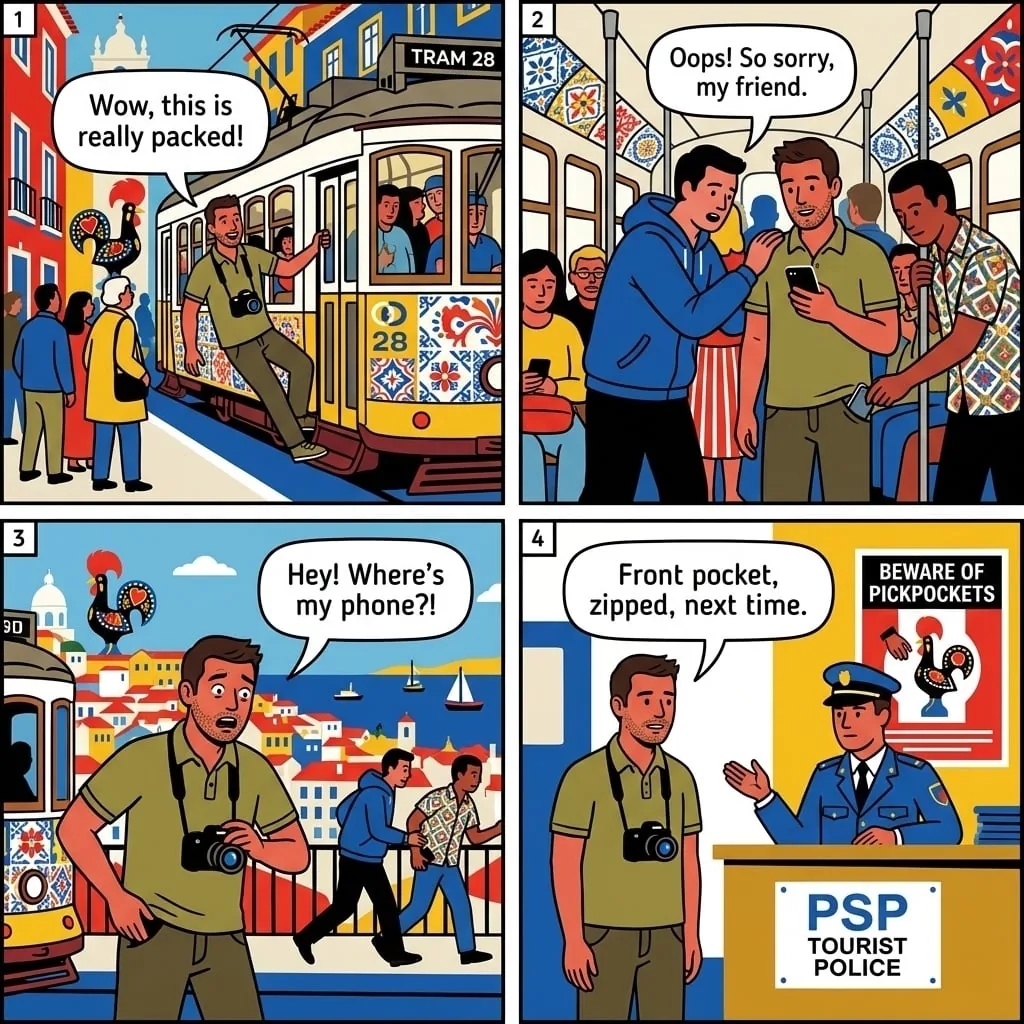
You board Tram 28 at Praça Martim Moniz at 11am to ride the famous Alfama-to-Baixa heritage loop. The tram fills past capacity in the first three stops; you stand in the central aisle pressed against other tourists, hand on a strap, daypack on your back. Three young men board at Praça da Figueira and arrange themselves: one in front of you, one behind, one across the aisle. By the time you reach Sé Cathedral, your daypack's outer pocket has been opened and your camera is gone. Tram 28 is the global archetype of a tourist-targeted pickpocket route: the tram is iconic, every tourist rides it, the schedule is published, and the route is fixed. The Lisbon PSP (Polícia de Segurança Pública) added uniformed presence on Tram 28 in 2023 after sustained complaint volume; the activity dropped 40% but did not stop. Defense: daypack ON YOUR FRONT before you board. Phone in deep front pocket. Camera on a wrist strap, not around your neck. The placement rule is the entire game on Tram 28; the police cannot watch every car every run. If you want the heritage tram experience without the pickpocket exposure, ride the parallel Tram 12 or 25 (less famous, less crowded, same Old Town views).
Read the full Lisbon scam guide →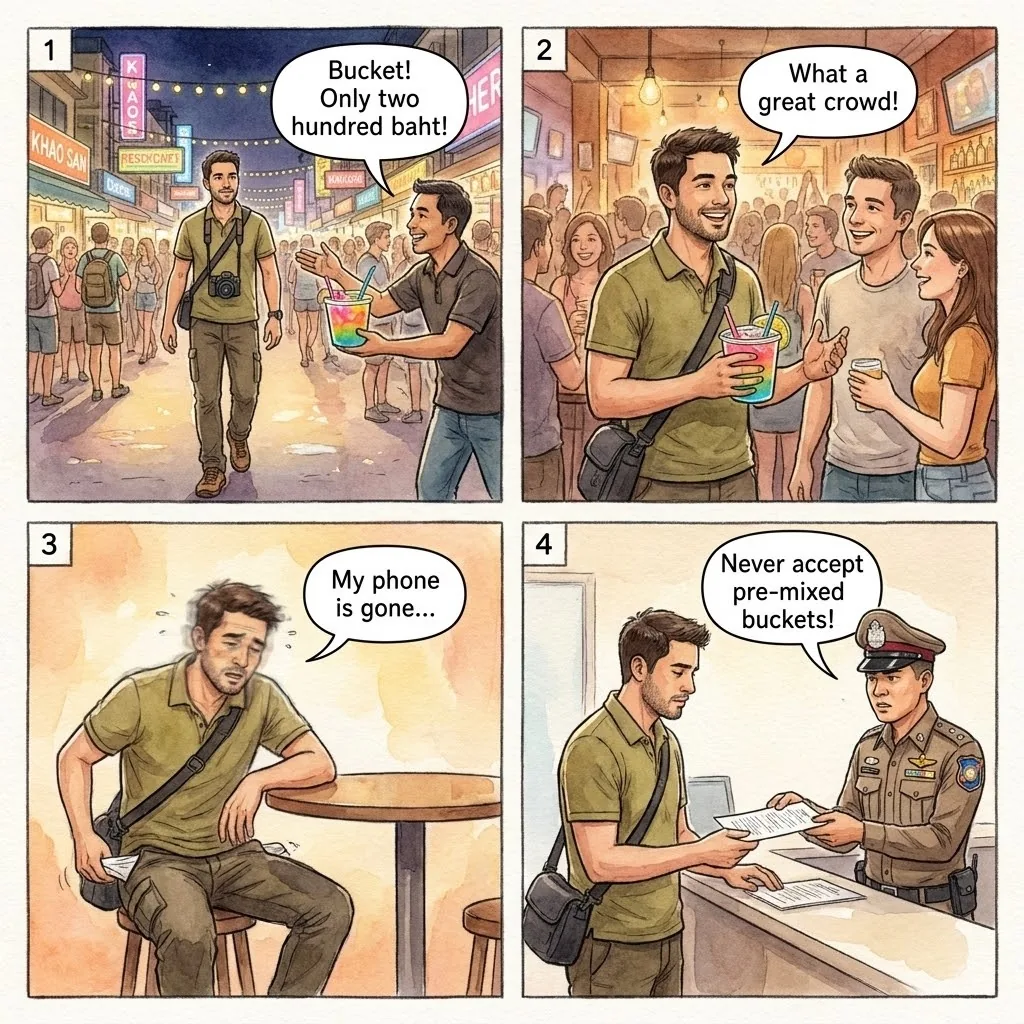
You walk down Khao San Road at 11pm and a friendly man offers you a small flower bracelet for free. You accept; he loops it around your wrist while explaining that it brings good luck. While you smile and nod, his accomplice has lifted your phone from your back pocket. The whole interaction is 12 seconds. Khao San after dark is one of the world's highest-volume distraction-coordination zones: the combination of dense foot traffic, alcohol, ATM-adjacent terraces, and Westerners who are explicitly there for the social atmosphere creates an ideal catchment. The BTS Skytrain platforms at Sala Daeng, Asok, and Mo Chit see the metro-door-snatch variant during rush hour; Khao San and Soi Cowboy work the distraction-coordination variant at night. Defense at Khao San specifically: when ANY stranger approaches you with an offer, hand goes to your front pocket. Phone in deep front pocket, NEVER in back pocket on Khao San. Wallet on a chain or money belt. The Tourist Police Bangkok (1155, 24/7 English-speaking) advise that pickpocket reports filed within an hour have meaningful recovery rates because the streets have CCTV; reports filed the next morning effectively never recover.
Read the full Bangkok scam guide →Red flags
If two or more of these signals appear in the first sixty seconds of a tourist-zone walk, route, or platform, flip your daypack to the front and put your hand on your phone pocket. The compounding rule: a single signal can be coincidence; two signals are a script.
- Sudden inability to walk forward at normal pace in a tourist zone
- Map unfolded in front of you by a stranger asking for help
- Group of three or more compressing you against a wall, railing, or window
- Person ahead of you stops abruptly to tie a shoe or check a phone
- Liquid spilled on you with apologies and offered cleaning help
- Child runs toward you for a hug or to ask a question
- Buskers or street performers drawing a tight crowd you're standing in
- Doors-closing buzzer on a metro train where you're standing near the door
- Café where a second party asks to share your table
- Festival or concert bottleneck where you cannot move sideways or back
The phrases that shut it down
Refusal in pickpocketing is mostly non-verbal: hand to front pocket, daypack flipped to chest, eye contact with the team. But a sharp verbal phrase ends the rare verbal-distraction setup and signals to nearby travelers that something is happening.
If you got hit
You're back at your hotel. Your wallet is gone, or your phone, or your passport. The first hour matters most for two reasons: card-fraud window and CCTV recovery window. Here is what to do, in order.
Within five minutes: call your bank or card issuer and freeze every card that was in the wallet. Most issuers have a 24/7 international fraud line on the back of every card (keep a photo saved separately on your phone for exactly this moment). Once cards are frozen, the rest of the recovery is paced: insurance, embassy if needed, police report.
Within thirty minutes: log into Find My iPhone or Find My Device from any computer to remote-wipe a stolen phone. The wipe is irreversible but it protects your accounts. Do not attempt to chase or recover the phone yourself; pickpocket teams sell to known fences within hours and the device is wiped or sold on by the time you'd reach it.
Within one hour: file a police report with the local tourist-police line. The report number is what your travel-insurance carrier requires. Most major tourist cities have a dedicated tourist-help line:
- Barcelona: Mossos d'Esquadra Tourist Help, +34 932 903 000 (24/7, English).
- Rome: Carabinieri 112; Polizia di Stato 113; Termini-area Polizia Ferroviaria 06-481-661.
- Paris: Préfecture de Police 17; tourist-victim help at 10 boulevard Strasbourg-Saint-Denis.
- Madrid: Sala de Atención al Turista Extranjero (SATE), Calle Leganitos 19, +34 91 548 8537.
- London: Action Fraud 0300 123 2040; Metropolitan Police 101 (non-emergency).
- Lisbon: PSP Tourist Help, Praça dos Restauradores, +351 21 342 1623.
- Bangkok: Tourist Police 1155 (24/7, English).
For passport theft specifically, contact your embassy's emergency line same-day. Most embassies issue an emergency replacement passport (limited validity, usually one year) within 24 to 72 hours of the in-person appointment. Travel-insurance policies typically reimburse this fee against an itemized police report number. American Express, Chase Sapphire, and most premium-tier travel cards include passport-replacement assistance as a benefit; check the card directory before paying out of pocket.
Related atlas entries
Sister entries in the Scam Atlas. Pickpocketing overlaps heavily with distraction-theft and transit-zone scam families.
Sources
- El País and La Vanguardia, multi-year coverage of Las Ramblas pickpocket teams (Barcelona, 2018–2025).
- Mossos d'Esquadra (Catalan police), Q1-2025 public statistics on Barcelona Las Ramblas arrests.
- La Repubblica, "Operation Trevi: Carabinieri arrest schedule" (Rome, ongoing 2018–2025).
- Le Parisien, "RATP renforce la lutte contre les pickpockets dans le métro" (Paris, 2024).
- El Mundo, Madrid Metro Sol pickpocket-team coverage (2022–2025).
- Diário de Notícias, Tram 28 pickpocket reporting (Lisbon, 2023–2024).
- Bangkok Tourist Police, recovery-window guidance via 1155 hotline (verified April 2026).
- r/travel, r/solotravel, r/Barcelona, r/AskParis, r/rome, r/lisbon, r/Bangkok, continuing thread monitoring 2023–2026.
Read the pickpocket playbook for your destination.
Each Travel Safety atlas covers every documented pickpocket route in one country, plus the country's full scam catalog: taxi, ATM, restaurant, distraction, fake authority. Buy once, lifetime updates as scams evolve. $4.99 on Kindle.