Airport arrival scams, terminal by terminal.
One scam family. Five sub-variants. Fifty-four countries. Documented from airport-authority advisories, local press, and a year of arrivals-hall field reports. The eight-second window between customs and the official counter is where most of it happens.

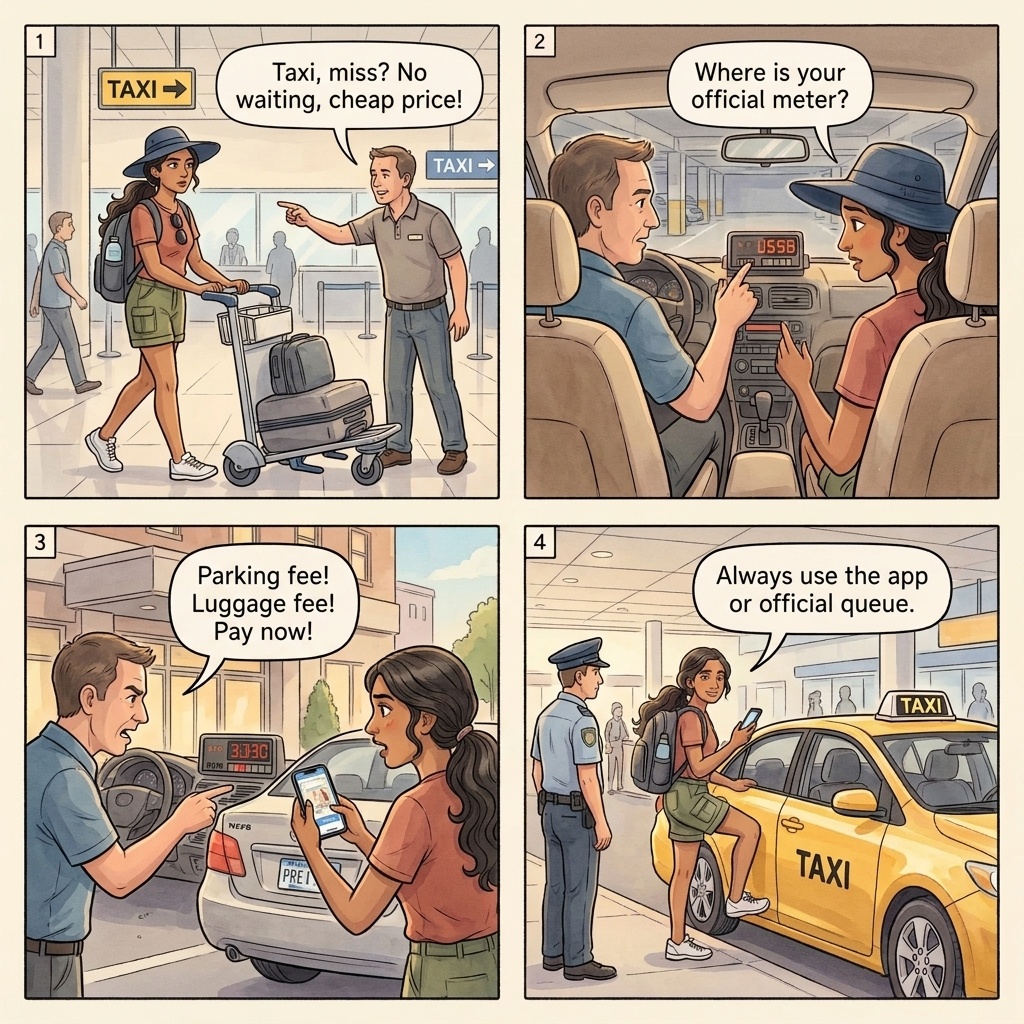
Airport arrival scams run in 54 countries across 146 documented variants. Five sub-types account for nearly every reported case. Unlicensed taxi drivers who intercept you before the official rank. Meet-and-greet touts holding generic "Private Transfer" signs. Fake online transfer-booking websites that charge 3 to 4 times the official rate. Currency-exchange counters offering 8 to 15% below interbank. SIM card kiosks at 2 to 4 times in-town pricing. The single most effective defense in nearly every airport is to walk past anyone who approaches you in the arrivals hall and find the official posted-rate counter inside the terminal.
"You need to pay the Visitax now, señor."
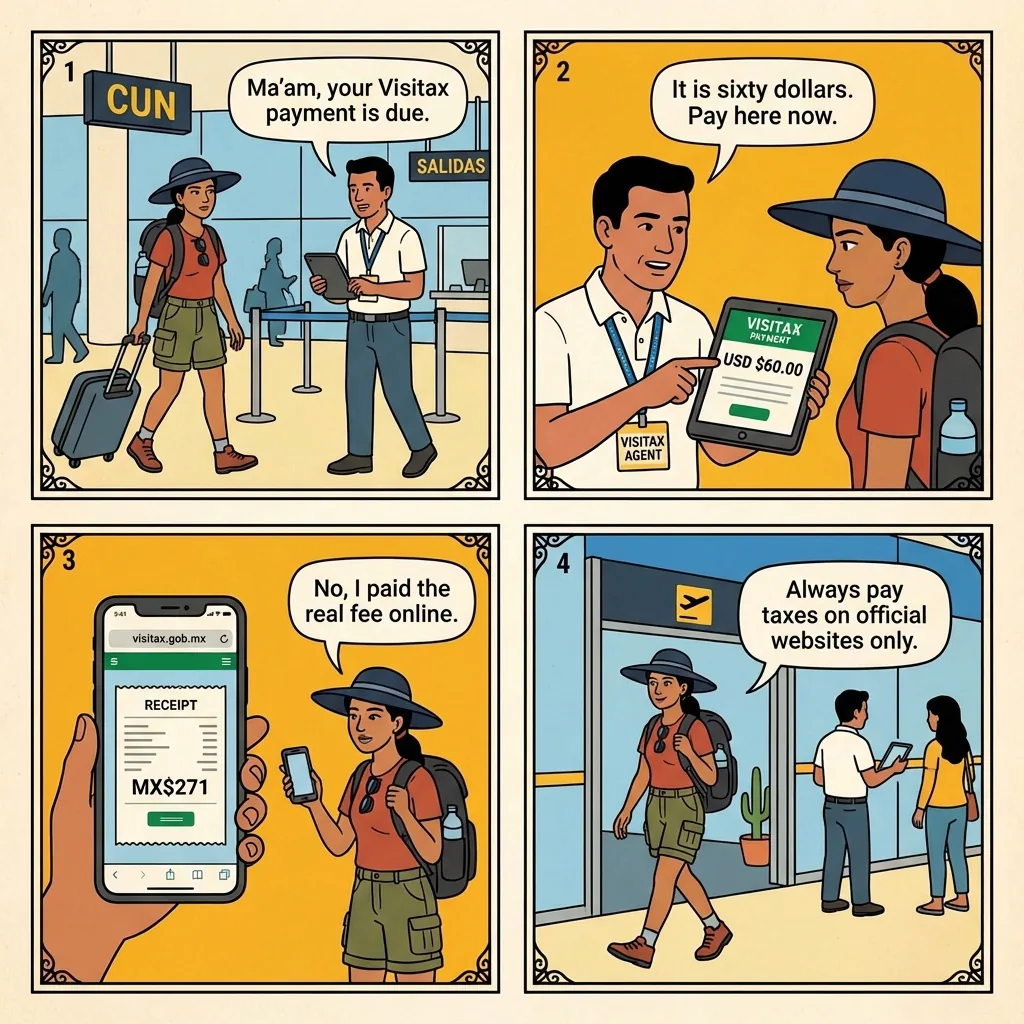
You walk out of CUN's customs hall after a five-hour flight. Two men in matching navy polos with laminated badges step in front of you before you reach the official taxi counter twenty feet away. "Welcome, señor. You need to pay the Mexico Visitax. It is required for all visitors. Two hundred dollars cash, please. We give you the receipt." One of them is already waving a credit-card reader; the other is holding a printed-looking form with the Mexican government seal at the top. They look official. The man behind them in cargo shorts and flip-flops is the actual tout running the scam.
The Mexico Visitax is real. It applies to all foreign visitors entering Quintana Roo state and costs 271 Mexican pesos (around $14 USD) per person, paid online at visitax.gob.mx with a credit card before departure or at airport-authority kiosks that issue receipts with QR codes verifiable on the .gob.mx domain. It is not paid in cash to uniformed freelancers in arrivals halls. The receipt the touts hand you is a glossy printout with a fake QR code. The "credit card reader" is a Square POS connected to a personal account. You learn this six hours later when your hotel concierge looks at your receipt and asks, gently, where you found these gentlemen.
That is one of five airport-arrival sub-variants stacked into a single eight-second encounter. The rest of this page is what just happened to you, why it works, and the universal counter-move that bypasses all five: in 54 countries, across every continent.
Read the full Cancún scam guide →Key Takeaways
The universal mechanism
The eight seconds between customs and the official counter is where everything happens. Every airport arrival scam exploits the same window: you've just deplaned, you're disoriented, you don't know the city's transport system, you have luggage, and the first authority-looking person who speaks to you gets a head start. The mechanism has five steps, identical from CUN to PEK to FCO to JNB.
- The scammer is positioned before the official option. Touts physically place themselves between the customs exit and the licensed taxi counter inside the terminal. By the time you see the official sign, you've already walked past three people who quoted you a price. The geography is engineered. If anyone offers you a ride before you reach the counter, they are not the official option.
- The greeting is informational, not transactional. "Welcome, where are you going?" "First time in Bali?" "Need a taxi to your hotel?" These don't sound like sales pitches. They sound like local helpfulness. The pivot to a quote happens after you've answered, when leaving costs more social friction than continuing. The friendly opener is the bait. The quote follows.
- The price is anchored before you know the legal rate. Without a posted reference price visible, any quote sounds plausible. "Two hundred for the Riviera Maya" sounds about right if you don't know the licensed flat rate is forty. The scam works on the information gap, not on extortion. If you don't know the legal rate, you can't refuse the inflated one.
- The exit cost rises as you commit. Once your bags are in their cart, their car, or their queue, walking away is socially harder. Once you've paid the "tourist tax" cash, asking for a refund means a confrontation. The deeper into the script you are, the higher the cost of stopping. The first 30 seconds are when refusal is cheap.
- The paper trail vanishes after. No printed receipt with verifiable QR. No driver name on a recibo. No company on the meet-and-greet sign. Reporting the scam to airport authorities means pointing at "a man in a polo shirt" who is gone five minutes later. Without a receipt, the recovery cost is higher than the loss.
The five sub-variants
Different airports lean on different mechanics within the same family. Here are the five we've documented globally. Each has a recognition tell, a defense, and a small list of airports where the variant is heaviest.
1. Unlicensed Airport Taxi
Drivers operating outside the airport's licensed taxi system, intercepting passengers before the official rank. Quoted fares run 2 to 4 times the licensed rate. Vehicles are real cars but not affiliated with the airport's taxi cooperative or rideshare zone.
What it feels like: brisk, helpful, slightly aggressive, and always positioned close to the customs exit doors.
Most reported in: Bangkok BKK, Mexico City MEX, Madrid MAD, Bali DPS, Beijing PEK.
2. Meet-and-Greet Hustle
Touts holding generic "Private Transfer", "Hotel Shuttle", or just laminated cards with hotel names. Some are unaffiliated freelancers; some run real prepaid websites that charge $80–$150 for what costs $25–$40 at the official counter inside.
What it feels like: the most professional-looking of the airport scams. Often the touts have matching uniforms and printed signage.
Defense: walk past every sign-holder. Find the licensed taxi or rideshare counter inside the terminal.
3. Fake Private Transfer Website
Online booking sites that look like legitimate airport-transfer services and charge 3 to 4 times the curb price for the same ride. Sometimes operated by the same drivers who work the airport floor; sometimes pure-play scams that no-show entirely after taking the prepayment.
What it feels like: reassuring SEO-friendly websites with stock photos and "trusted by 50,000 travelers" badges. The URL was bought last year.
Defense: book through Viator, GetYourGuide, your hotel directly, or skip prepayment entirely and use the airport's official counter on arrival.
4. Currency Exchange Arrival Trap
Airport currency-exchange counters offer rates 8 to 15% below interbank. That is the worst conversion option globally. The "no commission" marketing hides the spread. Compounding: many airports have only one or two operators, so there is no in-airport competition.
What it feels like: not aggressive, not deceptive in any single transaction, just systematically expensive in a way most travelers never compute.
Defense: use a bank ATM in the arrivals hall (a real bank brand, not a free-standing tourist ATM), or wait until your hotel city. No-foreign-fee debit cards beat every airport exchange.
5. SIM Card Kiosk Overcharge
Airport SIM kiosks charge 2 to 4 times what the same plan costs in town. The plans look local because the carrier branding is real, but the airport-channel pricing is a separate SKU at a different markup.
What it feels like: convenient, official-looking, and effectively a one-time tax on impatience.
Defense: wait for in-town carrier shops, 7-Eleven (Thailand/Japan/Taiwan), or buy an eSIM (Airalo, Ubigi, Holafly) before you fly that activates on landing.
Where it runs
The airport arrival scam is the most geographically widespread variant in our archive after the taxi meter scam, documented at major international airports across all six inhabited continents. The eight countries below account for over 45% of all recorded incidents.
| Country | Documented variants | Iconic airport pattern |
|---|---|---|
| 🇦🇺 Australia | 14 | Sydney Kingsford-Smith taxi rank · Melbourne Tullamarine ride-share zone confusion |
| 🇨🇳 China | 13 | Beijing PEK black taxi · Shanghai PVG Daxing fake-rideshare |
| 🇪🇸 Spain | 9 | Madrid Barajas T4 taxi · Barcelona El Prat T1 unlicensed-private-transfer |
| 🇲🇽 Mexico | 7 | Cancún CUN Visitax shakedown · Mexico City MEX "Taxi Autorizado" curb tout |
| 🇻🇳 Vietnam | 7 | Hanoi Noi Bai cooperative · Saigon Tan Son Nhat meter-rigging |
| 🇮🇩 Indonesia | 6 | Bali Ngurah Rai fake-Grab · Jakarta CGK taxi-mafia rank |
| 🇩🇪 Germany | 6 | Frankfurt FRA inflated meet-greet · Munich MUC overpriced kiosks |
| 🇹🇷 Turkey | 5 | Istanbul IST taxi · Antalya AYT private-transfer overcharge |
Bar width is data-bound at 8 pixels per documented variant. The eight countries above account for 67 of 146 total variants, or 46% of the global atlas.
Four more airports, four more variants
The Cancún scene above stacked Visitax and meet-greet into one encounter. Here are four more airports where different sub-variants dominate. Each links to the full city scam guide.
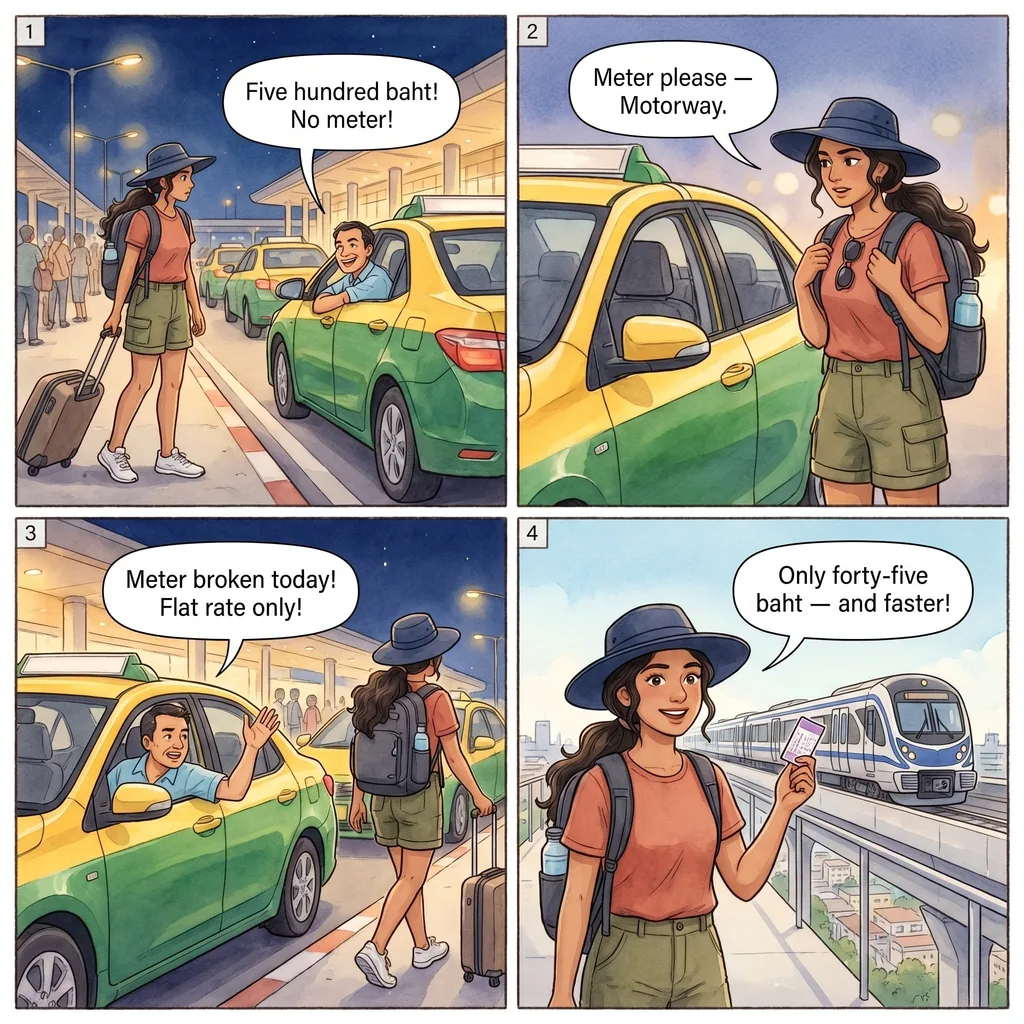
You exit Suvarnabhumi customs at 11pm and follow signs to the official "Public Taxi" rank on Level 1, expecting the metered service. The dispatcher hands you a paper queue ticket; a driver loads your bag. He pulls into traffic and refuses to start the meter. "Better, my friend, fixed price 1500 baht to Sukhumvit." The legal metered fare is around 350 baht plus 50 baht airport surcharge plus tolls. Call it 500 baht (around $15 USD) total. He is asking for $45. The pivot from official rank to unmetered ride happens after you have committed. The defense at Suvarnabhumi specifically: insist on the meter at the curb before pulling away. Say "bpèrt mí-dtə̂r kráp" ("meter on, please"), or refuse the ride and switch to Grab from the official Grab pickup zone on Floor 2. The Airport Rail Link to Phaya Thai for 45 baht is the cheapest option entirely. Bangkok Post has covered the Suvarnabhumi meter-refusal pattern continuously since 2017.
Read the full Bangkok scam guide →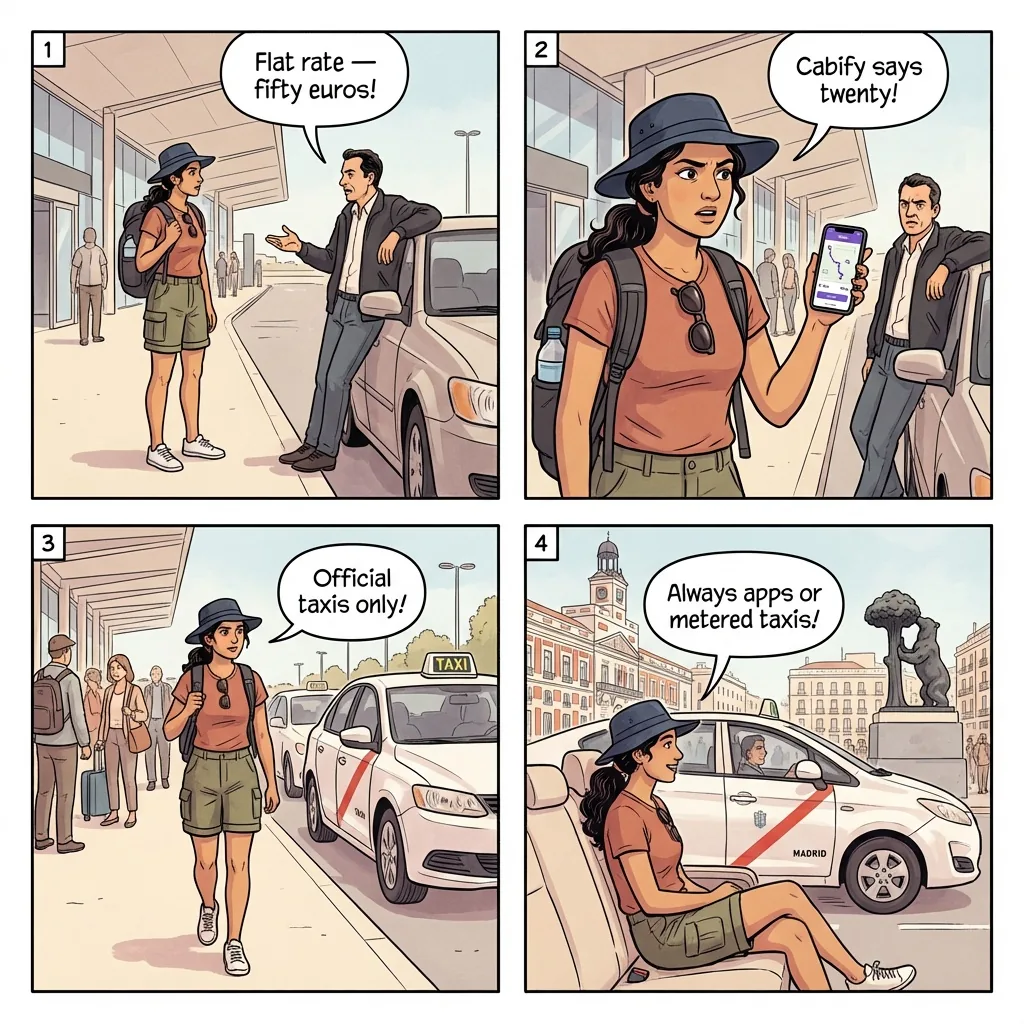
You step out of MAD's T4 arrivals at 7am and the first driver in the rank quotes "sixty euros, fixed" to your hotel near Sol. The legal Madrid flat-rate from Barajas to anywhere within the M-30 ring road is €33 (around $36 USD), posted on a sign at the rank that's angled away from passengers. He waits with your bag in the trunk. You hand him €60 and walk down €27 (around $29) before you've left the airport zone. The single phrase that ends the scene at the curb is "Tarifa fija al centro, por favor". The legal flat rate to the center, please. Drivers running this script retreat from informed riders. If he refuses, walk to the next car in the rank or step over to the EMT bus 200 (€5 to Atocha) or Line 8 metro (€4.50 to Nuevos Ministerios). Madrid's Cabify, Uber, and Bolt all operate legally from the designated rideshare zone outside T4 and run €30–€40 for the same ride.
Read the full Madrid scam guide →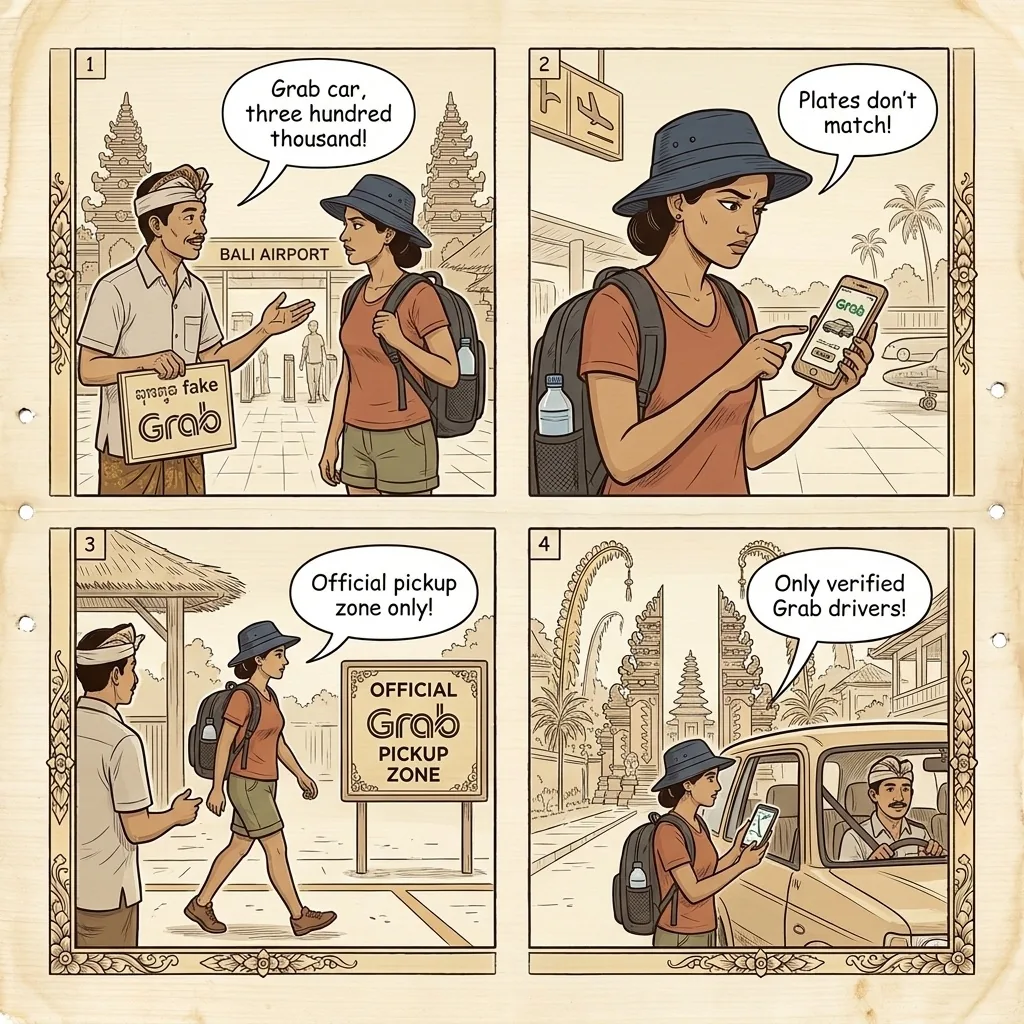
You walk out of DPS arrivals at 8pm and a man in a green polo holds a sign with "GRAB" hand-written on it. He quotes 400,000 IDR (around $25 USD) to Seminyak; the legal Grab fare for the same ride is 130,000 IDR (around $8). He is not a Grab driver. Grab and Gojek both operate legally at DPS but the airport taxi cooperative ("Koperasi Taxi") historically blocks rideshare access to the curb, so passengers must walk to a designated rideshare zone in the parking deck (a zone the cooperative drivers don't always volunteer the location of). Bali tourism authorities have run multiple operations on the cooperative since 2019; the situation is improving but not fixed. Defense: open Grab or Gojek before you exit customs. The app shows the legal rideshare zone with walking directions. Refuse anyone holding a "Grab" sign in arrivals. Real drivers are met at the rideshare zone, not the curb. The legal posted-rate "Bluebird Express" airport taxi at the official rank inside the terminal is around 250,000 IDR to Seminyak and is the next-safest option.
Read the full Bali scam guide →
You land at CMN, walk to the currency-exchange counter in the arrivals hall, and convert €200 at a posted rate of 9.8 dirham per euro. The interbank rate that day is 11.0. You've lost roughly 240 dirham (around $24 USD) on a 200-euro conversion before you've left the airport. The "no commission" sign hides a 12% spread baked into the rate. CMN currency-exchange counters consistently rank among the worst for spread in Africa. The defenses are simple: use the BMCE Bank ATM in the arrivals hall (real bank, real interbank-near rate) with a no-foreign-fee debit card; or skip exchange entirely and pay the airport-to-hotel taxi (around 300 dirham) by card if it accepts. Better still: in-town money-changers in the medina or at major hotel-zone branches offer 10.7–10.9 dirham per euro, a 5–7% improvement over CMN. The single rule: airport currency exchange is the worst rate of any conversion option in nearly every country. Reach for the bank ATM instead.
Read the full Casablanca scam guide →Red flags
If two or more of these signals appear in the first sixty seconds of arrival, walk to the official terminal counter before you commit to anything. The compounding rule: a single signal can be coincidence; two signals are a script.
- Anyone approaches you in the arrivals hall before you reach the official counter
- "Private Transfer" or generic hotel-name signs with no airport-authority branding
- Quoted price is given in your home currency, not the local one
- Cash-only payment demanded for any "tourist tax" or fee
- The receipt has a QR code that doesn't link to a .gov / .gob domain
- The credit-card reader is a Square / Stripe POS connected to a personal account
- You are walked past the official taxi counter without seeing it
- The driver refuses to start the meter at the rank
- Currency-exchange counter posted rate is more than 8% off the day's interbank
- SIM kiosk price is 3× higher than what your eSIM provider quoted yesterday
The phrases that shut it down
Memorize one phrase per country before you fly. Refusal works because it signals you know the script. Touts running airport hustles retreat from informed travelers.
If you got hit
You're at your hotel an hour later. The Visitax was fake, or the taxi was triple, or the SIM kiosk burned you for $80. Don't beat yourself up. The eight-second arrivals-hall window was engineered for exactly this. Here's how to recover, in order, while it's still fresh.
Photograph everything you have: the receipt, the badge, the vehicle license plate (if you remember), the kiosk signage. Open a credit-card dispute the same day if you paid by card. For the fake "tourist tax" specifically: airport authorities take these reports seriously because the scam damages the airport's reputation. File a complaint at the airport-police kiosk inside the terminal (every major international airport has one), or with the country's tourism complaint line:
- Mexico (CUN, MEX): Profeco tourism complaint line 800-468-8722; Visitax fraud reporting at visitax.gob.mx contact form.
- Thailand (BKK, DMK, HKT): Tourist Police 1155 (24/7, English-speaking). AOT (Airports of Thailand) complaint line 1722.
- Spain (MAD, BCN): Aena airport complaints at aena.es/en/airports/passengers/contact; Madrid Tourist Police (Servicio de Atención al Turista Extranjero) +34 91 548 8537.
- Indonesia (DPS, CGK): Bali Tourist Police +62 361 7894777; airport-authority complaint at lapor.go.id.
- China (PEK, PVG): National Tourism Hotline 12301; airport-authority complaint at desk inside terminal.
- Morocco (CMN): Tourism Brigade +212 537 688 999; Royal Gendarmerie 177; ONMT online complaint portal.
For credit-card transactions where the merchant identifier is suspect (Square POS connected to a personal Stripe account, etc.), open a chargeback dispute citing "merchant misrepresentation" and provide the photo of the fake receipt. Most card networks resolve these within 7 to 14 business days. American Express, Visa Signature, and Mastercard World Elite all have strong records on tourist-services chargebacks.
Related atlas entries
Sister entries in the Scam Atlas. Many airport scams overlap with other transport-family entries.
Sources
- Bangkok Post, "Suvarnabhumi taxi rank meter-refusal pattern" (continuing coverage, 2017–2025).
- El País, "El timo del taxi en Barajas: la tarifa fija que no es" (Madrid, 2024).
- The Jakarta Post, "Bali airport taxi cooperative blocks rideshare access" (Bali tourism reporting, 2019–2024).
- Reforma and El Universal, multi-year coverage of fake Visitax shakedowns at Cancún CUN (2022–2025).
- Aena, official Madrid Barajas flat-rate tariff posted at all rank locations (verified April 2026).
- AOT (Airports of Thailand), Suvarnabhumi public-taxi tariff schedule (verified April 2026).
- Royaume du Maroc Office des Changes, currency-exchange spread reporting at CMN (annual airport-services audit, 2024).
- r/travel, r/SoutheastAsia, r/cancun, r/spain, r/Beijing, r/Casablanca, continuing thread monitoring 2023–2026.
Get the airport playbook for your destination.
Each Travel Safety atlas covers every documented airport-arrival scam in one country, plus the rest of the country's scam mechanics: taxi, ATM, restaurant, distraction, fake authority. Buy once, lifetime updates. $4.99 on Kindle.