
Key Takeaways
- The #1 reported scam is the Marché Central Seafood Restaurant Overcharge.
- 1 of 7 scams is rated high risk; 4 are medium and 2 low.
- Use app-based ride services (Uber, Bolt) instead of unmarked taxis — always confirm the fare before departure.
- Never accept unsolicited offers from strangers near tourist sites in Casablanca.
⚡ Quick Safety Tips
- Learn a few phrases in French and Darija (Moroccan Arabic) — 'la shukran' (no thank you) and 'le compteur s'il vous plaît' (the meter please) are essential for declining scammers and getting fair taxi fares.
- Use ride-hailing apps like Careem or InDrive in Casablanca for transparent, GPS-tracked fares instead of negotiating with street taxis.
- Dress modestly and avoid displaying expensive jewelry or electronics, especially in the medina and market areas, to reduce unwanted attention.
- Keep a photocopy of your passport in your hotel safe and carry only a photo on your phone — the tourist police number is 177 for any incidents.
Jump to a Scam
- High Marché Central Seafood Restaurant Overcharge
- Medium Fake Guide and Medina Commission Hustle
- Medium Petit Taxi Meter Refusal and Overcharge
- Medium Airport Currency Exchange Rip-Off
- Low Henna Tattoo Ambush
- Low Aggressive Souvenir Shop Pressure Sales
- Medium The Casa Voyageurs Tramway Bump-and-Lift
The 7 Scams

A tout outside Casablanca's Marché Central walks you to a stall, the waiter delivers prawns and salad you didn't order, and the bill arrives at 430 MAD for a fish platter that costs 60–80 MAD anywhere else in town.
You walk into the bustling Marché Central — Casablanca's covered art-deco market on Boulevard Mohammed V — drawn by the smell of grilled fish and the gleaming seafood displays. A friendly tout outside the south entrance steers you to a specific stall, the waiter seats you at a tiled table, and within two minutes plates start arriving — bread, olives, a prawn salad, fried calamari — none of which you ordered.
The grilled fish you actually asked for arrives next, generous and fresh. When the bill comes it's 430 MAD ($43) for a solo meal: 180 for the fish, 60 for the prawn "starter," 50 for the calamari, 40 for the bread service, 50 for olives, 50 for water. Outside the tourist circuit a similar fish lunch in Casa runs 60–80 MAD all-in. Reddit threads and TripAdvisor's Casablanca forum document the exact play running daily — one user logged a 210 MAD charge for a fish platter locals priced at 40–60.
The defensive move that actually works at Marché Central is the local one: buy your own fish from the fishmongers in the central hall first, then walk it over to a restaurant stall and negotiate a fixed cooking fee — typically 20–30 MAD for grilling. The defense is to skip the touts at the entrance, buy fish from the market vendors directly, agree on a cooking fee in writing before sitting, and refuse every plate that arrives without being ordered ("c'est gratuit?" — if not, send it back). Done right, lunch at the market is 80–100 MAD all-in for a beautiful fresh-caught grilled fish.
Red Flags
- A tout outside the market steers you to a specific restaurant rather than letting you choose
- Plates of bread, olives, salads, and appetizers arrive without you ordering them
- No menu with prices is offered or the menu has no prices listed
- The waiter does not confirm your order or total cost before bringing food
- The bill includes items labeled as 'cover charge' or 'service' that were never mentioned
How to Avoid
- Buy your own fish from the fishmongers first, then negotiate a fixed cooking fee with the restaurant before sitting down — typically 20-30 MAD.
- Ask for a menu with prices before ordering anything and refuse any plates you did not specifically request.
- Politely but firmly wave away touts outside the market and choose your own restaurant inside.
- Bring a Moroccan-speaking friend or ask your hotel concierge which stalls are fair with tourists.
- Photograph the menu prices with your phone before ordering so you have proof if the bill is inflated.

A "university student" in Casablanca's Old Medina near Bab Marrakech offers a free walking tour, walks you 40 minutes to a carpet shop owned by his cousin, and demands 200 MAD when you try to leave — the cousin hands him 30% of whatever you buy.
You're wandering the narrow lanes of Casablanca's Old Medina near Bab Marrakech when a well-dressed young man approaches in good English. He's a university student on his lunch break, he says, and would love to show you "the real Casablanca that tourists never see." He walks with you for thirty or forty minutes through winding alleys, points out brass workshops and an ottoman ceiling, and the conversation is genuinely interesting.
The route ends at a carpet showroom owned by his "cousin." Mint tea appears on a silver tray. The cousin starts unrolling rugs — 4,000 MAD, 6,000 MAD, 9,000 MAD — and your "student" hangs near the door watching the kids while the pitch runs. Whether you buy or not, the demand arrives at the end: 200 MAD ($20) "for the tour and the friendship." If you bought a rug, your guide also collects a 30% commission from his cousin on the way out.
Morocco banned unlicensed guiding in 2007 under Law 05-12 — only government-licensed guides with photo-ID badges may legally take payment for tours. Reddit and Reddit threads describe the same script running on every medina entrance in the country. The defense is to clarify the deal in the first sentence — "I'll pay you 50 MAD for ten minutes of directions and that's it" — most fake-guide scripts break the moment a small price is named at the start, because the script depends on the obligation building over time. Real licensed guides at the Casablanca tourist office are 200–300 MAD per half-day with a photo ID.
Red Flags
- A stranger approaches you near a landmark claiming to be a student or friendly local offering free help
- The person cannot produce a government-issued guide ID badge when asked
- After walking with you for a while, they steer you toward a specific shop or workshop
- They become insistent or aggressive if you try to decline the shop visit or end the walk
- They claim the medina is 'dangerous without a local' to make you feel dependent on them
How to Avoid
- Only hire guides through your hotel, a licensed agency, or the tourist office — look for the official Ministry of Tourism badge.
- Politely decline help from strangers with a firm 'la shukran' (no thank you) and keep walking.
- If someone follows you persistently, mention the tourist police (177) — unlicensed guiding is illegal and they will leave.
- Navigate using Google Maps or Maps.me offline so you don't look lost in the medina.
- If you do end up in a shop, you are under no obligation to buy — simply say 'I need to think about it' and leave.

A red Casablanca petit-taxi driver at the Casa Voyageurs train station says the meter is "broken," quotes 150 MAD for a run to the Hassan II Mosque area, and refuses to negotiate — the metered fare is 15–25 MAD.
You step out of Casa Voyageurs train station and flag down one of Casablanca's red petit taxis — the small four-cylinder cars that handle most in-city moves. You name your hotel near the Hassan II Mosque. The driver waves at the dashboard meter ("cassé, pas marche") and quotes 150 MAD ($15) flat. The metered fare for that run is 15–25 MAD; he's quoting roughly six times honest price.
Reddit's "Why are taxi drivers in Morocco such scam artists" thread is full of the same script. Hespress placed Morocco eighth in a global ranking of taxi-scam hotspots based on a Reddit-sourced study cited by The Independent. The mechanics are identical at Mohammed V Airport (CMN), where unlicensed drivers approach you inside arrivals offering "city transport, very cheap" while the official white grand taxi rank publishes a flat 250–300 MAD airport fare on a posted sign. Inside the city, petit taxis are legally required to use meters with a starting fare around 2.50 MAD and a 50% night surcharge after 8pm.
Careem and inDrive both operate in Casablanca with transparent app pricing and no haggling — both undercut the petit-taxi rank by 30–50%. The Casablanca Tramway also runs from Casa Voyageurs into the city center for 6 MAD if you have time over taxis. The defense is to insist on the meter ("le compteur, s'il vous plaît") and walk to the next car if refused, or order Careem or inDrive on your phone before stepping outside; from CMN airport, take only the official white grand taxi at the posted flat rate, never an offer made inside the terminal.
Red Flags
- The driver does not switch on the meter when the ride begins or claims the meter is broken
- The driver proposes a flat rate before starting — metered rides are always cheaper for short city trips
- The driver takes an unusually long or winding route through unfamiliar streets
- At the airport, someone approaches you inside the terminal offering a taxi instead of waiting at the official rank
- The driver claims there is a 'night surcharge' or 'luggage fee' not displayed on any official tariff
How to Avoid
- Always insist the meter is running — say 'le compteur, s'il vous plaît' and if they refuse, exit and take another taxi.
- Use Careem or InDrive apps in Casablanca for transparent, pre-quoted fares with GPS tracking.
- Ask your hotel for the approximate fare before heading out so you know what to expect.
- At the airport, use the official taxi desk with fixed posted fares rather than accepting rides from people who approach you.
- Keep small bills — drivers often claim they have no change for large notes to pocket the difference.
Like what you're reading? Get a full Casablanca itinerary with safety tips built in.
Browse travel-safety books →
The Global Exchange counter at Mohammed V Airport quotes a clean-looking rate, hands you a printed receipt, and walks off with 700 MAD that should have stayed in your pocket — the real rate is buried under a hidden commission you'd never spot at the window.
You land at Mohammed V International (CMN), clear customs, and the first thing you see in the arrivals hall is a Global Exchange booth with the corporate logo and a backlit board listing rates. You exchange €200 for taxi money and the first day's spending. The teller hands you a stack of 100-MAD notes and a printed receipt. The rate looked normal at the counter — call it 9.0 MAD per euro — and you head for the taxi rank.
Back at the hotel you check XE on your phone and the live mid-market is 10.8 MAD per euro. You did the math: at the actual rate you should have walked away with about 2,160 MAD; you got roughly 1,460. The booth pocketed close to 700 MAD on a single transaction. Reddit's "Scammed by Global Exchange at Casablanca Airport" thread documents the exact pattern, and a parallel TripAdvisor warning thread "Don't use Global Exchange at Marrakech Airport!" shows the same operator running the same play at every Moroccan airport. The receipt buries a "commission" line that erases another 3–5% on top of the spread.
Outside the airport, the street money changers near the Old Medina at Bab Marrakech offer tempting rates but commonly palm off counterfeit or discontinued dirham notes, or use sleight-of-hand counting to shortchange tourists who don't recount in front of them. The defense is to skip every airport exchange counter, walk to the nearest ATM in the arrivals hall, and withdraw 1,500–2,000 MAD directly from a major Moroccan bank's ATM (Attijariwafa, BMCE, or Banque Populaire) — the rate is interbank plus your home bank's foreign-transaction fee, which beats Global Exchange by 15–20% every time.
Red Flags
- The exchange counter at the airport does not clearly display both the buy and sell rates with commission included
- The rate offered is significantly worse than what XE.com or Google shows as the current market rate
- A street money changer offers a rate that seems too good to be true compared to banks
- The street exchanger counts money very quickly and won't let you recount before walking away
- You receive notes that feel different in texture or color from the ones you see at official banks
How to Avoid
- Use ATMs from major Moroccan banks (Attijariwafa, BMCE, Banque Populaire) for the best exchange rates.
- If you must exchange at the airport, compare the displayed rate to the live market rate on your phone first.
- Never exchange money with street changers — counterfeit notes and shortchanging are common.
- Exchange only a small amount at the airport for the taxi and exchange more in the city at a licensed bureau.
- Always count your money carefully at the counter before walking away and ask for a printed receipt.

A woman near the Hassan II Mosque grabs your wrist with "free, gift," paints a henna design before you can pull away, then demands 200–500 MAD with two men appearing at her shoulder — the paste is often "black henna" (PPD) that can scar skin within 48 hours.
You're on the plaza outside the Hassan II Mosque — the largest mosque in Africa, with a minaret rising 210 meters over the Atlantic — and a woman with a henna applicator falls in beside you. "Free, gift, for luck, my friend." Before you can pull back, she's drawing a paisley curl across the back of your hand. The motion takes four seconds.
When she finishes the price arrives. 200–500 MAD ($20–50), and a male relative steps out of the small crowd to "explain" what you owe. The numbers in Casablanca run higher than the Marrakech version because the Hassan II Mosque is a single-day stop for cruise passengers and the operators know the captive audience. The same script runs along the Corniche south of the mosque and at the entrances to the Old Medina near Bab Marrakech.
The chemistry concern is the bigger risk. Many street henna mixes contain "black henna" — para-phenylenediamine (PPD), a hair-dye chemical that causes chemical burns, blistering, and permanent scarring on tourist skin within 48 hours. Real henna is rust-brown, never jet black. The defense is to walk past the mosque plaza and the Corniche with hands in pockets or holding a phone — the script needs the wrist. If a hand reaches for yours, step back loudly and say "la, shukran"; if paste lands on your skin, wipe it off immediately with a tissue and keep walking. If you do want henna, book it through your hotel for 50 MAD with prices posted up front.
Red Flags
- A woman approaches you with henna paste and reaches for your hand without you asking
- She says 'free' or 'gift' while starting to apply the design immediately
- She works with a partner — one distracts while the other grabs your hand
- The demand for payment only comes after the henna is already on your skin
- She creates a loud scene or follows you if you try to walk away without paying
How to Avoid
- Never extend your hand to anyone offering henna — keep your hands in your pockets or crossed if approached.
- Say 'la shukran' (no thank you) firmly and walk away without stopping.
- If henna is applied without consent, offer 10-20 dirhams maximum and walk away — do not pay 200+ dirhams.
- Book henna through your hotel at a pre-agreed price if you actually want it — typically 30-50 MAD for a hand design.
- Be extra cautious around tourist landmarks like the Hassan II Mosque and the Old Medina entrance where these operators cluster.

A shop owner in Casablanca's Habous Quarter pours you mint tea, unrolls thirty Berber rugs across the floor, and quotes 8,000 MAD for a piece worth 1,500 — when you try to leave he reminds you that you drank his tea.
You step into a carpet showroom in the Habous Quarter (Quartier des Habous) — Casablanca's "new medina," built by the French in the 1930s with cleaner streets and posted prices than the Old Medina. The owner brings out the silver pot before any conversation about products, pours mint tea, and sits you on a low cushion. Over the next twenty minutes he unrolls thirty rugs across the tiled floor, naming the Berber tribes that wove them and the dyes used.
The first prices land high. A 1×2 meter Berber rug starts at 8,000 MAD ($800), settles after pressure to 4,000–5,000. The same rug at the Marrakech ensemble artisanal sells for 1,200–2,500 MAD with posted certification. When you try to leave without buying, the mood shifts: he reminds you that you drank his tea, that unrolling the carpets was real work, that walking out is "disrespectful." TripAdvisor and Reddit threads document the script running across the Habous, the Old Medina, and the leather workshops near Bab Marrakech.
Mint tea in Morocco is genuinely a one-way gift in honest commerce — the social pressure is the weapon, not the original meaning. The Ensemble Artisanal (the government-backed craft center near Habous) posts fixed prices on every item and is the cleanest baseline for what a Berber rug, ceramic, or leather bag is actually worth. The defense at any Habous carpet shop is to decline tea up front, browse silently, name your max budget out loud before the unrolling starts ("budget 2,000 MAD, no more"), and walk out empty-handed without apology if the number doesn't get there — the seller will often run after you with a real price.
Red Flags
- The shop owner offers free mint tea immediately — this is a social pressure tactic to create obligation
- Items are aggressively presented without you asking, making it awkward to leave empty-handed
- No prices are displayed and the initial quote is extremely high, expecting you to negotiate down
- The seller claims items are rare, handmade, or one-of-a-kind when similar goods are available everywhere
- The seller becomes hostile, emotional, or guilt-trips you when you try to leave without buying
How to Avoid
- Visit the government-run Ensemble Artisanal first to learn fair baseline prices for carpets, ceramics, and leather goods.
- Politely decline tea if you don't intend to buy — or accept it knowing you owe nothing in return.
- Never feel obligated to purchase because you entered a shop, sat down, or drank tea.
- Research typical prices online before visiting the souks — handmade Berber carpets can legitimately cost 500-2,000 MAD depending on size.
- Start negotiation at 20-30% of the first quoted price and be prepared to walk away — the seller will often follow with a much lower offer.

A team of three on the Casablanca Tramway at Casa Voyageurs during rush hour bumps you from behind while another presses in from the side — your phone and wallet are gone before the train doors close.
You're boarding the Casablanca Tramway at the Casa Voyageurs platform during 6pm rush hour. The platform is packed; the doors open and the crowd surges. Someone bumps you hard from behind, another person presses against your right side, and a third "drops" something at your feet. The whole compression takes four seconds. You step into the carriage, find a spot, and reach for your phone — empty pocket. Wallet too.
Pickpocketing teams work the Casablanca Tramway lines T1 and T2 between Casa Port, Casa Voyageurs, and the Hassan II Mosque stops, especially during morning and evening rush hours and on cruise-ship days when the platforms fill with confused tourists. Reddit's safety threads and World Nomads' Casablanca brief both flag the tramway specifically. The teams are typically three people: one bumps, one shields, one lifts; the lift goes into a third hand and out the door at the next stop before you notice.
The high-speed Al Boraq trains and the tramway system itself are excellent and safe — the issue is the platform pressure points, not the rolling stock. The defense is to wear a crossbody bag in front during boarding, keep phone in a zipped front pocket (never the back pocket of jeans, never a loose jacket pocket), and step backward off the platform pressure when the doors open — let the surge pass, then board the second wave. If you feel a bump, immediately check pockets; if something is gone, photograph the carriage and the platform and file a report with the station police on duty.
Red Flags
- Someone bumps into you or creates unnecessary physical contact in a crowd
- A group of people suddenly surrounds you or blocks your path for no clear reason
- Someone points at something on your clothes or on the ground to distract your attention downward
- You feel a tug or pressure on your bag, pocket, or jacket in a crowded area
- A stranger engages you in conversation while a companion moves behind you
How to Avoid
- Use a crossbody bag worn in front or a money belt under your clothes for valuables.
- Keep your phone in a zipped front pocket, never in a back pocket or loose jacket pocket.
- Avoid displaying expensive jewelry, watches, or large amounts of cash in public.
- Stay alert during boarding and alighting at tramway stops and train stations during rush hour.
- If someone creates a distraction or bumps you, immediately check your pockets and secure your belongings.
🆘 What to Do If You Get Scammed
📋 File a Police Report
Go to the nearest Sûreté Nationale (National Police) station. Call 19. Get an official crime report — you'll need this for insurance claims. You can also report online at Sûreté Nationale Website.
💳 Cancel Your Cards
Call your bank immediately. Most have 24/7 numbers on the back of the card (keep a photo saved separately). Block any suspicious transactions before the thieves use your details.
🛂 Lost Passport?
Report to the nearest police station and obtain a police report, then contact your country's embassy or consulate in Casablanca. Tourist police hotline: 177.
📱 Track Your Device
If your phone was stolen, use Find My (iPhone) or Find My Device (Android) from another device. Don't confront thieves yourself — share the location with police instead.
Frequently Asked Questions
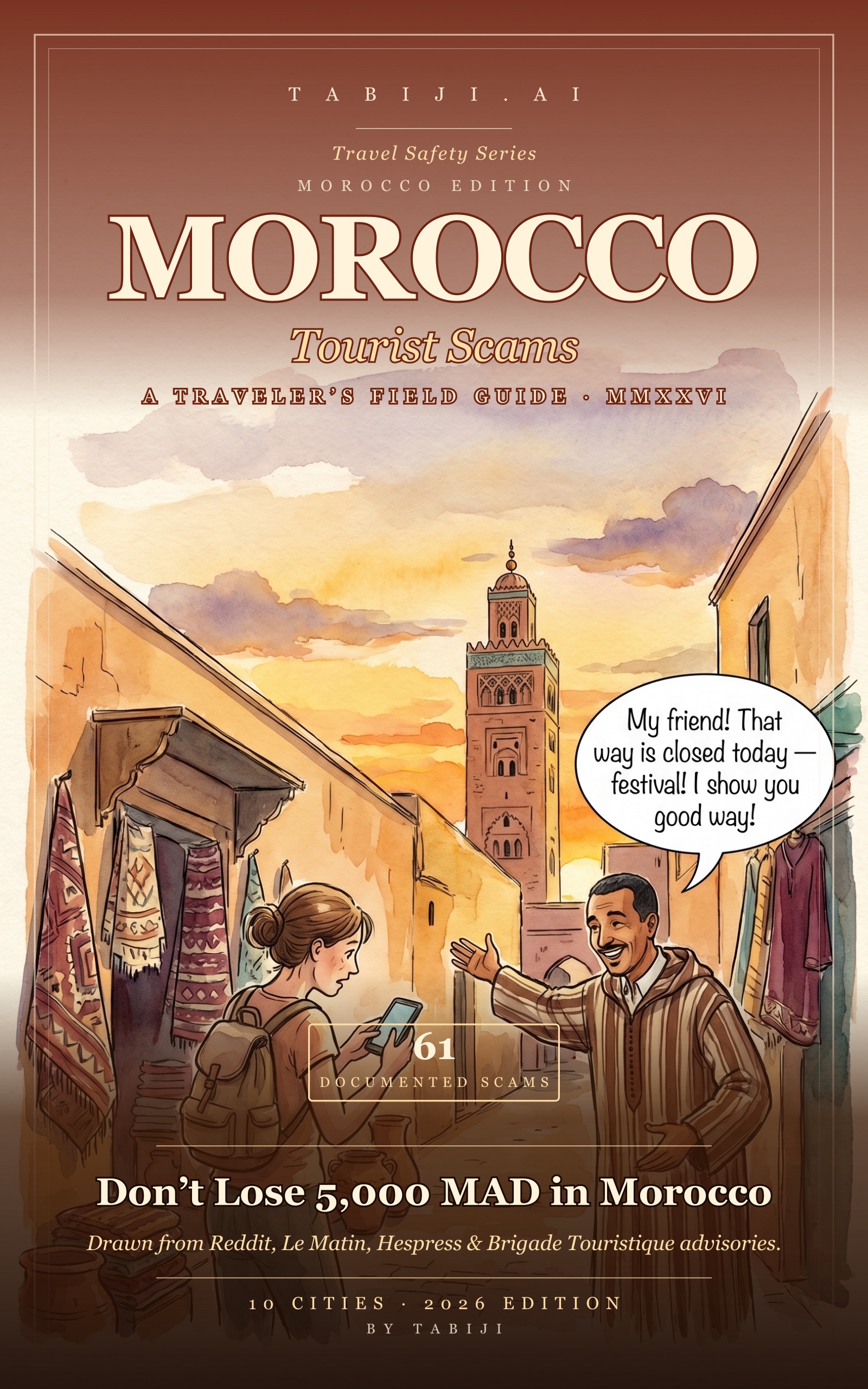
You just read 7 scams in Casablanca. The Morocco book has all 61 across 10 cities — with the exact scripts, red flags, and Darija/French phrases that shut each one down.
61 documented Morocco scams across Marrakech, Fez, Casablanca, Rabat, Tangier, Chefchaouen, Merzouga, Ouarzazate, Agadir & Essaouira — every named scam, every red flag, every Darija and French exit phrase. Drawn from Moroccan press (Hespress, Yabiladi, Le Matin), Sûreté Nationale & Brigade Touristique advisories, and US/UK embassy traveler reports.
- 61 documented scams across 10 Moroccan cities
- Darija and French phrases that shut each scam down
- Post-scam recovery playbook + emergency contacts
- $4.99 on Amazon Kindle — 234 pages, offline-ready