
Key Takeaways
- The #1 reported scam is the 'That Way's Closed' Fake Guide.
- 1 of 7 scams is rated high risk; 5 are medium and 1 low.
- Use app-based ride services (Careem, inDrive) instead of unmarked taxis — Uber does not operate in Morocco.
- Never accept unsolicited offers from strangers near tourist sites in Marrakech.
⚡ Quick Safety Tips
- In the Medina, a 'free' guide who approaches you will expect substantial payment at the end — agree on a price upfront for any guide.
- At Djemaa el-Fna square, entertainers (snake charmers, monkey handlers) will demand payment if you photograph them — agree on a price first or don't photograph.
- Negotiate all prices before shopping in the souks — initial prices are almost always dramatically inflated.
- Book taxis through your riad — street taxi prices for tourists are rarely metered and require firm pre-negotiation.
Jump to a Scam
The 7 Scams

A man on the edge of Djemaa el-Fna says the route to the Bahia Palace is closed today — festival, construction, his cousin's wedding — and offers to walk you the right way; fifteen turns later you're in his uncle's carpet shop and he wants 200 MAD when you try to leave.
You're standing on the edge of Djemaa el-Fna, phone in hand, working out the route through the souks to the Bahia Palace. A friendly man looks over your shoulder and shakes his head. "That way is closed today, my friend — festival inside the medina." He offers to walk you the alternate route. Free. Just to be helpful.
Twenty turns later you're in a carpet shop owned by his cousin, with mint tea on a silver tray and a stack of rugs being unrolled across the floor. When you try to leave he steps into the doorway and names a price: 200 MAD ($20) "for the service." The original route to the Bahia Palace was open the whole time; the "festival" was the open of the script.
Reddit's "Most common scams Morocco" thread, Reddit, and the standing TripAdvisor warnings all describe the same play running daily — one Marrakech traveler captured it as "every day was relentless scamming of road closed or we are from your hotel." Real route closures in the medina happen rarely and are visible — barricades, police, signage; one stranger's verbal claim is the scam's signature move. The defense is to keep walking past anyone who proactively volunteers route information, eyes on offline Google Maps, and respond to "that's closed" with "la shukran" while continuing in your original direction; if you're genuinely lost, ask a shopkeeper already at work in their store, never a man who approached you.
Red Flags
- Someone proactively tells you a street or attraction is 'closed' without you asking
- Offer to show you a 'better route' to wherever you're going
- Guide claims to work for your hotel or to know the manager
- You end up in a shop, restaurant, or someone's home — not where you intended to go
- Friendly conversation that turns into a demand for money once you reach your destination
How to Avoid
- Download offline maps (Maps.me or Google Maps offline) before entering the medina.
- If someone says a street is closed, verify independently by walking toward it yourself.
- Say 'la, shukran' (no, thank you in Arabic) and keep moving without engaging.
- Book official guides through Riad Marrakech or the ONMT tourist office — they have ID badges.
- If you reach a shop, you're under no obligation to buy anything — just leave politely.

A woman near Djemaa el-Fna grabs your wrist with "for luck, no money," paints a henna design before you can pull away, then calls over two male relatives demanding 200–300 MAD ($20–30) — refuse and the volume rises until you pay.
You're crossing Djemaa el-Fna toward the Koutoubia Mosque when a woman steps off the curb and reaches for your hand. "Just for luck, free, no money" — and before you can pull back, a syringe-like applicator is drawing a paisley curl across the back of your hand. The whole motion takes four seconds. By the time your brain catches up, you have a half-finished henna pattern you didn't agree to and a woman who is very much expecting payment.
The price is not 50 dirhams. She names 200–300 MAD ($20–30) and two men step out of the crowd to stand beside her — one near your shoulder, the other ready to "explain" what you owe. Reddit's standing thread "Jemaa el Fna, Marrakech, henna lady" is wall-to-wall with the same script; one widely-shared report described being "physically held by the wrist" until payment. Walking off with paste still wet is not really an option — the design will smear, the men are next to you, and your partner is watching.
The chemistry of it is also a problem. Many street mixes are not pure henna — they contain "black henna" (PPD), a hair-dye chemical that can cause permanent chemical burns and scarring on tourist skin within 48 hours. The Marrakech tourist police (Brigade Touristique, blue uniforms) work the square actively and will move on these touts on sight, but they cannot un-paint what's already on your hand. The defense is preemptive: walk through Djemaa el-Fna with both hands in your pockets or holding a phone, and the moment a woman reaches for your wrist say "la, shukran" loudly and step backward into open space — the script breaks the second the wrist isn't available.
Red Flags
- Someone grabs your hand or wrist without asking permission first
- Offer of a 'free gift' of henna, a bracelet, or a flower in a tourist area
- Male companions nearby who move closer if you try to leave
- Artist doesn't show you a price list before starting
- Henna application happens faster than you can process what's happening
How to Avoid
- Keep your hands in your pockets or crossed over your chest near Djemaa el-Fna.
- Firmly say 'la' (no) and step back the moment someone reaches for your hands.
- If you want a henna tattoo, book it through your riad or go to an established shop with prices posted.
- If already trapped, negotiate down to 50 dirhams maximum — never pay the initial demand.
- Walk toward tourist police (identifiable by blue uniforms) if things feel threatening.

A snake charmer on Djemaa el-Fna catches your eye and a handler from behind drapes a cobra around your neck before you can step back; three men surround you demanding 200 MAD per person for the "photo experience" — same script with the Barbary macaques.
The snake charmers and Barbary macaque handlers in the central performance ring of Djemaa el-Fna are one of the iconic Marrakech images — flutes, snake baskets, monkeys on chains. You raise your phone for a photo from twenty meters away. A charmer catches your eye, gives a slight nod, and a handler you didn't see materializes behind you and lifts a cobra around your neck.
The cobra is real but defanged. The choreography is what matters: by the time you've reacted, three men are around you — the charmer, the handler, a "translator" — naming 200 MAD ($20) per person in the group for the photo "you" took. Refuse and the cobra is still on your neck. The Barbary macaque version runs the same way: a handler swings a monkey onto your shoulder mid-step and the price appears.
Reddit threads on Djemaa el-Fna document the full sequence. The Brigade Touristique works the square in blue uniforms but cannot prevent every grab in time. The Barbary macaque side is also an animal-welfare story — the species is endangered and the photo trade contributes directly to its decline. The defense is to keep your phone in your pocket in the central performance ring, walk the outer perimeter rather than through the middle, and never let an animal touch your body — once the cobra or the monkey is on you, the price negotiation has already started; if you do want a photo, agree on 20–30 MAD out loud before any animal moves.
Red Flags
- Any eye contact or camera motion near snake charmers or monkey handlers signals willingness
- Handlers move toward you proactively — the performance comes to you, not the other way around
- Animal or prop placed on your body before any price is agreed
- Multiple handlers surround you during the 'experience'
- Aggressive tone when you offer a lower amount or try to walk away
How to Avoid
- Keep your phone out of sight and avoid eye contact with performers on Djemaa el-Fna.
- If you want the photo, agree on a price in dirhams BEFORE any animal or prop touches you.
- The going rate for a negotiated photo is 20–30 dirhams — not 200.
- Walk in the outer ring of the square where performers are less concentrated.
- Say clearly: 'bikam?' (how much?) before engaging — if they can't quote a price, walk away.
Like what you're reading? Get a full Marrakech itinerary with safety tips built in.
Browse travel-safety books →
A young man outside Souk el-Attarine offers to walk you to a "women's cooperative" with certified argan oil and saffron — the certificates on the wall are props, the oil is sunflower-blended, and the 500 MAD bottle is worth 80.
You're browsing Souk el-Attarine — Marrakech's main spice and cosmetics souk — and a young man with an ONMT-style lanyard offers to show you a "women's cooperative" with traditional argan pressing. The story is appealing: support local women, see real production, buy fair-trade. He walks you four alleys deep into a private shop with framed "certificates" on the wall and women in headscarves grinding nuts at a low table.
The presentation is real. The bottle is not. After tea and a 30-minute demo, he names 500 MAD for a 100ml bottle of "pure argan" — genuine certified cosmetic argan retails at 150–200 MAD at proper cooperatives like Marjana or AMONT. The "certificates" are decorative; the women are paid to perform; the oil is mostly sunflower with a topnote of real argan to pass the smell test. Reddit threads name the rug and argan scams as the biggest money-extraction patterns in Marrakech.
Real licensed women's cooperatives in Morocco operate outside the medina, are signed with the ASNANE or IGP Argane label, and don't take walk-up traffic from a guide working on commission. The defense is to refuse cooperative detours from anyone who approached you in the souk, and buy at Marjana's signed shops or at certified cooperatives outside the medina — Coopérative Tafyoucht (on the Essaouira/Agadir road) and AMONT both publish fixed prices and certifications on every bottle.
Red Flags
- Guide takes you to a 'cooperative' or 'factory' that wasn't on your itinerary
- Certificates and awards on walls that look professional but have no verifiable details
- Pressure to buy more after the initial demonstration — 'it's for a good cause'
- Price seems like a good deal compared to Western stores — but quality is unverifiable on the spot
- Shop has no fixed price list — prices seem to change based on how interested you look
How to Avoid
- Buy argan oil only from shops recommended by your riad or from the official AMONT cooperatives.
- Genuine argan oil is never cheap — expect to pay 150–250 dirhams for a small authentic bottle.
- Don't follow strangers to any shop — decide your shopping destinations before entering the souks.
- Real women's cooperatives are usually outside the medina in quieter neighborhoods.
- Use smell and texture tests: real argan oil has a nutty scent and isn't perfectly clear.

A petit-taxi driver at the Djemaa el-Fna rank says the meter is "broken," quotes 100 MAD for the run to your riad in Gueliz, and refuses to negotiate — the metered fare is 15–25 MAD, and three taxis down the line will use the meter.
You step out of the Marrakech medina at one of the Djemaa el-Fna taxi stands with luggage and the first petit taxi in line opens the door. You name your hotel in Gueliz. The driver waves at the dashboard meter: "Cassé, pas marche — 100 dirhams." The meter is fine. The price he's quoting is roughly four times the metered run.
Reddit's "Most common scams Morocco" and "Why are taxi drivers in Morocco such scam artists" threads are loud about this — locals say openly to use the meter, and Morocco World News documented a tourist charged 50 MAD for a 5-minute ride that should have been 15. The mechanic is the same across every Moroccan tourist hub: shield the meter, claim it's broken, quote a flat tourist price. From Marrakech Menara Airport (RAK) into Gueliz or the medina, the legitimate flat fare is 100–150 MAD by day, slightly more by night — that part is real.
Marrakech petit taxis (the small beige cars) are legally required to use meters within the city, with a starting fare around 2.50 MAD plus a small night surcharge after 8pm. Careem and inDrive both operate in Marrakech with transparent app pricing and no haggling. The defense is to insist on the meter ("al-addad, min fadlak") and walk to the third or fourth car in the rank if the first refuses, or skip the rank entirely and order an inDrive from your phone — both options put the metered or algorithmic price up front and remove the haggling.
Red Flags
- Driver immediately says the meter is broken before you've even stated your destination
- Quoted price is quoted in euros or dollars rather than dirhams
- Driver refuses to negotiate or show the standard tariff card
- Taxi stops unexpectedly and driver suddenly demands more money
- Driver takes a noticeably long route while watching for your reaction
How to Avoid
- Always insist on the meter — say 'al-addad, min fadlak' (the meter, please).
- If the meter is claimed broken, exit and find another taxi — there are always more.
- Agree on a price in dirhams before entering if no meter is available, and show it written.
- Use Careem or inDrive app in Marrakech for fixed-price rides with upfront quotes.
- Ask your riad what the fair price is for your destination before leaving — they'll know the going rate.

A rooftop restaurant overlooking Djemaa el-Fna hands you a 60 MAD tagine menu, you order, then the bill arrives at 280 MAD with a 50 MAD "terrace supplement," 30 MAD "bread service," and a 15% service charge buried at the bottom.
The rooftop terraces overlooking Djemaa el-Fna are one of the great views in Marrakech — sunset over the square, the Koutoubia minaret in silhouette, the food stalls lighting up below. The waiter hands you a printed menu and you order tagine and mint tea. Tagine of the day 60 MAD, mint tea 15 MAD. Reasonable for a tourist neighborhood.
When the bill arrives the same dishes total 280 MAD ($28). The line items: tagine 90 MAD ("evening price"), mint tea 25 MAD, "bread service" 30 MAD for the basket already on the table, "terrace supplement" 50 MAD for the view, 15% service charge applied at the bottom. The waiter shrugs at a different laminated menu produced from a clipboard: "the dinner menu, sir." The menu you ordered from is not the one you're being billed against.
Reddit and TripAdvisor warnings document the rooftop-Djemaa play running on multiple terraces around the square. Honest Marrakech rooftops post their menu on a board at the door with all supplements and service charges visible up front. The defense is to photograph the menu when it lands on your table — that's your contract — confirm the total out loud before ordering ("the tagine is 60, the tea is 15, total 75, c'est ça?"), and refuse bread or water that arrived unrequested. If the bill differs from the photographed menu, ask for the manager or call the Brigade Touristique on 19.
Red Flags
- Menu prices seem inconsistent or menus are laminated with easily swappable inserts
- Bill is handwritten with no itemized breakdown matching what you ordered
- Waiter adds a 'terrace charge,' 'view charge,' or 'service tax' that wasn't mentioned
- No prices posted at the entrance or on the menu outside the restaurant
- Other tourists at the same restaurant appear to be paying different amounts
How to Avoid
- Take a photo of the menu when you first receive it so you have a record of prices.
- Confirm the total before ordering: 'So this meal will be approximately X dirhams, correct?'
- Eat away from the main square — restaurants two blocks off Djemaa el-Fna are cheaper and often better.
- Check recent Google Maps reviews — scam restaurants get called out specifically.
- Ask for an itemized receipt and compare it line by line to what you ordered.

A teenager in the medina near Bab Doukkala ties a leather bracelet on your wrist with "welcome to Morocco, my friend, free gift," then names 50 MAD for the gift and refuses to take it back — bad luck, he says.
You're walking the medina near Bab Doukkala and a teenage boy steps off a doorway with a stack of leather bracelets in his hand. "Welcome to Morocco, my friend — gift." Before you can step back, he's tied a knotted bracelet around your wrist with a slipknot that takes a full minute to untie. He smiles and starts narrating the "traditional meaning" of the design.
The price arrives with the meaning: 50 MAD ($5) for the bracelet you "received." If you try to untie it and hand it back, he refuses to accept it and explains that gift bracelets that come back are bad luck for the giver. Accomplices nearby — sometimes another teenager, sometimes an older man — watch to see whether the social pressure works.
This is the low-stakes version of Morocco's hand-touch scam family — same script as the henna ambush, smaller money, less aggressive escalation. Reddit threads describe it as annoying rather than dangerous, and the same bracelet sells for 10 MAD in any souk without the script. The defense is the wrist again: walk through the medina with hands in pockets or holding a phone, step back the moment a hand reaches for your wrist, and if a bracelet does land on you untie it calmly and hand it back without paying — the social pressure breaks the second you treat it as an ordinary object instead of a gift.
Red Flags
- Someone puts an object on your body without asking
- 'It's free' — nothing is free in tourist zones in Marrakech
- Item tied or fastened so it's difficult to quickly remove
- Multiple people nearby who watch the exchange unfold
- Scammer is usually young (teen or early twenties) and very friendly
How to Avoid
- If someone reaches for your wrist, step back immediately and say 'la' firmly.
- If a bracelet is already on you, untie it calmly and hand it back without paying.
- Don't feel guilty — saying no to an unsolicited item is completely reasonable.
- Walk with a purpose and don't make eye contact with people selling items on the street.
- Traveling with others makes you a less attractive target for bracelet scammers.
🆘 What to Do If You Get Scammed
📋 File a Police Report
Go to the nearest Sûreté Nationale (DGSN) station. Call 19 (Police) or 15 (Emergency/SAMU). Get an official crime report — you'll need this for insurance claims. You can also report online at dgsn.ma.
💳 Cancel Your Cards
Call your bank immediately. Most have 24/7 numbers on the back of the card (keep a photo saved separately). Block any suspicious transactions before the thieves use your details.
🛂 Lost Passport?
Contact your nearest embassy or consulate. The US Consulate General in Casablanca is at 8 Boulevard Moulay Youssef, Casablanca. For emergencies: +212 522-64-2099.
📱 Track Your Device
If your phone was stolen, use Find My (iPhone) or Find My Device (Android) from another device. Don't confront thieves yourself — share the location with police instead.
Sources & further reading
Every scam here is cross-checked against official government advisories, police bulletins, and established reporting. Confirm current details with the primary sources below before you travel.
-
UK Foreign, Commonwealth & Development Office (GOV.UK) — Safety and security - Morocco travel advice - GOV.UK
Government advisory
“It is common for people posing as official tourist guides to harass tourists.”
-
U.S. Department of State — Morocco International Travel Information
Government advisory
“Aggressive panhandling, pickpocketing, purse-snatching, theft from unoccupied vehicles, and harassment of women are the most frequently reported issues.”
-
World Nomads — 6 Common Tourist Scams to Watch Out for in Morocco
Travel-safety guide
“Taxi drivers are obliged by law to use a meter, and there are standardized rates to and from the airport.”
Frequently Asked Questions
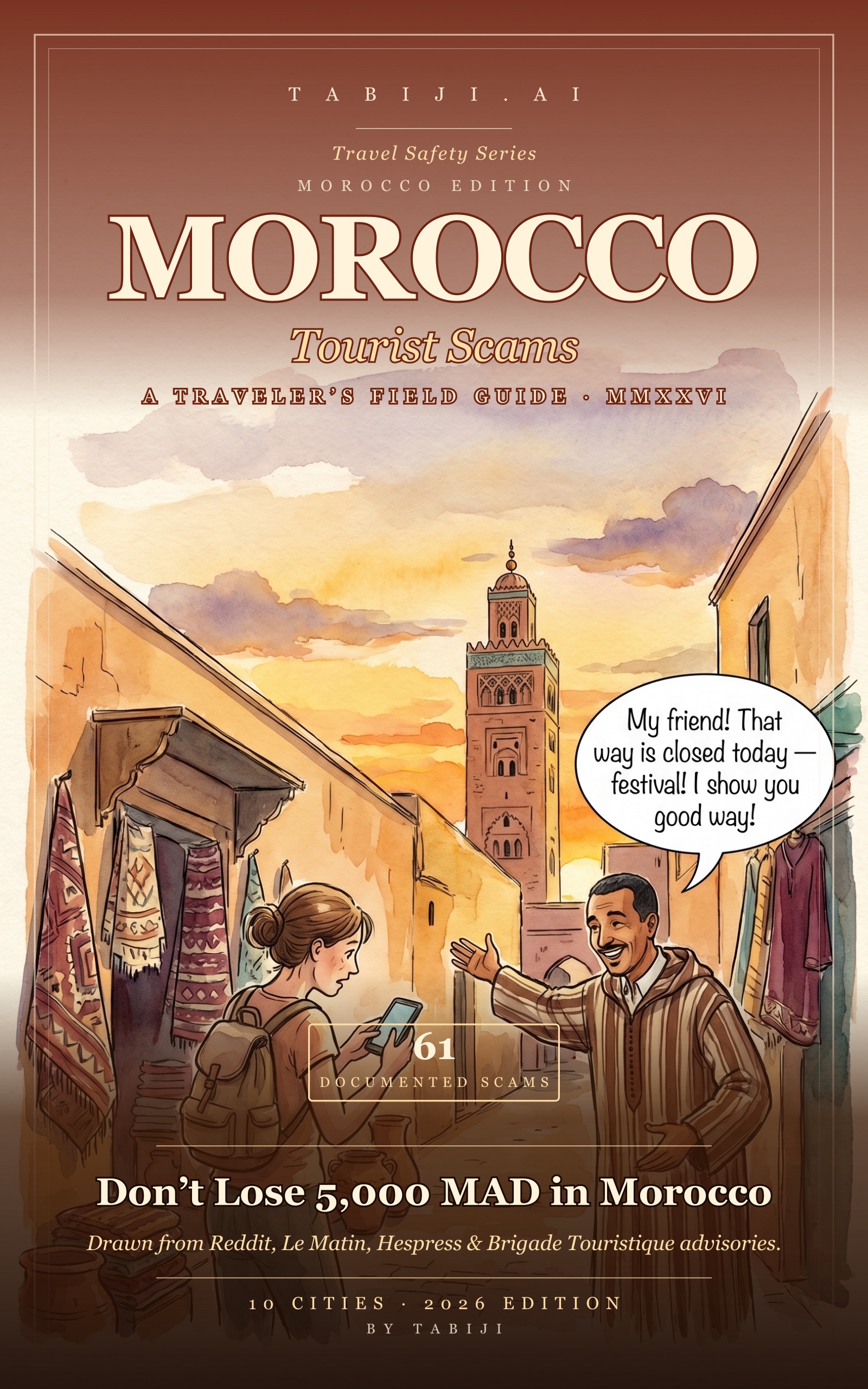
You just read 7 scams in Marrakech. The Morocco book has all 61 across 10 cities — with the exact scripts, red flags, and Darija/French phrases that shut each one down.
61 documented Morocco scams across Marrakech, Fez, Casablanca, Rabat, Tangier, Chefchaouen, Merzouga, Ouarzazate, Agadir & Essaouira — every named scam, every red flag, every Darija and French exit phrase. Drawn from Moroccan press (Hespress, Yabiladi, Le Matin), Sûreté Nationale & Brigade Touristique advisories, and US/UK embassy traveler reports.
- 61 documented scams across 10 Moroccan cities
- Darija and French phrases that shut each scam down
- Post-scam recovery playbook + emergency contacts
- $4.99 on Amazon Kindle — 234 pages, offline-ready