
Key Takeaways
- The #1 reported scam is the Fake Argan Oil Cooperative — buy only from certified cooperatives with Ecocert or IGP Argane labels.
- 5 of 6 scams are rated medium risk; 1 low. Essaouira's vibe is calmer than Marrakech but the scam patterns rhyme.
- Place Moulay Hassan, Skala du Port, and the beach south of the medina are the three pressure zones — know the price before engaging.
- Never accept unsolicited offers near Bab Doukkala, Bab Marrakech, or the harbor — the "free" framing is the open of every script.
⚡ Quick Safety Tips
- Buy argan oil only at certified cooperatives (Marjana, Tighanimine, Coopérative Tafyoucht) — skip roadside "cooperatives" on the Marrakech road.
- Confirm restaurant prices before sitting down on Place Moulay Hassan terraces — bread, water, and "service" are routinely added unannounced.
- Agree on a fixed total price for camel or horse rides on the beach in writing before mounting; refuse photo upcharges.
- The Sûreté Nationale (DGSN) station in Essaouira is on Avenue de l'Istiqlal — call 19 for police, 15 for emergency.
Jump to a Scam
The 6 Scams

A tour bus stops at a roadside "argan cooperative" where women in headscarves demonstrate traditional pressing — the demonstration is real, but the bottles for sale are diluted with sunflower oil and priced at 2–3x what genuine certified argan costs.
You're on the road from Marrakech to Essaouira and the driver pulls into a low building set back from the N8 with a wooden sign reading "Coopérative des Femmes." Inside, half a dozen women sit on the floor cracking argan nuts with stones — the demonstration is genuine, the work is genuinely hard, and the smell of fresh-pressed oil fills the room. After the demo, you're walked into a showroom where shelves of bottles, soaps, and creams are priced in dirhams and euros.
The bottle marked "100% pure argan, 100ml, 350 MAD" ($35) is the trap. Genuine certified cosmetic argan retails at 150–200 MAD per 100ml at proper cooperatives like Marjana or Tighanimine; this roadside operation prices at twice that and the oil itself is typically a 20–30% argan blend with sunflower or other neutral oils. Your driver, who recommended this stop "because it's the best one," is collecting a 30–40% commission on whatever you spend. Reddit threads and Essaouira-specific scam guides flag the N8 cooperatives as the most-reported overpay zone in the region.
The pressing is real, the women are paid, and the building exists — what's broken is the relationship between price, purity, and certification. Genuine argan should be sold in dark glass (UV degrades it fast), should carry an Ecocert, USDA Organic, or IGP Argane label, and should be priced under 200 MAD per 100ml. The defense is to refuse the tour-bus stop entirely and buy in Essaouira itself at the Coopérative Tafyoucht on the road south of the kasbah, or at Marjana's shop near Bab Doukkala — both have certification on every bottle and posted fixed prices.
Red Flags
- Tour bus or grand-taxi driver insists on "the best cooperative" stop
- No Ecocert, USDA Organic, or IGP Argane certification on the bottle
- Oil sold in clear plastic rather than dark glass
- Price 300+ MAD for 100ml when certified argan retails at 150–200
- Driver visibly receives an envelope or returns to the cashier after you leave
How to Avoid
- Refuse roadside cooperative stops on the Marrakech–Essaouira N8 entirely.
- Buy in Essaouira at Coopérative Tafyoucht or Marjana — both certified, both fixed-price.
- Look for Ecocert, USDA Organic, or IGP Argane labels — no label, don't buy.
- Genuine cosmetic argan is 150–200 MAD per 100ml; culinary grade is similar.
- If a bottle is in clear plastic, walk — UV destroys real argan within weeks.

A Gnawa musician plays a few minutes of music on Place Moulay Hassan, smiles your way, then walks over with a hat demanding 50–100 MAD per listener — refuse and a second musician steps in to "explain" the donation.
Place Moulay Hassan is the heart of Essaouira — the open square between the medina and the port where locals gather at sunset and traditional Gnawa musicians play the krakebs (iron castanets) and the gimbri (three-string bass). The music is genuinely part of the city's heritage, the players are genuinely skilled, and the scene is one of the loveliest in Morocco. You stop to listen for two minutes. That's the trigger.
The musician finishes a verse, smiles in your direction, and walks straight over with a hat or a small woven basket. "For the music, my friend." The number named is 50–100 MAD ($5–10) per person who stopped, not per group. If you only have 10 MAD or try to walk away, a second musician with the krakebs steps over to back up the request, and a small crowd of locals watches the negotiation. Reddit threads and Essaouira scam guides document the same script running on the square and along the Skala de la Ville rampart walk.
Real licensed street performance happens in Morocco and a tip is genuinely appropriate — but for a deliberate stop, not a thirty-second listen. Tip ranges that locals actually pay are 5–20 MAD per group for a few minutes of listening; the 50–100 MAD per-person ask is the tourist surcharge. The defense is to keep walking past Gnawa musicians on Place Moulay Hassan — only stop if you've decided in advance you want to listen and tip — and if you do tip, hand 10–20 MAD per group at the end of a song, not 100 per person.
Red Flags
- Musician walks toward you with a hat after only a few minutes of listening
- Donation is named per-person rather than per-group
- Second musician moves in if you offer a small amount
- No posted "donations welcome" sign — just verbal demand
- Aggressive escalation if you try to walk away mid-conversation
How to Avoid
- Walk past Gnawa musicians on Place Moulay Hassan unless you intend to stop, listen, and tip.
- If you stop, decide on 10–20 MAD per group as the tip and hand it at the end of a song.
- Refuse per-person pricing — tipping street performance is per-group, never per-listener.
- For genuine Gnawa music, attend the Essaouira Gnawa Festival (June) or a riad performance.
- If pressured aggressively, walk to a cafe or shop — most won't follow into a business.

A handler on Essaouira beach quotes "10 dirhams per minute" for a camel ride — twenty minutes later he's demanding 300 MAD per person plus 100 MAD in "photo fees," with the kids still on the camel until you pay.
You're walking the beach south of the medina when a man leading two camels intercepts you. "Camel ride for the kids? Ten dirhams a minute, very cheap." It sounds like 100 MAD for ten minutes. The kids are excited. You agree. The handler swings them up onto the camel, hands you the lead rope to walk alongside, and the photos start.
Twenty minutes later — because "ten minutes" became "twenty, just to make it worth it" — the handler stops the camels and names the price. 300 MAD per person, 100 MAD in "photo fees" because he was taking photos on his own phone the whole time, and a 50 MAD "tip" he describes as obligatory. The kids are still up on the camel; getting them down requires the handler's cooperation. A Facebook traveler-warning thread on Essaouira camel rides flagged this exact play with the line: "Avoid the camel rides outside hotel, it's a con — also charge for photos, will get aggressive for more money."
Honest camel and horse rides do operate on Essaouira beach — the legitimate stables are typically signed, post a flat rate, and operate from the road south of the kasbah rather than mid-beach. The defense is to settle a flat total price in writing before the kids leave the sand: "200 MAD total, all-in, no photo fees, twenty minutes" — refuse anything quoted "per minute" and walk to the next stable if the handler won't commit. Riads can also book a stable directly with a posted price and a receipt.
Red Flags
- Pricing quoted "per minute" rather than as a fixed total
- Handler intercepts you on the beach rather than from a posted stable
- Handler takes photos on his phone without being asked
- Ride extends beyond the agreed time "to make it worth it"
- Refusal to let kids dismount until payment is settled
How to Avoid
- Settle a fixed total price out loud before mounting: "200 MAD total, no extras."
- Refuse "per-minute" pricing entirely.
- Use a riad-recommended stable from the road south of the kasbah, not a beach freelancer.
- Decline photos taken on the handler's phone — take your own only.
- If the handler refuses to dismount the kids, photograph him and call 19 (police).
Like what you're reading? Get a full Essaouira itinerary with safety tips built in.
Browse travel-safety books →
A street tout on Place Moulay Hassan shows you a 60 MAD tagine menu, seats you, then hands over an indoor menu where the same dish is 180 MAD — by then the bread is on your table and walking out feels rude.
You're walking off the Skala ramparts toward Place Moulay Hassan looking for dinner and a man with a clipboard steps onto the sidewalk in front of you. "Best fish in Essaouira, just caught this morning." He shows you a laminated menu — tagine of the day 60 MAD, grilled sardines 50, half a lobster 120. The numbers look right for a port town. You and your partner sit at a cafe-style table on the terrace.
The waiter who hands you the indoor menu is a different person, and the menu is different too. Tagine of the day is now 180 MAD, sardines 110, lobster 350. "Bread service" is 25 MAD for the basket already on the table, and a 15% service charge will be added at the bottom. You point at the laminated street menu still in your hand and the waiter shrugs: "Street menu is for street, sir. This is the dinner menu." Walking out at this point feels confrontational — bread is on the table, water is open, the kids are seated.
The bait-and-switch runs on inertia — once you've sat, getting up and leaving feels socially expensive. Honest Essaouira restaurants on Rue de la Skala and the small streets around Place Chefchaouni post their actual prices on a board at the entrance and don't have street touts. The defense is to ask for the indoor menu before you sit and compare it to the street version — if the prices don't match, walk away while you can; if bread arrives unrequested, ask "c'est gratuit?" before touching it, because anything that lands on the table will be billed.
Red Flags
- Street tout actively trying to pull you toward the restaurant — honest places don't do this
- Laminated street menu prices noticeably below the neighborhood average
- Indoor menu different from the one shown outside
- Bread, olives, or water arrive without being ordered
- Mandatory "service charge" buried at the bottom of the indoor menu
How to Avoid
- Ask for the indoor menu before sitting and compare it to the street version.
- If bread or olives arrive unordered, ask "c'est gratuit?" before touching them.
- Walk one block off Place Moulay Hassan toward Rue de la Skala for honest pricing.
- Check Google or TripAdvisor for the restaurant before sitting — 60 seconds saves $50.
- Photograph the menu in front of the waiter so the bill cannot quietly add items.

A man at Bab Doukkala falls in beside you saying he's "not a guide, just a student practicing English," walks you for thirty minutes through the souk, then steers you into his cousin's spice shop and demands 200 MAD for the tour.
You arrive at the Essaouira bus station and walk the ten minutes to Bab Doukkala, the medina's main eastern gate. A man in his thirties falls in step beside you almost immediately. He says he's not a guide — he's a teacher, a student, a local who grew up nearby and just wants to practice his English with travelers. The conversation is genuinely interesting: he points out the brass workshops, the carpentry on Rue de la Skala, the route to Place Moulay Hassan.
Thirty minutes in, you're standing in his cousin's spice shop being walked through ras el hanout blends and saffron threads. He hangs back near the door while the cousin presses you to buy — which means you can't leave without acknowledging him on the way out. At the end he names a price: 200 MAD ($20) "for the tour and the friendship." Refuse, and the friendliness drops a couple of degrees and the cousin in the shop joins the conversation.
Reddit's Essaouira threads and Reddit document the same play running on every medina entrance in the country — Essaouira's smaller version is less aggressive than Marrakech's, but the script is identical. Real licensed Moroccan guides wear a photo ID badge and are bookable through any riad for 150–250 MAD per half-day with a clear scope. The defense is to clarify the deal in the first sentence: "I'll pay you 50 MAD for ten minutes of directions and that's it" — most fake-guide setups break the moment a price is named at the start, because the script depends on the obligation building over time.
Red Flags
- Stranger insists he's "not a guide" while doing exactly what guides do
- Conversation drifts toward shops the stranger "just happens to know"
- No photo ID badge clipped to his shirt
- The stranger waits outside while a shop-owner cousin handles the pitch
- Demand for payment only emerges at the end, never at the start
How to Avoid
- Book a licensed guide through your riad with a clear scope and posted fee (150–250 MAD/half-day).
- If a stranger starts walking with you, name a price up front: "50 MAD for directions only."
- Refuse shop detours — "no shopping, just the medina" — and watch the friendliness fade if commission is the goal.
- Licensed guides wear a photo ID — no badge, no obligation.
- "La shukran" works better than English here; using a Darija phrase signals you've heard the script before.

You photograph the iconic blue Essaouira fishing boats from the Skala du Port and a fisherman walks over: "20 dirhams per photo, my friend" — the harbor is public and free to photograph, but the demand is hard to argue with face-to-face.
The Skala du Port is one of the most photographed scenes in Morocco — a row of bright blue wooden fishing boats packed against the harbor wall below the medina ramparts, gulls overhead, the Atlantic behind. You stand at the railing with your phone or camera, frame the shot, take three or four photos. A fisherman in a yellow oilskin who's been mending nets nearby looks up, walks over, and holds out a hand. "Twenty dirhams. Per photo. Or fifty for the boats."
The harbor is public. The boats are working fishing vessels in a working port. There is no legal basis for charging photography fees — but face-to-face on a quiet section of the rampart, the demand is uncomfortable to refuse, especially when the fisherman gestures at his colleagues fifty meters away and the implied audience grows. The amounts are small (20–50 MAD, $2–5) which is what makes most travelers pay rather than escalate. Repeat the same pattern at the kasbah ramparts and you've added another 20 MAD to the day.
This is the classic "freelance photo fee" pattern documented across Moroccan ports and tourist viewpoints — it works on the social cost of saying no, not on any actual rule. Real fishermen working a real catch don't generally chase tourists for photo money; the ones who do are usually positioned specifically to do that. The defense is to take photos quickly and keep walking — the demand only lands if you've stopped to chat. If approached for a fee, smile, say "non merci" and continue; the fisherman has no way to enforce anything and the demand is gone in twenty meters.
Red Flags
- Fisherman approaches only after you've taken photos
- "Per photo" pricing for what is publicly visible scenery
- Gestures at colleagues to imply social pressure
- No posted sign anywhere on the harbor about photography fees
- Demand grows when you hesitate or open a wallet
How to Avoid
- Take photos and keep walking — don't stop to chat after.
- If approached, smile, say "non merci" and continue past.
- The harbor is public — there is no legitimate fee for photography.
- Photograph from the ramparts above for sweeping shots without close contact.
- If you want a portrait of a specific fisherman, agree on 10–20 MAD before pressing the shutter.
🆘 What to Do If You Get Scammed
📋 File a Police Report
Go to the nearest Sûreté Nationale (DGSN) station. Call 19 (Police) or 15 (Emergency/SAMU). Get an official crime report — you'll need this for insurance claims. You can also report online at dgsn.ma.
💳 Cancel Your Cards
Call your bank immediately. Most have 24/7 numbers on the back of the card (keep a photo saved separately). Block any suspicious transactions before the thieves use your details.
🛂 Lost Passport?
Contact your nearest embassy or consulate. The US Consulate General in Casablanca is at 8 Boulevard Moulay Youssef, Casablanca. For emergencies: +212 522-64-2099.
📱 Track Your Device
If your phone was stolen, use Find My (iPhone) or Find My Device (Android) from another device. Don't confront thieves yourself — share the location with police instead.
Frequently Asked Questions
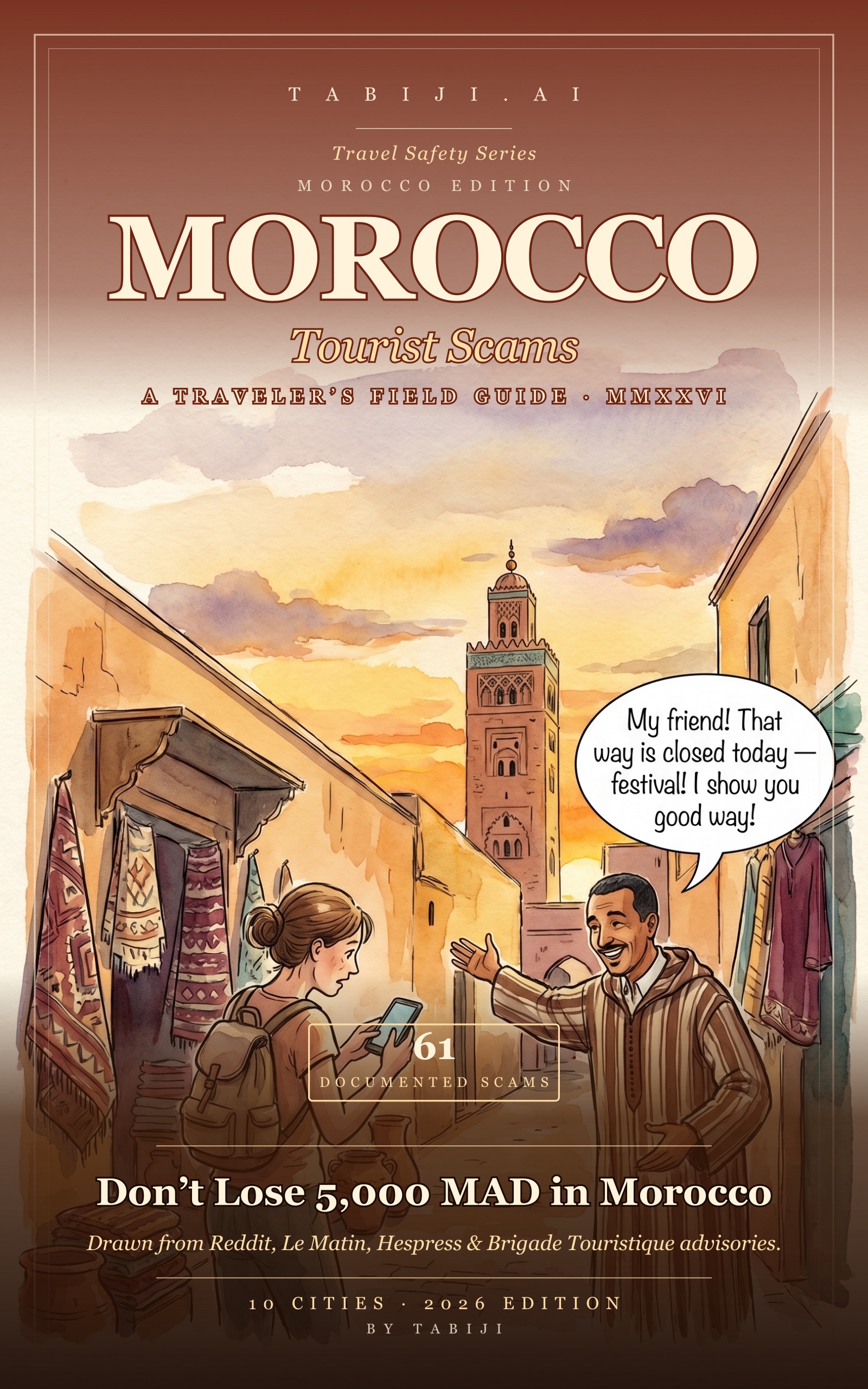
You just read 6 scams in Essaouira. The Morocco book has all 61 across 10 cities — with the exact scripts, red flags, and Darija/French phrases that shut each one down.
61 documented Morocco scams across Marrakech, Fez, Casablanca, Rabat, Tangier, Chefchaouen, Merzouga, Ouarzazate, Agadir & Essaouira — every named scam, every red flag, every Darija and French exit phrase. Drawn from Moroccan press (Hespress, Yabiladi, Le Matin), Sûreté Nationale & Brigade Touristique advisories, and US/UK embassy traveler reports.
- 61 documented scams across 10 Moroccan cities
- Darija and French phrases that shut each scam down
- Post-scam recovery playbook + emergency contacts
- $4.99 on Amazon Kindle — 234 pages, offline-ready