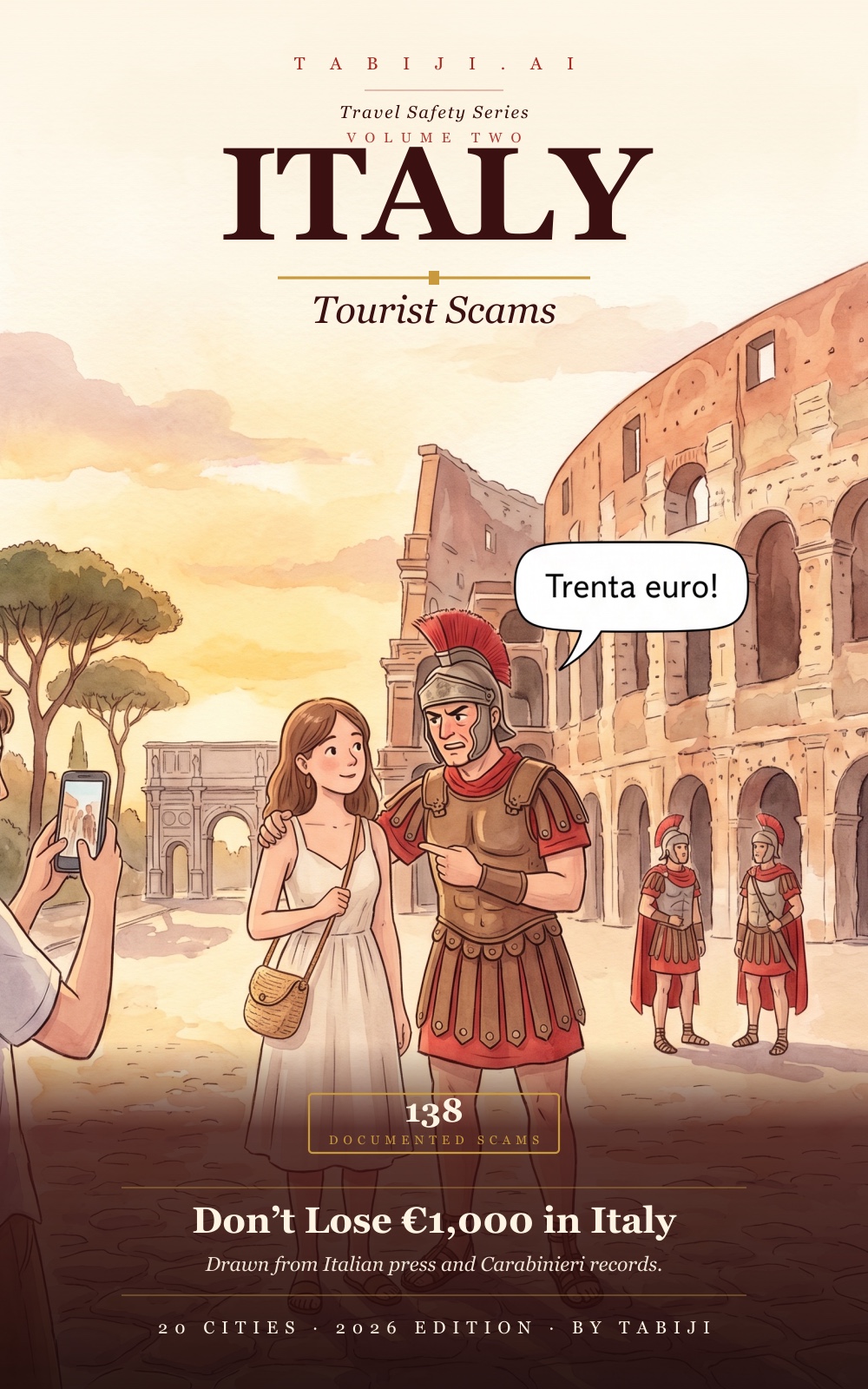
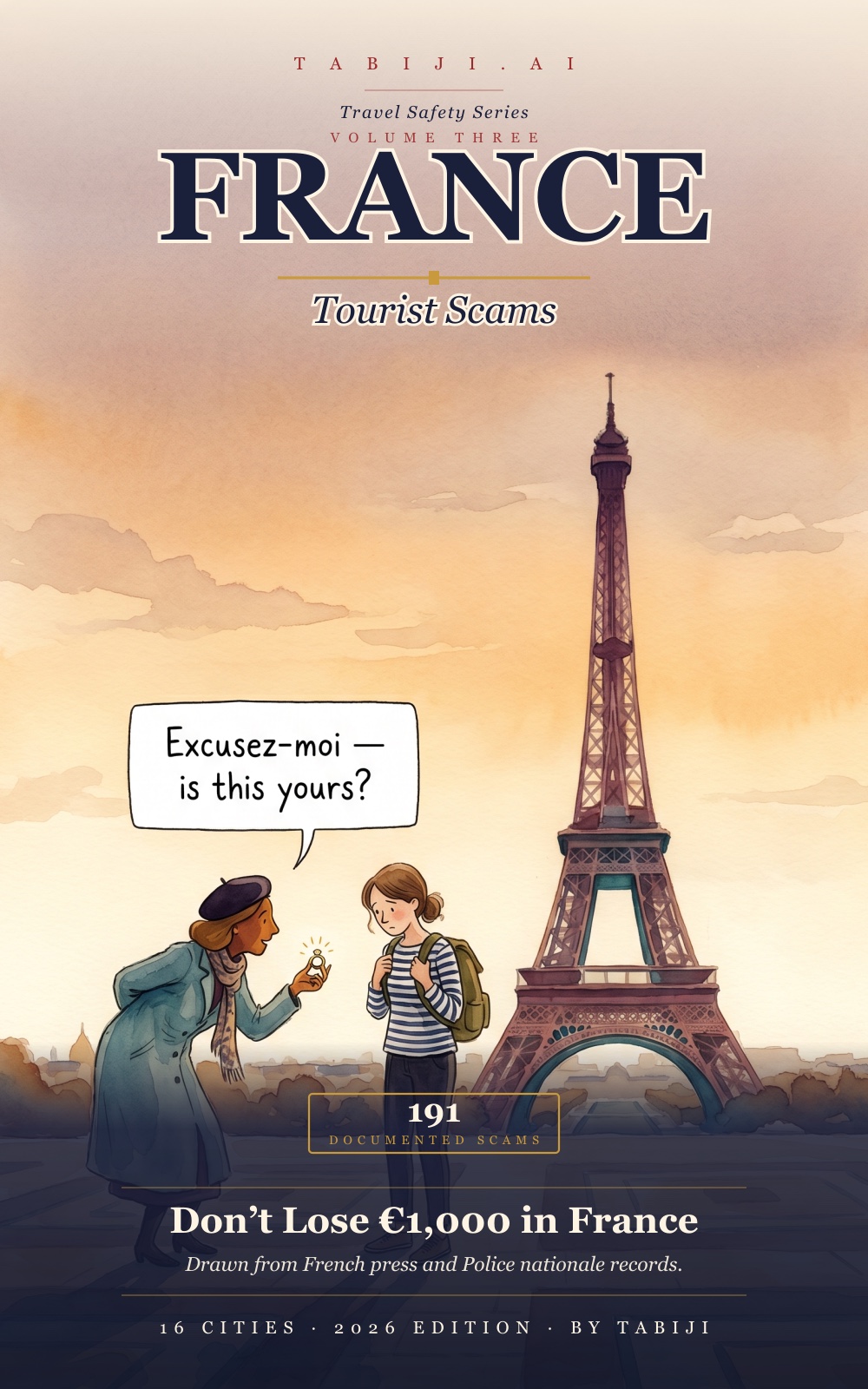
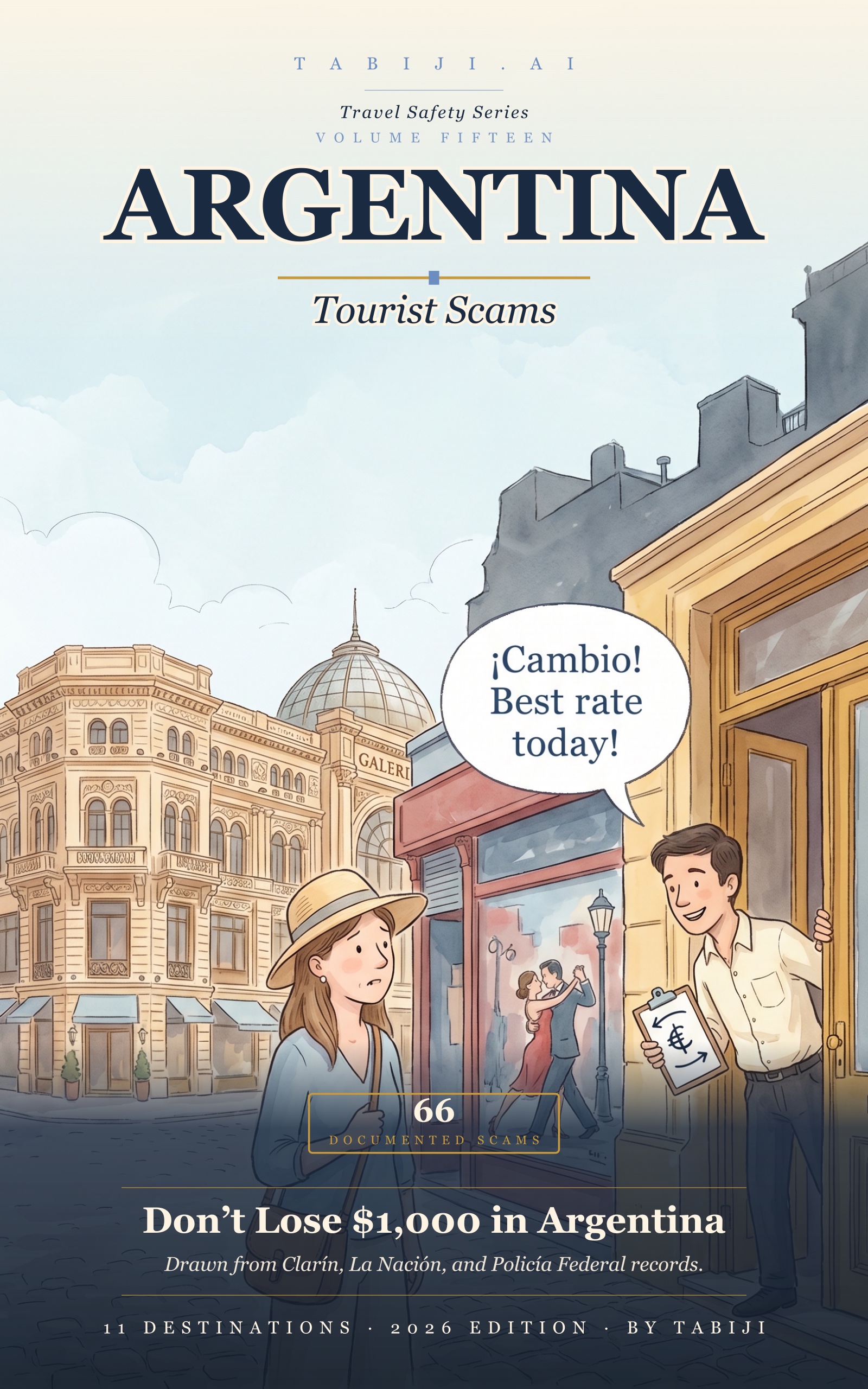
The taxi meter scam, country by country.
One scam family. Five sub-variants. Sixty-five countries. Drawn from police arrest records, local press, and a year of field reports. The cloned meter, the long-route detour, the counterfeit-bill swap. And the exact local-language phrases that shut each one down in 30 seconds.

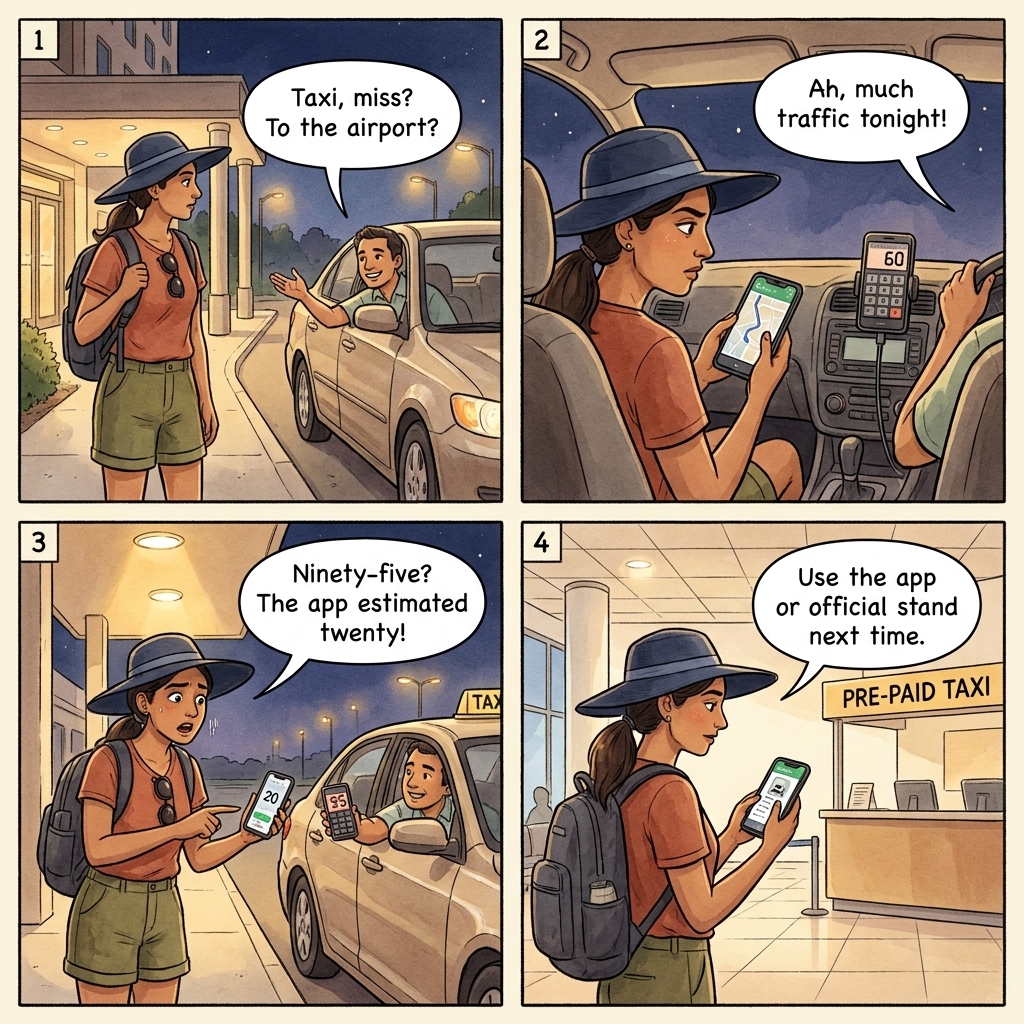
Taxi meter scams run in 65 countries across 140 documented variants. Five sub-types account for nearly every reported case. Cloned meters running at 2–3× the legal tariff. Long-route detours that pad distance by 30–50%. Counterfeit-return bill swaps where the driver palms your real banknote. Meter-refusal flat-rate negotiation. Duplicate-charge POS "failures" that force cash on top of a card already debited. The single most effective defense in nearly every country is to skip street taxis and use a rideshare app: Uber, Cabify, DiDi, Bolt, Grab, Careem, or whichever local equivalent operates legally there. App fares lock before you board and eliminate every variant in one move.
Cloned meter, long route, then the bill swap.
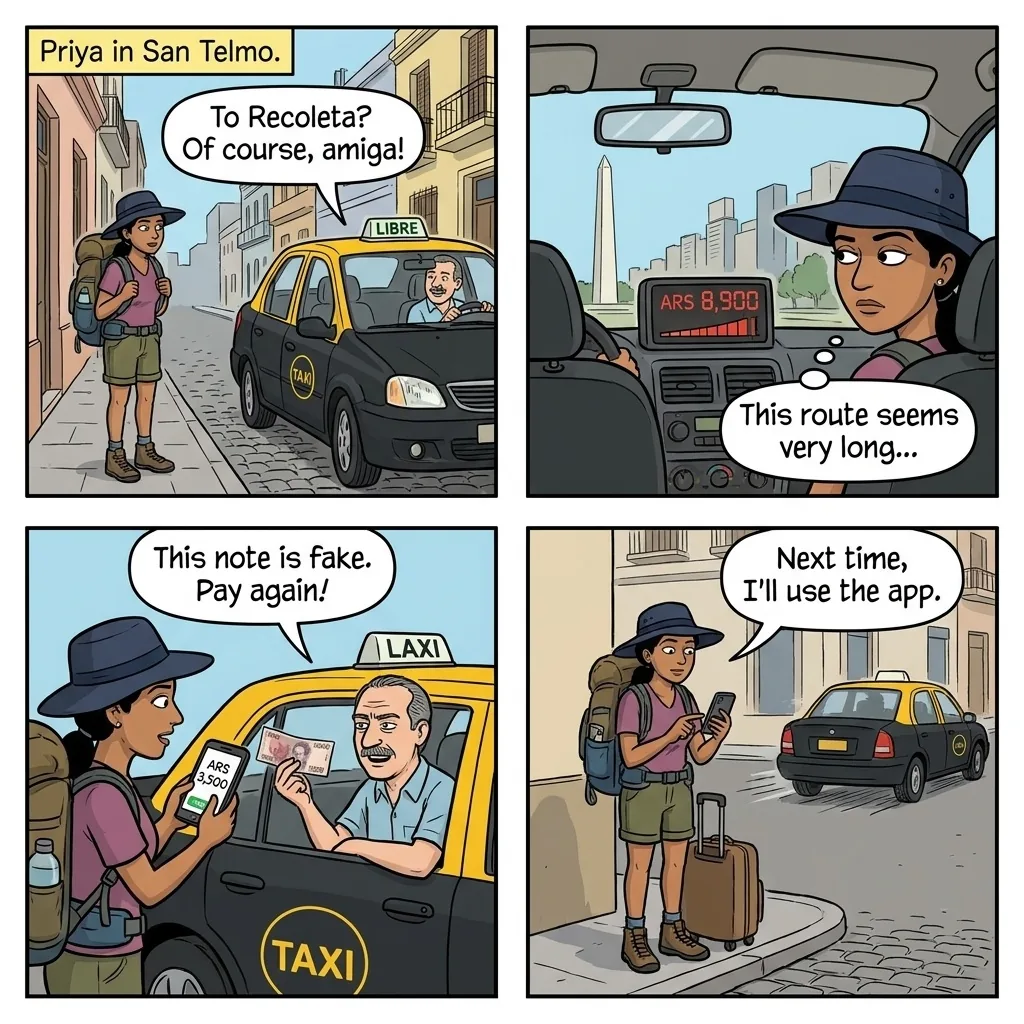
You step out of a wine bar on Defensa Street in San Telmo and a taxi with a "Libre" sign coasts up before you've raised your hand. The driver is friendly, opens the trunk for your bag, asks where you're staying. Recoleta. "No problem, twenty minutes." The base meter reads ARS260, matching the dashboard tariff, so you settle in. He takes the route to Avenida 9 de Julio instead of cutting north on Bolívar, then detours onto the autopista because of "traffic on Callao." It's Sunday night with no traffic. The meter is climbing faster than the streetlights are passing.
At Recoleta the meter reads ARS9,800. You know it's wrong. Cabify quoted you ARS3,500 for the same trip last week. You hand him a 10,000-peso note. He turns it over, frowns, holds it up to the cabin light: "Esta no sirve, señor. Counterfeit. You have another?" In one practiced motion he has already palmed your real note and is showing you a different bill from his door pocket, creased and faded, obviously a plant. You are alone on Avenida Alvear at midnight with luggage in his trunk. You hand him a second 10,000 to make the scene end and walk to your hotel down a hundred dollars.
That is three sub-variants in one ride. The rest of this page is what just happened to you, why it works, and the exact phrases that shut it down: in eight languages, across sixty-five countries.
Read the full Buenos Aires scam guide →Key Takeaways
The universal mechanism
The taxi finds you. That is the giveaway. Every variant of taxi-meter manipulation rides the same five-step social engineering. Step one is always the driver initiating contact rather than the rider. The script has been running on tourists in Mediterranean port cities since at least the 1970s; what changes is the technology and the local language. Recognize the pattern and the local accent becomes obvious thirty seconds in.
- The taxi finds you. A "Libre" or "Free" sign coasts up before you've raised your hand. The driver is unusually friendly: opens the trunk for your bag, asks where you're staying, sometimes uses your name from a luggage tag he glanced at. The premise of legitimate licensed taxis is that the rider initiates. The first 10 seconds tell you everything. If the driver finds you, you are already inside the scam.
- Commitment locks in before friction shows up. Your bag is in his trunk. The base meter reads correctly: ARS260 in Buenos Aires, €3.50 in Rome, ฿35 in Bangkok. It matches the dashboard tariff sign. You settle in. The first 90 seconds of every variant look identical to a legitimate ride. The divergence comes later, after exit costs are high.
- The route or the meter starts to drift. He takes the autopista detour "because of traffic" on a Sunday night with no traffic. The meter climbs faster than streetlights pass on a steady-speed road. The card reader "isn't working tonight, sorry, cash only." Each drift is a probe. If you do not react, the next probe is bolder.
- The pressure point lands at the destination. The fare is two or three times what it should be. You're alone with luggage at midnight on Avenida Alvear, or at a hotel curb in Recoleta, or in front of an Airbnb in Cairo where you don't speak the language. Confronting the driver costs you time, safety, and certainty. Paying costs $30 to $200 and ends the scene. The math is engineered.
- The paper trail vanishes. The driver refuses the printed recibo, declines to give a name or número, drives off before you've finished counting your change. Without a receipt or plate photo, the claim against him at the tourist police is "a stranger took my money in a yellow car." The recovery cost is higher than the loss. That is why the script keeps working.
The five sub-variants
Different countries lean on different mechanics within the same family. Here are the five documented globally. Recognize the script in 30 seconds and you can shut it down before exit costs lock in.
1. The Cloned Meter
The taximeter starts at the legal base tariff and looks compliant, but the per-kilometer rate has been altered electronically to charge two or three times the legal rate. The tell is meter speed: on a steady-speed road, the displayed fare climbs faster than the streetlights pass.
What it feels like: normal ride, friendly driver, then a sudden gut-punch at the destination when the meter reads triple what your hotel's front desk quoted.
Most reported in: Buenos Aires, Rome, Antalya, Mexico City, Cairo.
2. The Long-Route Detour
The driver takes a "shortcut" or detours onto a tolled motorway citing traffic that doesn't exist. The meter is legitimate; the route is engineered to add 30 to 50% distance.
What it feels like: a slow growing unease as you watch unfamiliar streetlights pass and your hotel doesn't appear when it should.
Defense: pull up the destination on Google Maps before you board, name the route ("via Avenida Paulista, please"), and watch the live arrow.
3. The Counterfeit-Return Bill Swap
At the destination you hand over a high-denomination note. The driver inspects it, frowns, holds it up: "Esta no sirve" / "haza muzayyaf" / "this is fake." In one motion he palms your real bill and shows you a creased plant from his door pocket. You hand over a second note to end the scene.
What it feels like: a clean transaction until the last 10 seconds, when his hand is faster than your eye.
Defense: never pay with notes larger than 2× the fare; always match small bills.
4. The Meter Refusal / Flat Rate
The driver refuses to start the meter ("broken tonight, my friend") and quotes a flat rate that's two to four times the metered fare. By the time you negotiate down, it's still 2× legal.
What it feels like: friendly start, increasingly firm voice when you mention the meter, escalating pressure as the destination approaches.
Defense: agree to nothing without the meter; if he refuses, get out and find a marked taxi or open a rideshare app. In Cairo and Amman, Uber and Careem operate legally and bypass the negotiation entirely.
5. The Duplicate Charge / Card 'Broken'
You tap your card on the in-cab POS. It "fails." Driver says try again. Third attempt "works." Your statement later shows three separate charges.
What it feels like: nothing wrong at the time. The damage shows up two days later on your statement, when you are already three countries away.
Defense: if the first tap declines, demand a transaction-failed slip before retrying; pay cash if the slip won't print. Many "failures" are real authorizations the driver claims as failures.
Where it runs
The taxi-meter scam is the most geographically widespread variant in our archive, documented across all six inhabited continents. The five countries below account for over 30% of all recorded incidents.
| Country | Documented variants | Iconic city pattern |
|---|---|---|
| 🇮🇹 Italy | 15 | Rome's Ciampino flat-rate lie · Naples Capodichino abusivi · Catania Fontanarossa |
| 🇫🇷 France | 11 | CDG unlicensed-taxi ambush · Nice Côte d'Azur cash-only meter |
| 🇬🇷 Greece | 8 | Athens airport-to-Plaka flat rate · Santorini ATV-meter swap |
| 🇹🇷 Turkey | 5 | Antalya Kaleiçi meter trick · Istanbul Beyazıt overcharge |
| 🇲🇦 Morocco | 4 | Agadir hotel-rank petit taxi per-person trap · Marrakesh airport flat-rate |
| 🇪🇬 Egypt | 4 | Cairo Corniche fare-renegotiation · Alexandria white-taxi extortion |
| 🇨🇴 Colombia | 4 | Bogotá Calle 26 cloned meter · Cartagena Bocagrande flat-rate |
| 🇺🇸 United States | 4 | San Juan SJU airport overcharge · Las Vegas Strip long-haul detour |
Bar width is data-bound at 8 pixels per documented variant. The eight countries above account for 55 of 140 total variants, or 39% of the global atlas.
Four more cities, four more variants
The Buenos Aires scene above showed three sub-variants stacked into one ride. Here are four more cities where the same mechanism plays out with regional accents: Rome, Cairo, Mexico City, Amsterdam. Each links to the full city scam guide.
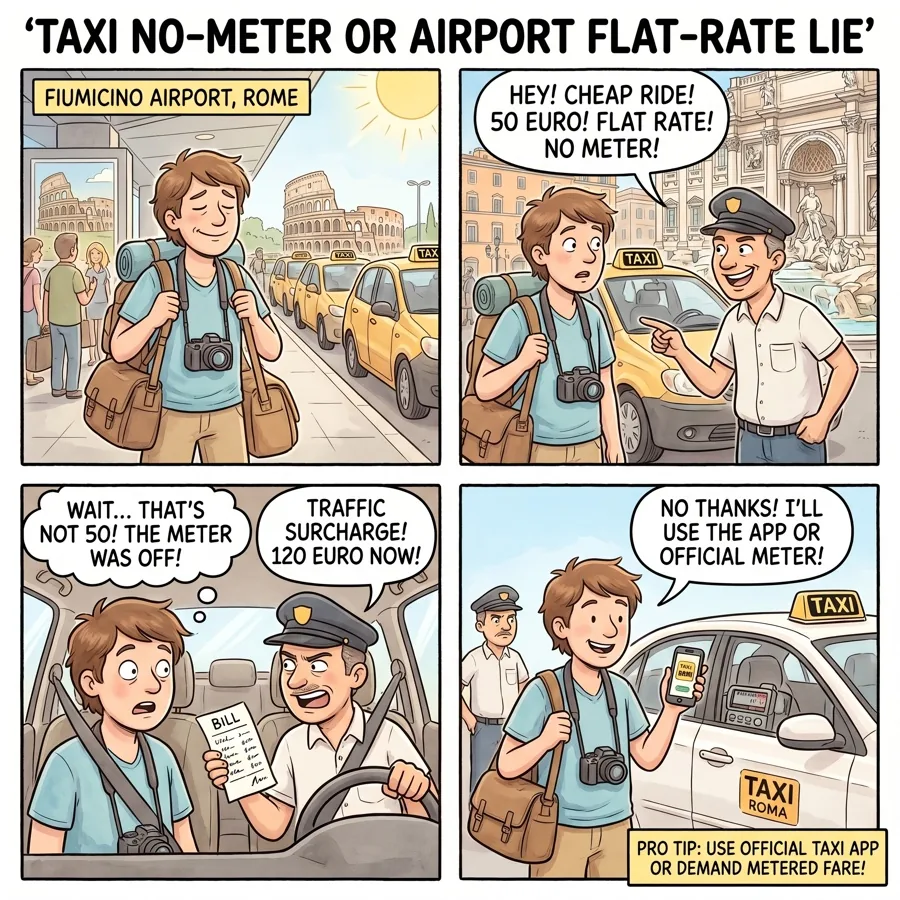
You step out of FCO's Terminal 3 arrivals at 11pm with two suitcases. The first taxi in the rank, a white Fiat with no roof light visible from your angle, opens its trunk before you have reached it. The driver loads your bags, asks the hotel ("Hotel Albergo, Trastevere?"), and quotes "ottanta euro, fixed." That is €80 flat, around $87 USD. The legal Comune di Roma flat rate from FCO to anywhere inside the Aurelian Walls is €50 (around $54), posted on a sign you cannot see because the rank is angled away from arrivals. He waits. Your bags are in his trunk. You hand him €80 and walk down €30 before you have even seen the Colosseum. The single phrase that ends the scene at the curb is "Tariffa fissa per il centro storico, per favore". The legal flat rate to the historic center, please. Drivers running this script retreat from informed riders; if he still refuses, walk to the next car. Inside the city Rome's licensed white taxis are legitimate, but the abusivi (unlicensed cars in similar livery) work hotel ranks and Termini Station. Demand the meter starts at €3.00 (daytime base) and refuse "rotto stasera" / "broken tonight" claims.
Read the full Rome scam guide →
You hail a white-and-black Cairo taxi outside the Egyptian Museum at 4pm and ask for the Marriott Zamalek across the river. The driver waves you in without starting the meter. Twenty minutes through Tahrir traffic the ride is normal: friendly small talk, music on the radio. At the hotel curb the meter never came on. He quotes 350 EGP (around $7) for what should be 80 EGP (around $1.60) by the meter, raises his voice when you reach for your wallet, gestures to the lobby and the doorman walking out. You are in front of your hotel. You hand over 350 and learn the lesson at a 270-EGP markup (around $5.50). The numbers feel small individually, but the same playbook runs ten times a day on the Corniche; cumulative tourist losses in Cairo run into the millions of dollars annually. White-and-black Cairo taxis legally must use the meter. Refusing it is the scam, and it works because the dispute lands at your hotel curb with witnesses you would rather not include. Al-Ahram Weekly and Daily News Egypt have covered the pattern continuously since 2014. The fix in 2026 is Uber or Careem; both operate legally citywide with locked app fares. If you need a street taxi, hail a moving car (never one waiting at a tourist rank), say "بالعداد من فضلك" ("bil-'addaad min fadlak", or "with the meter, please") before opening the door, and refuse the ride entirely if the driver refuses the meter.
Read the full Cairo scam guide →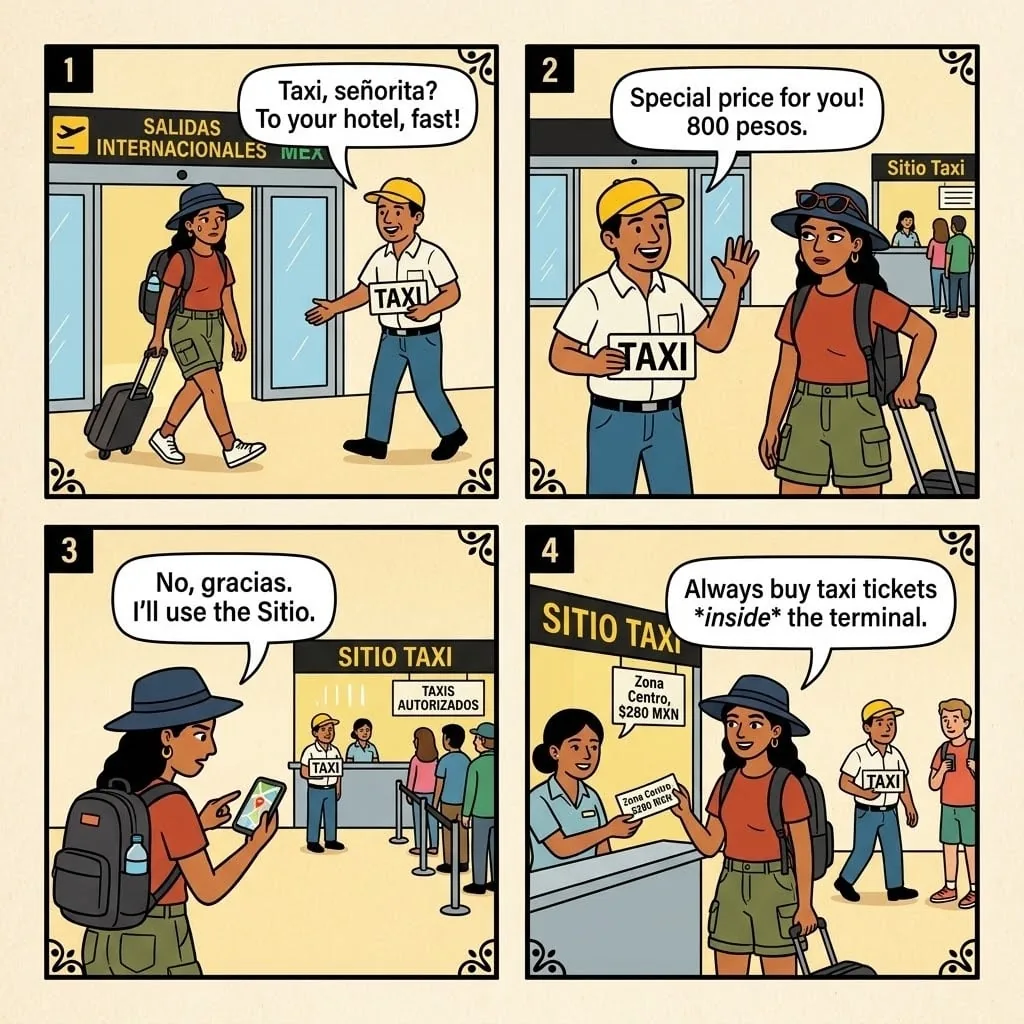
You walk out of MEX Terminal 2 arrivals at 10pm and three men in yellow-and-white uniforms holding clipboards labeled "Taxi Autorizado" intercept you between the customs exit and the official booth twenty feet away. They quote 750 pesos (around $44 USD) to Polanco. The booth twenty feet further on quotes 280 pesos (around $16). Both quotes use the same words, both uniforms look identical, and you have no way to tell the difference until you have already paid the wrong one. The official Mexico City Benito Juárez "Taxi Autorizado" service is a posted-rate, zone-based system sold only at booths inside the terminal. The booth gives you a paid voucher, you hand it to the driver outside, no money changes hands at the curb. Anyone selling you a ride before that booth is the scam. Buy at the booth inside; ignore everyone in the corridor. Uber and DiDi both operate legally from the designated rideshare zone outside Terminal 2 and are the default for Polanco, Roma, Condesa, and the historic center: typically 180 to 280 pesos (around $11 to $16) for the same ride.
Read the full Mexico City scam guide →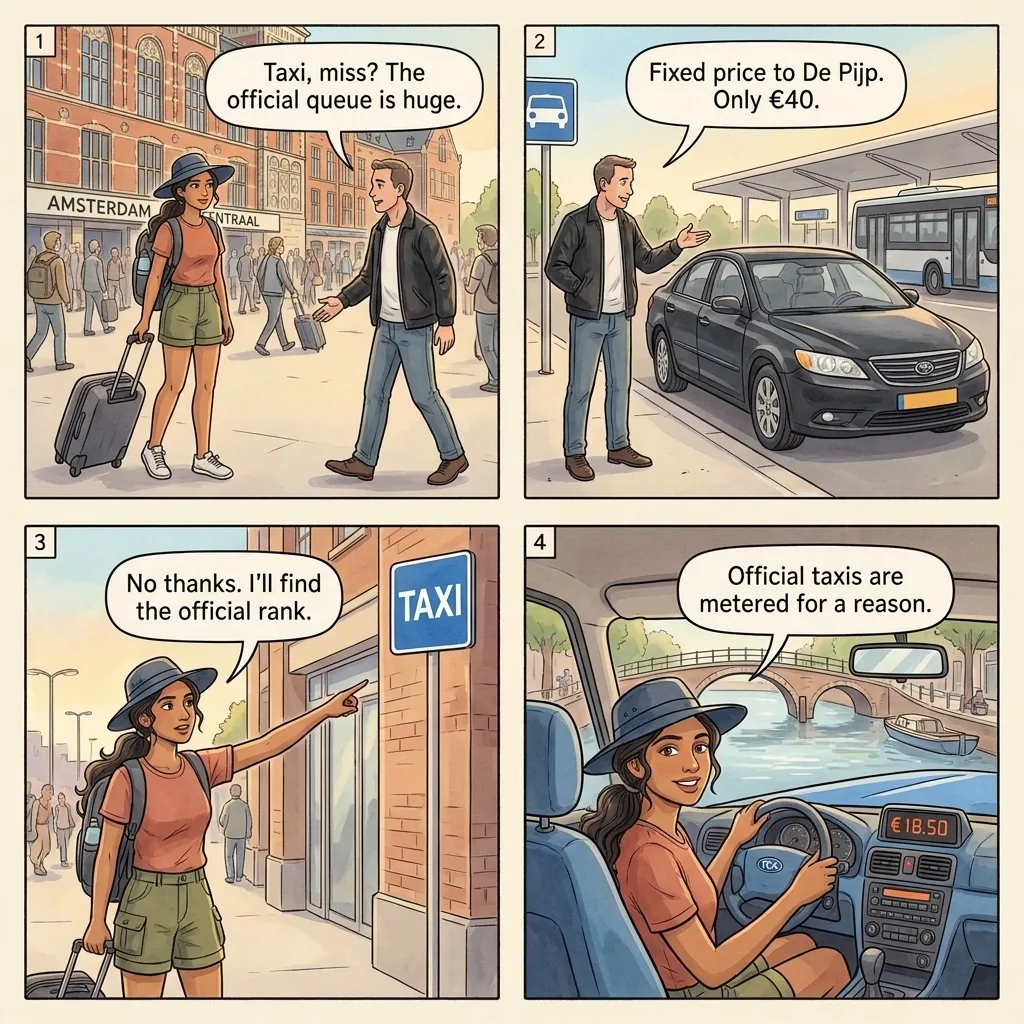
You step off the Schiphol airport train at Amsterdam Centraal at 9pm with a suitcase, walk out the front exit, and the first driver in the TCA taxi rank quotes €50 (around $54 USD) flat to your hotel in De Pijp, twenty minutes' walk south. The same ride metered runs €15 (around $16). The rank's reputation problem comes from a long-running cohort of drivers, referred to in the Dutch press as the "Centraal taxi gang," who quote inflated flat rates by default and only switch to the meter after you push back. The Amsterdam Taxi Centrum has flagged the rank repeatedly, and Het Parool ran a year-long investigation in 2023. Defense is simpler than confrontation: take the tram. Lines 1, 2, 5, 13, and 17 leave from Centraal directly outside and serve nearly every central hotel for €3.40 (around $3.70) with an OV-chipkaart (the Dutch transit smartcard you can buy at any station kiosk), no scam exposure. Or open Uber from inside the station before you walk to the rank. Amsterdam Uber is legal and runs €1.50/km flat. If you must use the rank, demand the meter (legally posted starting tariff: €3.19 plus €2.35/km) and refuse any flat-rate quote in writing.
Read the full Amsterdam scam guide →Red flags
If two or more of these signals show up in the first sixty seconds of a ride, get out at the next safe stop. The compounding rule: a single signal can be coincidence; two signals are a script.
- Driver flagged you down (rather than the other way around)
- No roof light, no company markings, no posted base tariff visible
- Meter doesn't start at the posted base, or doesn't start at all
- Meter climbs faster than streetlights pass on a steady-speed road
- Driver takes a "shortcut" that adds distance vs Google Maps
- Card reader "isn't working tonight" → cash demanded
- Driver refuses to print a printed receipt
- At payment: driver inspects your bill at length, frowns, "returns" a different one
- Driver drives off before you've finished counting your change
The phrases that shut it down
Memorize one phrase per country before you fly. Refusal works because it signals you know the script. Drivers running cloned meters retreat from informed riders.
If you got hit
You're standing in your hotel lobby. The taxi is gone. Your wallet is lighter and you feel stupid. Don't. The script is engineered to work on smart people: if it didn't, the drivers wouldn't keep running it. Here is what to do, in order, while it is still fresh.
Photograph the license plate now if the car is still in sight, even from a distance as he pulls away. Then file a report with the local tourist police within 24 hours. The report number is what your travel-insurance carrier needs to process a claim. Most major scam-prone destinations operate a dedicated tourist-police line:
- Buenos Aires: Comisaría Turística, Av. Corrientes 436. Phone +54 11 4346 5748 (24/7, English).
- Rome: Polizia di Stato emergency 112; tourist help line 06-46861.
- Bangkok: Tourist Police 1155 (24/7, English-speaking).
- Cairo: Tourist Police 126; tourism complaints +20 2-2391-2644.
- Mexico City: Policía Turística 55-5208-9898.
- Amsterdam: Politie non-emergency 0900-8844; taxi complaints via Inspectie Leefomgeving en Transport (ILT).
For credit-card duplicate charges (sub-variant 5), open a dispute with your issuer the same day. Most card networks reverse merchant-side double-charges within 7 to 10 business days when you provide the meter photo and the time-of-day mismatch. American Express in particular has a strong record on this category.
Bring three things to the report: a photo or recollection of the license plate, the approximate fare quoted vs the legal-tariff fare, and any payment evidence (receipt, card statement, screenshot of an app fare comparison). Even if the driver is never caught, the report puts your incident in the city's incident database. Cities track these. Buenos Aires arrested 47 cloned-meter drivers in 2024 from exactly this kind of paper trail.
Related atlas entries
Sister entries in the Scam Atlas. More entries shipping through Q2 2026; for now, browse the city-by-city archive.
Sources
- Clarín, "Tacheros estafadores: el modus operandi del taxi trucho en Buenos Aires" (continuing coverage, 2018–2025).
- La Repubblica, "Taxi abusivi a Roma e Fiumicino: la mappa delle truffe" (Rome, 2023).
- Le Parisien, "Faux taxis à Roissy: la nouvelle escroquerie qui cible les touristes" (CDG, 2024).
- Al-Ahram Weekly, multi-year coverage of Cairo Corniche meter-refusal pattern (2014–2024).
- Het Parool, "De TCA-rang op Centraal: hoe de prijzen ontsporen" (Amsterdam, 2023).
- Comisaría Turística de la Ciudad de Buenos Aires, annual incident reports, 2020–2025.
- Policía Federal Argentina, Operativo Tachero arrest data, 2024.
- Carabinieri Roma, abusivi enforcement bulletins, FCO and CIA, 2023–2025.
- r/travel, r/argentina, r/BuenosAires, r/rome, r/egypt, r/mexicocity — continuing thread monitoring 2023–2026.
Get the full taxi playbook for your destination.
Each Travel Safety atlas covers every documented scam in one country: the taxi script you just read, plus 50 to 100 more, with the exact local-language phrases that shut each one down. Buy once, lifetime updates as scams evolve. $4.99 on Kindle.