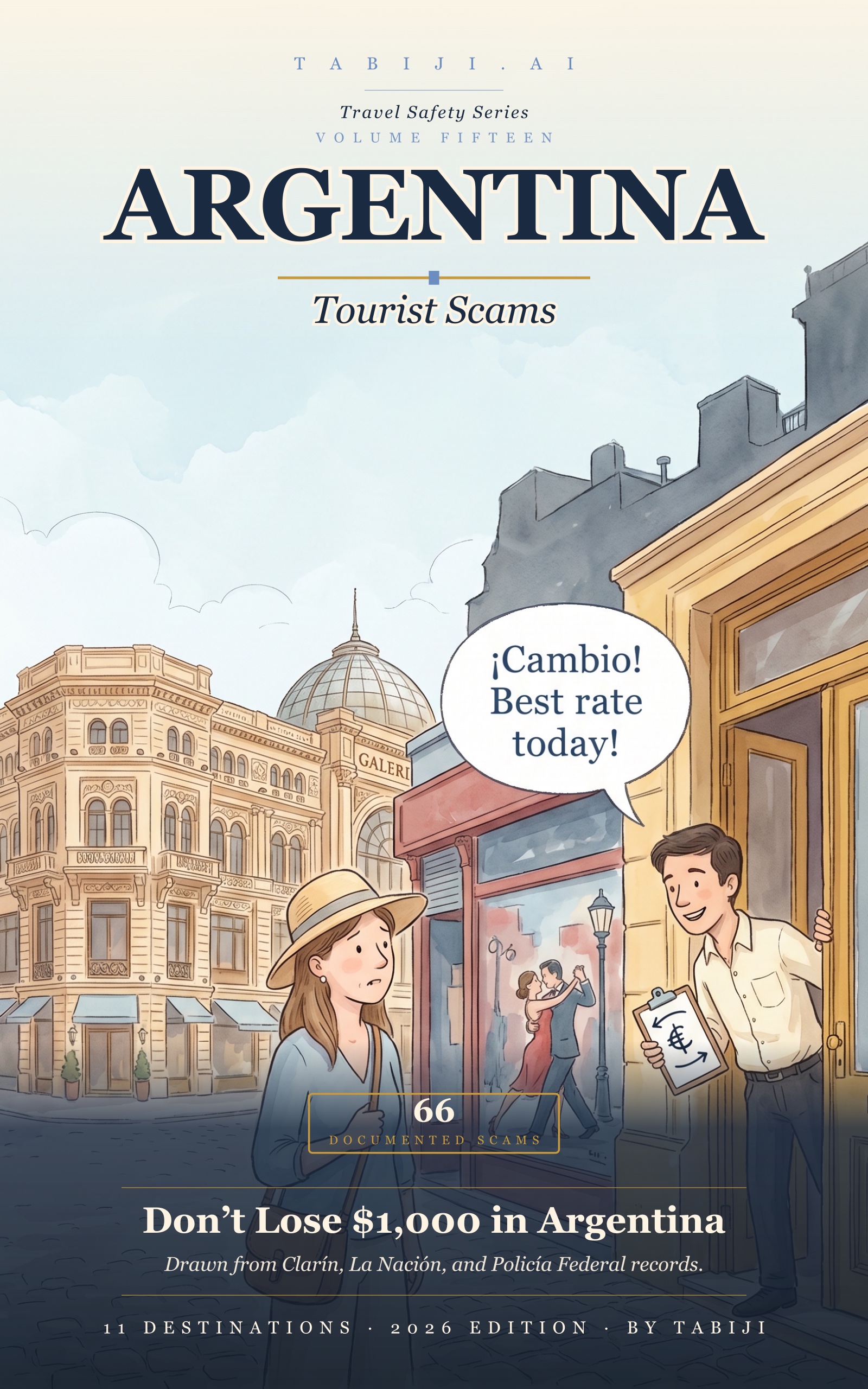
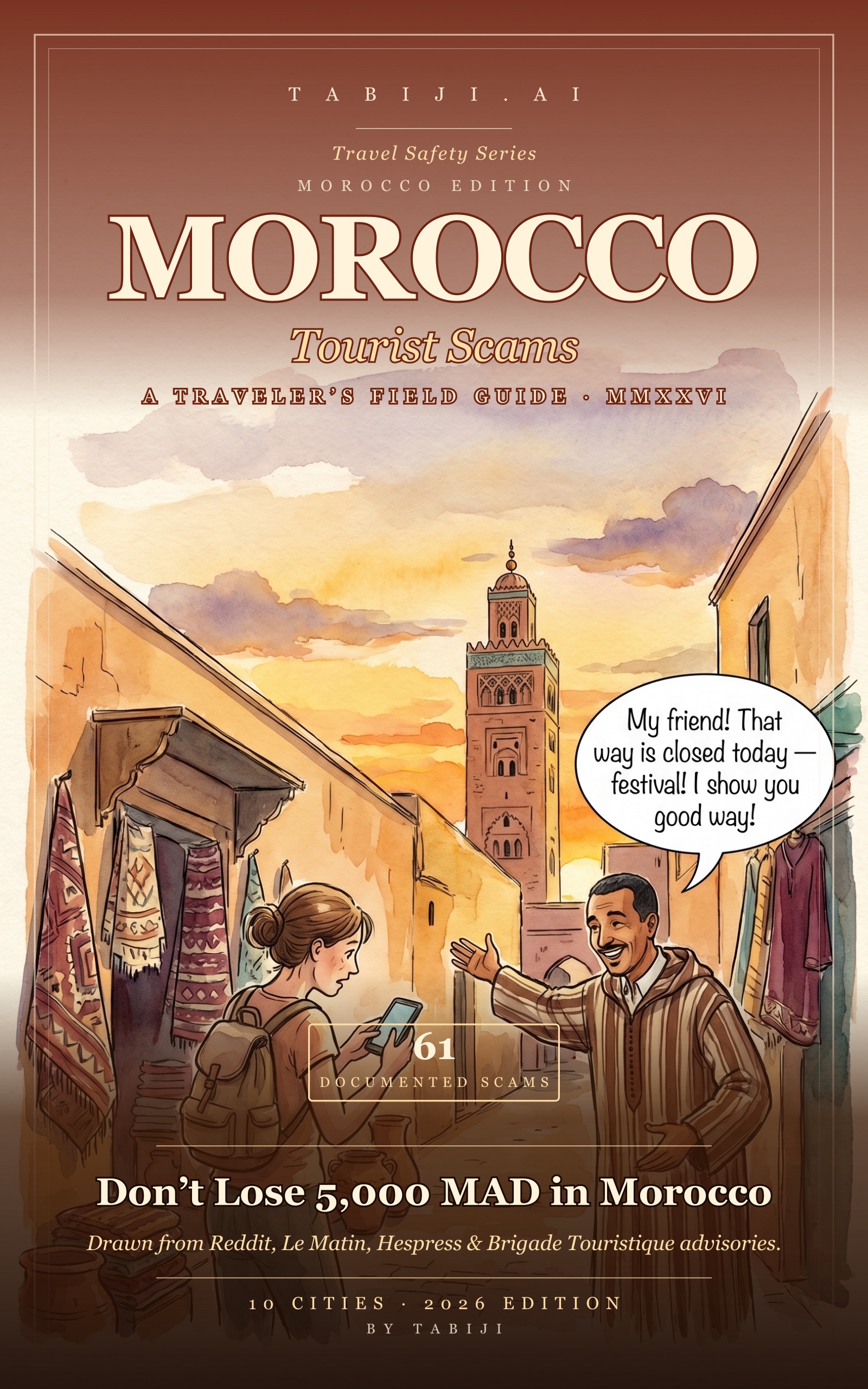
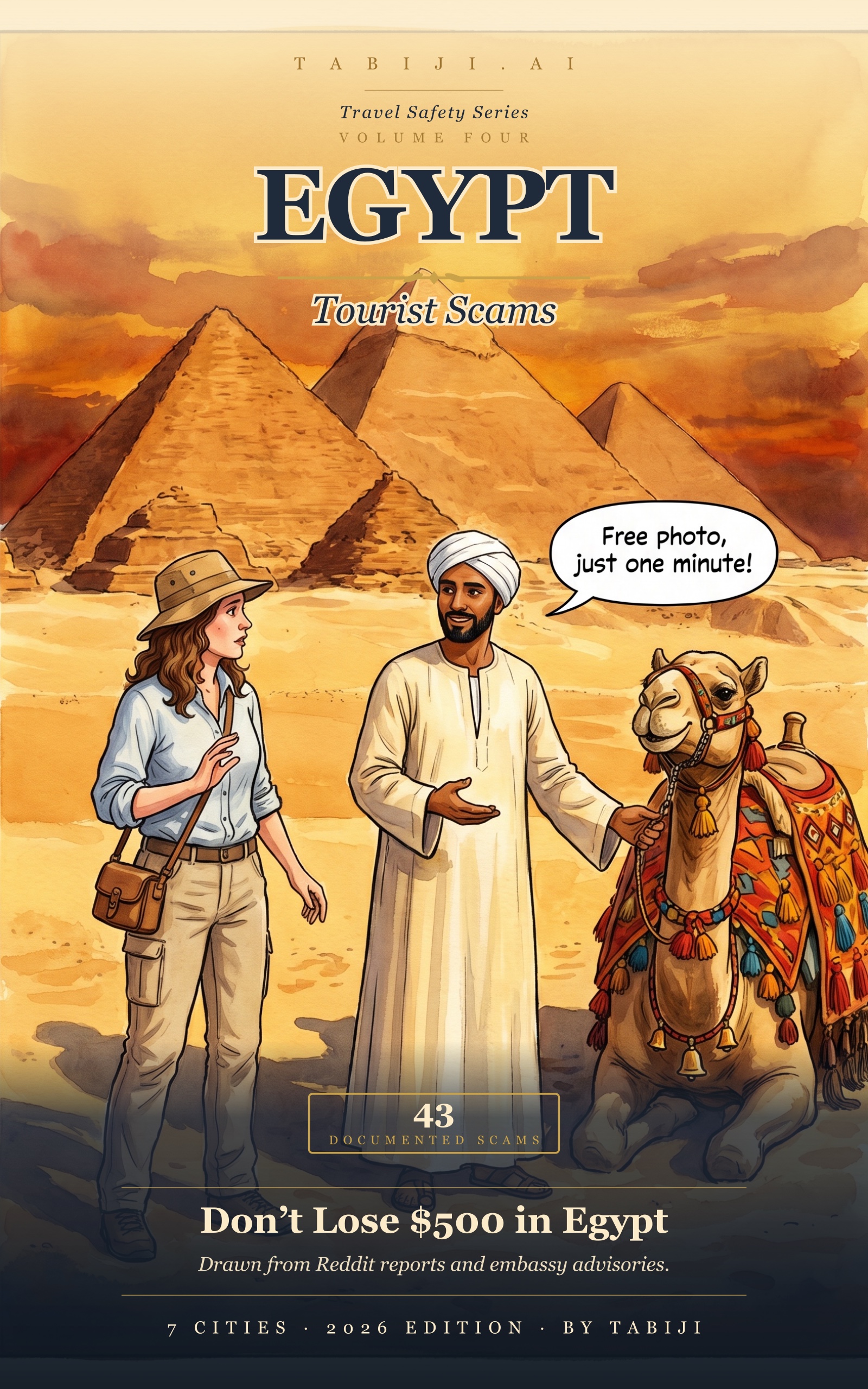
The clean bill in, the counterfeit out.
One scam family. Four sub-variants. Across Argentina, Morocco, Egypt, Vietnam, and Mexico. Drawn from r/argentina, r/Morocco, and r/travel field reports, BCRA counterfeit-banknote hotline records, Comisaría Turística incident logs, and a year of city-by-city research. The taxi bill swap. The Florida Avenue cambio counterfeit-mix. The small-shop change padding. And the local-language phrases that shut each one down before the bill leaves your hand.

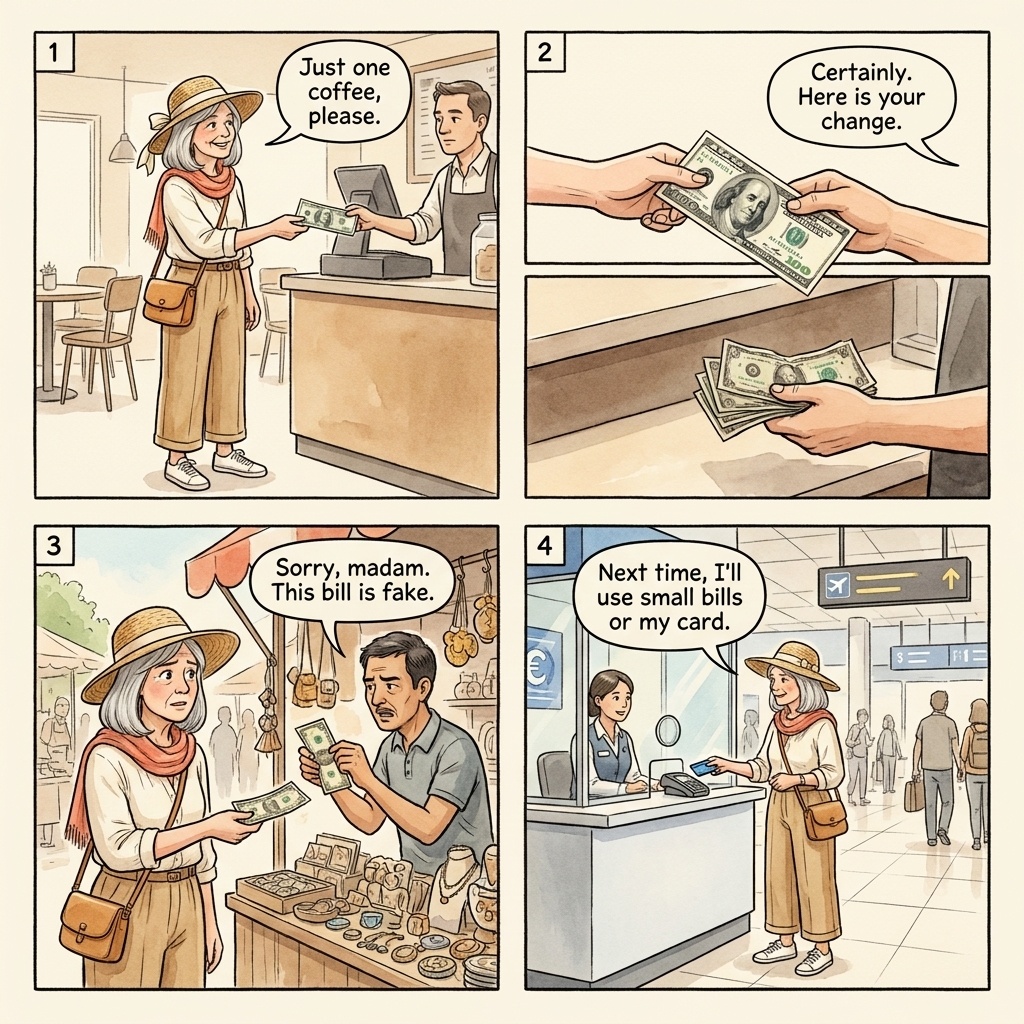
Counterfeit currency returned as change runs in eight countries across at least fourteen documented variants. Four sub-types account for nearly every reported case. Taxi bill swaps, where the driver palms your clean note, produces a counterfeit, and demands a real replacement (Buenos Aires, Mexico City, Cairo). Small-shop change padding, where one or two counterfeit notes are mixed into the change after a large-denomination purchase (Hanoi, Cairo, Buenos Aires). Cambio counterfeit-mix, where street money changers in Buenos Aires's Florida Avenue, Mendoza's Peatonal Sarmiento, the Tangier ferry exit, and the Casablanca Bab Marrakech medina fan the bills quickly during the count and slip in counterfeits or discontinued notes (Argentina, Morocco). And private-ATM counterfeit dispense, where standalone ATMs in pharmacies and mini-markets load drawers with mixed-quality cash. The defense is the same in every country: pay with small bills matched to the price, count change in front of the cashier in daylight, check watermarks and tactile relief on every high-denomination note, and use Western Union or major-bank ATMs instead of street cambio.
"¡Cambio, cambio! Best rate today, my friend."
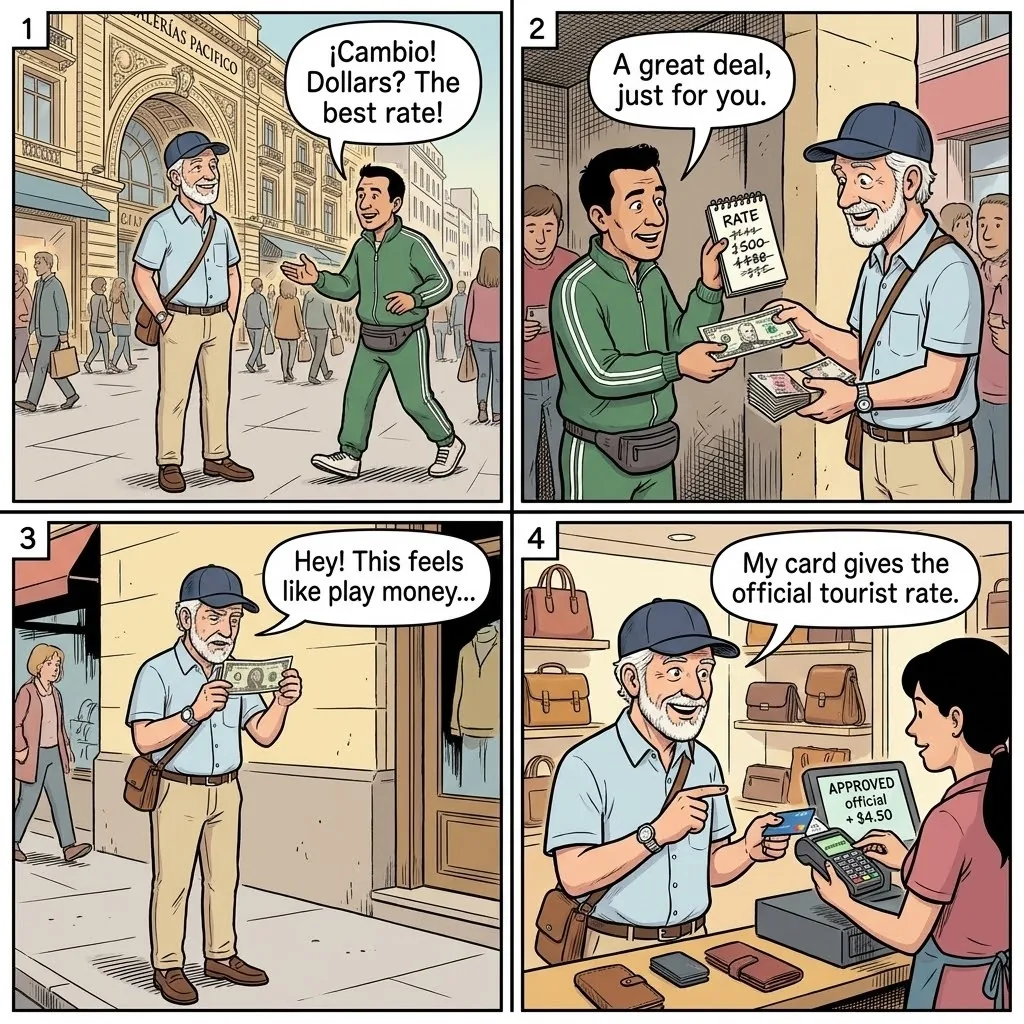
You walk Calle Florida between Plaza de Mayo and Plaza San Martín on a sunny Tuesday afternoon, browsing the leather stalls and the artisan kiosks. Within two blocks the chant starts from every doorway — "¡Cambio, cambio! Dollar, euro!" — and the arbolitos ("little trees") rotate every ten meters along the pedestrian strip. One steps in front of you with a small calculator: "1,200 per dollar today, my friend, best rate in Buenos Aires." It is slightly above what your hotel quoted yesterday, so you slow down for a second look. That is the whole game.
He waves you toward an upstairs "cueva" off Florida 165 or a doorway on Lavalle, past a closed clothing-store entrance, up a narrow stairwell, into a back office with a metal grille and a man behind a desk. The rate quoted on the street has now dropped to 1,050. "Exchange-rate moved in the last hour, my friend." You are already there. You hand over $200 USD; he counts back a stack of 1,000- and 2,000-peso notes too quickly to follow, the top three crisp, the next five suspiciously flat, and one more from a separate envelope. By the time you step back onto the sidewalk and stop in a café to re-count, the math is short by $20 and three of the bills do not pass the watermark check against the window.
The Argentine peso landscape changed under the 2024–2025 Milei reforms — the informal "blue dollar" rate has collapsed to or below the legal Western Union pickup rate, which means the historic upside that made street cambio worth the risk no longer exists. Skip the touts entirely and walk to a Western Union branch (Plaza San Martín, Retiro, or any of 40+ city locations) — you will get a legal peso pickup at a rate that matches or beats blue, with zero counterfeit risk. r/argentina threads tracking the post-reform peso landscape note the same pattern: the people still working Florida know the arbitrage is gone, which is exactly why they are leaning harder on counterfeit bills and short counts to make the day.
That is the Buenos Aires variant of one global script. The rest of this page is what just happened to you, why it works, and the exact phrases (in Spanish, French, Arabic, Vietnamese, and Italian) that shut it down before the next bill leaves your hand.
Read the full Buenos Aires scam guide →Key Takeaways
The universal mechanism
The bill that leaves your hand is the load-bearing element. Every variant of the counterfeit-currency-as-change scam rides the same five-step social engineering. The taxi driver, the cambio tout, the small-shop cashier, and the private-ATM operator are all betting on the same window — the few seconds between the bill leaving your hand and you noticing the swap. Recognize the pattern and the local accent becomes obvious thirty seconds in.
- You arrive needing change for a large note. The 1,000-peso ride, the 200-dirham ferry-exit exchange, the 100,000-dong taxi from Noi Bai, the 200-pound Cairo souk purchase. The taxi driver, the cambio tout, the market vendor, or the small-shop cashier knows you do not have exact change and that you are mildly disoriented after a flight, a long walk, or a bus ride. The first 30 seconds tell you everything.
- The handoff happens out of your sightline. The driver takes your 1,000-peso note "to break it for change" and turns half away. The cambio fans the bills with a thumb-flick that is hard to follow. The market cashier slips your note under the counter into a drawer with a divider. The bill leaves your hand and re-enters as a different bill, sometimes literally a counterfeit from a sleeve, sometimes a discontinued or worn-out note no bank will accept. The handoff is the load-bearing element. If the bill goes out of sight, the swap is already underway.
- The accusation lands first, before you can examine. "This is fake, my friend. Look at the watermark, you gave me a counterfeit. I need a real one." Or in the small-shop variant, the change comes back with one or two flat, papery notes mixed in among the crisp ones, fanned out so quickly you cannot count. The driver's posture is mildly aggrieved, which is the clue: he is selling the lie. The bill in his hand is the counterfeit; the bill you handed over is in his sleeve. The accusation is the tell. A real cashier never opens with one.
- The pressure compresses your time horizon. The taxi meter is still running. The cambio's back-room door is closing. The market vendor is already gesturing the next customer forward. You have thirty seconds to either accept the loss, escalate publicly in a language you barely speak, or pay again with a second clean bill. Most travelers, exhausted and embarrassed, calculating that the loss is still smaller than the friction, pay again. That compression is what the script is engineered to produce.
- The paper trail dissolves on contact. Street currency exchange is illegal in Morocco — if you are scammed at the Tangier ferry exit you cannot file a clean police report without admitting to the illegal transaction. The taxi driver vanishes from a 1,000-peso ride untraceable. The market vendor disclaims any memory of the transaction the moment you return with the receipt. The Comisaría Turística in Buenos Aires accepts reports and the BCRA hotline at 0800-999-6663 logs counterfeit serial numbers, but recovery is slow and most travelers eat the loss. That is why the script keeps working.
The four sub-variants
Different countries lean on different points in the bill's path within the same family. Here are the four documented globally. Recognize the script in 30 seconds and you can shut it down before the bill leaves your hand.
1. The Taxi Bill Swap
You hand the driver a 1,000-peso note for a 700-peso fare. He turns half away to "break it" and produces a different note from a sleeve. "This is counterfeit, my friend; you owe me 700 in real money." The bill in his hand is the counterfeit; the bill you handed over is in his sleeve. r/BuenosAires and Comisaría Turística incident logs document the same routine across all three variants of the BA taxi mafia.
What it feels like: a mildly aggrieved driver doing you a favor by pointing out the "fake" bill, which is the script.
Most reported in: Buenos Aires street taxis (Microcentro, Recoleta, San Telmo), Mexico City Sitio cabs, Cairo no-meter taxis from Tahrir Square.
2. The Small-Shop Change Padding
You buy a 50-peso coffee and pay with a 1,000-peso note. The change comes back fanned across the counter: eight or nine notes, two or three of them subtly flat or papery. By the time you have walked out and unpacked the stack, three of the larger denominations do not pass the watermark check. The shop denies all memory of the transaction the moment you return.
What it feels like: a busy cashier moving fast, change handed over too quickly to count, and a queue behind you that pressures you to pocket and go.
Most reported in: Buenos Aires Microcentro kiosks, Hanoi Old Quarter convenience shops, Cairo Khan el-Khalili souk stalls, Marrakech medina stalls.
3. The Cambio Counterfeit-Mix
A street tout calls a rate above the bank's posted rate and waves you toward an upstairs cueva, a back-room bureau, or a curbside handoff at the ferry exit. The rate quoted on the street drops once you commit; the bills are fanned with a thumb-flick that is hard to follow; one or two counterfeit or discontinued notes are mixed into the stack mid-fan. r/Morocco and r/argentina threads document the pattern. Street currency exchange is illegal in Morocco, which is the second layer of the trap.
What it feels like: a generous opening rate, a back-room "negotiation," and a fast count where the bills blur together.
Most reported in: Buenos Aires Calle Florida, Mendoza Peatonal Sarmiento, Tangier ferry exit, Casablanca Bab Marrakech, Marrakech Grand Socco.
4. The Private-ATM Counterfeit Dispense
Standalone ATMs in pharmacies, mini-markets, hotel lobbies, and gift shops are loaded by their operators rather than a major bank's cash-handling division. A small percentage of the dispensed notes are counterfeits or discontinued bills mixed in among the genuine ones. The withdrawal receipt is real; the bills are mixed-quality. Argentine BCRA bulletins flag the standalone-ATM channel as a primary counterfeit-distribution route.
What it feels like: a convenient ATM at exactly the right moment, with no line and a slightly faster transaction time than a bank ATM, in a tourist-heavy zone.
Defense: use only major-bank ATMs at branch lobbies: Banco Nación, Santander, BBVA, HSBC, Galicia, Macro in Argentina; Attijariwafa, BMCE, Banque Populaire in Morocco; Vietcombank or BIDV in Vietnam.
Where it runs
Counterfeit currency returned as change concentrates in countries with high inflation, large-denomination notes that are easy to fake, and informal currency-exchange economies. Argentina, Morocco, and Egypt account for two-thirds of documented variants. The eight countries below cover nearly every case in our archive.
| Country | Documented variants | Iconic city pattern |
|---|---|---|
| 🇦🇷 Argentina | 5 | Buenos Aires Calle Florida cambio counterfeit-mix · Microcentro taxi bill swap · Mendoza Peatonal Sarmiento cueva |
| 🇲🇦 Morocco | 3 | Tangier ferry-exit street exchange · Casablanca airport "Global Exchange" + Bab Marrakech medina · Marrakech Grand Socco |
| 🇪🇬 Egypt | 2 | Cairo Khan el-Khalili souk small-shop change padding · Tahrir Square no-meter taxi bill swap |
| 🇻🇳 Vietnam | 1 | Hanoi Old Quarter copycat-livery taxi meter+swap · Bui Vien district small-shop change padding |
| 🇲🇽 Mexico | 1 | Mexico City Sitio cab bill swap on 500- and 1,000-peso notes |
| 🇮🇹 Italy | 1 | Rome Termini and Naples Piazza Garibaldi taxi 50-euro short-count swap |
| 🇹🇷 Turkey | 1 | Istanbul Sultanahmet street cambio counterfeit lira slip on 100- and 200-TL notes |
| 🇮🇩 Indonesia | 1 | Bali Kuta money-changer "no commission" booth short-count and discontinued-rupiah swap |
Bar width is data-bound at 24 pixels per documented variant. Argentina, Morocco, and Egypt together account for 10 of 14 total variants, or roughly two-thirds of the global atlas.
Four more cities, four more variants
The Buenos Aires Florida Avenue scene above showed the canonical cambio counterfeit-mix. Here are four more cities where the same mechanism plays out with regional accents: Buenos Aires (counterfeit pesos returned as change), Mendoza (Peatonal Sarmiento cambio), Tangier (ferry-exit street exchange), and Casablanca (airport rip-off + Bab Marrakech). Each links to the full city scam guide.
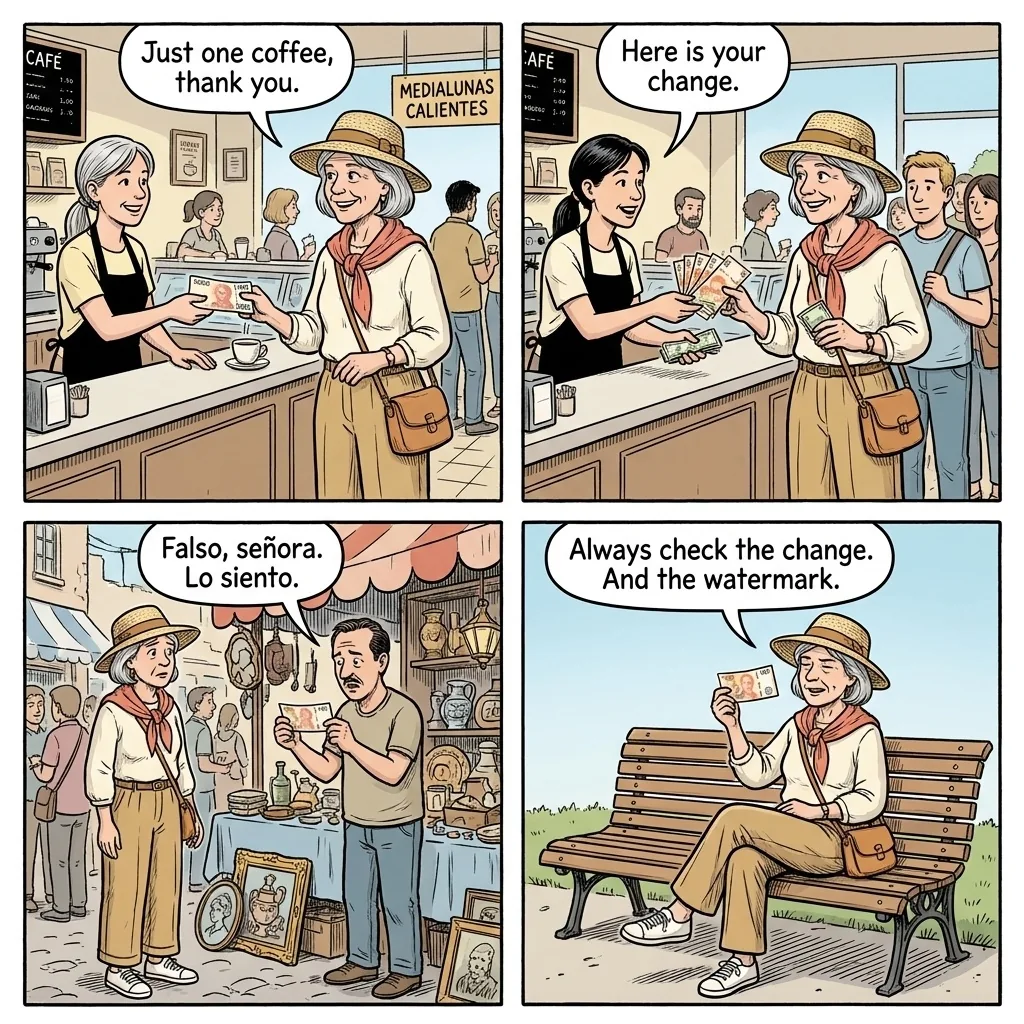
You buy a 250-peso medialuna and two cortados at a Microcentro café on Avenida de Mayo and pay with a 10,000-peso note because the morning's Western Union pickup gave you nothing smaller. The cashier (busy, brusque, a queue of porteños behind you) fans the change across the counter — eight or nine notes, plus coins, handed over in the time it takes you to pocket your wallet. You step outside, walk three blocks to Plaza de Mayo, and only then pull out the stack to count it. Three of the larger denominations — two 2,000-peso Carrillo–Grierson notes and one 1,000-peso Rosas — feel flat and papery in your fingers, miss the tactile relief on the portrait, and fail the watermark check against the Casa Rosada in the morning sun. The change-padding play depends on exactly that delay. The 2024 introduction of the 20,000-peso bill widened the surface area; counterfeit rates on 1,000- and 2,000-peso notes are elevated enough that the BCRA hotline at 0800-999-6663 maintains a public serial-number register. The Comisaría Turística at Av. Corrientes 436 in Buenos Aires (+54 11 4346 5748, 24/7 with English-speaking officers) accepts in-person reports. Defense, per r/argentina: pay with cards on transactions over ARS 5,000, withdraw only at major-bank ATMs (Banco Nación, Santander, BBVA, HSBC, Galicia, Macro) at branch lobbies, and if you must pay cash for a coffee, hand over the smallest bill you have and count change in front of the cashier in daylight before you walk away.
Read the full Buenos Aires scam guide →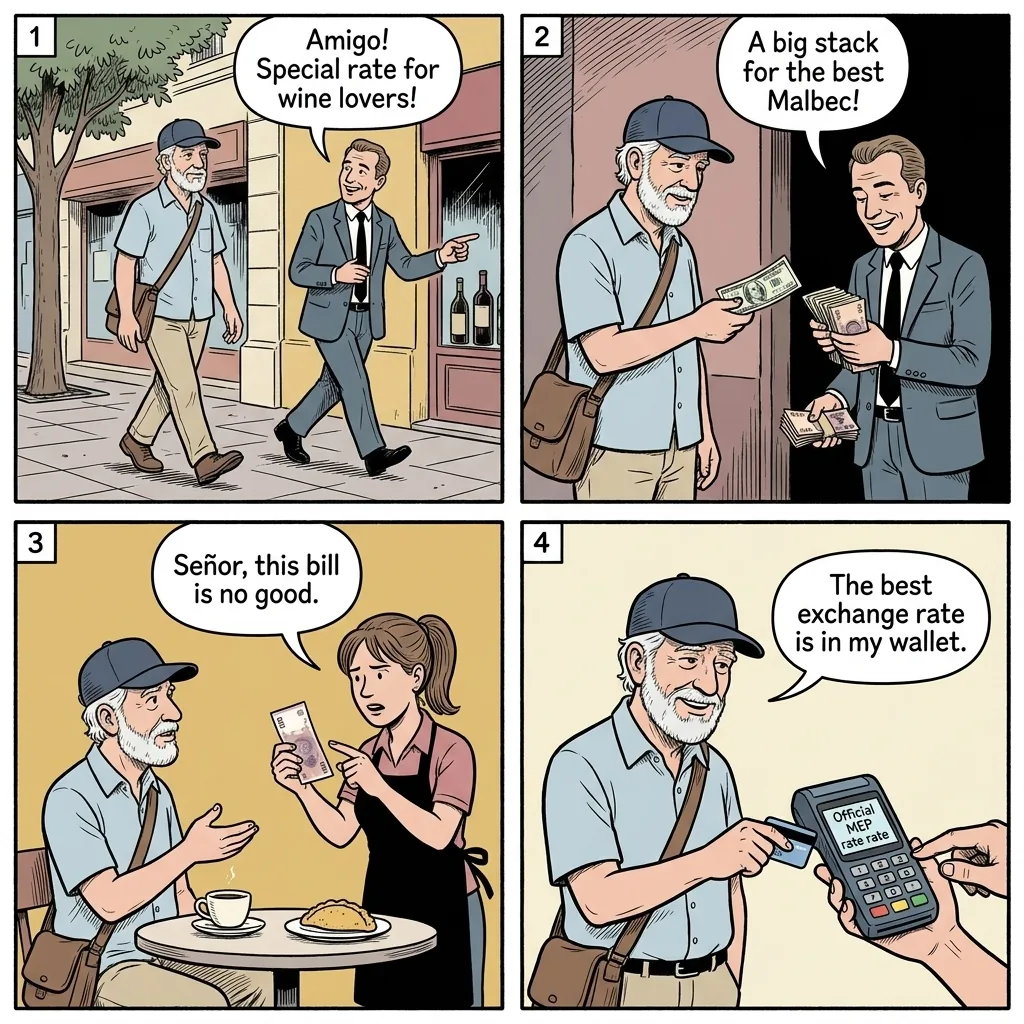
You walk Peatonal Sarmiento from Plaza Independencia toward Av. San Martín on a wine-tour rest day, browsing the artisan stalls. A man in a baseball cap steps off a doorway as you pass and falls in beside you. "Cambio, dollar, special Mendoza rate today, one thousand one hundred fifty per dollar — best rate in the city." His phone is open to a calculator app showing the math. The street is busy with tourists; he does not look out of place. The Mendoza cambio scene runs the same script as Buenos Aires's Florida Avenue, and like Florida, the underlying economics changed under the 2024–2025 Milei reforms — the informal "blue dollar" rate that historically beat the official rate by 30–50% has collapsed to within a few percent of the legal rate, and at Western Union you can get the same legal rate with no counterfeit risk. The street touts know this, so they pad the harm by mixing one or two counterfeit 1,000- or 2,000-peso notes into your stack of change, by quoting one rate on the street and dropping it once you commit upstairs to a "cueva," or by routing you to an upper-floor exchange office that turns into a robbery setup. The defense is to walk past every Peatonal Sarmiento "cambio" approach with a "no gracias", and to use Western Union at Av. Sarmiento 228 (the Mendoza main branch, plus three other city locations) for any USD-to-peso pickup, since the 2025 legal rate matches or beats whatever the touts are quoting and carries zero counterfeit risk. r/argentina has a pinned 2025 thread on the post-Milei cambio collapse with the same advice.
Read the full Mendoza scam guide →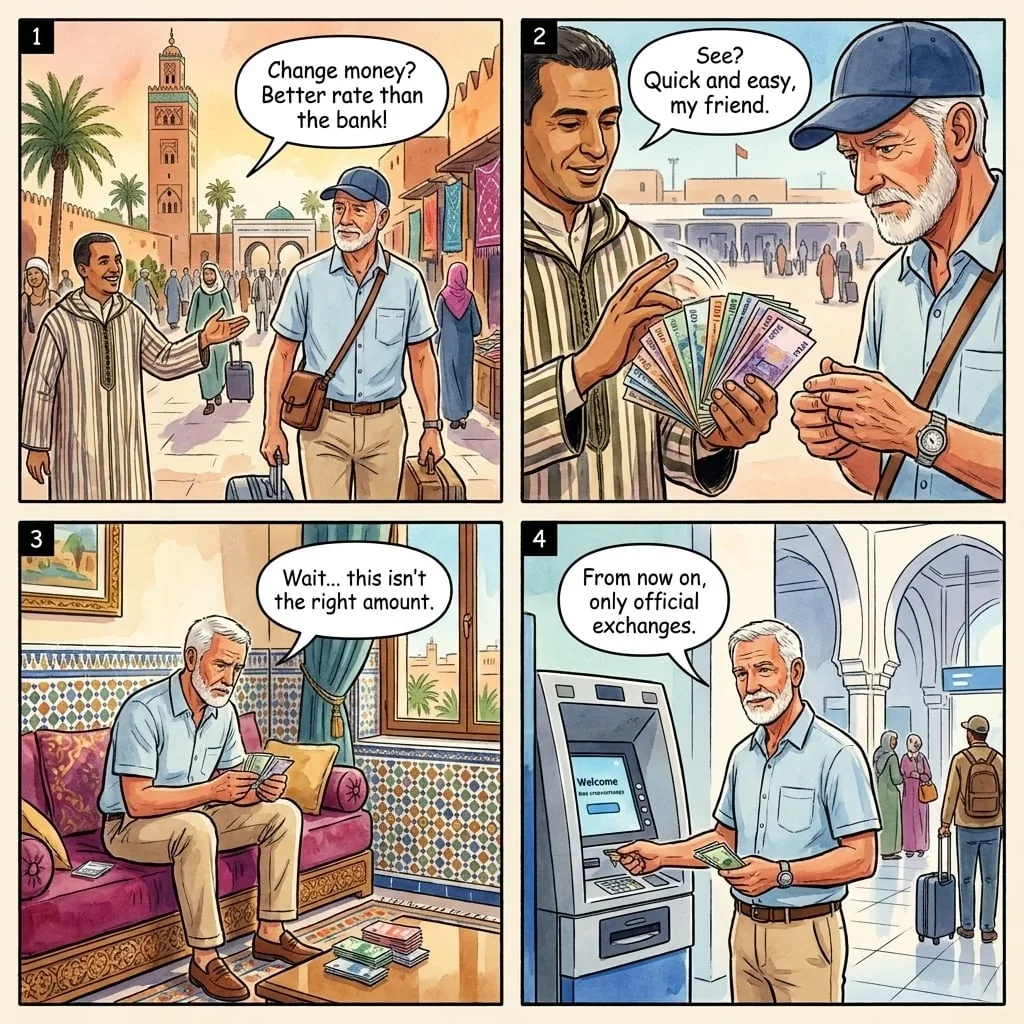
You walk out of the Tangier ferry terminal with a wallet of euros from Spain when a man on the curb says "change money? Better rate than the bank, my friend." His rate is 1 EUR = 11.5 MAD when the live mid-market is 10.8 (generous on paper). You agree, hand him 100 euros, and he counts out 1,150 MAD in front of you, fanning the notes with a thumb-flick that is hard to follow. Back at the hotel you re-count and the stack is 800–950 MAD. The fan was sleight of hand; he palmed two or three of the larger notes during the count, and some operators go further by mixing in counterfeit 200-MAD notes (Moroccan dirham counterfeits are common enough that legitimate banks will not accept disputed notes) or older discontinued bills no one will take. r/Morocco threads and the Journal of Nomads' Tangier guide both document the pattern at the ferry exit, around the Grand Socco, and along Rue de la Liberté. Street currency exchange is also illegal in Morocco, which is the second layer of the trap — if you are scammed, you cannot cleanly file a police report without admitting to an illegal exchange. Licensed bureaux de change post fixed rates with no commission, and Moroccan bank ATMs (Attijariwafa, BMCE, Banque Populaire) at the ferry terminal give the cleanest interbank rate. The defense is to skip the curb and walk into the ferry terminal's bank ATM, withdraw 1,500–2,500 MAD directly with your home card and you are done; the curb-side rate is always either a scam or illegal or both.
Read the full Tangier scam guide →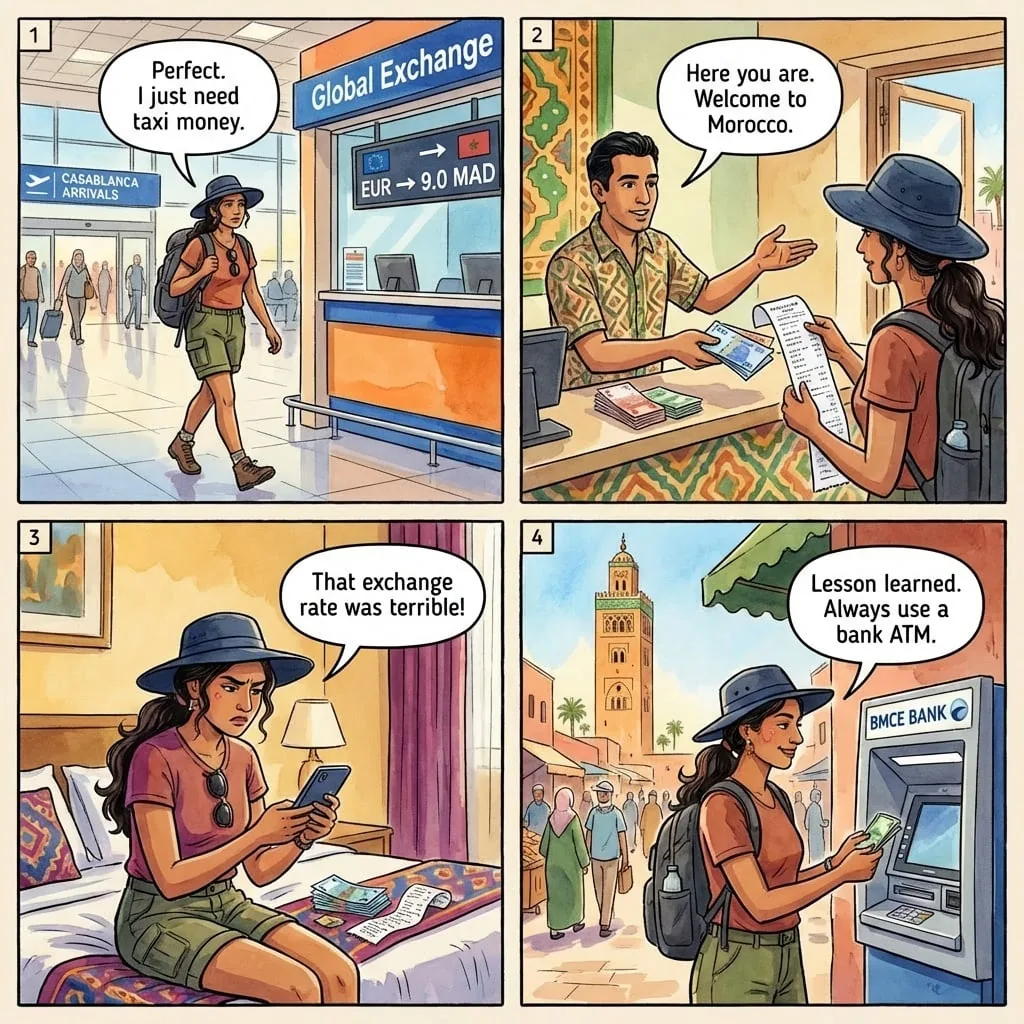
You exit Casablanca's Mohammed V Airport at the arrivals hall and head for the bright Global Exchange counter: the rate posted on the board says "1 EUR = 9.5 MAD." You hand over 250 euros and walk away with a stack of 200- and 100-dirham notes plus a printed receipt. Back at the hotel you check XE on your phone and the live mid-market is 10.8 MAD per euro. You did the math: at the actual rate you should have walked away with about 2,160 MAD; you got roughly 1,460. The booth pocketed close to 700 MAD on a single transaction. r/Morocco's "Scammed by Global Exchange at Casablanca Airport" thread documents the exact pattern, and a parallel TripAdvisor warning thread "Don't use Global Exchange at Marrakech Airport!" shows the same operator running the same play at every Moroccan airport. The receipt buries a "commission" line that erases another 3–5% on top of the spread. Outside the airport, the street money changers near the Old Medina at Bab Marrakech offer tempting rates but commonly palm off counterfeit or discontinued dirham notes, or use sleight-of-hand counting to shortchange tourists who do not re-count in front of them. The defense is to skip every airport exchange counter, walk to the nearest ATM in the arrivals hall, and withdraw 1,500–2,000 MAD directly from a major Moroccan bank's ATM (Attijariwafa, BMCE, or Banque Populaire); the rate is interbank plus your home bank's foreign-transaction fee, which beats Global Exchange by 15–20% every time, and Bab Marrakech change is not your problem.
Read the full Casablanca scam guide →Red flags
If two or more of these signals show up at the moment of payment or at the cambio handoff, stop the transaction and re-count. The compounding rule: a single signal can be coincidence; two signals are a script.
- A street tout calls a rate above the bank's posted rate ("¡cambio!" on Florida or Sarmiento; "change money?" at the Tangier ferry exit)
- The exchange happens in an upstairs cueva, a back office, or a curbside handoff rather than a licensed bureau de change
- The cashier or driver fans the bills with a thumb-flick that is hard to follow, or counts faster than you can match
- The rate quoted on the street drops once you commit and step inside
- A taxi driver turns half away to "break" your large note and then accuses you of paying with a counterfeit
- The change includes one or two flat, papery notes mixed in among crisp ones, failing the tactile-relief test on the portrait
- The bill fails the watermark check when held up to the light, or the color-shifting denomination does not shift
- A standalone ATM in a pharmacy, mini-market, hotel lobby, or gift shop dispenses without your home bank's network logo
- The cashier refuses to provide a printed receipt, or hand-writes the receipt in a way that obscures denominations
The phrases that shut it down
Memorize one phrase per country before you fly. Refusal works because it signals you know the script. Touts running the cambio line and drivers running the bill swap retreat from informed travelers; the phrase tells them you have read this page.
If you got hit
You're back at your hotel. Three of the bills in your wallet do not pass the watermark check, the cambio shorted you by 700 dirham, or the taxi driver palmed your 1,000-peso note and you handed him a second one to keep the peace. Don't beat yourself up. The script is engineered to work on smart, traveled, well-prepared people. If it weren't, the touts wouldn't be standing on Calle Florida every afternoon. Here is what to do, in order, while it is still fresh.
Photograph every disputed note on a flat surface, showing the serial number clearly. Photograph the receipt if you have one; photograph the cashier counter or taxi license plate if you can find it on Google Maps Street View. Note the time of the transaction. Then call the local tourist police within 24 hours — the report number is what your travel-insurance carrier and your card issuer need to process a claim. Most cities in this atlas operate a dedicated tourist-police line:
- Buenos Aires: Comisaría Turística at Av. Corrientes 436, +54 11 4346 5748 (24/7, English-speaking). For counterfeit-banknote reports, BCRA hotline 0800-999-6663 logs serial numbers in the public counterfeit register.
- Mendoza: Policía de Mendoza emergency 911. Western Union main branch at Av. Sarmiento 228 will replace counterfeit notes received from a recent legitimate pickup if you return within 48 hours with the original receipt.
- Tangier: Brigade Touristique (blue uniforms) work the Petit Socco and the ferry terminal area; police emergency 19. Note that street currency exchange is illegal in Morocco; file the report carefully.
- Casablanca: Royal Gendarmerie 177; Tourist Police +212 22 22 41 53. Report Global Exchange and similar airport-counter rate disputes to ONMT (Office National Marocain du Tourisme) +212 537 27 83 00.
- Cairo / Aswan: Egyptian Tourist Police 126; tourism complaints hotline +20 2-2391-2644. The Comisaría Turística in Cairo accepts in-person reports near Tahrir Square.
- Hanoi: Tourist Police at 46 Ly Thuong Kiet, +84 24 3822 2148 (within 24 hours for insurance documentation). Ho Chi Minh City Tourist Police +84 28 3838 2990.
For credit-card disputes on cambio or taxi-related counterfeit losses, open a dispute with your issuer the same day. Most major card networks recognize the bill-swap pattern and reverse charges when you submit a tourist-police report number plus a photo of the disputed bills. American Express has the strongest record on this category; Visa and Mastercard reverse roughly 60% of well-documented cases within 30 days. The window is short: file within 60 days of the charge, ideally within seven.
Bring three things to the report: the disputed bills (do not destroy them), a photo of every serial number, and the receipt or transaction record (cambio printed slip, taxi receipt, ATM withdrawal slip). Even when individual recovery fails, the report puts the serial numbers into the city's counterfeit register. The BCRA in Argentina, Bank Al-Maghrib in Morocco, and the State Bank of Vietnam all track suspect serial-number ranges, and reported counterfeits sometimes match clusters under active investigation.
Related atlas entries
Sister entries in the Scam Atlas. More entries shipping through Q2 2026; for now, browse the city-by-city archive.
Sources
- Clarín, continuing coverage of counterfeit peso circulation and BCRA serial-number register (2023–2025).
- La Nación, "Cómo reconocer un billete falso de 1.000 y 2.000 pesos" (2024, with the 20,000-peso introduction follow-up).
- Infobae, "Florida y la cueva: cómo opera la trampa del 'arbolito' en 2025" (2025).
- Banco Central de la República Argentina (BCRA), counterfeit-banknote hotline records and public serial-number register, 0800-999-6663.
- Comisaría Turística (Buenos Aires) at Av. Corrientes 436, in-person counterfeit-currency incident bulletins (2023–2026).
- Le Matin and L'Économiste, multi-year reporting on Tangier ferry-exit and Casablanca airport currency-exchange complaints (2019–2025).
- Al-Ahram Weekly, Cairo souk small-shop change-padding and Tahrir-Square taxi-fare disputes (2014–2024).
- Journal of Nomads, "The Tangier ferry-exit scam: what we learned the hard way" (2023, ongoing field-report updates).
- r/argentina, r/Morocco, r/travel: continuing thread monitoring 2023–2026, including the pinned r/argentina "post-Milei cambio collapse" megathread and the r/Morocco "Scammed by Global Exchange at Casablanca Airport" canonical thread.
Get the full counterfeit-currency playbook for your destination.
Each Travel Safety atlas covers every documented scam in one country: the bill-swap script you just read, plus 50 to 100 more, with the exact local-language phrases that shut each one down. Buy once, lifetime updates as scams evolve. $4.99 on Kindle.