
Key Takeaways
- The #1 reported scam is the Medina Fake Guide Ambush.
- 3 of 7 scams are rated high risk.
- Use app-based ride services (Uber, Bolt) instead of unmarked taxis — always confirm the fare before departure.
- Never accept unsolicited offers from strangers near tourist sites in Tangier.
⚡ Quick Safety Tips
- Keep phones and valuables in secure pockets when in crowded areas.
- Use only licensed taxis or app-based ride services.
- Book tours and tickets through verified operators with online reviews.
- Keep a copy of your passport separate from the original.
Jump to a Scam
The 7 Scams

A man falls in beside you within ten meters of the Tangier ferry exit, says the medina is "impossible without a guide," walks you fifteen minutes to his cousin's carpet shop, and demands 200 MAD ($20) when you try to leave.
You step off the Tarifa–Tangier fast ferry, clear customs, and the moment you reach the Ville port gate a man in a button-down shirt falls in step beside you. He's all smiles. "First time in Tangier? The medina is impossible without a guide, my friend — but I'll show you, free, just to practice my English." Within ten meters of the gate he's named your supposed risk: getting "lost and robbed."
He walks you up Avenue d'Espagne and into the Petit Socco, then off the main square into a sequence of narrowing alleys where your phone GPS gets unreliable between tall buildings. The destination is always a carpet shop, a leather workshop, or a "Berber pharmacy." You're inside before you realize the tour's actual purpose, and when you try to leave he blocks the doorway and demands 200 MAD ($20) for "the service" — sometimes 300 MAD if you've been walking longer.
Reddit and TripAdvisor's standing Tangier warning thread both describe the port-area touts as the most aggressive in the country. Real licensed Moroccan guides carry a government-issued ID badge with a photo and license number, are bookable through any riad or the ONMT tourist office near the Grand Socco for 300–500 MAD per half-day, and never approach you on the street. The defense is to walk past anyone who falls in beside you within ten meters of the ferry exit, eyes on Google Maps offline, and say "la shukran" while keeping moving — the script needs you to stop and respond, and the touts move on quickly when you don't.
Red Flags
- A stranger approaches you immediately upon exiting the ferry terminal or entering the medina offering to 'show you the way'
- The person claims to be a guide but cannot produce a government-issued ID badge with photo and license number
- The 'guide' insists on leading you through narrow alleyways rather than main thoroughfares and makes stops at specific shops
- They initially claim the service is free or just for a small tip, then demand 100-300 dirhams at the end
- The person becomes hostile or blocks your path when you decline their offer or try to leave
How to Avoid
- Download offline Google Maps of Tangier before arrival and navigate independently; the medina is compact and manageable without a guide.
- Only hire guides through your hotel or the official ONMT tourist office near the Grand Socco; licensed guides carry government badges with photos.
- Walk with purpose and avoid eye contact with touts at the ferry terminal; a firm 'La, shukran' (No, thank you) in Arabic is more effective than English.
- If followed, walk toward the Tourist Police station near Petit Socco or any uniformed officer; fake guides will disappear immediately.
- Book a licensed guide in advance through your hotel for 300-500 dirhams for a half-day tour, which prevents all solicitation.

The petit-taxi driver at the Tangier ferry exit says his meter is "broken" and quotes 100 MAD for the 10-minute ride to the medina — the metered fare is 15–20 MAD, and the meter on the dashboard works fine for locals.
You walk out of the Tangier Ville ferry terminal with luggage and the first three petit-taxi drivers at the rank say the same thing: meter broken, flat fare 100 MAD ($10) to the medina or 150 MAD ($15) to a Ville Nouvelle hotel. The "broken meter" run is a five-minute drive that should cost 15–20 MAD on the official tariff. Most tourists pay because they're tired, the kids are tired, and the alternative is walking with luggage.
Reddit's "Why are taxi drivers in Morocco such scam artists" thread documents the same play across every Moroccan port and airport. The mechanics are simple: the driver shields the meter with his hand, presses buttons mid-ride to inflate the rate, takes a circuitous route through back streets, or simply refuses to start the meter once the door is closed. Morocco World News flagged a documented case of a tourist charged 50 MAD for a 5-minute ride that should have been 15.
From Tangier Med port (the larger commercial port 40 km east), 200–250 MAD is the legitimate fare — that's a real distance, not a "broken meter" rate. inDrive and Careem both operate in Tangier and undercut the rank by 30–50% with transparent app pricing. Petit-taxi night surcharges (after 8pm) are legal and add about 50% — that part is real. The defense is to insist on the meter ("al-addad, min fadlak") and walk to the next car if the first driver refuses; or skip the rank entirely and order an inDrive or Careem from your phone before stepping outside the ferry terminal.
Red Flags
- The driver claims the meter is broken and proposes a flat rate significantly higher than 20 dirhams for a city center trip
- The driver shields the meter with their hand or an object, preventing you from reading it
- The driver takes a circuitous route through back streets instead of the direct road to your destination
- The driver refuses to start the meter until you are already in the car and moving
- Other drivers at the taxi rank discourage you from waiting for a metered taxi, claiming they all charge the same flat rate
How to Avoid
- Always insist on the meter before getting in; if the driver refuses, walk to the next taxi in line or say you will call the police.
- Use inDrive or Careem apps for transparent pricing that removes all negotiation and shows the fare upfront.
- Ask your hotel or ferry terminal information desk for the approximate fare to your destination before hailing a taxi.
- Take a photo of the taxi license plate and driver ID card displayed on the dashboard as a deterrent against overcharging.
- For trips from Tangier Med port (40km away), agree on a price of 200-250 dirhams before departure or pre-arrange a hotel transfer.

A street money changer outside the Tangier ferry exit offers a rate above the bank rate, fans the bills quickly, and palms 30–50% of the notes during the handoff — sometimes mixing in counterfeit or discontinued dirhams that are worthless.
You're walking out of the ferry terminal with a wallet of euros from Spain when a man on the curb says "change money? Better rate than the bank, my friend." His rate is 1 EUR = 11.5 MAD when the live mid-market is 10.8 — generous on paper. You agree, hand him 100 euros, and he counts out 1,150 MAD in front of you, fanning the notes with a thumb-flick that's hard to follow.
Back at the hotel you recount and the stack is 800–950 MAD. The fan was sleight of hand; he palmed two or three of the larger notes during the count. Some operators go further: mixing in counterfeit 200-MAD notes (Moroccan dirham counterfeits are common enough that legitimate banks won't accept disputed notes) or older discontinued bills no one will take. Reddit threads and the Journal of Nomads' Tangier guide both document the pattern at the ferry exit, around the Grand Socco, and along Rue de la Liberté.
Street currency exchange is also illegal in Morocco, which is the second layer of the trap — if you're scammed, you cannot cleanly file a police report without admitting to an illegal exchange. Licensed bureaux de change post fixed rates with no commission, and Moroccan bank ATMs (Attijariwafa, BMCE, Banque Populaire) at the ferry terminal give the cleanest interbank rate. The defense is to skip the curb and walk into the ferry terminal's bank ATM — withdraw 1,500–2,500 MAD directly with your home card and you're done; the curb-side rate is always either a scam or illegal or both.
Red Flags
- A person on the street or near the ferry port approaches you offering currency exchange at rates above the official market rate
- The money changer fans bills rapidly and insists you take the cash quickly without counting it yourself
- The changer suggests moving to a quieter location or doorway to do the exchange 'privately'
- Bills have a different texture, color, or size compared to genuine Moroccan dirhams
- The changer becomes aggressive or calls accomplices when you attempt to recount the money
How to Avoid
- Exchange currency only at licensed bureaux de change, banks (Attijariwafa, BMCE, Banque Populaire), or ATMs inside bank branches.
- Use ATMs at the ferry terminal or airport for the best exchange rates with the lowest risk.
- Never accept currency exchange offers from strangers on the street; it is illegal and you have no recourse if scammed.
- Familiarize yourself with Moroccan dirham denominations before arrival so you can identify counterfeit notes.
- Carry a mix of euros and a debit card; many shops and restaurants in Tangier accept euros at fair rates.
Like what you're reading? Get a full Tangier itinerary with safety tips built in.
Browse travel-safety books →
A woman in Tangier's medina near Petit Socco "accidentally" spills a henna line on your wrist, "fixes" it into a full design before you can pull away, then demands 150 MAD plus another 150 from your friend who walked away — the paste is often "black henna" (PPD) that can chemically burn skin within 48 hours.
You're walking through Petit Socco — the small square in the heart of Tangier's medina, ringed by cafes — and a woman with a henna applicator brushes past you. A line lands on the back of your hand. "Sorry, sorry — let me fix it for you, it's nothing." Before you can react, the line is being extended into a paisley curl, then a flower, then a full design. The motion takes ten seconds.
When she finishes, the price is 150 MAD ($15) — and another 150 from your partner who was walking ahead and didn't get a tattoo. If you refuse, a second henna woman appears from a nearby doorway, then a third, and the polite scene becomes a small loud one in the middle of a crowded square. Reddit threads document the same script running at Petit Socco, Grand Socco, and the alleys near the American Legation; the women cluster on cruise-ship days when the streets are crowded.
The chemistry is the bigger risk. Many street henna mixes contain "black henna" — para-phenylenediamine (PPD), a hair-dye chemical that causes chemical burns, blistering, and permanent scarring on tourist skin within 48 hours. Natural henna is rust-brown, never jet black. The defense is to walk through Petit Socco and the medina with hands in pockets or holding a phone, and the moment a hand or applicator comes near your wrist, step backward and say "la, shukran" loudly; if paste lands on your skin, wipe it off with a tissue immediately — no legitimate henna artist accidentally drips on a stranger.
Red Flags
- A woman approaches you with a henna syringe or paste tube and reaches for your hand without asking
- She 'accidentally' gets ink on your hand or wrist and immediately offers to fix it with a full design
- The henna is jet black rather than natural brown or red-brown, indicating dangerous PPD chemicals
- Other women gather nearby to surround you if you try to refuse or walk away
- She starts applying before you agree to a price, then demands 100-200 dirhams upon completion
How to Avoid
- Keep your hands in your pockets or crossed when walking through the medina, especially near Petit Socco and the Kasbah.
- If a woman spills ink on your hand, immediately wipe it off on a tissue and walk away briskly without engaging.
- Say 'La, shukran' firmly and keep walking; do not stop to argue or negotiate.
- If you want henna, arrange it through your hotel or visit a reputable salon where prices are posted and natural henna is used.
- Travel with a male companion when possible, as the scammers disproportionately target women walking alone or in female groups.

A friendly shop owner on Rue es-Siaghin offers free mint tea and an elaborate argan-and-saffron demonstration, then quotes 400 MAD for a bottle of "100% pure argan" that's mostly sunflower oil — the tea is the obligation, not the gift.
You step into a Berber pharmacy on Rue es-Siaghin and the owner gestures you to a low cushion, pours mint tea from a silver pot, and starts a tour of small glass jars: argan oil for the skin, saffron threads, ras el hanout, rose water, lavender. The presentation is genuine craftsmanship; the products in the open jars are sometimes even genuine. The bottle for sale is what's not.
After half an hour of tea and conversation he names a total — 400 MAD ($40) for a 100ml bottle of "pure argan," 100 MAD per gram of saffron, 200 MAD for a small box of ras el hanout. Genuine certified argan from Marjana or Tighanimine cooperatives runs 150–200 MAD per 100ml; high-quality saffron threads are 50–60 MAD per gram. Reddit and Endless Travelers' Tangier guide both flag the medina pharmacies as a 3–5x markup over the certified cooperatives outside the city, with the bottles routinely topped up with sunflower oil and a few drops of real argan to pass the smell test.
The pressure tactic is the tea — accepting hospitality "obligates" you to buy. Real Moroccan hospitality is genuinely real and the sellers know exactly how to weaponize it; if you decline a purchase the owner gets quietly offended and the room cools. You owe nothing for tea you didn't request, and Moroccan hospitality is a one-way gift, not an exchange. The defense is to skip the medina pharmacies entirely and buy at Marjana's certified shops or at the Coopérative Tafyoucht near Essaouira/Agadir on the way south — fixed prices, certified product, no tea ritual. If you do step in, decline the tea up front; once you've drunk it, the social pressure is set.
Red Flags
- A tout leads you to a 'special pharmacy' or 'cooperative' that happens to be his friend's shop
- The shop owner offers free tea and an elaborate product demonstration before mentioning prices
- Argan oil is jet black or has a strong chemical smell rather than the golden-amber color and nutty scent of genuine argan
- Saffron threads are uniformly colored with no variation, are odorless, or are suspiciously cheap per gram
- The seller becomes offended or guilts you about hospitality when you decline to purchase or try to negotiate
How to Avoid
- Buy argan oil only from verified cooperatives near Essaouira or Agadir where it is locally produced; in Tangier, buy from established stores with Google reviews.
- Research genuine argan oil characteristics before your trip: it should be golden-amber, smell nutty, and feel non-greasy when rubbed between fingers.
- Accepting tea does not obligate you to buy anything; Moroccan hospitality is genuine, but scam shops weaponize it.
- Compare prices at multiple shops before buying; genuine argan oil costs 80-120 dirhams for 100ml at cooperatives.
- If buying saffron, test by placing a thread in warm water: genuine saffron slowly releases golden-yellow color while fakes bleed red dye immediately.

A tout outside a fish restaurant near the Tangier port walks you to a window of "fresh today" fish, seats you with no menu, and presents a 450 MAD bill for a single grilled sea bream — the per-kilo rate they didn't quote was triple the market price.
You're walking the Corniche from the medina toward the port and a man on the sidewalk swings open a restaurant door. "Best fish in Tangier, just caught — come, come, see." He walks you to a window display of whole fish on ice and points at a sea bream. "This one, 200 MAD." The number sounds fine. You sit. Bread, olives, and a salad arrive without you ordering them.
At the end the bill is 450 MAD ($45) and the line items are: sea bream 350 MAD (priced "by weight," 1 kg at 350 MAD per kg, the bream weighed exactly 1 kg conveniently), bread 30 MAD, olives 20 MAD, water 25 MAD, "service" 25 MAD. None of these were quoted up front. The 200 MAD number from the sidewalk turned out to be "per portion not whole" or "we forgot to mention by weight."
Reddit's Tangier threads and TripAdvisor warnings flag the port-side fish row specifically. Honest Tangier fish restaurants — the ones a block back from the Corniche, in the medina alleys near the Place de France — post per-kilo rates on the door and weigh the fish in front of you. The defense is to ask for a written menu with per-kilo rates before sitting; refuse bread, olives, or salad you didn't order ("c'est gratuit?" — if not, send it back); and if you want fish, walk one block off the Corniche to a posted-price place where 250–300 MAD buys you a full grilled platter for two.
Red Flags
- The restaurant has no visible menu with prices, or the waiter dismisses your request to see one
- A tout on the street aggressively solicits you to enter the restaurant with promises of special dishes or discounts
- Unrequested dishes, bread, olives, or drinks are brought to your table automatically
- The waiter quotes fish prices verbally without specifying whether the rate is per piece or per kilogram
- The final bill has no itemized breakdown, just a single total that seems disproportionately high
How to Avoid
- Always ask for a menu with printed prices before sitting down; if one is not available, leave immediately.
- For fish restaurants, ask the price per kilogram before ordering and confirm the total cost before the fish is cooked.
- Refuse any unrequested items brought to the table by saying 'I did not order this' and do not touch the plates.
- Request an itemized bill at the end and compare each line item to the menu prices; photograph the menu as backup.
- Eat where locals eat by walking two to three streets away from the port and tourist squares; Google Maps reviews are reliable for Tangier restaurants.

A man in the Tangier medina says he knows a shortcut to the Kasbah viewpoint, walks you through three carpet shops along the way, and the shop owners feed him a 30% commission on whatever you buy — if you buy nothing, he demands 100 MAD at the end for "the help."
You're trying to find the route from Petit Socco up to the Kasbah viewpoint and the alleys are stepping in confusing directions. A man falls in beside you. "I know a shortcut, my friend, just five minutes through here." He walks ahead briskly and you follow because the route does seem to go up and toward the kasbah district.
The "shortcut" is a sequence of three shops he stops at along the way — a carpet showroom, a leather workshop, a jewelry stall. At each one, the owner greets him by name, offers tea, and runs a soft pitch on you. He stays near the door watching the kids while the owner talks. The script depends on you buying something in one of the shops; he earns 20–40% commission on whatever you spend. If you buy nothing, the demand pivots: 100 MAD at the kasbah viewpoint for "the help."
Reddit and Reddit document the same play running in every Moroccan medina — Tangier's version is less aggressive than Marrakech's but the shop network is identical. Real shortcuts in Tangier exist and Google Maps offline knows them all, even when GPS gets sketchy between tall buildings. The defense is to download Maps offline before entering the medina, walk with the phone visible in front of you, and respond to "I know a shortcut" with "la shukran, j'ai mon plan" — without your visible commitment to follow, the script has nothing to compress.
Red Flags
- A stranger offers to show you a 'shortcut' or 'better route' to your destination through the medina
- The route involves increasingly narrow, empty alleys rather than main pedestrian thoroughfares
- The guide stops at one or more shops along the way and introduces you to the owner as a 'friend'
- You feel disoriented and cannot find your way back to a main street without the guide's help
- The guide or shop owner becomes hostile when you decline to buy or attempt to leave
How to Avoid
- Download offline maps and GPS before entering the medina; even in narrow alleys, GPS generally works with some accuracy.
- Stick to main thoroughfares like Rue es-Siaghin and follow signs to major landmarks rather than accepting shortcut offers.
- If you need directions, ask shopkeepers who are already working in their stores rather than people who approach you on the street.
- Politely decline all unsolicited help with 'La, shukran, ana aref' (No thank you, I know the way) and keep walking with purpose.
- If led to a shop, you owe nothing for entering; firmly say 'no' and walk out the way you came in, retracing your steps to a main street.
🆘 What to Do If You Get Scammed
📋 File a Police Report
Go to the nearest Sûreté Nationale (DGSN) station. Call 19 (Police) or 15 (Emergency/SAMU). Get an official crime report — you'll need this for insurance claims. You can also report online at dgsn.ma.
💳 Cancel Your Cards
Call your bank immediately. Most have 24/7 numbers on the back of the card (keep a photo saved separately). Block any suspicious transactions before the thieves use your details.
🛂 Lost Passport?
Contact your nearest embassy or consulate. The US Consulate General in Casablanca is at 8 Boulevard Moulay Youssef, Casablanca. For emergencies: +212 522-64-2099.
📱 Track Your Device
If your phone was stolen, use Find My (iPhone) or Find My Device (Android) from another device. Don't confront thieves yourself — share the location with police instead.
Frequently Asked Questions
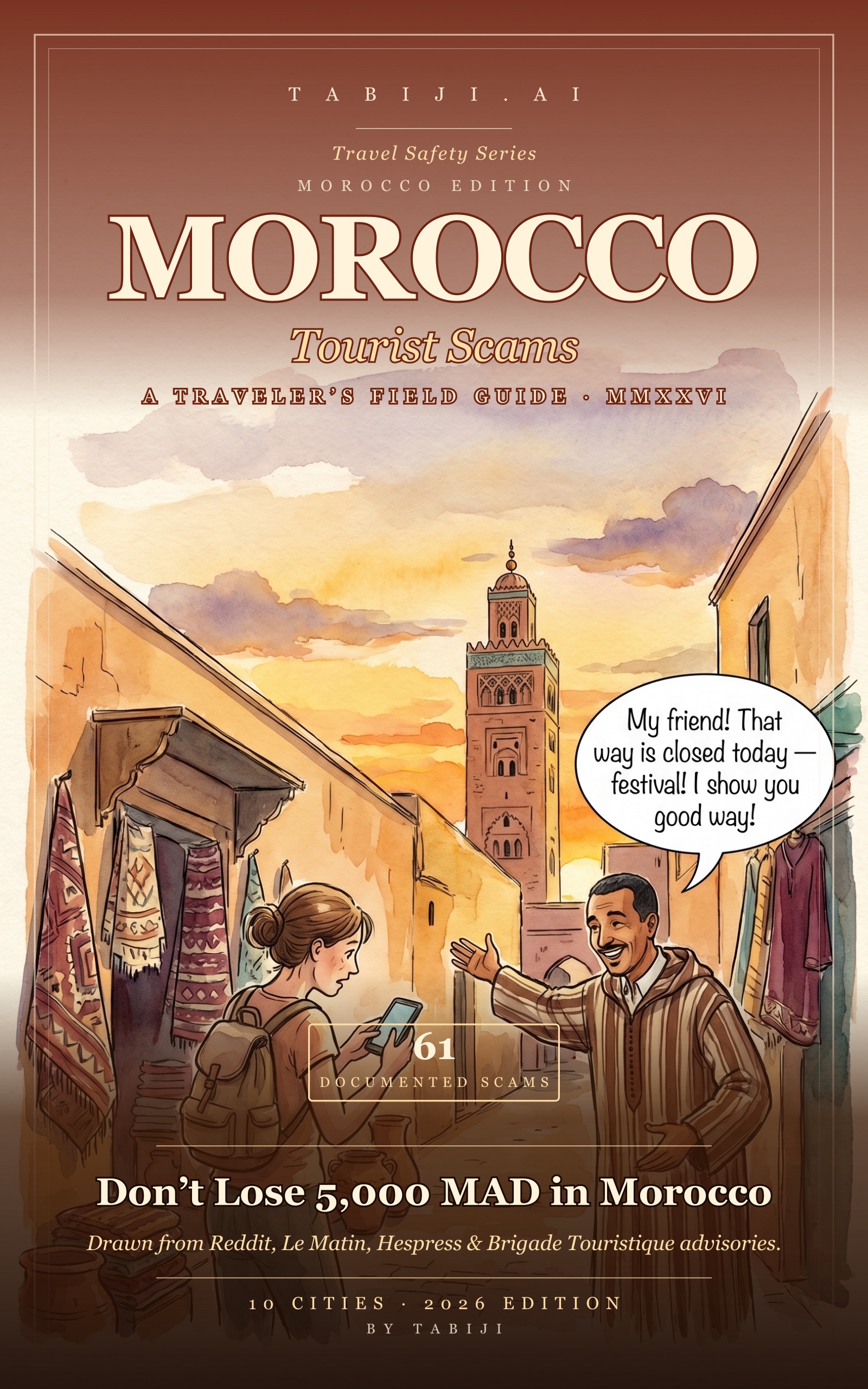
You just read 7 scams in Tangier. The Morocco book has all 61 across 10 cities — with the exact scripts, red flags, and Darija/French phrases that shut each one down.
61 documented Morocco scams across Marrakech, Fez, Casablanca, Rabat, Tangier, Chefchaouen, Merzouga, Ouarzazate, Agadir & Essaouira — every named scam, every red flag, every Darija and French exit phrase. Drawn from Moroccan press (Hespress, Yabiladi, Le Matin), Sûreté Nationale & Brigade Touristique advisories, and US/UK embassy traveler reports.
- 61 documented scams across 10 Moroccan cities
- Darija and French phrases that shut each scam down
- Post-scam recovery playbook + emergency contacts
- $4.99 on Amazon Kindle — 234 pages, offline-ready