ATM skimming, four ways your card gets cloned.
A skimmer overlay on a Champs-Élysées standalone. A pinhole camera above the keypad on Las Ramblas. A private ATM in a Sukhumvit pharmacy. A Lebanese-loop trap on Wenceslas Square. Four mechanics across 19 countries, defeated by the same 60-second wiggle-cover-stay routine.

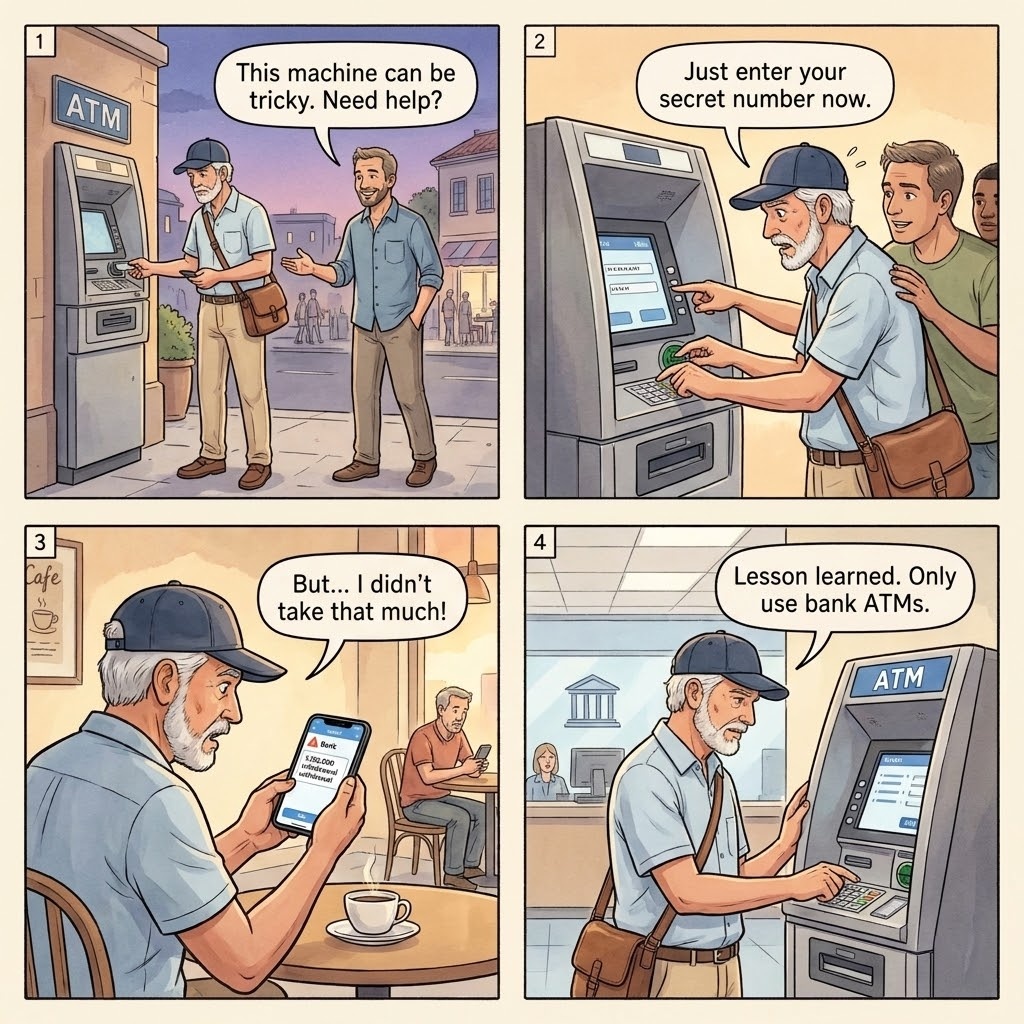
ATM skimming and card cloning runs four mechanics across 19 countries: overlay skimmers, shoulder-surf PIN capture, private-ATM machines, and Lebanese-loop card traps. The universal defense is a 60-second routine. Use major-bank ATMs (BNP Paribas, Intesa Sanpaolo, Santander, Bangkok Bank), inside the branch when possible. Wiggle the card slot before inserting; legitimate slots have zero play. Cover the keypad with your free hand on every PIN entry. Stay at the machine until your card and receipt are physically in your hand, ignoring any "helpful stranger" who approaches mid-transaction. Set up real-time card-fraud alerts before you leave home. The clone-to-first-fraud window is typically four to twelve hours; an instant alert lets you freeze the card before the second charge lands.
The €4,000 cloned in three seconds while a stranger handed you a €20.

You walk up to a standalone ATM half a block off the Champs-Élysées at 6pm on a Saturday because the BNP Paribas queue is fifteen people deep. The standalone says "International Cards Welcome," in five languages. The slot looks normal. You insert your card and start the withdrawal.
Behind you, a man in a windbreaker approaches with a smile and a €20 note in his hand. "Excuse me, monsieur, you dropped this." You half-turn. Your PIN goes into the keypad while your eyes are on him. His partner across the plaza, phone raised like a tourist photo, has just captured your four digits.
The €20 he's holding was always his. While you thank him and turn back, your card is already being swapped for a near-identical decoy by a third person who came up on your other side. You finish the withdrawal, take the cash and the wrong card, and walk away. By the time your bank flags the cloned-card transactions in Marseille that night, you're €4,000 in.
That is the universal mechanic, executed at the Paris archetype: a private ATM with skimming hardware, plus a three-person team running shoulder-surf PIN capture and a card swap. A March 2025 DailyMail investigation estimated 1 in 10 tourists to France, 212,000 people across five years, had been scammed, with ATM fraud a significant contributor. The same crews work the Champs-Élysées, the Marais, Montmartre, and the perimeter of Sacré-Cœur. Le Parisien publishes annual coverage of the Champs-Élysées card-fraud belt; arrests are made in cycles and the activity resumes within weeks.
The rest of this page is the four-mechanic playbook, the four other cities where it runs, and the 60-second wiggle-cover-stay routine that defeats every variant.
Read the full Paris scam guide →Key Takeaways
The wiggle-cover-stay routine
ATM skimming depends on you not noticing for the seconds it takes to capture your card data and PIN. The capture itself is fast, under three seconds, but unwinding it after a clone is in the wild requires hours of bank disputes and possibly an embassy visit if your access to cash is gone. The defensive routine is a 60-second sequence that runs once per ATM, in any country.
- Use major-bank ATMs only, inside the branch when possible. France: BNP Paribas, Crédit Agricole, Société Générale, LCL. Italy: Intesa Sanpaolo, UniCredit, Banca Nazionale del Lavoro. Spain: Santander, BBVA, CaixaBank. Thailand: Bangkok Bank, Kasikornbank, Siam Commercial Bank. Czech Republic: Česká spořitelna, ČSOB. Avoid pharmacy, mini-market, hotel-lobby, and standalone street-kiosk ATMs entirely. The fraud rate at non-bank ATMs is 5–10× the bank-branch rate; the fee saving is 1–2%.
- Wiggle the card slot before inserting. Overlay skimmers are loosely attached to the legitimate slot. A firm wiggle reveals plastic that comes off in your hand or rocks suspiciously. The genuine slot has zero play. Five seconds defeats every overlay-skimmer variant; takes longer to explain than to perform.
- Cover the keypad with your free hand on every PIN entry. Cup your free hand over the keypad as you type. Defeats both shoulder-surf observers and pinhole cameras hidden in the faceplate. One second; the universal defense against PIN capture across all four sub-variants.
- Stay at the machine until your card and receipt are physically in your hand. Do not turn around for any approach: a dropped bill, asked directions, a tap on the shoulder. The Lebanese-loop card-trap and the swap-during-distraction variants both depend on you breaking eye contact. If anyone approaches, finish the transaction first or cancel and walk away. The thirty seconds after PIN entry are when both lift variants execute.
- Set up real-time card-fraud alerts before you travel. Most major issuers (Chase, Amex, Capital One, Wise, Revolut) offer push notifications on every transaction. Enable them. Keep a backup card from a different network in a separate physical location so a single compromise does not strand you. The clone-to-first-fraud window is typically 4–12 hours; instant alerts let you freeze before the second charge lands.
The four mechanics
Different countries and different operator crews lean on different mechanics within the same family. Here are the four sub-variants documented globally. Each has a recognition tell, a primary geography, and the routine step that defeats it.
1. Overlay Skimmer
A fake card-slot faceplate fits over the genuine ATM slot. As your card passes through, a battery-powered reader records the magnetic-stripe data. The overlay is colored and shaped to match the machine but is loosely attached, designed for fast install/removal between police patrols. Operators install in early morning and harvest data at end of shift.
Defense: wiggle the slot. Genuine slots are firm. Most reported in: Paris Champs-Élysées, Barcelona Las Ramblas, Rome Termini, Bangkok Sukhumvit.
2. Shoulder-Surf PIN Capture
An observer (human or pinhole camera) records your PIN as you type. The human variant runs as a "helpful stranger" approach combined with two- or three-person card-swap teams. The camera variant is a tiny lens hidden in a plastic strip above the keypad, often near a handwritten "use this ATM" sign. Both feed cloned cards.
Defense: cup your free hand over the keypad. Most reported in: Paris Métro and Champs-Élysées, Barcelona Plaza Catalunya, Madrid Sol.
3. Private-ATM Machine
An ATM owned and stocked by a private operator (not a bank) that has skimming hardware permanently installed in the cassette and reader path. The operator gets a small per-transaction fee from the network plus all skimmed card data. Common branding: "Euronet," "Cardtronics," generic "ATM" signage. Bank-issued chargeback claims are harder against private-ATM transactions.
Defense: avoid entirely. Use only major-bank-branded ATMs. Most reported in: Bangkok Sukhumvit and Khao San, Bali Kuta and Seminyak, Cancún Hotel Zone, Prague Wenceslas.
4. Lebanese-Loop Card Trap
A thin plastic loop is inserted into the card slot before your transaction. The loop grips your card so it cannot return. You attempt several PIN entries; the machine reports an error; you eventually walk away assuming the bank kept your card. A waiting operator, who has watched your PIN entries via shoulder-surf or camera, extracts the trapped card and uses it before you can call your issuer to freeze it.
Defense: if your card does not return within 30 seconds, do NOT walk away. Stand at the machine and call your issuer. Most reported in: Prague Wenceslas, Bucharest Old Town, Sofia city center.
Where it runs
ATM skimming concentrates where two conditions overlap: dense tourist foot traffic and prevalence of non-bank ATMs. Western Europe and Southeast Asia account for over 70% of documented variants.
| Country | Documented variants | Iconic location pattern |
|---|---|---|
| 🇫🇷 France | 8 | Paris Champs-Élysées and Marais standalones · Marseille Vieux-Port · Nice Promenade des Anglais |
| 🇮🇹 Italy | 6 | Rome Termini standalones · Florence Duomo perimeter · Venice San Marco private ATMs |
| 🇪🇸 Spain | 6 | Barcelona Las Ramblas and Gothic Quarter · Madrid Sol-area private ATMs · Seville Santa Cruz |
| 🇹🇭 Thailand | 5 | Bangkok Sukhumvit and Khao San private ATMs · Phuket Patong · Pattaya Walking Street |
| 🇨🇿 Czech Republic | 4 | Prague Wenceslas Square · Old Town private ATMs · near-Charles-Bridge standalones |
| 🇲🇽 Mexico | 4 | Cancún Hotel Zone private ATMs · Playa del Carmen Quinta Avenida · Mexico City Roma |
| 🇮🇩 Indonesia | 3 | Bali Kuta and Seminyak private ATMs · Ubud monkey-forest perimeter |
| 🇷🇴 Romania · 🇧🇬 Bulgaria | 3 | Bucharest Old Town · Sofia city center · Lebanese-loop heavy |
Bar width is data-bound at 10 pixels per documented variant. The eight countries above account for 39 of 45 total variants, or 87% of the global atlas.
Four more cities, four more variants
The Champs-Élysées scene above showed the shoulder-surf and card-swap stack. Here are four more cities where different sub-variants dominate. Each links to the full city scam guide.
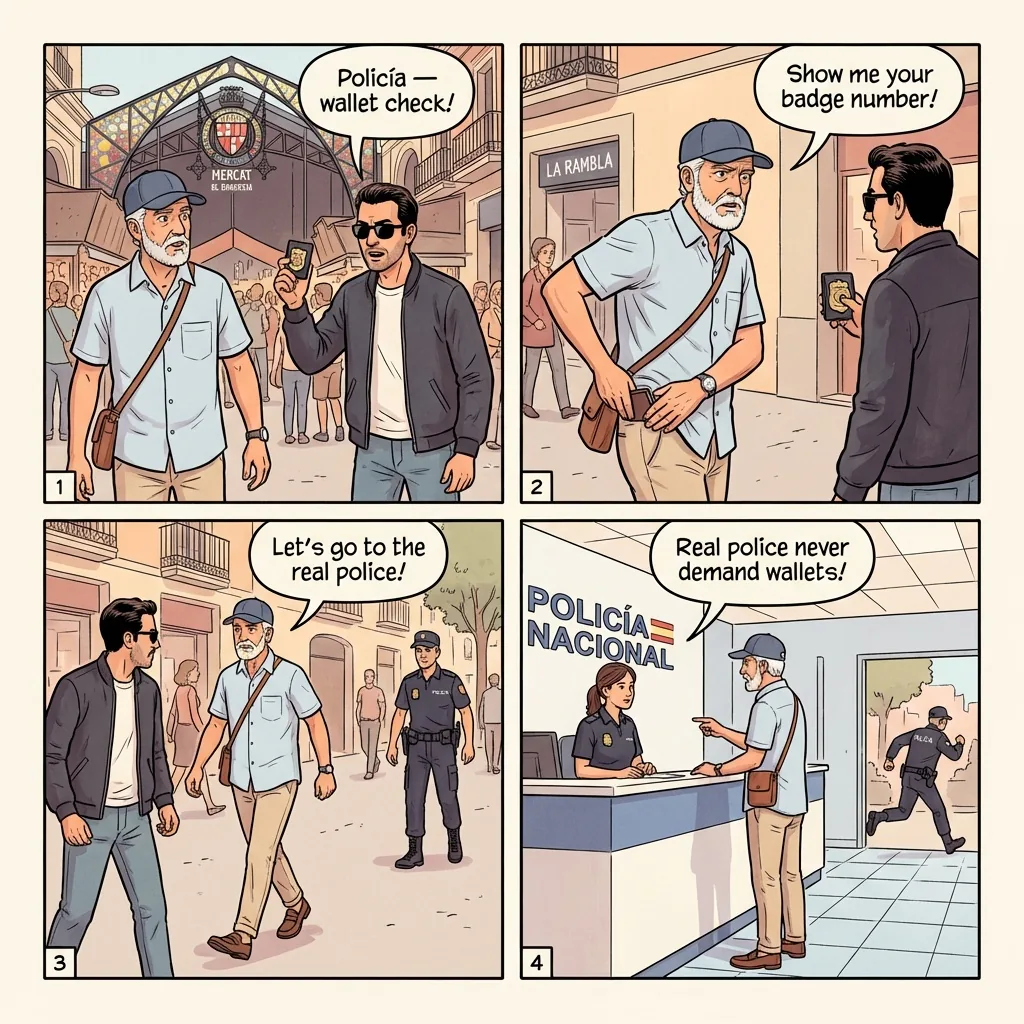
You step off Las Ramblas into a covered passageway housing a standalone ATM in front of a souvenir shop. The screen shows the bank network logos and "International Cards Welcome." The slot looks normal but the faceplate around it is a slightly off-color beige. You wiggle the slot before inserting; it rocks. The overlay comes off in your hand. The Las Ramblas and Gothic Quarter perimeter run overlay-skimmer hardware on standalones near Plaça de Catalunya, the Liceu Metro entrance, and the small alleys feeding off Carrer de Ferran. Pinhole cameras above the keypad pair with the overlay; the combination captures both stripe and PIN. The Mossos d'Esquadra publish quarterly card-fraud arrest numbers; Las Ramblas accounts for 30 to 40% of Barcelona's tourist-card-fraud incidents. Defense: walk back up Las Ramblas to the BBVA, Santander, or CaixaBank branch ATMs around Plaça Catalunya. The 200-meter walk saves four-figure cloning losses. The Mossos Tourist Help line at +34 932 903 000 takes English-language reports.
Read the full Barcelona scam guide →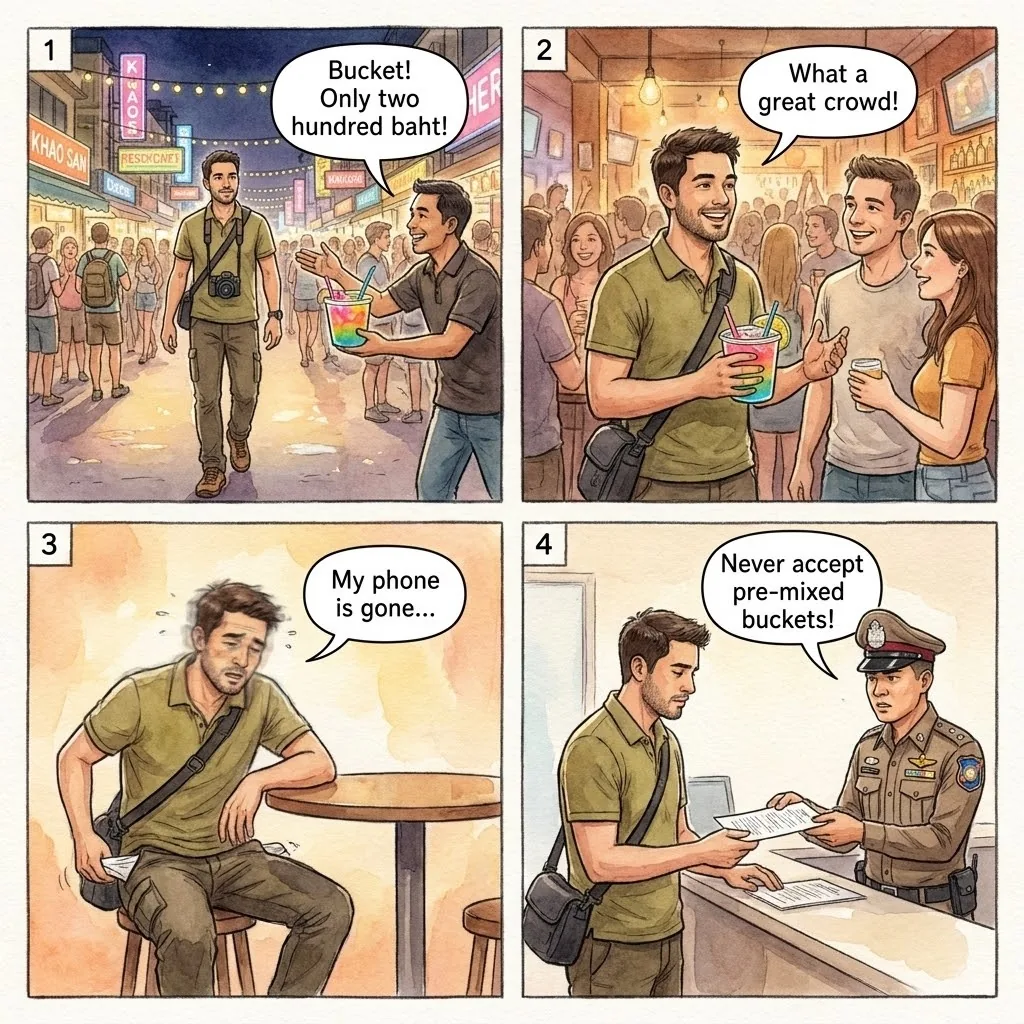
You walk into a 24-hour mini-market on Soi Sukhumvit 11 at 11pm because the BTS Asok station ATMs are gated after midnight. The mini-market has a standalone ATM near the back, branded "AEON" or "Easy Pass" or just "ATM" with no bank logo. You withdraw 5,000 baht. Two days later, your bank flags 80,000 baht in transactions you did not authorize, all stamped Bangkok. The Sukhumvit and Khao San private-ATM circuit is documented through Bangkok Post, Khaosod English, and r/Thailand threads as the highest-density skimming exposure in Southeast Asia. The Tourist Police Bangkok line at 1155 (24/7, English-speaking) accepts card-fraud reports; the report number is what your card issuer needs for chargeback under Visa/Mastercard zero-liability. Defense: Bangkok Bank, Kasikornbank (KBank), and Siam Commercial Bank (SCB) operate 24/7 ATMs at most BTS stations and major shopping centers (Terminal 21, EmQuartier, ICONSIAM). The Bangkok Bank ATM at Asok station is open round-the-clock and is the canonical safe alternative to Sukhumvit private ATMs.
Read the full Bangkok scam guide →
You insert your card at a standalone ATM at the bottom of Wenceslas Square at 9pm. The PIN works. Then the machine displays "Card retained" and your card does not return. You walk away assuming the bank kept it for some routine reason. A man who has been watching from a doorway moves in, slides a thin tool into the slot, and extracts your card; he has your PIN from a hidden camera in the faceplate above the keypad. By the time you call your bank from the hotel, six transactions across Prague's private ATMs have already drawn your daily limit. The Wenceslas Square and Old Town areas (around Staromestske Namesti and the Charles Bridge approaches) run Lebanese-loop hardware most consistently. The Czech Tourist Police accepts complaints at the Old Town station off Bartolomějská; Česká spořitelna and ČSOB are the safer alternatives, with branches at Wenceslas nám. and Nám. Republiky. Defense: if your card does not return within 30 seconds, stand at the machine and immediately call your issuer's 24/7 fraud line on the back of any other card you have. Most banks can flag the card mid-trap.
Read the full Prague scam guide →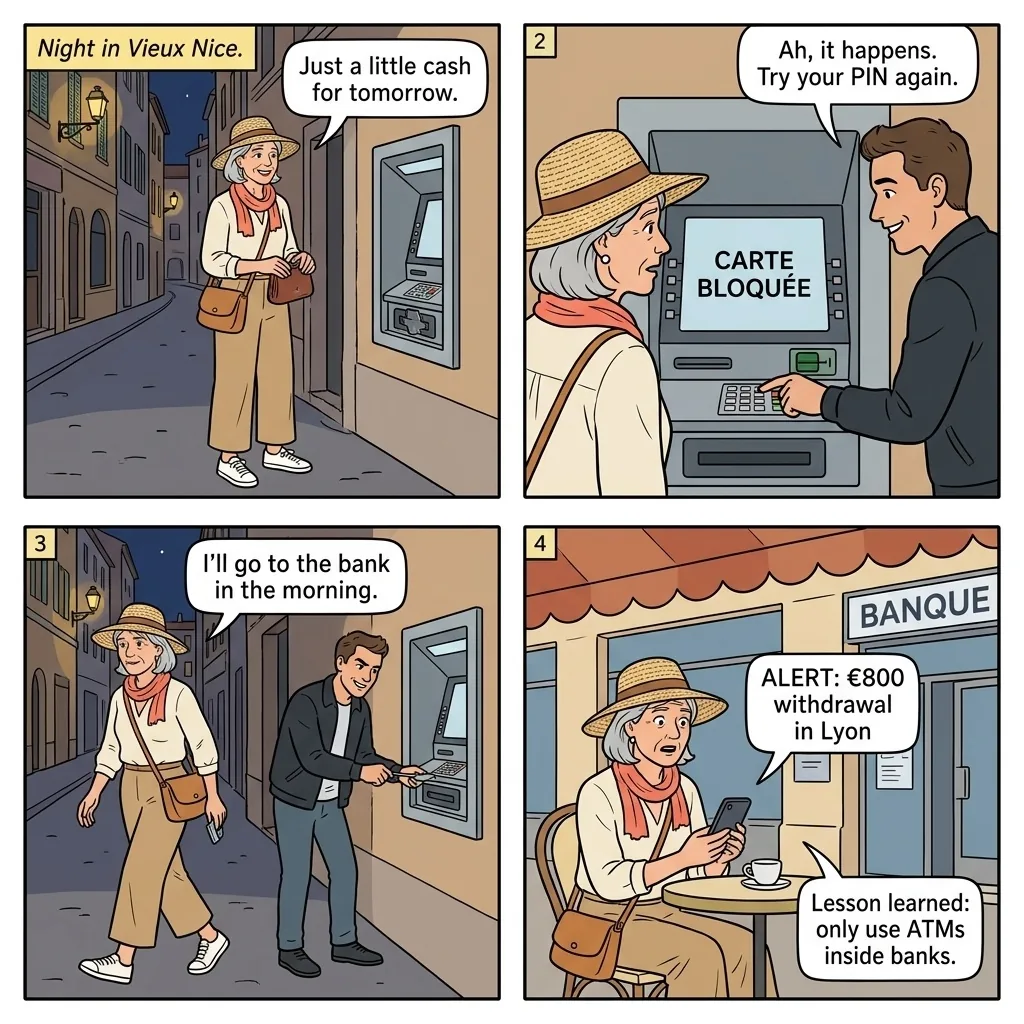
You walk along the Promenade des Anglais at sunset. A standalone ATM sits in a small kiosk between two beachfront cafés, branded with the colors of a major French bank but missing the actual bank's logo. You wiggle the slot, it shifts. Skimmer hardware is fitted snugly inside the kiosk. The Vieille Ville (Old Town) of Nice and the eastern stretch of the Promenade between the Negresco and the Casino Ruhl run overlay-skimmer hardware seasonally; the operator crews follow the cruise-ship calendar from May through October. The Police Nationale Nice tourist help desk at the Hôtel de Police on Avenue Maréchal Foch accepts English-language reports. The Crédit Agricole and BNP Paribas branches at Place Masséna are 200 meters off the Promenade and have 24/7 ATM access. Defense: the standalone-on-the-Promenade pattern is the tell. Walk inland one block to a major-bank branch.
Read the full Nice scam guide →Red flags
If two or more of these signals fire when you approach an ATM, walk to the next major-bank branch instead. The compounding rule: a single signal might be a coincidence; two signals are a script.
- Standalone ATM in a recessed alcove, dimly lit doorway, or off the main pedestrian flow
- ATM branded generically ("ATM" or "Cash" or no logo) without a major-bank name
- The card slot wiggles or rocks when you push it gently
- The faceplate around the slot is a slightly different color than the rest of the machine
- The PIN keypad feels mushy or has visible plastic seams (keypad overlay)
- A small pinhole or unusual marking on the faceplate above the keypad
- A handwritten or laser-printed sign near the machine ("use this one" or arrow)
- Someone approaches you mid-transaction with a dropped bill or asked direction
- Your card does not return within 30 seconds of completion
- The transaction receipt does not print at all, or prints partially
The phrases that shut it down
ATM skimming refusal is mostly non-verbal: walk away from suspicious machines, cup your free hand over the keypad, do not engage with anyone who approaches. But a clean phrase ends the rare verbal-distraction approach immediately and signals to nearby travelers that something is happening.
If you got hit
Your bank flagged a transaction you did not make, or your card was retained at an ATM and the machine wallet shows charges already posting. The first hour matters most: the cloned card will be used in cycles until you freeze it, and Visa/Mastercard zero-liability policies require you to report the unauthorized transactions promptly.
Within five minutes: call your card issuer's 24/7 international fraud line. The number is printed on the back of every card; save photos of every card back separately on your phone for exactly this moment. Freeze the card; the issuer will block all future transactions and reverse fraudulent ones.
Within thirty minutes: file a police report with the local tourist-police line. The report number is what most card issuers' fraud-investigation teams require for full reimbursement above a small threshold.
- Paris: Préfecture de Police 17 (24/7); SARIJ commissariats including 10 boulevard Strasbourg-Saint-Denis; English-language reports accepted.
- Barcelona: Mossos d'Esquadra Tourist Help, +34 932 903 000 (24/7, English).
- Madrid: SATE (Sala de Atención al Turista Extranjero), Calle Leganitos 19, +34 91 548 8537.
- Rome: Carabinieri 112; Polizia di Stato 113; Termini-area Polizia Ferroviaria 06-481-661.
- Bangkok: Tourist Police 1155 (24/7, English-speaking).
- Prague: Tourist Police, Městská policie Praha; Old Town station off Bartolomějská; English-language reports accepted.
- Nice: Police Nationale Hôtel de Police, Avenue Maréchal Foch.
Within 24 hours: order a replacement card. Most major issuers (Amex, Chase, Capital One, Wise, Revolut) offer overnight emergency replacement cards via DHL or FedEx to your hotel. Premium-tier travel cards (Amex Platinum, Chase Sapphire Reserve, Capital One Venture X) include emergency cash-advance assistance up to $1,000–$2,500. Keep a backup card from a different network in a separate physical location, not your wallet, so a single compromise does not strand you. The Visa/Mastercard zero-liability policy covers all unauthorized transactions made before the freeze, with the police report as supporting evidence.
Related atlas entries
Sister entries in the Scam Atlas. ATM skimming overlaps with currency-related scams (where cash withdrawal is the trigger event) and with distraction-theft tactics (where the helpful-stranger approach pairs with PIN capture).
Sources
- DailyMail, March 2025 investigation: 1 in 10 tourists to France scammed (212,000 across 5 years), with ATM fraud as a significant contributor.
- Le Parisien, multi-year coverage of Champs-Élysées and Marais ATM skimming arrests (Paris, 2018–2025).
- La Repubblica, Termini and Trastevere ATM-fraud reporting (Rome, 2020–2025).
- El País and La Vanguardia, Las Ramblas card-fraud coverage with Mossos d'Esquadra arrest data (Barcelona, 2021–2025).
- Bangkok Post and Khaosod English, Sukhumvit and Khao San private-ATM skimming reports (2022–2025).
- European Card Payment Association annual fraud-rate-by-country reports (2023, 2024, 2025).
- Czech Police Wenceslas Square card-trap arrest summaries (Prague, 2023–2025).
- r/travel, r/Paris, r/spain, r/Thailand, r/Prague continuing thread monitoring 2018–2026.
Get the full ATM-safety playbook for your destination.
Each Travel Safety atlas covers every documented ATM-skimming variant in one country, plus the country's full scam catalog: taxi, restaurant, pickpocket, fake authority. Buy once, lifetime updates as scams evolve. $4.99 on Kindle.