
Key Takeaways
- The #1 reported scam is the Hariri Airport USD-Curb Quote.
- 2 of 7 scams are rated high risk.
- Use app-based ride services (Uber, Careem) or official metered taxis instead of unmarked vehicles.
- Never accept unsolicited offers from strangers near tourist sites in Beirut.
⚡ Quick Safety Tips
- Beirut is generally safe for tourists within the main urban areas — Hamra, Gemmayzeh, Mar Mikhael, Downtown, and Raouché — but always check current travel advisories due to the evolving security situation in Lebanon.
- Taxis in Beirut do not use meters — always agree on a price before getting in the car or use Bolt/Uber for transparent pricing. Airport to Hamra should cost $10-15, not $40-70.
- Since 2024, the official bank exchange rate matches the street rate — there is no longer any advantage to exchanging money on the street. Use bank ATMs and licensed exchange offices only.
- Beirut's nightlife in Gemmayzeh and Mar Mikhael is legendary but keep your guard up — stick to well-reviewed venues, watch your drinks, and use ride-hailing apps to get home safely.
Jump to a Scam
The 7 Scams
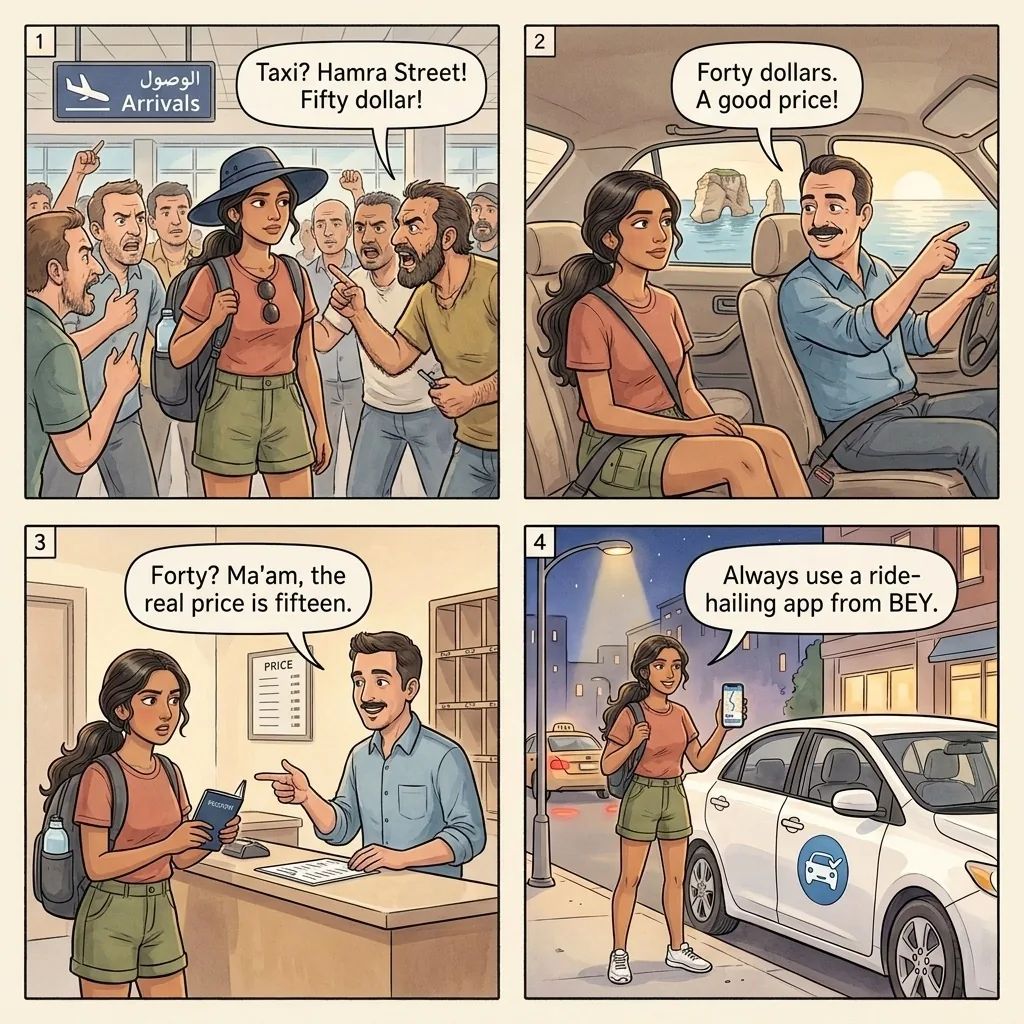
Drivers swarm the BEY arrivals curb shouting USD quotes of $40–$70 to Hamra — the legitimate fare is $10–$15, there is no posted tariff to argue against, and the meter (if any) is programmed to a tourist rate.
You exit Beirut's Rafic Hariri International Airport (BEY) and are immediately surrounded by drivers shouting destinations and waving. You ask one how much to Hamra. He says '$50.' Another says '$40.' You agree to the $40 ride, thinking you negotiated well. The trip takes 15 minutes covering about 10 km — and you've just paid three to four times the legitimate metered rate.
Taxi overcharging is the most documented tourist scam in Beirut. TravelScams.org's Lebanon page notes that 'taxis in Lebanon do not use meters, so inflated fares can be quoted if you have not done your research.' A TripAdvisor review of Beirut Airport Taxi titled 'Scam outside airport' describes a driver presenting a fake taxi license and a rigged meter. WildAboutTravel's 'Never, Don't trust a Beirut Taxi Driver' covers another tourist dramatically overcharged on a 10 km airport-to-Hamra ride.
BrandLebanon's report on Lebanon's taxi reforms notes that 'tourists at the airport are approached by drivers who quote random prices — there is no official pricing board, no meter, and no clear process.' Many BEY operators are linked to political factions, meaning 'zero oversight or regulation.' The dollar-quoting maximizes foreign-tourist fares; the absence of a posted tariff removes any anchor for negotiation; the lack of regulation means there is no one to file a complaint with after the fact.
The pattern extends well beyond the airport. Drivers in Hamra, Gemmayzeh, Mar Mikhael, and Downtown routinely charge tourists three to five times the local rate for inter-neighborhood trips, often quoting in USD even when locals would pay in lira. Pre-arranging through your hotel typically lands a $15–$25 fixed-rate transfer to anywhere central.
The defensive move is to use Bolt or Uber from inside the terminal — both apps work in Beirut, both quote the fare in advance, and a Bolt ride to Hamra is typically $10–$15. For city trips, agree on a price before getting in and confirm whether the figure is USD or LBP. The 'service' (shared taxi) system handles short fixed routes for about 100,000 LBP ($1–$2). For complaints, the Internal Security Forces tourist-assistance line is 1735 (24-hour) and the US Embassy Beirut main line is +961-4-543-600.
Red Flags
- Multiple drivers aggressively compete for your business at the airport exit — this is a marketplace, not a regulated taxi rank
- The driver quotes a price in US dollars rather than Lebanese lira — a tactic to maximize the fare from foreign tourists
- There is no meter in the vehicle, or the driver claims the meter is broken or 'not needed for airport trips'
- The quoted price is $30-70 for a trip within Beirut — most trips between neighborhoods should cost $5-15
- The driver takes an unnecessarily long route through Beirut's notoriously congested streets to justify a higher fare
How to Avoid
- Pre-arrange airport pickup through your hotel — most hotels in Beirut offer shuttle services at fixed, reasonable rates.
- Use the Bolt or Uber app, which work in Beirut and show transparent fare estimates before you confirm the ride.
- Research approximate taxi fares before arrival: airport to Hamra should be $10-15, airport to Gemmayzeh $12-18, airport to Downtown $8-12.
- For city trips, agree on a price before getting in the car and confirm whether it is in USD or Lebanese lira.
- Use the 'service' (shared taxi) system for short trips within the city — a service ride on a fixed route costs about 100,000 LBP ($1-2).
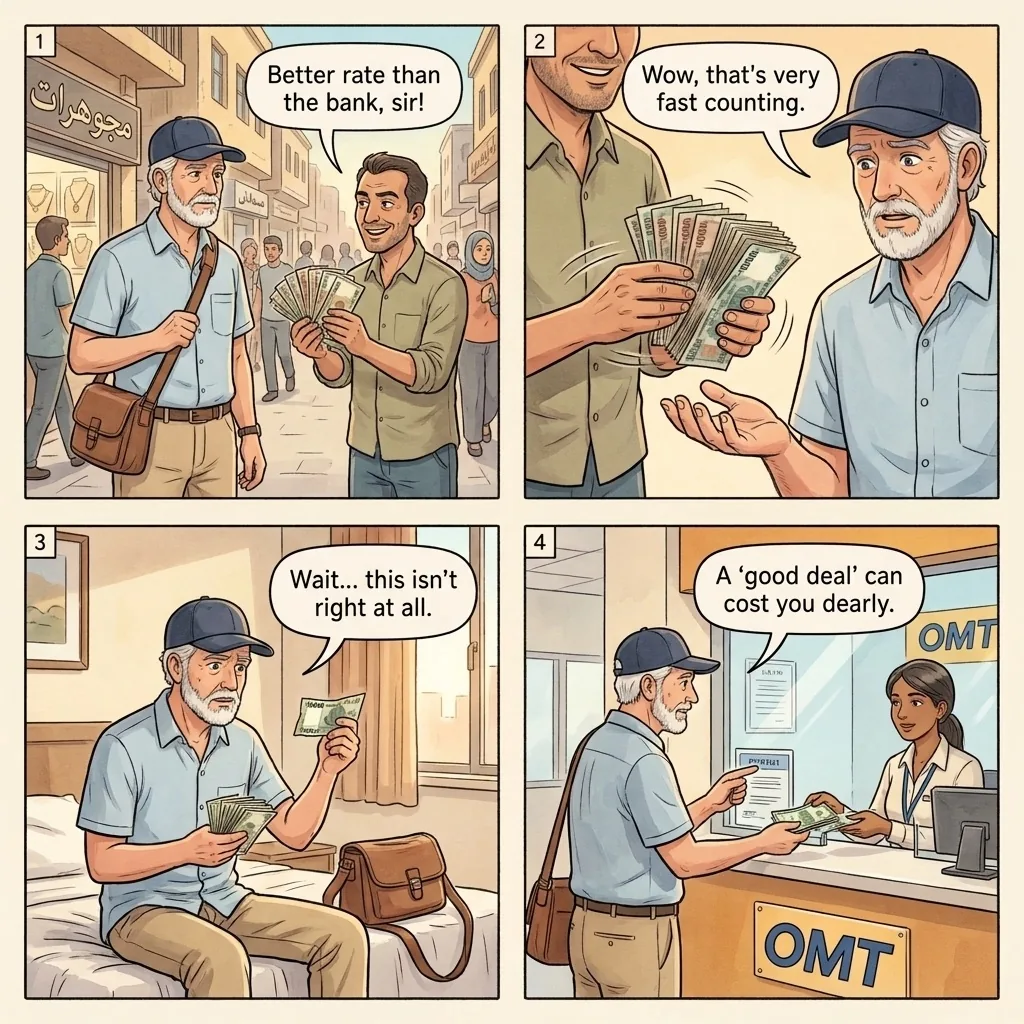
A man on Hamra Street offers a slightly better-than-bank rate, fans worn lira notes for you to 'verify,' and palms 25% of the stack during the count — a few of the 100,000 LBP bills are counterfeit too.
At your hotel the rate is 89,500 LBP per dollar. A man on Hamra Street offers 91,000 — a seemingly better deal. You hand over $300. He counts out stacks of worn lira notes with impressive speed, fanning them for you to verify. Back at your hotel you discover you received only about $240 worth of lira; several high-denomination notes were palmed during the rapid counting. Two of the 100,000 LBP notes feel wrong. They are counterfeit.
Lebanon's currency crisis created a complex exchange landscape that scammers exploit. Al Jazeera's investigation 'Like a drug deal: Inside Lebanon's black market currency trade' documents how informal exchanges became commonplace during the economic collapse. Johnny Africa's 'How To Exchange Money On Lebanon's Black Market As A Tourist' explains that while official and street rates were unified in 2024, informal street exchange persists.
YourLastBorders.com's guide warns that street exchangers use quick-hand counting techniques and may slip counterfeit notes into the bundle. The Lebanese lira's high-denomination notes — bills up to 100,000 LBP — make it easy to shortchange tourists who don't know the look or weight of legitimate paper. Rest of World documented how exchange transactions migrated to WhatsApp and Telegram groups, making them even harder to track or dispute.
The defensive move is simple: since 2024 the official bank rate matches the market rate, so there is zero advantage to exchanging on the street. Use ATMs at Banque du Liban, BLOM Bank, or Bank Audi, or licensed sarrafs (exchange offices) that issue receipts. Always count at the counter before walking away and check each high-denomination bill for the watermark, the security thread, and the raised printing on the denomination numeral.
If you receive counterfeit notes, the Lebanese Central Bank Banque du Liban (Hamra district, +961-1-750-000) accepts authenticity checks. For shortchange disputes filed within 24 hours, call the ISF tourist-assistance line 1735 or the general police line 112. Carry small-denomination USD bills for hotels, high-end restaurants, and emergency exchanges, and limit street-level lira holdings to the day's spending.
Red Flags
- A stranger approaches you on the street offering to exchange money at a better rate than banks or exchange offices
- The exchanger counts money extremely quickly with elaborate hand movements and discourages you from recounting
- The transaction takes place on the street, in a doorway, or in any location that is not a licensed exchange office
- Some bills in the bundle feel different in texture, weight, or color compared to others — these may be counterfeit
- The exchanger adds a surprise 'commission' or 'fee' after the exchange is supposedly complete
How to Avoid
- Exchange money only at licensed exchange offices (sarrafs) or withdraw from ATMs at banks like Banque du Liban, BLOM Bank, or Bank Audi.
- Since 2024, the official bank rate matches the market rate — there is no longer an advantage to exchanging on the street.
- Always count your money carefully at the counter before walking away, and check each bill for security features.
- Familiarize yourself with Lebanese lira denominations and security features before arriving — the Central Bank website has images.
- Carry US dollars for larger transactions (hotels, high-end restaurants often price in USD) and exchange only what you need for daily expenses.
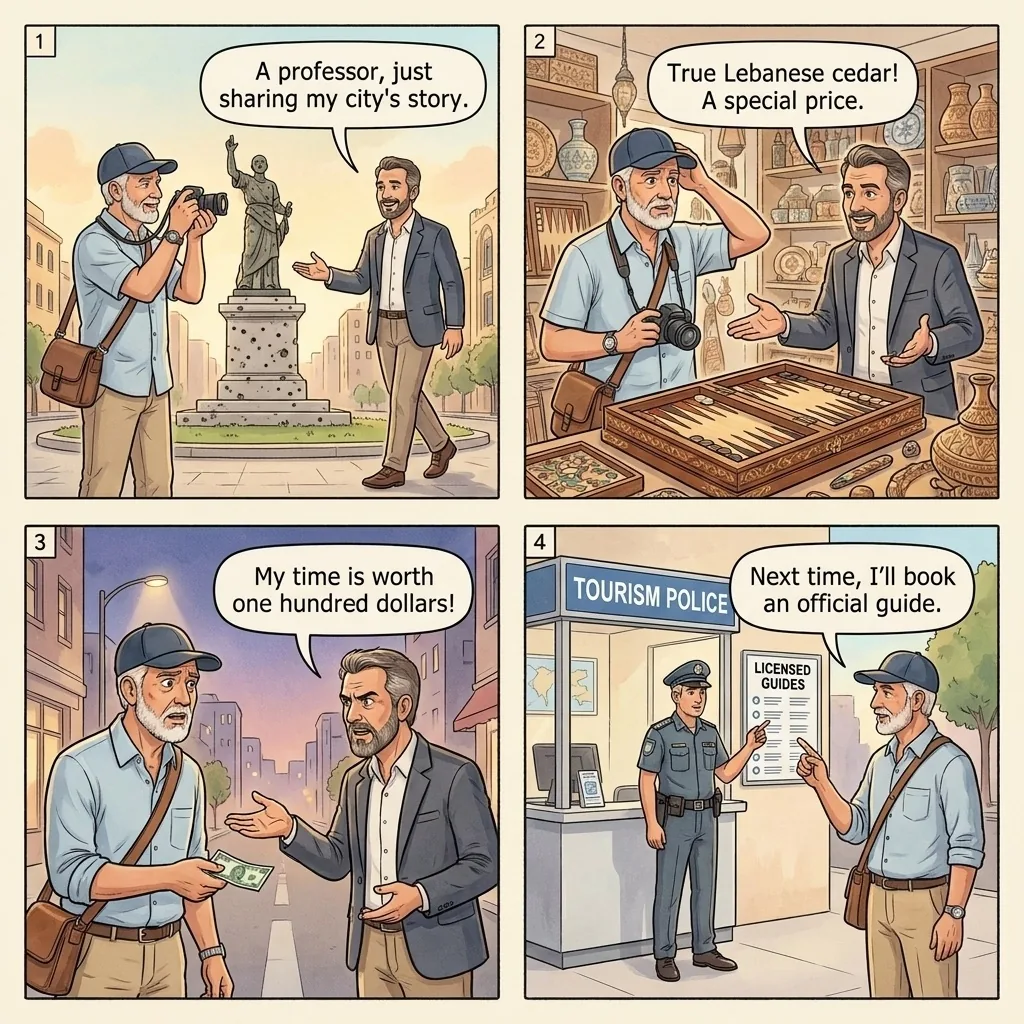
A 'university professor' at Martyrs' Square offers a free walking tour 'just for the pleasure of conversation,' steers you through three commission shops, then demands $50–$100 at the end and accuses you of disrespecting Lebanese hospitality if you decline.
You are standing at Martyrs' Square, photographing the bullet-riddled statue, when a well-dressed man approaches speaking excellent English. He says he is a university professor and history enthusiast who loves sharing Beirut's story with visitors. He offers to walk you through the city for free — 'just for the pleasure of conversation.'
Over the next two hours he takes you to interesting spots but also to specific shops where he collects a commission on your purchases. At the end he asks for a 'small donation for his time' — suggesting $50–$100. When you offer $10, the tone hardens and he accuses you of disrespecting Lebanese hospitality. The free framing is the hook: it disarms refusal, and the donation request only lands after you have already received two hours of attention.
Fake tour guides are documented across multiple Beirut safety sources. TheWorldTravelIndex's Beirut safety guide warns about 'individuals offering guided tours who are not licensed and may provide misleading information or demand high fees.' WikiForTravel's Beirut scam guide describes the same pattern — a local 'befriending' tourists and leading them to commission shops. The GOV.UK Lebanon travel advice notes that 'some officials may try to solicit bribes or make up violations,' extending the unofficial-demand pattern even to quasi-official contexts.
Licensed guides in Lebanon carry credentials from the Ministry of Tourism and agree on rates before any tour begins. The scam targets solo travelers and couples at major tourist sites — Martyrs' Square, the National Museum, the Raouché Corniche viewpoint, and along Byblos day-trip routes — where slow-moving tourists are taking photos and a friendly approach feels organic rather than predatory.
The defensive move is to book guided tours only through your hotel, a licensed Ministry of Tourism operator, or platforms like GetYourGuide and Viator with transparent pricing. If a stranger offers a walk, ask to see the Ministry of Tourism guide license before agreeing to anything; legitimate guides produce credentials immediately. Do not enter shops your 'guide' suggests unless you independently planned to. For pressure or aggression, the Internal Security Forces tourist line is 1735 and the general police line is 112.
Red Flags
- A stranger approaches you at a tourist site and offers a free or very cheap guided tour — they will expect significant payment later
- The 'guide' takes you to specific shops, restaurants, or services where they clearly have a relationship with the owner
- They cannot show you an official guide license from the Lebanese Ministry of Tourism when asked
- The tour seems improvised rather than following a structured itinerary, and historical information may be inaccurate
- At the end, a 'donation' is requested that is far higher than what was implied (or nothing was discussed upfront)
How to Avoid
- Book guided tours through your hotel, a licensed tour company, or platforms like GetYourGuide and Viator with transparent pricing.
- If someone offers to show you around, agree on an exact price before starting — get it in writing or text if possible.
- Ask to see an official guide license from the Ministry of Tourism — licensed guides will have credentials readily available.
- Decline to enter shops that the 'guide' recommends unless you independently planned to visit them — these are commission stops.
- Research Beirut's history using free audio guides or apps before your visit so you can spot inaccurate information.
Like what you're reading? Get a full Beirut itinerary with safety tips built in.
Browse travel-safety books →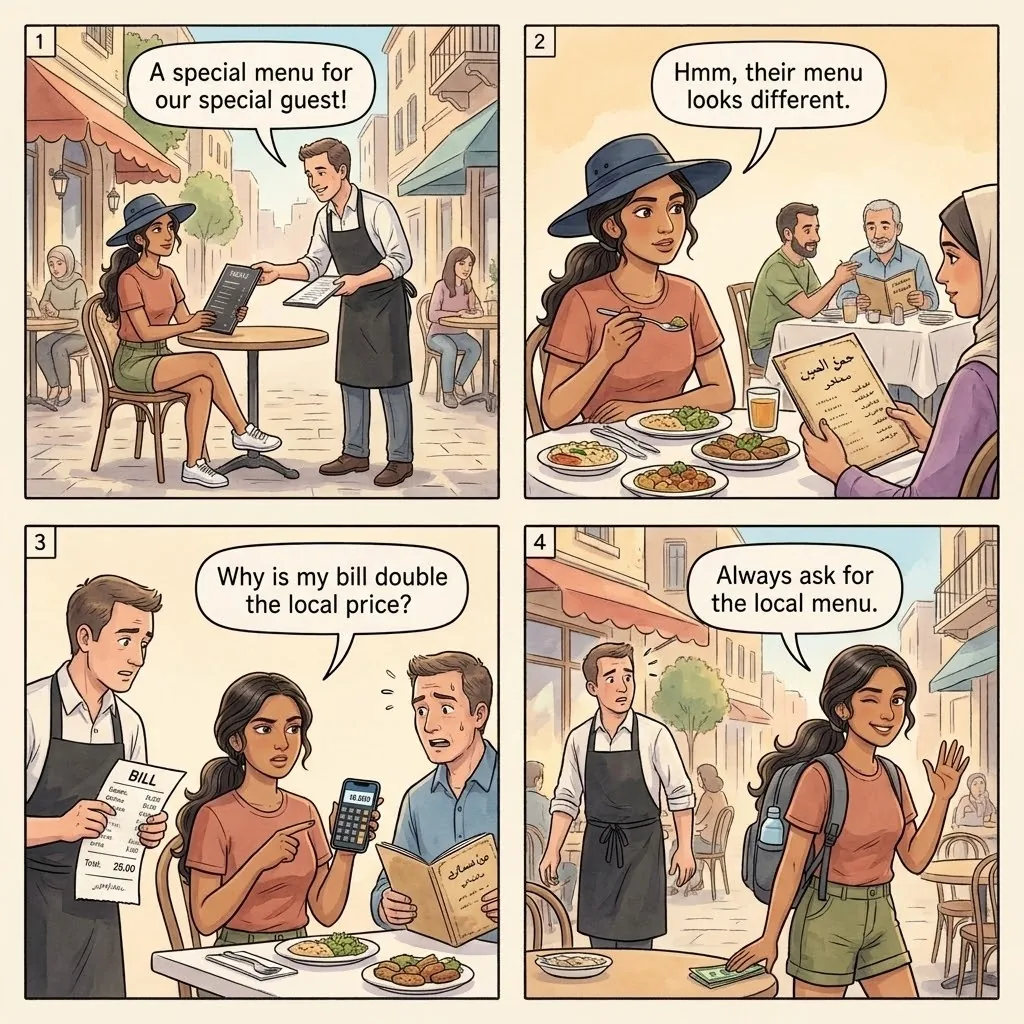
A trendy Rue Gouraud restaurant hands you an English menu where the mezze platter is $25 and hummus is $12 — the Arabic menu at the next table lists the same dishes at $15 and $7, plus a 15% service charge and an undisclosed 'live music' surcharge land on your bill.
You sit down at a trendy-looking restaurant on Rue Gouraud in Gemmayzeh. The waiter brings an English menu. A mezze platter is listed at $25, hummus at $12, a cocktail at $18. You order a spread for two and the bill comes to $120. What you did not realize is that the Arabic menu at the next table shows the same mezze platter at $15, the hummus at $7, and cocktails at $12.
A 15% service charge and a 'live music' surcharge were added to the bill without disclosure. The mark-up averages 60–80% above the local-menu price for the same dishes, and the surcharges add another 20–30% on top. Both numbers compound on every line, so a $60 'fair' bill at the next table becomes $120–$140 at yours.
Restaurant overcharging is documented across Beirut travel guides. TheWorldTravelIndex's Beirut safety section warns about 'restaurants that add hidden charges to your bill, such as excessive service fees or inflated prices for drinks' and notes that 'restaurants might offer a tourist menu with higher prices than the regular menu.' TripAdvisor's Beirut trip reports surface the same pattern in the Gemmayzeh and Mar Mikhael nightlife strips, particularly at venues with English-language hosts working the sidewalk.
The dual-menu practice is less common at upscale Beirut restaurants, which post USD prices for everyone, and more prevalent at mid-range establishments on tourist strips where an English menu is provided by default. Lebanon's service-charge practices also vary widely — some venues add 10–15% automatically while others expect tips on top, so the bill can compound without warning.
The defensive move is to ask for the menu with prices before sitting down, ask explicitly whether a service charge is included, and walk one or two blocks off the main Gemmayzeh and Mar Mikhael strips for authentic restaurants at fair prices. If you suspect dual pricing, politely ask for the Arabic menu or compare with what other tables received. For disputes, the Lebanese consumer-protection line is 1739 and the ISF tourist-assistance line is 1735.
Red Flags
- You are given a separate English menu while Arabic-speaking diners receive a different menu — compare prices if possible
- Prices are not listed on the menu, or the menu shows only dish names and descriptions without costs
- Extra charges appear on the bill — service charges, live music fees, bread charges, or cover charges not mentioned when you sat down
- The waiter recommends specific items without mentioning their price — these are often the highest-margin dishes
- The restaurant is on a main tourist strip (Rue Gouraud, Armenia Street) with prominent English-language signage and aggressive hosts outside
How to Avoid
- Ask for a menu with prices before sitting down — if the menu has no prices, request them verbally for each item you consider ordering.
- Ask explicitly whether a service charge is included before ordering, and whether there are any cover charges or surcharges.
- Check Google Maps and TripAdvisor reviews for specific pricing complaints before choosing a restaurant.
- Eat where locals eat — walk one or two blocks off the main Gemmayzeh and Mar Mikhael strips for authentic restaurants at fair prices.
- If you suspect dual pricing, politely ask for the Arabic menu or compare your menu with what other tables received.
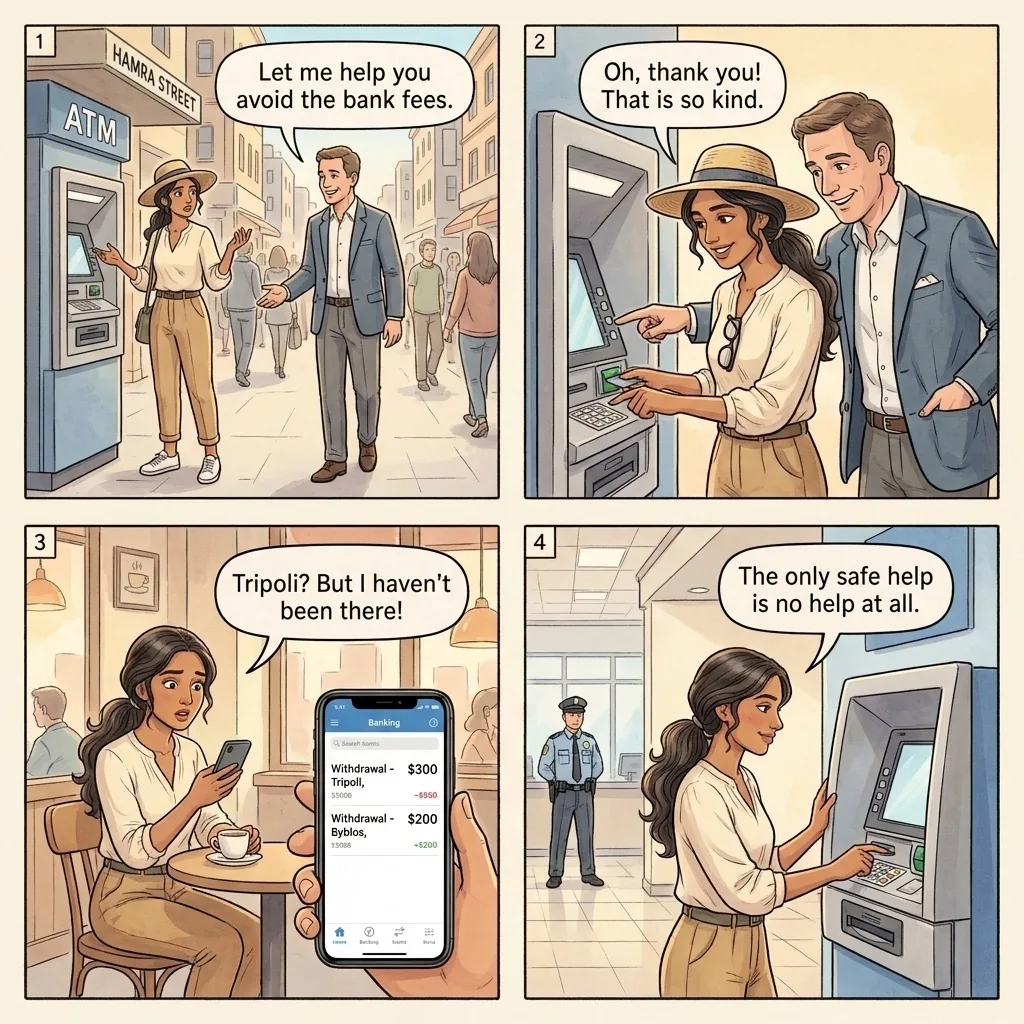
A 'helpful' man at a Hamra Street ATM offers to show you which buttons avoid local fees, watches your PIN entry, and brushes a pocket skimmer against your card — three days later unauthorized charges drain your account from across Lebanon.
You are using an ATM on Hamra Street when a friendly man approaches and offers to help you 'avoid the local bank fees.' He says he can show you which buttons to press for the best exchange rate. While seemingly helping, he watches you enter your PIN and may have a card-skimmer reader in his pocket that he brushes against your card. Three days later, unauthorized transactions appear from across Lebanon.
ATM helper-skim scams in Beirut follow the same pattern documented across the Middle East and Latin America. WikiForTravel's Beirut scam guide describes the scenario directly: 'Someone approaches you at an ATM to help you avoid local bank fees, while their true intention is to scan your debit or credit card and watch you enter your PIN so they can drain your account later.' GlobalRescue's travel-scam guide confirms this approach-and-assist play is one of the most common worldwide, with Lebanon no exception.
The deterioration of Lebanon's banking infrastructure during the economic crisis has pushed more people onto standalone ATMs outside bank branches, which are more vulnerable to skimming hardware than indoor lobby machines. Some ATMs in Beirut have also been fitted with overlay skimmers — physical devices that sit over the real card slot and capture the magnetic-stripe data as your card passes through.
A second variant is the 'card stuck' setup: your card appears jammed, a helpful bystander suggests entering your PIN one more time to retrieve it, and once you walk away the accomplice extracts the card and drains the account. Both variants depend on a stranger getting close enough to see your keypad — that proximity is the single root cause of the entire scam category.
The defensive move is to use ATMs only inside BLOM Bank, Bank Audi, or Byblos Bank branches during business hours, cover the keypad completely with your hand on every entry, and refuse all stranger 'help' at ATMs without exception. Inspect the card slot and keypad for loose parts before inserting your card. Enable transaction notifications and set daily withdrawal limits before traveling. For fraud reports, the ISF cybercrime line is 1734 and most card issuers have 24/7 international reverse-charge numbers on the back of the card.
Red Flags
- A stranger approaches you while you are using or about to use an ATM, offering help or advice
- The ATM card slot feels loose, bulky, or has an attachment that does not match the rest of the machine
- Someone is standing unusually close or positioned where they could see your PIN entry
- The ATM is in an isolated location without security cameras or bank staff nearby
- Your card gets 'stuck' in the machine and a helpful bystander suggests entering your PIN again to retrieve it
How to Avoid
- Use ATMs inside bank branches during business hours only — BLOM Bank, Bank Audi, and Byblos Bank have secure indoor ATMs.
- Always cover the keypad completely with your hand when entering your PIN, even if no one appears to be watching.
- Never accept help from strangers at an ATM — if the machine is not working, go to a different one inside a bank.
- Check the card slot and keypad for loose parts, extra attachments, or anything that looks different from normal before inserting your card.
- Enable transaction notifications on your banking app and set daily withdrawal limits before traveling to Lebanon.
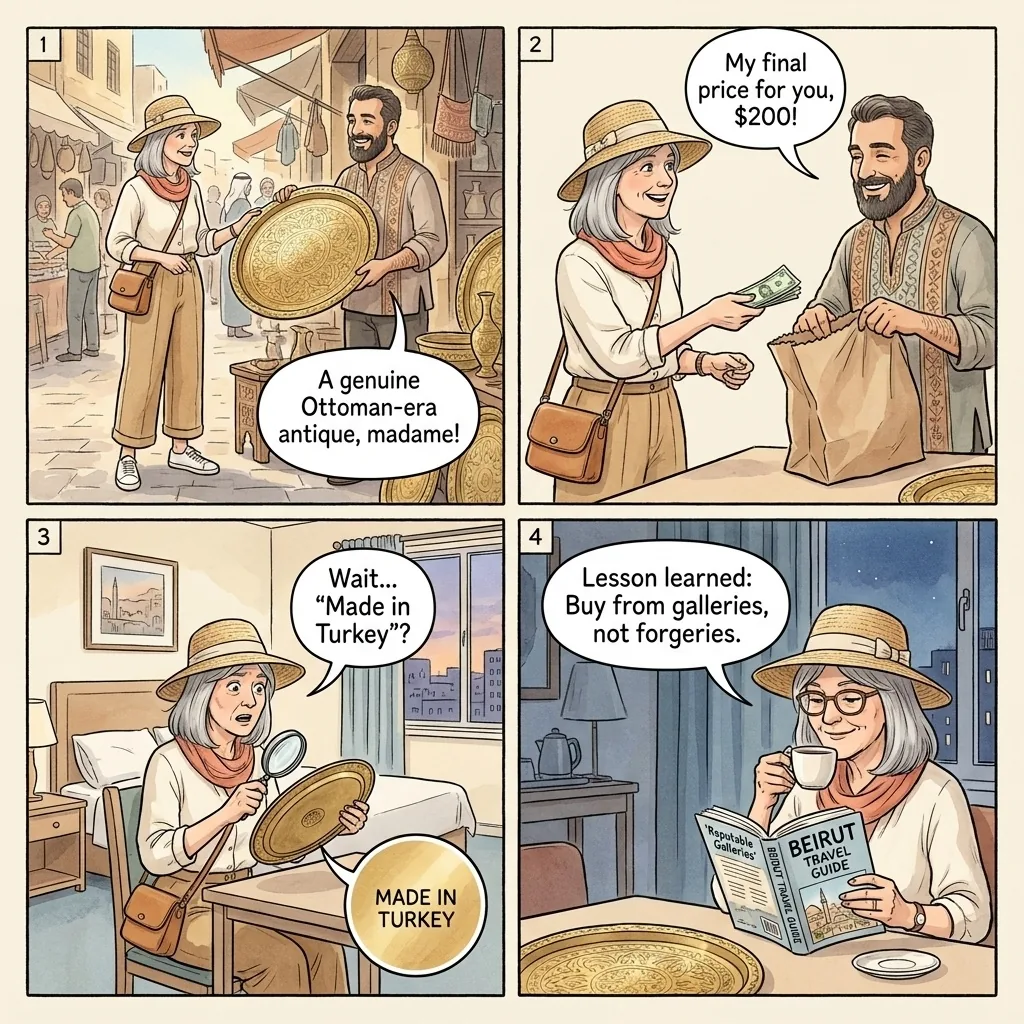
A vendor in the Beirut Souks calls a brass tray an 'Ottoman-era antique' for $300, you negotiate to $200, and discover at home it's a $30 Turkish reproduction aged with chemicals — the same playbook runs harder in Byblos where 'Phoenician' artifacts are all modern forgeries.
You are browsing the restored Beirut Souks downtown and find a beautiful brass tray that the vendor calls 'Ottoman-era antique.' He quotes $300. You negotiate down to $200 and feel good about the deal. Back home you discover it is a modern reproduction worth about $30 — mass-produced in Turkey and aged artificially with chemicals. A parallel shop in Byblos sells 'genuine Phoenician' artifacts ranging from $50 to $500, all of which are reproductions sold as authentic.
Lebanon has a well-documented counterfeit-antiques market. A numismatic study published on Snible.org examined coins purchased at the Byblos Antique Shop and found that 'all three Byzantine gold solidus coins examined were forgeries,' with one fake 'so thin and malleable that it could be folded double with the fingers.' The study notes Lebanon has a flourishing counterfeiting industry, with fakes produced locally and imported from Turkey, Syria, Greece, and Egypt.
Beyond coins, the same problem extends to 'antique' brassware, textiles, pottery, and jewelry sold across every tourist area. Some vendors operate honestly and price reproductions accordingly. Others deliberately misrepresent modern factory items as centuries-old antiques, knowing that tourists rarely have the expertise to distinguish patina-from-age from patina-from-chemicals at the moment of purchase.
The practice is especially aggressive in Byblos, where the city's archaeological reputation primes tourists to expect Phoenician relics within reach. There is a second risk: exporting genuine Lebanese antiquities without a Ministry of Culture permit is illegal and can result in confiscation and a fine on departure — so even a real antique is contraband if the vendor offered to ship it 'no paperwork.'
The defensive move is to assume every 'antique' in a tourist area is a reproduction and buy only because you like the object — never because it's 'genuine.' For authentic Lebanese craftsmanship, visit the Lebanese Artisan Association or L'Artisan du Liban for fixed-price work with provenance. For purchases over $100, demand a written authenticity certificate plus the vendor's business registration. The Ministry of Culture (+961-1-981-115) handles export permits for any item over 100 years old.
Red Flags
- The vendor describes an item as an 'antique' from the Ottoman, Phoenician, or Roman period but cannot provide provenance documentation
- The price has been dramatically reduced from the initial asking price — genuine antiques do not drop 70% in negotiation
- Multiple 'identical' antiques are available — real antiques are one-of-a-kind, not produced in sets
- The aging on the item looks artificial — uniform patina, chemical darkening, or machine-made wear patterns
- The shop is in a heavy tourist zone and the vendor specifically targets foreign visitors while ignoring local customers
How to Avoid
- Assume all 'antiques' in tourist areas are reproductions unless you have expert knowledge — buy them because you like them, not because they are 'genuine.'
- If you want authentic Lebanese craftsmanship, visit established galleries and cooperatives like the Lebanese Artisan Association or L'Artisan du Liban.
- For any purchase over $100, ask for a written authenticity certificate and the vendor's business registration — legitimate dealers provide these.
- Be aware that exporting genuine antiquities from Lebanon is illegal without a government permit — if a vendor offers to ship an 'antique' with no paperwork, it is either fake or illegal.
- Shop at fixed-price stores in Saifi Village or Beirut Souks for quality Lebanese souvenirs at transparent prices.
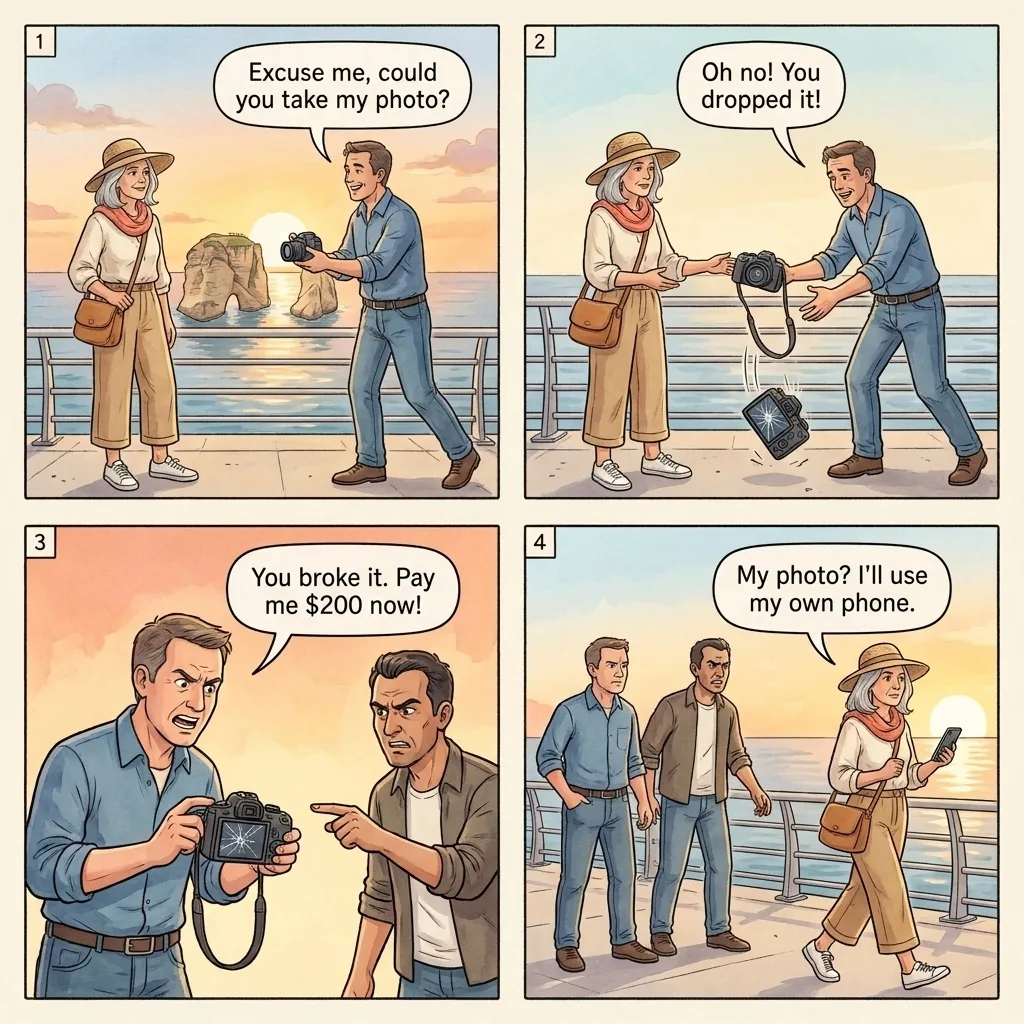
A friendly man at the Pigeon Rocks viewpoint asks you to take his photo, 'fumbles' the handoff so the camera drops and cracks, then his accomplice arrives demanding $200–$300 in cash — the camera was already broken before he approached you, the crack hidden by his palm.
You are admiring the view at Pigeon Rocks in Raouché when a friendly man asks if you could take a photo of him with his camera. You agree. He hands it over, and as you reach for it, he 'accidentally' drops it. The screen cracks. He becomes upset, accuses you of breaking his camera, and demands $200–$300 to replace it. A friend of his appears within seconds and pressures you to pay.
The whole thing is staged. The camera was already broken before he approached you — the cracked screen was covered by his hand during the handoff. The 'fumble' is choreographed so you feel responsible the instant the device hits the ground. The friend's 'arrival' is rehearsed: he was watching the whole time, waiting for the moment of damage to step in as a corroborating witness.
The broken-camera scam is documented in WikiForTravel's Beirut tourist scam guide as a known scheme targeting visitors at popular photo spots. The technique relies entirely on social pressure: the scammer creates a situation where you feel responsible for the damage and a small crowd is forming. Variations swap the camera for a phone, a pair of sunglasses, or a fragile souvenir — the mechanic is identical, only the prop changes.
The scam clusters at the Pigeon Rocks viewpoint along the Raouché Corniche, the broader Corniche promenade, and Martyrs' Square — locations where tourists are already holding their own cameras and are in a photo-taking mindset. The friendly approach feels organic; the script begins the second you reach out to receive the device.
The defensive move is to politely decline to take photos for strangers or hold their belongings — say you are in a hurry and keep walking. If you do help, let the person place the device into your hand rather than reaching for it during a handoff (eliminates the fumble vector). If a scam attempt occurs, stay calm and refuse to pay; you have no legal obligation for accidental damage to a stranger's property, especially in a staged scenario. Walk to a public area and call ISF on 112 or the tourist line 1735 if pressured.
Red Flags
- A stranger at a tourist spot asks you to take their photo or hold an item — they specifically approach tourists, not locals
- The handoff of the camera or phone seems awkward or deliberately fumbled to create a 'drop'
- A second person appears immediately after the item breaks, backing up the scammer's claims — they were watching the whole time
- The scammer demands a specific cash amount on the spot and refuses to exchange insurance information or contact details
- The 'broken' item is an older or cheaper model, but the demanded compensation suggests a premium device
How to Avoid
- Politely decline to take photos for strangers or hold their belongings — say you are in a hurry.
- If you do agree to help, let the person place the camera or phone in your hands rather than grabbing for it during a handoff.
- If a scam attempt occurs, stay calm and refuse to pay — say you will call the police (112) and let them sort it out.
- Walk away from anyone who becomes aggressive about a 'broken' item — do not engage or negotiate.
- Remember that you have no legal obligation to pay for accidental damage to a stranger's belongings, especially in a staged scenario.
🆘 What to Do If You Get Scammed
📋 File a Police Report
Go to the nearest Internal Security Forces (ISF / Quwwa al-Amn ad-Dakhili) station. Call 112. Get an official crime report — you'll need this for insurance claims. You can also report online at isf.gov.lb.
💳 Cancel Your Cards
Call your bank immediately. Most have 24/7 numbers on the back of the card (keep a photo saved separately). Block any suspicious transactions before the thieves use your details.
🛂 Lost Passport?
Contact the US Embassy in Beirut at Awkar, facing the Municipality. Phone: +961-4-542-600. For after-hours emergencies: +961-4-543-600. Other nationalities should check their embassy or consulate location in the Beirut area.
📱 Track Your Device
If your phone was stolen, use Find My (iPhone) or Find My Device (Android) from another device. Don't confront thieves yourself — share the location with police instead.
Frequently Asked Questions
You just read 7 scams in Beirut. The full Travel Safety Series has 780+ more across 20+ countries.
Tokyo's Kabukichō ¥130,000 bar trap. Rome's gladiator photo extortion. Paris's gold-ring trick. Bali's ATM skimmer scams. Bangkok's grand-palace closure ruse. Every documented scam across 20+ destinations — with the exact scripts, red flags, and local-language phrases that shut each one down. Drawn from Reddit traveler reports, embassy advisories, and consumer-protection cases.
- 780+ documented scams across Tokyo, Rome, Paris, Bali, Bangkok, Rio & 100+ more cities
- 20+ countries covered, with country-by-country phrase cards for every destination
- Updated annually — buy once, re-download future editions free
- All titles $4.99 each on Amazon Kindle