
Key Takeaways
- The #1 reported scam is the Boracay 'Beachfront Booth' Phantom Tour.
- 2 of 3 scams are rated high risk.
- Use official taxi ranks or local ride apps where available — always confirm the fare before departure.
- Never accept unsolicited offers from strangers near tourist sites in Boracay.
⚡ Quick Safety Tips
- Keep phones and valuables in secure pockets when in crowded areas.
- Use only licensed taxis or app-based ride services.
- Book tours and tickets through verified operators with online reviews.
- Keep a copy of your passport separate from the original.
Jump to a Scam
The 3 Scams
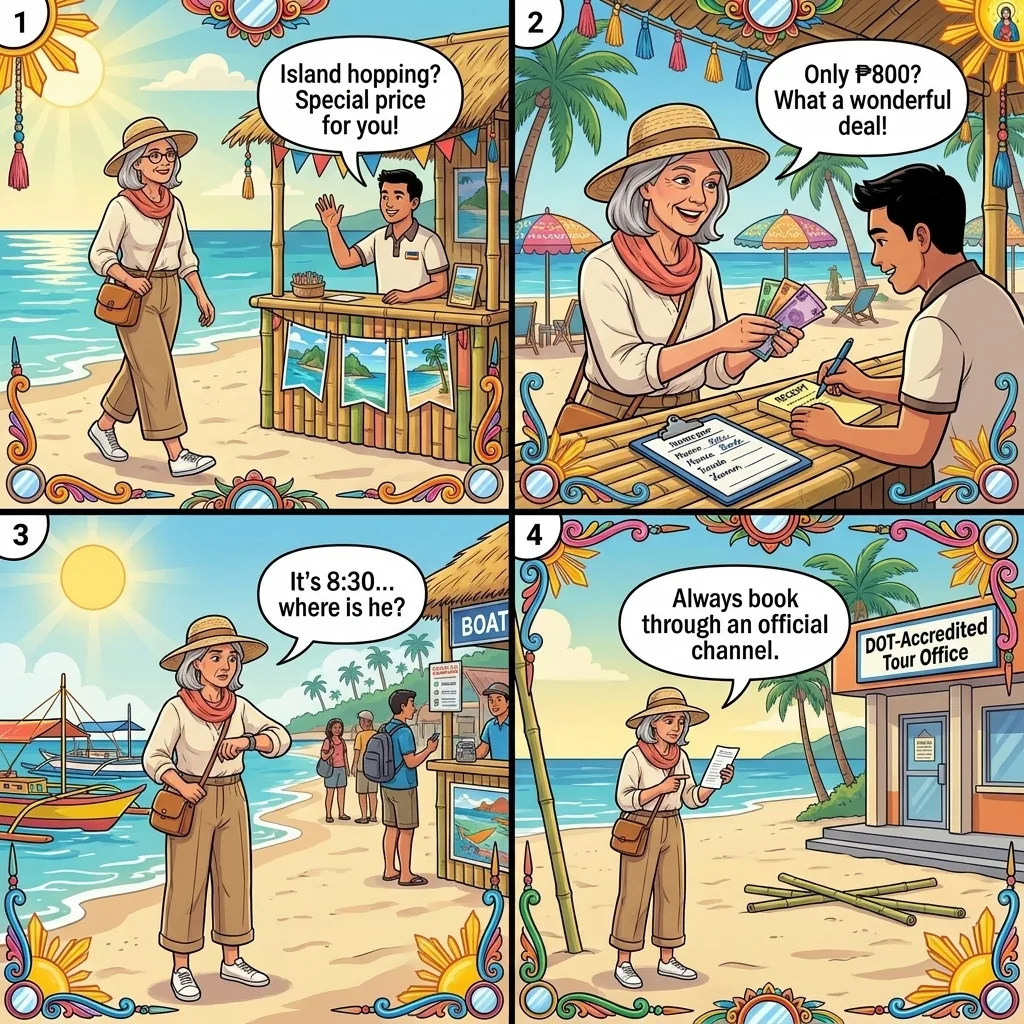
A young man at a bamboo booth between Stations 2 and 3 calls you over and offers a 'special' island-hopping plus Crystal Cove plus snorkeling package for ₱800 per person — half the price your hotel's tour desk quoted that morning.
The booth has a printed banner with photos of crocodile-shaped Crocodile Island and the famous tholo (sandbar) at Puka Beach, a clipboard with a few names already written down, and a confident pitch in fluent English. He asks for full payment in cash to 'reserve the boat,' tears off the bottom of a generic receipt pad, and tells you to meet at the Station 1 boatmen's beach entrance at 8 a.m. tomorrow. There is no DOT accreditation number on the receipt and no follow-up email confirmation.
In the morning you walk to Station 1 at the agreed time. Nobody is there. You wait fifteen minutes, then thirty, then walk back along the beach to where the booth was — and the booth is gone. The bamboo frame has been folded down, the banner is rolled up, and the young man has moved a few hundred meters down the strip or vanished into the warren of side streets behind D'Mall. The receipt has no operator name, no phone number that picks up, and no recourse.
The Malay-Boracay Tourism Office has issued repeated warnings since 2024 about unregistered operators flooding White Beach during peak season, with online and beachfront booking fraud rising sharply. The Department of Tourism enforcement teams sweep the strip periodically and confiscate unlicensed booths, but the operators rebuild within a day or two further down the beach. Cagban Jetty Port has its own variation: touts intercept arriving tourists at the e-trike queue with discounted island-hopping pitches and the same disappearing-booth trick.
The pricing tells the story. A legitimate DOT-accredited three-island tour with a working banca, life jackets, snorkel gear, and lunch runs ₱1,500–2,500 per person. The ₱800 sidewalk pitch is below the cost of fuel and food for a real trip — there is no actual boat behind it, only the booth. Even when a boat does show up, it is often the overloaded-bangka pattern from the Siargao guide: half the safety equipment, twice the headcount, no manifest.
Book island-hopping only through DOT-accredited operators — ask for the accreditation number, then verify it on the DOT accreditation portal before paying. Use Klook, GetYourGuide, your hotel's tour desk, or established Boracay operators like Mad Monkey, Henann, or Real Coffee Tours, and pay by credit card so a fraud chargeback is possible. If a beachfront booth quotes a price 30%+ below hotel rates and asks for cash now, walk away. If you have already paid a phantom booth, file a report at the Malay-Boracay Tourism Office near the chapel at Station 2 and at the Tourist Police on +63 2 524-1660.
Red Flags
- Price significantly below what hotels or DOT-accredited operators charge
- No official receipt or DOT accreditation number
- Booking via Facebook messenger or cash only
- Operator has no physical office
How to Avoid
- Only book with DOT-accredited operators — ask for their accreditation number.
- Book through your hotel's tour desk.
- If booking online, verify the operator on the DOT accreditation portal.
- Pay by credit card for fraud protection.
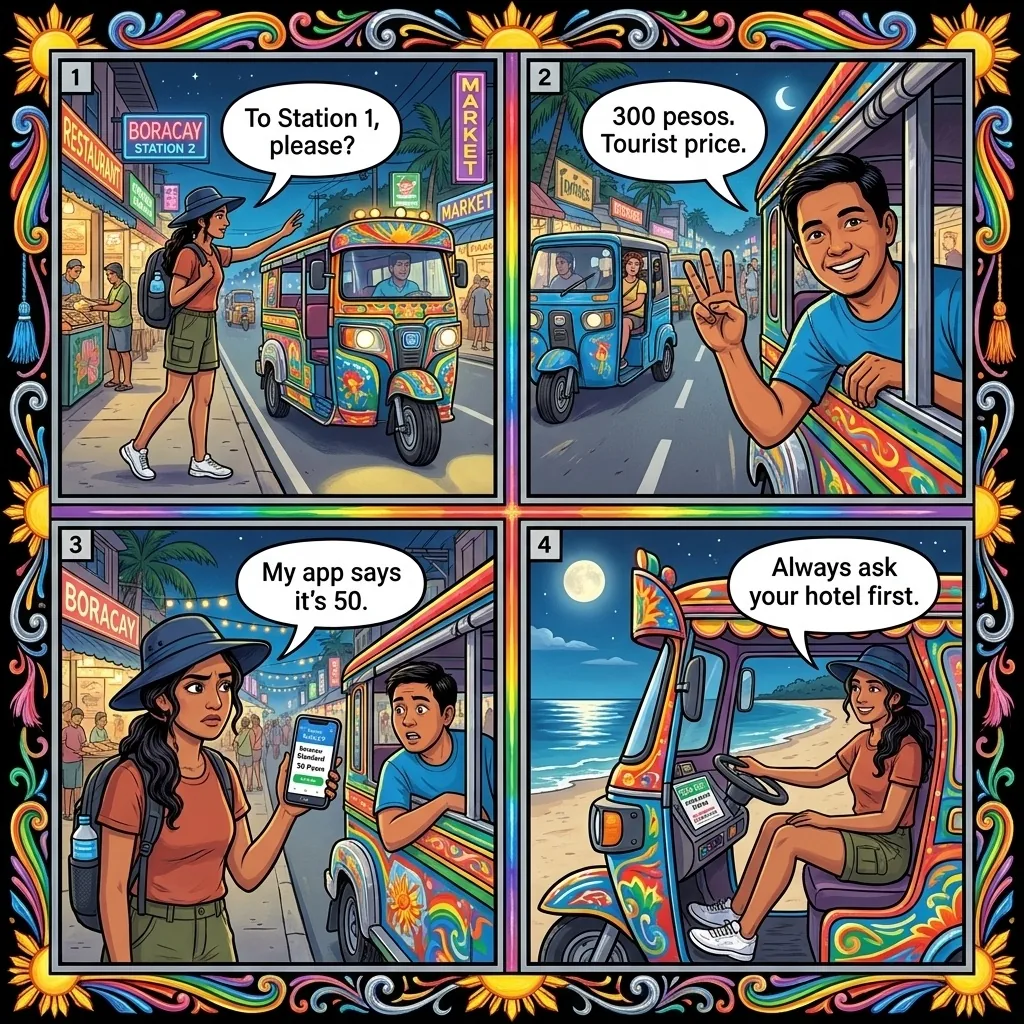
You step out of your hotel at Station 2 at nine in the evening and wave down a passing e-trike to ride twenty meters down the beach road to a restaurant near Station 3 — a five-minute ride at most.
The driver smiles, leans out, and says ₱300 in a tone that suggests it is non-negotiable. You hesitate. He shrugs and says it is the 'tourist price' or, if you wait too long, the 'night rate.' The standard local fare for that stretch is ₱20–50 per person, posted on a small sign at the Boracay Land Transportation cooperative office near D'Mall and confirmed by every hotel concierge on the island. The driver knows you do not know that.
If you accept, the ride is exactly as advertised: five minutes, no detours, no surprise fees. The whole scam is the quote itself, calibrated to look like a normal tricycle fare to someone who arrived that day and has not yet learned the island's pricing. Some drivers add a second layer for tourists they sense are even greener, taking the long way around the back roads behind Boracay Hill so the ride feels long enough to justify ₱300. The island is only seven kilometers from Yapak in the north to Manoc-Manoc in the south, so 'long' is relative.
The pattern is most aggressive at Cagban Jetty Port, where arriving travelers with luggage step off the ferry from Caticlan and have no easy way to comparison-shop. Drivers there quote ₱500–800 to Station 1 and Station 2 hotels, while the local shuttle bus runs the same route for ₱100–150. The Boracay Tricycle Operators and Drivers Association (BTODA) and the Department of Tourism have published the official rate card multiple times — between Stations 1, 2, and 3 the fare is ₱20–50 per person, and longer routes (Cagban to Station 1) cap around ₱100–150.
The e-trike drivers who run the route honestly are the majority; the gougers are a smaller subset who target obvious foreigners and luggage-laden new arrivals. Local Filipinos and longer-stay travelers rarely encounter the inflated quote because they ask for the meter equivalent or hand over a fixed coin amount and walk away. The scam survives on tourists who want to avoid the awkwardness of negotiating in a foreign language at the end of a long travel day.
Ask your hotel front desk for the current standard tricycle and e-trike fares before your first ride, write the numbers down on your phone notes (Station-to-Station ₱20–50, Cagban to your hotel ₱100–150 max), and quote them confidently before stepping in. Agree on the price out loud before the trike moves and hand over close to the exact fare in coins. The island is only 7 km long, so walking between Stations 2 and 3 along the beach is often faster than waiting for a fair fare anyway. If a driver insists on a 'tourist rate,' photograph the trike's TODA number and report it to BTODA at the D'Mall office or the Tourist Police at +63 2 524-1660.
Red Flags
- Fare quoted is 5-10x the local rate
- Driver claims special rates for tourists or time of day
- Unnecessarily long route on a very small island
How to Avoid
- Ask your hotel what the standard tricycle fare should be.
- Standard fare is ₱20-50 between stations, ₱100-150 for longer routes.
- Agree on price before getting in.
- Use Angkas or walk — the island is only 7km long.
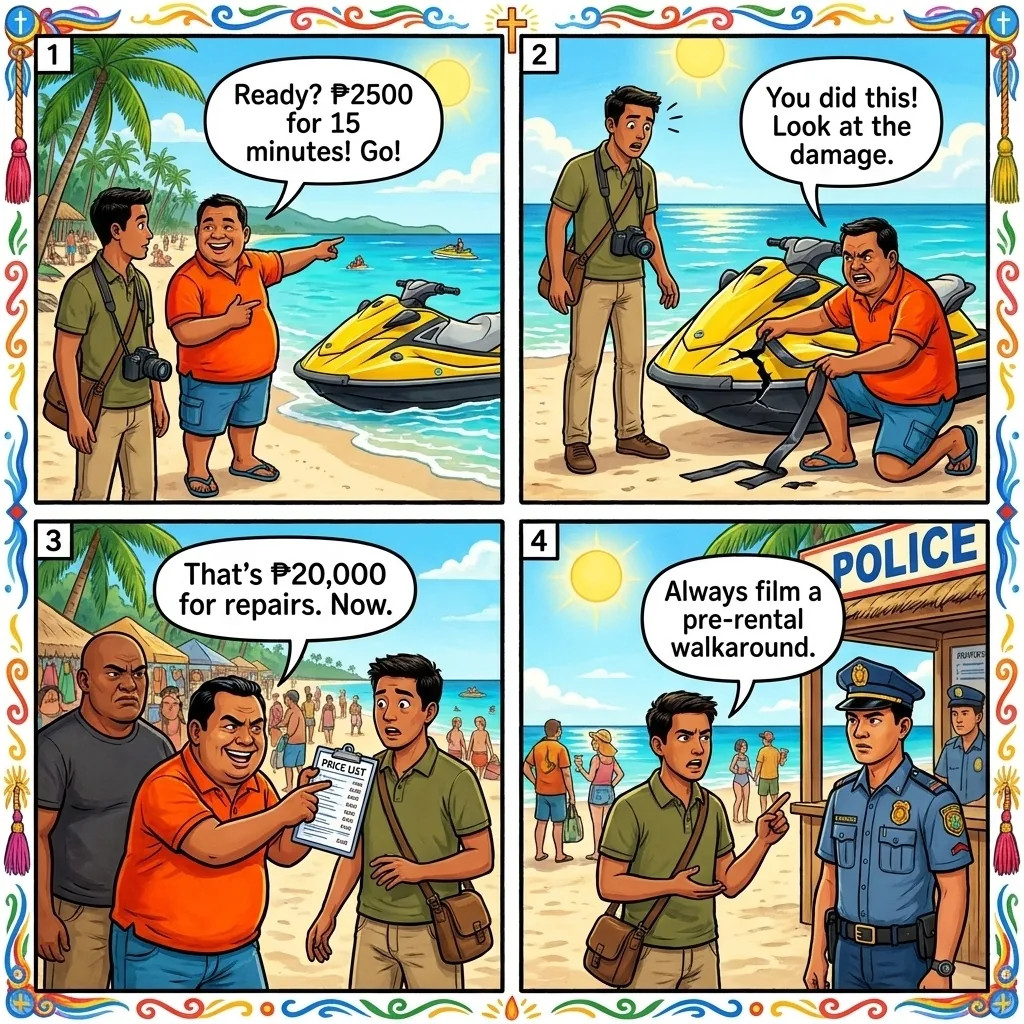
A watersports operator at the Station 2 stretch of White Beach quotes you ₱2,500 for fifteen minutes on a jet ski, gestures at a row of waiting machines on the sand, and waves you out toward the boat without going through any kind of damage inspection.
You climb on, the operator pushes you off, you spend fifteen minutes carving figure-eights past the swimming line, and you ride the machine back to the beach feeling perfectly fine. The operator pulls the jet ski up onto the sand and walks you around to the side of the hull. Then he peels back a strip of black electrical tape that was wrapped around the rear quarter panel — and underneath are scratches, a long crack, and a chipped corner that were clearly there before you ever touched the throttle.
'You did this,' he says, calm at first. He produces a quote sheet and asks for ₱15,000–50,000 for 'repairs.' His tone shifts as you protest. Two other staff appear from the booth nearby, then a third leaning on the watersports flag pole, all of them watching. Your phone is on the beach with your bag. Your passport is at the hotel. The tape was put there before you arrived to set up exactly this moment, and the whole crew is part of the play.
The tape-and-pre-existing-damage scam runs the same playbook here that it does in Phuket and Pattaya, and Reddit plus the Boracay TripAdvisor forum have first-person accounts going back years. The damage is real but old, the tape covers it deliberately, and the price quoted bears no relation to actual repair cost — it is calibrated to whatever the watersports crew thinks they can extract on the spot. Once you have ridden the machine, the dispute reduces to your word against four locals on a beach.
Real Boracay operators do exist and are legitimate, especially the larger watersports concessions at Stations 1 and 3 with branded shirts, posted price lists, and a written waiver process. The tape-trick crews tend to operate from smaller pop-up setups along the Station 2 stretch and on the Bulabog side, where supervision is thinner and turnover of staff makes accountability harder. The five-minute pre-ride photo and video sweep is the only meaningful defense.
Before paying for any jet ski rental, walk around the hull with your phone in video mode and narrate what you see — pull up every piece of tape and every sticker, and film the operator visibly in frame as you do. Refuse to ride if anything is taped over. Better still, skip jet skis on Boracay entirely; paraw sailboats, parasailing with the larger Station 1 operators, and kiteboarding carry far less damage-claim risk. If a crew demands fake-damage payment, dial 911 or 117 for police, call the Tourist Police at +63 2 524-1660, and walk to the Malay-Boracay Tourism Office to file a report.
Red Flags
- Tape or stickers on the hull that seem oddly placed
- No pre-ride damage inspection offered
- Operator becomes aggressive when you deny causing damage
How to Avoid
- Video the entire jet ski including under all tape/stickers before riding.
- Take photos with the operator visible in frame for proof of condition.
- If confronted, stay calm and call the Tourism Police or barangay hall.
- Consider skipping jet skis entirely — this scam is extremely common.
🆘 What to Do If You Get Scammed
📋 File a Police Report
Go to the nearest Philippine National Police (PNP) station. Call 911 or 117 (PNP Hotline). Get an official crime report — you'll need this for insurance claims. You can also report online at pnp.gov.ph.
💳 Cancel Your Cards
Call your bank immediately. Most have 24/7 numbers on the back of the card (keep a photo saved separately). Block any suspicious transactions before the thieves use your details.
🛂 Lost Passport?
Contact your nearest embassy or consulate. The US Embassy in Manila is at 1201 Roxas Boulevard, Ermita, Manila 1000. For emergencies: +63 2-5301-2000.
📱 Track Your Device
If your phone was stolen, use Find My (iPhone) or Find My Device (Android) from another device. Don't confront thieves yourself — share the location with police instead.
Frequently Asked Questions
You just read 3 scams in Boracay. The full Travel Safety Series has 780+ more across 20+ countries.
Tokyo's Kabukichō ¥130,000 bar trap. Rome's gladiator photo extortion. Paris's gold-ring trick. Bali's ATM skimmer scams. Bangkok's grand-palace closure ruse. Every documented scam across 20+ destinations — with the exact scripts, red flags, and local-language phrases that shut each one down. Drawn from Reddit traveler reports, embassy advisories, and consumer-protection cases.
- 780+ documented scams across Tokyo, Rome, Paris, Bali, Bangkok, Rio & 100+ more cities
- 20+ countries covered, with country-by-country phrase cards for every destination
- Updated annually — buy once, re-download future editions free
- All titles $4.99 each on Amazon Kindle