
Key Takeaways
- The #1 reported scam is the NAIA Terminal-Touts Flat-Rate Quote.
- 3 of 6 scams are rated high risk.
- Use official taxi ranks or local ride apps where available — always confirm the fare before departure.
- Never accept unsolicited offers from strangers near tourist sites in Manila.
⚡ Quick Safety Tips
- Use Grab exclusively for transportation — regular taxis in Manila frequently have rigged meters or refuse to use them entirely.
- In Intramuros and Rizal Park, ignore anyone offering unsolicited tours or 'help' getting somewhere — it invariably leads to a request for money.
- Keep phones and valuables completely hidden in crowded areas like Divisoria Market — phone snatching and pickpocketing are extremely common.
- Never exchange money on the street — use bank ATMs or licensed exchange offices in shopping malls.
Jump to a Scam
The 6 Scams
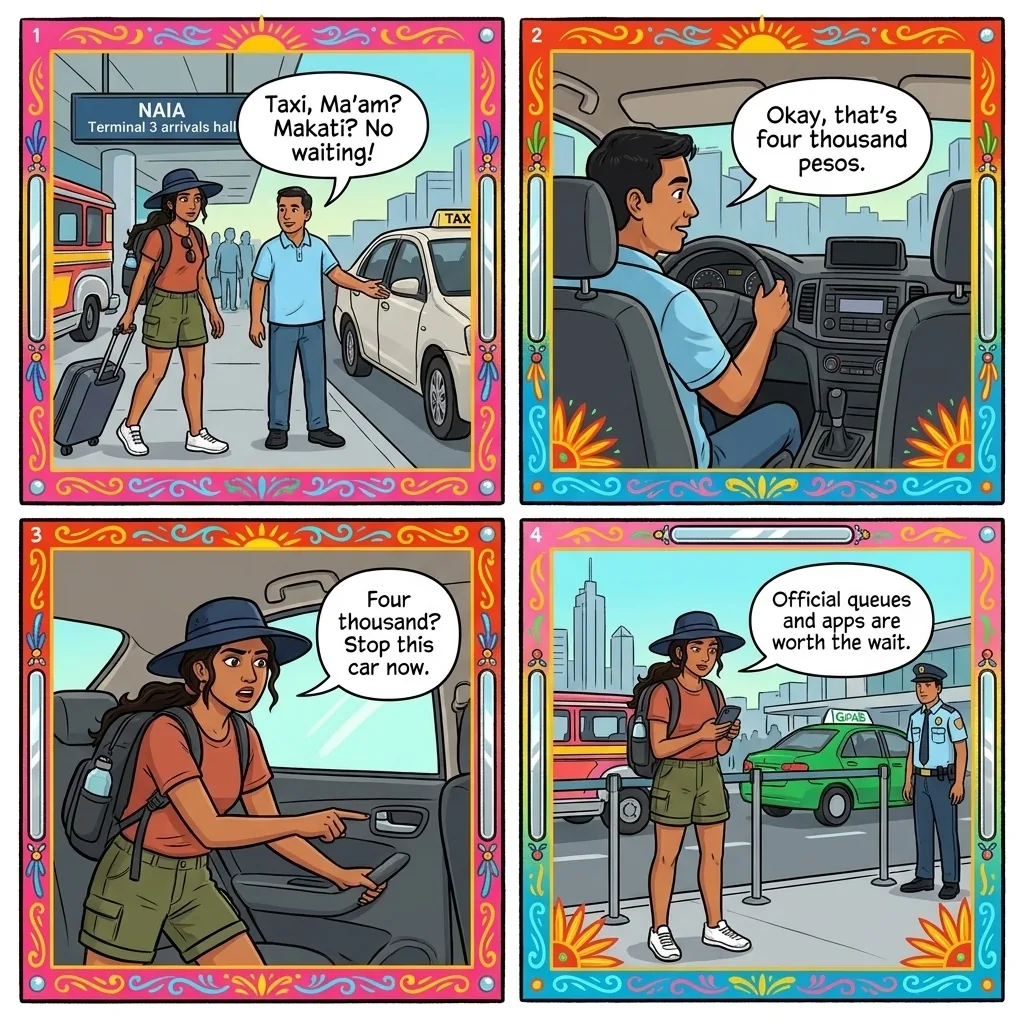
You walk out of NAIA Terminal 3 with a single rolling bag and a hotel pin in Makati on your phone, and a man in a polo shirt waves you toward a white sedan parked just past the official taxi line.
He picks up your bag before you have agreed to anything, tells you he will get you to your hotel quickly, and slides into the driver's seat. As he pulls away from the curb, he glances back and quotes ₱4,000 for the trip. You ask about the meter. He shakes his head — 'meter broken, sir' — and adds something about a 'fixed airport rate' that does not exist. The metered fare from NAIA to Makati runs roughly ₱200–300 plus a small terminal surcharge.
The fourteen-times-meter quote is the headline version, but the same touts run several variants. One charges ₱4,000 for the free inter-terminal shuttle between T1 and T3 — a five-minute ride on a service that is signposted as 'free' inside the arrivals hall. Another quotes a 'discounted' ₱1,800 only after a long pre-amble about traffic and surge pricing. The common thread is that the price is named after you are already in the car, when refusing means hauling your bag back through Customs traffic on foot.
NAIA airport overcharging is the most consistent tourist scam reported on the Philippines subreddit and on the long-running TripAdvisor Manila forums, and the Department of Tourism has flagged it repeatedly across 2024 and 2025. Touts work the curbside outside arrivals at all four terminals, especially T1 and T3, intercepting foreigners before they reach the official MIAA-licensed yellow-cab queues. The yellow MIAA airport taxis use the meter by law plus a fixed ₱70 terminal fee; coupon taxis quote a flat fare upfront from a posted board.
The cleanest fix is to skip every curbside conversation entirely. Grab works on the NAIA Wi-Fi, the pickup zone is signposted at every terminal, and the fare to Makati is fixed in the app at roughly ₱350–500 including surge. The MIAA yellow taxis at the official stand are the next best option, and the coupon-taxi booth inside arrivals is fine if you read the rate board first. Anyone approaching you outside the official queues is, by definition, not part of those systems.
Book Grab on the airport Wi-Fi before walking outside, follow the green signs to the Grab pickup zone, and ignore every driver who approaches you on the curb. If Grab is unavailable, use the MIAA yellow-cab queue and; reports confirm 'meter, please' before sitting down — the driver will start the meter and add the ₱70 terminal fee at the end. Photograph the plate and operator card on the dashboard, follow the route in Google Maps, and never let a driver who refuses the meter take your bag. If a tout overcharges, dial 911 for emergencies, the Tourist Police on +63 2 524-1660, or report to the MIAA Customer Care desk inside arrivals.
Red Flags
- Driver quotes flat rate before you state your destination
- Driver says meter is broken or unavailable
- Unlicensed taxi touts approach you before you reach the official queue
How to Avoid
- Use Grab (rideshare app) from the designated Grab pickup zones at each terminal.
- Or use the official airport taxi counters inside arrivals where rates are metered.
- Never get in a taxi that won't run the meter — walk away.
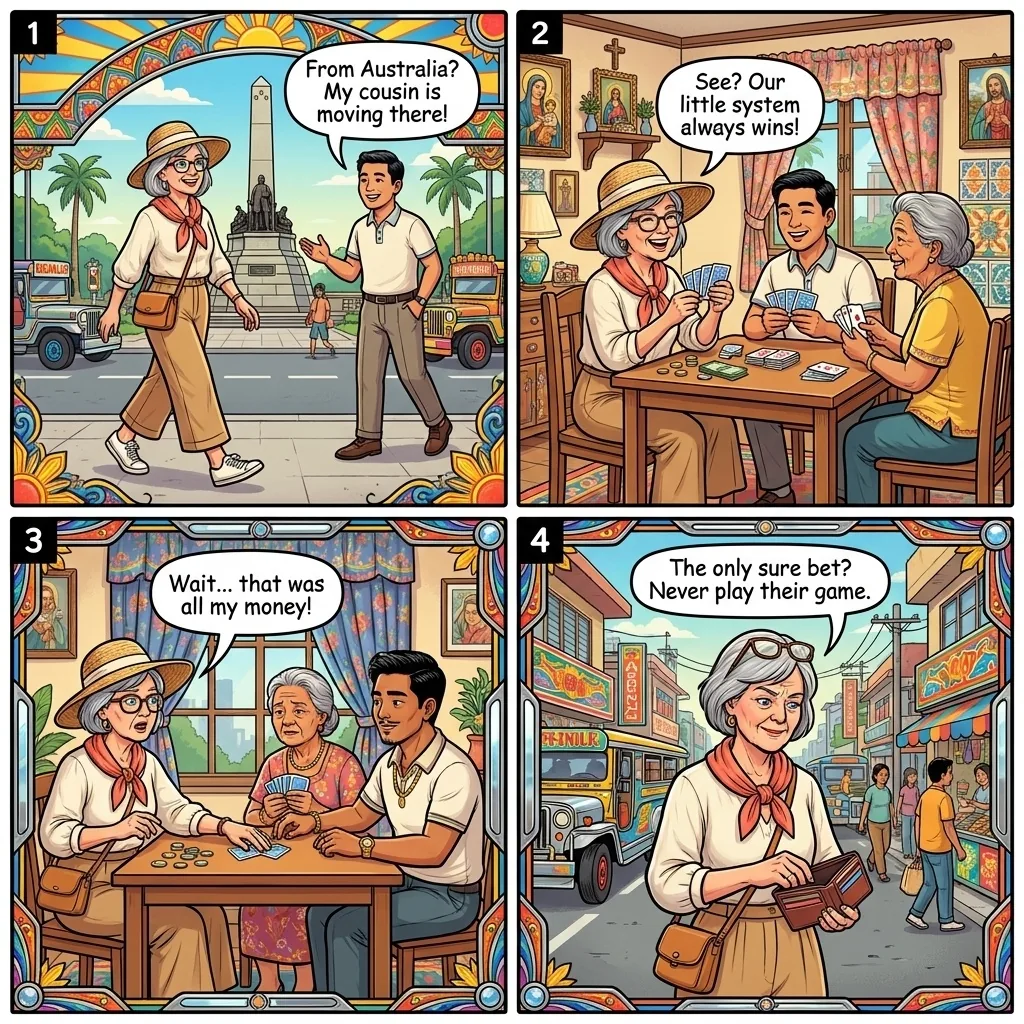
You are walking near Rizal Park on your second afternoon in Manila when a smiling, well-dressed Filipino in his thirties falls into step beside you and starts a friendly conversation about where you are from.
He says he studied in your country — Toronto, or San Diego, or Brisbane, whichever matches your accent — and is back in Manila visiting family. His sister or his cousin or his auntie is a nurse who is about to leave for a job in your hometown, he says, and she would love to ask you a few questions about life there. His English is fluent, his manner is warm, and he is careful never to ask for anything. After ten minutes you feel like you have made an unexpected friend.
He gestures up the block and offers to bring you home for a quick coffee — just to meet his sister, just for fifteen minutes. The house is on a quiet side street, the auntie meets you at the door with mango, and a relative pulls out a deck of cards 'just to teach you a Filipino game.' You play a few rounds for tiny stakes and somehow keep winning. They show you a 'system' they use to win against a wealthy local who is about to arrive — if you put in some money, they will play it for you and split the winnings.
From there the play tightens. The wealthy player arrives, the bets escalate quickly, and the rigged streak that was running in your favor flips at exactly the moment your stake is highest. By the time the hand is over, you have lost everything you brought to play with — and often whatever you can withdraw at the ATM the auntie offers to drive you to. The whole house is part of the operation: the sister, the auntie, the cousin who 'happened' to walk in, the wealthy mark, the dealer.
The Manila card-game scam is among the most consistently reported high-loss tourist scams in the Philippines. The U.S. Embassy in Manila has warned about it for years; Reddit and the long-running Lonely Planet Thorn Tree threads are full of first-person accounts running from ₱30,000 up to several thousand dollars. The opener almost always involves a flattering connection to your home country, a 'sister leaving for a job there,' and a private home you have no reason to enter — the choreography is consistent across decades.
Treat any stranger in Ermita, Malate, or near Rizal Park who claims a personal connection to your country as a setup until proven otherwise — the opener is the scam. Never follow a new acquaintance to a private home, an apartment, or a 'sister's place,' however polite the invitation. Decline the card game even if no money is mentioned; once the deck appears, the trap has already been set, and the system that has you 'winning' is rigged to flip the moment your stake matters. If you have already lost money, dial 911 or 117 for police and call the Tourist Police at +63 2 524-1660 — the embassy can also help if you report quickly.
Red Flags
- Stranger claims connection to your home country immediately
- Invitation to a private home or apartment within minutes of meeting
- Card game presented as a way to 'help them win money'
How to Avoid
- Never follow a stranger you just met to a private residence.
- The 'friendly local with a connection to your home country' opener is the most common Manila scam intro.
- If invited anywhere private within minutes of meeting someone, politely decline and leave.
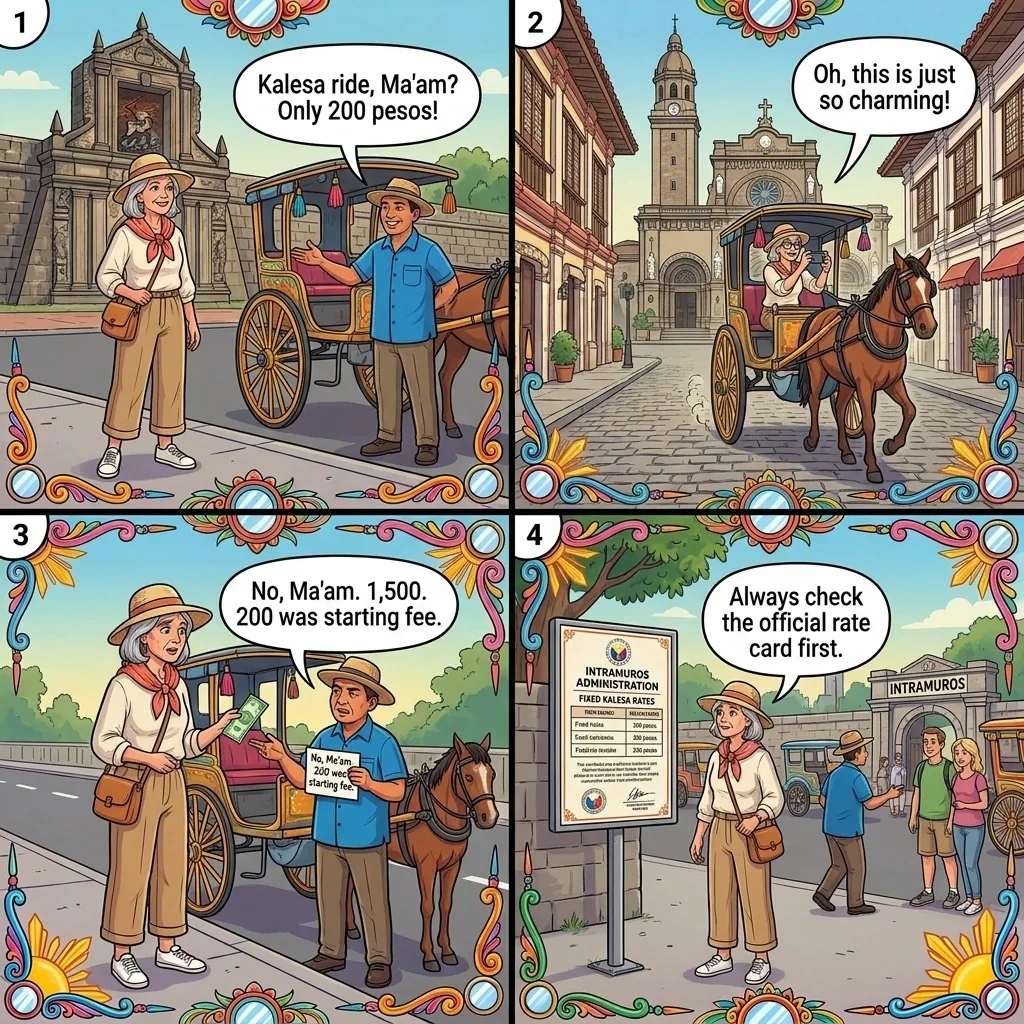
You walk into Intramuros through the main gate near Fort Santiago, a kalesa driver waves you over with a wide smile, and you ask the price for a quick ride around the walled city.
He pats the bench seat and says ₱200, no problem, very fair. You think the price is reasonable for a horse-drawn carriage and a slow loop past San Agustin Church and the Manila Cathedral. The driver flicks the reins, the kalesa rolls onto the cobblestones, and for forty minutes you take photos, hear a tour-guide narration, and stop briefly at a souvenir stand the driver knows. The afternoon feels like exactly the romantic Intramuros experience you came for.
When you climb down at the gate, the driver names a different number. The bill is ₱1,500. The ₱200, he explains calmly, was the 'starting fee' or 'flag-down rate.' The actual tour price was ₱1,500, which he insists you must have understood when he said 'two hundred to start.' Bystanders, often other kalesa drivers, drift over and quietly side with him. You can pay or argue in front of a small crowd while your driver stands beside the horse waiting.
The 'starting fee' switch is documented in long-running TripAdvisor and Reddit Manila threads. The Intramuros Administration has actually posted official rate cards at major stops — the agreed kalesa rates run roughly ₱350 for thirty minutes and ₱600 for an hour for up to four passengers — but enforcement is patchy and many drivers operate well outside the posted system. Souvenir-stand kickbacks add another layer; some drivers route to specific shops where they earn a percentage of any purchase.
The ambiguity is what makes the play work. A casual ₱200 sounds like a price; framed retroactively as a 'starting fee,' it becomes a deposit toward an undisclosed total. Most travelers do not negotiate hard during the ride because the experience feels pleasant and the driver is friendly, and the price reveal at the end is calibrated to the moment refusal feels socially uncomfortable in front of bystanders.
Lock the price in writing before the kalesa moves — ask 'What is the TOTAL price for the full ride back to this same gate?' and have the driver write it on paper. Walk to the official rate cards near Plaza Roma and the Fort Santiago entrance and quote those numbers (₱350 for 30 minutes, ₱600 for an hour). Pay only the agreed amount in exact change, and refuse any 'souvenir stop' you did not ask for. If a driver demands more, photograph the kalesa number and call the Tourist Police at +63 2 524-1660 or walk to the Intramuros Administration office to file a complaint.
Red Flags
- Price quoted verbally without showing a rate card
- Vague description of what the quoted price covers
- Driver initiates the ride before price is fully agreed
How to Avoid
- Ask specifically: 'What is the TOTAL price for the full ride back to this point?'
- Official kalesa rates in Intramuros are posted — look for the tourism board rate card.
- Pay only the pre-agreed amount — have exact change ready.
Like what you're reading? Get a full Manila itinerary with safety tips built in.
Browse travel-safety books →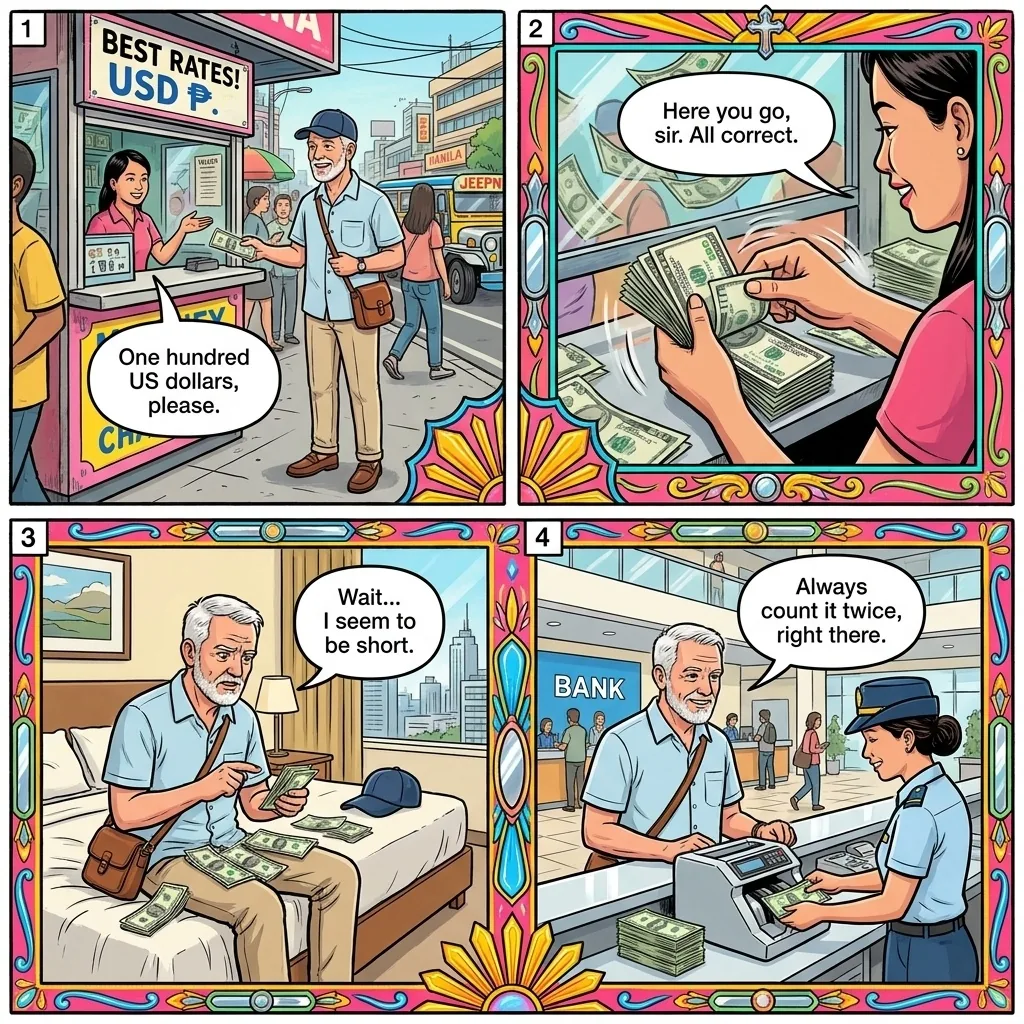
You walk into a small money-changer kiosk on A. Mabini Street in Ermita, drawn in by a hand-painted board advertising a rate slightly better than the bank.
You hand over $100 USD and ask for pesos. The teller is friendly, the rate looks correct, and she pulls a stack of bills from a drawer below the counter. She counts them out across the glass in a rapid fan — five hundreds, then a thousand, then more, the bills moving so quickly the eye cannot keep up. She taps the stack square, slides it into an envelope, and says 'thank you, sir' before the next customer steps up.
Back at your hotel you tip the bills out on the bed and recount. You are short by ₱400, sometimes ₱500, sometimes more. There is no obvious gap in the count; the teller used a quick-hand technique, often folding two bills as one or palming a note under her thumb on the way to the stack. Locals call this the 'quick hand' or palabas, and it is consistent enough that the expat forums on Reddit treat it as a baseline risk of using independent changers.
The scam is well-documented across multiple sources. The Bangko Sentral ng Pilipinas has issued advisories about non-bank money-changer practices in tourist districts, and Guide to the Philippines, Respicio Law, and the Philippines Expats Facebook group all describe the technique in detail. A second variation slips a counterfeit ₱500 or ₱1,000 note into the stack — the math looks right, but two bills will not be accepted at your hotel or at most retail counters when you try to spend them.
The kiosks themselves are often legitimate businesses with a license tucked behind the glass, which makes the sleight harder to spot. The teller is a fast counter by trade, and for most foreign customers the unfamiliar bills and the speed of the fan make verification almost impossible without slowing the transaction down. The fix is simply to slow it down, even when there is a queue behind you and the teller looks impatient.
Calculate the expected peso amount on your phone before handing over any USD, then count every single bill yourself across the counter before stepping away — say 'I need to count this' and ignore any rush. Use mall-based changers (Czarina at Ayala Center, Sanry's at SM Mall of Asia) or established Ermita branches with cameras and posted licenses, and avoid changers without a visible BSP-issued license. ATMs from BDO, BPI, and Metrobank give the safest rate after fees. If a kiosk shorts you, take photos of the counter and any receipt, and report it to the Tourist Police at +63 2 524-1660 and the BSP counterfeit hotline at +63 2 524-7141.
Red Flags
- Teller counts money very quickly and hands it over immediately
- Money counted behind a partition or below the counter
- Teller urges you to move aside quickly for the next customer
How to Avoid
- Count every bill yourself, in front of the teller, before leaving the counter.
- Use ATMs or hotel exchange desks instead of street money changers.
- Say clearly 'I need to count this' and do not be rushed.
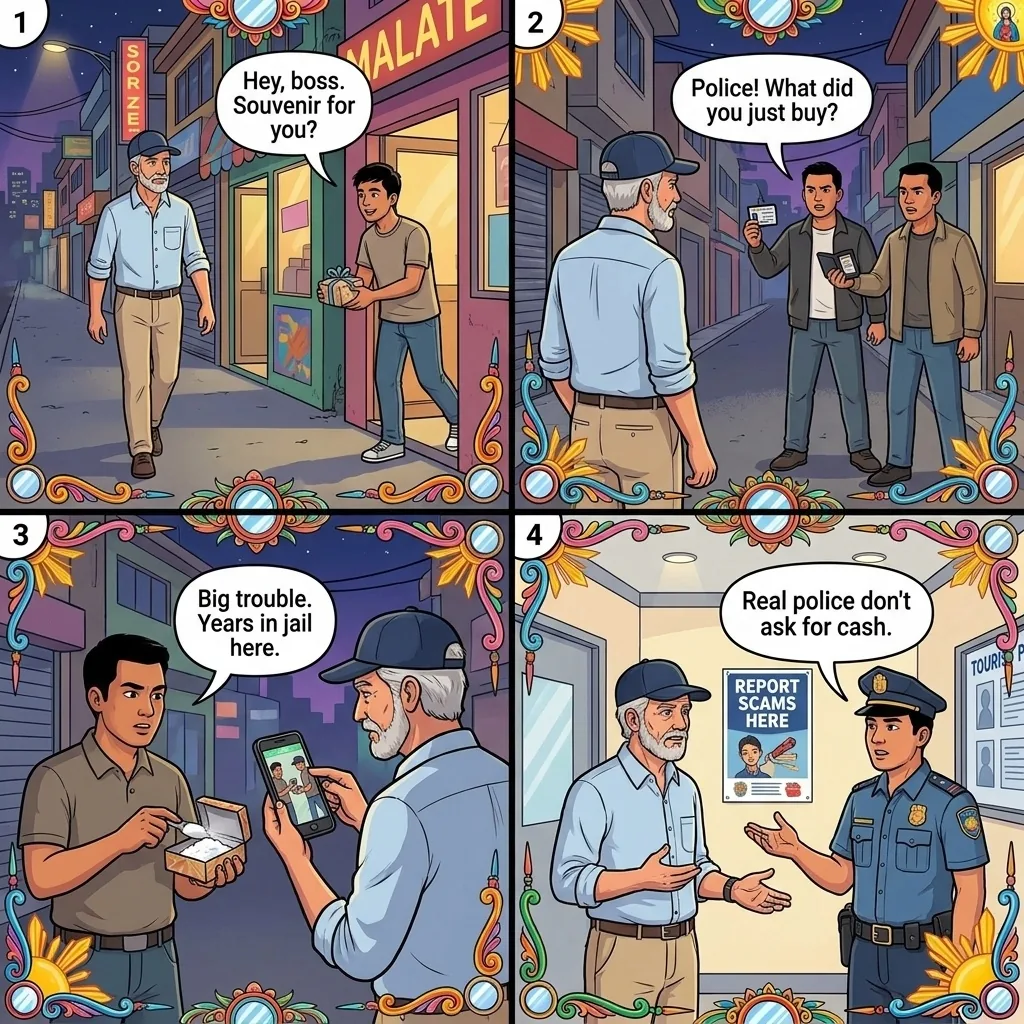
It's late on your second night in Manila and you are walking back to your hotel down a side street in Malate when a young guy steps out from a doorway and offers you something quietly — a souvenir, a token, a small package.
You hand over a few hundred pesos to make the awkward encounter end, take whatever it is, and slip it into your pocket without looking closely. The seller nods and disappears into another doorway. Forty meters down the block, two men in plainclothes step in front of you, flash IDs that look official from a distance, and announce they are police. They ask what is in your pocket. They have just watched you make a 'drug purchase.'
From there the script is fast. They open the package — sometimes it is actually a small amount of marijuana or a powder, sometimes it is a flour-filled wrap that is dressed up to look like one. They show you a phone with a photo of you and the seller talking, taken from down the block. They tell you the offense carries serious jail time in the Philippines, and that an arrest tonight means a missed flight, a court appearance, and an embassy call. Then they offer a way out: a 'fine' paid on the spot, in cash, USD if possible. Often $300–500, sometimes more.
The seller and the 'police' are the same operation. The U.S. Embassy in Manila has warned about this scam for years, and Reddit and TripAdvisor's Manila forum carry first-person accounts every few months. Real Philippine National Police officers do not collect cash fines on the street; they take suspects to the station, document arrests, and follow due process. A demand for cash to make a charge disappear, especially in a side-street setting after dark, is the signature of the shakedown.
The trap closes around the moment of fear. Most travelers reach for their wallet within ninety seconds because the consequences sound serious and the alternative — a Philippine police station at midnight, with no embassy contact and no lawyer — sounds worse. The fake officers know this and pace the conversation accordingly, alternating between threat and 'we're trying to help you' framing until the cash is in their hand.
Never buy anything from a stranger in Manila's entertainment districts after dark — there is no benign version of that interaction in Malate, Ermita, or P. Burgos. If a 'police officer' demands a cash fine on the street, refuse, ask for a uniformed officer in a marked car, and insist on going to an actual police station; real PNP officers will comply, and the shakedown crew will melt away. Keep your embassy's emergency number saved on your phone (US Embassy Manila: +63 2-5301-2000) and do not show large amounts of cash. If you are pressured, dial 911 or 117 immediately and call the Tourist Police at +63 2 524-1660.
Red Flags
- Strangers approaching you in entertainment districts offering goods
- Police who appear immediately after a street purchase
- Demand for cash 'fine' paid directly to the officer rather than at a station
How to Avoid
- Never buy anything from street sellers in Manila's entertainment districts.
- Real Philippine police do not collect cash fines on the street.
- If approached, insist on going to the actual police station — scammers will back down.
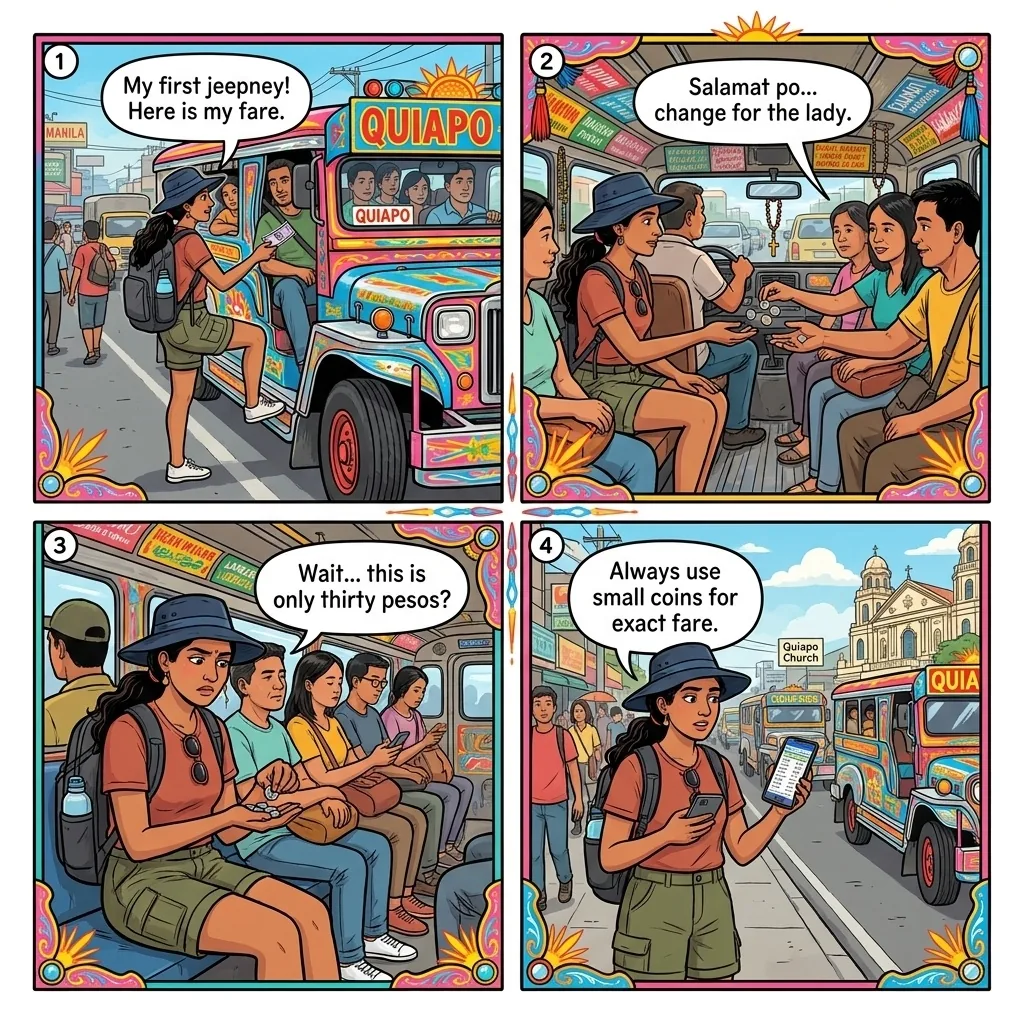
You climb into a jeepney for the iconic Manila experience, take a seat on the long bench, and hand a ₱100 bill forward when the barker calls for fares.
The other passengers are passing coins forward in a smooth chain — ₱13 here, ₱15 there — and your bill threads through several hands until it reaches the driver. A few seconds later, change comes back through the same chain. You count it: ₱30. You expected closer to ₱85. When you question the driver in English, he answers rapidly in Tagalog, waves a hand, and turns back to the road. The bench keeps moving and the moment to argue passes.
First-time visitors who do not know the exact route fare are the regular targets of jeepney short-changing. The current minimum fare on most Metro Manila routes is ₱13 for the first four kilometers, with a small per-kilometer surcharge after that — most short trips inside the tourist corridor cost ₱13–20. A handful of drivers and barkers selectively short-change passengers who hand them larger bills and look unfamiliar with the route, knowing the chance of a confrontation in a moving vehicle is low.
The Land Transportation Franchising and Regulatory Board (LTFRB) sets jeepney fares and posts the official minimum on its website, with periodic updates published in the Manila Bulletin and Inquirer. Local riders know the exact fare for their route and pass close to the right amount in coins, which keeps disputes minimal. The same is not true for tourists, who hand over crumpled hundreds and trust the barker to do the math correctly.
The financial scale is small — a typical short-change is ₱30–60 — but the friction is large. Most tourists either accept the loss to avoid escalation in a crowded jeepney, or they argue and end up creating a scene that delays the entire route. The cleaner approach is to remove the leverage entirely by paying with exact change.
Carry small change for jeepney rides — keep a stack of ₱1, ₱5, and ₱10 coins in a front pocket and pay close to the exact fare, never with a ₱100 or ₱500 bill. Ask a fellow passenger 'Magkano po sa [destination]?' before you board to confirm the fare for your route, and check the LTFRB website or recent Reddit posts before your trip for current minimum fares. For longer trips and night rides, use Grab or the EDSA Carousel BRT instead, where prices are fixed and tracked. If a driver short-changes you and refuses to correct it, photograph the franchise number and report it to the LTFRB tourist hotline at 1-342 or the Tourist Police at +63 2 524-1660.
Red Flags
- Conductor gives change very quickly without verifying
- Not knowing the exact fare for the route
- Paying with large bills for small fares
How to Avoid
- Carry exact change for jeepney fares — ask fellow passengers what the fare is before boarding.
- The standard minimum fare is ₱13-15 for the first 4km.
- Use Grab or the new EDSA Carousel BRT for hassle-free fixed-price travel.
🆘 What to Do If You Get Scammed
📋 File a Police Report
Go to the nearest Philippine National Police (PNP) station. Call 911 or 117 (PNP Hotline). Get an official crime report — you'll need this for insurance claims. You can also report online at pnp.gov.ph.
💳 Cancel Your Cards
Call your bank immediately. Most have 24/7 numbers on the back of the card (keep a photo saved separately). Block any suspicious transactions before the thieves use your details.
🛂 Lost Passport?
Contact your nearest embassy or consulate. The US Embassy in Manila is at 1201 Roxas Boulevard, Ermita, Manila 1000. For emergencies: +63 2-5301-2000.
📱 Track Your Device
If your phone was stolen, use Find My (iPhone) or Find My Device (Android) from another device. Don't confront thieves yourself — share the location with police instead.
Frequently Asked Questions
You just read 6 scams in Manila. The full Travel Safety Series has 780+ more across 20+ countries.
Tokyo's Kabukichō ¥130,000 bar trap. Rome's gladiator photo extortion. Paris's gold-ring trick. Bali's ATM skimmer scams. Bangkok's grand-palace closure ruse. Every documented scam across 20+ destinations — with the exact scripts, red flags, and local-language phrases that shut each one down. Drawn from Reddit traveler reports, embassy advisories, and consumer-protection cases.
- 780+ documented scams across Tokyo, Rome, Paris, Bali, Bangkok, Rio & 100+ more cities
- 20+ countries covered, with country-by-country phrase cards for every destination
- Updated annually — buy once, re-download future editions free
- All titles $4.99 each on Amazon Kindle