
Key Takeaways
- The #1 reported scam is the Hlavná Stanica Taxi Curb Quote.
- 2 of 7 scams are rated high risk.
- Use app-based ride services (Uber, Bolt) or official metered taxis instead of unmarked vehicles.
- Never accept unsolicited offers from strangers near tourist sites in Bratislava.
⚡ Quick Safety Tips
- Bratislava is one of the safest capital cities in Europe — violent crime against tourists is extremely rare, but taxi scams, bar scams, and pickpocketing are real risks in the tourist center.
- Never take a street taxi from the train station or airport — always use Bolt, Uber, or the local Hopin app. A ride from the station to the Old Town should cost €5-9, not €30-50.
- Be extremely cautious if strangers (especially attractive women) approach you on the street and suggest going to a specific bar — the 'pretty woman' drink scam is Bratislava's most notorious tourist trap.
- Always validate your tram or bus ticket immediately after boarding by stamping it in the small yellow machine — unvalidated tickets result in fines of up to €80 from inspectors who specifically target tourists.
Jump to a Scam
- High The Hlavná Stanica Taxi Curb Quote
- High The Hviezdoslavovo Pretty-Woman Champagne Trap
- Medium The Bratislava Tram Validation Trap
- Medium The Old Town Euronet DCC Markup
- Low The Hlavné Námestie Tourist-Menu Mark-Up
- Medium The Tram-1 Christmas-Market Bag-Lift
- Medium The Hlavná Stanica Street-Euro Hand-Off
The 7 Scams
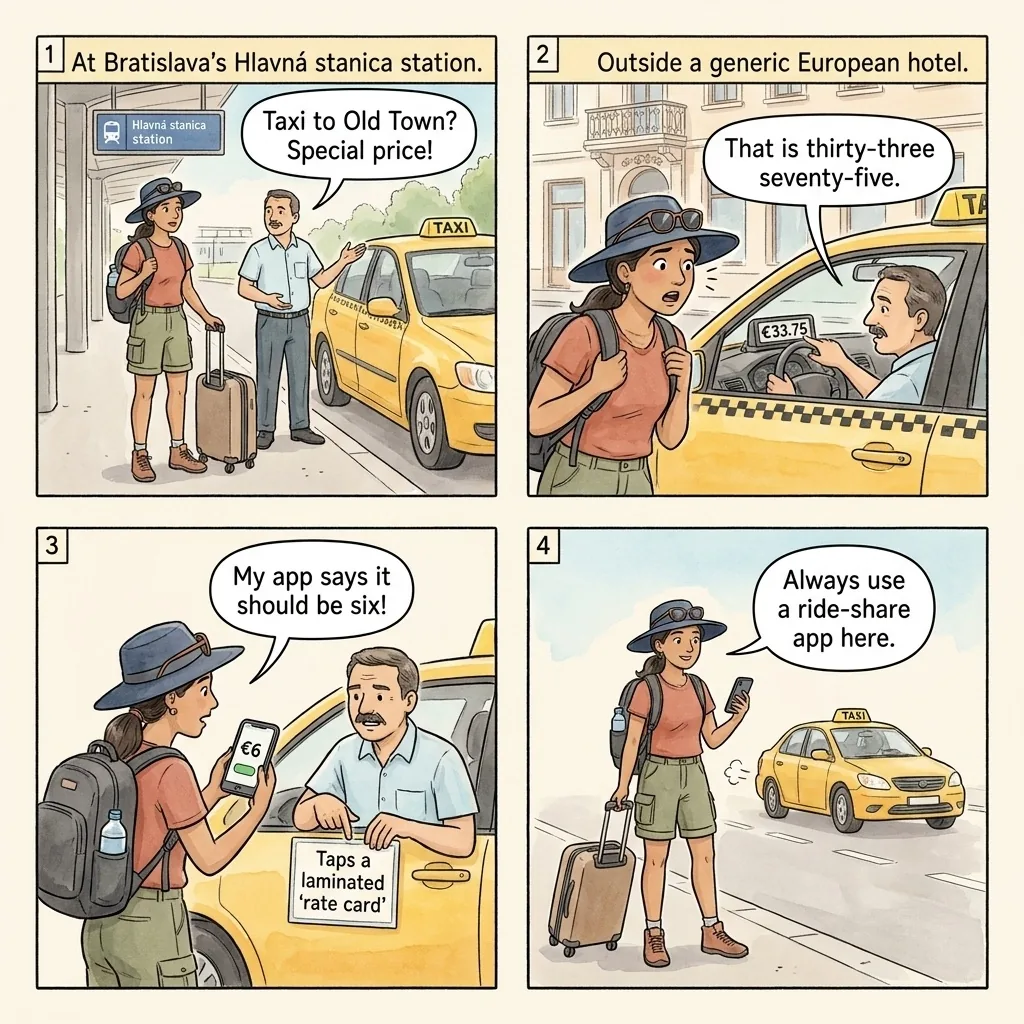
A driver at Bratislava's main station meters you €33.75 for a 10-minute Old Town ride — Bolt or Uber runs the same trip at €5–€7. The 'rate card' he points to includes invented luggage, 'tourist tax,' and night surcharges that aren't standard.
You step off the train at Bratislava's main station and walk to the taxi rank outside. A driver waves you over and agrees to take you to your hotel in the Old Town. The ride takes less than 10 minutes. When you arrive, the meter shows €33.75. The same trip with Bolt or Uber would cost €5–€7. When you protest, the driver points to a printed rate card that shows inflated per-kilometer charges and surcharges for luggage, a 'tourist tax,' and a night supplement — none of which are standard.
Taxi overcharging at Bratislava's train station is one of the most documented tourist scams in Slovakia. TripAdvisor's Bratislava Forum has a dedicated thread titled 'Taxi scam — please avoid the scammers' with dozens of reports from travelers charged €30–€50 for rides worth under €10.
BratislavaGuide.com's taxi page warns that 'at tourist hotspots such as the main train station, drivers not signed up with taxi companies often prey on unsuspecting tourists and try to charge them double or triple prices.' WelcomeToBratislava.eu advises travelers to 'always check that the taxameter is on' and to demand a receipt that includes the price, route, license plate, and driver identification.
The independent-driver tell is that the taxi has no company logo on the door — legitimate firms (Taxi Bratislava, ABC Taxi, Hopin) display their branding clearly. The 'rate card' presented at the end of the ride is the second tell: real Slovak taxi tariffs are set by company and posted on the door, not produced from a glove box at the destination.
The defensive move is to use Bolt, Uber, or the local Hopin app instead of curbside taxis — a Hlavná Stanica to Old Town trip should cost €5–€9 quoted in advance. If you must take a curb taxi, call Taxi Bratislava (+421 2 16 302) rather than flagging one. Demand a printed receipt with price, origin, destination, plate number, and driver ID — Slovak law requires it. Police: 158. Tourist Police: 0905-211-355.
Red Flags
- The taxi is parked at a stand outside the train station or airport but is not affiliated with a known company — no logo on the door
- The driver does not turn on the meter or claims a 'fixed rate' that is much higher than expected
- Additional charges appear on the receipt — 'luggage fee,' 'tourist tax,' 'night supplement' — that were not agreed upon
- The driver takes an indirect route through side streets rather than the direct road to the Old Town
- The driver refuses to provide a proper receipt with the required information (price, route, plate number, driver ID)
How to Avoid
- Always use Bolt, Uber, or the local Hopin app instead of taxi stands — a trip from the train station to the Old Town should cost €5-9.
- If you must take a taxi, call one from a reputable company like Taxi Bratislava (+421 2 16 302) rather than using a street taxi.
- Confirm the approximate fare before getting in and ensure the meter is running from the start of the ride.
- Demand a printed receipt at the end of the ride — Slovak law requires it to include the price, origin, destination, plate number, and driver ID.
- Screenshot the Google Maps route and estimated time before getting in, so you can tell if the driver is inflating the route.
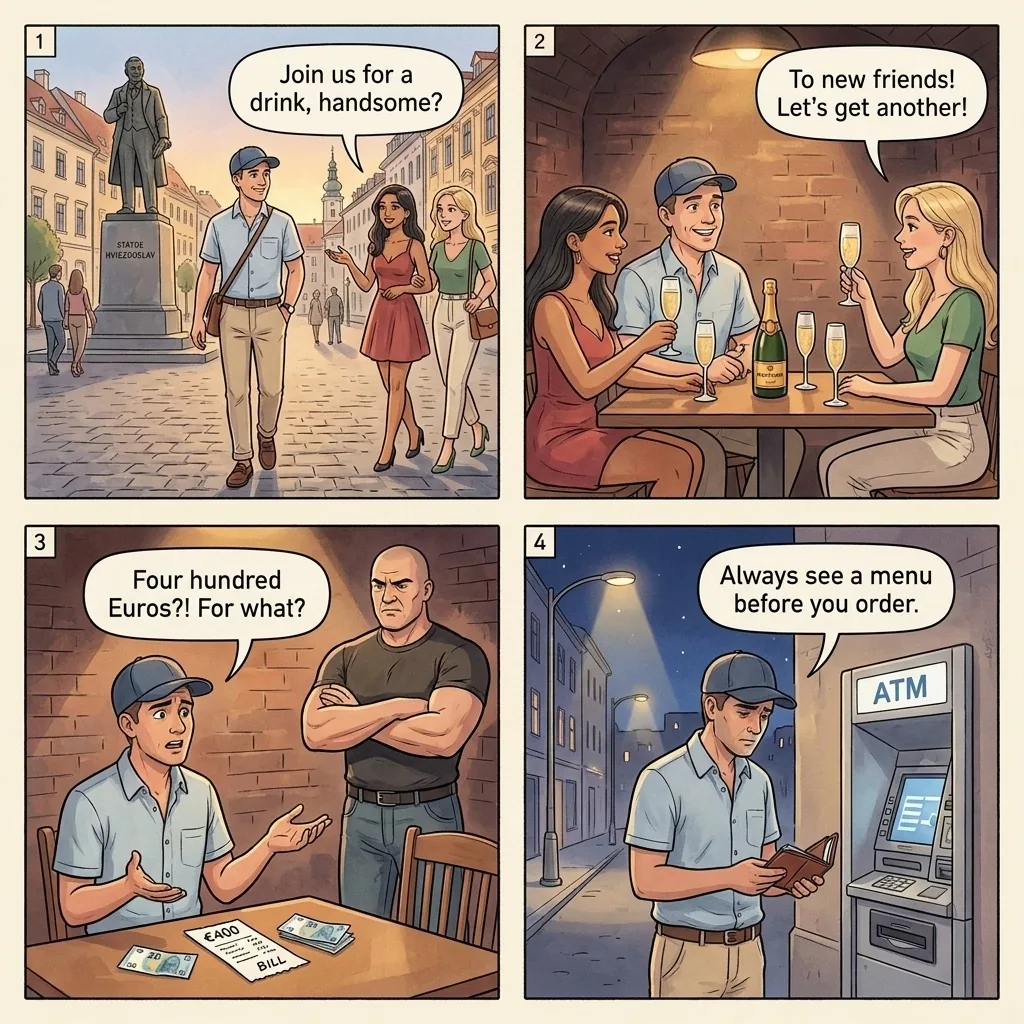
Two attractive English-speaking women approach you near Hviezdoslavovo námestie and suggest a drink 'just around the corner' at a dimly-lit bar with no visible menu — three rounds in the bill lands at €400, the women throw down €20 each, and a bouncer walks you to an ATM.
You are walking through the Old Town on a Friday evening when two attractive women approach, speaking English, and strike up a friendly conversation. They suggest going for a drink at a bar 'just around the corner.' You agree. Inside, the bar is dimly lit with no visible menu. They order a round of cocktails and some shots. After an hour and three rounds, the bill arrives: €400. The women put down €20 each and look at you expectantly. When you protest, a large bouncer materializes and escorts you to an ATM down the street to withdraw cash.
The 'pretty woman' drink scam is the most notorious tourist scam in Bratislava and is well-documented across multiple sources. WikiForTravel's Bratislava scam guide describes it in detail: 'friendly girls make small talk and lead you to believe there is mutual interest, then suggest a drink at a bar they are partners with. After a couple of shots you will end up paying 5–10 times more.'
Quora threads on Bratislava scams confirm that 'if you don't pay up, you will be escorted by the bar bodyguards to an ATM to withdraw enough cash.' BendThePlanet.com published a dedicated article titled 'Watch Out for this Scam in Bratislava' documenting the same pattern. The bouncer escort to an ATM is the most coercive element — it removes the option of waiting it out at the table.
The scam particularly targets solo male travelers and stag-party groups visiting from the UK and Western Europe. The women receive a 30–50% commission on whatever bill the venue extracts, which is why they steer aggressively toward expensive items (champagne bottles at €120, cocktails at €25, shots at €18) rather than ordering anything they'd actually want to drink.
The defensive move is to never enter a bar suggested by someone you just met — if strangers want to drink with you, insist on choosing the venue yourself from a TripAdvisor or Google Maps shortlist. Always ask for a menu with prices before ordering anything; if the bar has no menu, leave immediately. If presented with an outrageous bill, calmly say you are calling police on 158 — venues often immediately reduce the bill at the police mention. Stick to well-reviewed Old Town squares; avoid basement bars and unmarked side-street venues.
Red Flags
- Attractive strangers approach you on the street and suggest going to a specific bar — they always choose the bar, never let you pick
- The bar is dimly lit, has no visible menu or price list, and is in a side street or basement
- Drinks arrive without you seeing prices, and the women order expensive items like champagne or premium cocktails
- The women contribute a token amount to the bill but expect you to cover the vast majority
- A bouncer or security person appears when you express shock at the bill — their role is to intimidate you into paying
How to Avoid
- If strangers suggest going to a bar, insist on choosing the venue yourself — suggest a well-reviewed place you already know.
- Always ask for a menu with prices before ordering anything — if the bar has no menu, leave immediately.
- Avoid entering any bar suggested by someone you just met on the street, no matter how friendly or attractive they are.
- If you are presented with an outrageous bill, calmly say you are calling the police (155) — in many documented cases, the bar immediately reduces the bill.
- Stick to well-reviewed bars on TripAdvisor or Google Maps in the main Old Town squares — avoid basement bars and unmarked venues on side streets.
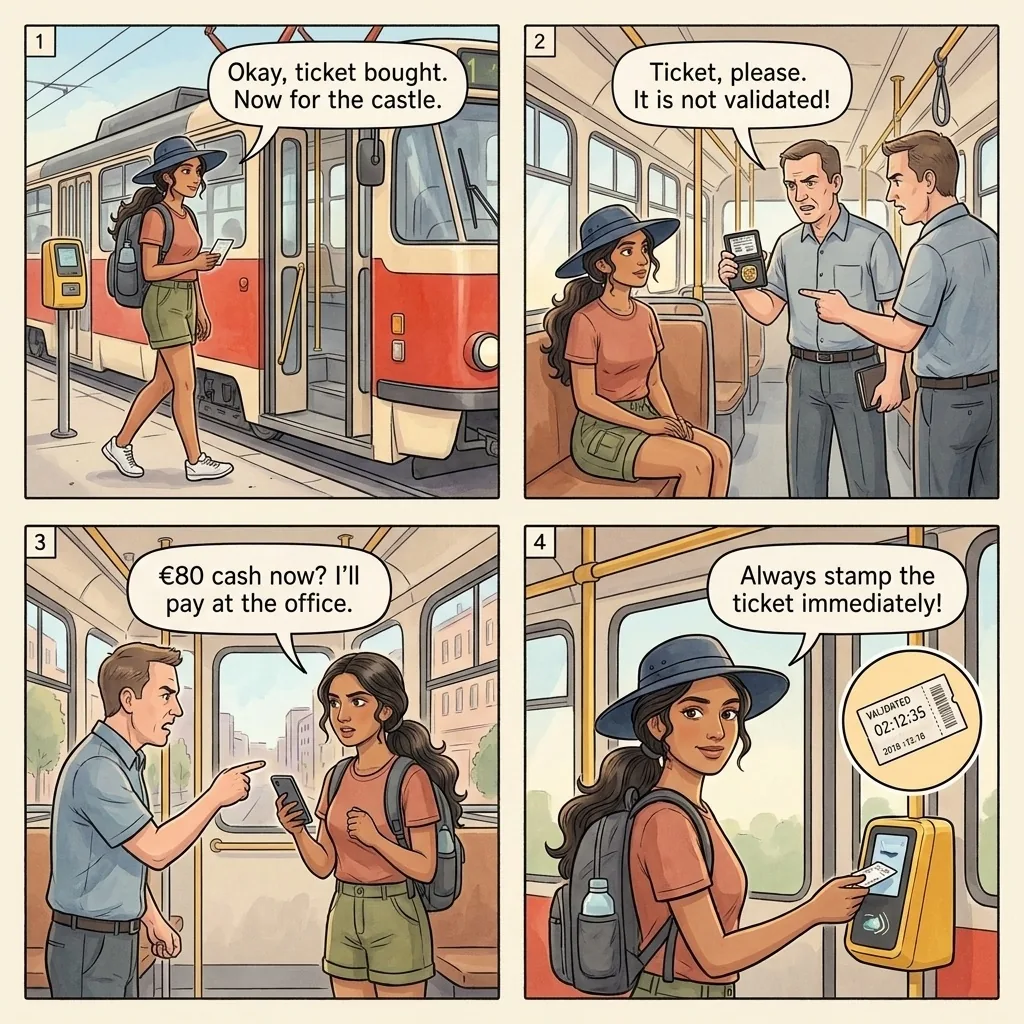
You buy a tram ticket and board — two stops later plain-clothes inspectors fine you €80 cash for not stamping it in the small yellow on-board validator (in-English signage missing), and pressure you to walk to an ATM rather than pay later at the DPB office.
You buy a tram ticket from a machine at the stop. You board the tram and sit down, ticket in your pocket. Two stops later, plain-clothes inspectors flash badges and ask for your ticket. You hand it over. They point out that the ticket is not validated — you were supposed to stamp it in a small yellow machine immediately after boarding. The fine is €80, payable immediately in cash. When you explain you did not know, the inspector becomes aggressive, threatens to call police, and insists you pay on the spot.
The tram and bus ticket validation trap is heavily documented on TripAdvisor's Bratislava Forum. A thread titled 'The great bus ticket swindle' details multiple incidents where tourists were fined within minutes of boarding. The key issue is that purchased tickets must be stamped in a small validation machine on board immediately after boarding — but the instruction appears only in very small print on the back of the ticket, with no English-language signage on the machines.
BratislavaGuide.com explains that 'until validated, a ticket can be used at any future time, and validation ties the ticket to a specific time when you use it.' The unvalidated-ticket logic is internally consistent (it prevents reuse) but the signage gap is what catches every first-time tourist who assumes the punched receipt from the platform machine IS the validated ticket.
Some travelers have reported inspectors using 'illegal intimidation tactics, threatening a 110€ fine if police were called' as a pressure tactic. In at least one documented case, inspectors insisted on cash payment and asked a tourist to walk to an ATM, raising corruption concerns. Legitimate fines under DPB rules can always be paid later at a DPB office in Bratislava — there is no legal requirement to pay cash on the tram.
The defensive move is to validate every ticket in the small yellow on-board machine immediately after boarding — push it in and the date/time is stamped — or skip the issue entirely with the IDS BK mobile app or a 24/72-hour tourist pass. If fined, ask for the inspector's official ID number and an official written fine (pokutový blok); pay later at a DPB office, not in cash on the spot. Photograph your validated ticket each time. Police: 158.
Red Flags
- You purchased a ticket but did not stamp it in the small yellow validation machine immediately after boarding
- Plain-clothes inspectors board the tram and begin checking tickets — they flash a badge-like credential quickly
- The inspector demands immediate cash payment and becomes hostile when you explain you did not know about validation
- The inspector suggests walking to an ATM together to pay the fine — legitimate fines can be paid later at a DPB office
- The fine amount quoted does not match the official amount — check the DPB (Bratislava public transport) website for current penalties
How to Avoid
- Immediately after boarding any tram or bus, validate your ticket in the small yellow machine — push the ticket in and it will be stamped with the date and time.
- Better yet, use the IDS BK mobile app or buy contactless tickets that do not require validation — these are available for SMS purchase.
- If fined, ask for the inspector's official ID number and an official written fine (pokutový blok) — you have the right to pay at a DPB office rather than on the spot.
- Consider buying a 24-hour or 72-hour tourist pass, which does not require per-ride validation and covers unlimited trips.
- Take a photo of your validated ticket each time you board — this provides evidence in case of a dispute with inspectors.
Like what you're reading? Get a full Bratislava itinerary with safety tips built in.
Browse travel-safety books →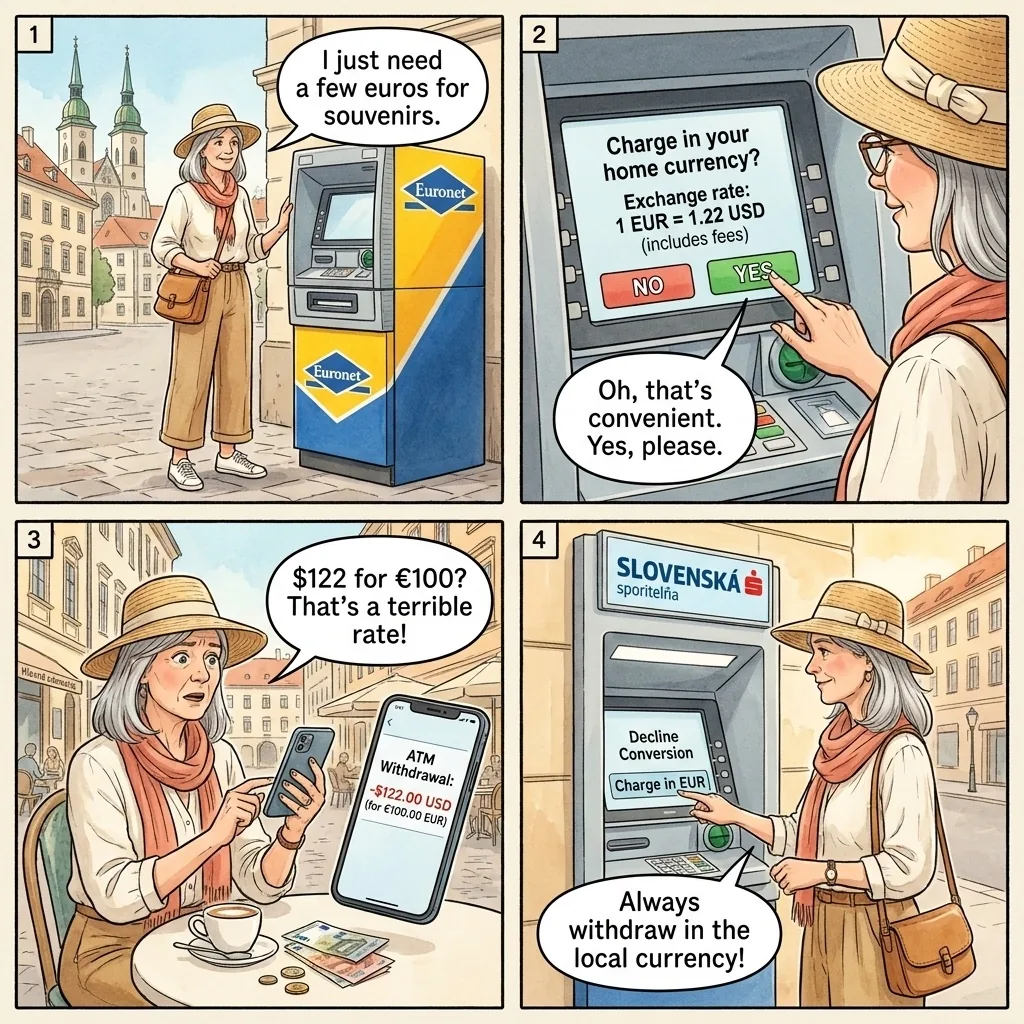
A Bratislava Old Town Euronet ATM asks 'Charge in your home currency?' — say YES on a €100 withdrawal and your bank charges $122 instead of $108–$110, a 10–12% Dynamic Currency Conversion markup hidden behind a 'helpful' prompt.
You need cash and find a bright, modern Euronet ATM in the Old Town. You insert your card and select a withdrawal of €100. The screen then asks: 'Would you like to be charged in your home currency?' and shows a conversion rate. Thinking this is helpful, you press 'Yes.' Your bank statement later shows you were charged $122 for €100 worth of euros — roughly a 10–12% markup. If you had selected 'Without conversion' (local currency), your bank would have charged $108–$110.
The Euronet ATM dynamic currency conversion (DCC) trap is one of the most widespread legal scams in Central Europe, extensively documented on travel blogs and forums. ChrisLettner.com published a detailed exposé titled 'The Euronet ATM Scam: Supersized Withdrawals at Huge Markups.' HonestBlog.com's 'ATM Scam in Europe' article explains that the difference between rates 'can be as much as 10% or more.'
Euronet ATMs are ubiquitous in tourist areas of Bratislava, Prague, Budapest, and other Central European cities. The ATMs also suggest inflated withdrawal amounts — starting at large sums (€200–€500) rather than small ones, encouraging tourists to take out more cash than needed and compounding the percentage-based DCC markup on the larger amount.
Expats.cz ran a SCAM ALERT specifically about Euronet ATMs. While DCC is technically legal, consumer advocates argue the presentation is deliberately confusing and designed to trick users into the worse option — the 'home currency' button is presented as the default while 'local currency' is shown as secondary or in smaller text.
The defensive move is to always select 'WITHOUT conversion' or 'charge in local currency (EUR)' at every Euronet ATM and card terminal — never accept the home-currency conversion offer. Use ATMs from Slovak banks (Slovenská sporiteľňa, Tatra banka, VÚB) rather than Euronet machines. Decline DCC at point-of-sale terminals too — when paying by card, choose euros. Carry a Wise or Revolut card for near-interbank rates. Police: 158.
Red Flags
- The ATM asks if you want to be charged in your 'home currency' — this is dynamic currency conversion and always costs you more
- The suggested withdrawal amounts start high (€200-500) rather than offering smaller amounts first
- The ATM is a Euronet machine, identifiable by its blue and yellow branding — these are found at virtually every tourist hotspot
- The 'home currency' option is presented as the default or recommended choice, while 'local currency' is shown as secondary
- The displayed exchange rate is noticeably worse than what Google shows for the current EUR to your home currency rate
How to Avoid
- Always select 'WITHOUT conversion' or 'charge in local currency (EUR)' — never accept the home currency conversion offer.
- Use ATMs from actual banks like Slovenská sporiteľňa, Tatra banka, or VÚB rather than independent Euronet machines.
- Withdraw cash in larger amounts less frequently to minimize per-transaction fees — but only what you will actually spend.
- Decline DCC at point-of-sale terminals too — when paying by card, always choose to pay in euros, not your home currency.
- Carry a travel-friendly bank card like Wise or Revolut that offers near-interbank exchange rates and reimburses ATM fees.
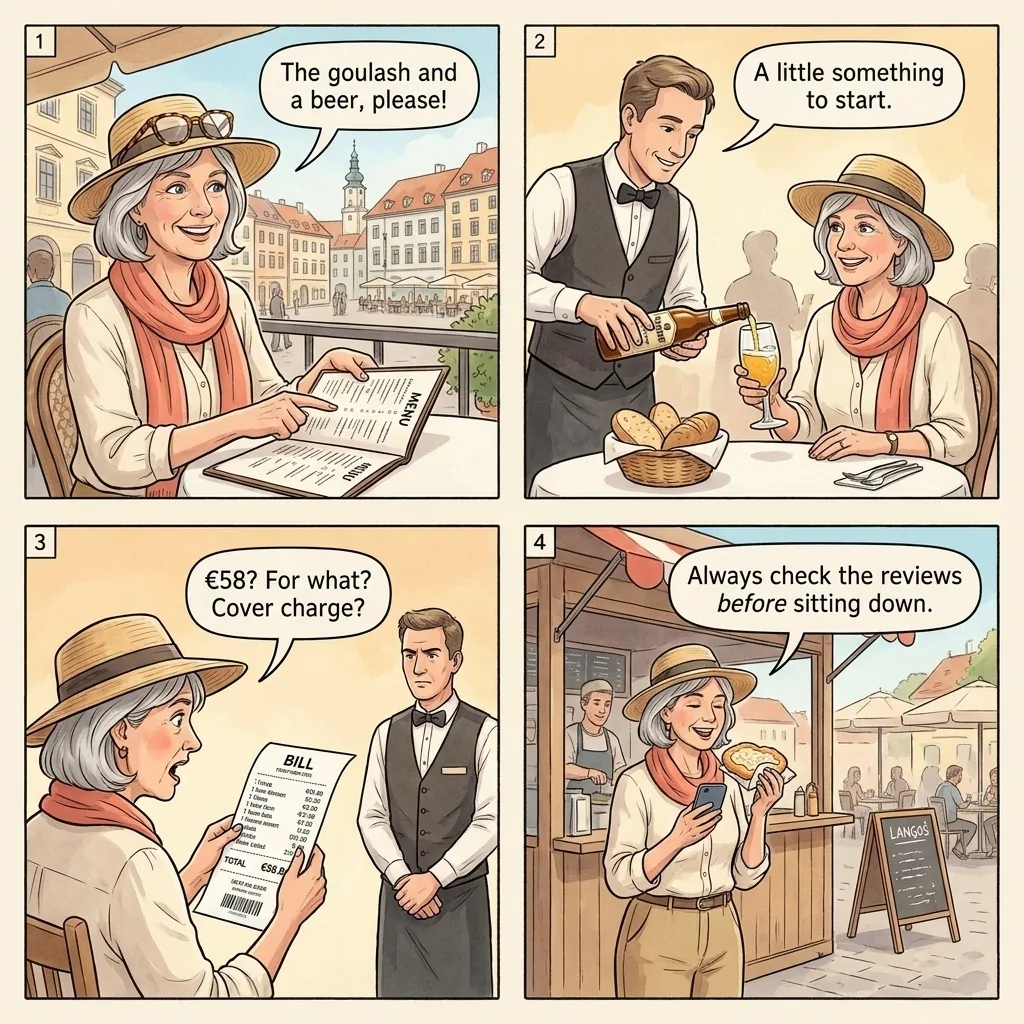
A Hlavné Námestie terrace restaurant lists mains at €15 and beer at €4 — your bill lands at €58 instead of €25 with €3 'cover charge,' €2 unrequested bread, 15% service, and your 'beer' rebadged as €7.50 'premium import' instead of the €4 draft on the front page.
You sit down at a restaurant on the Main Square with a lovely terrace view. The waiter brings a menu in English with prices that seem reasonable — a main course for €15, a beer for €4. You order, enjoy the meal, and ask for the bill. It arrives at €58 instead of the expected €25. There is a €3 'cover charge' per person, a €2 'bread and butter' fee you never ordered, a 15% 'service charge,' and your beer was apparently from the 'premium import' list at €7.50, not the €4 draft listed on the front page.
Hidden charges at Old Town restaurants are a common complaint from Bratislava tourists. TripAdvisor reviews for several Main Square restaurants document surprise fees for bread baskets that arrive unrequested, mandatory cover charges not mentioned on the menu, and service charges added automatically. Quora's 'What are common scams in Slovakia?' thread notes that 'overpriced food and beverages in the old historic center and city business centers are typical tourist traps.'
AGlobeWellTravelled.com's Bratislava safety guide confirms that some restaurants operate two pricing tiers — one for tourists and one for regulars. The bread-on-arrival trick is the easiest hook: it appears unbidden, you eat it, and a €2–€4 'bread service' line surfaces on the bill. Refusing requires touching nothing on the basket, which most diners forget to do.
The Bratislava Guide warns that 'some ice cream shops mix powder with water or milk rather than using real ingredients,' selling the result at premium gelato prices on top of the menu-tier markup. Restaurants two blocks off the main squares typically charge 30–50% less for comparable quality, and the difference compounds across a 3–4 night trip.
The defensive move is to read the full menu carefully — including footnotes and the back page — for any mention of cover charges, service fees, or bread pricing before ordering. If bread or appetizers arrive unrequested, ask immediately if they are complimentary; if not, send them back without touching them. Walk two blocks off the main squares (Obchodná, Eurovea-area streets) for better value. Police: 158. Slovak Trade Inspection (consumer disputes): +421 2 5827 2107.
Red Flags
- Bread, butter, or appetizers arrive at your table without being ordered — they will appear on the bill
- The menu does not list a service charge but one appears at the bottom of the bill (10-15%)
- Beer prices vary wildly between 'draft,' 'bottled,' and 'premium' categories — the cheap price on the menu is for a single specific option
- A 'cover charge' or 'coperto' line appears on the bill that was not disclosed when you sat down
- The restaurant is on the main square with prominent tourist signage in English — and the terrace seat comes with a premium
How to Avoid
- Read the full menu carefully, including footnotes and the back page, for any mention of cover charges, service fees, or bread pricing.
- If bread or appetizers arrive unrequested, ask immediately if they are complimentary — if not, send them back before touching them.
- Ask specifically whether a service charge is included before ordering — if yes, there is no need to tip additionally.
- Walk two blocks off the main squares — streets like Obchodná and areas near the Eurovea mall offer much better value.
- Check recent TripAdvisor or Google reviews before sitting down — tourists consistently report hidden charges at specific restaurants.
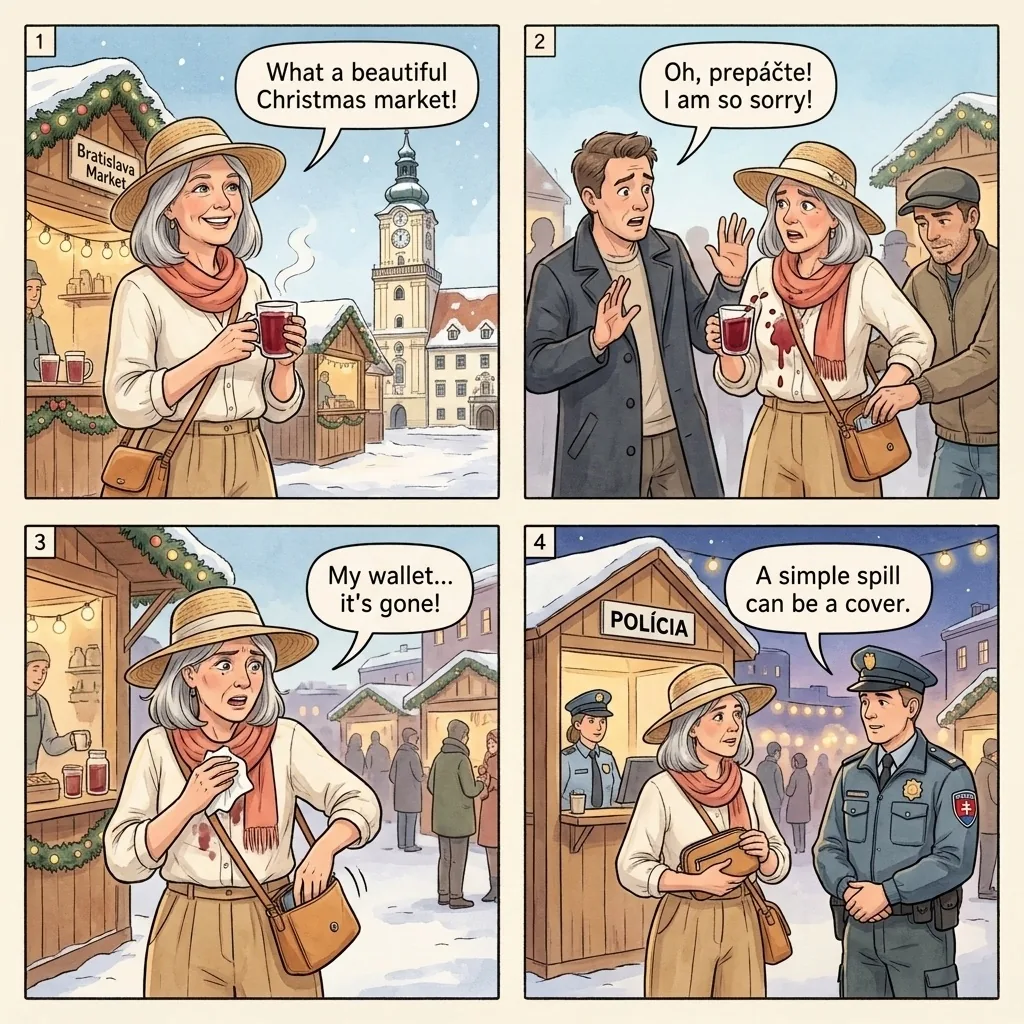
Boarding a crowded Tram 1 during Christmas Market season, two-person pickpocket teams squeeze you front-and-back as the doors close — your wallet is gone by your stop. Variant: spilled mulled wine at Hlavné Námestie distracts you while the partner lifts your phone from your coat.
You board a crowded tram during rush hour or during the popular Christmas Market season. As passengers push in, someone bumps into you from behind while another person presses against your front. You think nothing of it — it is a packed tram. When you reach your stop and check for your wallet, it is gone. Alternatively, at the Christmas Market on Main Square, someone spills their mulled wine on your jacket. While you are cleaning it off, their partner lifts your phone from your coat pocket.
Pickpocketing on crowded public transport and at markets is a documented problem in Bratislava, particularly during the busy Christmas Market season (late November through December). RadicalStorage.com's guide to 'Christmas Market Scam Hotspots' specifically lists Central European markets including Bratislava.
FlannelsOrFlipFlops.com's '6 Sneaky Pickpocket Scams You Need to Watch For' describes the team technique: 'Someone bumps into you and spills their drink, so you focus on cleaning up while their accomplice makes off with your wallet.' The mulled-wine variant is winter-specific to Central European markets — the spill is real, the cleanup is the cover, and the partner is positioned within arm's reach of your jacket.
TravelerWiz.com's European pickpocket guide warns about crowded trams and buses, noting that 'thieves strike the moment the doors open or close.' The door-close moment is the key window: passengers shift, attention fragments, and a 3-second extraction goes unnoticed in the surrounding movement. The scam is typically non-violent — victims often do not realize they have been pickpocketed until minutes later when they reach for a wallet that's no longer there.
The defensive move is to carry your wallet in a front zippered pocket or money belt, wear backpacks on your front in crowded settings, and stay alert when boarding and exiting trams — that's the highest-risk window. If liquid is spilled on you, move away from the spill location BEFORE cleaning up, and check your belongings first. Carry only the cash you need for the day; leave passport and extra cards in the hotel safe. Police: 158. Tourist Police: 0905-211-355.
Red Flags
- You are being pressed or jostled more than the crowd density warrants — this may be deliberate positioning by a pickpocket team
- Someone bumps into you and immediately apologizes or starts a conversation — this is a distraction while a partner works your pockets
- A drink, food, or liquid is spilled on you in a crowded area — classic distraction technique
- You notice someone's hand near your pocket, bag, or jacket — sometimes you will feel a light touch
- A group of people seem to be moving together and positioning themselves around you on a tram or in a market
How to Avoid
- Carry your wallet in a front zippered pocket or use a money belt under your clothing — never in a back pocket or open bag.
- At the Christmas Market and on crowded trams, wear your backpack on your front and keep zippers facing inward.
- Be especially alert when boarding and exiting trams — this is when pickpockets are most active as the crowd shifts.
- If someone spills something on you, do not stop to clean up — move away first and check your belongings, then clean up in a safe spot.
- Carry only the cash you need for the day and leave passport, extra cards, and valuables in your hotel safe.
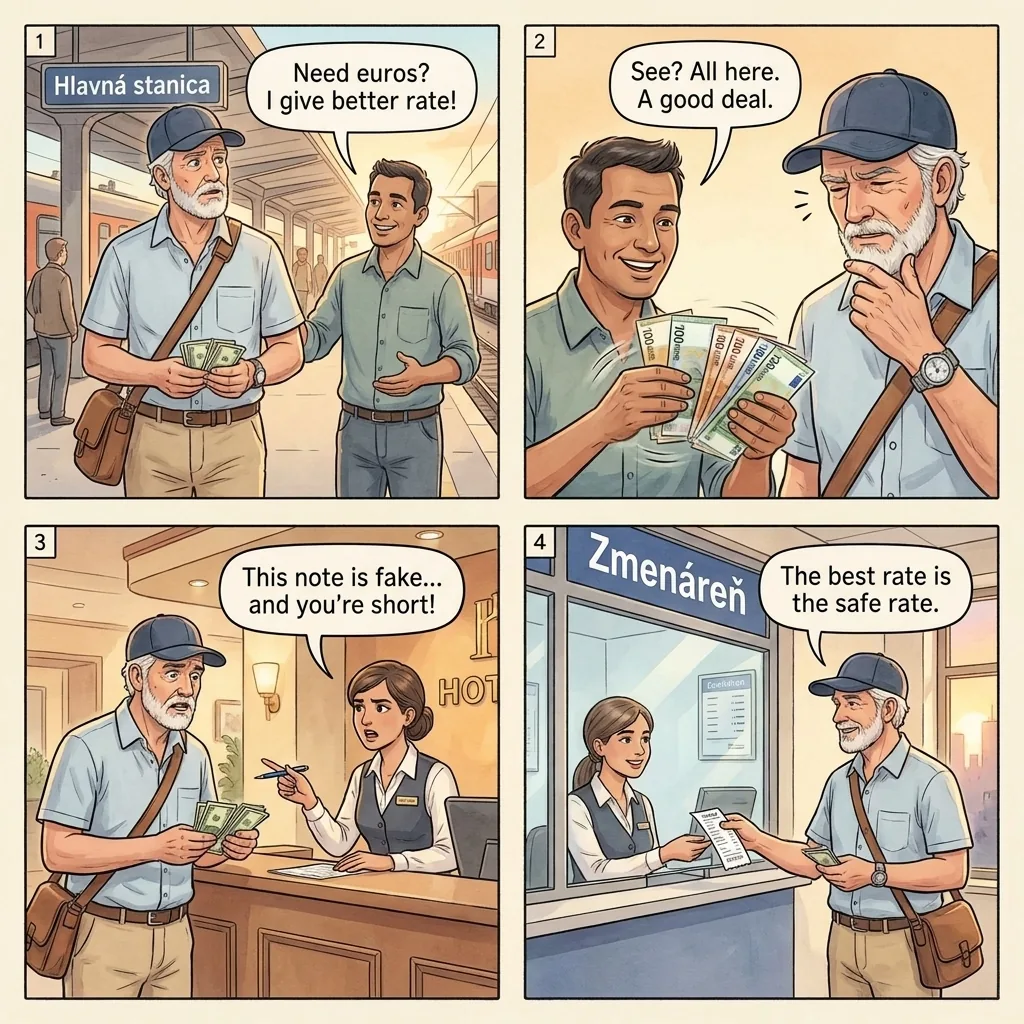
A man near Hlavná Stanica offers a better-than-office rate for your dollars or pounds — he palms bills during the fast count and slips two counterfeit notes into the stack. You arrive at your hotel with €120 instead of the €180 he advertised.
You are walking near the train station when a man approaches and offers to exchange your dollars or pounds for euros at a rate noticeably better than the exchange office across the street. You agree to exchange $200. He counts out the euros with quick hand movements, fanning the bills for you to see. You pocket the cash and walk away. At your hotel, you discover you received only €120 instead of €180 — several bills were palmed during the fast counting. Worse, two notes feel different — they are counterfeit.
Street money exchange scams are documented across Central European tourist destinations, including Bratislava. Quora's 'What are common scams in Slovakia?' thread warns that 'people may approach you on the streets offering money exchange services with good exchange rates — this is usually a scam designed to rob tourists by providing counterfeit money.'
Since Slovakia uses the euro, tourists arriving from non-eurozone countries (UK, US, Australia, Hungary, Poland) may be looking to exchange currency and are targeted near transport hubs. The Hlavná Stanica perimeter is the busiest hunting ground because arriving tourists with foreign cash are visibly disoriented and looking for ways to make quick conversions before continuing into the Old Town.
The RewardExpert.com travel guide warns about the 'slightly better rate' trap, noting that the small improvement in exchange rate is never worth the risk of counterfeit notes or shortchanging. HonestBlog.com documents how street exchangers use fast hand movements to palm bills during counting — folding two together, slipping notes back into a sleeve, or relying on the visual misdirection of an impressively rapid fan.
The defensive move is to exchange money only at banks or licensed exchange offices (zmenáreň) — never on the street, regardless of the rate offered. Use ATMs from Slovenská sporiteľňa, Tatra banka, or VÚB and always decline DCC. If you're coming from a eurozone country you don't need to exchange anything. Count cash carefully at the counter before leaving any exchange office. Police: 158. National Bank of Slovakia counterfeit reporting: +421 2 5787 1111.
Red Flags
- Someone approaches you on the street offering to exchange currency — legitimate exchange services do not solicit customers on the sidewalk
- The offered rate is noticeably better than what exchange offices and banks are posting — the difference is your loss
- The person counts money very quickly with elaborate hand movements and wants you to take the cash and leave immediately
- They suggest doing the exchange in a quiet area away from main streets or security cameras
- The bills feel different in texture, weight, or the security features look slightly off
How to Avoid
- Exchange money only at banks or licensed exchange offices (zmenáreň) — never on the street, no matter how good the rate seems.
- Use ATMs from Slovak banks like Slovenská sporiteľňa, Tatra banka, or VÚB for the best rates — always decline dynamic currency conversion.
- If you are coming from a eurozone country, you do not need to exchange anything — Slovakia uses the euro.
- If you do use an exchange office, count your money carefully at the counter before leaving and check notes for security features.
- Carry a Wise or Revolut card for near-interbank exchange rates without needing to exchange physical cash.
🆘 What to Do If You Get Scammed
📋 File a Police Report
Go to the nearest Polícia Slovenskej republiky (Slovak Police) station. Call 158. Get an official crime report — you'll need this for insurance claims. You can also report online at minv.sk.
💳 Cancel Your Cards
Call your bank immediately. Most have 24/7 numbers on the back of the card (keep a photo saved separately). Block any suspicious transactions before the thieves use your details.
🛂 Lost Passport?
Contact the US Embassy in Bratislava at Hviezdoslavovo námestie 4. Phone: +421-2-5443-0861. For after-hours emergencies: +421-2-5443-0861 (follow prompts). Other nationalities should check their embassy's Bratislava location.
📱 Track Your Device
If your phone was stolen, use Find My (iPhone) or Find My Device (Android) from another device. Don't confront thieves yourself — share the location with police instead.
Sources & further reading
Every scam here is cross-checked against official government advisories, police bulletins, and established reporting. Confirm current details with the primary sources below before you travel.
-
UK Foreign, Commonwealth & Development Office (GOV.UK) — Safety and security - Slovakia travel advice
Government advisory
“Pickpockets operate around the main tourist areas, particularly the Christmas markets and in bars, and have targeted foreign nationals.”
-
U.S. Department of State — Slovakia Travel Advisory — Level 1: Exercise Normal Precautions
Government advisory
“Criminals may target tourists at nightclubs and bars.”
-
Government of Canada (travel.gc.ca) — Travel advice and advisories for Slovakia
Government advisory
“Certain establishments, such as bars or nightclubs, may try to overcharge you.”
-
Visit Bratislava (Bratislava Tourist Board) — Taxi | Useful Information | Visit Bratislava
Official tourism
“All taxi companies have multiple fare rates: lower when ordering over the phone, higher when stopping a taxi on the street or boarding at a taxi stand.”
-
The Slovak Spectator — Two women 'snatched €2,200 from tourist's bag' in Bratislava – only to be stopped by police moments later
News report
“One of the suspects allegedly distracted the pair by asking for directions, while the other reportedly opened the victim's shoulder bag, took €2,200 in cash and walked away.”
Frequently Asked Questions
You just read 7 scams in Bratislava. The full Travel Safety Series has 780+ more across 20+ countries.
Tokyo's Kabukichō ¥130,000 bar trap. Rome's gladiator photo extortion. Paris's gold-ring trick. Bali's ATM skimmer scams. Bangkok's grand-palace closure ruse. Every documented scam across 20+ destinations — with the exact scripts, red flags, and local-language phrases that shut each one down. Drawn from Reddit traveler reports, embassy advisories, and consumer-protection cases.
- 780+ documented scams across Tokyo, Rome, Paris, Bali, Bangkok, Rio & 100+ more cities
- 20+ countries covered, with country-by-country phrase cards for every destination
- Updated annually — buy once, re-download future editions free
- All titles $4.99 each on Amazon Kindle