
Key Takeaways
- The #1 reported scam is the Rozenhoedkaai Canal Selfie Pickpocket.
- Most scams in Bruges are low-to-medium risk.
- Use app-based ride services (Uber, Bolt) or official metered taxis instead of unmarked vehicles.
- Never accept unsolicited offers from strangers near tourist sites in Bruges.
⚡ Quick Safety Tips
- In the Markt square, horse-drawn carriage prices should be posted — confirm the route and price before boarding to avoid surprise charges.
- Tourist restaurants on the Markt charge 2-3x local prices — walk two blocks to any side street for the same Belgian cuisine at fair rates.
- Chocolate shops near the Belfry are often overpriced tourist traps — locals shop at Dumon, The Chocolate Line, or BbyB for quality at better prices.
- Bike rental shops should provide a lock — if yours doesn't, buy one, as bike theft happens even in small, safe Bruges.
Jump to a Scam
- Medium The Rozenhoedkaai Canal Selfie Pickpocket
- Medium The Markt Square Belfry-View Tourist Menu
- Low The Bruges 'Chocolate Factory Tour' Gift-Shop Funnel
- Medium The Burg Square Horse Carriage Per-Person Reveal
- Medium The Bruges Station Platform Conversation Bag Lift
- Medium The Bruges Burg Square Petition-Signature Donation
The 6 Scams
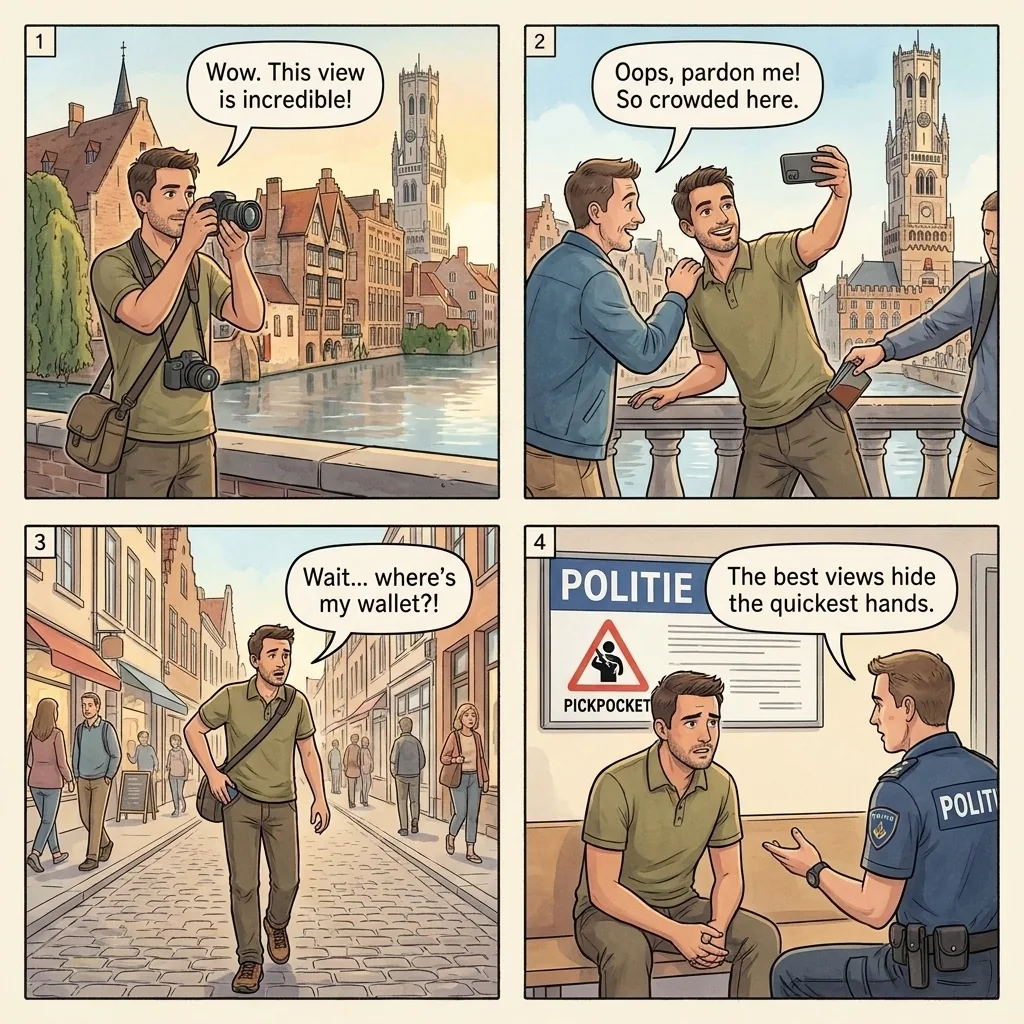
You walk to Rozenhoedkaai — the most Instagrammed canal corner in Bruges — and join the small crowd already pressed against the railing trying to frame the postcard shot of the swans, the gables, and the Belfry tower behind.
The space is narrow. People are leaning over the rail, holding phones at arm's length, asking strangers to take photos, stepping aside to let others through. A tour group with a flag pushes past behind you. You feel a soft bump on your hip and barely register it because the light is changing and you are trying to time the shot before the next cloud rolls in. Two minutes later you slip your phone back into your jacket pocket and walk on.
Twenty meters down Wollestraat you reach for the phone again to check Maps and find the pocket empty. Your wallet, in the other jacket pocket, is also gone. The lift happened in the four-second window when the tour group pressed past behind you and your attention was entirely on the canal. By the time you turn around, the crowd has shifted, and even if you spotted the operator the canal-side warren of side streets makes pursuit pointless.
Pickpocketing at Bruges' canal viewpoints is the most consistently reported tourist crime in the city. Belgian Federal Police advisories, the Visit Bruges tourism office, and Reddit all flag Rozenhoedkaai, the Markt, the Burg, the Belfry queue, and the small bridges around Dijver as the consistent hotspots. Operators work in pairs or trios — a bumper, a lifter, and a runner — and concentrate during peak season (April-October) and at golden-hour photo windows.
The Bruges variant is gentler than Barcelona or Rome — there is no aggressive dipping, no obvious distractions, no overt 'help.' Instead, it is the press of a tour group, the slip of fingers in a coat pocket while you reach to steady yourself on a railing, and the quiet exit through a side street. Most victims do not notice the lift until they reach a café fifteen minutes later. The operators favor jacket and back pockets, open-top tote bags, and the back compartments of unzipped daypacks.
Wear a crossbody bag on your front with a zipper at Rozenhoedkaai, on the Markt, and at the Belfry queue, and keep your wallet and phone in a zipped front pocket — never a back pocket or an open jacket pocket. When you stop for a photo, take it quickly and move on; the longer you stand still in a photo crowd, the higher the lift risk. Visit popular viewpoints at sunrise (before 8 a.m.) when crowds are thin. If you are pickpocketed, dial 101 (Belgian Police) or 112 (general emergency) and report the theft to the nearest politiezone for an insurance-grade report.
Red Flags
- Unusually crowded on narrow bridges and canal paths
- Someone bumps into you or asks for directions while another person moves close
- Bags worn on the back in dense crowds
How to Avoid
- Use a crossbody bag or keep wallet in a front pocket.
- Visit popular viewpoints early morning to avoid peak crowds.
- Be especially vigilant when stopped for photos — that's when pickpockets strike.
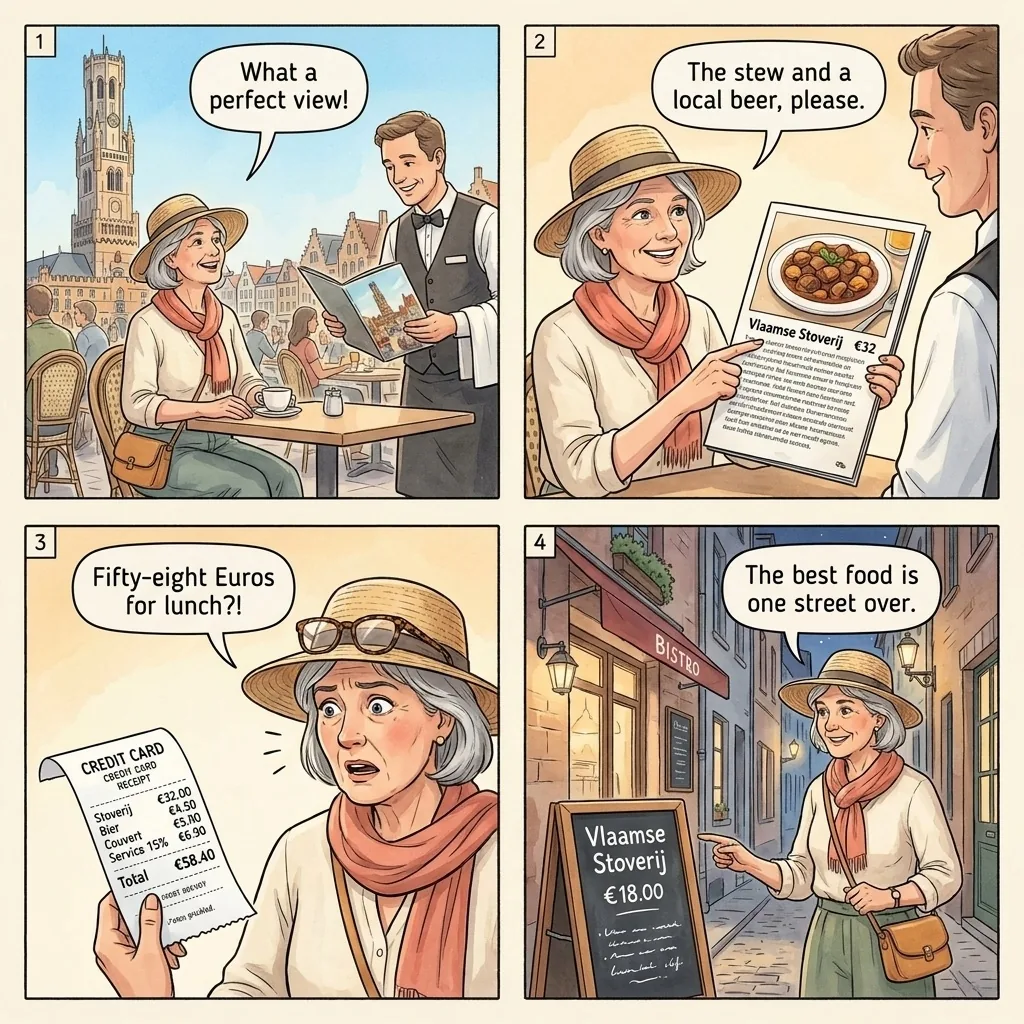
You sit down at one of the beautiful terraced restaurants directly on the Markt with a clear view of the Belfry tower, and a waiter slides a leather-bound menu in front of you with a warm smile.
The menu is in three languages, the layout is glossy, and the prices are listed but in a small font in the corner of each line. You order a Flemish stew and a Trappist beer, expecting a typical Belgian lunch in the €25–30 range. The food arrives quickly, looks fine, and tastes mediocre. The beer is correct. You eat, you pay by card, and only when the receipt prints do you really focus on the numbers.
The Flemish stew was €32. The single Westmalle Trappist was €11. There was a couvert (place setting) charge of €4 per person, a 15% service charge added to the subtotal, and a small additional VAT line. A lunch you expected at €30 has come in at €58 plus tip. The food was technically priced, but the format buried the markups, and the additional surcharges were nowhere on the menu.
The Markt Square premium is real and known. Belgian restaurants directly on the main square charge a 50–100% tourist surcharge for the view, with menus calibrated to extract maximum spend from one-time visitors who will not return. The Visit Bruges tourist office and the Belgian consumer protection authority (FOD Economie) have both flagged the practice, but it is technically legal as long as prices are listed somewhere on the menu — even in tiny font. The food at these places is also genuinely mediocre because the model is volume tourism, not return customers.
A second variation involves the wine list. Some Markt restaurants have an unmarked house wine that the waiter pours without asking which one you want, then charges €40 for a bottle that retails at €8. The 'tourist menu' fixed-price option (€25 for three courses) sometimes also includes hidden upcharges for specific cuts or seafood that push the bill past €40 per person.
Walk one or two streets back from the Markt for dramatically better value — Sint-Amandsstraat, Geldmuntstraat, and Mariastraat all have proper Belgian restaurants at €15–22 per main and €5–8 per Trappist. Check Google Maps reviews sorted by 'most critical' for any restaurant before sitting down, and avoid any place with a hawker outside actively pulling in customers. Read the entire menu including small-print surcharges before ordering, and decline the couvert if it appears. If a restaurant adds undisclosed surcharges, dispute the bill at the table or via your card issuer.
Red Flags
- Restaurant has a hawker or tout standing outside waving menus
- Tables are directly on the square with prominent monument views
- Menu prices differ significantly from nearby streets
How to Avoid
- Walk one or two streets back from the main square for dramatically better value.
- Check Google Maps reviews sorted by 'most critical' for price complaints.
- Avoid any restaurant with a salesperson outside actively pulling in customers.
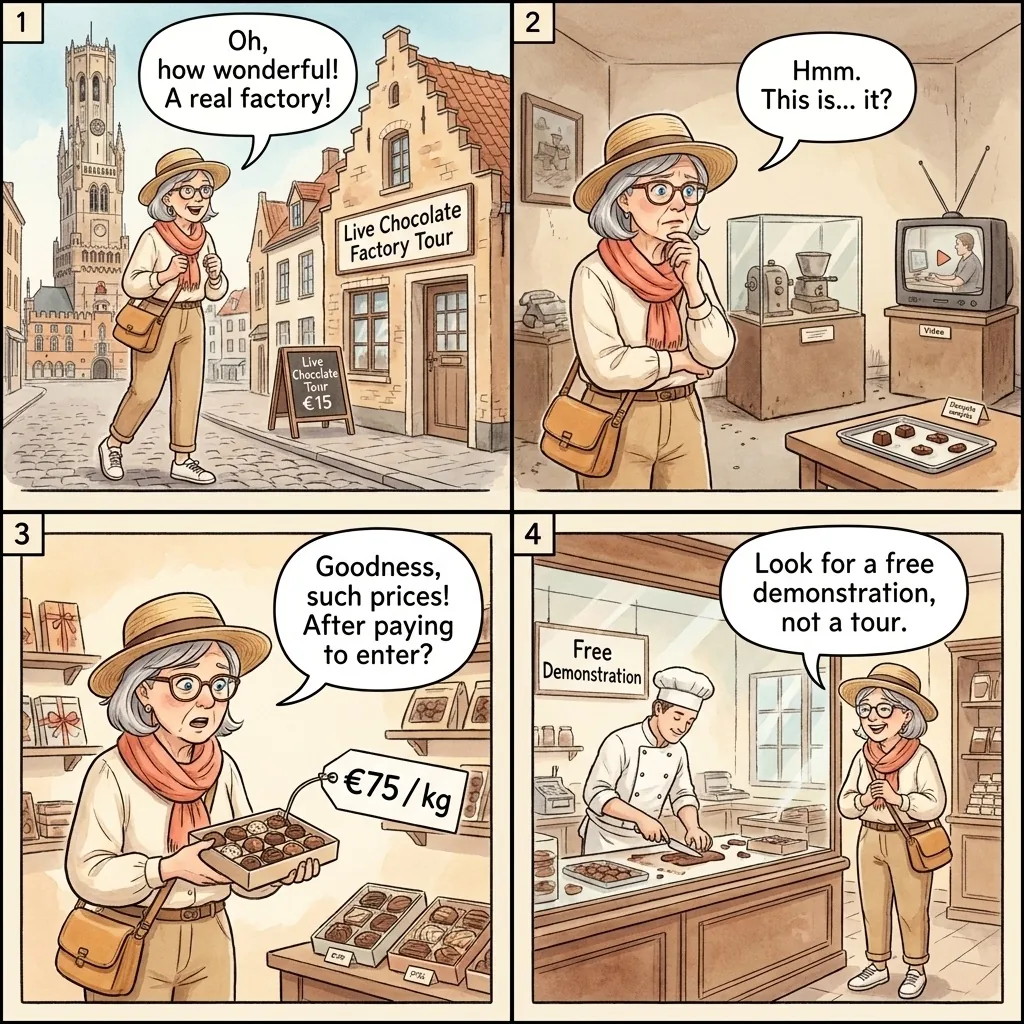
You see a sign for a 'chocolate factory tour' in a charming medieval building near the Markt and pay €15 per person to enter, expecting demonstrations, behind-the-scenes glimpses, maybe a master chocolatier at work.
Inside, the 'tour' turns out to be a single small room with a glass display of antique chocolate-making equipment, a short looping video on Belgian chocolate history, three or four tasting samples on a tray, and a doorway into the retail gift shop. The 'tour' takes you twelve minutes from entry to exit. There is no production line, no live demonstration, no chocolatier, no real factory. The €15 was essentially a cover charge to enter a chocolate shop.
Bruges has several of these pseudo-museums that charge €10–18 entry primarily to funnel tourists into overpriced gift shops where the chocolate sells at €60–80 per kilogram (roughly double the going Belgian price). The structure is technically legal — the venue does have some chocolate-history content — but the marketing implies a working factory tour that does not exist. Most reputable chocolate experiences in Bruges either operate as actual museums (paid, content-rich) or as proper free chocolatier visits (no charge, real demonstrations).
The legitimate options are well-known. Choco-Story (the official Bruges Chocolate Museum on Wijnzakstraat) is a proper museum with real exhibits, live demonstrations, and €12 entry — it is generally well-reviewed. The independent chocolatiers Dumon, The Chocolate Line, Sukerbuyc, and Chocolatier Van Oost offer free tastings during shopping hours, no entry fee, and you can watch the chocolatier work behind the counter. The 'factory tour' venues that are not Choco-Story rarely show up on TripAdvisor's top recommendations for a reason.
A second related pattern is the 'beer tour' or 'frites factory' near the Markt, where €10–15 buys you a pamphlet, a single sample, and an exit through a gift shop. Bruges' actual De Halve Maan brewery tour is a real walking tour with live brewery operations and is bookable on halvemaan.be — anything else marketed as a 'beer factory tour' downtown is most likely a souvenir-shop wrapper.
Research specific chocolate experiences in Bruges before paying entry — Choco-Story (Wijnzakstraat 2) is the only legitimate full-museum option at €12. For tastings without entry, visit Dumon, The Chocolate Line, Sukerbuyc, or Van Oost during shop hours and ask politely; all four offer free samples and real chocolatier interaction. For brewery experience, book De Halve Maan (halvemaan.be) — the only working brewery tour in central Bruges. Read TripAdvisor reviews before paying any 'factory tour' fee. If a tour misrepresents what is included, dispute the charge with your card issuer.
Red Flags
- Tour advertised with impressive-sounding branding but vague descriptions
- Entry ticket purchased before seeing what's inside
- Exit leads directly through a shop
How to Avoid
- Research specific chocolate experiences beforehand — Choco-Story is generally considered legitimate.
- Read TripAdvisor reviews before paying entry to any attraction.
- Many real chocolatiers offer free tastings without the entry fee.
Like what you're reading? Get a full Bruges itinerary with safety tips built in.
Browse travel-safety books →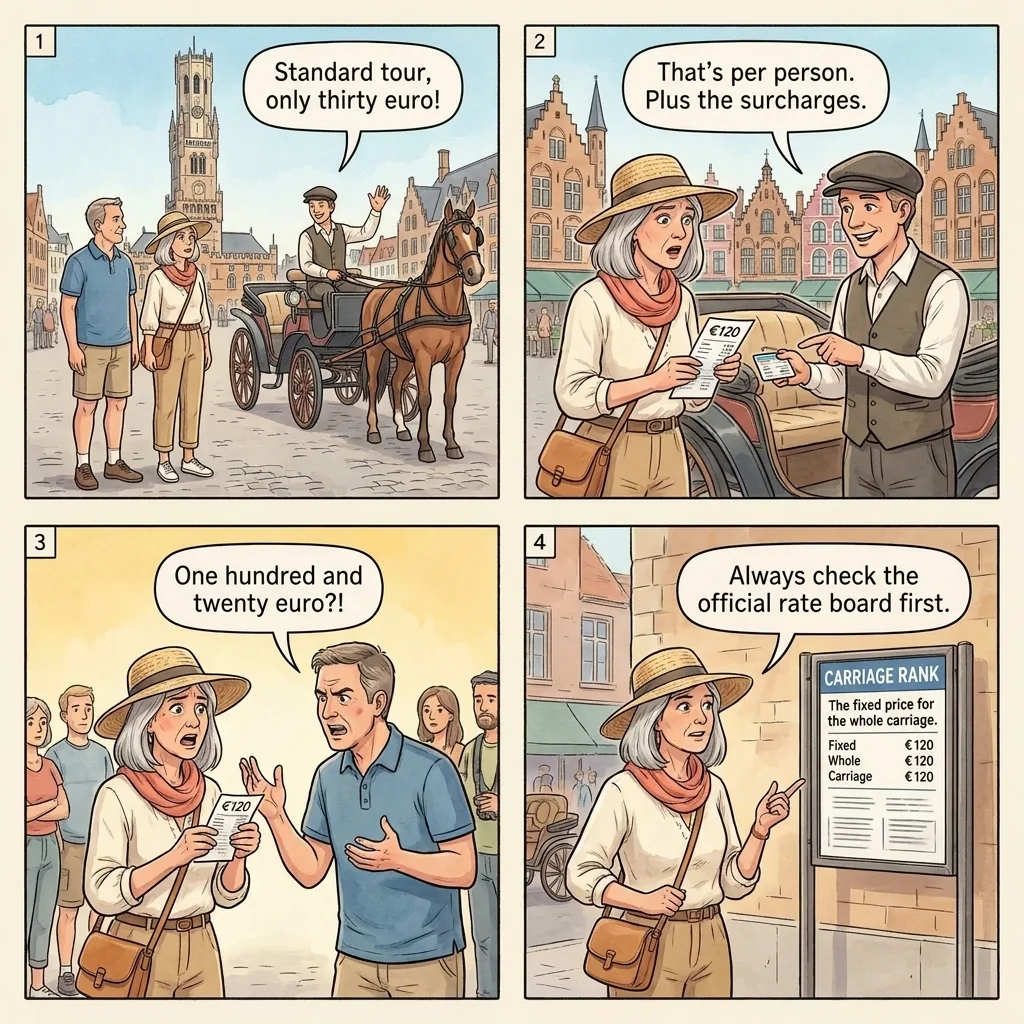
You decide to splurge on a romantic horse-drawn carriage ride through Bruges' canals, walk to the rank on the Markt, and the driver of the third carriage in line waves you over and quotes €30 for a 'standard tour.'
It seems fair for thirty minutes of clip-clop past gabled houses and quiet canals. You and your partner climb up onto the velvet bench, the driver shakes the reins, and the carriage rolls down Wollestraat toward the Beguinage. The route is exactly as advertised — the horse stops once for water at the half-way point — and forty minutes later you are back at Burg Square. The driver helps you down and presents the bill: €120.
When you object, he points calmly at a small laminated card on the inside of the carriage. The €30 quote, he explains, was per person — there are two of you, so €60. The 'water stop' adds €30 (a 'water surcharge'). The longer route (he took you past two extra bridges 'for the photos') adds €30. The total is €120 (€30 quote × 4 layers of post-hoc additions). Refusing means a public scene at one of Bruges' busiest tourist squares.
The Bruges horse-carriage scam is a per-person reveal identical in choreography to the Krakow and Manila variants in this guide. The official posted Bruges carriage rate is €60 for 30 minutes for up to five passengers — it is fixed, regulated by the city, and shown on a small printed rate card on the railing of every legitimate carriage. Drivers who quote anything else, or who charge 'per person' or 'per stop,' are operating outside the regulated rate. The Visit Bruges office and Reddit both flag the pattern.
A second variation involves the 'extended' or 'romantic' tour, where the driver quotes a base rate then adds €15–25 surcharges for stops at specific bridges or photo spots that you did not request. Some drivers also push commission stops at chocolate shops or beer cafés along the route. The honest drivers are the majority, but the freelance gougers concentrate at the Markt rank during peak season and target obvious foreign couples on weekend afternoons.
Lock the price in writing before any horse carriage moves in Bruges — ask the exact phrase: 'What is the TOTAL price for the full ride for [number] passengers, including stops?' and have the driver point to the official rate card on the carriage railing. The official posted rate is €60 for 30 minutes for up to five passengers, full stop. Refuse any 'per-person' or 'per-stop' framing, and walk away if the driver will not show you the rate card. If a driver demands inflated payment, photograph the carriage number and report it to the Visit Bruges tourist office at +32 50 44 86 86 or call 101 for police.
Red Flags
- Price quoted verbally without any written receipt
- Driver suggests 'optional' extra routes during the ride
- Price mentioned was ambiguously 'per person' vs 'per carriage'
How to Avoid
- Official carriage rides in Bruges have fixed rates — confirm the TOTAL price before boarding.
- Get the agreed price confirmed by pointing to the official rate card posted at the stand.
- Pay the agreed amount only — if they dispute it, ask them to call the tourist police.
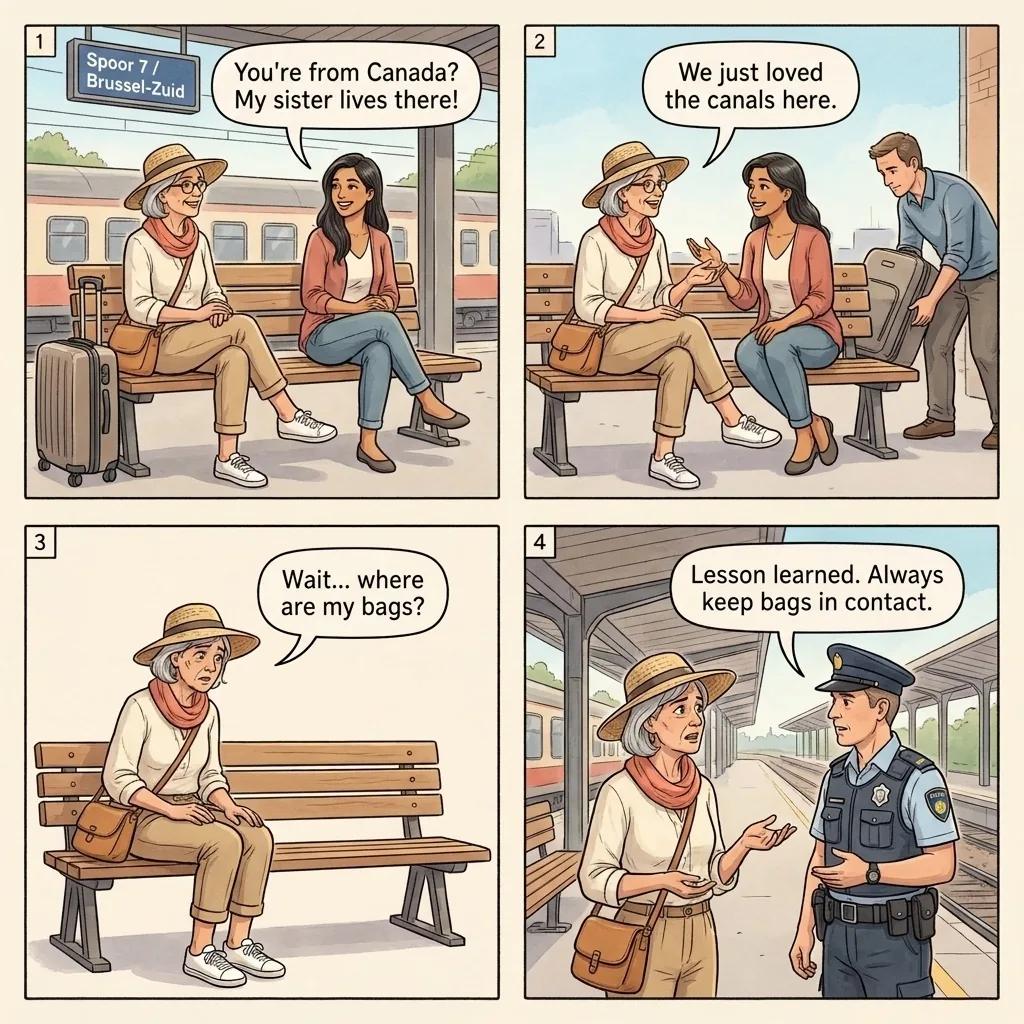
You arrive at Brugge station after the day in town with your suitcase and a backpack, sit down on a platform bench to check the onward Brussels connection on your phone, and a friendly woman sits next to you and starts chatting in fluent English.
She asks where you are from, where you are going, mentions that her sister lives in your country. The conversation is easy and pleasant — exactly the kind of small kindness that makes traveling feel human. After a few minutes, she stands up to find the toilet and walks away. You go back to your phone, then look up to check the platform display. Your suitcase, which had been beside the bench, is gone. The backpack at your feet is also gone.
The friendly woman never returned. While you were focused on the conversation and on your phone, an accomplice had been moving slowly along the row of benches behind you, lifted both bags during the conversation pause, and walked them out through the station exit toward a waiting car at the taxi rank. The lift took perhaps fifteen seconds. By the time you realize, both operators are gone, the bags are gone, and the platform CCTV may or may not have caught a clear angle.
Train-station bag lifts are documented at most major Belgian and Dutch tourist hubs, with Bruges, Brussels-Midi, Amsterdam Centraal, and Antwerp all flagged by their respective transport police as consistent hotspots. The Belgian Federal Police's tourist-safety advisories specifically call out the 'platform conversation' pattern — operators target English-speaking solo travelers with luggage, especially during peak summer season. Antwerp's central station and Brussels-Midi see far more incidents, but the Bruges variant is consistent enough to warrant the same precautions.
The classic mistake is letting a bag sit beside you on a bench, with a strap not looped around your leg or arm. The professional crews scout for that exact configuration and pair it with a friendly conversation that absorbs your peripheral attention. The same lifters work the waiting hall and the bus terminal forecourt, where seated tourists with backpacks at their feet are easier targets than standing travelers with bags in hand.
Keep your luggage between your feet on Bruges station platforms with a strap looped around your ankle or wrist, or use the station's luggage lockers (€4–6/day on the lower level) if you want to explore Bruges bag-free for the day. Be alert when a stranger initiates conversation in a quiet area, and never take your eyes off your bags during a chat. If you must check your phone, place the bags on the bench between you and the wall, not the open side. If your bag is lifted, dial 112 immediately and report to NMBS station police on Platform 1.
Red Flags
- Stranger initiates lengthy conversation in an otherwise quiet area
- Someone sits unusually close when other seats are free
- Someone crouches near your bags asking about something on the floor
How to Avoid
- Keep luggage between your feet or looped around your leg.
- Use luggage lockers at the station if you want to explore bag-free.
- Be especially alert when someone initiates unexpected conversation.
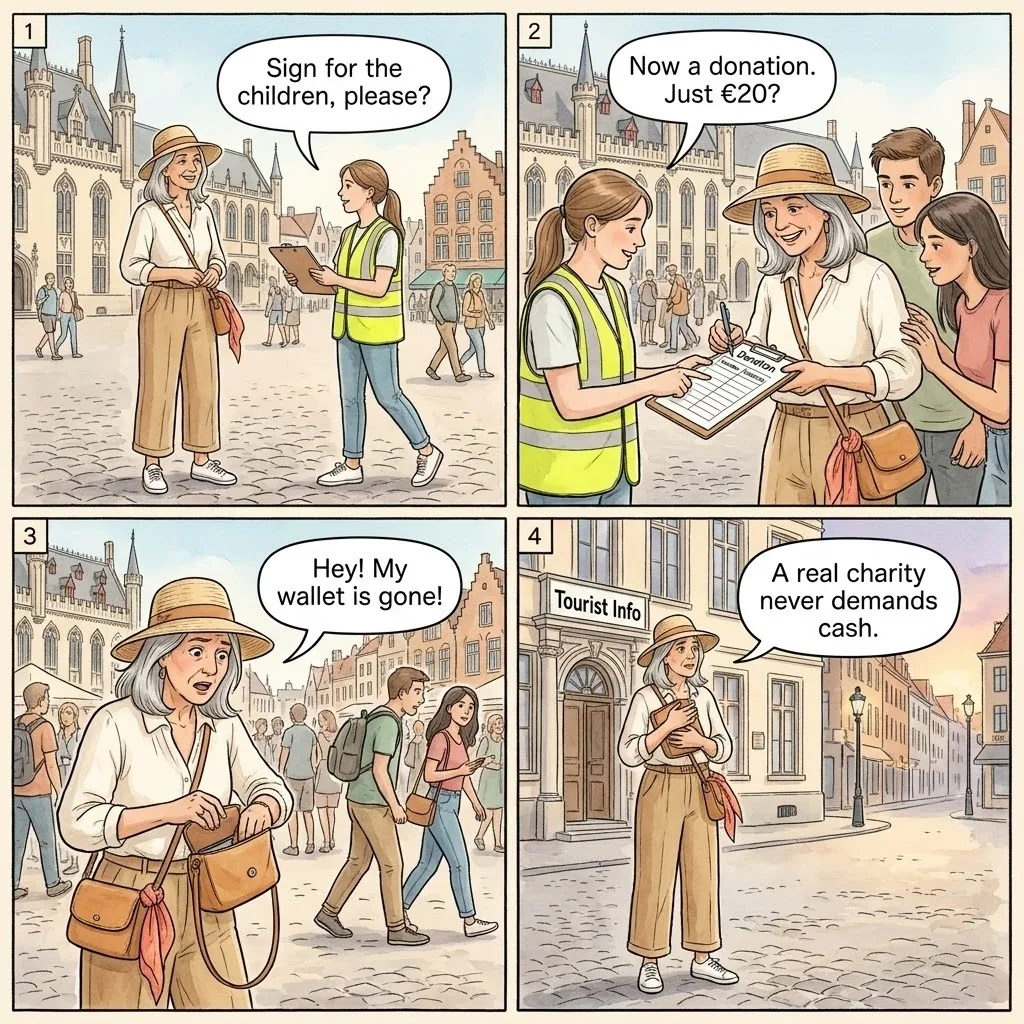
A young woman in jeans and a high-visibility vest steps in front of you on Burg Square with a clipboard, smiles, and asks if you will sign a petition for disability rights — or children's charities, or environmental protection, depending on the day.
The clipboard has a printed form in three languages with a dozen signatures already on it. She says her English is limited, points at where you should sign, and holds out a pen. Two of her associates drift over from a few meters away, smiling, holding their own clipboards. The whole encounter feels mild, low-stakes, and almost embarrassingly easy to engage with — you sign, feeling vaguely virtuous about it.
She immediately points to a column on the form labeled 'donation' and asks for €10–20 in cash to support the cause. While you reach for your wallet, the second associate has stepped close on your other side, leaning in to read what you wrote on the form. The third stands a step behind you. The clipboard is positioned at chest level, blocking your peripheral vision of your own hands and pockets.
The Bruges petition variant runs two scams in parallel. The first is the cash 'donation' itself — the charity does not exist, the signatures are fake, and the high-vis vest is bought online. The second is pickpocketing: while your attention is on the clipboard and the pen, the people standing too close on either side are working your jacket and bag, and the clipboard itself is the line-of-sight blocker. Some operators run only the first scam, some only the second, and many run both.
The pattern is documented across Reddit, the long-running TripAdvisor Bruges forum, and matches identical 'deaf and mute' or 'children's charity' petition scams in Paris near the Eiffel Tower, Rome at the Trevi Fountain, and Krakow at Rynek Główny. Real Belgian charities do not solicit foreign tourists for cash on the street, and any legitimate petition would never require a payment to sign. The 'I'm deaf-mute' framing variant is designed to discourage you from asking questions because the operator pretends not to be able to communicate.
Walk past anyone who approaches you with a clipboard at Burg Square, the Markt, or near the Belfry — there is no legitimate version of the interaction in these locations. Do not stop, do not engage, do not slow down. If someone steps directly into your path, change direction without breaking stride and say 'no thank you' firmly. Keep your wallet in a zipped front pocket and your bag worn across your front; people standing close while you are distracted are looking for it. If you spot pickpocket attempts or aggressive 'collectors,' dial 101 for Belgian police.
Red Flags
- Person approaches specifically targeting tourists
- Petition is printed in multiple languages
- Donation request follows signature with increasing pressure
How to Avoid
- Never sign anything or hand over personal details to strangers on the street.
- Ignore or walk past clipboard petitioners without engaging.
- If you want to donate to a cause, do it through a verified charity website.
🆘 What to Do If You Get Scammed
📋 File a Police Report
Go to the nearest Belgian Federal Police (Politie/Police) station. Call 101 (Police) or 112 (Emergency). Get an official crime report — you'll need this for insurance claims. You can also report online at police.be.
💳 Cancel Your Cards
Call your bank immediately. Most have 24/7 numbers on the back of the card (keep a photo saved separately). Block any suspicious transactions before the thieves use your details.
🛂 Lost Passport?
Contact your nearest embassy or consulate. The US Embassy in Brussels is at Boulevard du Régent 27, 1000 Brussels. For emergencies: +32 2-811-4000.
📱 Track Your Device
If your phone was stolen, use Find My (iPhone) or Find My Device (Android) from another device. Don't confront thieves yourself — share the location with police instead.
Frequently Asked Questions
You just read 6 scams in Bruges. The full Travel Safety Series has 780+ more across 20+ countries.
Tokyo's Kabukichō ¥130,000 bar trap. Rome's gladiator photo extortion. Paris's gold-ring trick. Bali's ATM skimmer scams. Bangkok's grand-palace closure ruse. Every documented scam across 20+ destinations — with the exact scripts, red flags, and local-language phrases that shut each one down. Drawn from Reddit traveler reports, embassy advisories, and consumer-protection cases.
- 780+ documented scams across Tokyo, Rome, Paris, Bali, Bangkok, Rio & 100+ more cities
- 20+ countries covered, with country-by-country phrase cards for every destination
- Updated annually — buy once, re-download future editions free
- All titles $4.99 each on Amazon Kindle