
Key Takeaways
- The #1 reported scam is the Váci Street Honey-Trap Bar Bill.
- 2 of 6 scams are rated high risk.
- Use app-based ride services (Uber, Bolt) or official metered taxis instead of unmarked vehicles.
- Never accept unsolicited offers from strangers near tourist sites in Budapest.
⚡ Quick Safety Tips
- Never follow attractive strangers to a bar in the District V area — the 'pretty girl bar scam' can result in bills of hundreds of euros enforced by bouncers.
- Exchange currency only at banks or official exchange offices — the exchange booths on Váci utca are notorious for hidden fees and terrible rates.
- On tram lines 4/6 and the M1 metro, keep valuables in front pockets — organized pickpocket groups target tourists on these routes.
- At restaurants near the Danube and Fisherman's Bastion, always check the bill line by line — surprise charges for bread, music, and service are common.
Jump to a Scam
The 6 Scams
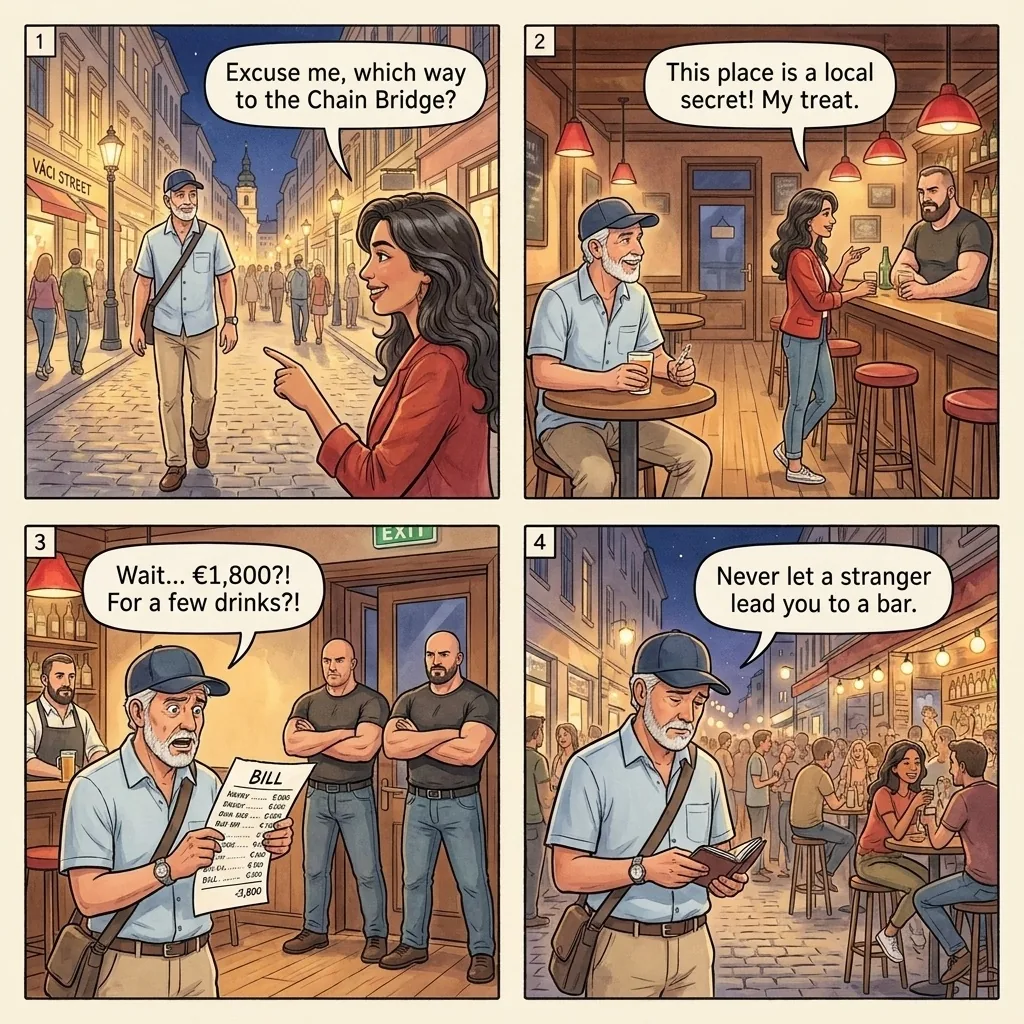
It is your second night in Budapest, you are walking down Váci Street alone after dinner, and an attractive woman around your age stops you with a smile and a question about directions to the Chain Bridge.
Her English is fluent. She apologizes for stopping you, says she just moved to Budapest for work, and asks if you happen to know a good bar nearby. You mention you are heading toward the ruin bars. She brightens — there is a place she knows, just a couple of streets away, very local, much better than the tourist spots on Váci. She walks beside you, easy and laughing, and within five minutes you are stepping into a small bar down a side street near Kazinczy.
The bar is dimly lit, almost empty, and the bartender greets her by name. She orders something for both of you in Hungarian. The drinks arrive in elegant glasses. You talk for ninety minutes — work, travel, her studies, your trip. She orders another round, then a third. A second woman joins you for a few minutes and leaves. There is no menu visible anywhere. The lights are warm. The music is low. You are having what feels like one of the better nights of your trip.
Then she excuses herself to the bathroom and the bartender brings the bill. The total is €1,800 — sometimes €500, sometimes €5,000, with no menu reference and no itemization beyond a hand-written line. When you protest, the bartender shrugs and points to a small printed price card you never saw. Two bouncers appear at the door. The woman does not return. If you reach for your phone to call police, you are told politely but firmly that the police will not help, that you signed a tab when you ordered, that the ATM is just outside.
The Váci Street and Kazinczy honey-trap is one of Budapest's most serious and well-documented scams. The U.S. Embassy in Budapest, the U.K. Foreign Office, and the Hungarian Tourism Police have issued formal warnings going back a decade. The pattern is consistent: an attractive stranger picks up a solo male tourist on Váci, Andrássy, or near St. Stephen's, redirects to a specific bar, the bar charges absurd prices, and bouncers block the exit until the bill is paid — often by walking the victim to a nearby ATM under physical pressure.
Never follow a stranger you just met to a specific bar in Budapest — pick your own venue, ideally an established ruin bar like Szimpla Kert, Instant, or Mazel Tov where prices are visible and management is reputable. If you are at a bar with no menu in sight, leave immediately before ordering anything. If you are handed a massive bill, refuse to pay, demand the police be called (dial 107 — the bar staff bluffs about police; police actually side with victims), and stay calm; many travelers have walked out without paying. Save the U.S. Embassy Budapest line on your phone (+36 1 475 4400) before you go out, and never withdraw cash from an ATM under pressure.
Red Flags
- Attractive stranger approaching solo male tourists unprompted
- Suggestion of a specific bar nearby rather than asking your preference
- Drink prices not visible or menu not offered upfront
How to Avoid
- Never follow strangers to bars they choose — pick your own or go to established ruin bars.
- Check prices before ordering anything and see a written menu.
- If you're handed a massive bill, know that many victims have successfully refused to pay and left — call the police if needed.
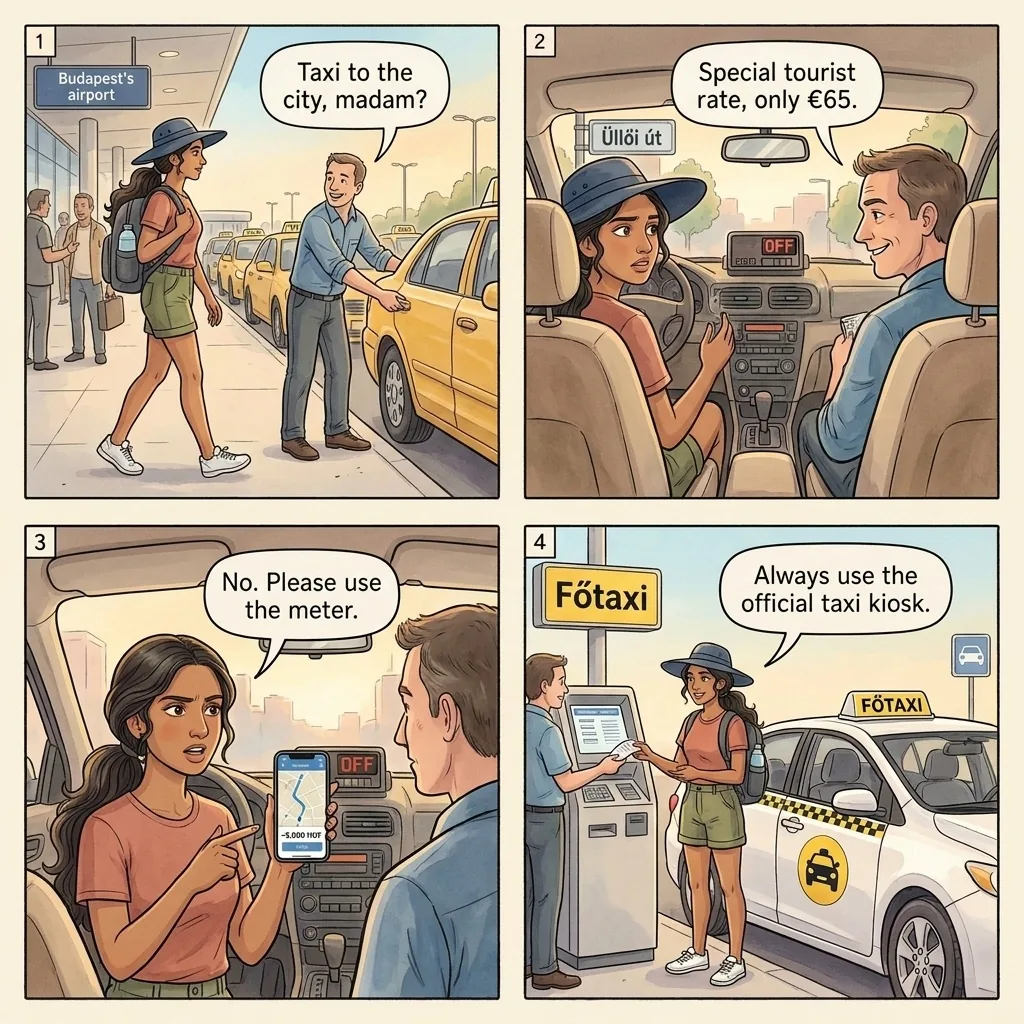
You walk out of arrivals at Ferenc Liszt International on a Friday evening, ignore the 'minicab' touts inside the terminal, and slide into a taxi at the curb whose driver greets you in fluent English.
He loads your bag and asks where you are going. You name a hotel near the Buda Castle. He nods, mentions a 'special tourist rate' of HUF 25,000 or €65, and pulls onto the Üllői út before you have a chance to reply. The metered fare from the airport to central Budapest is roughly HUF 7,000–9,000, about €18–24, on a posted Budapest Taxi tariff that all licensed cabs are required to use. You are looking at three times the legitimate rate.
If you protest, his tone shifts. He explains that this rate is 'after-hours,' that the meter is 'broken,' or that there is a special airport surcharge that does not exist on the official tariff. The car keeps moving. By the time you reach the hotel, the conversation has been settled by momentum — most travelers pay rather than fight a curbside negotiation at midnight in a city they do not know. A second variation runs the meter at triple speed, with a digit set to flick faster than the kilometer clock, and the driver takes a circuitous route through Pest while the number climbs.
The unofficial 'fake taxi' problem is well-documented. Vehicles with magnetic taxi-like signs and no company branding work the airport curb and the Kazinczy ruin-bar district, and the Budapest Police have run periodic stings that confiscate dozens of unlicensed vehicles each season. The 2013 reform that fixed all licensed Budapest taxis to a single yellow color and a posted tariff (HUF 1,000 base + HUF 400/km daytime / HUF 280/min waiting) was meant to end the problem, but the unmarked-cab gray market has refused to die at the airport especially after 10 p.m.
The legitimate fix is to ignore the curb entirely. Bolt is the dominant rideshare in Budapest, runs on the airport Wi-Fi, shows the fare upfront in the app, and takes about ₂₅ minutes to central Pest at HUF 7,000–10,000. Főtaxi, City Taxi, and Budapest Taxi are the three reputable companies; their cars are bright yellow with a roof sign, a posted tariff card on the dashboard, and a printed receipt at the end of the trip. Anyone curbside who is not in a yellow car with company branding is, by definition, not part of the licensed system.
Book Bolt on the airport Wi-Fi before walking outside — the fare to central Budapest is HUF 7,000–10,000 fixed in the app, and the driver is rated and tracked. If Bolt is unavailable, use only yellow taxis with Főtaxi, City Taxi, or Budapest Taxi branding visible on the door, confirm the meter is on and reading the standard HUF 1,000 base before the car moves, and refuse any 'flat tourist rate' over HUF 9,500 to central Pest. Photograph the plate and driver ID, and follow the route in Google Maps. If a driver overcharges, refuse to pay the disputed amount, dial 107 for police, or call the Hungarian Tourist Police at +36 1 438 8080.
Red Flags
- Taxis without a taxi company logo or license number displayed
- Driver quoting a flat rate instead of using the meter
- Meter that moves suspiciously fast
How to Avoid
- Only use Bolt (most popular app in Budapest) or licensed taxi companies like City Taxi.
- Never get into an unmarked taxi.
- Fares from airport to city center should be around 7,000-9,000 HUF.
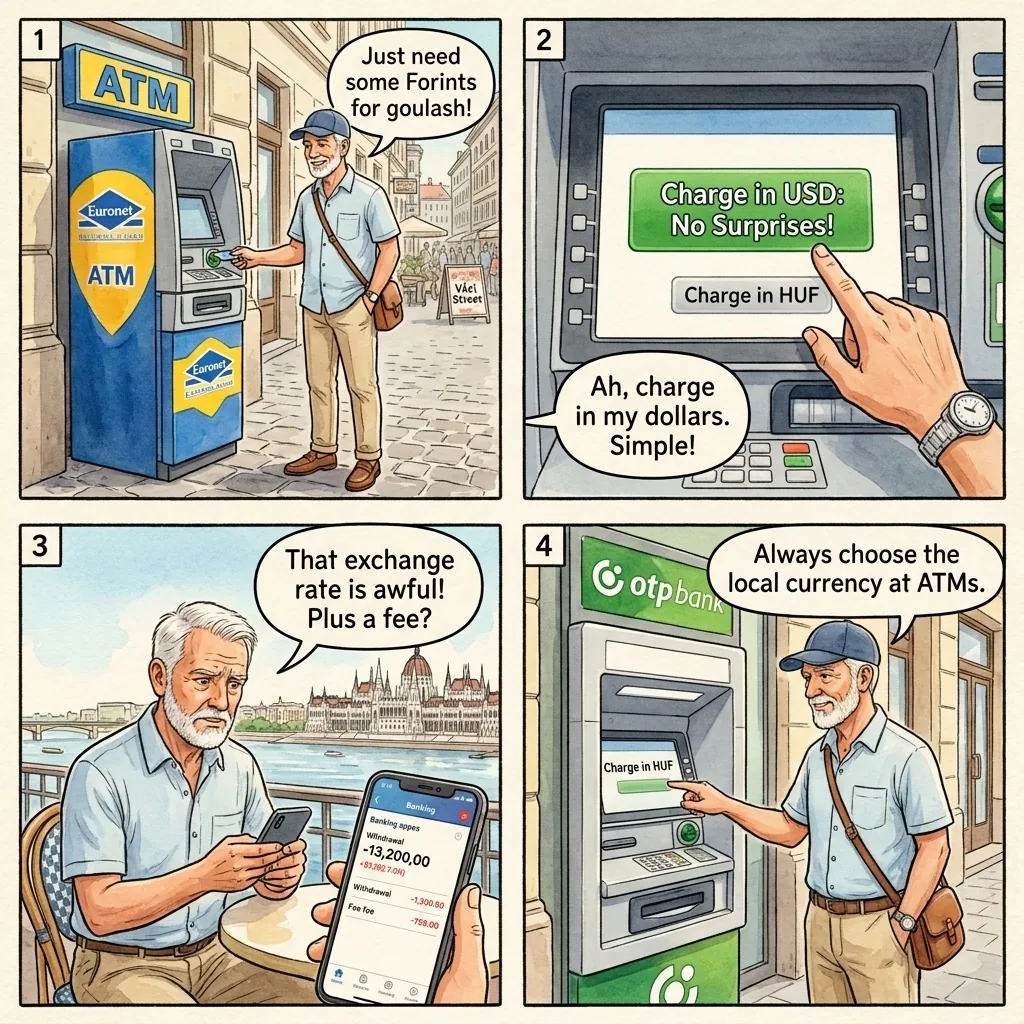
You stop at a free-standing ATM on Váci Street labeled Euronet, slot in your debit card, ask for HUF 50,000, and the screen presents you with what looks like a helpful question: do you want to be charged in Hungarian Forints, or in your home currency?
The button labeled 'EUR' or 'USD' is highlighted, often in green, with a friendly explainer that says 'see exact charge in your home currency, no surprises.' The HUF option is dimmer, smaller, and labeled with an unfamiliar exchange-rate disclaimer. The framing makes the home-currency choice feel like the helpful, transparent option. You tap it, the machine dispenses cash, and you walk away thinking you have just made a sensible choice.
You have just paid 5–15% more than you needed to. Choosing your home currency activates Dynamic Currency Conversion (DCC), a service the ATM operator runs at a deliberately poor exchange rate. The transaction is converted to your home currency at the ATM, not by your bank, and the spread between the ATM's rate and the interbank rate becomes the operator's margin. On a HUF 50,000 withdrawal that should cost about €128 at interbank, DCC typically charges €138–145.
Euronet, the operator behind the bright blue and yellow free-standing ATMs across central Budapest, runs the most aggressive version of this in Hungary. Their machines deliberately default to home-currency framing, the rate disclosure is buried, and the same machine often charges a separate HUF 1,500–2,500 'access fee' on top. The pattern is documented in Wise, Revolut, and Visa's own consumer-protection materials, and the European Banking Authority has explicitly warned about DCC misrepresentation across EU tourist destinations.
A second variation runs at restaurant card terminals. The waiter brings the terminal, hands it to you, and the screen offers EUR or HUF before you tap your card. The same DCC math applies: choosing EUR adds 5–10% to the bill at a poor exchange rate. Hungarian credit-card terminals are required by EU regulation to disclose the DCC rate clearly, but in practice the disclosure is often a small line of text the customer never reads.
Always choose to pay or withdraw in local currency (Hungarian Forints) — at every ATM and every card terminal in Hungary, without exception. Decline DCC even if the screen appears to recommend your home currency, because your bank's actual rate is almost always significantly better than the ATM operator's rate. Use ATMs attached to actual bank branches (OTP Bank, Erste, Raiffeisen, K&H) rather than Euronet free-standing machines, and avoid hotel-lobby ATMs entirely. If you suspect DCC was applied without your consent, dispute the charge with your card issuer — EU regulation gives you grounds to recover the spread.
Red Flags
- ATM offering to charge in your home currency
- ATMs branded by companies like Euronet — known for high fees
- Exchange rate displayed that seems 'convenient' but differs from market rate
How to Avoid
- Always choose to pay/withdraw in local currency (Hungarian Forints).
- Use ATMs attached to actual banks rather than standalone machines.
- Decline DCC at every ATM and card terminal in Hungary.
Like what you're reading? Get a full Budapest itinerary with safety tips built in.
Browse travel-safety books →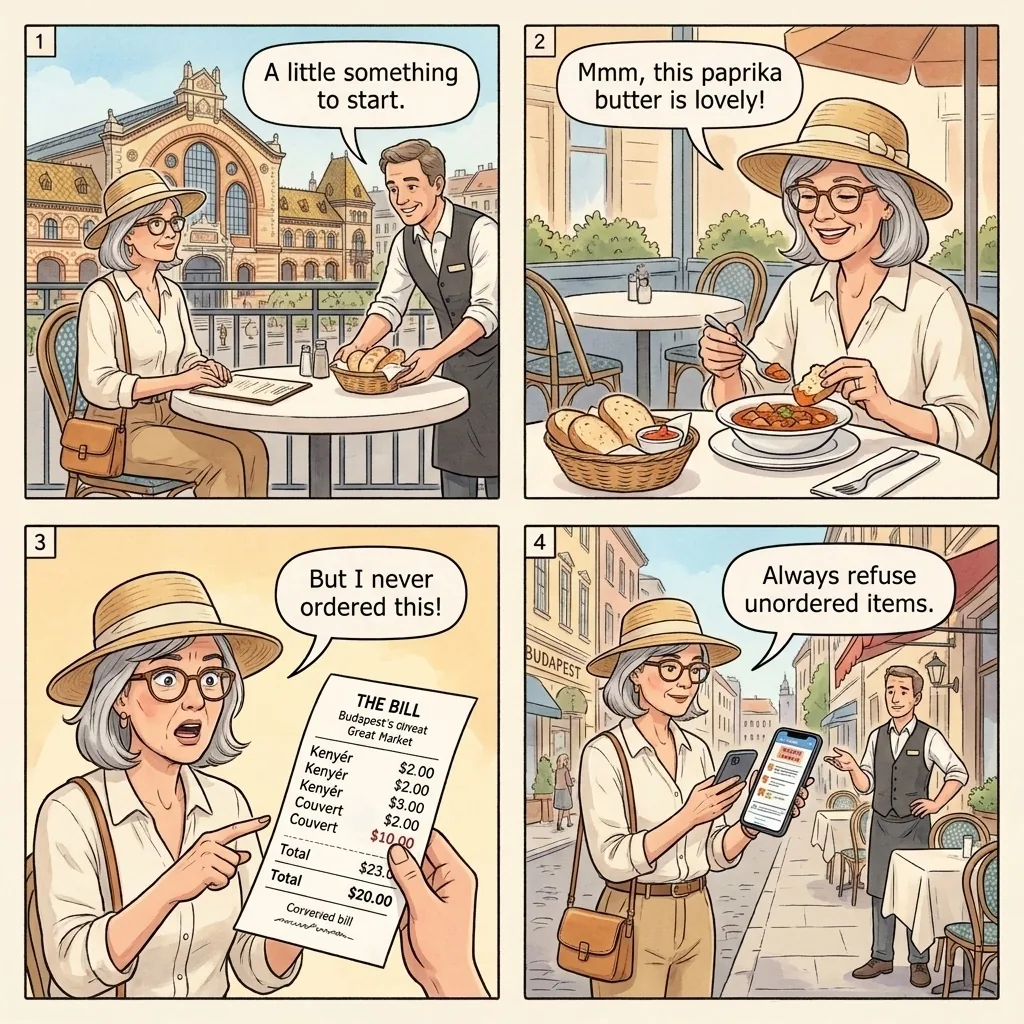
You sit down at a traditional-looking Hungarian restaurant near the Great Market Hall, order a bowl of goulash and a shot of pálinka, and the waiter slips a small basket of bread and a tiny dish of paprika butter onto the table without comment.
You eat the bread because it is on the table. The goulash is good. You sip the pálinka. When the bill arrives, it lists items you did not knowingly order: kenyér (HUF 1,200 for the bread), couvert (HUF 800 'place setting fee'), service charge 12%, plus an unfamiliar VAT line. The bowl of goulash that was advertised on the chalkboard outside as HUF 3,200 has, somewhere in the math, become HUF 6,800, and the total bill is roughly double what you expected.
When you ask the waiter, he points calmly to a tiny line at the bottom of the menu, in Hungarian, that mentions a couvert and a service charge. He shrugs. There is no fraud, technically — the menu disclosed everything — but the bread and butter were brought without being ordered, the disclosures are in Hungarian, and the practice is calibrated to extract €10–20 in surcharges per table from foreign tourists who would never have agreed to the bread upcharge if asked.
The pattern is well-documented at the row of restaurants directly facing the Great Market Hall on Fővám tér, on the streets fanning out from Vörösmarty Square in central Pest, and at several Buda Castle-side restaurants. Reddit, the long-running TripAdvisor Budapest forum, and most updated guidebooks list specific offenders by name; the Hungarian Consumer Protection Authority (Fogyasztóvédelem) periodically fines restaurants for inadequate disclosure but enforcement is uneven. Some establishments push it further with unsolicited 'amuse-bouche' bites or a 'welcome shot' that appears on the bill at a steep price.
The cleaner version of the same pattern is the dual-menu trick, where the waiter brings a different menu in English (or simply translates verbally) with prices 30–50% higher than the Hungarian menu posted in the window. This is illegal under Hungarian Consumer Protection law, which requires identical pricing across all menu versions, but it persists at a handful of central Pest restaurants whose business model depends on foreign tourists who do not return.
Ask to see the full menu with prices in Hungarian before sitting down at any restaurant near tourist landmarks, and verify the prices match what is on the chalkboard or window. Send back any bread, amuse-bouche, or 'welcome shot' you did not explicitly order before touching it. Demand an itemized printed receipt before paying, compare it line by line to the menu, and dispute any couvert, service charge, or surcharge that was not explicitly disclosed in the same language as your menu. If a restaurant refuses to honor the menu price, photograph the menu and the bill, file a complaint with the Hungarian Tourist Police at +36 1 438 8080, and dispute via your card issuer.
Red Flags
- Bread or amuse-bouche placed on table without being asked for it
- Menu without prices for add-ons like service or table charges
- Waiter who can't clearly explain bill items
How to Avoid
- Ask to see a full menu with prices before sitting down.
- Send back any food you didn't order before touching it.
- Ask for itemized receipt and compare to menu prices before paying.
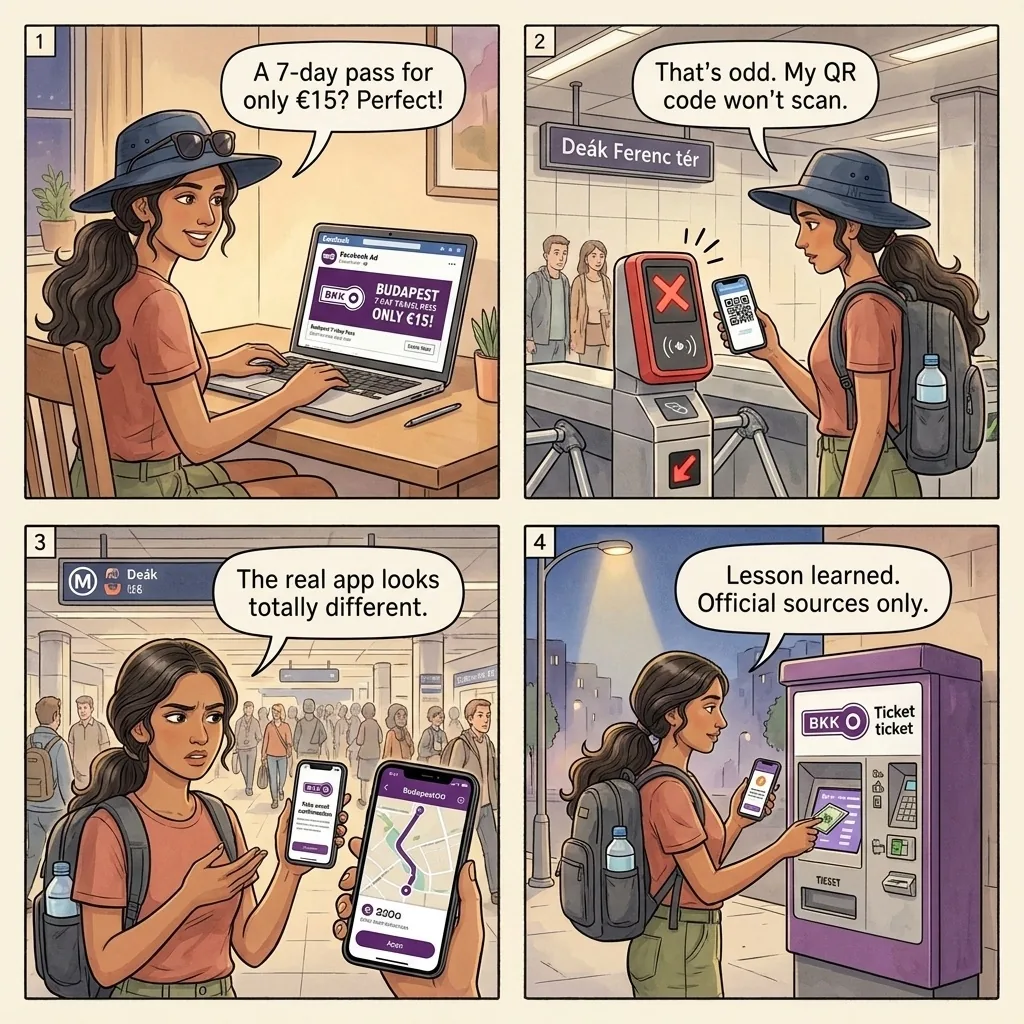
A few days before your Budapest trip, a Facebook ad appears in your feed showing the BKK (Budapesti Közlekedési Központ) logo, a smiling tourist on a yellow Castle Hill funicular, and a 'limited-time offer' for a 7-day Budapest travel pass at €15 — half the official price.
The page is named 'BKK Tickets' or 'Budapest Travel Pass Official,' has a blue check that turns out not to be Facebook's real verification badge, and shows several thousand likes. You click through to a checkout page that looks polished and legitimate. You enter your card details, your name, your travel dates, and you pay €15. A confirmation email arrives within minutes with a QR code attached as a PDF.
You arrive at Liszt Ferenc Airport, take the bus to Deák Ferenc tér, and try to pass through the metro turnstile by tapping the QR code on the BKK reader. The reader buzzes red. The pass does not exist in the BKK system. You try again at a different station — same result. The QR code was generated by a fraudulent operator who never had any connection to BKK; your €15 is gone, and your card details and travel dates are now in someone else's database.
The fake-BKK pattern is the most common pre-arrival scam targeting Budapest visitors, and it is well-documented in BKK's own consumer warnings, on Reddit, and in formal advisories from the Hungarian Consumer Protection Authority. The scam survives because Facebook and Instagram ad platforms allow operators to use the BKK logo and brand colors without verification, and because BKK's actual ticket pricing (HUF 9,500 / €25 for a 7-day Budapest Card) is high enough that a half-price 'deal' feels plausible to a tourist comparison-shopping casually.
A second variation runs through aggregator sites that style themselves as 'Budapest Pass' or 'BKK Tickets' with .com or .net domains. Some of these are pure fraud; others are legal middlemen who file a real BKK ticket purchase on your behalf at a marked-up fee, which works at the turnstile but means you have just paid extra and handed your data to an unnecessary third party. The official BKK e-ticket runs only on bkk.hu, the BudapestGO app, or in person at metro station ticket offices.
Buy BKK tickets and Budapest passes only through the official BKK channels: bkk.hu, the BudapestGO app, or the ticket offices at major metro stations (Deák Ferenc tér, Nyugati, Keleti, Astoria). Never click a Facebook or Instagram ad for a 'Budapest travel pass,' and ignore any offer significantly below the official rates (HUF 2,500/24h, HUF 5,500/72h, HUF 9,500/7-day Budapest Card). The 'Budapest Card' from budapest-card.com is a separate official tourism product — buy it only on that exact domain. If you have already paid a fake site, dispute the charge with your card issuer and assume your card details are compromised.
Red Flags
- Transport passes sold through social media or unofficial websites
- Prices dramatically below the official BKK website rates
- No physical address or official contact for the seller
How to Avoid
- Only buy BKK passes from official BKK apps, official website, or station ticket offices.
- Check the URL carefully — official site is bkk.hu.
- If the deal seems too cheap to be real, it almost certainly is.
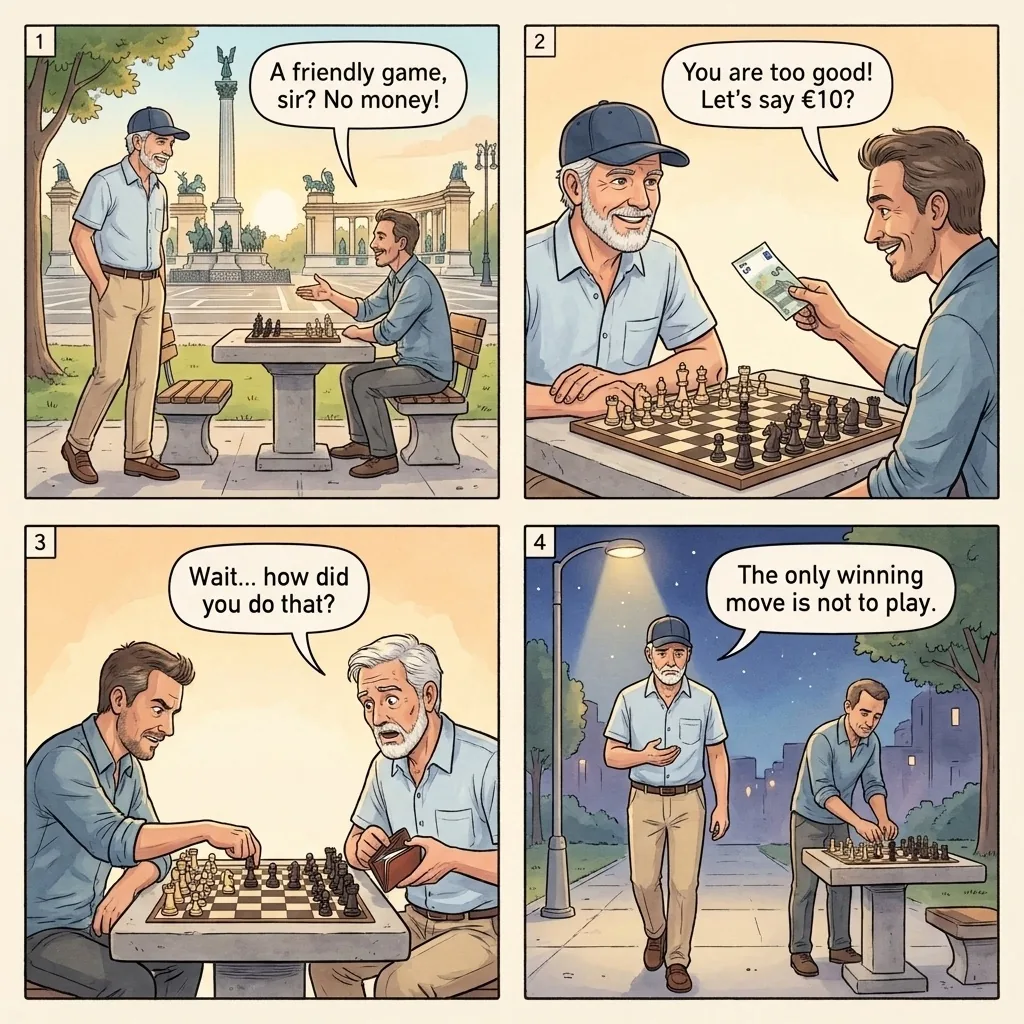
A friendly older man at a stone chess table near Heroes' Square waves you over, gestures at the empty seat opposite him, and asks in passable English if you would like a quick game — Budapest is a chess city, he says, and there is a tradition of friendly play in the park.
You sit down to be polite. The first game is for fun, no money, just a casual half-hour. He plays surprisingly badly, makes a few obvious blunders, and you win in twenty moves. He claps once, congratulates you, and suggests a small wager on the next game — say €5 or HUF 2,000, just to make it interesting. Your confidence is up. You agree.
You win the second game too. He pays you the €5 with a smile and proposes doubling the stake. You play again. You win again, narrowly this time, and he hands over €10. Now he is excited, says you must be a serious player, and proposes €20 on a 'best-of-three.' You agree. Somewhere in that next round his game tightens dramatically — moves you do not see coming, sacrifices that work three plies later, an endgame that grinds you down — and you lose. By the end of the afternoon you have lost €40–80 and the man is packing up his board with a polite handshake.
The Budapest chess hustle is the textbook long-con version of street gambling, and it works because the operator is genuinely a strong player — often a club-rated 1900–2200 ELO former competitor — who deliberately throws the early small-stake games to build your confidence and bait you into bigger bets. The pattern is documented across Budapest tourist forums, runs in Vienna and Prague with the same script, and the U.S. Embassy's 'safety in Hungary' page mentions chess hustles by name as a non-violent but consistent tourist scam.
A second variation runs at the chess corner outside Széchenyi Baths after a soak, where the relaxed-tourist demographic is even more susceptible. Some operators work in pairs — one plays, the other 'comments' from the side and quietly shills for higher stakes. The endgame is the same: a few hundred euros over an afternoon, paid in increments small enough that no single payment feels worth disputing.
Never play chess for money against strangers in Budapest parks or tourist squares — the operator is almost always a far stronger player who is throwing the early games. If you want to play casually, agree explicitly to no-stakes only and walk away the moment money is suggested. If you want serious chess, visit the Hungarian Chess Federation's club at Falk Miksa utca where games are organized, rated, and stake-free. If a hustler pressures you to keep playing, simply leave — there is no enforcement and no recourse if you stay.
Red Flags
- Strangers who specifically seek out tourists for games
- Stakes that escalate after an initial win for you
- Multiple friendly bystanders watching and encouraging
How to Avoid
- Only play games with strangers in formal public settings.
- Never bet money in informal street games.
- Enjoy watching chess in the park but decline to play for money.
🆘 What to Do If You Get Scammed
📋 File a Police Report
Go to the nearest Hungarian Police (Rendőrség) station. Call 107 (Police) or 112 (Emergency). Get an official crime report — you'll need this for insurance claims. You can also report online at police.hu.
💳 Cancel Your Cards
Call your bank immediately. Most have 24/7 numbers on the back of the card (keep a photo saved separately). Block any suspicious transactions before the thieves use your details.
🛂 Lost Passport?
Contact your nearest embassy or consulate. The US Embassy in Budapest is at Szabadság tér 12, 1054 Budapest. For emergencies: +36 1-475-4400.
📱 Track Your Device
If your phone was stolen, use Find My (iPhone) or Find My Device (Android) from another device. Don't confront thieves yourself — share the location with police instead.
Sources & further reading
Every scam here is cross-checked against official government advisories, police bulletins, and established reporting. Confirm current details with the primary sources below before you travel.
-
UK Foreign, Commonwealth & Development Office (GOV.UK) — Safety and security - Hungary travel advice
Government advisory
“Some bars, clubs and restaurants might charge high amounts for food and drink.”
-
Government of Canada (travel.gc.ca) — Hungary travel advice
Government advisory
“Young women sometimes approach travellers at reputable bars with invitations to socialize at a nearby bar.”
-
U.S. Department of State — Hungary Travel Advisory
Government advisory
“In Budapest, some U.S. citizens have been overcharged for food, drinks, or taxi services.”
-
BKK - Budapesti Közlekedési Központ (BKK Centre for Budapest Transport, official municipal transport authority of Budapest) — Vigyázat, adathalász csalók élnek vissza a BKK nevével, és ajánlanak utazási kedvezményeket!
Reference
“Ezek az oldalak kizárólag adathalászat céljából készültek, és nincs közük a BKK-hoz.”
-
BKK – Centre for Budapest Transport (Budapesti Közlekedési Központ, official news page) — Tickets and passes - only from safe sources
Reference
“Recently, BKK has received several reports of fraudsters posing as employees of the company in busy public spaces in Budapest.”
-
GVH – Hungarian Competition Authority (Gazdasági Versenyhivatal) — ATM network operator under investigation by the GVH
Reference
“The GVH suspects that the company is misleading consumers by displaying available functions on the home screens of the ATMs it operates and by hiding certain functions, thereby causing them to incur…”
Frequently Asked Questions
You just read 6 scams in Budapest. The full Travel Safety Series has 780+ more across 20+ countries.
Tokyo's Kabukichō ¥130,000 bar trap. Rome's gladiator photo extortion. Paris's gold-ring trick. Bali's ATM skimmer scams. Bangkok's grand-palace closure ruse. Every documented scam across 20+ destinations — with the exact scripts, red flags, and local-language phrases that shut each one down. Drawn from Reddit traveler reports, embassy advisories, and consumer-protection cases.
- 780+ documented scams across Tokyo, Rome, Paris, Bali, Bangkok, Rio & 100+ more cities
- 20+ countries covered, with country-by-country phrase cards for every destination
- Updated annually — buy once, re-download future editions free
- All titles $4.99 each on Amazon Kindle