
Key Takeaways
- The #1 reported scam is the Copenhagen 'Plain-Clothes Police' Wallet Inspection.
- 1 of 6 scams are rated high risk.
- Use app-based ride services (Uber, Bolt) or official metered taxis instead of unmarked vehicles.
- Never accept unsolicited offers from strangers near tourist sites in Copenhagen.
⚡ Quick Safety Tips
- Keep bags zipped and in front on the Metro and at Nyhavn — pickpocketing is Copenhagen's most common tourist crime.
- At Strøget and Tivoli, be wary of anyone who bumps into you or creates a distraction — it's often a coordinated pickpocket team.
- Use Rejsekort or contactless payment for transport — buying single tickets is expensive and ticket inspectors fine without warning.
- Don't leave bikes unlocked even briefly — bike theft is rampant and rental shops will charge you the full replacement cost.
Jump to a Scam
- High The Copenhagen 'Plain-Clothes Police' Wallet Inspection
- Medium The Central Station Refugee Train-Ticket Refund
- Medium The Strøget Pedestrian Crowd Pickpocket
- Low The Copenhagen Single-Ticket Rejsekort Overpay
- Medium The Nyhavn Canalside Smørrebrød Tourist Surcharge
- Medium The Little Mermaid 'Take Your Photo' Phone Snatch
The 6 Scams
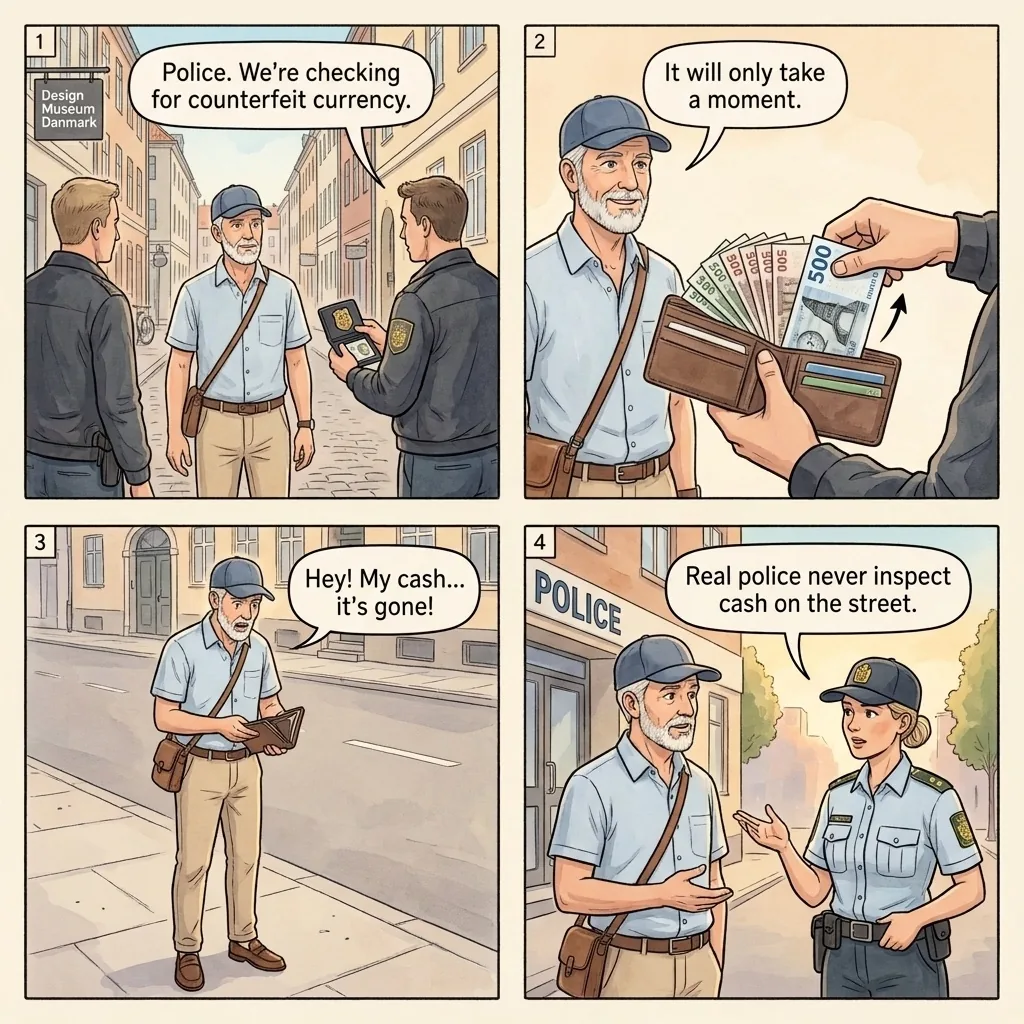
You are walking down a quiet street near the Design Museum when two men in casual clothes step into your path, flash leather wallets that flip open to show what looks like a police badge, and tell you in fluent English that they need to check your wallet for counterfeit currency.
They are calm, polite, and businesslike. They explain that there is a drug problem in the neighborhood, that fake euros have been circulating, and that they need a brief inspection of any cash you are carrying. The badges flip closed before you can read them clearly. One of them holds out a hand expectantly. The whole encounter is over in seconds, before you have time to fully process what is happening.
If you comply, things unfold quickly. They take your wallet, fan through the bills, ostensibly examining them for counterfeits, and hand the wallet back. By the time you walk on, anywhere from 200 to 2,000 DKK is missing — slipped from the wallet during the 'inspection' by a hand kept low and out of your line of sight. Some operators take only a few large bills (you may not notice for hours); others are more aggressive and clean out the visible cash entirely.
The Copenhagen 'plain-clothes police' scam has been documented for years by Københavns Politi and the Danish Foreign Ministry's traveler-safety advisories. Real Danish police never request to inspect a tourist's wallet on the street, never demand to see cash, and almost always operate in uniform. Plain-clothes officers, on the rare occasions they engage tourists, do so with formal ID that they will hold open and let you read clearly, and typically with a uniformed colleague nearby in a marked vehicle.
A second variation involves passport checks. The 'officers' ask to see your passport, hold it briefly, and either pocket it or take it long enough to photograph for later identity-fraud use. The passport variant is rarer than the wallet inspection, but more damaging in the long term. The same operators sometimes work the area near Christianshavn, near Tivoli Gardens, and along Strøget side streets after dark.
Refuse any wallet or passport inspection by anyone in plain clothes claiming to be police in Copenhagen — real Danish police do not do this. Ask politely but firmly to see formal ID with a name and badge number, photograph it before it closes, and offer to walk together to the nearest police station to verify (Politigården is the main station, near Tivoli). If they walk away when you propose this, the scam is confirmed. Never hand over your wallet or passport on the street. If pressured, dial 112 (general emergency) or 114 (Danish Police non-emergency) immediately.
Red Flags
- Plain-clothes 'officers' without a uniformed officer present
- Request to show your wallet contents
- Pressure to comply immediately without asking questions
How to Avoid
- Ask to see proper ID and write down their badge numbers.
- Offer to go with them to the nearest police station instead.
- Real Danish police will never demand to see your cash on the street.
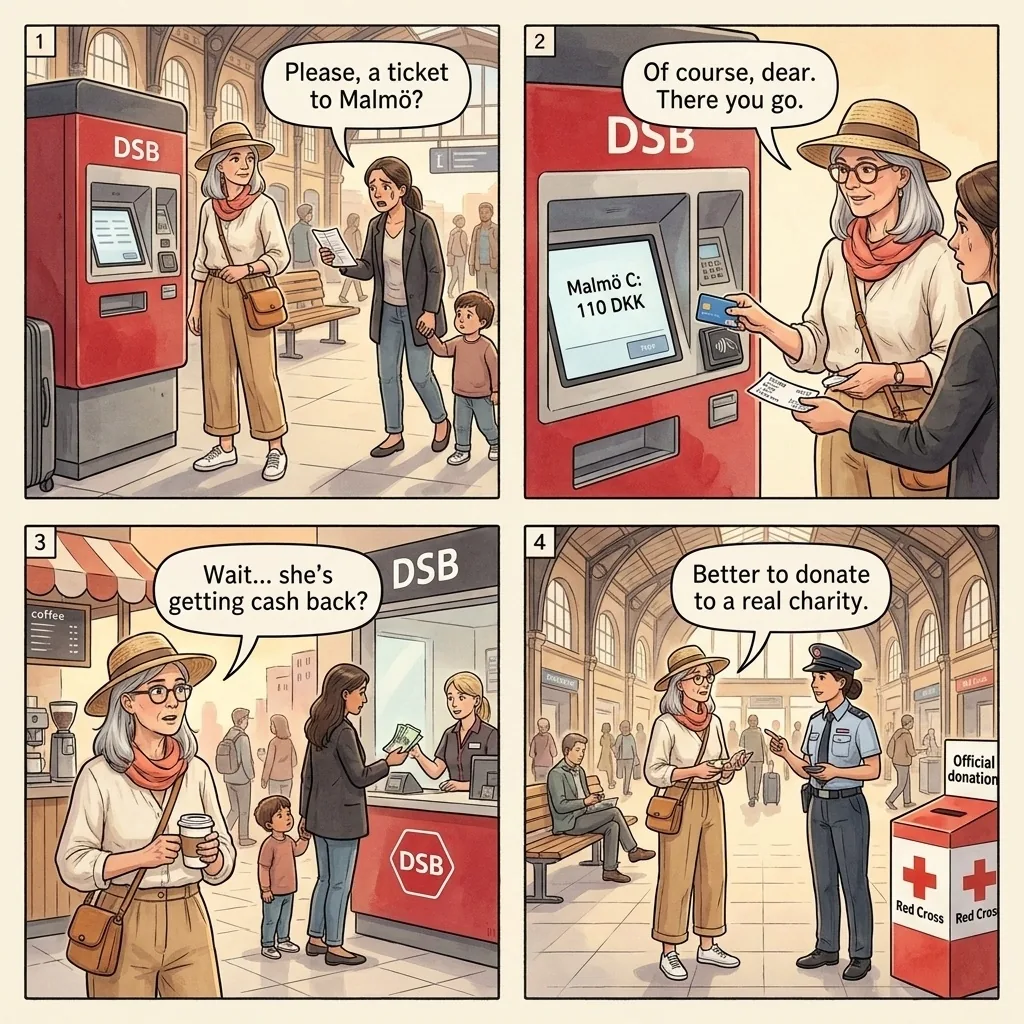
A young woman with a child approaches you at the DSB ticket machine inside Copenhagen Central Station, holds out a folded refugee-status document, and asks in halting English whether you would buy her a train ticket to Malmö — she just needs to reach her cousin.
She has no cash, no card, and her phone is dead. The story is plausible — Copenhagen has been a stopping point for Ukrainian and other refugee flows for years, and her composure suggests genuine distress. You feel empathy. You tap your card on the machine, buy a 110 DKK ticket to Malmö, and hand it to her. She thanks you profusely, takes the printed ticket, and walks toward the platform.
She does not get on a train. Within minutes she walks to the DSB ticket counter, requests a refund on the unused ticket, receives 110 DKK in cash, and pockets it. Then she returns to a different ticket machine on a different platform and approaches the next foreign-looking traveler. The refugee-status document is photocopied or printed; the cousin in Malmö is fictional; the entire transaction is a way to convert your kindness into untraceable cash.
The Copenhagen Central Station refund scam has been documented by Danish Rail (DSB) and Copenhagen police for years. The pattern is consistent — solo women with children, refugee-status framing (Ukrainian, Syrian, depending on current events), Malmö as the destination because it is just across the Øresund and feels low-stakes. Reddit carries first-person accounts; DSB has installed signs at major stations warning passengers not to buy tickets for strangers.
A second variation runs at Nørreport, where operators ask for cash directly under the same framing rather than going through the ticket-purchase loop. Some target tourists in the cobbled streets between Strøget and Christiansborg with the same pitch. The empathy hook is real — refugees do exist, the war is real, and discomfort with refusing is the emotional lever the scam relies on.
Do not buy train tickets, bus tickets, or food for strangers at Copenhagen Central, Nørreport, or any other Danish train station — DSB and Danish social services have explicitly asked travelers not to do this because it directly funds the refund scam. If someone genuinely needs help, direct them to the Red Cross Refugee Help desk at Central Station or call Copenhagen social services (the municipal hotline is 33 66 33 66). Never hand cash directly to anyone claiming to be a refugee on the street. If you witness a refugee in genuine distress, contact a station officer.
Red Flags
- Strangers asking you to buy transit tickets for them
- Urgency and emotional stories at ticket machines
- Person who doesn't seem to know their destination clearly
How to Avoid
- Don't purchase tickets for strangers at stations.
- If you want to help someone in need, direct them to Copenhagen social services.
- Keep your distance from people hovering at ticket machines.
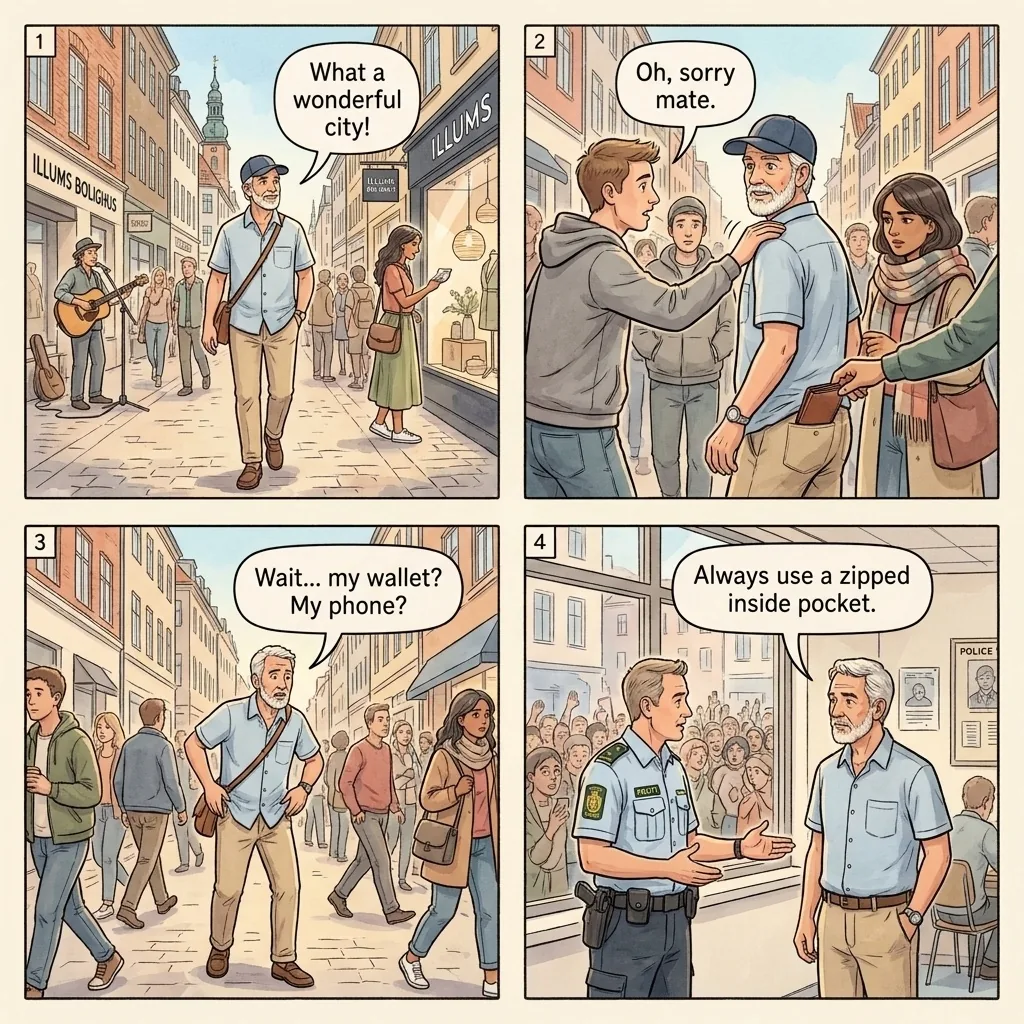
You walk Strøget — Copenhagen's mile-long pedestrian shopping spine — on a Saturday afternoon, browsing the windows of Magasin du Nord and Illums Bolighus, when you reach the Højbro Plads corner where the crowd narrows.
A street performer is drawing a small crowd. Tour groups pass through. A young man in a hoodie bumps your shoulder hard enough to push you forward, mutters 'sorry' in English, and keeps walking. A woman immediately ahead of you slows down to dig in her bag, forcing you to swerve. The whole moment lasts perhaps three seconds. You keep walking.
Twenty meters later you reach for your phone in your back pocket and find it gone. The wallet that was in your jacket pocket is also gone. The lift happened during the bump-and-block sequence — the bumper drew your attention forward, the woman ahead created the pinch point, and a third operator behind worked your pockets in the four-second pause. By the time you turn around, the crowd has shifted and any chance of identification is gone.
Strøget and Copenhagen Central Station are the two highest pickpocket-risk locations in Denmark, both flagged in Københavns Politi's tourist-safety advisories and consistently mentioned on Reddit and the TripAdvisor Copenhagen forum. Operators travel from elsewhere in Europe for peak summer (June-August) and concentrate on the Højbro Plads, Amagertorv, and Rådhuspladsen ends of Strøget where pedestrian flow narrows. Tour-group cluster points and the Tivoli entrance queue are secondary hotspots.
The Copenhagen variant is gentler than Barcelona or Naples — there are no aggressive distractions, no fake spills, no children swarming. The technique relies on natural crowd density, brief contrived bumps that mimic accidental contact, and a coordinated pinch-and-lift that is over before the target processes what happened. The same operators rotate to Tivoli queues in the evening.
Wear a crossbody bag on your front with a zipper on Strøget, especially during peak season afternoons. Keep your wallet and phone in zipped front pockets — never back pockets, never an open jacket pocket. When the crowd narrows at Højbro Plads or Amagertorv, slow down and put your hand on your bag. Be alert when someone bumps you and apologizes; the bump is the signal, not the accident. If you are pickpocketed, dial 114 (Danish Police non-emergency) or 112 and report immediately at Politigården for an insurance-grade report.
Red Flags
- Unusual crowding or jostling in specific spots
- Someone apologizing for bumping into you while others are nearby
- Distraction from someone asking for directions
How to Avoid
- Keep valuables in front pockets or a secure crossbody bag.
- Be extra vigilant during crowded summer months.
- Avoid displaying expensive cameras or jewelry on Strøget.
Like what you're reading? Get a full Copenhagen itinerary with safety tips built in.
Browse travel-safety books →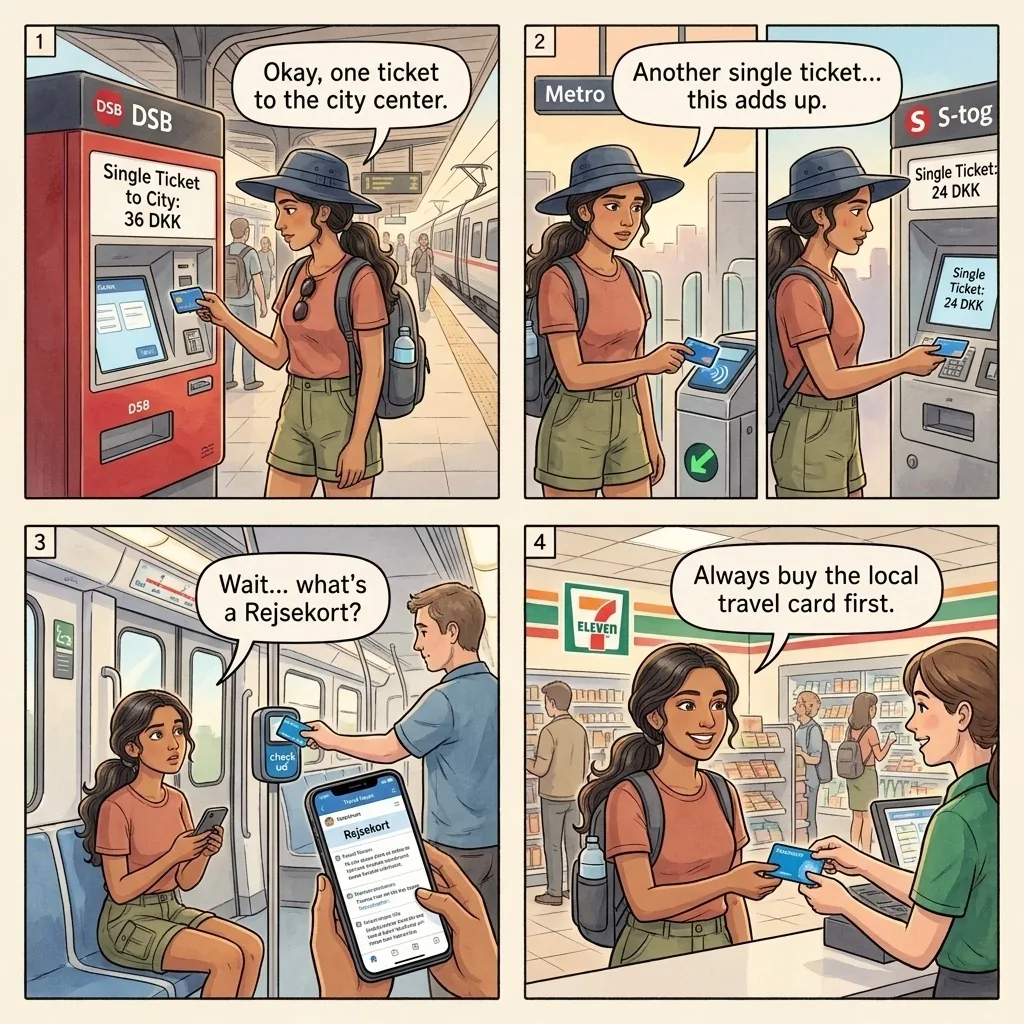
You arrive at Copenhagen Airport on a four-day trip, walk to the DSB ticket machine on the train platform, and tap through the menus to buy a single ticket to Central Station for 36 DKK.
The transaction is fast, the screen is in English, the journey is quick. Over the next four days you do the same thing six or eight more times — Metro to Christianshavn, S-tog to Nørreport, bus to Amalienborg, S-tog out to Hellerup. Each trip costs 24-36 DKK on a single ticket. By the end of the week you have spent maybe 240 DKK on transit, which feels reasonable for a Scandinavian city.
What no one at the airport, the tourist information desk, or the ticket machine has mentioned is the anonymous Rejsekort. The reusable Rejsekort (travel card) offers 20–45% savings on every Metro, S-tog, and bus journey in the Copenhagen zone, automatically calculates the correct fare on tap-out, and is available for an 80 DKK deposit at any 7-Eleven, DSB office, or Metro station service point. With a Rejsekort, your same six or eight trips would have cost 130-160 DKK instead of 240. Over a week, the deposit pays for itself within two days.
The 'scam' here is not malicious — it is a soft information asymmetry. DSB (Danish Rail) and Metro Service have no incentive to advertise the cheaper alternative at the ticket machine, and the airport tourist desk does not actively push it. Reddit, the long-running TripAdvisor Copenhagen forum, and most updated guidebooks flag the Rejsekort gap as the single most common 'tourist tax' in the city — easily 100+ DKK lost per traveler per week, all of it avoidable.
A second related option is the City Pass for 24/48/72/96/120 hours, which costs 80–230 DKK depending on length and offers unlimited travel on Metro, S-tog, harbor buses, and regional buses inside zones 1-4. For very short trips (one or two days with heavy transit use), the City Pass beats both single tickets and Rejsekort. For four+ day trips, the anonymous Rejsekort is almost always the cheapest option.
Buy an anonymous Rejsekort at any 7-Eleven, DSB ticket office, or Metro service point on arrival in Copenhagen — 80 DKK deposit, plus whatever you load (start with 100 DKK for a few days). Tap on at every Metro, S-tog, or bus journey, and tap off at the destination; the system calculates the cheapest fare automatically. For 1-3 day intensive trips, compare against the Copenhagen City Pass (80-230 DKK). Return the Rejsekort at any DSB station before you leave for an 80 DKK deposit refund minus a 10 DKK processing fee. The DSB app also works for single tickets but does not get the Rejsekort discount.
Red Flags
- High per-ride cost on single-journey tickets
- No one mentioning the Rejsekort option at ticket machines
How to Avoid
- Buy an anonymous Rejsekort travel card at any 7-Eleven or DSB station.
- The card pays for itself within 2-3 days of regular use.
- Return the card before you leave for a partial refund of the deposit.
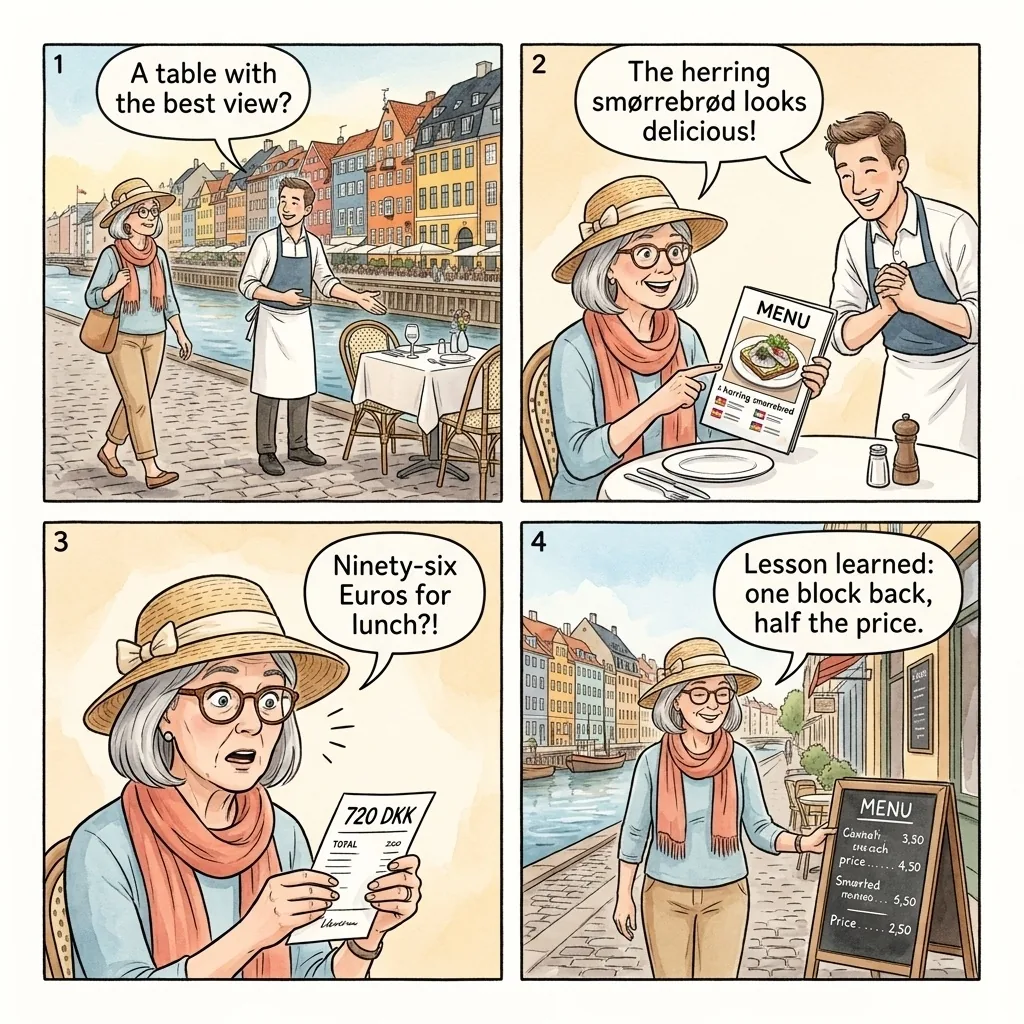
You walk down Nyhavn — the postcard canal lined with red, yellow, and blue 17th-century townhouses — and the smell of grilling fish and fresh bread pulls you to one of the canalside restaurant terraces.
A waiter waves you to a table with a perfect view of the canal. The menu is glossy, in five languages, with photos of smørrebrød and grilled fish that look like classic Danish lunch. You order a smørrebrød with marinated herring and a small piece of grilled fish with potatoes. The food arrives quickly. The smørrebrød is fine, the fish is correct, the view is genuinely beautiful.
The bill comes to 720 DKK (€96) for two people sharing a smørrebrød, two fish dishes, and two glasses of house white. The same smørrebrød at Aamanns or Schønnemann two streets away costs 95 DKK; the fish dish you paid 220 DKK for is closer to 130 at Schønnemann; the wine was 95 DKK a glass for what was clearly a sub-€10 bottle. You have paid roughly double the going rate for mediocre versions of Danish lunch classics.
The Nyhavn premium is real and well-known. Restaurants directly on the canal charge a 60–100% tourist surcharge for the view, with menus calibrated to extract maximum spend from one-time visitors. The Visit Copenhagen tourism office and Reddit flag Nyhavn restaurants by name, and most updated guidebooks recommend walking one block back from the canal for genuine quality at half the price. The food at Nyhavn canalside is also frequently mediocre — the volume model leaves no room for craft, and the regular customers are tourists who do not return.
A second variation is the unrequested bread basket and the 'service charge' line. Some Nyhavn restaurants drop a basket of bread and butter on the table 'complimentary' — but it appears on the bill at 60–80 DKK. A 12% service charge is added to the subtotal even though tipping is not customary in Denmark and Danish law requires service to be included by default. Both are technically disclosed somewhere on the menu, but the format obscures them.
Walk one block back from Nyhavn for any meal — Aamanns 1921 (Niels Hemmingsens Gade), Schønnemann (Hauser Plads), and Restaurant Krebsegaarden (Studiestræde) all serve genuine Danish smørrebrød at half the canalside prices, with locals as regulars. Read the menu carefully before ordering, including small-print bread and service charges, and decline any 'complimentary' bread basket that lacks an explicit free disclosure. For the canalside view, walk Nyhavn and grab takeaway smørrebrød elsewhere to enjoy on a bench. If a restaurant adds undisclosed surcharges, dispute the bill at the table or via your card issuer.
Red Flags
- Restaurants on the canal with menus in 10 languages
- No prices prominently displayed outside
- Waiter who flags you down aggressively from the door
How to Avoid
- Walk one block back from Nyhavn to find restaurants with locals inside.
- Look at full menus with prices before sitting anywhere near the canal.
- Most Copenhagen restaurants add 'bread' charges automatically — ask if it's included.
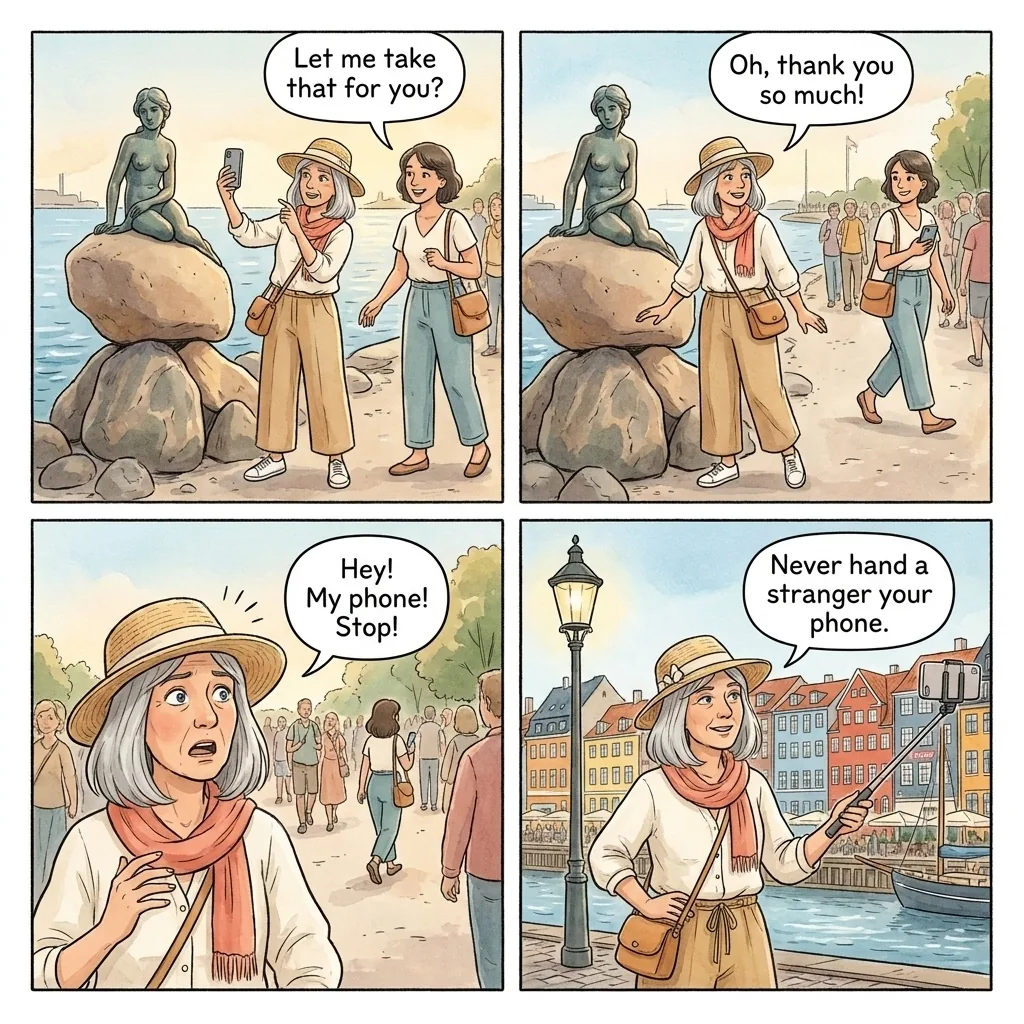
You stand at the rocks below the Little Mermaid statue at Langelinie, holding your phone out at arm's length to frame the iconic shot, when a friendly person approaches with a smile and offers to take a 'proper' photo of you with the statue.
It is a thoughtful offer — you would otherwise be stuck with an awkward selfie. You hand over your phone with a quick thank you, the stranger steps back to frame the shot, takes one or two photos, and starts walking quickly toward the path along the harbor. They are not running, but they are not stopping either. By the time you realize what is happening they have a thirty-meter head start and the path forks into the busy Langelinie park.
A second variation is the 'bad photo demand' — the stranger takes a deliberately blurry or poorly framed shot, then holds your phone out of reach and asks for a 'tip' or 'fee' to give it back. The amount starts at 50 DKK and creeps up if you protest. Some operators work in pairs, with a partner who 'happens' to need help nearby at the moment of the handoff to draw your attention sideways while the photographer slips into the crowd.
The pattern is documented at the Little Mermaid, the Nyhavn corner where the canal meets Kongens Nytorv, the Christianshavn canal bend, and the Rosenborg Castle gardens. Copenhagen Police and the Visit Copenhagen office both flag the photo-snatch at major tourist attractions, especially during peak summer. The Little Mermaid is the highest-incidence single location because the statue requires people to put down bags and lean over the railing for the shot, creating perfect conditions for both the snatch and the quick getaway.
The deeper risk is the unlocked phone itself, not the device cost. A snatched iPhone or Android with an active session can be used in seconds to push WhatsApp messages to your contacts asking for money, transfer funds via banking apps, change your Apple ID password, and lock you out of iCloud. Professional crews drain banking apps in minutes; the phone itself is often abandoned afterward once the data is harvested.
Ask other tourists to take your photo, not strangers who approach you unprompted — the offered help at a tourist landmark is the warning sign. Use a small selfie stick or tripod for important shots; both work fine at the Little Mermaid railing. If you do hand a phone to someone, stand close enough to grab it back instantly and never let them step more than two meters away. Set your screen-lock to under 30 seconds and require Face ID for banking apps so a snatched device cannot transact. If your phone is snatched, dial 114 (Danish Police) immediately and remote-wipe via iCloud or Google.
Red Flags
- Strangers volunteering to take your photo unprompted
- Taking your device out of your grip rather than staying beside you
- Person moving away from you while holding your phone
How to Avoid
- Ask other tourists to take your photo instead of strangers.
- Use a selfie stick for important shots.
- If you hand your phone to someone, stand close enough to grab it back easily.
🆘 What to Do If You Get Scammed
📋 File a Police Report
Go to the nearest Danish Police (Politi) station. Call 114 (non-emergency) or 112 (emergency). Get an official crime report — you'll need this for insurance claims. You can also report online at politi.dk.
💳 Cancel Your Cards
Call your bank immediately. Most have 24/7 numbers on the back of the card (keep a photo saved separately). Block any suspicious transactions before the thieves use your details.
🛂 Lost Passport?
Contact your nearest embassy or consulate. The US Embassy in Copenhagen is at Dag Hammarskjölds Allé 24, 2100 Copenhagen. For emergencies: +45 33 41 71 00.
📱 Track Your Device
If your phone was stolen, use Find My (iPhone) or Find My Device (Android) from another device. Don't confront thieves yourself — share the location with police instead.
Sources & further reading
Every scam here is cross-checked against official government advisories, police bulletins, and established reporting. Confirm current details with the primary sources below before you travel.
-
U.S. Department of State — Denmark International Travel Information
Government advisory
“'Pickpockets' and 'purse-snatchers' operate aggressively in areas frequented by tourists, on trains and buses, and at transit stations, including Copenhagen Central Station, Copenhagen Airport, and quays.”
-
UK Foreign, Commonwealth & Development Office (GOV.UK) — Safety and security - Denmark travel advice
Government advisory
“Crime levels are generally low, but pickpockets and bag-snatchers operate in crowded areas, mainly in Copenhagen.”
-
Government of Canada (travel.gc.ca) — Travel advice and advisories for Denmark
Government advisory
“Pickpockets and purse snatchers may work in teams. One person will distract the victim while another commits the robbery.”
-
Visit Copenhagen (official Copenhagen tourism site; footer copyright VisitDenmark) — Safety | Visit Copenhagen
Official tourism
“On a few rare occasions, tourists have been scammed by fake police officers.”
-
The Local Denmark — Copenhagen tourists conned by fake officers
News report
“According to police, the two men posed as plain-clothes officers and used a phony or foreign police sign to convince tourists that they had violated a law and needed to pay a…”
-
World Nomads — Crime and Scams in Denmark: Essential Tips to Stay Safe
Travel-safety guide
“They will then ask to see how much money you have on you and ask for a bribe.”
Frequently Asked Questions
You just read 6 scams in Copenhagen. The full Travel Safety Series has 780+ more across 20+ countries.
Tokyo's Kabukichō ¥130,000 bar trap. Rome's gladiator photo extortion. Paris's gold-ring trick. Bali's ATM skimmer scams. Bangkok's grand-palace closure ruse. Every documented scam across 20+ destinations — with the exact scripts, red flags, and local-language phrases that shut each one down. Drawn from Reddit traveler reports, embassy advisories, and consumer-protection cases.
- 780+ documented scams across Tokyo, Rome, Paris, Bali, Bangkok, Rio & 100+ more cities
- 20+ countries covered, with country-by-country phrase cards for every destination
- Updated annually — buy once, re-download future editions free
- All titles $4.99 each on Amazon Kindle