
Key Takeaways
- The #1 reported scam is the Dhaka CNG Auto-Rickshaw Meter Trick.
- 1 of 6 scams are rated high risk.
- Use app-based ride services (Uber, Ola) instead of street taxis — always confirm the fare before departure.
- Never accept unsolicited offers from strangers near tourist sites in Dhaka.
⚡ Quick Safety Tips
- Keep phones and valuables in secure pockets when in crowded areas.
- Use only licensed taxis or app-based ride services.
- Book tours and tickets through verified operators with online reviews.
- Keep a copy of your passport separate from the original.
Jump to a Scam
The 6 Scams
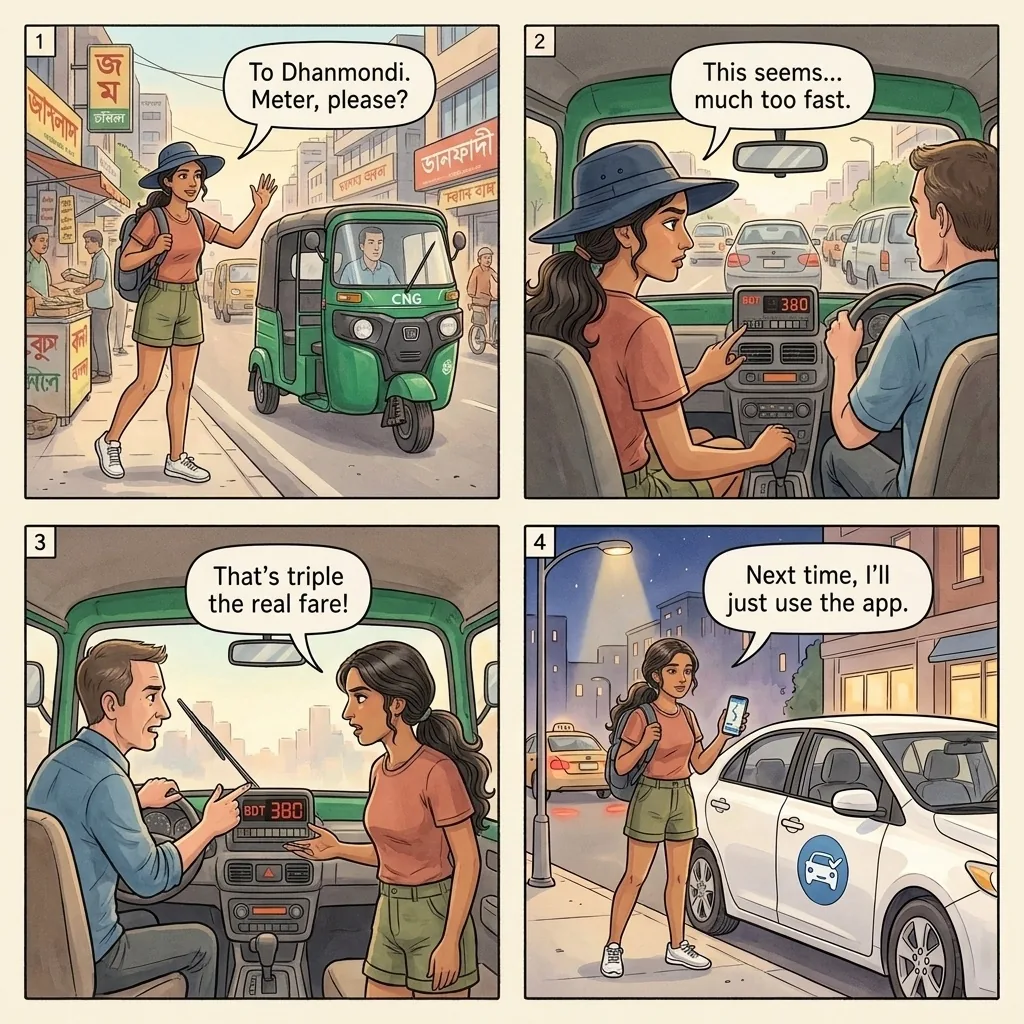
You flag down a green CNG auto-rickshaw in Gulshan for a 4-kilometer ride to Dhanmondi, the driver agrees to use the meter, and you climb in.
The meter starts at the standard BDT 40 base. The driver pulls onto Gulshan Avenue and the rickshaw lurches into Dhaka traffic. You watch the meter on the dashboard, expecting maybe BDT 100–150 for the trip. But the digits tick far too fast — the meter is rolling up by 5–10 BDT every twenty seconds even when the rickshaw is stopped at lights. By the time you reach Dhanmondi, the meter reads BDT 380 for what should be a BDT 130 ride.
When you protest, the driver shrugs and points at the meter. The number is what the number is. The meter, rigged at a Dhaka mechanic shop to tick at 2.5–3x the legal rate, looks identical to a normal meter from the outside. The Bangladesh Road Transport Authority has threatened fines of BDT 50,000 for meter tampering, but enforcement is nearly nonexistent on Dhaka's 50,000+ CNG fleet. A Kawran Bazar to TSC ride that should be about BDT 40 by a fair meter is regularly charged at BDT 150–200.
A second variation runs the meter refusal. Drivers see a foreigner, refuse the meter entirely ('meter broken, sir'), and quote a flat rate of BDT 300–500 for a ride worth BDT 100–150. The flat-rate quote is calibrated to be roughly 3x the legitimate fare, the same scale as the rigged-meter scam, just with different framing. The U.K. Foreign Office Bangladesh travel advice, Reddit, and the long-running TripAdvisor Dhaka forum all flag the pattern.
The cleanest fix is to skip the curbside CNG conversation. Pathao and Uber both operate in Dhaka, work on smartphone apps with in-app fare quotes in BDT, GPS-track the route, and rate drivers. A Pathao or Uber from Gulshan to Dhanmondi runs BDT 130–180 fixed in-app. The drivers are typically more accountable because the rating system actually affects their bookings.
Use Pathao or Uber for every CNG, ride-share, or moto ride in Dhaka — both apps work well, fares are in-app, and drivers are tracked. If you must use a flagged CNG, agree on the flat fare upfront and use Google Maps to track the route. For airport transfers, use the pre-paid taxi counter inside the Hazrat Shahjalal terminal rather than drivers outside, or pre-book through your hotel. Learn approximate fares for common routes from your hotel's reception. If a driver demands inflated payment, dial 999 (Bangladesh emergency) or 100 (Police) and report the CNG plate number.
Red Flags
- Driver agrees to meter but it ticks unusually fast
- Driver refuses to turn on the meter and insists on a flat fare
- Quoted flat fare is two to three times what the Pathao app shows
- Driver takes a longer route through congested areas claiming 'road closures'
How to Avoid
- Download the Pathao or Uber app before arriving — it works in Dhaka and sets a fair market price.
- If taking a CNG, agree on the fare before getting in and use Google Maps to track the route.
- For airport transfers, use the pre-paid taxi counter inside the terminal rather than drivers outside.
- Learn the approximate fares for common routes from your hotel reception.
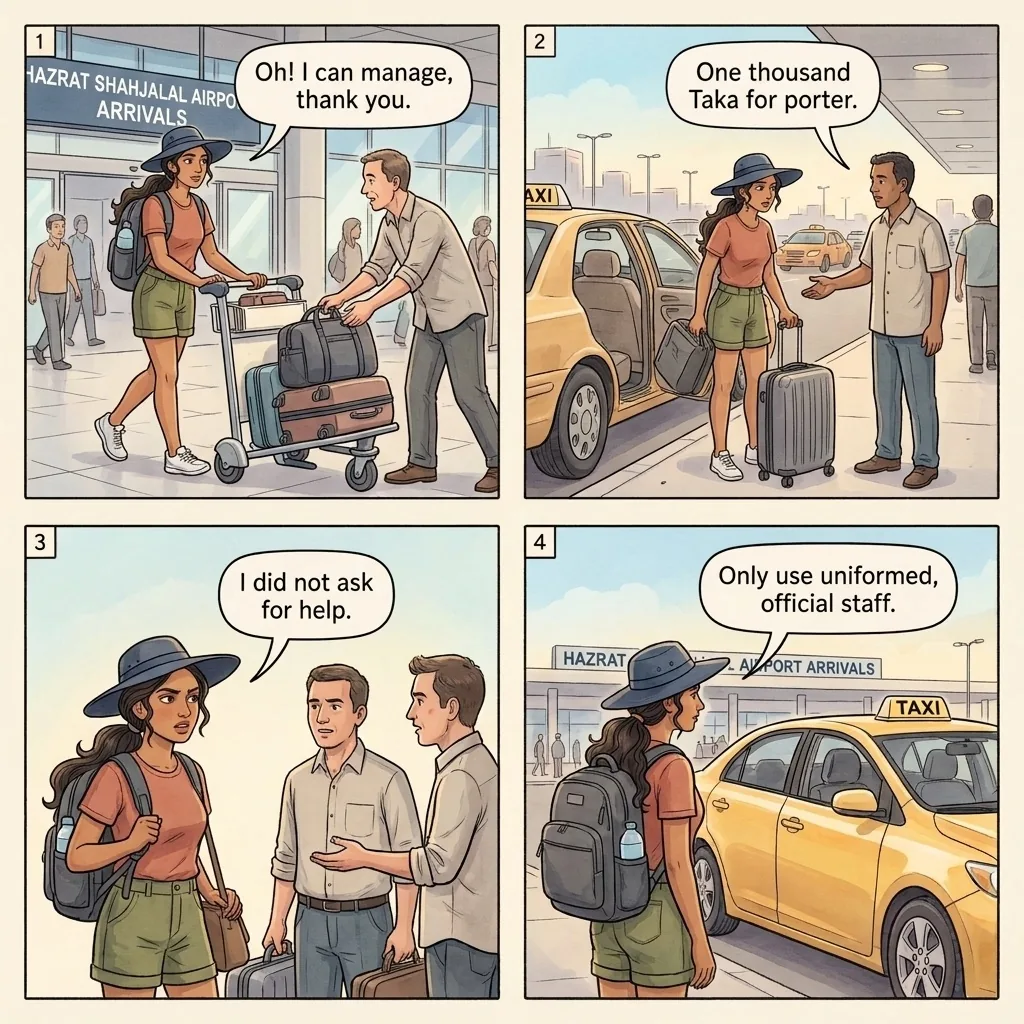
You walk out of arrivals at Hazrat Shahjalal International Airport in Dhaka with two suitcases on a luggage cart, blinking in the warm air, and immediately a man grabs the handle of your cart and starts pushing it toward the exit.
He is not in uniform, has no airport ID badge, and you did not ask for help — but he is already walking briskly with your luggage. You follow because your bags are on his cart. He weaves through the crowd toward the curbside exit, gestures at a taxi, and begins unloading your suitcases onto the pavement. Then he turns to you and holds out his hand: BDT 1,000, about $9, for the twenty-meter cart push.
When you protest that you never agreed to a porter, his tone shifts. A second man appears beside him, also in plain clothes, also confidently asserting he 'helped' move your luggage. The two of them stand between you and your suitcases. Other travelers exit the terminal around you and continue past, and you realize most foreigners pay the BDT 500–1,000 just to disengage and move on with their trip.
The Hazrat Shahjalal porter shakedown is documented across Reddit, the long-running TripAdvisor Dhaka forum, and traveler advisories from multiple embassies. The 'porters' are self-appointed, work in teams targeting visibly foreign arrivals with large luggage, and rotate between the arrivals hall and the curbside drop zones. They specifically target the moment when arriving travelers are jet-lagged, disoriented, and least equipped to argue.
Real airport porters at Hazrat Shahjalal exist and wear official uniforms with photo ID badges. The legitimate rate is BDT 100–200 per bag for a longer haul through the terminal — not BDT 1,000 for a twenty-meter curbside push. The U.K. Foreign Office Bangladesh travel advice and the U.S. Embassy in Dhaka's traveler-safety materials both flag this pattern.
Keep both hands firmly on your luggage cart at Hazrat Shahjalal arrivals and do not allow anyone without a uniformed badge to take it. Decline help with a clear 'na, dhonnobad' (no, thank you in Bangla) and walk past. If you genuinely need a porter, use the official airport porters identified by uniforms and visible airport ID. Pre-arrange hotel pickup so someone is holding a sign for you, or pre-book a Pathao/Uber from inside the terminal so you walk straight to a known driver. If a self-appointed porter blocks your bags, stop walking, firmly say 'no,' and call airport security at the information desk; do not follow them outside.
Red Flags
- Person grabs your bags without asking permission
- No uniform, official badge, or airport ID visible
- Porter moves quickly toward the exit to create a sense of obligation
- A second person appears to support the first when you resist paying
How to Avoid
- Keep a firm hand on your luggage cart and decline help with a clear 'no, dhonnobad' (no, thank you).
- If you need a porter, use the official airport porters identified by uniforms and ID badges.
- Arrange hotel pickup in advance so someone is holding a sign for you at arrivals.
- If someone grabs your bag, stop walking, firmly say 'no,' and wait — do not follow them outside.
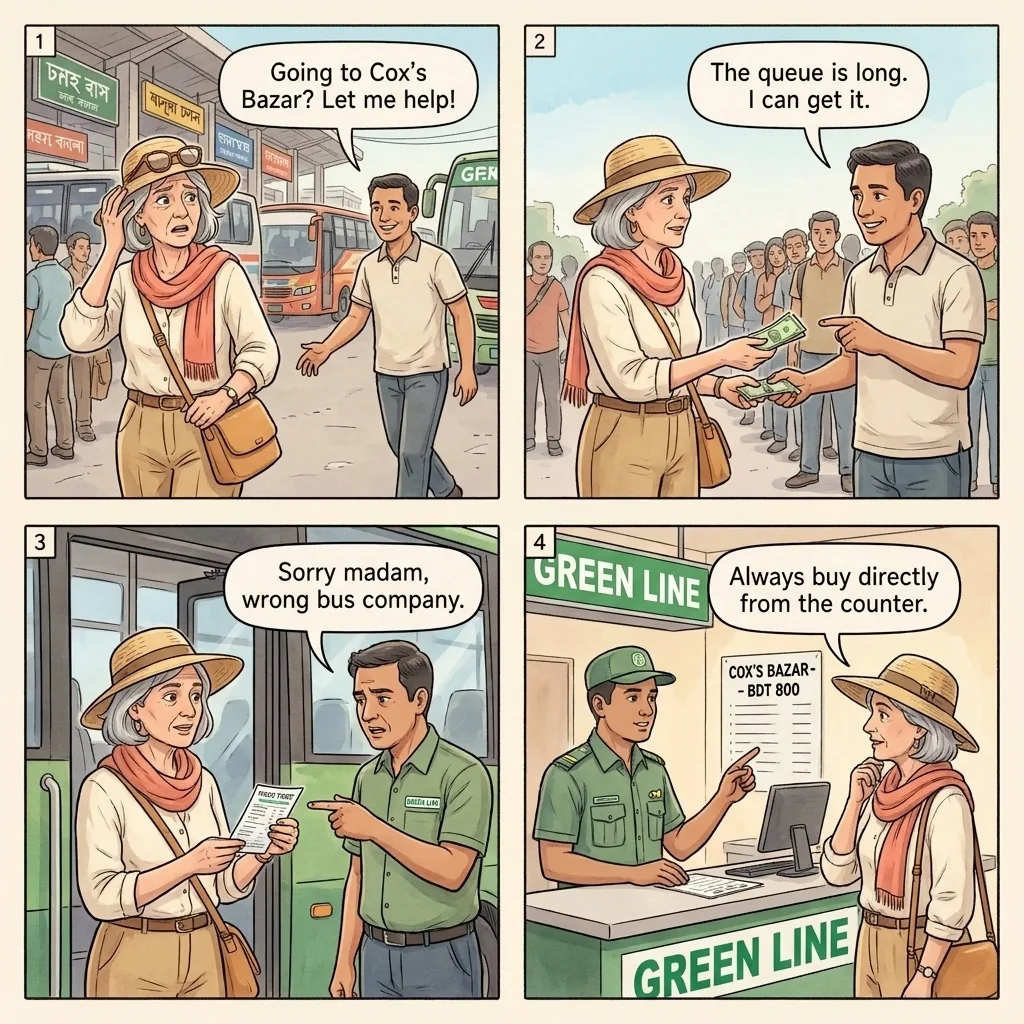
You arrive at Gabtoli Bus Terminal in northwest Dhaka to buy a ticket on the overnight Green Line coach to Cox's Bazar, planning to head to the beach for a few days.
Before you reach the official Green Line counter, a man in a clean polo shirt intercepts you and offers to 'help' get a ticket — he says seats are nearly sold out for tonight's departure, and that he can secure one for you faster than the queue at the counter. He quotes BDT 1,500. The price feels reasonable for a long-haul coach to the coast.
You hand over the BDT 1,500 in cash. He walks toward the counter and returns five minutes later with a printed ticket — official-looking, with a seat number and departure time. You thank him, find the platform, and wait for the bus. The bus that arrives is a different company than your ticket shows, the seat number does not exist on the actual bus layout, and the counter staff (when you walk over to verify) tell you the official Green Line ticket for the same overnight Cox's Bazar coach costs BDT 800 — half what you paid.
Variations get worse. Sometimes the ticket is for a canceled departure or a lower-class bus than promised. In the worst documented cases, travelers buy tickets for buses that simply do not exist — the tout pockets the cash, hands over a forged ticket, and disappears into the terminal before the 'departure' time arrives. The Gabtoli, Sayedabad, and Kamalapur transit hubs all see this pattern, with peak intensity during festival seasons (Eid, Pohela Boishakh) when legitimate buses fill quickly.
The fix is structural: book long-distance bus tickets online through Shohoz.com (Bangladesh's main ticketing platform) before arriving at the terminal, or directly through the official websites of named operators (Green Line, Shohagh, Hanif Enterprise, ShyamoIi). Walking directly to the official counter at the terminal works too, but only if you can ignore the touts intercepting you on the way in.
Walk directly to the official ticket counter of a known operator (Green Line, Shohagh, Hanif Enterprise, ShyamoIi) at Gabtoli, Sayedabad, or Kamalapur — do not engage with anyone who approaches you in the terminal forecourt. Better still, book long-distance bus tickets online through Shohoz.com before arriving, or ask your hotel to arrange tickets in advance. Ignore 'almost sold out' urgency from anyone who is not behind a counter; it is the standard pressure tactic. If you have already paid a tout for a fake ticket, dispute via your card issuer (if applicable) and report to the Bangladesh Road Transport Authority.
Red Flags
- Person approaches you before you reach the official ticket counter
- Claims seats are 'almost sold out' and creates urgency to buy immediately
- Price is significantly higher than what you researched online
- Ticket is handwritten or lacks official company branding
- Tout discourages you from going to the official counter
How to Avoid
- Walk directly to the official ticket counter of a known bus company like Green Line, Shohagh, or Hanif.
- Book long-distance bus tickets online through Shohoz.com before arriving at the terminal.
- Ignore anyone who approaches you in the terminal — legitimate counter staff do not solicit.
- Ask your hotel to arrange bus tickets in advance.
Like what you're reading? Get a full Dhaka itinerary with safety tips built in.
Browse travel-safety books →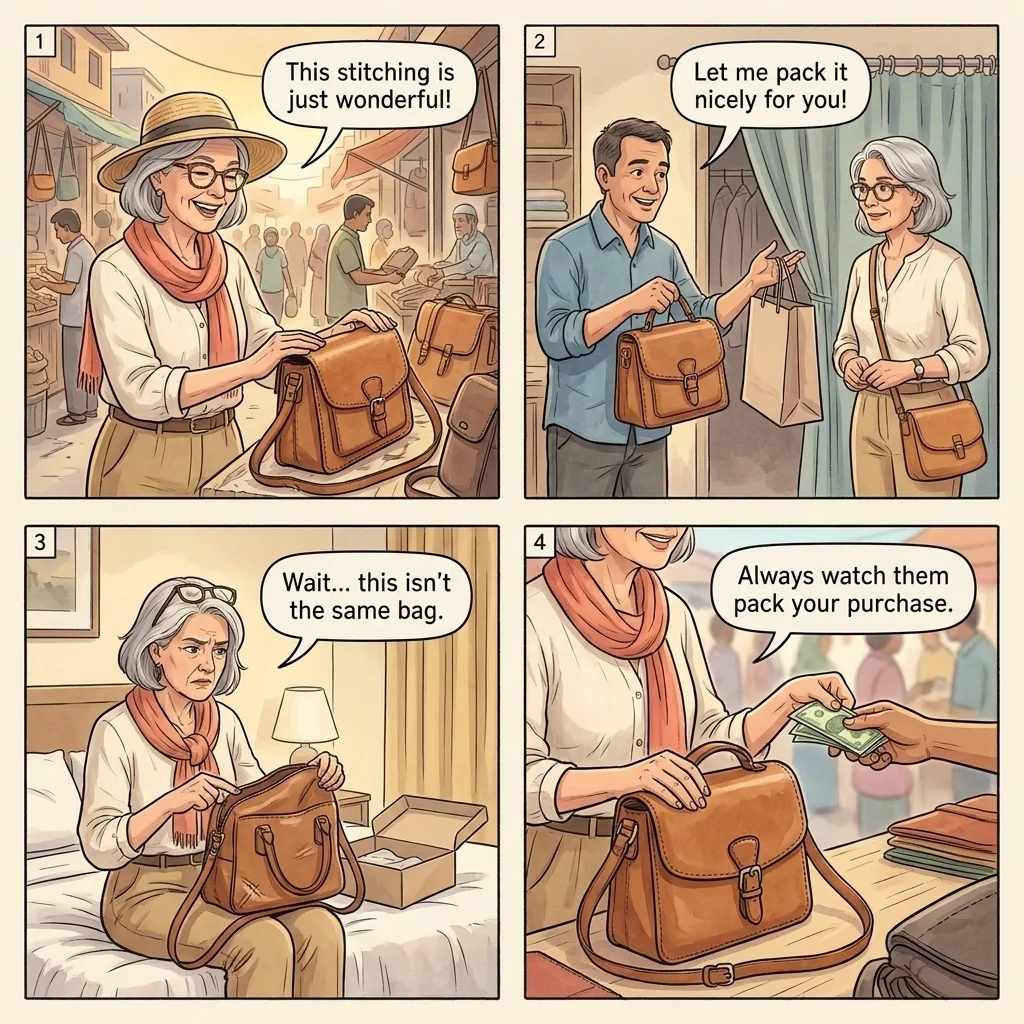
You browse the leather-goods section of New Market in Dhaka and find a beautiful brown leather messenger bag, hand-stitched, with thick stitching and a soft leather handle.
You inspect it carefully, the vendor quotes BDT 2,500, you negotiate down to BDT 2,000, and you agree. He takes the bag to 'pack it properly' — into a clean shopping bag with tissue paper. He disappears behind a curtain at the back of the stall for thirty seconds. He returns with a sealed shopping bag, hands it to you, and pockets the money.
Back at your hotel, you open the bag. The leather is stiffer, the stitching is uneven, the color is slightly wrong, and there is a small but visible defect on one corner that you are sure was not on the bag you chose. The vendor swapped your bag during the wrapping for a similar-looking lower-quality piece, knowing tourists almost always wait until they reach their hotel to inspect the purchase.
The bait-and-switch product swap is documented across Reddit, Quora's Dhaka shopping threads, and the long-running TripAdvisor Dhaka forum. The technique is especially common with leather goods (jackets, bags, wallets), clothing (saris, shirts), and handicrafts where items look broadly similar but vary significantly in quality. New Market, Gausia Market, and the leather stalls in Old Dhaka are the consistent hotspots; the wrapping-room swap is the consistent mechanic.
A second variation runs the opaque-packaging trick. The vendor wraps your purchase in heavy paper or a sealed bag and rushes the final transaction with social pressure 'just go, just go, the price is good.' Some vendors mark the swap window with a brief distraction — a cousin who appears to ask a question, a phone call, anything that breaks your eye-line — during the moment the swap happens.
Never let the vendor take your chosen item out of your sight at New Market or any Dhaka market — insist on watching every step of the wrapping at the counter. Open and inspect the packaged item before paying or leaving the stall. Discreetly mark your item with a pen mark or take a photo with the timestamp visible before it goes into wrapping. For higher-quality Bangladeshi handicrafts at fixed prices with no swap risk, shop at Aarong (multiple Dhaka locations) — it is the largest fair-trade craft retailer in the country. If you discover a swap, return immediately to the stall (the vendor often refuses but it sometimes works) and dispute via your card issuer if you paid by card.
Red Flags
- Vendor takes the item out of your sight to 'wrap' or 'bag' it
- Item is wrapped in opaque packaging that discourages inspection
- Vendor rushes the final transaction and hands you a sealed bag
- Price seems unusually good for the apparent quality
How to Avoid
- Never let the vendor take your chosen item out of your sight — insist on watching it being wrapped.
- Open and inspect the packaged item before paying or leaving the stall.
- Mark your item discreetly with a small pen mark or photo before it goes behind the counter.
- Shop at fixed-price stores like Aarong for handicrafts where bait-and-switch is not possible.
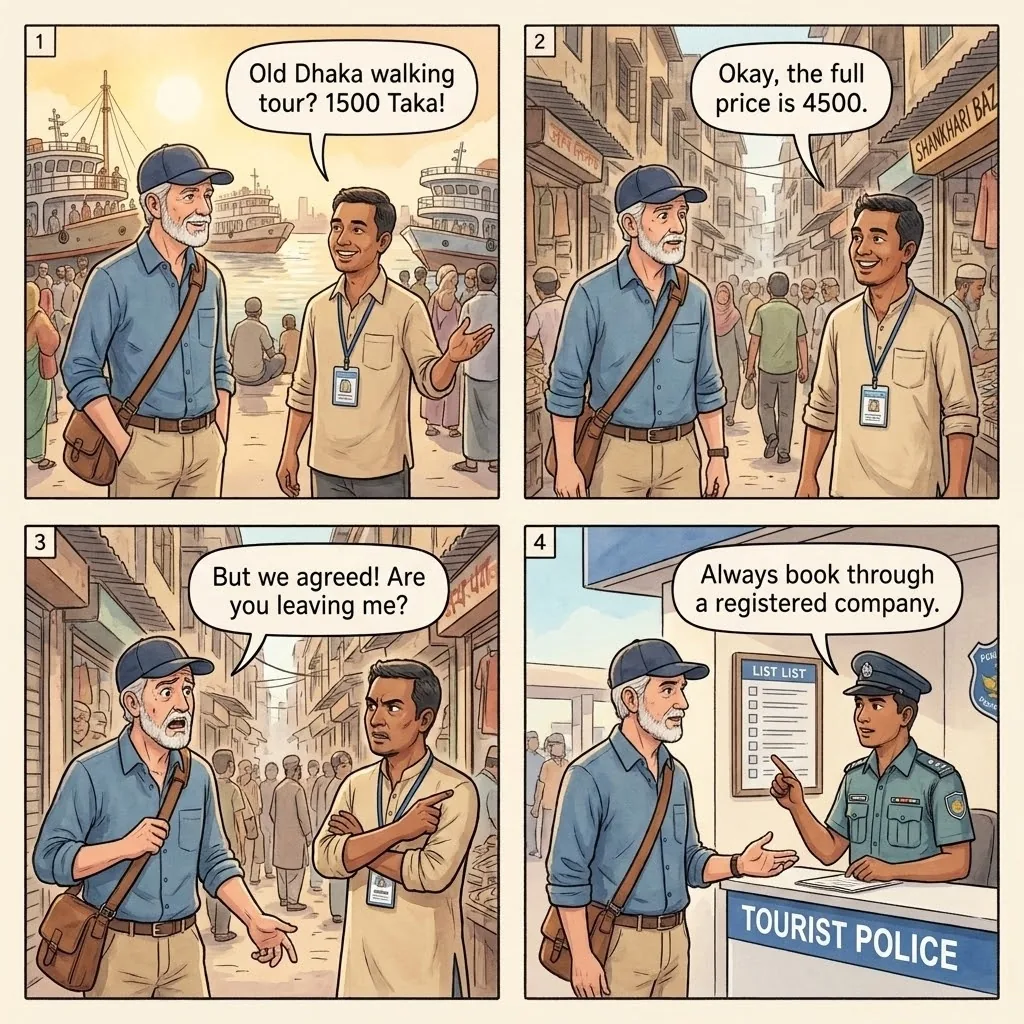
You hire a freelance guide at Sadarghat ferry terminal to show you around Old Dhaka for an agreed BDT 1,500 for a half-day walk through the alleys, mosques, and river views.
The guide is articulate, points out architectural details, and walks you confidently through narrow streets you would not have found alone. Three hours in, deep in the warren of Hindu Street and Shankhari Bazaar, he stops at a small mosque entry and announces that the BDT 1,500 covers his time only — entry fees, the rickshaw transfer, the boat ride to Buriganga, and lunch are all 'extra charges' not included in the original price. The total is now BDT 4,500, payable now.
When you protest, the guide's tone shifts. He becomes upset and threatens to abandon you in this unfamiliar neighborhood — somewhere you would have a hard time finding your way out of without him. He is calm but firm: pay the additional BDT 3,000 or find your own way back. The escalation tactic works because tourists genuinely feel vulnerable in the crowded, disorienting alleys of Old Dhaka, where street signs are inconsistent and the language barrier is real.
The Sadarghat mid-trip price hike is documented across Reddit, the long-running TripAdvisor Dhaka forum, and the U.K. Foreign Office Bangladesh travel advice. The pattern affects freelance guides at Sadarghat, near Lalbagh Fort, and at the starting points of day trips to Sonargaon. The tactic is calibrated to the moment when you are deepest in unfamiliar territory and least equipped to walk away.
A subtler variation runs the 'tip pressure' play. The original price is honored, but at the end of the tour the guide insists on a 'mandatory tip' of BDT 1,000–2,000, framed as customary. Some guides also push you toward specific shops (handicrafts, leather, antiques) where they earn 10–25% commission on any purchase, which inflates the day's spending without explicit upcharges.
Get all inclusions in writing on your phone before starting any Old Dhaka tour — entry fees, transport (rickshaw, boat), meals, all extras explicitly priced. Book guides through your hotel or a verified platform like Viator or GetYourGuide rather than freelancers at Sadarghat. Carry an offline map (Maps.me or Google Maps offline) so you can navigate independently if the guide abandons you. Pay 30% upfront and 70% at the end to keep leverage if the guide changes terms. If a guide pressures mid-trip, refuse the inflated amount, walk to the nearest main road, and dial 999 (Bangladesh emergency).
Red Flags
- Guide agrees to a suspiciously low price for a full-day tour
- No written agreement specifying what is included
- Surprise 'extra charges' appear midway through the tour
- Guide becomes hostile or threatens to leave you when you push back
How to Avoid
- Get all inclusions in writing before starting — entry fees, transport, meals, boat rides.
- Book guides through your hotel or a verified platform like Viator, not freelancers at tourist sites.
- Carry offline maps on your phone so you can navigate independently if the guide abandons you.
- Pay a portion upfront and the rest at the end, ensuring leverage if the guide changes terms.
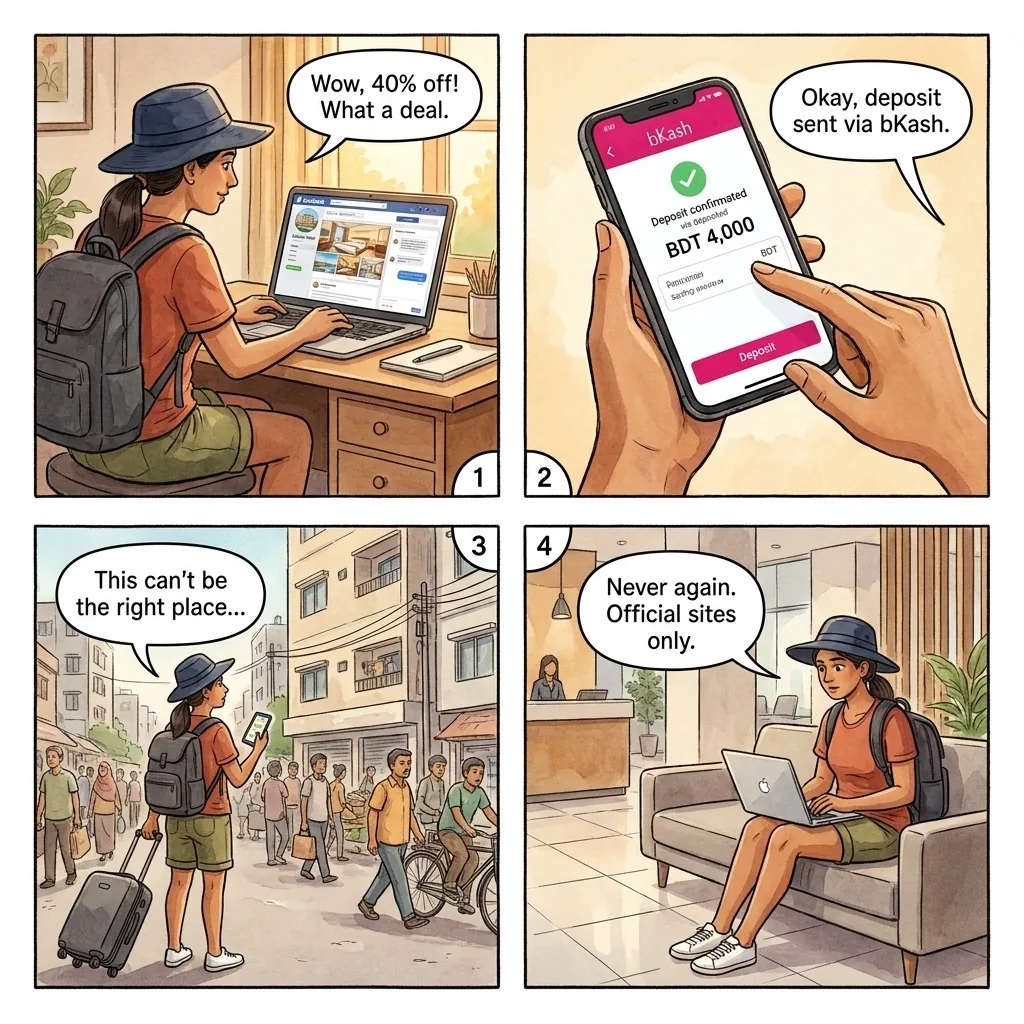
You search Facebook Marketplace for hotels in Gulshan two weeks before your Dhaka trip and find a listing offering BDT 2,000 per night for a room at what looks like a 4-star property — about 40% of the going rate.
The listing has glossy professional photos of a marble lobby, a king-size bed, and a hotel restaurant. The Facebook page has 1,200 likes, dozens of positive comments from satisfied guests, and a friendly admin who responds within minutes when you message. He asks for a 50% deposit (BDT 4,000 for two nights) via bKash mobile money to secure the booking, and promises a confirmation receipt and the hotel address by SMS once payment clears.
You send the BDT 4,000 via bKash. The confirmation arrives. The bKash transaction completes. Three weeks later you land in Dhaka, take a taxi to the address, and discover one of two outcomes. Either the hotel exists but has no record of your booking and the photos in the Facebook listing were stolen from their official site — or the hotel address simply does not exist as a hotel at all. The Facebook page has been deleted by the time you check from your phone in the lobby. The bKash payment is irreversible.
The Dhaka Facebook hotel-booking bKash fraud pattern is documented across Reddit, the long-running TripAdvisor Dhaka forum, and Bangladesh Police consumer-protection materials. The scammers create new pages frequently using stolen photos from real hotels, run them for a few weeks while collecting deposits from multiple tourists, and delete the page before complaints accumulate. The scam spikes during peak travel seasons (cooler months from November to February, plus Eid holidays) when legitimate hotels fill up and travelers become desperate for affordable options.
Variations run on WhatsApp and Telegram with the same script — direct messages from supposed 'hotel managers' offering rates well below market, pressure to send a deposit via bKash or Nagad (Bangladesh's other dominant mobile-money platform), and disappearing operators after the payment clears. The mobile-money rails are irreversible by design, which is what makes the scam work; once you have hit confirm, recovery is essentially impossible.
Book Dhaka hotels only through established platforms (Booking.com, Agoda, Expedia) or directly via the hotel's official website verified through Google Maps — never through Facebook Marketplace, Facebook pages, or WhatsApp DMs. Call the hotel directly using the number from Google Maps or their verified website to confirm any reservation before paying. Never send advance payment via bKash or Nagad to an unverified party. If a deal seems too good to be true for Gulshan, Uttara, or Banani, it almost certainly is. If you have already paid a fake site, file a complaint with the Bangladesh Police Cyber Unit and bKash customer service.
Red Flags
- Hotel price significantly below market rate for the neighborhood
- Booking is through Facebook Marketplace or WhatsApp rather than an established platform
- Payment requested via bKash or other mobile money with no refund option
- No verifiable phone number, physical address, or TripAdvisor presence for the hotel
- Pressure to pay quickly because rooms are 'almost sold out'
How to Avoid
- Book only through established platforms like Booking.com, Agoda, or the hotel's official website.
- Call the hotel directly using the number from Google Maps or their verified website to confirm your reservation.
- Never send advance payment via bKash to an unverified party.
- If a deal seems too good to be true for Gulshan or Banani, it almost certainly is.
🆘 What to Do If You Get Scammed
📋 File a Police Report
Go to the nearest Bangladesh Police station. Call 999 (Emergency) or 100 (Police). Get an official crime report — you'll need this for insurance claims. You can also report online at police.gov.bd.
💳 Cancel Your Cards
Call your bank immediately. Most have 24/7 numbers on the back of the card (keep a photo saved separately). Block any suspicious transactions before the thieves use your details.
🛂 Lost Passport?
Contact your nearest embassy or consulate. The US Embassy in Dhaka is at Madani Avenue, Baridhara, Dhaka-1212. For emergencies: +880 2-5566-2000.
📱 Track Your Device
If your phone was stolen, use Find My (iPhone) or Find My Device (Android) from another device. Don't confront thieves yourself — share the location with police instead.
Frequently Asked Questions
You just read 6 scams in Dhaka. The full Travel Safety Series has 780+ more across 20+ countries.
Tokyo's Kabukichō ¥130,000 bar trap. Rome's gladiator photo extortion. Paris's gold-ring trick. Bali's ATM skimmer scams. Bangkok's grand-palace closure ruse. Every documented scam across 20+ destinations — with the exact scripts, red flags, and local-language phrases that shut each one down. Drawn from Reddit traveler reports, embassy advisories, and consumer-protection cases.
- 780+ documented scams across Tokyo, Rome, Paris, Bali, Bangkok, Rio & 100+ more cities
- 20+ countries covered, with country-by-country phrase cards for every destination
- Updated annually — buy once, re-download future editions free
- All titles $4.99 each on Amazon Kindle