
Key Takeaways
- The #1 reported scam is the Hamad Airport Meter-Off Quote.
- 2 of 7 scams are rated high risk.
- Use app-based ride services (Uber, Careem) or official metered taxis instead of unmarked vehicles.
- Never accept unsolicited offers from strangers near tourist sites in Doha.
⚡ Quick Safety Tips
- Qatar is one of the safest countries in the world for violent crime — the main risks for tourists are financial scams like taxi overcharging, counterfeit goods, and phishing rather than physical danger.
- Respect local customs: dress modestly (shoulders and knees covered in public areas), avoid public displays of affection, and do not photograph people without permission — violating these norms can lead to fines or legal trouble.
- Use the Doha Metro for cheap, efficient, and scam-free transportation between the airport, West Bay, Souq Waqif, and other major areas — single rides cost just 2 QAR.
- Download the Metrash2 app for official government services, reporting incidents, and verifying official communications — any government notice that doesn't come through this app is likely a scam.
Jump to a Scam
- Medium The Hamad Airport Meter-Off Quote
- Medium The Souq Waqif Pearl-Authenticity Switch
- Medium The Corniche 'Found Cash' 50/50 Split
- High The West Bay Lounge-Move Champagne Trap
- High The Qatar Post 'Fake Delivery' SMS Phish
- Medium The Souq Waqif ATM Helper-Skim
- Medium The Souq Waqif Desert-Safari Flyer Vanish
The 7 Scams
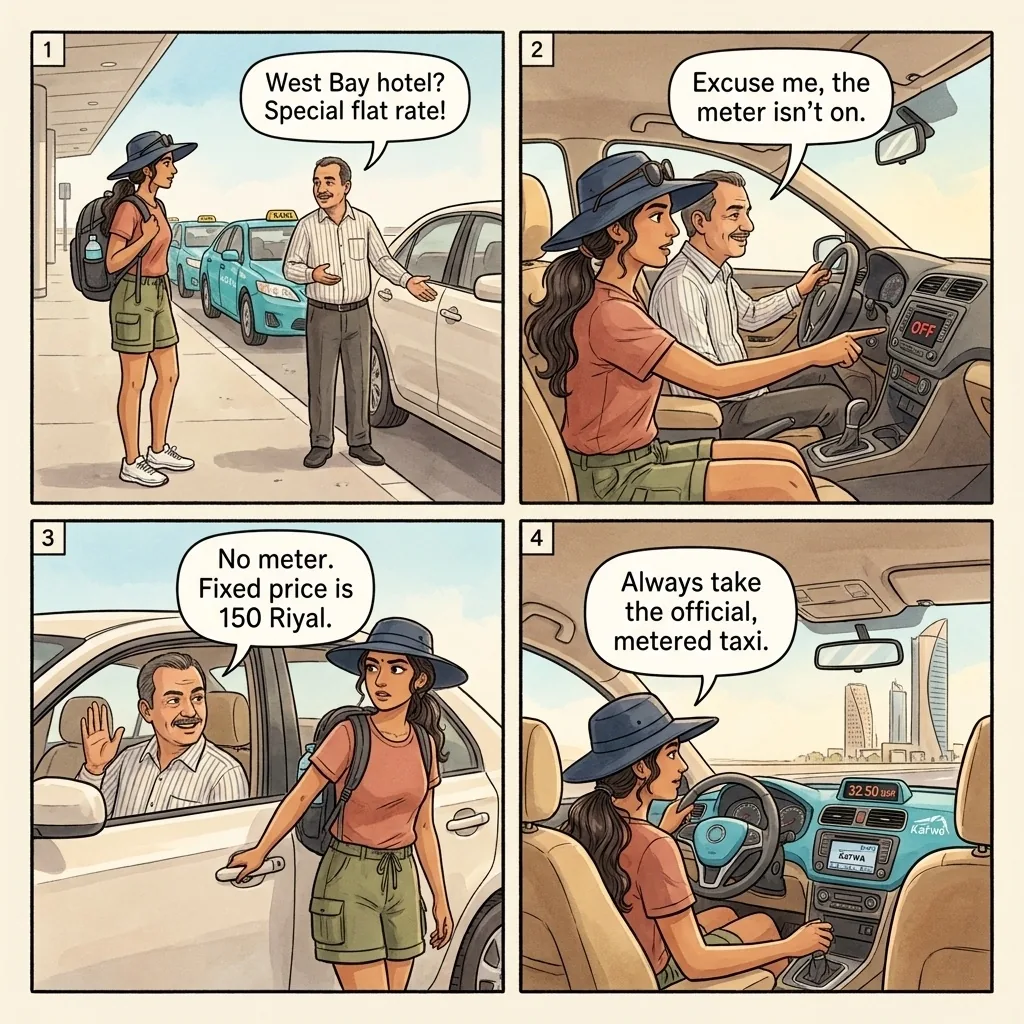
A Hamad Airport driver doesn't start the meter and quotes 150 QAR to West Bay — the metered rate is 40–50 QAR, and the meter (if any) was 'left running' from a previous passenger so the fare starts high.
You exit Hamad International Airport (DOH) and get into a taxi for your West Bay hotel. The driver greets you warmly but doesn't start the meter. When you arrive he quotes 150 Qatari riyals for a trip that should cost 40–50 QAR by meter. When you point this out, he claims there's a flat rate from the airport, or that his meter is broken, or that the tariff changed.
TripAdvisor's Doha forum has a dedicated thread titled 'Feedback on taxis in Doha' documenting this pattern. GoDigit's Qatar tourist-scam guide and ILoveQatar.net both list taxi overcharging as the most frequent tourist scam in the country. The tactics include refusing to turn on the meter and quoting inflated rates, conveniently 'forgetting' to reset the meter after a previous passenger so the fare starts high, and taking unnecessarily long routes.
Some drivers also refuse to give change, keeping the difference from large bills. Welcome Pickups' Doha guide notes that official taxis should have yellow license plates with the letter 'T' and a tariff sticker displayed on the side windows. Anything missing those identifiers — or anything advertised as a 'flat airport rate' — is the scam, not a regulation.
Qatar's strict regulatory environment makes the scam paradoxically more profitable, because tourists assume the country is too tightly governed for street-level fraud and lower their guard. The Qatar National Tourism Council does pursue enforcement, but in-the-moment recourse depends on you knowing the meter rule before you get in the car.
The defensive move is to take the Doha Metro from inside the airport — the Gold Line connects to West Bay and Souq Waqif for just 2 QAR — or use Uber/Careem with pre-quoted GPS-tracked fares. If you take a taxi, insist the meter is running from the base fare (currently 4 QAR daytime), check that the vehicle has a yellow 'T' plate, and call 999 (police) or 106 (Tourism Hotline) if the driver refuses. You're not legally obligated to pay an off-meter fare.
Red Flags
- The driver does not start the meter when the journey begins or claims it is broken
- The meter appears to already have a fare on it from a 'previous passenger'
- The vehicle lacks a yellow license plate with the letter 'T' or has no tariff sticker on the side windows
- The driver takes an unfamiliar route that seems longer than necessary
- At the end of the ride, the driver claims he has no change for your large bill
How to Avoid
- Use the Doha Metro for airport transfers and major destinations — it connects the airport to West Bay and Souq Waqif area for just 2 QAR.
- Use Uber or Careem apps for transparent, pre-quoted fares with GPS tracking and digital payment.
- If taking a taxi, insist the meter is running and verify it starts from the base fare (currently 4 QAR daytime).
- Check that the taxi has a yellow 'T' license plate and a tariff sticker visible on the side windows.
- If the driver doesn't turn on the meter, you are not legally obligated to pay — state this calmly and offer to call the police.
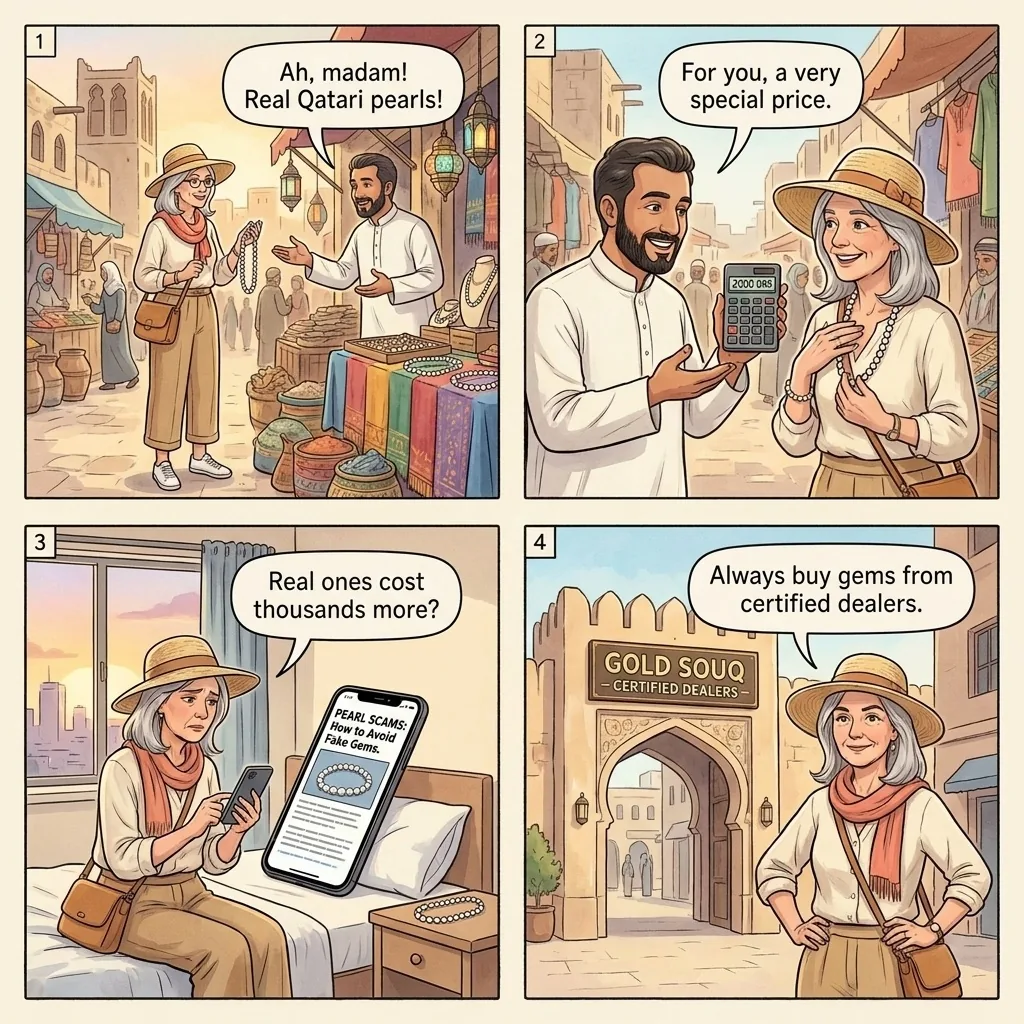
A Souq Waqif vendor sells you 'authentic Qatari natural pearls' for 2,000 QAR — they're cultured pearls imported from Southeast Asia worth a fraction of that, and real Qatari natural pearls start at 5,000–30,000 QAR through specialized collectors only.
You're browsing Souq Waqif and stop at a jewelry stall where the vendor shows you what he says are 'authentic Qatari natural pearls' — a symbol of the country's heritage. He quotes 2,000 QAR for a necklace as a 'special deal.' What you're actually holding are cultured pearls imported from Southeast Asia worth a fraction of that price. A genuine Qatari natural pearl typically costs between 5,000 and 30,000 QAR and is only available from a handful of specialized collectors and traders.
Pearl-Guide.com has a dedicated thread titled 'Qatar Natural Pearl Fraud — Buyer Beware' documenting how sellers pass off imported cultured pearls as highly valued Qatari natural pearls to 'unsuspecting and gullible buyers, especially tourists.' The pricing differential makes the scam profitable: cost basis of 100–200 QAR, sale price of 2,000+ QAR, no certificate of authenticity, no recourse once you've left the country.
The Peninsula Qatar reported that the Ministry of Commerce and Industry conducted a massive crackdown seizing fake jewelry and watches, with 147 cases registered. A separate raid in the Al-Sadd area targeted shops selling counterfeit leather goods bearing international brands. Counterfeit items include fake 18-carat gold jewelry with non-precious stones, imitation perfumes marketed as luxury brands, and knock-off designer accessories.
The Qatar government imposes fines of 10,000–50,000 QAR on shops selling counterfeits, but the trade persists in tourist-facing stalls. Legitimate gold shops in the Gold Souq (Souq al-Dahab) are generally reliable — they display official certifications and provide stamped receipts with karat weight. The issue clusters in individual stalls and wandering vendors in the main souq area where there's no fixed-location accountability.
The defensive move is to buy pearls only from established, reputable dealers with certificates of authenticity, and gold only from Gold Souq shops that display official certifications and provide stamped receipts with karat weight. Compare prices across multiple vendors before buying. For designer goods, only buy from authorized retailers in malls (Villaggio, City Center, The Pearl-Qatar). For complaints, the Ministry of Commerce hotline is 16001 and the Tourism Hotline is 106.
Red Flags
- A vendor claims pearls are 'authentic Qatari natural pearls' at a price below 5,000 QAR — genuine ones start much higher
- Designer brand goods (bags, watches, perfumes) are sold at prices far below retail — they are almost certainly counterfeit
- The vendor cannot provide a certificate of authenticity or refuses to let you examine goods closely
- Gold jewelry finishing looks rough or stones lack sparkle compared to genuine precious gems
- The vendor pressures you to buy immediately, claiming the item is rare or the price is 'today only'
How to Avoid
- Buy pearls only from established, reputable dealers who provide certificates of authenticity — not from market stalls.
- Purchase gold from shops in the Gold Souq that display official certifications and provide stamped receipts with karat weight.
- Ask for receipts and authenticity certificates for any expensive purchase — legitimate shops always provide them.
- Compare prices across multiple vendors before buying and research typical prices online beforehand.
- For designer goods, only buy from authorized retailers in malls like Villaggio, City Center, or The Pearl-Qatar.
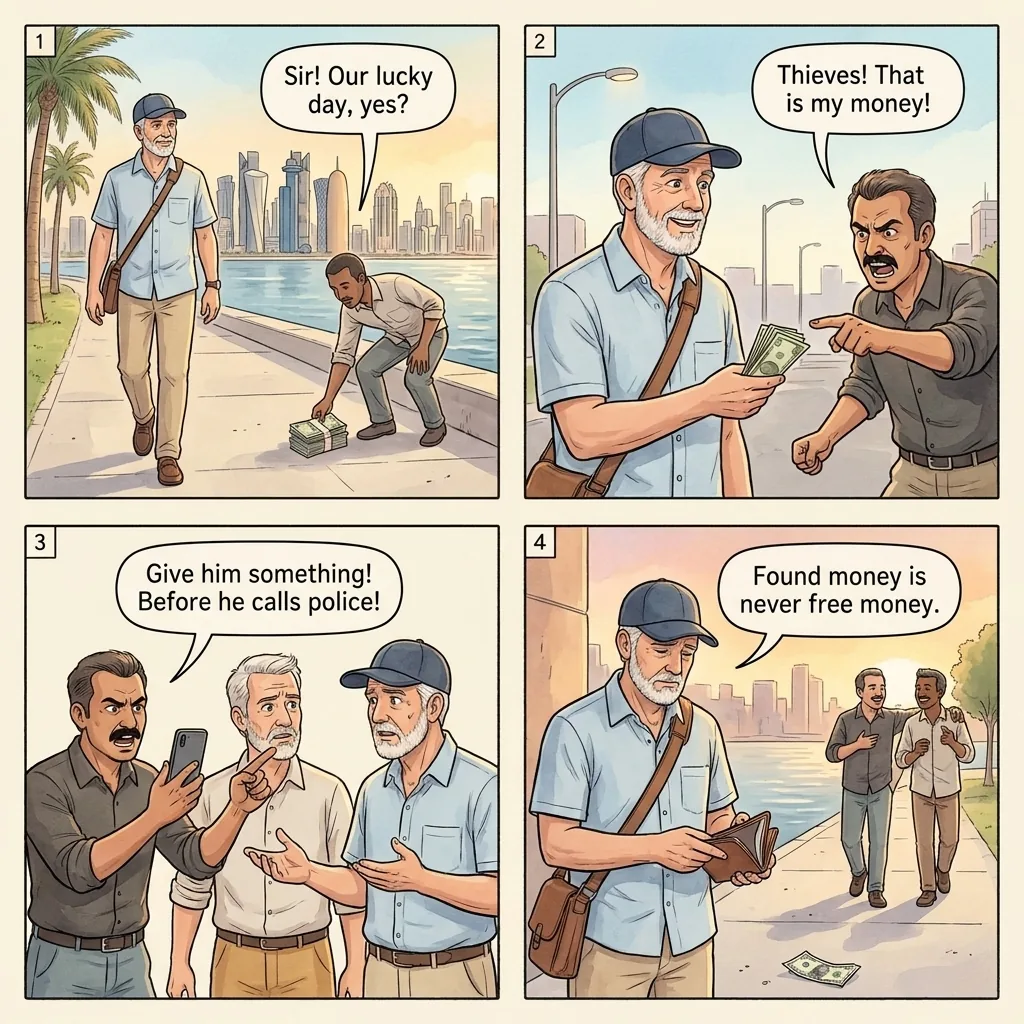
A stranger on the Corniche 'finds' a bundle of QAR banknotes at your feet and offers a 50/50 split — within a minute a second person arrives claiming to be the owner, threatens to call police, and demands a 'good faith' deposit from your own cash to settle.
You're walking along the Corniche when someone ahead of you 'finds' a bundle of Qatari banknotes on the ground. They pick it up, turn to you excitedly, and suggest splitting the money 50-50 since you both 'witnessed' the find. As you examine the cash, a second person appears claiming to be the owner and threatens to call the police unless you both pay compensation.
A second variant has the 'finder' ask you to hold the money while he goes to find the owner — but first asks you to put up some of your own cash as 'good faith.' Once you hand over your real bills he disappears, and either the found cash is counterfeit or it's never seen again. Both variants extract real money from the victim through different applied-greed routes.
ILoveQatar.net documented this exact scam occurring near Al Muntaza Plaza Hotel in Doha, where someone picked up a bundle of currency notes from the street and asked a passerby if the money belonged to them, then proceeded to offer a 50/50 split. This is a classic confidence trick found worldwide but specifically reported in Doha's Corniche and the Souq Waqif parking perimeter.
The scam works because it exploits the victim's greed — the prospect of free money — combined with social pressure from the supposed 'owner' arriving on cue. The choreography is rehearsed: finder, owner, threat-of-police, demand for compensation, all within 90 seconds. By the time you've processed what's happening, you've already engaged with the framing of being a witness rather than a target.
The defensive move is absolute: never engage with strangers who 'find' money in front of you, never hand over your own cash as a deposit or good-faith gesture in any street scenario, and walk away the moment a stranger involves you in supposedly-found property. If you feel threatened, dial 999 (police) or 106 (Tourism Hotline) — the police take this scam category seriously. Any scenario involving free money from a stranger is a scam, with no exceptions.
Red Flags
- A stranger 'finds' money right in front of you and immediately involves you in the discovery
- They suggest splitting the found cash — this is the bait to get you engaged in the scheme
- A second person conveniently appears claiming to be the owner of the lost money
- You are asked to put up your own money as 'good faith' or 'security' while someone goes to find the owner
- The scenario creates urgency — someone might call the police, or you need to decide quickly
How to Avoid
- Never engage with strangers who claim to find money in front of you — walk away immediately.
- Never hand over your own cash as a 'deposit' or 'good faith' in any street scenario involving found items.
- If someone claims you're involved in found property, tell them to take it to the nearest police station.
- Remember that any scenario involving free money from a stranger is always a scam — no exceptions.
- Report the incident to the police on 999 if you feel threatened or pressured.
Like what you're reading? Get a full Doha itinerary with safety tips built in.
Browse travel-safety books →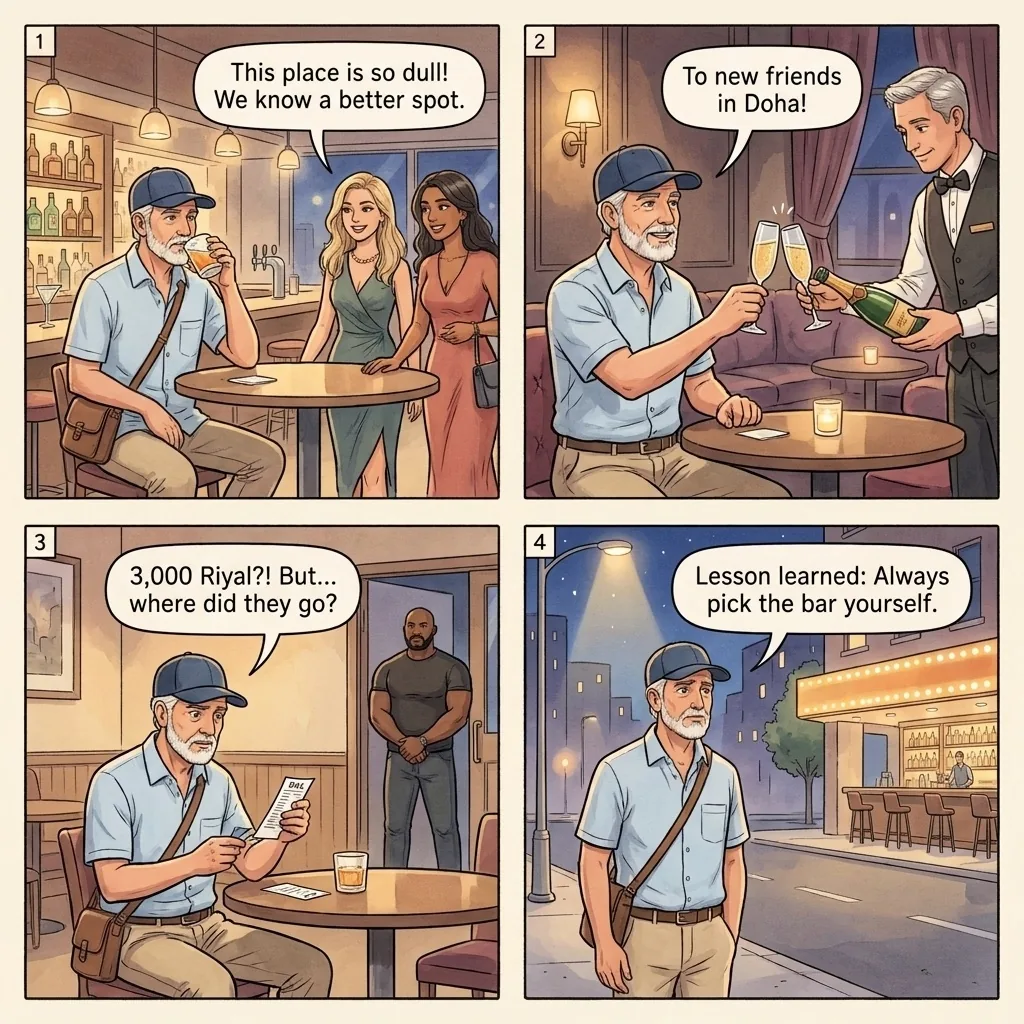
Two attractive English-speaking strangers chat you up at a West Bay hotel bar, suggest a 'better lounge they know,' and your bill arrives at 2,000–3,000 QAR for a few drinks — the new friends have vanished and a bouncer stands between you and the door.
You're at a West Bay hotel bar when two well-dressed, often attractive strangers start chatting with you. After some pleasant conversation, they suggest moving to a different bar they know nearby. You follow them to a dimly lit lounge where drinks are ordered and the conversation continues. When the bill arrives, it's 2,000–3,000 QAR for what you thought were a few drinks.
Your 'new friends' have disappeared, and a large security guard is standing between you and the door. The 'friends' receive a commission from the establishment for bringing in victims, and the venue charges astronomical prices that were never disclosed. Some venues present a menu with normal prices but add hidden charges for 'service,' 'entertainment,' or 'cover' on the final bill.
GoDigit's Qatar tourist-scam guide describes the scenario directly: 'Two friendly girls or guys make small talk and lead you to believe there is mutual interest, then suggest going to a bar they are partners with. After which you end up paying 5–10 times more than normal.' The scam operates specifically in hotel bars and lounges in Doha's West Bay and Pearl-Qatar areas where the legitimate venues themselves are real, just adjacent to the scam venues.
Qatar's strict alcohol regulations — alcohol is only served in licensed hotel restaurants and bars — make the bar scene smaller and more controlled, which paradoxically makes it easier for scam venues to operate in the limited nightlife space. Tourists assume any bar attached to a hotel district is safe; the reality is that side-street lounges within a 5-minute walk of legitimate venues run the play.
The defensive move is to stay at established, well-reviewed hotel bars and never follow strangers to unfamiliar venues. Always check menu prices before ordering anything at a new bar — if there's no menu, leave immediately. Pay for drinks individually rather than running a tab that can be inflated later. If the bill is outrageous, calmly dispute it, refuse to pay for items you didn't order, and threaten to call 999 (police) — venues fold quickly when police are mentioned.
Red Flags
- Attractive strangers at a hotel bar initiate unusually friendly conversation and quickly suggest moving to another venue
- The suggested venue is one you haven't heard of and isn't listed on Google Maps or TripAdvisor with credible reviews
- The bar or lounge has no visible menu with prices displayed or the menu seems surprisingly cheap
- Your new acquaintances order freely and seem unconcerned about the cost
- When the bill arrives, it includes charges for items or services you never agreed to
How to Avoid
- Stay at established, well-reviewed hotel bars rather than following strangers to unfamiliar venues.
- Always check the menu prices before ordering anything at a new bar — if there's no menu, leave immediately.
- Be cautious of strangers who are overly friendly and quickly suggest changing location — this is a classic setup.
- Pay for your own drinks as you go rather than running a tab that could be inflated later.
- If presented with an outrageous bill, calmly dispute it, refuse to pay for items you didn't order, and threaten to call the police (999).
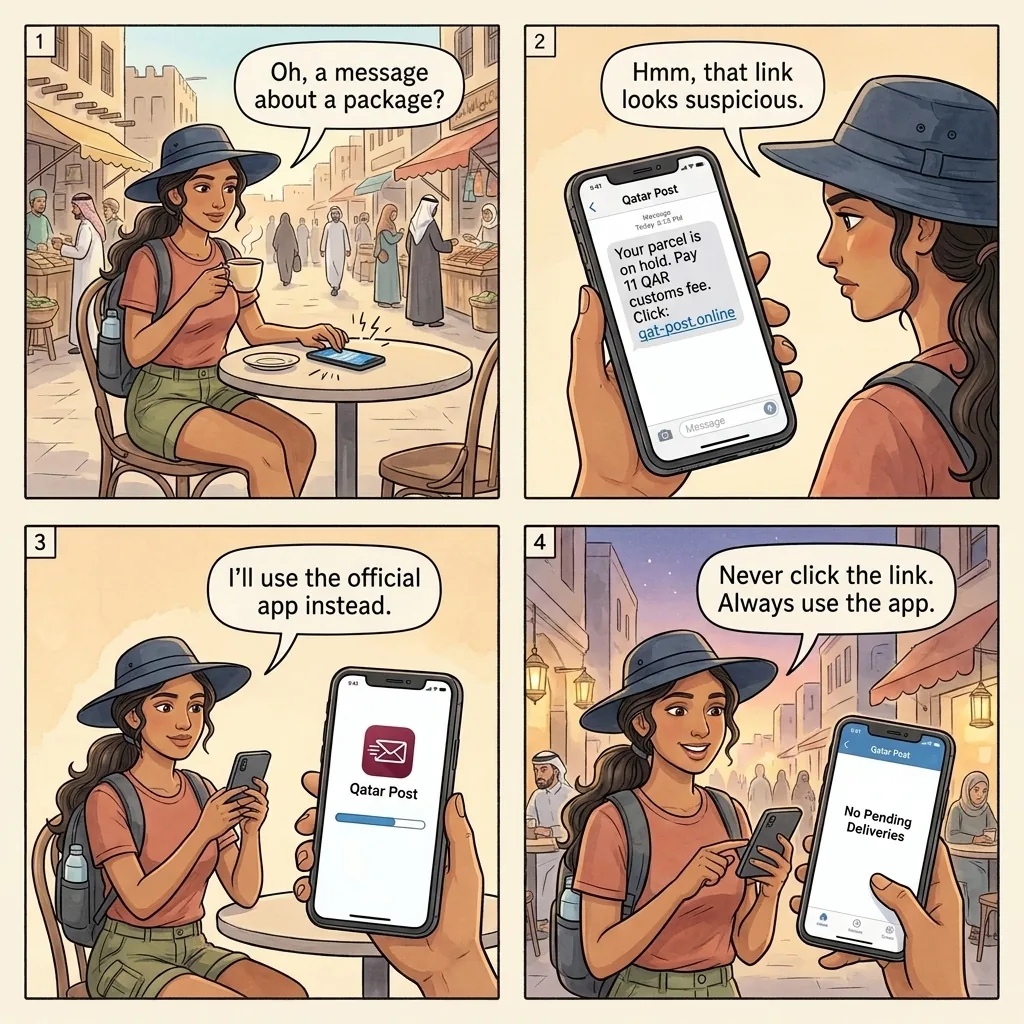
An SMS lands within days of inserting a Qatar SIM, claiming Qatar Post or DHL has a package waiting and asking you to click a link to pay a small customs fee — the link captures credit card details, with one Qatari woman losing a large sum after clicking.
You arrive in Doha and insert a local SIM card. Within days, you receive an SMS that appears to be from Qatar Post or DHL saying a package is waiting for you and asking you to click a link to update delivery details or pay a small customs fee. The link leads to a convincing fake website that captures your credit card details. A Qatari woman lost a large sum from her bank account after clicking one of these Qatar Post phishing links.
Doha News reported that scammers are 'stealing thousands of riyals through messages pretending to be Qatar Post,' with the phishing campaign specifically targeting mobile phone users. The General Authority of Customs issued an urgent alert warning about 'fraudulent messages being circulated via SMS and messaging apps' that 'falsely claim to be from Qatari Customs and often mention fake parcels.'
The Peninsula Qatar confirmed that similar phishing campaigns impersonated DHL, manipulating individuals into transferring shipping costs. Qatar has seen an 88% increase in phishing attacks per Doha News, with tourists particularly vulnerable because they may actually be expecting packages or deliveries during their stay — the message arrives at exactly the moment a real notification would land.
The scam extends beyond SMS to WhatsApp messages, emails, and fake social media ads. The Qatar government uses the Metrash2 app as its official communication channel — any delivery notification outside this app should be treated with suspicion. Real Qatar Post URLs are at qpost.com.qa; anything else (qatar-post.com, qpost-delivery.online, etc.) is the phish.
The defensive move is absolute: never click links in unsolicited SMS or WhatsApp messages about deliveries — go directly to qpost.com.qa or call Qatar Post on 163 to verify any claim. Use the official Metrash2 app for all government communications. Enable two-factor authentication on banking apps and set transaction alerts. Report phishing attempts to the Ministry of Interior via Metrash2 or email [email protected].
Red Flags
- You receive an unexpected SMS or WhatsApp about a package delivery you weren't expecting
- The message asks you to click a link to 'update delivery details' or 'pay a customs fee'
- The link URL doesn't match the official Qatar Post (qpost.com.qa) or customs domain
- The message creates urgency — 'your package will be returned if you don't respond within 24 hours'
- After clicking, you're asked for credit card details, bank information, or a one-time password
How to Avoid
- Never click links in unsolicited SMS or WhatsApp messages about deliveries — go directly to the official Qatar Post website instead.
- Verify any delivery claims by calling Qatar Post directly at 163 or the customs authority.
- Use the official Metrash2 app for all government communications — it's the only legitimate channel for official notices.
- Enable two-factor authentication on your banking apps and set transaction alerts.
- Report phishing attempts to the Ministry of Interior via the Metrash2 app or email [email protected].
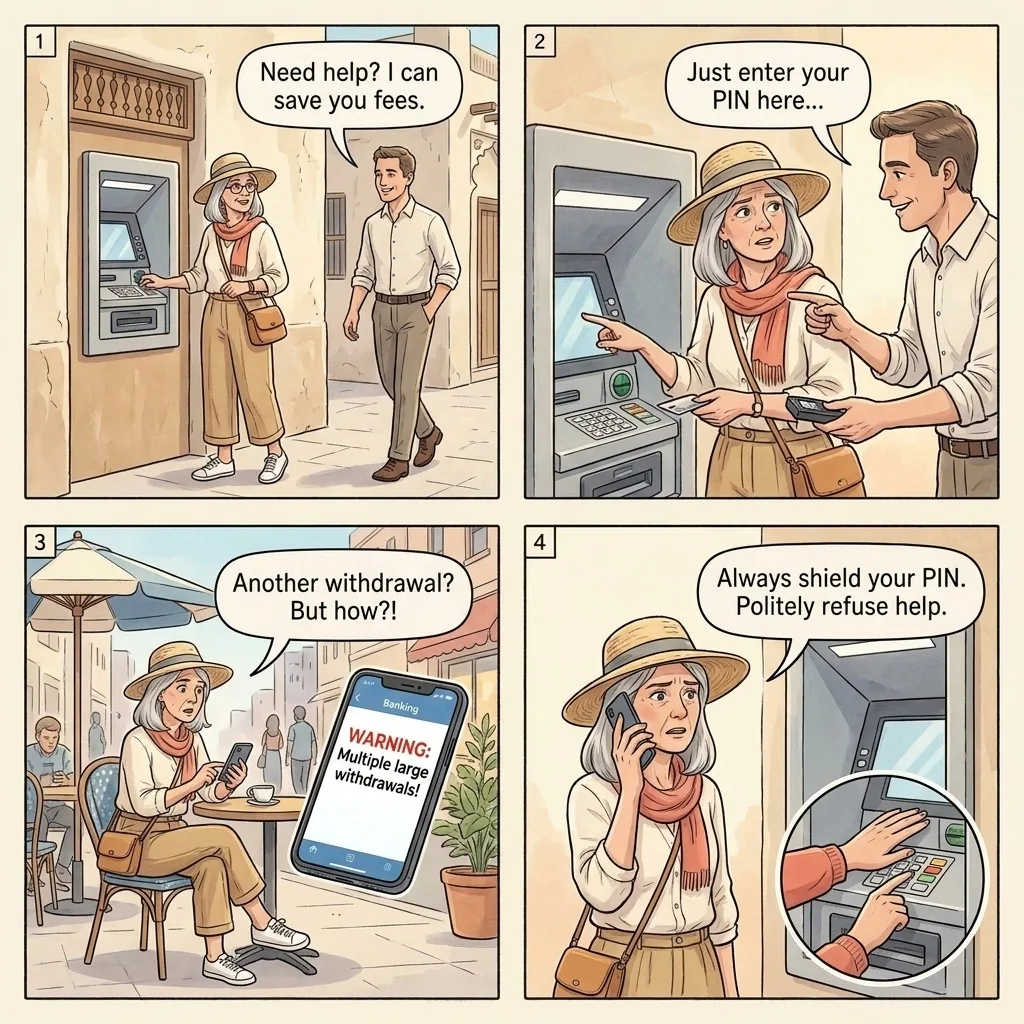
A 'helper' at a Souq Waqif ATM offers to show you how to 'avoid local bank fees,' watches your PIN, and brushes a pocket skimmer against your card — within hours, cloned copies are being used at ATMs across Doha.
You're withdrawing cash from an ATM near Souq Waqif when a helpful stranger approaches and offers to assist you with the machine, explaining that there are 'local bank fees' you can avoid if you follow certain steps. While appearing to help, they're actually watching you enter your PIN and have a card-skimmer device in their pocket that they use to scan your card when you're distracted.
Within hours, cloned copies of your card are being used at ATMs across Doha. The skimmer captures your magnetic-stripe data; the over-the-shoulder PIN observation completes the second factor. By the time you notice the unauthorized withdrawals, the cards have been used to drain your daily limit and possibly the next day's limit before you can call your bank.
GoDigit's Qatar scam guide describes the scenario directly: 'Someone approaches you at an ATM to help you avoid local bank fees. Their true intention is to scan your debit or credit card with a card skimmer and watch you enter your pin number.' The ICICI Lombard travel-insurance guide also warns about ATM-assistance scams in Qatar.
The scam relies on tourists being unfamiliar with local ATMs and grateful for help — the 'helper' is positioned to see your PIN while their skimming device reads your card's magnetic stripe. Standalone ATMs in tourist zones (especially the Souq Waqif perimeter and petrol-station forecourts) are the highest-risk locations because they're not monitored by bank staff.
The defensive move is to use ATMs only inside bank branches during business hours — Qatar National Bank (QNB) and Commercial Bank have machines throughout Doha including major malls and metro stations. Cover the keypad with your hand on every PIN entry. Never accept help from strangers at an ATM — politely decline and wait for them to leave. Wiggle the card slot before inserting your card; a loose slot may indicate a skimmer overlay. Set instant transaction alerts on your banking app, and call the Ministry of Interior on 999 for fraud reports.
Red Flags
- A stranger approaches you at an ATM offering to help, regardless of whether you appear to need assistance
- They stand very close to you or position themselves where they can see your PIN entry
- They suggest you use a specific ATM or warn you about fees at the one you're using
- The card slot on the ATM feels loose, bulky, or looks different from the rest of the machine
- There are unusual attachments or additions near the keypad or screen
How to Avoid
- Use ATMs inside bank branches or inside shopping malls where machines are regularly inspected.
- Always cover the keypad with your hand when entering your PIN — every single time.
- Never accept help from strangers at an ATM — politely decline and wait for them to leave before continuing.
- Wiggle the card slot gently before inserting your card — a loose slot may indicate a skimmer.
- Set up instant transaction alerts on your banking app to catch unauthorized withdrawals immediately.
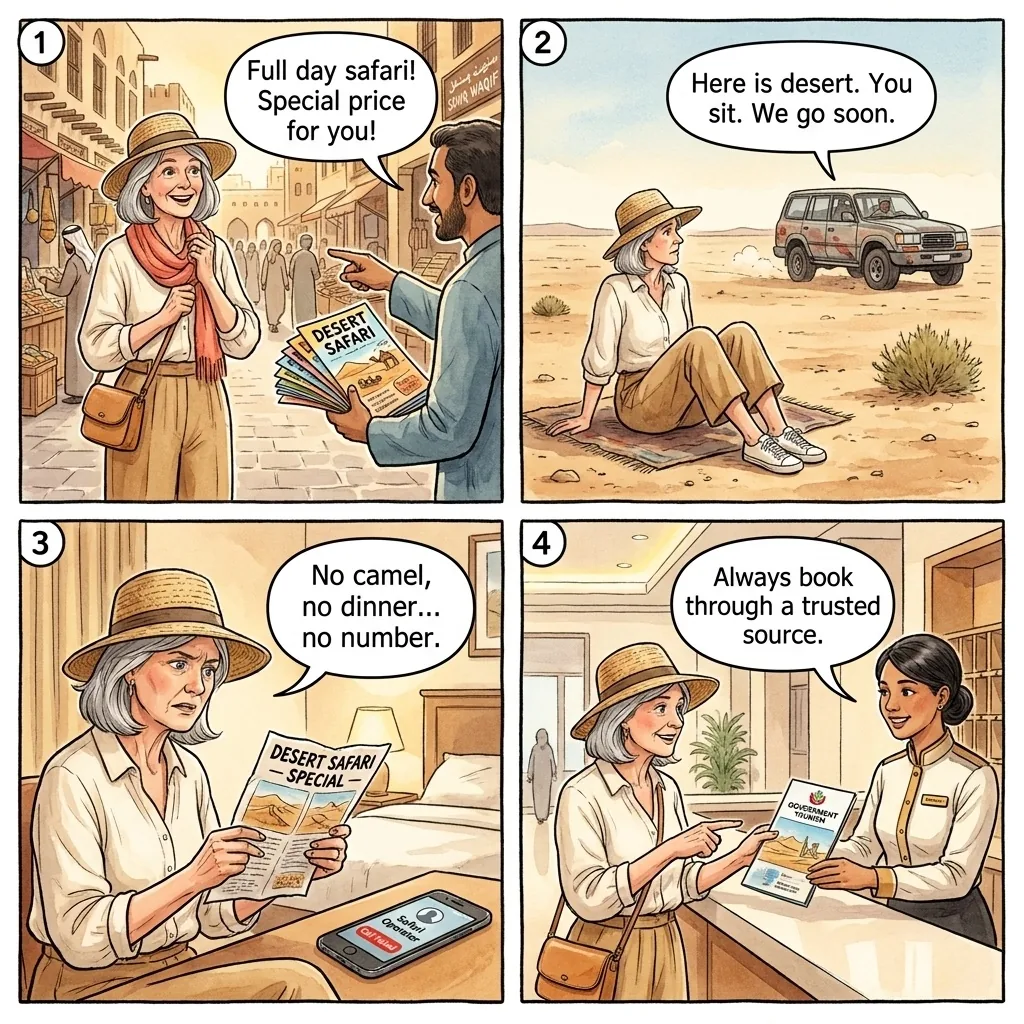
A flyer-distributor near Souq Waqif sells you a 300 QAR full-day desert safari with dune bashing, camel ride, and dinner — established operators charge 500–700 QAR for the same trip, and the morning's beat-up SUV produces 2 hours of driving, 30 minutes on a mat, no dinner, no camel, no dunes.
Your hotel concierge is unavailable, so you book a desert safari through a man distributing flyers in the Souq Waqif area. He promises a full-day experience — dune bashing, camel ride, dinner under the stars — for 300 QAR per person, well below the 500–700 QAR that established operators charge. You pay in full upfront.
The next morning a beat-up SUV arrives with bald tires and no safety equipment. The 'desert safari' is two hours of driving to a spot where you sit on a mat for 30 minutes before being driven back. No dinner, no camel, no dunes. The flyer operator is unreachable, and any 'office address' on the flyer is a forwarding mailbox or a residential building.
TripAdvisor's Doha forum includes reviews of fake operators where tourists reported being refused service or refunds after booking tours, even when they were only minutes late. GoDigit's Qatar guide warns that tourists 'may encounter individuals offering to act as guides for a fee, promising insider knowledge or exclusive access to attractions' but who 'lack credentials and provide little value.'
The scam operates through both in-person flyer distribution and fake online booking pages. Some fake operators collect deposits through WhatsApp transfers and then become unreachable. The unsafe-vehicle variant has the additional risk of being stranded in the desert with bald tires and no proper recovery equipment, which is genuinely dangerous in summer heat.
The defensive move is to book desert safaris through your hotel concierge, a licensed Qatar National Tourism Council operator (Arabian Adventures, Regency Tours, 365 Adventures), or platforms like Viator and GetYourGuide with buyer protection. Verify the operator has a physical office, check TripAdvisor and Google reviews, never pay the full amount upfront in cash, and demand the QNTC license number before paying. Tourism Hotline: 106. Police: 999.
Red Flags
- The price is significantly below what established operators charge — 40-50% cheaper is a major warning sign
- The operator has no website, physical office, or verifiable online reviews
- They insist on full cash payment upfront or payment via WhatsApp/bank transfer with no invoice
- Flyers are distributed by hand in tourist areas rather than being available through hotels or licensed agencies
- They cannot provide a license number from the Qatar National Tourism Council
How to Avoid
- Book desert safaris through your hotel concierge, a licensed tour operator, or platforms like Viator and GetYourGuide with buyer protection.
- Verify the operator has a physical office and check reviews on TripAdvisor and Google before booking.
- Never pay the full amount upfront in cash — use a credit card for fraud protection.
- Ask for the operator's Qatar National Tourism Council license number and verify it before paying.
- Compare prices across at least three established operators — a typical quality desert safari costs 450-700 QAR per person.
🆘 What to Do If You Get Scammed
📋 File a Police Report
Go to the nearest Ministry of Interior — Qatar Police station. Call 999. Get an official crime report — you'll need this for insurance claims. You can also report online at Ministry of Interior Portal / Metrash2 App.
💳 Cancel Your Cards
Call your bank immediately. Most have 24/7 numbers on the back of the card (keep a photo saved separately). Block any suspicious transactions before the thieves use your details.
🛂 Lost Passport?
Report to the nearest police station and file a report through the Metrash2 app, then contact your country's embassy immediately. Tourism hotline: 106.
📱 Track Your Device
If your phone was stolen, use Find My (iPhone) or Find My Device (Android) from another device. Don't confront thieves yourself — share the location with police instead.
Frequently Asked Questions
You just read 7 scams in Doha. The full Travel Safety Series has 780+ more across 20+ countries.
Tokyo's Kabukichō ¥130,000 bar trap. Rome's gladiator photo extortion. Paris's gold-ring trick. Bali's ATM skimmer scams. Bangkok's grand-palace closure ruse. Every documented scam across 20+ destinations — with the exact scripts, red flags, and local-language phrases that shut each one down. Drawn from Reddit traveler reports, embassy advisories, and consumer-protection cases.
- 780+ documented scams across Tokyo, Rome, Paris, Bali, Bangkok, Rio & 100+ more cities
- 20+ countries covered, with country-by-country phrase cards for every destination
- Updated annually — buy once, re-download future editions free
- All titles $4.99 each on Amazon Kindle