
Key Takeaways
- The #1 reported scam is the O'Connell Street ATM 'Helpful Stranger' Skim.
- 2 of 6 scams are rated high risk.
- Use app-based ride services (Uber, Bolt) or official metered taxis instead of unmarked vehicles.
- Never accept unsolicited offers from strangers near tourist sites in Dublin.
⚡ Quick Safety Tips
- Use only metered taxis or ride apps like Free Now — never accept a 'flat rate' from a driver, especially at Dublin Airport.
- In Temple Bar, choose your own pub — locals who invite you to 'the best place' around the corner often lead to overcharging bars.
- Keep phones in pockets on Grafton Street and at Luas stops — phone snatching on foot and by bicycle is increasing.
- Cover your PIN at ATMs and use machines inside banks — card skimming devices have been found on ATMs near O'Connell Street.
Jump to a Scam
The 6 Scams
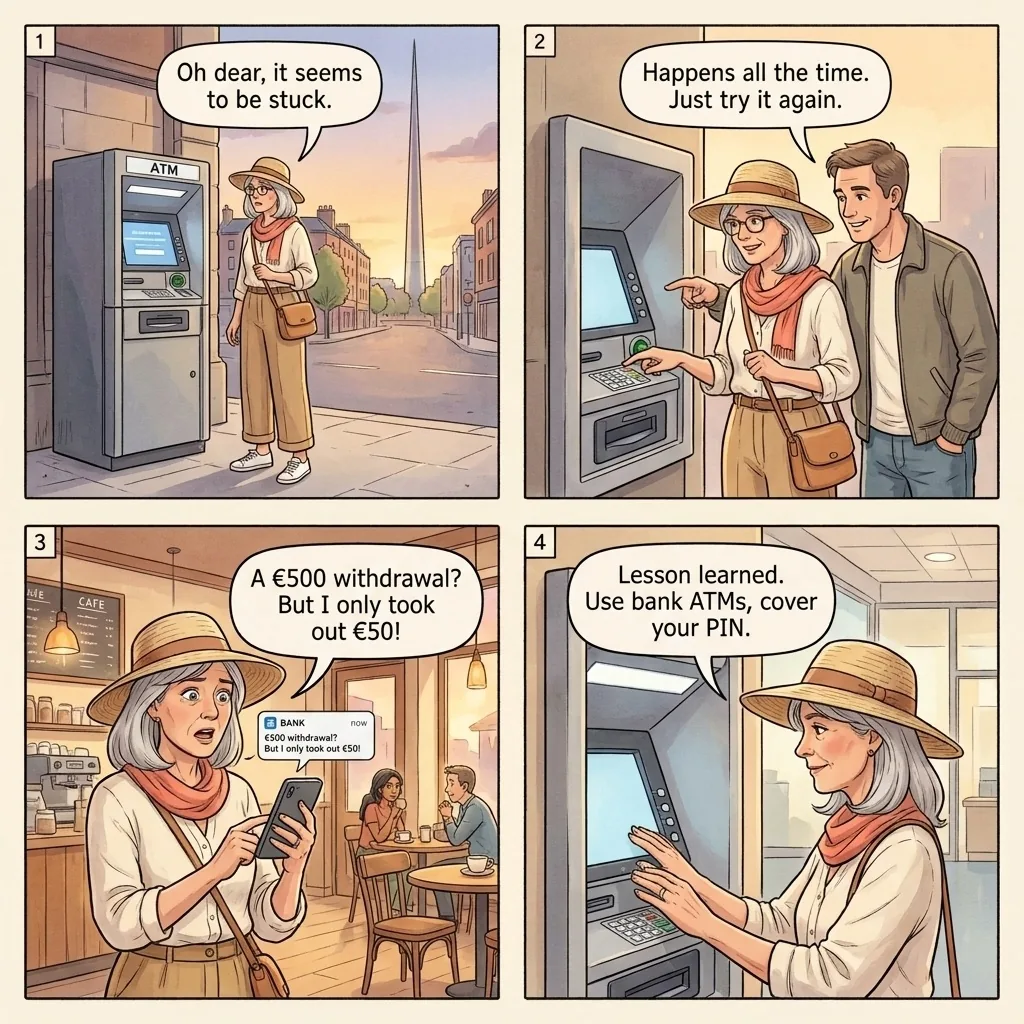
You stop at a free-standing ATM near the Spire on O'Connell Street, slot in your debit card, and the machine seems sluggish — the screen pauses oddly after your PIN, asks you to wait, and then prompts you to re-insert the card.
A man in his thirties drifts up beside you and says cheerfully that this happens all the time at this machine, that he had the same problem yesterday, and that there is a trick to get it working. He stands close enough to see the keypad, gestures helpfully toward the screen, and watches as you re-enter your PIN. The machine eventually dispenses a small amount of cash, you thank him, and you walk on with your card.
The 'sluggish' machine has a thin skimmer device fitted over the real card slot — the device captured your card details on insertion. The 'helpful stranger' watched and memorized your PIN over your shoulder as you re-entered it. Within a few hours, a cloned card is being used at ATMs and shops elsewhere in Dublin or abroad, often draining the daily withdrawal limit before you have even noticed. By the time your bank flags it, several hundred to several thousand euros are gone.
The Garda National Economic Crime Bureau and the Banking & Payments Federation of Ireland have flagged this pattern at standalone Dublin ATMs for years. The skimmer crews rotate machines and concentrate on tourist-heavy hours and locations — O'Connell Street, Henry Street, the Talbot Street stretch, and Temple Bar after dark are the consistent hotspots. Bank-branded ATMs inside lobbies (AIB, Bank of Ireland, PTSB) are physically harder to skim and are watched by staff.
A second variation is the 'cash-trap' overlay, where a thin plastic sleeve traps your dispensed cash in the machine. The 'helpful' stranger appears, suggests entering your PIN again to release the bills, then walks off with both your card details and (often, after the supposed jam) the trapped cash itself. The give-away is that ATMs do not, ever, ask you to enter your PIN multiple times in a single transaction.
Use ATMs only inside bank lobbies (AIB, Bank of Ireland, PTSB, Ulster Bank) during opening hours, or at supermarkets like Tesco and Dunnes Stores where the machines are watched. Cover the keypad with your other hand every single time you enter a PIN. Never accept help from a stranger at an ATM — if the machine misbehaves, walk away with your card and call your bank from somewhere else. Tug the card-slot bezel before inserting; a skimmer often wiggles or sits proud of the metal. If you suspect skimming, dial 999 (or 112) for An Garda Síochána and freeze your card immediately.
Red Flags
- Strangers approaching you at ATMs unsolicited
- ATM that seems to malfunction just as you insert your card
- Suspicious devices attached to the card slot
How to Avoid
- Always use ATMs inside banks or well-lit, busy lobbies.
- Cover your PIN with your hand every time.
- Never accept help from strangers at ATMs — go inside the bank instead.
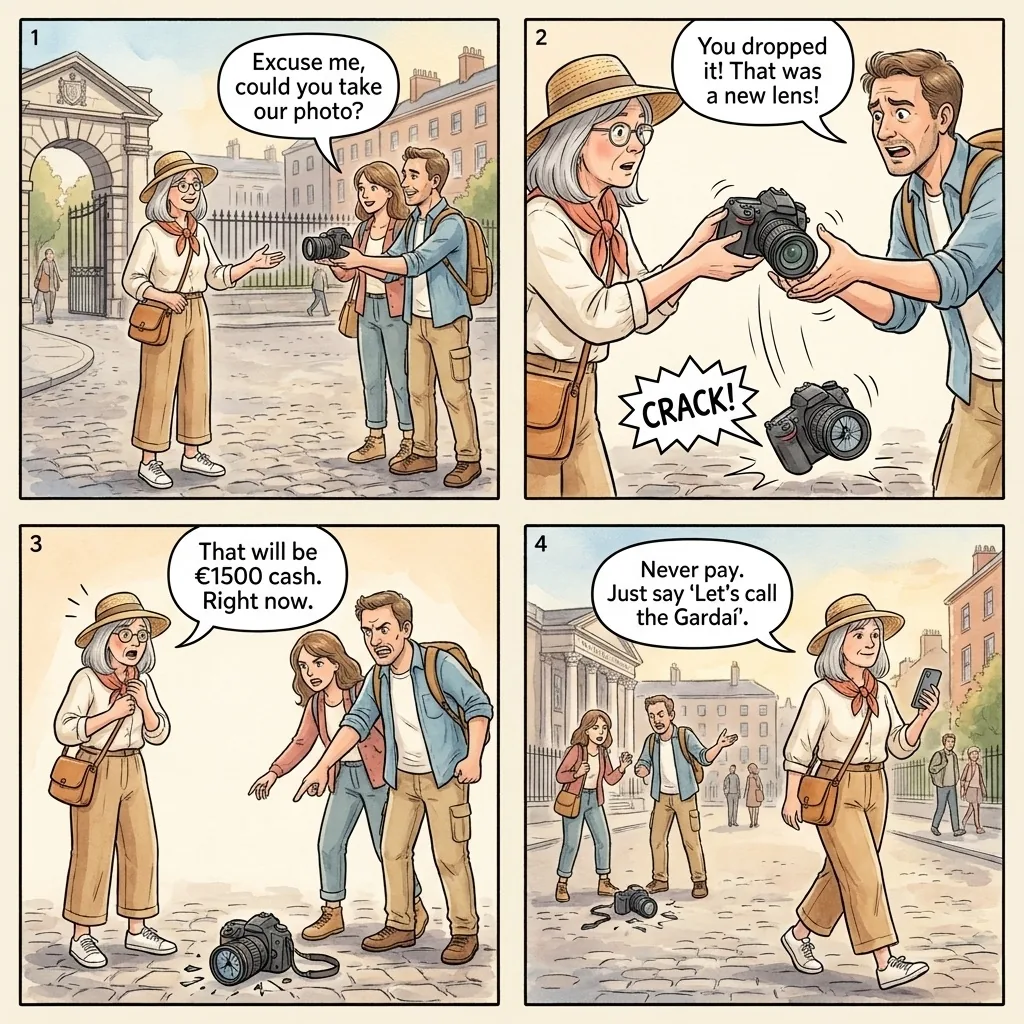
A friendly tourist with a camera around his neck stops you near the front gate of Trinity College, holds out a chunky-looking DSLR, and asks if you would mind taking a picture of him and his partner with the iconic Campanile in the background.
You agree — it is a normal request and they look like normal travelers. He hands the camera over carefully, you frame the shot, click, and hold the camera out to give it back. As his hand closes around the strap, something fumbles between you. The camera tips, slips, and either you drop it onto the cobbles or — more often — he steps back at the wrong moment and lets it fall. The lens cracks audibly on the stone.
His tone changes immediately. The camera, he says, was professional gear — €1,200, sometimes €2,000 — and he needs you to pay for the damage right now, in cash. His partner echoes him. A second 'witness' may appear from a few meters away to confirm that you dropped it. The camera body looks expensive enough to be plausible, and the broken lens is real, and your instinct is to apologize and reach for your wallet.
The camera is a key prop. The body is often a cheap older DSLR purchased for €30 at a market, the lens was already cracked or stuck on a broken model, and the entire 'drop' is choreographed. The Garda's tourist-safety advisories, the long-running TripAdvisor Dublin forum, and Reddit all carry first-person accounts. The same scam runs in Paris, Rome, and Barcelona with different camera brands — the Trinity College gate and the Temple Bar pedestrian zone are Dublin's two consistent locations.
A second variation skips the camera entirely. A 'tourist' bumps into you on the Ha'penny Bridge, claims you broke their phone or sunglasses, and demands cash. The pattern is the same: a contrived collision, a fragile prop, a calm but firm demand for immediate payment, and a 'witness' to back the story. Real travelers who break their own gear shrug and move on; the demand for immediate cash is the signature of the scam.
Politely decline to handle strangers' camera or phone equipment in Dublin tourist zones — say 'sorry, my hands are full' and keep walking. If you are pressured after a contrived 'drop,' do not pay; refuse the demand, walk to a public area with crowds and CCTV, and call An Garda Síochána on 999 or 112. Photograph the 'damaged' equipment, the people involved, and any 'witnesses' before leaving — real victims welcome police; scammers melt away. Trinity College and the Ha'penny Bridge both have CCTV coverage that the Gardaí can pull.
Red Flags
- Stranger specifically choosing you to take their photo despite many people around
- Camera seems older than they claim it's worth
- Immediate demand for money after the 'accident'
How to Avoid
- Politely decline to handle strangers' camera equipment.
- If you do take a photo, be deliberate about the handover.
- Don't pay — walk away and if they get aggressive, call the Garda.
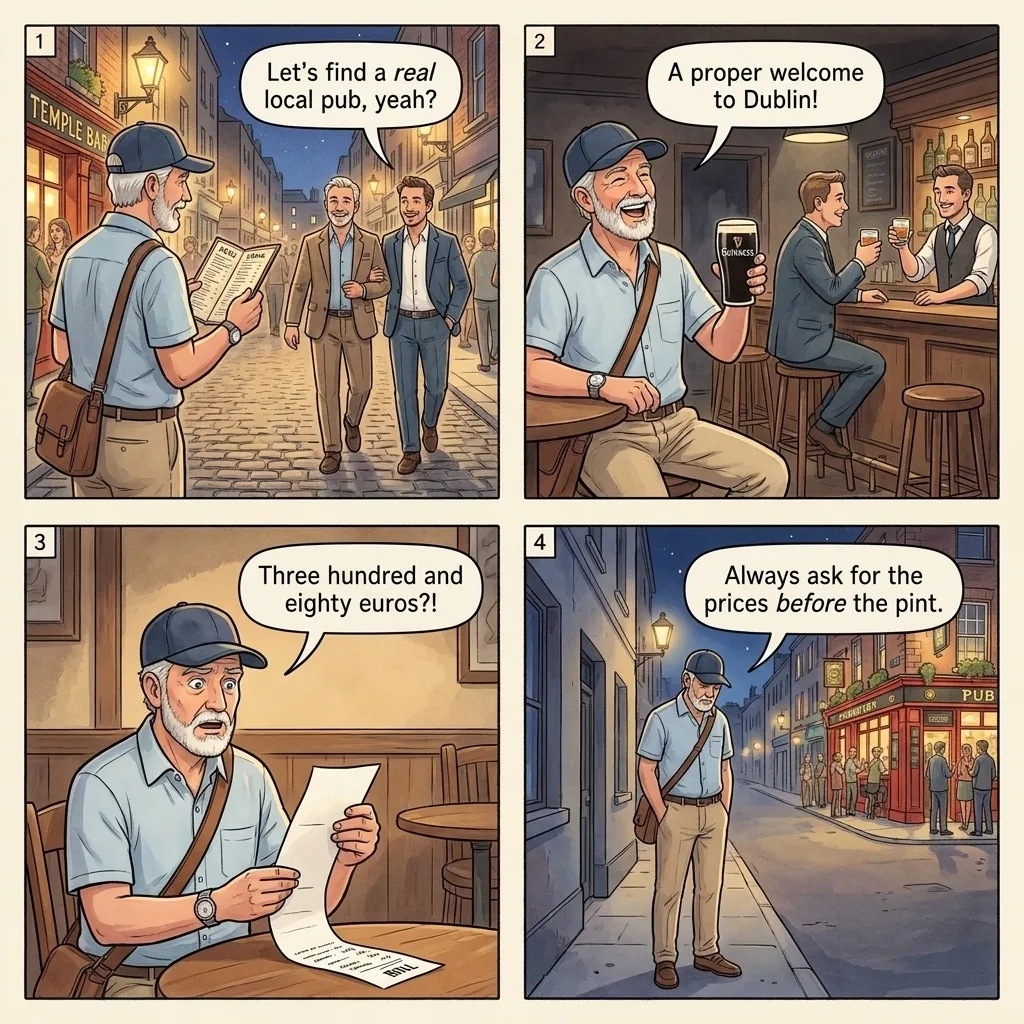
You are wandering through Temple Bar on a Friday night, a few pints in, when two cheerful locals strike up a friendly conversation about your trip and offer to take you to 'a real Dublin pub' just around the corner — better than the tourist places, locals only.
They are warm, funny, and quintessentially Dublin in their banter. Within five minutes you are walking with them down a side street off Dame Street toward a dimly lit bar with no windows and a small unmarked door. Inside it is loud, the bartender greets your new friends by name, and pints of Guinness appear before anyone has explicitly ordered. Your two friends order whiskies for the table. The chat is easy, the music is good, and you feel like you have stumbled into an authentic Dublin night out.
An hour and a half later you ask for the bill. The total is €380. The eight pints, four whiskies, and 'top-shelf' rounds you do not remember ordering have been priced at €15–25 each. There is no menu visible anywhere in the bar, no till receipt, no itemization. Your two new friends have, somewhere in the last twenty minutes, vanished to the bathroom. The bartender shrugs and points to a small handwritten card behind the till, tilted away from the room, listing the supposed prices.
The Temple Bar 'local pub' bait is a softer cousin of the Budapest and Krakow honey-traps from earlier in this guide. It works on the same principle: friendly strangers steer you to a venue with no transparent pricing, where the bar is in on the take and the 'locals' get a cut of your tab. The Garda Síochána's tourist-safety advisories and the Dublin TripAdvisor forum carry accounts going back years, and the venues themselves rotate to stay ahead of complaints.
Real Dublin pubs are not subtle about it. The Brazen Head, The Long Hall, The Stag's Head, John Mulligan's, Grogan's, and Kehoe's all have visible printed menus, prices on a chalkboard or laminated card, and pints of Guinness at €6–7. Anywhere charging €15 a pint without showing the price first is, by definition, not a real Dublin pub. The 'locals only' framing is the giveaway — actual Dublin locals are not paid commission to bring tourists into pubs.
Choose your own pub in Dublin — never follow strangers, however friendly, to a specific bar around a corner. Stick to named, well-reviewed pubs (The Brazen Head, John Mulligan's, Grogan's, The Long Hall, Kehoe's, The Stag's Head) where prices are visible at the bar and a pint of Guinness costs €6–7. Pay for each round as it is served rather than running a tab, and refuse any drink that arrives without an explicit order. If you are handed an inflated bill, refuse to pay it, demand the Gardaí be called (dial 999 or 112), and stay calm — Dublin police side with victims.
Red Flags
- Strangers who immediately invite you to a specific pub by name
- Drinks arriving without you ordering them
- Prices not displayed at the bar
How to Avoid
- Choose your own pub — don't follow strangers to theirs.
- Check prices at the bar before ordering.
- In legitimate Dublin pubs, a pint of Guinness costs around €6-7.
Like what you're reading? Get a full Dublin itinerary with safety tips built in.
Browse travel-safety books →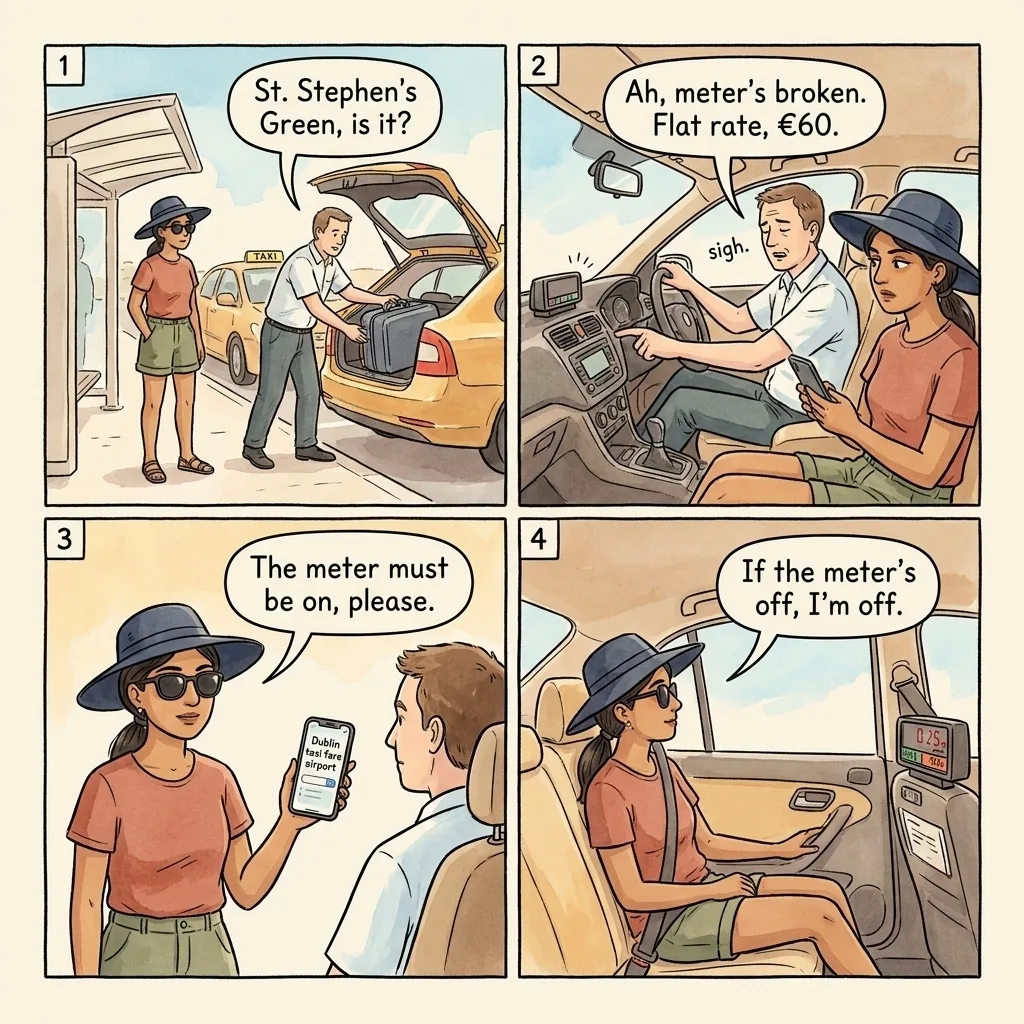
You walk out of arrivals at Dublin Airport, ignore the Aircoach kiosk because you have luggage, and take the next taxi at the rank where the driver loads your bag and asks where you are going.
You name a hotel near St Stephen's Green. He shakes his head, taps the meter, and tells you 'sorry, meter's gone, I'll do you a flat rate — €60.' The legitimate metered fare from Dublin Airport to the city centre runs €25–35 depending on traffic, on the regulated Taxi Regulator tariff that all licensed Irish taxis are required to use. The €60 quote is nearly double.
If you protest, his tone becomes affable but firm. He says the meter problem is the airport's fault, that the flat rate is what 'all the lads' charge, and that the next cab in line will say the same. You are tired, the rank is moving slowly, and the alternative is hauling your bag back to the Aircoach. By the time you reach the hotel, the conversation has been settled by momentum, and you pay €60 in cash because the driver also says the card reader is broken.
The 'broken meter' and 'broken card reader' pair is the most consistently reported Dublin taxi scam. The National Transport Authority (NTA), which licenses all Irish taxis, requires the meter to be running on every metered fare and prohibits cash-only practices when a card reader is fitted. Reddit and the Dublin TripAdvisor forum carry first-person accounts running €15–40 over legitimate fares, and the airport rank is the most common location.
A second variation runs on route. Some drivers, especially late at night from Temple Bar back to suburbs or hotels, take a circuitous route through quiet streets to inflate a metered fare by 40–60%. The legitimate fare from O'Connell Street to most central hotels should be €10–15 on the meter; anything above €25 to the same hotel signals route inflation. The fix in both cases is to use a regulated rideshare instead.
Use Free Now (the dominant Dublin rideshare, formerly Hailo) or Lynk on the airport Wi-Fi for fixed-fare rides — €25–35 to the city centre, no negotiation. If you must use a rank taxi, refuse any 'broken meter' or 'flat rate' framing — by NTA regulation, the meter must run on every metered fare. Walk to the next cab in line if a driver insists on a flat rate. Demand a printed receipt at the end (also a regulatory requirement) and pay by card whenever possible. If a driver overcharges, photograph the SPSV (taxi) ID and report it to the National Transport Authority at +353 1 879 8300 or the Gardaí on 999/112.
Red Flags
- Driver mentions 'flat rate' before starting the meter
- Meter mysteriously not working
- Driver taking unfamiliar routes when destination should be close
How to Avoid
- Only use metered taxis or ride apps like Free Now or Lynk.
- Agree on a price before getting in if the meter is off, or find another cab.
- Dublin Airport to city center should be roughly €25-35.
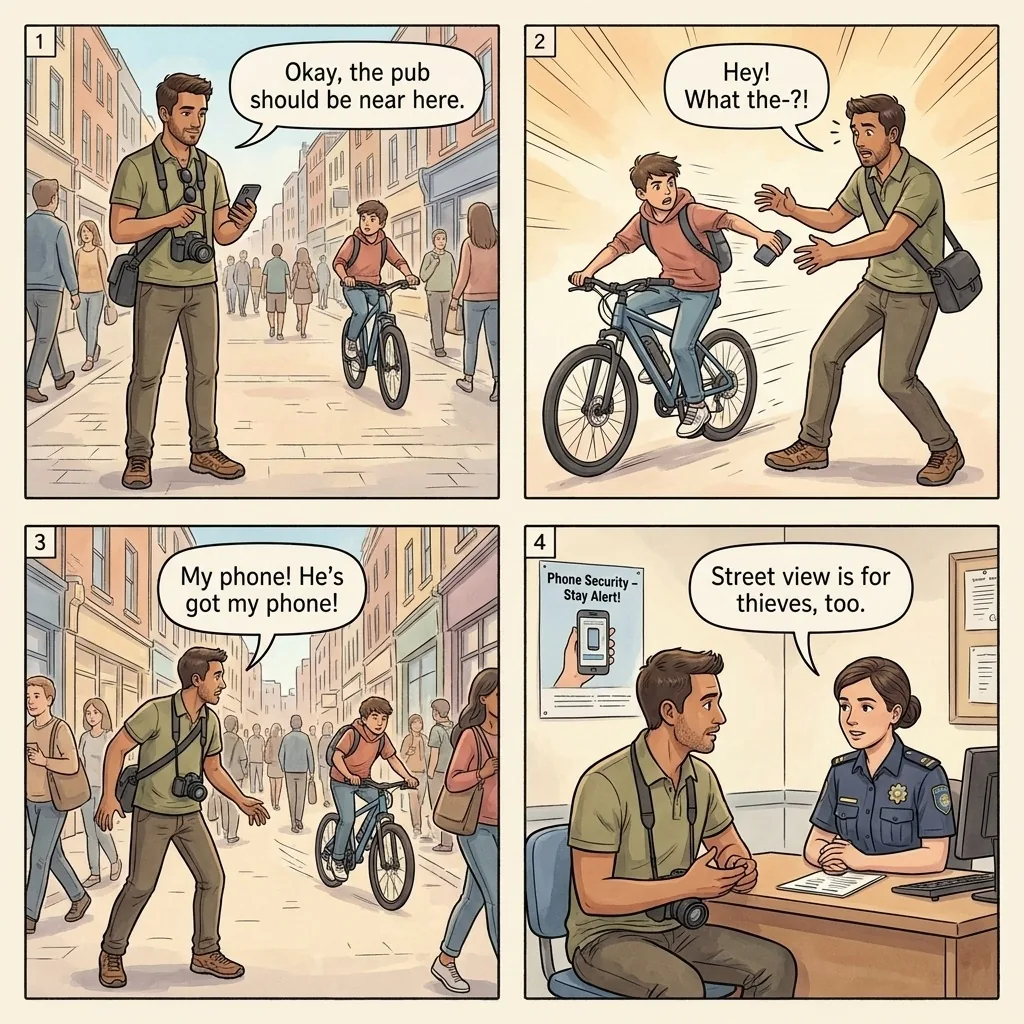
You stop on Grafton Street to check Google Maps, hold the phone out at chest height to read the screen in the bright afternoon light, and get bumped from behind hard enough to rock you forward.
By the time you turn around, your phone is gone. A young man on an electric bicycle is already thirty meters down the pedestrian zone, weaving between shoppers, your phone in his hand. He turns onto South King Street and disappears. The whole sequence took perhaps four seconds. There was no warning, no demand, no contact beyond the shoulder bump that masked the grab.
Phone snatching by cyclists is the single most reported Dublin street crime by tourists, and incidents have risen sharply since 2023 with the spread of fast e-bikes. The Garda Síochána's National Bureau of Criminal Investigation has flagged Grafton Street, O'Connell Street, the Luas Green Line stops at Stephen's Green and Harcourt, and Smithfield Square as the most consistent hotspots, especially during evening rush hour and weekend afternoons. Operators work in pairs — a spotter on foot identifies a target, a rider on the bike executes the snatch.
The phone itself is rarely the goal. What matters is the unlocked screen at the moment of the snatch — within seconds the rider is using your active session to push WhatsApp messages to your contacts, transfer money via Revolut or banking apps, change your Apple ID password, and lock you out of your own iCloud account. The professional crews can drain banking apps in minutes. By the time you reach a Garda station, the financial damage is often greater than the cost of the phone itself.
A second variation involves Luas tram doors. Snatchers wait on the platform, a victim with phone in hand boards the tram, and the snatcher grabs and exits before the doors close. The tram pulls away and the snatch is irreversible. The Luas Green Line stops at Stephen's Green, Harcourt, and Charlemont have repeated reports; the Red Line at Connolly and the Point are next.
Keep your phone tucked into a front pocket or zipped bag when you are not actively using it on Dublin streets. When you do use it, step into a doorway or a café rather than stand exposed on the pavement, and hold it with both hands close to your body. Set your screen-lock to under 30 seconds and enable Face ID/Touch ID for banking apps so a snatched device cannot transact. Set up Find My iPhone (or Google Find My Device) before you arrive in Dublin. If you are snatched, dial 999 or 112 immediately, report to An Garda Síochána, and remote-wipe via iCloud or Google as fast as possible.
Red Flags
- Being stationary with phone held out prominently in busy areas
- Groups of people lingering nearby watching pedestrians
How to Avoid
- Keep your phone tucked away when not actively using it.
- Hold your phone with both hands and close to your body in crowds.
- Use your phone in cafes or doorways rather than while walking on busy streets.
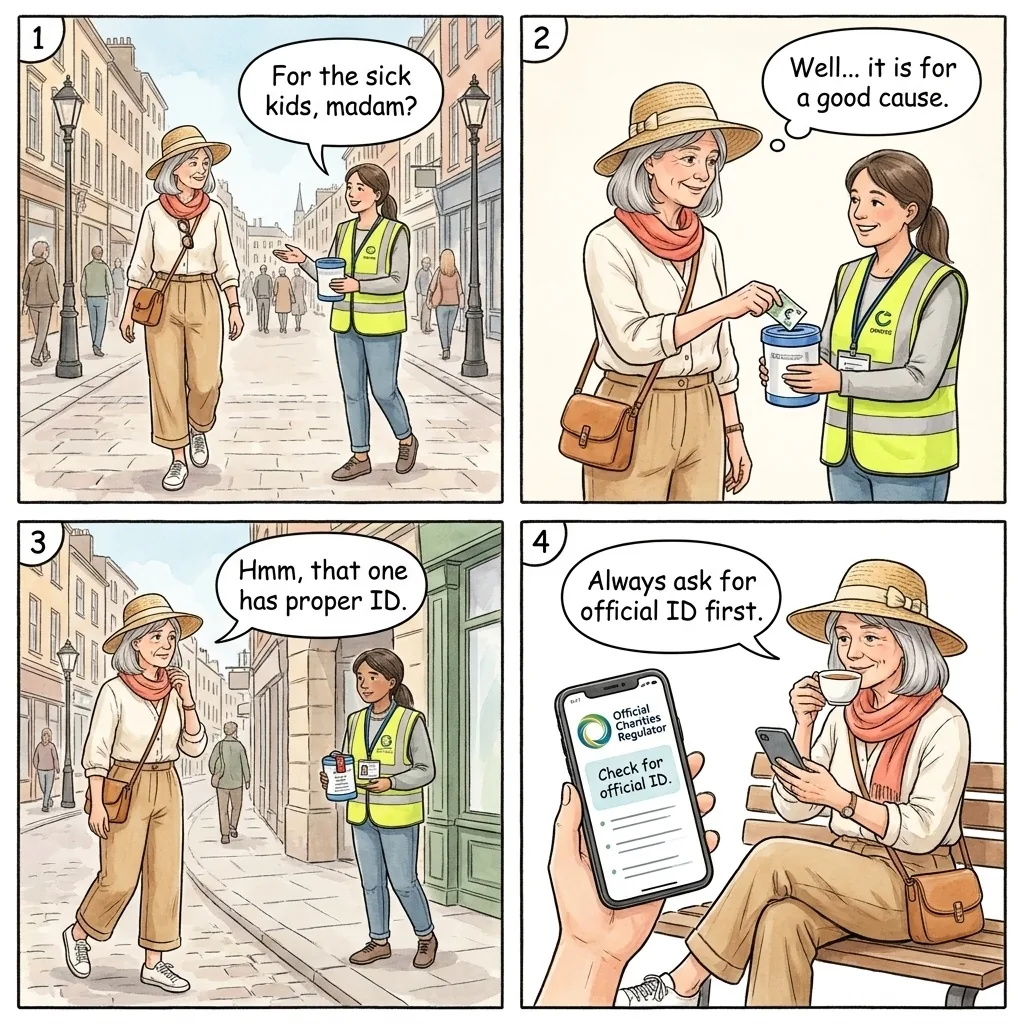
You walk along the Grafton Street pedestrian zone on a Saturday afternoon and someone in a high-visibility vest steps in front of you with a sealed plastic collection tin and a friendly smile.
The vest has a charity logo that looks vaguely familiar — perhaps Children's Hospital Crumlin, or the Irish Cancer Society, or the Simon Community. The collector says a few warm words about the cause, gestures at the tin, and waits expectantly for you to drop coins or notes through the slot. Other tourists are doing it; you do not want to look ungenerous in front of strangers, and you slip €5 in.
The vest is bought online, the logo is generic or borrowed, the tin is unsealed at the bottom, and the collector has no permit from the local authority or the named charity. The money goes straight into a pocket at the end of the shift. The Charities Regulator and An Garda Síochána have run periodic enforcement against unlicensed street collectors in Dublin, but new operators rotate in faster than they can be removed.
The legitimate version exists. Real Irish street collections are tightly regulated under the Street and House to House Collections Act and require an annual permit from the local authority for each named charity. Authorized collectors carry visible photo ID with their name and permit number, the tin is officially sealed (Charities Regulator-issued seals are tamper-evident), and the collector can produce a registration number on request. Genuine fundraisers also do not press tourists on Grafton Street; they are far more likely to be standing politely outside specific events.
A second variation involves a clipboard signup for direct debits or 'one-time donations' via card. The clipboard is held at chest level, blocking your peripheral vision, while a partner stands too close on your other side. The 'signup' captures your card details, which are then used for unauthorized recurring charges. The clipboard tactic is also a pickpocket distraction, identical to the petition scams in Krakow and Paris.
Walk past anyone with a collection tin or clipboard on Grafton Street, Henry Street, or near the GPO who cannot show you a numbered permit and personal ID — say 'I prefer to donate online' and keep walking. Real Irish charity collections happen at organized events and outside churches, not as random street stops in tourist zones. If you genuinely want to support a cause, donate directly through the charity's official website where you can verify the registration number on charitiesregulator.ie. If a 'collector' becomes pushy or you feel a pickpocket attempt, dial 999 for An Garda Síochána.
Red Flags
- Collector cannot produce an official permit or charity registration number
- Pressure to give cash immediately
- Vest or branding that looks slightly off or generic
How to Avoid
- Ask for their official charity registration number and collection permit.
- Donate directly to charities online instead of cash on the street.
- Legitimate Irish charity collectors should have visible official ID badges.
🆘 What to Do If You Get Scammed
📋 File a Police Report
Go to the nearest An Garda Síochána station. Call 999 or 112. Get an official crime report — you'll need this for insurance claims. You can also report online at garda.ie.
💳 Cancel Your Cards
Call your bank immediately. Most have 24/7 numbers on the back of the card (keep a photo saved separately). Block any suspicious transactions before the thieves use your details.
🛂 Lost Passport?
Contact your nearest embassy or consulate. The US Embassy in Dublin is at 42 Elgin Road, Ballsbridge, Dublin 4. For emergencies: +353 1-668-8777.
📱 Track Your Device
If your phone was stolen, use Find My (iPhone) or Find My Device (Android) from another device. Don't confront thieves yourself — share the location with police instead.
Frequently Asked Questions
You just read 6 scams in Dublin. The full Travel Safety Series has 780+ more across 20+ countries.
Tokyo's Kabukichō ¥130,000 bar trap. Rome's gladiator photo extortion. Paris's gold-ring trick. Bali's ATM skimmer scams. Bangkok's grand-palace closure ruse. Every documented scam across 20+ destinations — with the exact scripts, red flags, and local-language phrases that shut each one down. Drawn from Reddit traveler reports, embassy advisories, and consumer-protection cases.
- 780+ documented scams across Tokyo, Rome, Paris, Bali, Bangkok, Rio & 100+ more cities
- 20+ countries covered, with country-by-country phrase cards for every destination
- Updated annually — buy once, re-download future editions free
- All titles $4.99 each on Amazon Kindle