
Key Takeaways
- Transport Minister Oleg Butković announced national taxi fare caps on Nova TV Dnevnik (Aug 28, 2025) in response to Split and Dubrovnik tourist overcharge cases; Dubrovnik Times reported an unlicensed driver hid his plates with garbage bags to enter the Special Traffic Management Zone.
- A 26-year-old Slovak tourist lost €1,050 to a fake Dubrovnik Airbnb in March 2025 (Dubrovnik Times, Mar 18); the Polish embassy in Zagreb has warned its citizens about Booking.com overbooking in Dubrovnik and wider Dalmatia.
- July 2025: Dubrovnik police discovered scammers had pasted fake QR code stickers over legitimate parking-meter codes — drivers scanning them lost card details to a phishing page (traveler reports, MSN 2025).
- The City Walls ticket is €35 at the Pile Gate booth or dubrovnikpass.com — third-party 'skip-the-line' resellers charge €45–70 and provide no real line skip.
- Save 112 (EU emergency, all services), Dubrovnik-Neretva Police +385 20 443 333, Dubrovnik Tourist Board at Brsalje 5 +385 20 312 011, and the Ministry of Finance consumer hotline 072 213 213.
⚡ Quick Safety Tips
- From Port Gruž, take Libertas bus 1A/1B to Pile Gate for €2, or Uber / Bolt (~€10–15) — both are explicitly recommended in the US State Department Croatia advisory; avoid the right-hand rank outside arrivals where unmetered cars quote €40–80.
- Buy City Walls tickets at dubrovnikpass.com or the Pile/Ploče/St. John's Fort booths only; ignore any 'skip-the-line' reseller or street tout at Pile Gate.
- Never transfer a deposit outside the Booking.com or Airbnb app; the Polish embassy has warned on same-apartment-multiple-listings overbooking fraud in Dalmatia.
- Pay parking with the official Sanitat payDo+ app or coin/card at the meter face — do not scan roadside QR code stickers; Dubrovnik Police found fake ones pasted over real codes in July 2025.
- Use only Croatian-bank ATMs (Zagrebačka, Privredna, Erste, OTP) and always decline Dynamic Currency Conversion — Euronet machines run 20–25% rate markups.
Jump to a Scam
- High Port Gruž Cruise-Taxi Overcharge
- Medium Old Town Menu Bait-and-Switch
- High Fake Apartment & Booking.com Reservation Hijack
- Medium City Walls & Dubrovnik Pass Fake-Ticket Resellers
- Medium Fake-QR-Code Parking Meter
- Medium Unlicensed Elafiti & Game of Thrones Tour Operator
- Medium Stradun Currency Exchange & Euronet ATM Markup
- Medium Stradun & City Walls Pickpocket Window
The 8 Scams
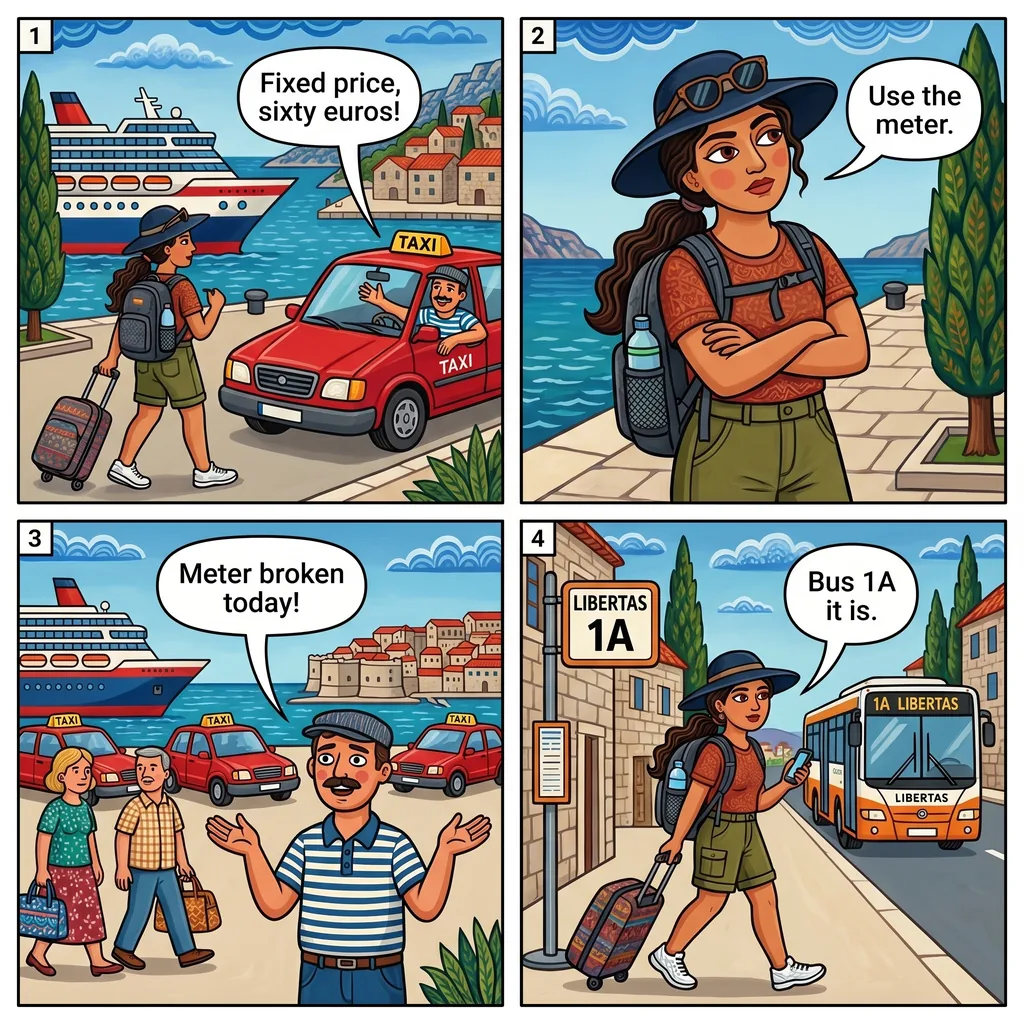
A taxi rank positioned immediately outside Port Gruž funnels disembarking cruise passengers into unmetered cars at flat €40–80 fares for Old Town runs that should cost €12–20 metered; unlicensed "white" taxis have been caught hiding their plates with garbage bags to enter the city's restricted zone.
The benchmark case is a Tripadvisor review of Port Gruž posted June 7, 2024 by a British cruise passenger: "Do NOT get a taxi directly from the port. Taxi rank just outside to the left, ushering tourists off the ship." She was charged €55 for a 15-minute ride into the Old Town — her hotel owner later told her the maximum legitimate fare for that route is €20, and Uber was quoting €12 for the same journey that day. The Dubrovnik Times reported on August 9, 2025 ("Dubrovnik Mayor Targets Illegal Taxis After Driver Hides Number Plates With Garbage Bags") that an unlicensed driver was caught using black plastic bags to cover his plates so he could slip into Dubrovnik's Special Traffic Management Zone (established June 2, 2025) and work the cruise-ship crowd directly; the mayor's response was a September 2025 proposal to amend the Road Transport Act and introduce a taxi vehicle card system linking specific cars to licensed drivers.
The pressure is national. Transport Minister Oleg Butković, on Nova TV's Dnevnik (August 28, 2025), pointed to a New Zealand tourist charged €1,506 for a short Zagreb ride — the driver first quoted €185, then demanded €150 cash, then ran the card for ten times the agreed amount — as the trigger case for reintroducing maximum fare limits (Croatia Week, Aug 28, 2025). The mechanic is a three-step squeeze tuned to cruise-ship time pressure. First, a cluster of men outside the Gruž arrivals gate "usher" you with clipboards and a few words of English toward a row of cars waiting on your right; the licensed rank is a short walk further out, but the touts intercept you before you find it. Second, the driver refuses to run the meter and quotes a flat fare that doubles or triples the standard rate; if you push back he produces a laminated "private taxi" price card that claims €20 per kilometre. Third, once you are in the car he may add a surprise "luggage fee" or "cruise surcharge" at the destination and demand cash only — or worse, run your card for multiples of the quoted amount.
Defense is a ride app and a documented plate number. Uber and Bolt both operate legally in Dubrovnik and show the fare before you accept the ride; the US State Department's Croatia advisory explicitly recommends them. From Gruž, public bus Line 1A/1B (Libertas) runs Pile Gate–Gruž for €2. If you must use a port taxi, photograph the plate and the driver's ID card before you load luggage, insist on the taxi-meter (legally required on licensed cars), and pay by card with a receipt that shows a business registration number — refuse cash-only drivers. To complain or report an overcharge, call 112 (EU emergency), 192 (Police), or the Dubrovnik-Neretva Police Department on +385 20 443 333; the Hrvatska Turistička Policija operate summer patrols specifically around Pile Gate and Gruž. Dubrovnik Tourist Board at Brsalje 5, +385 20 312 011, handles tourism-quality complaints. American cruise passengers needing document help: US Embassy Zagreb at Ulica Thomasa Jeffersona 2, +385 1 661 2200; UK Embassy Zagreb at Ivana Lučića 4, +385 1 6009 100.
Red Flags
- A tout with a clipboard intercepts you the moment you exit the Gruž arrivals gate and walks you to a car on the right instead of the licensed rank
- Driver refuses to run the meter and quotes a flat €40–80 fare for an Old Town run
- A laminated "private taxi" price card showing €20/km appears when you question the fare
- Driver will not take card or will not issue a receipt with a business registration number
- Number plates are obscured, dirty, or partially covered — a documented marker of unlicensed cars working restricted zones
How to Avoid
- Open Uber or Bolt before you leave the ship — both operate legally and show the full fare up front.
- Take Libertas bus 1A or 1B from Gruž to Pile Gate for €2, or the cruise shuttle if your line offers one.
- Photograph the taxi's plate, the driver's ID, and the meter before loading luggage.
- Pay by card with a receipt showing the company's business registration number; refuse cash-only drivers.
- Report overcharges to 112 or Dubrovnik-Neretva Police on +385 20 443 333 within 48 hours with the plate number.
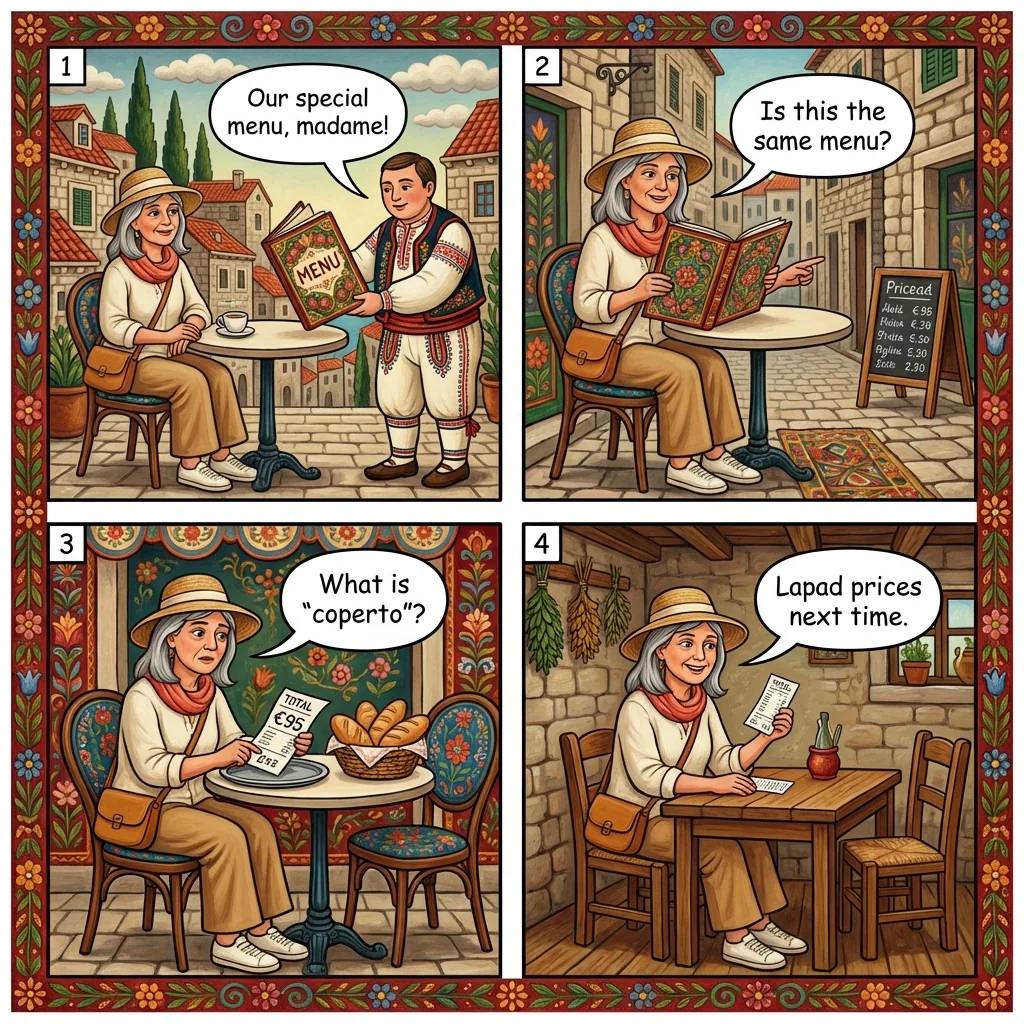
Old Town restaurants on Stradun, Prijeko and Od Puča post the cheapest item on a chalkboard outside, then hand you a menu 2–3× more expensive once you are seated — seafood pasta at €25+, a scoop of gelato at €5, a coffee on the Stradun at €6, and the Medium story of a tourist charged 70 kuna (~€9.30) for a single juice has been the defining complaint for a decade.
The pattern is consistent and well-documented. A 2024 Viralsnare Facebook investigation posted to the Croatia Travel group ("We nearly got scammed at this restaurant in Dubrovnik...") lists the anchor prices visitors routinely encounter inside the walls: "A scoop of gelato? €5. A simple seafood pasta? €25+. A drink on the Stradun? Let's just say you'll be sipping slowly." A Tripadvisor thread ("Avoid this restaurant in Old Town - Dubrovnik," Korta Bistro & Wine Bar) walks through the specific mechanic: "We got caught out by a dodgy restaurant just off the Stradun — Korta Bistro & Wine Bar. Late evening we couldn't find anywhere else open." The Medium piece "The Terrible Story Of How I Got Scammed In Dubrovnik"; official/local reports document 70 kuna (about €9.30 at the time) for a single juice — the reporter shares photos of the menu-swap. The traveler threads "Over expensive tourism prices / over tourism in Dubrovnik" (2024) summarizes the post-euro picture: "Restaurants and services are indeed terrible: expensive, but small quantity and low quality."
The mechanic has three moves. First, a chalkboard or laminated menu posted in the alley shows a handful of very cheap items — a €1.50 coffee, a €7 pizza — that turn out not to be on the printed menu you are handed at the table; the real menu starts three euros higher on every line. Second, fish and seafood are "market price by the kilogram," with no weight quoted on the menu; a whole sea bass arrives at €60–90 because the waiter has selected the largest one in the display case. Third, cover charges (couvert, coperto) of €3–5 per person, a bread plate you did not order, and service charges of 10–20% stack on top of the printed prices, often in small type at the bottom of the bill. Unlike the Greek or Italian versions, the charge is rarely framed as fraudulent — Croatian receipt law requires the bill to be electronically registered with the tax service, so the inflated price is what the restaurant actually declared. That makes challenge on the spot awkward and police intervention unusual.
Defense is a decision made before you pull out a chair. Away from the Stradun tourist strip — in the Lapad and Gruž neighborhoods, Kono Pjerin and Bistro Tavulin in the Old Town, and family-run konobas outside Pile — prices are still moderate and the cuisine is genuinely good; the Reddit traveler reports locals thread is the most reliable filter. Read Google reviews that are specifically dated in the last twelve months, and skip any review that mentions "cover charge" or "surprise bill." Ask for the full menu with prices, in English, before you order; ask the weight and price per kilogram of any fish or steak before it is cooked; photograph the chalkboard menu in the alley next to your table number. If a bill arrives with line items you did not agree to, ask politely for the itemized receipt, pay the agreed items, and if the staff refuses, call the Croatian Ministry of Finance consumer hotline 072 213 213 and the Dubrovnik-Neretva Police on 112 or +385 20 443 333. For chargeback recourse, pay by card rather than cash and dispute the charge with your bank within 30 days.
Red Flags
- A chalkboard menu in the alley shows prices that do not appear on the printed menu at the table
- Fish, seafood, or steak is listed "by the kilogram" without a price, weight, or portion size
- A cover charge (couvert, coperto, bread, service) in small type at the foot of the menu
- Bill arrives without itemization or with unexplained rounding and "gratuity included"
- Staff pressures you to order the market-priced whole fish before you have confirmed weight and total in euros
How to Avoid
- Eat outside the walls — Lapad, Gruž, Ploče — where prices are half and the food is often better.
- Ask for the English menu with printed prices before you order; photograph the chalkboard menu.
- For seafood, always confirm price per kilogram and the final total in euros before the fish goes to the grill.
- Pay by card for chargeback recourse and retain the receipt with the business registration number.
- For disputes, call 072 213 213 (Ministry of Finance consumer hotline) or +385 20 312 011 (Dubrovnik Tourist Board).
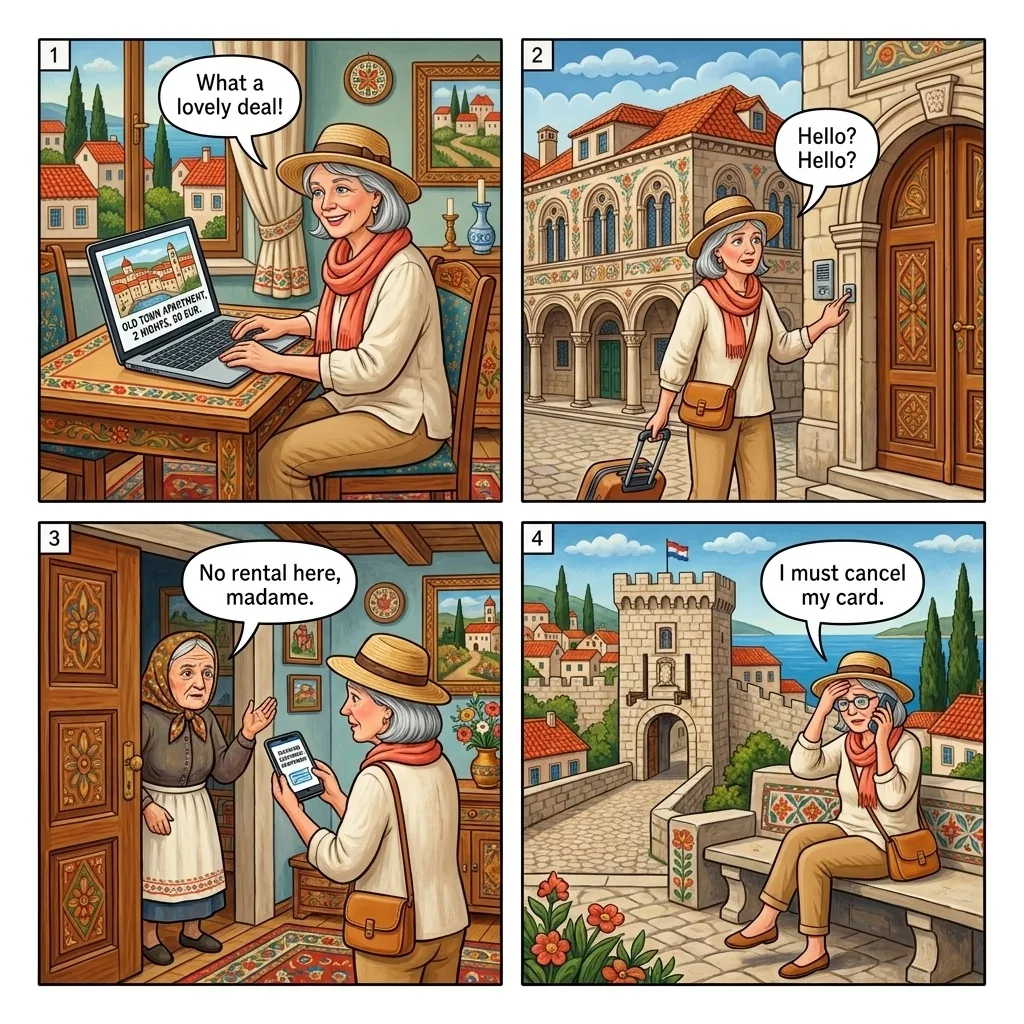
A 26-year-old Slovak tourist lost €1,050 in March 2025 to a fake Dubrovnik rental advertised on what looked like a legitimate booking site, and the Polish embassy in Zagreb has publicly warned its citizens about scammers publishing the same Dubrovnik apartment under several names and prices on Booking.com to trigger overbookings — the victim arrives to find the flat does not exist, is already occupied, or is a construction site.
The Dubrovnik Times case file ("Tourist Scammed in Fake Dubrovnik Apartment Rental — Police Issue Warning," March 18, 2025); the apartment did not exist. The police urged citizens to "be cautious when searching for accommodation through online ads and websites" and to "verify the property owner through publicly available sources." An older but still-active Dubrovnik Times report walks through the mechanic: scammers clone a real Dubrovnik Airbnb listing, stealing the photos, description, and rates; the fake host insists on bank transfer rather than the platform's payment system, claiming an "Airbnb agent" cannot show the apartment without a guarantee. TVP World (2024).com in Croatia. The BBC's November 2024 story "Booking.com customers warned of 'reservation hijacking'"
The mechanic splits into three versions. In the cloned-listing version, the property exists but the listing is not really controlled by the owner — the scammer has copied a real Dubrovnik flat to Instagram, Facebook Marketplace, or a phishing domain that reads "bookings-dubrovnik.com," takes your €500–1,500 by SEPA transfer or Revolut, and disappears. In the reservation-hijack version, you have booked genuinely through Booking.com, and a criminal using leaked data sends a WhatsApp that mirrors the hotel's branding and asks you to re-confirm your card "within 24 hours" through a linked form; the link is a credential phish that captures the card and the 3-D Secure code. The overbooking version, highlighted by the Polish embassy, has the same apartment listed three or four times on Booking.com at slightly different prices; multiple tourists arrive the same day, and the first one in the door keeps the flat — the others stand on the Stradun with luggage and a canceled reservation. Slobodna Dalmacija's recurring "prevara" (fraud) coverage — including the Neum fake-villa exposé showing counterfeit luxury villas on Booking.com — makes clear that Dalmatian Coast listings are a heavily worked target.
Defense is platform discipline and key-in-hand payment. Book only through the Booking.com, Airbnb, or Vrbo app — never through an email link — and ignore any request for a card, bank transfer, or payment outside the platform, regardless of which "verified" logo is on the message. Booking.com's official fraud policy is clear: the company never asks for your card on WhatsApp. Pay only on arrival, in the apartment, with keys in your hand — if the owner requests a bank transfer "deposit" before you arrive, the listing is not real. For Dubrovnik specifically, cross-check the apartment address against the Croatian tourism registry (eVisitor) and the owner's name on the Croatian business register (sudreg.pravosudje.hr); both are free to search. If you have already paid and the apartment is not real, report to the Dubrovnik-Neretva Police on 112 or +385 20 443 333 and file with your card's chargeback team within 30 days. US Embassy Zagreb on +385 1 661 2200 and UK Embassy Zagreb on +385 1 6009 100 can assist with emergency accommodation referrals for stranded travelers.
Red Flags
- A message from "Booking.com" or the apartment owner via WhatsApp or email asks for a payment or card re-verification outside the Booking.com app
- The host insists on bank transfer, Revolut, or SEPA instead of the platform's integrated payment
- The same apartment appears on Booking.com under several listings at different prices
- The listing URL is not a booking.com or airbnb.com subdomain — common phishes use "booking.com.hr" or "bookings-dubrovnik.com"
- The host refuses a video walk-through before payment and pressures a €500+ "deposit" to hold the dates
How to Avoid
- Book only through the official Booking.com, Airbnb, or Vrbo app; pay only through the platform, keys in hand.
- Cross-check the property in the Croatian eVisitor tourism registry and the host's name in sudreg.pravosudje.hr.
- Ignore any WhatsApp "card re-verification" message; call the platform's published support line directly.
- Use a credit card with chargeback rights; never pay by SEPA transfer before arrival.
- For losses, call +385 20 443 333 (Dubrovnik-Neretva Police) and file a chargeback within 30 days.
Like what you're reading? Get a full Dubrovnik itinerary with safety tips built in.
Browse travel-safety books →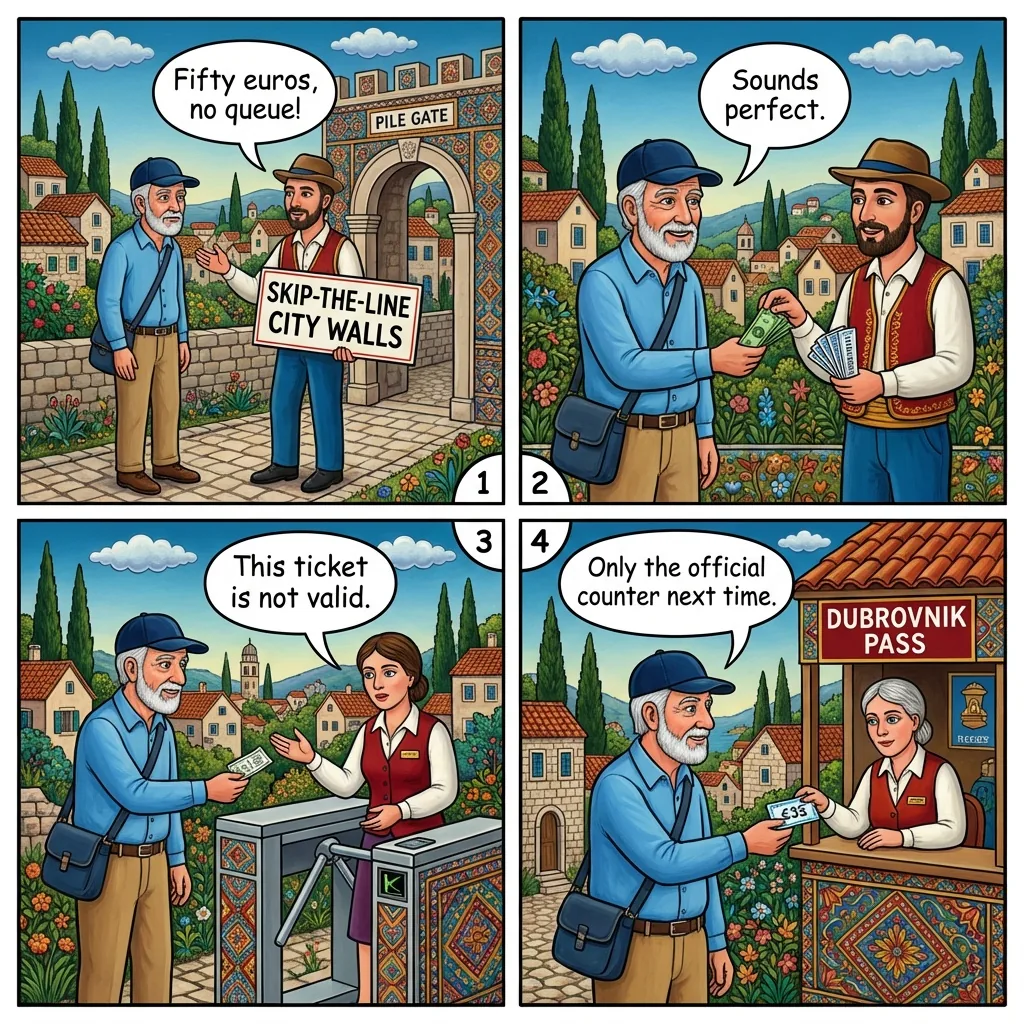
The official Dubrovnik City Walls ticket is €35 adults in 2025 (or bundled into the Dubrovnik Pass from dubrovnikpass.com), but a thicket of third-party resellers — Viator, Gulliver Travel, unverified agencies — sell the same ticket at €45–70 with a "skip-the-line" label that doesn't skip anything, and a parallel ecosystem of tout websites charges your card and emails an unusable voucher.
The Tripadvisor review that has anchored this complaint since 2023 ("SCAM — use official site Dubrovnik Pass," on Gulliver Travel) puts it plainly: "They charged us €50 per person on this site for a supposedly allotted time and stated that it was a Skip-the-Line ticket. This is a scam, buy at Dubrovnik Pass when you get here!" The same pattern appears on Viator's "Skip-the-Line Dubrovnik Cable Car Ticket" listing, where a traveler wrote: "Two adults tickets cost if taken directly at cable car around €52. With Viator I paid €92. You really don't need to skip the [line]." A Tripadvisor Dubrovnik forum thread ("Pre-buying City Walls-only ticket?") reinforces the rule from a local moderator: "Also, do not book anything from a website, other than the official ones; the third party ones can be a scam." The Dubrovnik Pass itself — a 1-day pass at €40 includes walls access plus Rector's Palace and several museums, per the Croatia Travel Facebook group's August 2025 breakdown — is run by the Dubrovnik Tourist Board.
The mechanic is a familiar phishing-plus-mark-up pairing. First, the Google-ads and Instagram-ads version: a domain like "dubrovnikcitywalls.com" or "skipline-dubrovnik.com" that is not the official wallsofdubrovnik.com or dubrovnikpass.com — it accepts your card, emails a QR code or PDF that either fails to scan at Pile Gate or that is revealed on arrival to be a "voucher" that you must still queue to exchange for the real ticket. Second, the legitimate-but-marked-up version: Viator, GetYourGuide, Klook and similar OTAs list the same city-walls ticket at 20–100% above the counter price and call it "skip the line" even though the walls have only one queue and one booth. Third, street touts — especially around Pile Gate and Brsalje Square at peak cruise-ship hours — sell "skip-the-line passes" that are sometimes real tickets already used that morning and sometimes nothing more than laminated cards the gate staff do not recognize. The cable-car variant is the same: Srđ Cable Car official ticket is €27 return at the lower terminus on Petra Krešimira IV; the third-party "VIP fast-track" bundles mark it up to €45–90.
Defense is the official site or the counter. For the City Walls and Old Town monuments, buy at dubrovnikpass.com (Dubrovnik Tourist Board's own portal) or at the Pile Gate, Ploče Gate, or St. John's Fort ticket booths on the day — there is no meaningful "skip-the-line" option because everybody uses the same gate. For the cable car, buy at the Petra Krešimira IV lower terminus counter or at dubrovnikcablecar.com. Verify any URL against the Brsalje 5 Tourist Board's printed map before you enter a card; the Dubrovnik Pass itself is the legitimate bundle option, not a reseller. Refuse street touts at Pile Gate — Croatian law requires licensed tour operators to wear a visible badge with their license number issued by the Ministry of Tourism. For phishing losses, call your card issuer's 24-hour fraud line immediately, file a report at Dubrovnik-Neretva Police on +385 20 443 333 and at the Croatian Ministry of Finance consumer hotline 072 213 213, and notify the Dubrovnik Tourist Board on +385 20 312 011.
Red Flags
- A third-party website charges €45–70+ for a "skip-the-line" City Walls ticket, well above the €35 counter price
- A tout at Pile Gate or Brsalje Square offers laminated vouchers, QR codes, or "VIP passes"
- The seller's URL is not wallsofdubrovnik.com, dubrovnikpass.com, or dubrovnikcablecar.com
- You are asked to pay by bank transfer, Revolut, or cryptocurrency rather than a chargeback-eligible card
- The voucher you receive by email asks you to exchange it at a "partner kiosk" somewhere other than the official gates
How to Avoid
- Buy City Walls and Old Town monument tickets at dubrovnikpass.com or at the Pile / Ploče / St. John's Fort booths.
- Buy Srđ Cable Car tickets at dubrovnikcablecar.com or the Petra Krešimira IV lower terminus counter.
- Refuse all street touts near Pile Gate, Brsalje, and Stradun — licensed guides wear a Ministry of Tourism badge with a license number.
- Use a credit card with chargeback rights and never pay by SEPA transfer or crypto.
- For phishing losses, call your card fraud line, then +385 20 443 333 (Police) and +385 20 312 011 (Tourist Board).
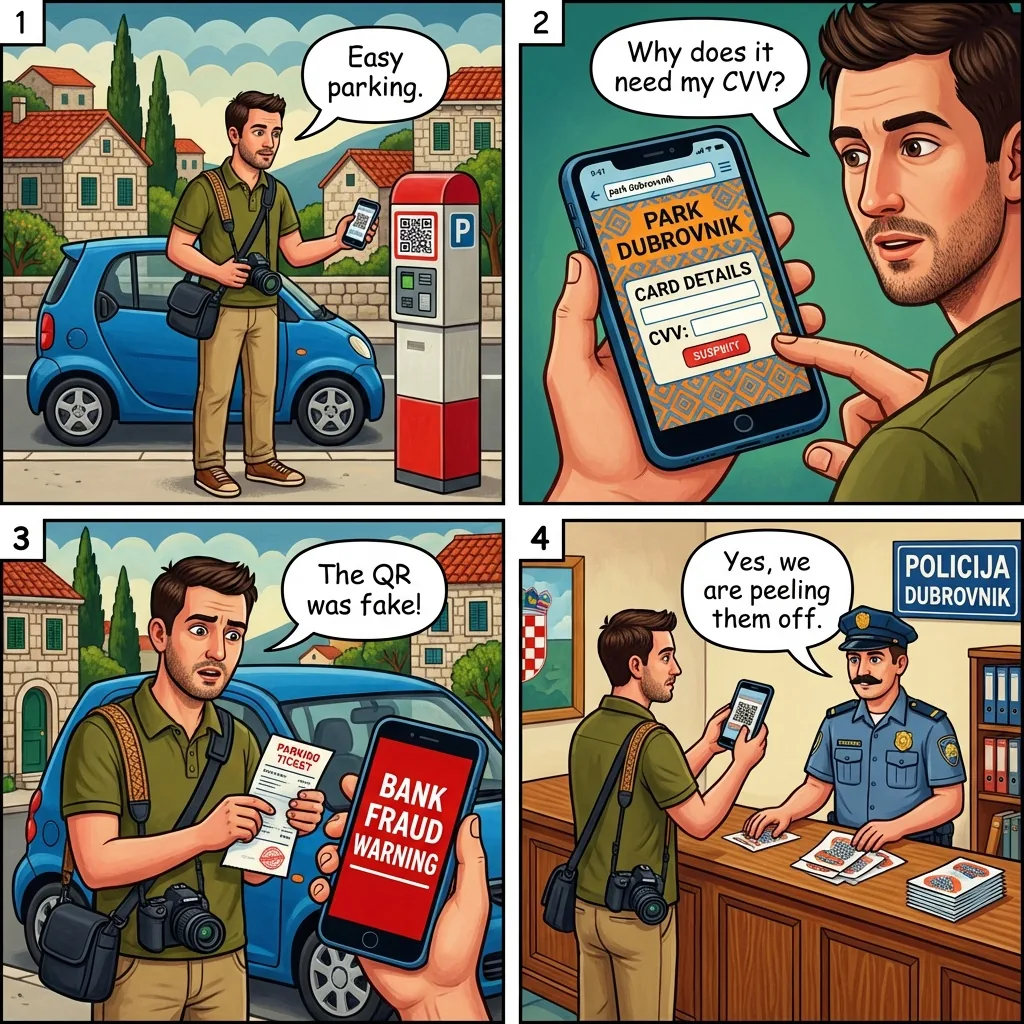
In July 2025, Dubrovnik police discovered that scammers had pasted stickers with fake QR codes over the legitimate codes on parking meters across the city; tourists scanning them were taken to a credential-phishing page that captured card details instead of paying for parking — employees of the City of Dubrovnik peeled dozens of the stickers off.
The July 2025 traveler threads "Netko u Dubrovniku zalijepio lažni QR kod na parkirnim automatima" ("Someone in Dubrovnik stuck fake QR codes on parking meters") is the primary trace: "The police discovered that the scammers had placed stickers with fake QR codes on the parking meters, and the employees of the City of Dubrovnik..." The firsthand complaint is that drivers who scanned the QR code expecting to be routed to the City of Dubrovnik parking payment portal (sanitat.hr) were instead taken to a copy-site harvesting card numbers, expiry, CVV, and 3-D Secure codes; by the time the legitimate parking-enforcement patrol passed, the driver had "paid" but was still marked unpaid, and received a ticket alongside losing the card details. An older Tripadvisor "Be Aware of Parking Scam in Dubrovnik Old Town" thread from the Pile / cable-car lower-terminus car park documents an adjacent practice — fake attendants demanding cash for "parking" on streets where parking is actually free or handled by meter.
Separately, Polish travelers have been hit by an SMS-based parking fraud that the MSN Canada story ("Brit tourists issued warning over parking scam plaguing tourist hotspot")." The template is international; Dubrovnik's version is that the QR code has moved from SMS to the meter itself. The mechanic is a sticker, an hour of work, and a copy-paste phishing site. The scammer laminates a QR code sticker that points to a typo-squatted domain — "dubrovnik-parking.com" or "sanitatdubrovnik.net" rather than the real sanitat.hr/parking — and places it over or next to the legitimate QR on a dozen meters, usually in Lapad and Gruž where turnover is high and drivers do not notice the substitution. The fake payment page looks convincing: it asks for the license plate and the card details; the transaction either fails or processes a €5 "parking" charge followed by larger charges on the card within 24–72 hours.
Defense is the app and the meter face. Pay parking in Dubrovnik only via the official Sanitat/payDo+ app (downloaded from the Apple App Store or Google Play), or with coins and card directly at the meter's physical interface — do not scan QR codes stickered to the meter unless you have verified the URL against the printed domain on the meter itself. If you have already scanned and entered card details, call your card issuer's 24-hour fraud line immediately and block the card; then file a report with the Dubrovnik-Neretva Police on +385 20 443 333 or 112. Legitimate Dubrovnik parking tickets are issued on the windscreen by uniformed Sanitat staff; any electronic notice arriving by SMS, WhatsApp, or email after you leave the country is almost certainly phishing. For broader tourism-quality complaints, the Dubrovnik Tourist Board at Brsalje 5, +385 20 312 011. The Hrvatska Turistička Policija summer patrols around the walls and Gruž can also take reports.
Red Flags
- A QR code sticker on a parking meter that looks recently applied, with peeling edges or a different paper texture than the meter itself
- Scanning the code opens a URL that is not sanitat.hr or dubrovnik.hr
- The payment page asks for card details including CVV and full 3-D Secure code (the real one does not)
- A high-vis "attendant" in Pile or Gruž demands cash for parking on a city street
- An SMS, WhatsApp, or email arrives after you leave the car claiming an unpaid parking ticket
How to Avoid
- Pay with the official Sanitat payDo+ app or at the meter with coin/card — do not scan roadside QR codes.
- Verify any URL shows sanitat.hr or dubrovnik.hr before entering card details.
- Photograph the license plate and meter number when you park, to verify later if a dispute arises.
- Block your card immediately if you entered details into a suspect QR site; call the issuer and +385 20 443 333.
- Ignore post-trip SMS "unpaid parking ticket" messages — Croatian municipal enforcement issues paper tickets on the windscreen.
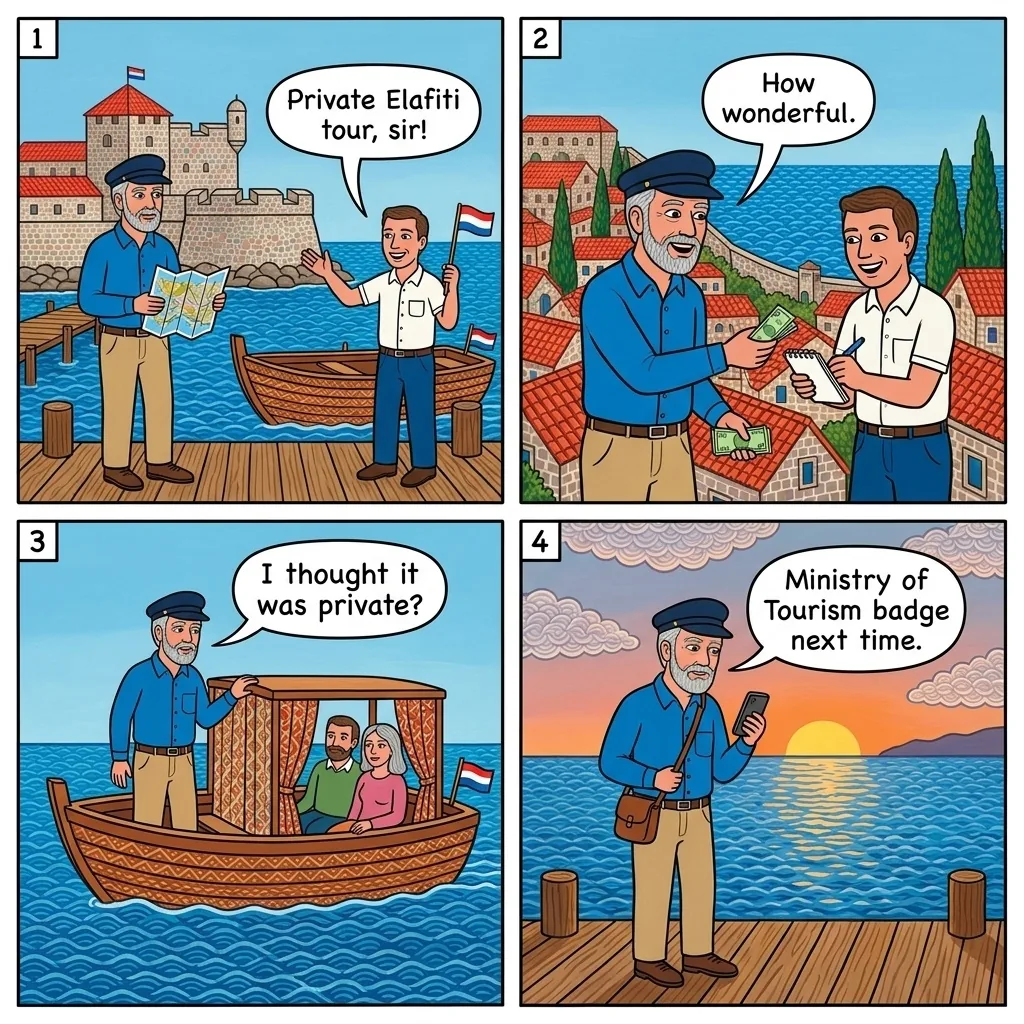
"Private" Elafiti boat tours advertised at €400 turn into shared tours with a curtain at the dock, unlicensed skippers offer "Game of Thrones island hopping" that leaves Dubrovnik-registered insurance out of the picture, and firsthand Tripadvisor reports on Triton, Super Tours, and Mala Mara document repeated no-show bookings and bait-and-switch upgrade demands.
Tripadvisor has three long-running firsthand case files. "Avoid 'TRITON'. SCAM" on Dubrovnik Boat Excursions is the canonical Elafiti warning — the top complaint is that the advertised private boat turned out to be a shared cruise. "Super Tours: Tourist scam and overpriced" (3,729 reviews). "Mala Mara: THIS IS A FRAUDULENT BUSINESS AND A SCAM" (Aug 8, 2025) is the newest and most detailed — a full-day booking turned into a no-show with a disputed refund. The Gari Transfer operator guide ("Dubrovnik Boat Tour Scams: How to Spot a Fake Private Trip") codifies the three moves that run through all three cases: "private boat = shared tour with a curtain," "unlicensed boat" with no insurance or safety certification, and "bait-and-switch pricing" (advertised €400 becomes €550 at the dock).
The mechanic revolves around Dubrovnik's compressed cruise-ship visiting window. Walk-up kiosks on Gruž and the Old Port sell tours in half a dozen languages at €80–120 per person for the Elafiti islands (Koločep, Lopud, Šipan) or €60–90 for shorter "Lokrum + Cavtat + Game of Thrones" runs. The unlicensed version is that the boat does not carry the Croatian maritime authority's safety inspection placard, the captain is not a registered skipper under the Sailor's Book regime, and travel insurance will not cover an incident on an illegal vessel. The "private" version is sold at €300–500 with a suggestion of exclusivity; at the dock, a second couple is already boarding, and the "private" curtain between seats is the only concession made. Game of Thrones tours have a parallel licensing issue on land: Croatian law requires a tour-guide license from the Ministry of Tourism displayed as a numbered badge, and the Pile Gate touts in branded T-shirts without a visible badge are reliably unlicensed.
Defense is booking through a named, insurance-backed operator with a fixed meeting point and a registered VAT number on the receipt. For the Elafiti islands, Krilo and Jadrolinija run scheduled Gruž departures at published prices; for guided island tours, GetYourGuide's Elaphite Island Cruise has 4,570+ reviews and a consistent rating; Dubrovnik Boat Trips (dubrovnikboattrips.com) is a well-reviewed private-charter alternative. For Game of Thrones, only book guides who display a Ministry of Tourism badge with license number — the Dubrovnik Tourist Guides Association at Brsalje 5 (+385 20 312 011) keeps the list. Never pay more than 30% up front and never pay in cash without a VAT receipt. If the advertised "private" boat arrives as a shared tour, refuse to board and demand an on-the-spot refund; if the operator refuses, call 112 (Police) or the Harbour Master's Office on +385 20 418 988. For disputed charges after the fact, call your card issuer's fraud line and file at the Dubrovnik-Neretva Police on +385 20 443 333; the Croatian Ministry of Finance consumer hotline 072 213 213 mediates tourism-service disputes.
Red Flags
- A walk-up kiosk on Gruž or Pile sells "private" tours at €300–500 without a VAT-registered receipt
- The boat at the dock has no visible Croatian maritime safety placard or the skipper cannot produce a Sailor's Book
- A second couple is already on board when you arrive for a "private" tour
- The Game of Thrones guide has no Ministry of Tourism license badge with a visible number
- The operator insists on cash-only payment without a registered receipt
How to Avoid
- Book island tours through Krilo, Jadrolinija, Dubrovnik Boat Trips, or an OTA with 1,000+ reviews.
- Check the operator's VAT number and tax-registered receipt before you pay.
- For Game of Thrones, use a Ministry of Tourism licensed guide (badge with number visible) from the Dubrovnik Tourist Guides Association.
- Never pay more than 30% up front; pay the remainder by card on arrival.
- For disputes, call the Harbour Master's Office +385 20 418 988 and Dubrovnik-Neretva Police +385 20 443 333.
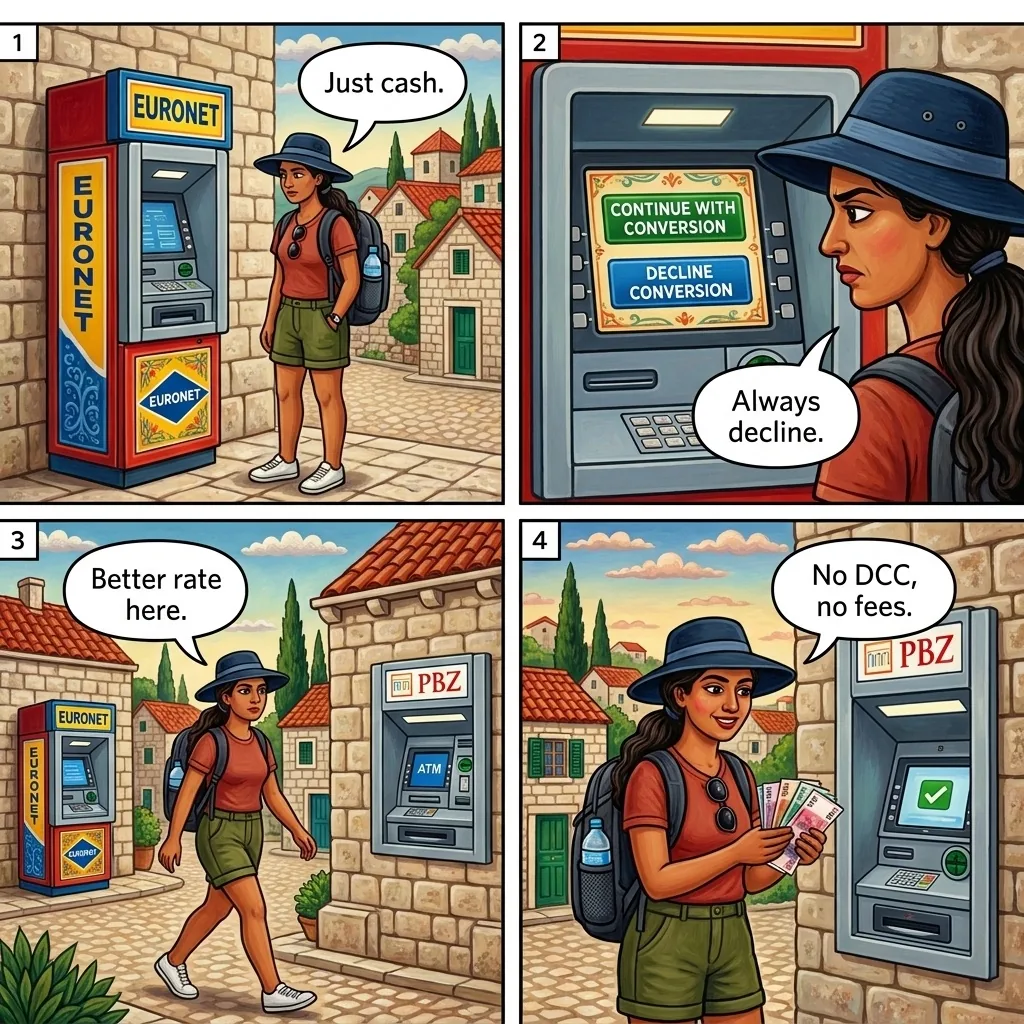
Since Croatia adopted the euro on January 1, 2023, currency exchange has become a smaller problem but ATM dynamic-currency-conversion (DCC) markups at independent Euronet machines have filled the gap — reddit traveler reports describes Euronet as "rip-off" and "scam machines" offering exchange rates up to 20–25% worse than major Croatian banks.
The traveler threads "Hi, what are the usual scams in Croatia?" puts the consensus bluntly: "The ATMs that rip-off tourists are Euronet ATMs which provide terrible exchange rate + huge withdrawal fees. If you're going to the coast, every town has some of them." A separate traveler threads in 2025 — "Jadran je pun ničijih bankomata s brutalnim" ("The Adriatic is full of nobody's ATMs with brutal [fees]"). In Split, they were on every corner by 2023." Paul Bradbury's widely-shared 2024 Facebook post ("A practical suggestion to minimize the cancer of the rip-off ATMs this summer") estimates commissions at 20–25% and has dozens of firsthand comments from Split and Dubrovnik users. The Dubrovnik Times ("Croatia Among Europe's Least Financially Hit by Rising Payment Fraud Despite AI-driven Surge," 2025). On the manual exchange side, the Split Tourist Board's own article references a Croatian media investigation showing tourists received 610 kuna for €100 instead of the legitimate 730–740 — the exchange-office rate rigged against them.
The mechanic is two-part. At the ATM: independent operators (Euronet, Cashzone, Your Cash) place high-fee machines in the highest-tourist locations — the Stradun entrance, Pile Gate, Gruž arrivals, the Dubrovnik airport arrivals hall — and default every transaction to Dynamic Currency Conversion (DCC), where the machine offers to "bill your card in your home currency" at a rate 5–15% worse than your issuer would charge. The screen flow is pressured: the "accept conversion" button is the default highlighted option, the "decline / charge in EUR" button is small and often mislabelled. Withdrawal fees of €4–8 stack on top. At the exchange booth: some mjenjačnice in Dubrovnik still advertise conversions from USD, GBP, CHF, or leftover kuna at a posted "buy" rate and then add a "commission" of up to 15% that is disclosed only in small print after the money has been taken. The legitimate version is Croatian-bank-branded ATMs (Zagrebačka Banka, Privredna Banka Zagreb, Erste Bank, Raiffeisen, OTP) and Croatian-bank-operated exchange windows, which charge the interbank rate plus a small transparent fee.
Defense is a Croatian bank ATM and a "no" to DCC. Use only ATMs on the outside wall of a named Croatian bank — Zagrebačka Banka on Stradun, Privredna Banka at Pile Gate, Erste on Obala Stjepana Radića in Gruž, OTP near Ploče. Decline DCC every single time; choose "Pay in EUR" or "Charge without conversion." Your home bank will convert at a far better rate than any ATM offering the choice. Withdraw larger amounts less often to minimise per-transaction fees; check your issuer's international withdrawal policy before you leave. For leftover kuna (still exchangeable at the Croatian National Bank until December 31, 2025 per HNB regulations), use a named bank rather than a street booth. For exchange complaints, call the Croatian Ministry of Finance consumer hotline 072 213 213 and the Dubrovnik Tourist Board on +385 20 312 011. For suspected card fraud: your issuer's 24-hour fraud line first, then Dubrovnik-Neretva Police on +385 20 443 333 and the Croatian Ombudsman on +385 1 49 21 837.
Red Flags
- The ATM's top-line branding is Euronet, Cashzone, or "Your Cash" rather than a Croatian bank
- The transaction screen offers "Continue with conversion in GBP/USD/EUR" as the highlighted default
- The posted exchange rate at a booth does not show the commission in the same window
- A withdrawal fee of €4–8 is announced only after you confirm the amount
- The exchange office on Stradun offers rates visibly worse than the interbank rate on XE.com or Google
How to Avoid
- Use only ATMs on the outer wall of a named Croatian bank — Zagrebačka, PBZ, Erste, Raiffeisen, OTP.
- Always decline DCC; choose "Pay in EUR" / "Charge without conversion."
- Withdraw larger amounts less often to minimise per-transaction fees.
- For manual exchange, use a named bank branch rather than a street booth.
- For card fraud, call your issuer first, then +385 20 443 333 and +385 1 49 21 837.
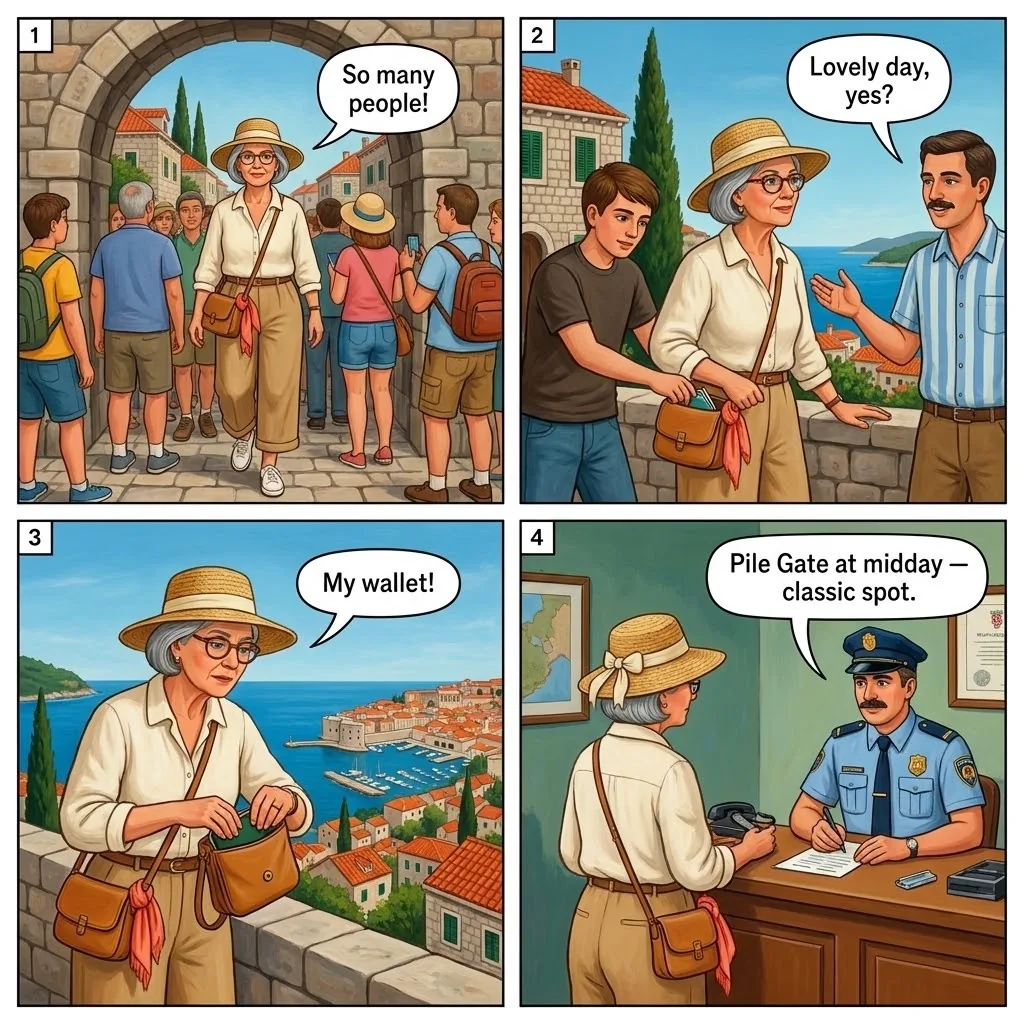
Pickpocketing inside the walls is concentrated in two predictable compressions — Pile Gate and the viewpoint benches on the City Walls during the mid-day cruise-ship wave — and the FCDO's 2025 Croatia advisory explicitly names Split and Dubrovnik as places where "pickpockets operate in tourist areas," while traveler reports and the Dubrovnik Safety Guide confirm that Stradun between 10:00 and 14:00 is the single highest-theft window.
The UK FCDO Croatia safety and security page (gov.uk/foreign-travel-advice/croatia/safety-and-security, 2025) is the clearest official statement: "Pickpockets operate in tourist areas" in Split and Dubrovnik. The Bookiscout Dubrovnik Safety Guide 2026 specifies the time and location: "Stradun (Placa): The main street in the Old Town is almost always packed, especially from 10:00 AM to 2:00 PM" — the exact cruise-ship window. Cava-tours.com's "Is Dubrovnik safe?" guide names the three flashpoints: "The Old Town, Stradun, and city walls get packed during peak season, making them prime areas for pickpockets." Dubrovnik-travel.net's "Top 10 Tourist Mistakes" is blunt: "Beware of pickpockets. They mix with tourists in busiest parts of the town." The Travelsafe-Abroad Split-and-Croatia guide rates pickpockets as "medium risk in crowded areas like Dubrovnik's Old Town or Split's ferry terminals." Against a national context where violent crime is rare (US State Department: "Violent crime is rare. Petty crime cases have been reported in densely-populated tourist areas"), Dubrovnik's pickpocket problem is entirely about crowd density and sight-line loss at pinch points.
The mechanic relies on the architecture of the Old Town. Pile Gate is a single stone arch about three metres wide that channels the entire cruise-ship tide onto Stradun — two or three thieves working the choke point can bump-and-lift four or five bags a morning, and the cobbled paving is loud enough to disguise the contact. The City Walls circuit is a 1.94-km single-file walkway with no side exits for about 400 metres in several stretches; the viewpoint benches at the Minčeta Tower and St. John's Fort are where people set down bags to take photos, and a second visitor leaning in for the same shot has four seconds with the open bag. Sunset at Buža Gate's cliff-side bar on the outside of the south wall is the third window — the bar is dark, the view is distracting, and the stone bench behind the bar is where phones get lifted from back pockets. The traveler reports and Facebook Croatia Travel threads report no firsthand pickpocket cases involving violence; the loss is almost always wallet or phone, quietly, in a crowd.
Defense is bag position and phone discipline. Wear any bag across your body with the zipper against your chest; keep your phone in a zipped front pocket, never in a back pocket or the outer mesh pouch of a backpack. At Pile Gate and Ploče Gate, briefly turn your backpack around to your front as you pass through the arch — locals do this and you will not look out of place. On the City Walls, keep your bag on your lap when you sit on a viewpoint bench and never hang it on the back of a bench. At Buža Gate's cliff bar, keep your phone off the stone bench. Carry only one card and €100–200 in cash; leave the rest in the hotel safe. If a wallet or phone is lifted, call 112 or 192 (Police) immediately and file at the Dubrovnik-Neretva Police Department on +385 20 443 333. For card freezes, call your issuer's 24-hour fraud line. For lost passports, US citizens call the US Embassy Zagreb on +385 1 661 2200; British citizens call the UK Embassy Zagreb on +385 1 6009 100. Dubrovnik Tourist Board at Brsalje 5, +385 20 312 011, has a walk-in desk for incident-report referrals.
Red Flags
- Two or three strangers cluster around you as the Pile Gate arch narrows the crowd
- A stranger leans in to share your viewpoint bench on the City Walls while asking a question
- Someone bumps into you on Stradun just as a tour group fills the paving
- A phone is left briefly on a stone bench at Buža or the Minčeta Tower
- A backpack is worn on the back with a phone or wallet in the outer mesh pouch
How to Avoid
- Wear bags crossbody with zip against your chest; phone in a zipped front pocket.
- Turn your backpack to your front at Pile Gate and Ploče Gate pinch points.
- Carry only one card and €100–200 cash; leave the rest in the hotel safe.
- Never set a phone, wallet, or bag down on a viewpoint bench on the City Walls.
- For thefts, call 112 and file at +385 20 443 333 (Dubrovnik-Neretva Police).
🆘 What to Do If You Get Scammed
📋 File a Police Report
Call 112 (EU emergency, all services) or 192 (Police). For Dubrovnik-specific cases, Dubrovnik-Neretva Police Department +385 20 443 333. Get the official Anzeige / policijska prijava reference — your travel insurance will require it. Non-urgent reports at mup.gov.hr. Hrvatska Turistička Policija operate summer patrols at Pile Gate, Brsalje, and Gruž.
💳 Cancel Your Cards
Call your home bank's 24/7 fraud line (number on the back of the card — keep a photo saved separately). Block suspicious transactions immediately. For Croatian consumer-protection complaints on retail / taxi / restaurant overcharges, call the Ministry of Finance consumer hotline 072 213 213 and the Croatian Ombudsman +385 1 49 21 837.
🛂 Lost Passport?
Contact your embassy in Zagreb. US Embassy: Ulica Thomasa Jeffersona 2 (+385 1 661 2200). UK Embassy: Ivana Lučića 4 (+385 1 6009 100). Canadian Embassy: Prilaz Gjure Deželića 4 (+385 1 488 1200). Australian Embassy: Centar Kaptol, Nova Ves 11 (+385 1 489 1200). Bring your police report reference number.
📱 Track Your Device & Dispute
If your phone was stolen, use Find My (iPhone) or Find My Device (Android) from another device. Do not confront thieves — share the location with police on 112. Dubrovnik Tourist Board at Brsalje 5, +385 20 312 011, mediates Tourism Quality Service complaints and has a walk-in desk for incident-report referrals. Harbour Master's Office for boat-tour disputes: +385 20 418 988.
Frequently Asked Questions
You just read 8 scams in Dubrovnik. The full Travel Safety Series has 780+ more across 20+ countries.
Tokyo's Kabukichō ¥130,000 bar trap. Rome's gladiator photo extortion. Paris's gold-ring trick. Bali's ATM skimmer scams. Bangkok's grand-palace closure ruse. Every documented scam across 20+ destinations — with the exact scripts, red flags, and local-language phrases that shut each one down. Drawn from Reddit traveler reports, embassy advisories, and consumer-protection cases.
- 780+ documented scams across Tokyo, Rome, Paris, Bali, Bangkok, Rio & 100+ more cities
- 20+ countries covered, with country-by-country phrase cards for every destination
- Updated annually — buy once, re-download future editions free
- All titles $4.99 each on Amazon Kindle