
Key Takeaways
- The #1 reported scam is the Granada Bus-Terminal Shared-Taxi Express Kidnapping.
- 1 of 6 scams are rated high risk.
- Use app-based ride services (Uber, DiDi) instead of street taxis — avoid unmarked vehicles, especially at night.
- Never accept unsolicited offers from strangers near tourist sites in Granada.
⚡ Quick Safety Tips
- Keep phones and valuables in secure pockets when in crowded areas.
- Use only licensed taxis or app-based ride services.
- Book tours and tickets through verified operators with online reviews.
- Keep a copy of your passport separate from the original.
Jump to a Scam
The 6 Scams
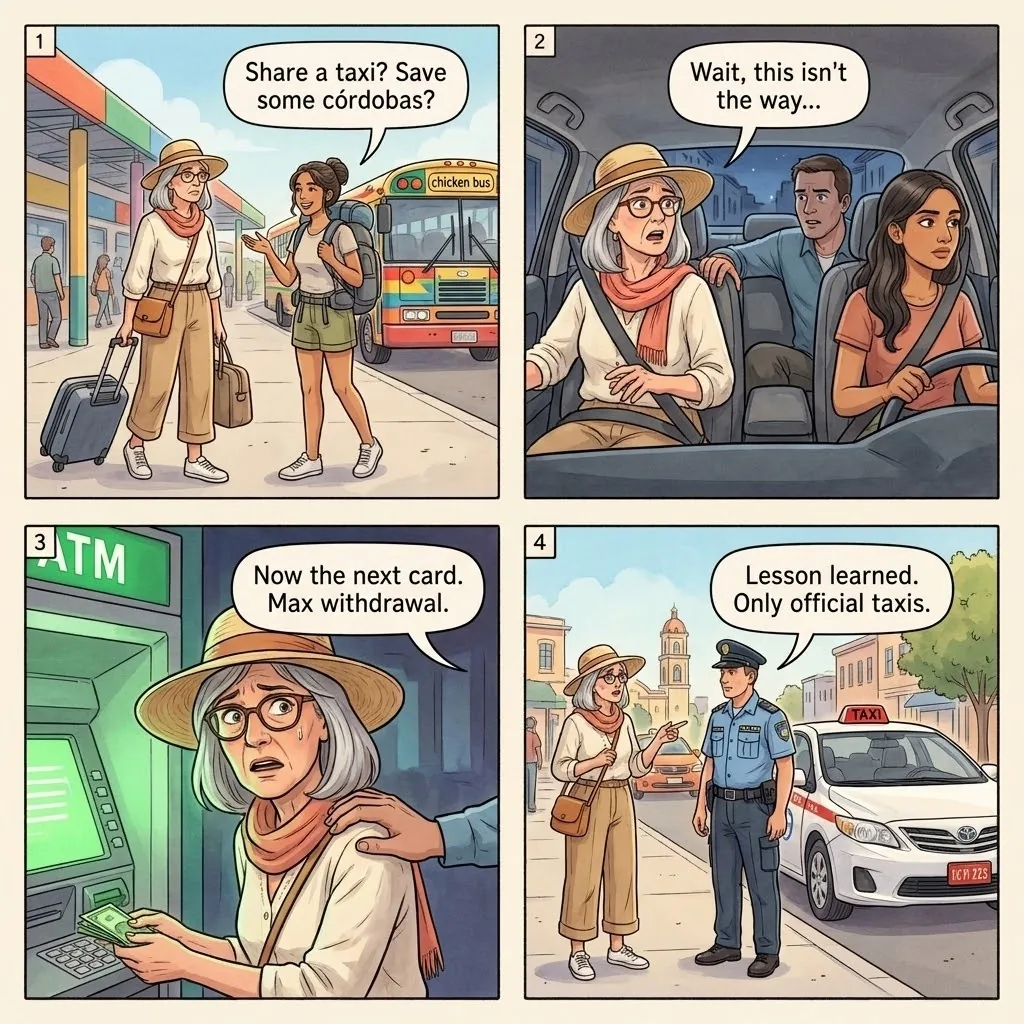
It's a Friday evening, you've just stepped off the chicken bus from Managua at the Granada bus terminal, and a friendly English-speaking backpacker who was on the same bus suggests you share a taxi into town to save the cash.
She seems trustworthy — she has a backpack, mentioned a hostel name on the bus, talked easily about Costa Rica yesterday and El Salvador next week. The taxi outside is unmarked but she says she rode it before and it's fine. You climb in. Two minutes after pulling away, the driver takes an unexpected turn off the route to your hostel. A third person — a man — opens the door at a stoplight and slides into the seat beside you. He shows you a knife handle in his jacket pocket without taking it out. The 'friendly backpacker' is suddenly silent.
The Granada shared-taxi express kidnapping (secuestro express) is documented by the U.S. Embassy in Managua, the U.K. Foreign Office Nicaragua travel advice, and the U.S. Department of State Nicaragua country information. The mechanism: the 'backpacker' is a paid recruiter who identifies tourists at the bus terminal; the 'taxi' is a confederate vehicle; the 'third person' is the cash-extraction operator. The route runs through three or four ATMs while the operators force daily-limit withdrawals on every card you carry, then drops you at a remote location once the cards are exhausted. As travelers report across Reddit, the TripAdvisor Granada Nicaragua forum, the Lonely Planet Central America thorntree, and the U.S. State Department Nicaragua country information page, this is the highest-stakes Granada Nicaragua tourist scam.
The financial damage typically lands at $500–$2,500 per incident. The daily ATM withdrawal limit on most international cards is $300–500, and the operators run you to multiple machines until per-day caps are hit on every card. Some hold you until midnight to extract a second day's withdrawals after the cards reset. Recovery rates are very low — the operators rotate vehicles and identities, the 'recruiter' alias disappears, and the cash is gone before you can file a Policía Nacional report. The U.S. Embassy in Managua has handled multiple consular cases of citizens stranded after this exact scam.
The structural defences are concrete. Never share a taxi with a stranger you just met at a bus terminal, no matter how friendly. Pre-arrange airport and bus-terminal pickups through your hostel or hotel — most Granada accommodations include free or low-cost terminal transfers. Use only taxis recommended by your accommodation, or app-booked rides through Inicia or Carros (Nicaraguan rideshare equivalents where available). If a taxi deviates from the expected route, demand to be let out immediately at a populated public location; do not wait for the diversion to escalate.
Never share a taxi with a stranger you just met at the Granada bus terminal — the 'friendly backpacker' is the entire mechanism. Pre-arrange terminal pickups through your hostel or hotel; most Granada accommodations offer free or low-cost transfers from the bus terminal. Use only taxis recommended by your accommodation; in-town rides should be radio-dispatched through your hotel rather than hailed off the street. If a taxi deviates from the agreed route, demand to be let out immediately at the next populated public location. Carry only one card and a small daily cash budget; leave the rest in your accommodation safe so the daily ATM-extraction ceiling on a kidnapping is capped low. Emergency: 118 (Police), 911 (national emergency); the U.S. Embassy in Managua is at +505 2252 7100.
Red Flags
- A stranger at the bus station or on a bus insists on sharing a cab
- They seem overly friendly and speak excellent English
- The taxi they suggest is not from an established company
- The driver deviates from the expected route
- Your new companion and the driver seem to know each other
How to Avoid
- Never share taxis with strangers you just met — the savings aren't worth the risk.
- Arrange airport and terminal pickups through your hotel or hostel.
- Use taxis recommended by your accommodation, not ones flagged at terminals.
- If a taxi deviates from the route, demand to be let out immediately in a public area.
- Keep your phone accessible with emergency contacts ready.
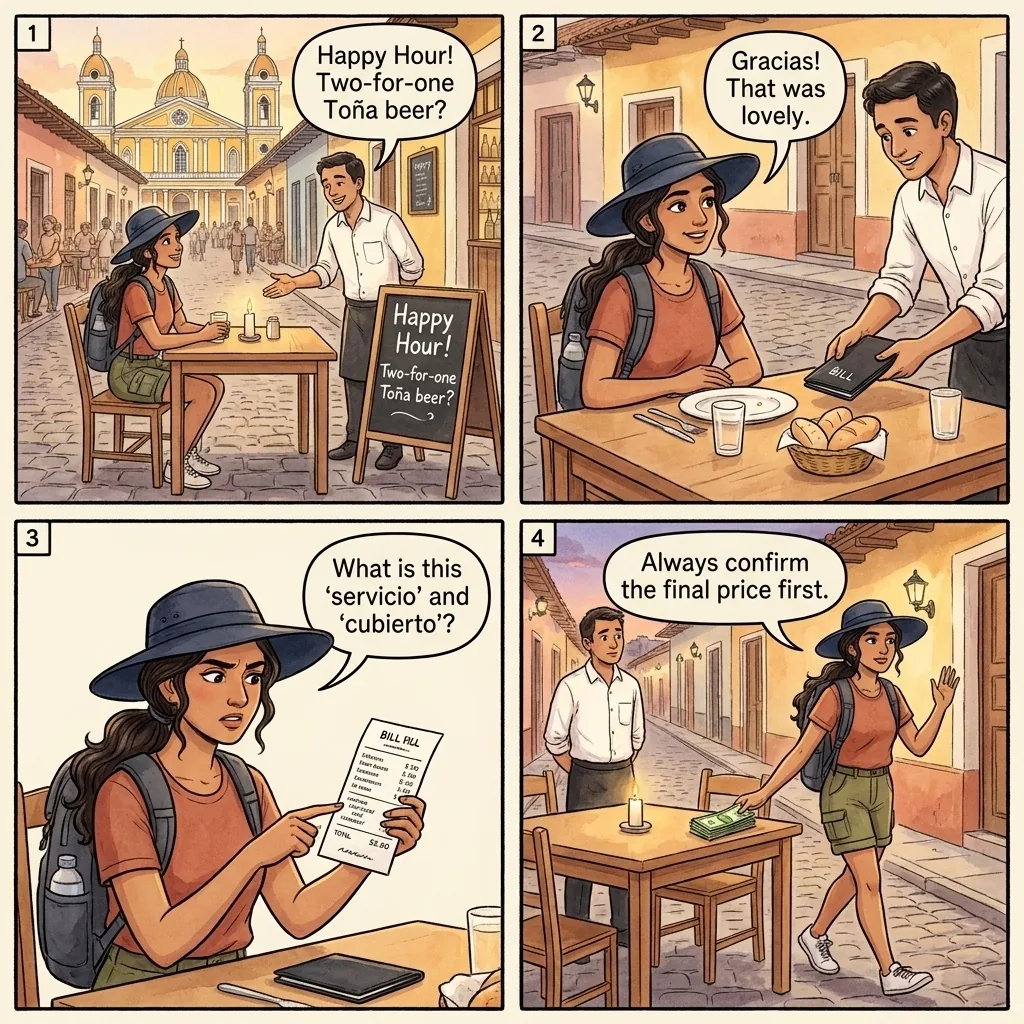
It's a Saturday evening on Calle La Calzada, Granada's lively tourist boulevard stretching from the cathedral toward Lake Nicaragua, and you've sat down at one of the candlelit terrace restaurants for what looks like a reasonable C$300 dinner with two beers.
The menu prices look fine — mains at C$120–180, beers at C$50, salads at C$80. The food arrives, you enjoy it, and the bill drops at the end at C$520 (about USD $14 versus the USD $8 you mentally tracked). The 'happy hour' beer you ordered turns out to have been full price; a 12% service charge has appeared at the bottom; a 'pan y cubierto' bread-and-cover charge of C$50 is listed; and the tax has been added on top of the service charge rather than on the food alone.
The Calle La Calzada bill pad is a low-grade but consistently-encountered Granada friction. The mechanism uses the standard tourist-strip restaurant patterns: 'happy hour' framings that don't match the bill, undisclosed service-and-cover charges, tax on top of service rather than just food, and unrequested bread baskets that appear on the bill. The bill lands 30–60% above the menu-listed total. As travelers report across Reddit, the TripAdvisor Granada Nicaragua forum, and the Lonely Planet Central America thorntree, the Calzada bill-pad pattern is the most-reported low-grade Granada friction.
The legitimate Granada restaurant pricing for the same dinner one or two streets back from Calle La Calzada — at neighbourhood spots like Mona Lisa, El Garaje, or Mercado Municipal — runs C$200–300 (about USD $5–8) for the same meal, with consistent menu pricing and no surprise charges. The Calzada strip charges meaningfully more for the candlelit-tourist experience and adds the bill-pad on top.
The structural defences are concrete. Photograph the menu before ordering — keep the photo on your phone. Confirm the per-item prices verbally, and ask explicitly whether 'happy hour' applies, whether service is included, and whether a 'pan y cubierto' charge will be added. Refuse unrequested bread baskets placed on the table. Check the bill line by line on arrival; dispute charges that don't match. Eat at neighbourhood places off the Calzada strip — the food is better and the pricing is honest.
Photograph the Calle La Calzada menu BEFORE ordering, and confirm verbally whether 'happy hour' applies and whether service is included on top of the menu prices. Refuse unrequested bread baskets — send them back before any bread is eaten, otherwise they appear on the bill. Check the bill line by line on arrival; dispute service-on-tax stacking and 'cubierto' charges that weren't disclosed at ordering. Eat at neighbourhood places one or two streets back from Calle La Calzada (Mona Lisa, El Garaje, Mercado Municipal) — better food, honest pricing. Pay by card if accepted for chargeback options. Emergency: 118 (Police).
Red Flags
- The restaurant has aggressive touts pulling you in from the street
- Menu prices seem too low to be true — they may charge differently
- No locals are eating there, only tourists
- The waiter suggests expensive items without mentioning prices
- Service charge or cover fee isn't listed on the menu
How to Avoid
- Check the bill carefully line by line before paying.
- Ask about service charges and taxes before ordering.
- Eat one or two blocks off Calle La Calzada for better prices and food.
- Look for restaurants where Nicaraguans are eating.
- Photograph the menu prices if they seem suspiciously low.
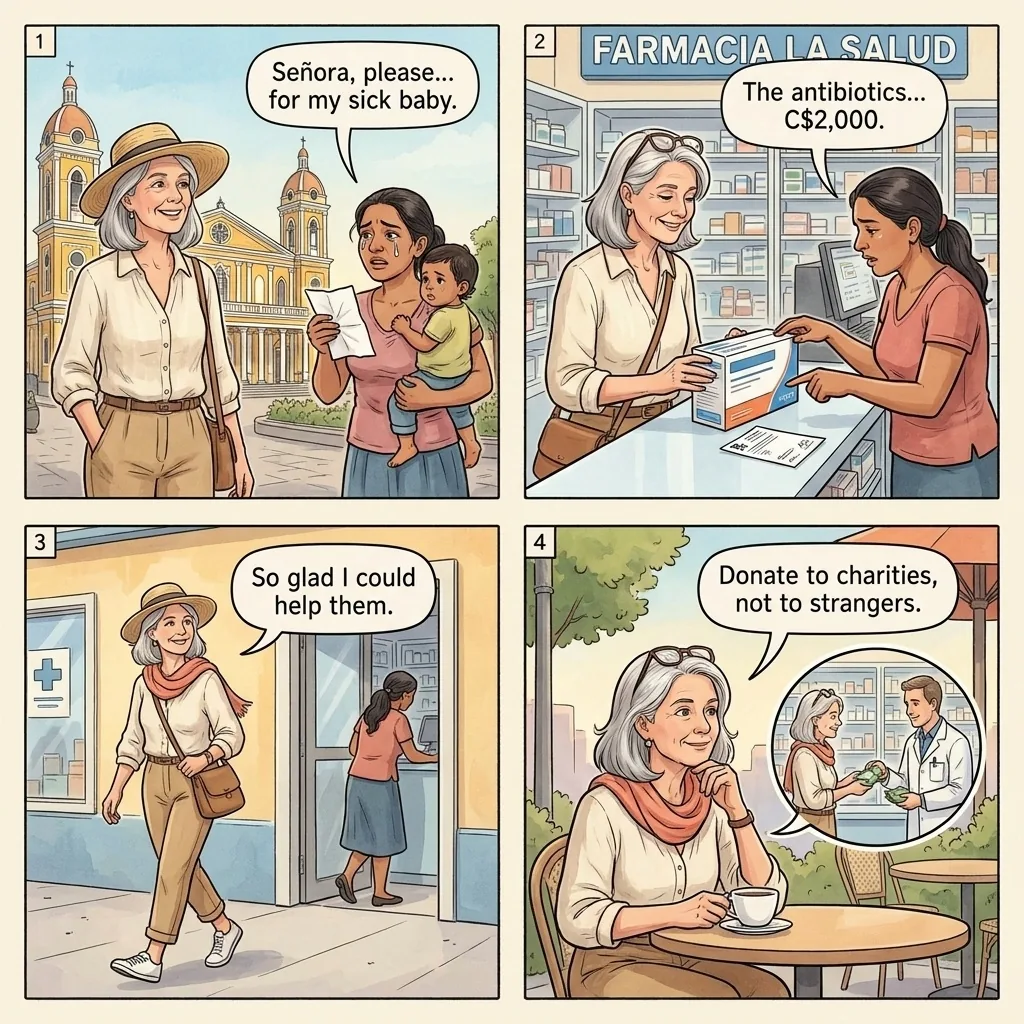
It's an afternoon near Parque Central, you've just left a café, and a woman in her thirties holding a small child approaches you with tears in her eyes and a folded paper she presents as a prescription.
She explains in halting English that the prescription is for her sick child but she can't afford the medicine. She gestures toward the pharmacy across the plaza and asks if you'd come with her and buy it for her. The medicine she names is specific and expensive — antibiotics or asthma medication or something pediatric — at C$1,500 or C$2,000 (about USD $40–55). Her tears are real-seeming, the child is real, the social pull is calibrated.
If you go to the pharmacy and pay, she takes the medicine and walks out with you, profusely thankful. As soon as you turn the corner, she returns to the pharmacy and the cashier hands her the money back, less a 20–30% kickback. The 'prescription' is fake (or for a different non-existent patient); the pharmacy staff are in on the operation; the child is a prop rotated through several women working the same scam in different Central American cities. As travelers report across Reddit, the TripAdvisor Granada Nicaragua forum, and the Lonely Planet Central America thorntree, the sick-child pharmacy con runs across Granada, Masaya, San Juan del Sur, and several Central American capitals.
The mechanism is structural. The dollar damage is small per encounter but the operators run multiple targets per day. The 'pharmacy in on it' framing is the load-bearing piece — it makes the cash-back loop seamless, and the legitimate-looking medicine purchase makes the scam feel less like a scam to the tourist. The legitimate Nicaraguan public-health system has free pharmaceutical coverage for children at MINSA hospitals; a real Nicaraguan family with a sick child wouldn't need to ask a tourist for cash to buy antibiotics.
The structural defences are concrete. Decline buying medicine for any stranger you meet on the street, no matter how compelling the story. The Nicaraguan public-health system handles real medical hardship cases at MINSA hospitals; the encounter you're having is a calibrated con. If you genuinely want to support Granada children's services, donate to established local NGOs (Casa Xalteva, Empowerment International, Hijos del Maíz) where 100% of the donation reaches programmes. A polite firm 'no, gracias' and continued walking ends the encounter within seconds.
Decline buying medicine for any stranger in Granada — the sick-child pharmacy con uses a real-seeming prescription, real-seeming child, and a confederate pharmacy. The legitimate Nicaraguan public-health system covers real pediatric medication needs at MINSA hospitals. If you genuinely want to support Granada children's services, donate to established local NGOs (Casa Xalteva, Empowerment International, Hijos del Maíz) where the donation reaches programmes. A polite firm 'no, gracias' ends the encounter within seconds. Do not give cash directly to street solicitors with children in tow — the Nicaraguan and Central American consensus is that this perpetuates the practice rather than helping children. Emergency: 118 (Police).
Red Flags
- A woman with a child approaches you specifically near a pharmacy
- She has a ready-made prescription for a specific expensive medication
- She asks you to buy medicine rather than giving her cash directly
- The pharmacy staff don't seem surprised by the interaction
- She becomes persistent or emotional if you hesitate
How to Avoid
- Politely decline and walk away — say 'no gracias.'
- Never buy items for strangers at their request.
- If you want to help children in need, donate to established local NGOs.
- Recognize this as a known con across Central American tourist cities.
Like what you're reading? Get a full Granada itinerary with safety tips built in.
Browse travel-safety books →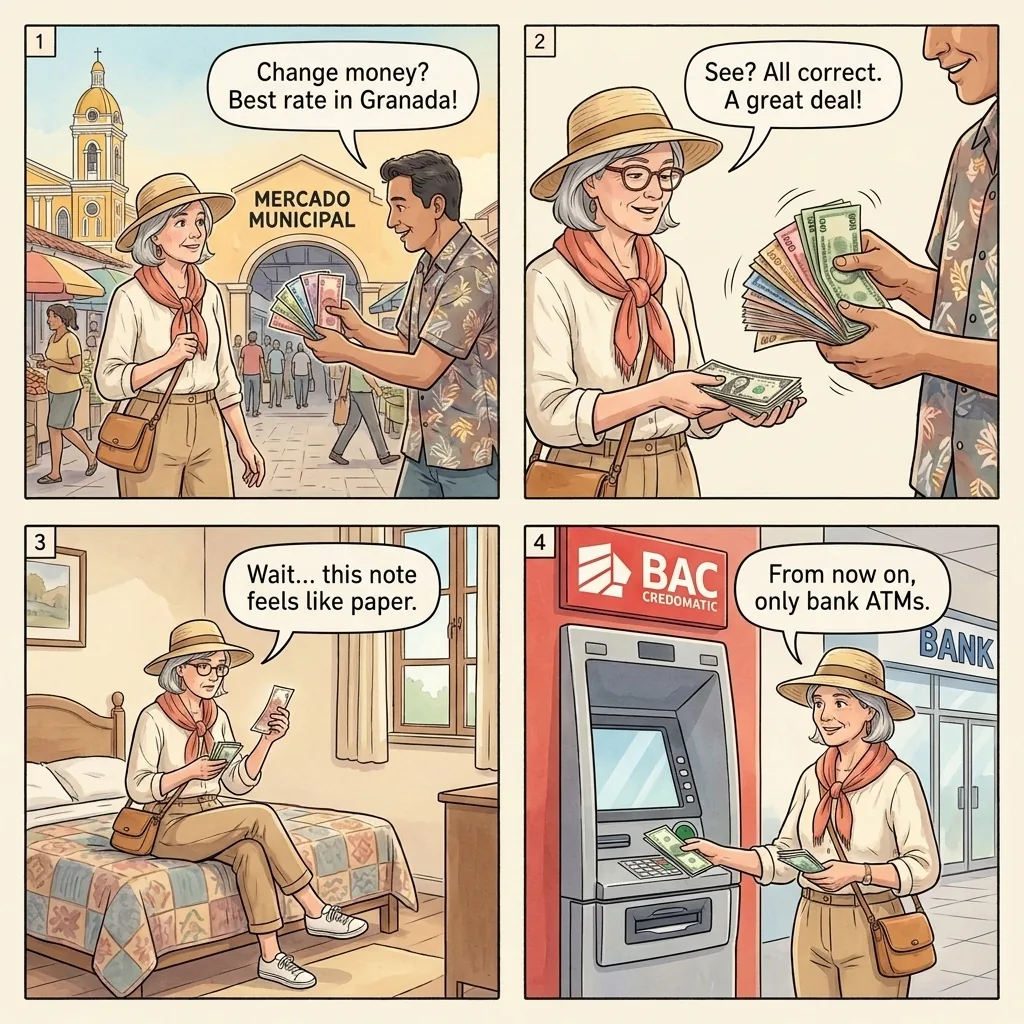
It's a Saturday morning near Granada's central market, you need to change USD into Nicaraguan córdobas for the next few days, and a man approaches offering a rate 5–8% better than the bank.
He says he can give you C$385 per dollar (when the official rate is roughly C$365). On a $200 exchange that's an extra C$4,000 (about USD $11), which feels meaningful. He fans out a stack of córdoba notes for you to count, the count appears legitimate, and you walk away with what looks like a great deal.
Back at the hostel later, you recount and discover several issues. Some notes are old, damaged, or in smaller denominations than they appeared during the rapid fan-out. Some are counterfeit — printed copies that look real on a quick glance but fail the watermark or texture test. The shortfall is anywhere from C$2,000 to C$10,000 of what you thought you'd received. As travelers report across Reddit, the TripAdvisor Granada Nicaragua forum, the Lonely Planet Central America thorntree, and the Banco Central de Nicaragua's published consumer guidance, street currency exchange in Nicaraguan cities runs a meaningful counterfeit risk and the official-vs-street spread isn't worth the exposure.
The legitimate Nicaraguan exchange options are straightforward. The major bank branches (BAC Credomatic, Banpro, Lafise Bancentro) run rates within 1–2% of the interbank market with no counterfeit risk; ATMs at these branches dispense clean córdoba notes. Hotel front desks and licensed cambio offices run slightly worse rates but reliably honest. Most Granada hostels and hotels will exchange small USD sums at fair rates as a courtesy. Street money exchange is technically legal but operationally risky.
The structural defences are concrete. Exchange currency only at banks, licensed cambio offices, or hotel front desks. The 5–8% 'better' rate offered by street operators is the cost of the counterfeit-and-miscount risk, not a real savings. Use ATMs at bank branches for the cleanest cash access. Check note authenticity by holding to light for the watermark, by feeling the texture of the printed denomination on the front, and by checking the security thread that runs through real notes. Carry only clean US dollars in good condition (no tears, no folds beyond mild use) for any USD-to-córdoba exchange.
Exchange currency only at Nicaraguan banks (BAC Credomatic, Banpro, Lafise Bancentro), licensed cambio offices, or your hotel/hostel front desk. The 5–8% rate gap that street operators offer is the cost of counterfeit-and-miscount risk, not a real savings. Use ATMs at bank branches for the cleanest cash access — they dispense verified clean córdoba notes. If you do exchange at a street operator, count slowly in front of them and check each note for watermark, texture, and security thread before walking away. Carry clean USD in good condition (no tears, no excessive folds) for any exchange. Never recount in front of the operator after the fact — it's too late by then. Emergency: 118 (Police).
Red Flags
- Someone approaches you offering to exchange money on the street
- The exchange rate seems better than banks or official exchange houses
- They count the money very quickly and try to rush you
- The bills feel different in texture or color compared to ones from ATMs
- They become impatient or aggressive if you want to recount
How to Avoid
- Only exchange money at banks, official exchange houses, or hotel front desks.
- Use ATMs inside banks for the best exchange rate.
- If you must use a street changer, count every bill slowly and check for fakes.
- Learn to identify genuine cordoba bills — check for watermarks and security threads.
- Carry small dollar bills for situations where cordobas aren't available.
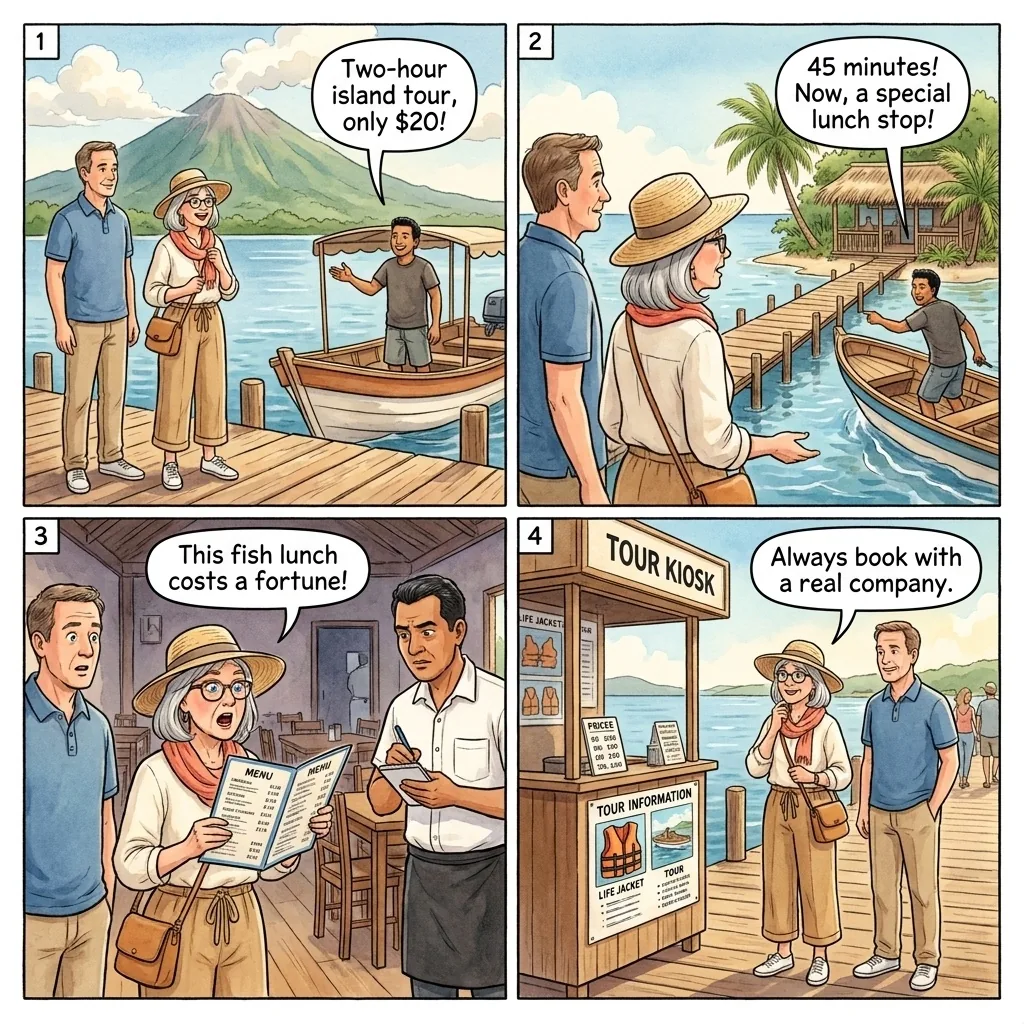
It's a sunny morning at Granada's lakefront, you've come to take the iconic boat tour of Las Isletas (the 365 tiny volcanic islands in Lake Nicaragua), and an unlicensed boatman at the dock offers you a 'two-hour tour' for USD $20 — half what the established operators quote.
You agree and pay $40 cash for two people. He helps you into a small wooden boat with an outboard motor, no life jackets visible, no operator branding on the hull. The 'two-hour tour' lasts 45 minutes, the route stays close to shore rather than navigating between the islands, and it ends with a mandatory stop at a restaurant on one of the islets where the boatman becomes hard to find while you're pressured by the restaurant staff to order a meal at triple normal Granada prices. The boatman and the restaurant split the profits on the upcharge.
The Granada Isletas tour ecosystem includes legitimate operators with documented safety equipment, real two-hour itineraries, and honest pricing — Erik Tours, Oro Travel, Tierra Tours, and the Inuit Kayak Tour cooperative all operate at $30–50 per person for a proper guided two-hour Isletas trip with life jackets, knowledgeable guides, monkey-island stops, and no commission-restaurant scheme. The unlicensed freelancers at the lakefront pier deliver a fraction of what they promise and offload the customer at a confederate restaurant. As travelers report across Reddit, the TripAdvisor Granada Nicaragua forum, and the Lonely Planet Central America thorntree, the Isletas underdeliver pattern is the most-reported Granada activity friction.
The mechanism uses three structural failures: cash-up-front payment with no written agreement, no operator name or hull branding to verify, and a 'restaurant stop' framing that lets the boatman vanish during the upsell. The downstream-quality issues extend to safety: unlicensed boats lack life jackets, lack VHF radios, and lack any liability path if something goes wrong on Lake Nicaragua's afternoon winds (which can produce significant chop). The legitimate operators all carry licensed-tour documentation, safety equipment, and trained guides.
The structural defences are concrete. Book Isletas tours only through named operators with documented TripAdvisor reviews — Erik Tours, Oro Travel, Tierra Tours, Inuit Kayak Tour. Verify the operator name and hull branding before paying. Confirm in writing the duration, the route, the restaurant-stop policy, and the inclusion of life jackets and a guide. Never pay the full sum upfront; agree a 50% deposit with balance on completion. Check that the boat has visible life jackets and a registration number painted on the hull. Read recent (last 12 months) TripAdvisor reviews for the specific operator before booking.
Book Isletas tours only through named licensed operators with documented TripAdvisor reviews — Erik Tours, Oro Travel, Tierra Tours, or Inuit Kayak Tour Cooperative — at $30–50 per person for a proper two-hour guided trip. Confirm in writing the duration, route, restaurant-stop policy, and inclusion of life jackets and guide before paying. Never pay full sum upfront; agree a 50% deposit with balance on completion. Verify the boat has visible life jackets and a hull registration number. Decline lakefront freelancers offering 'cheap' tours — the price gap is the underdeliver. Pay by card if accepted for chargeback options. Emergency: 118 (Police); the U.S. Embassy in Managua is at +505 2252 7100.
Red Flags
- An unlicensed boatman solicits you directly at the waterfront
- The price is cash-only with no receipt or written agreement
- The boat has no safety equipment, life jackets, or visible registration
- They promise a two-hour tour but are vague on the itinerary
- They insist on stopping at a specific restaurant during the tour
How to Avoid
- Book Isletas tours through established operators like Erik Tours or Oro Travel.
- Agree on the exact duration, itinerary, and restaurant-stop policy in writing.
- Check that the boat has life jackets and basic safety equipment.
- Read recent TripAdvisor reviews for the specific tour operator.
- Never pay the full amount upfront — negotiate a split payment.
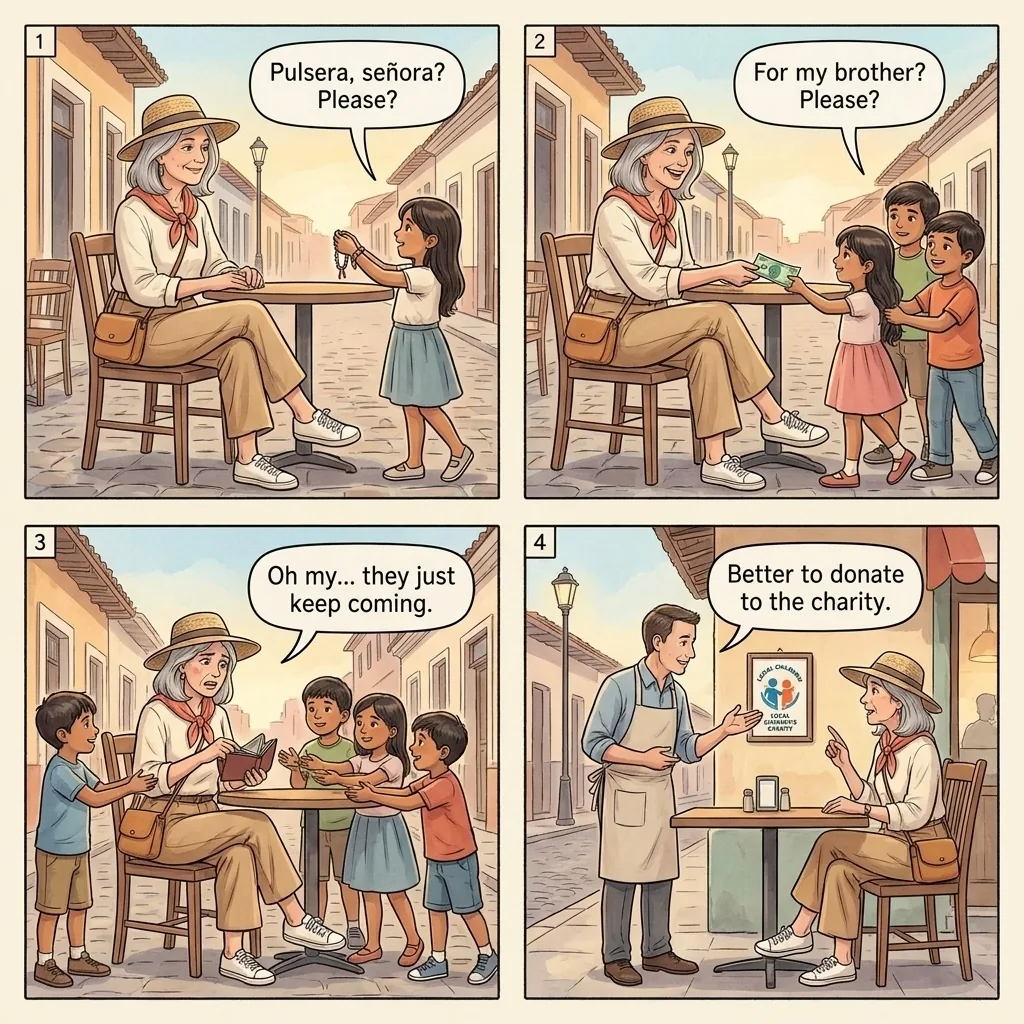
It's an evening on Calle La Calzada, you're having dinner at an outdoor restaurant table, and children — five, eight, eleven years old — approach your table asking for money or trying to sell you gum, hand-made bracelets, or small wooden trinkets.
They're persistent. They tug at your sleeve. Their sad eyes and small hands make refusal feel actively cruel. You give one of them C$20 to make them go away; the child returns five minutes later with a sibling or cousin; over the course of dinner you've handed out C$200–300 to a rotating group of children that doesn't seem to end. By the time you've finished your meal, you've contributed more to the begging operation than to the dinner itself.
The Calle La Calzada child-begging ring is a structural friction documented across Reddit, the TripAdvisor Granada Nicaragua forum, and Nicaraguan-press investigations. The children often work in organized groups; the money typically goes to adults who deploy them to the Calzada strip; some of the kids are glue-sniffing street children from the Masaya periphery; the operation runs on the social-pressure mechanic of dinner-table guilt. The Nicaraguan child-welfare NGOs and the Granada municipal authorities have weighed in repeatedly: giving cash to street children perpetuates the practice rather than helping them, and the structural alternative is to donate to programmes that pull children off the streets and into schools.
The Granada child-welfare ecosystem includes well-established operators. Casa Xalteva runs free school programmes for street children in Granada with documented attendance records. Empowerment International funds school supplies for low-income Granada families. Hijos del Maíz operates a vocational training programme for at-risk Nicaraguan youth. All three publish financial reports and have decade-long Granada operating histories. A USD $20 monthly donation to any of these does meaningfully more for a Granada child than the same money given hand-to-hand to a child on Calle La Calzada.
The structural defences are practical. Decline child-beggars and child-vendors on Calle La Calzada with a polite firm 'no, gracias' and continued conversation with your dinner companion — engagement extends the encounter, disengagement ends it. If you genuinely want to help Granada's at-risk children, donate to Casa Xalteva (casaxalteva.org), Empowerment International (empowermentinternational.org), or Hijos del Maíz. If a child is hungry, buying them a meal directly at a nearby comedor (a small Nicaraguan eatery) is a more honest alternative than handing cash to the begging operation.
Decline child-beggars and child-vendors on Calle La Calzada with a polite firm 'no, gracias' and continued attention to your dinner — engagement extends the encounter. The cash given hand-to-hand goes to adult operators, not to the child's welfare. If you genuinely want to help Granada's at-risk children, donate to Casa Xalteva (casaxalteva.org), Empowerment International (empowermentinternational.org), or Hijos del Maíz — these are decade-established programmes with documented school attendance records. If a specific child is hungry, buy them a plate of food at a nearby comedor rather than giving cash. Choose indoor seating if the dinner-table interaction is bothering you; the begging ring rarely operates inside enclosed restaurants. Emergency: 118 (Police).
Red Flags
- Very young children approach you at restaurant terraces at night
- They work in groups and seem coordinated in who they approach
- An adult is watching from nearby but not intervening
- They sell identical trinkets or gum at inflated prices
- They're persistent to the point of aggressive if you decline
How to Avoid
- Don't give money to child beggars — it perpetuates the cycle.
- Politely but firmly say no and avoid engaging.
- If you want to help, donate to organizations like Los Quinchos or Casa Xalteva.
- Buy food for them directly if you feel compelled to help.
- Choose indoor seating if it bothers you.
🆘 What to Do If You Get Scammed
📋 File a Police Report
Go to the nearest Nicaraguan National Police (Policía Nacional) station. Call 118 (Police) or 911 (Emergency). Get an official crime report — you'll need this for insurance claims. You can also report online at policia.gob.ni.
💳 Cancel Your Cards
Call your bank immediately. Most have 24/7 numbers on the back of the card (keep a photo saved separately). Block any suspicious transactions before the thieves use your details.
🛂 Lost Passport?
Contact the US Embassy in Managua at Km 5.5 Carretera Sur, Managua. For emergencies: +505 2252-7100.
📱 Track Your Device
If your phone was stolen, use Find My (iPhone) or Find My Device (Android) from another device. Don't confront thieves yourself — share the location with police instead.
Frequently Asked Questions
You just read 6 scams in Granada Nicaragua. The full Travel Safety Series has 780+ more across 20+ countries.
Tokyo's Kabukichō ¥130,000 bar trap. Rome's gladiator photo extortion. Paris's gold-ring trick. Bali's ATM skimmer scams. Bangkok's grand-palace closure ruse. Every documented scam across 20+ destinations — with the exact scripts, red flags, and local-language phrases that shut each one down. Drawn from Reddit traveler reports, embassy advisories, and consumer-protection cases.
- 780+ documented scams across Tokyo, Rome, Paris, Bali, Bangkok, Rio & 100+ more cities
- 20+ countries covered, with country-by-country phrase cards for every destination
- Updated annually — buy once, re-download future editions free
- All titles $4.99 each on Amazon Kindle