
Key Takeaways
- The #1 reported scam is the Hoi An Tailor Scam & 'Exclusive' Fabric Markup.
- Most scams in Hoi An are low-to-medium risk.
- Use official taxi ranks or local ride apps where available — always confirm the fare before departure.
- Never accept unsolicited offers from strangers near tourist sites in Hoi An.
⚡ Quick Safety Tips
- Use community-verified tailors (Yaly Couture, Bebe Tailor, A Dong Silk) with 2–3 days for fittings warns about 24-hour rush jobs and fabric markup.
- Book Ancient Town ticket at OFFICIAL booths (120K VND adult, 2025) — covers 5 of 20+ monuments; refuse 'combo ticket' touts.
- Book river boat rides ONLY at posted-price Bach Dang dock (150K–200K VND for 20–30 min) warns about mid-aged women booking 3–5x markup.
- Don't try on fruit-basket props offered by street women documents photo-demand scam.
- Book cooking classes and tours DIRECT (Red Bridge, Morning Glory, Vy's Market) or via Klook warns about hotel 'partner' kickbacks.
Jump to a Scam
- Medium Hoi An Tailor Scam & 'Exclusive' Fabric Markup
- Medium Hoi An Lantern Boat Ride Pushy Vendors & Fake Monk
- Medium Hoi An Ancient Town Ticket & 'Fake Ticket Checker' Confusion
- Low Hoi An 'Fruit Ladies' Photo Trap & Forced Weight Overcharge
- Medium Hoi An Cooking Class / Tour Booking Kickback Fraud
- Medium Hoi An Beach Bicycle & Motorbike Rental Damage Claims
The 6 Scams
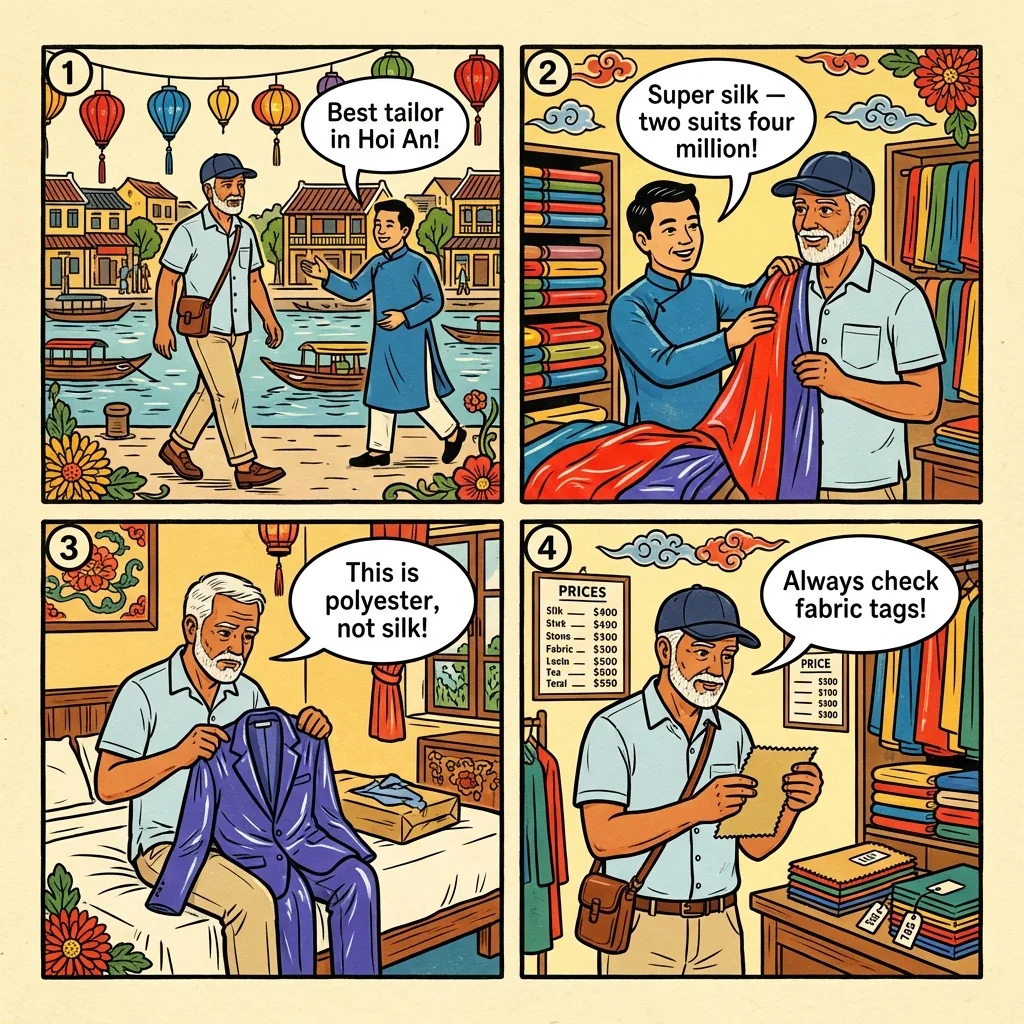
Hoi An's 300+ tailor shops use 'Italian wool' fabric upsells at 3× rate, 24-hour rush construction that fails after one wash, and hotel-concierge 'partner' kickbacks that inflate prices 30–50% — quality work needs 2–3 days and 2–3 fittings.
Hoi An has 300+ tailor shops competing for the suit-and-dress custom of cruise-day and multi-night visitors. Most are legitimate, but a distinct scam ecosystem operates around them. One traveler captured the pattern: 'Went to Hoi An to find a good tailor and ended up getting scammed — 90% of tailor-made clothing uses fabric 2-3× cheaper than advertised, with rushed construction and no follow-up fittings.' The volume of shops is exactly what makes the scams sustainable — there's always another tourist arriving tomorrow.
The specific patterns repeat across the Ancient Town. 'Free tea and design consultation' touts lead tourists to a specific shop where 'partner' commission arrangements inflate prices 30–50%. 'Premium fabric' upsells run 3× market rate — fabric that should be $30/metre sold as 'Italian wool' at $90/metre. 'Rushed 24-hour delivery' yields construction that doesn't survive a single wash. 'First fitting free, but alterations cost extra' when alterations should be included. And the hotel-concierge 'partner tailor' is the kickback engine that ties them all together. The pricing tells you which one you're in — $40 for a shirt or under $150 for a suit cannot deliver real quality.
For older travelers considering a Hoi An tailored piece, the practical playbook starts with vetting and ends with payment. Use only community-verified tailors with 4.5+ Google ratings and long review histories — Yaly Couture, Bebe Tailor, and A Dong Silk are the three most-consistently-recommended — allow 2–3 days minimum for fittings, and refuse hotel concierge 'partner tailor' recommendations outright. Bring a reference garment for fit matching. Verify fabric composition by touch and burn-test before purchase. Expect $150–$250 for a quality suit, $80–$150 for a tailored dress. Pay 50% deposit and 50% on final fitting — never 100% upfront. For older travelers on a 1-day cruise excursion, skip tailoring entirely; the rush produces poor quality regardless of which shop you walk into.
Red Flags
- Tout offers 'free tea and design consultation' leading to a specific tailor
- Hotel concierge pushes a 'partner tailor' — kickback arrangement
- 'Premium fabric' upsell 3x market rate ('Italian wool,' 'Japanese silk')
- Tailor promises 24-hour turnaround with no follow-up fittings
- Pricing below $40 for a shirt or $150 for a suit (quality can't be achieved)
How to Avoid
- Use community-verified tailors: Yaly Couture, Bebe Tailor, A Dong Silk (4.5+ Google ratings).
- Allow 2–3 days minimum with 2–3 fittings; bring a reference garment for fit matching.
- Refuse hotel 'partner tailor' recommendations — kickback arrangement.
- Pay 50% deposit, 50% on final fitting — Never 100% upfront.
- Expected: $150–$250 suit, $80–$150 dress; below this signals quality issues.
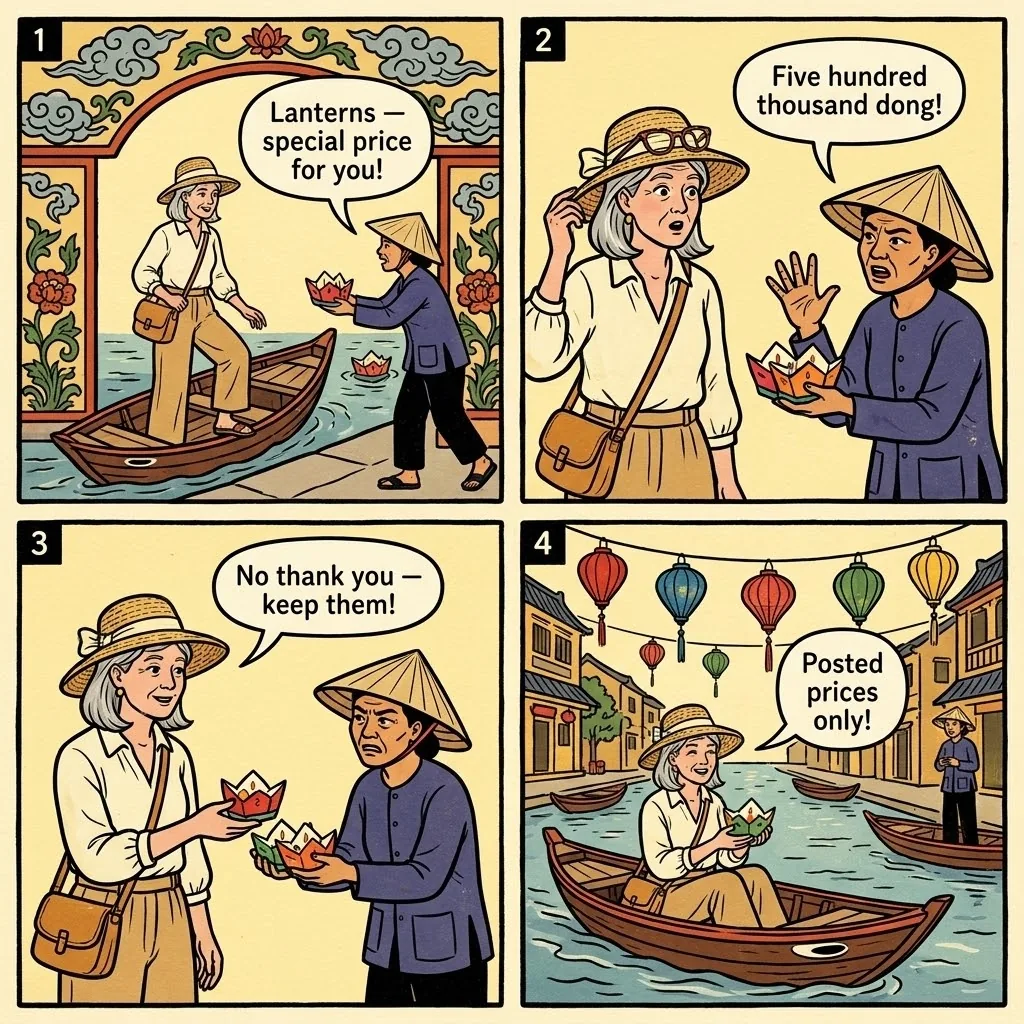
Hoi An's evening lantern-boat circuit hides 3–5× dock-rate overcharges through 'helpful' women steering tourists to commissioned boats, plus mid-ride 100K VND lantern-release upcharges and 'fake monks' soliciting 100K–500K VND at the Japanese Covered Bridge.
Hoi An's iconic lantern-lit river evenings have developed a specific 2025 scam ecosystem that operates the length of the Thu Bon waterfront. One traveler-community warning captures the recurring move: 'There are some people — we were approached by a middle-aged woman — walking around saying they'll help tourists book a boat,' then either quoting 3–5× the dock rate or funneling the tourist to a boat that charges extra mid-ride for lantern-release fees. The pressure is conversational, not aggressive, which is exactly why it works on relaxed evening visitors.
Another first-person account names the systemic angle: 'Lantern boat ride a scam-free experience? They're either getting kickbacks from the scammers or actively part of the scheme.' The specific variants are: a mid-aged 'helpful local' approaches offering to 'book a boat'; the boat operator quotes low (50K VND) at the dock then demands 300K+ at the end; lantern-release 'extra fees' of 100K VND per lantern appear mid-ride; and 'fake monks' in orange robes at the Japanese Covered Bridge ask for blessings or donations of 100K–500K VND. Real Vietnamese Buddhist monks never solicit money or approach tourists — that single rule shuts the monk variant down.
For older travelers, the practical defense lives at the dock and on the bridge. Book boat rides only at the posted-price Bach Dang street waterfront dock — typical 150K–200K VND for a 20–30 minute ride including 1–2 lanterns — and ignore every 'helpful local' approaching with boat or tour offers, regardless of how friendly the conversation feels. At the Japanese Covered Bridge, refuse 'blessing' requests from fake monks; real monks do not solicit. Buy lanterns directly from the boat operator at 5K–15K VND each rather than the mid-river 'release fee' upsell. For older travelers, the daytime Ancient Town walk between 10 AM and 4 PM is significantly less scam-pressured than the evening lantern scene.
Red Flags
- 'Helpful mid-aged woman' approaches offering to book a boat for you
- Boat operator quotes low (50K VND) at dock, demands 300K+ VND at end
- Lantern-release 'extra fee' 100K VND per lantern demanded mid-ride
- Fake monk in orange robes soliciting donations at Japanese Covered Bridge
- 'Tourist survey' English-speaker asks questions that pivot to product pitch
How to Avoid
- Book boat rides ONLY at posted-price Bach Dang dock (150K–200K VND for 20–30 min).
- Ignore all 'helpful locals' approaching with boat or tour offers.
- Refuse 'fake monk' blessing donations — real Buddhist monks never solicit.
- Buy lanterns directly from boat operator (5K–15K VND each) not mid-river upsell.
- Daytime Ancient Town walk (10 AM–4 PM) is less scam-pressured than evening.

Hoi An Ancient Town tickets (120K VND, 5 of 20+ monuments) are widely faked outside the official booths — unofficial 'ticket checkers' demand additional cash at secondary entries, and 'combo ticket' touts sell 3× markup with imaginary 'extra access.'
The Hoi An Ancient Town ticket policy generates confusion and an attached minor scam ecosystem. The official ticket — 120,000 VND for adults in 2025 — is required to enter the UNESCO heritage zone and provides access to 5 of 20+ heritage monuments of your choice; the money funds heritage preservation. The complexity around which monuments are covered, where the official booths sit, and how often checkers verify is exactly what the scammers exploit.
The variants that have emerged: unofficial 'ticket checkers' at secondary entry points demand cash from tourists who already have valid tickets; 'combo ticket' touts outside the official booths sell 3× markup tickets with 'extra access' claims that don't exist; vendors create confusion about which monuments your ticket covers (it covers 5 of your choice, not all); and 'back alley' tout offers to 'avoid the fee' lead to checkers now patrolling those routes too. None of these touch the official ticket — they target the moments when tourists aren't sure of the rules.
For older travelers, the practical playbook is to learn the rules once and refuse everything else. Buy Ancient Town tickets only at official booths at main entrance points — 120,000 VND for adults in 2025 — keep the ticket visible while walking the heritage zone, and refuse any 'ticket checker' demanding additional cash if you already have a ticket. Plan your 5-monument choice in advance: Japanese Covered Bridge, Phung Hung Ancient House, Hai Nan Assembly Hall, Tran Family Chapel, and Quan Cong Temple are most community-recommended. The Ancient Town is walkable in 3–4 hours with 2–3 monument stops plus lunch. The monthly full-moon festival (14th day of the lunar month) is free with your regular Ancient Town ticket — no additional fee, despite what touts may claim.
Red Flags
- Unofficial 'ticket checker' demanding additional cash at secondary entry point
- 'Combo ticket' tout outside official booth selling 3x-markup tickets
- Claim that 'regular' ticket doesn't cover monuments you want to visit
- Touts promoting 'back alley' routes to 'avoid the fee'
- Ticket prices above 120,000 VND for adult Ancient Town entry
How to Avoid
- Buy at OFFICIAL booths at main Ancient Town entrance — 120K VND adults (2025).
- Plan 5-monument choice: Japanese Covered Bridge, Phung Hung, Hai Nan Hall, Tran Family, Quan Cong.
- Keep ticket visible when walking Ancient Town — checkers occasionally verify.
- Refuse 'ticket checkers' demanding additional cash if you already have a ticket.
- Full-moon festival is free with Ancient Town ticket — no additional fee.

Hoi An 'fruit ladies' in traditional dress at photogenic Ancient Town corners offer 'try on the hat' photo invites, then demand 200K–500K VND or 'forced fruit purchase' at 100K VND for what should cost 10K — with crowd-pressure escalation if you refuse.
A specific 2025 Hoi An scam targets tourists seeking 'authentic' photos of Vietnamese women carrying bamboo poles with fruit baskets (gánh hàng rong). One traveler captured the broader sentiment: 'Out of all of that, Hoi An was our least favorite. Feels like the motto is — cram them in and extract every dong.' The fruit-lady scam is one face of a wider commercialization pattern where every photogenic corner has been monetized.
The sequence is consistent. A woman in traditional dress with fruit baskets positions herself at a photogenic Ancient Town corner; she offers to let tourists 'try on the hat and baskets for a photo'; once the photo is taken, she demands payment — typically 200K–500K VND, sometimes paired with a 'forced purchase' of fruit at 100K VND for what should cost 10K. If the tourist refuses, she becomes loud and attracts a crowd, escalating social pressure until paying becomes the path of least friction. The price never gets quoted before the photo because the photo is the leverage.
For older travelers, the practical defense is built around touch and price-before-photo. Don't accept offers to 'try on' a fruit-basket hat or pose with a stranger's props — if you want an authentic photo, ask politely from a distance without touching anything and agree a 20K–50K VND fee before taking the shot. Buy fruit only from fixed-stall vendors with posted-price signs, not from mobile fruit-lady carts; typical fair prices are 20K VND for a pineapple, 30K for 500g of rambutan, 40K for a dragon fruit. If caught in a photo-demand, pay 50K VND maximum (already above the fair rate) and walk away — scammers rarely escalate beyond shouting, and the pressure dissolves once you're past the next corner.
Red Flags
- Woman in traditional dress positioned at photogenic corner offering to 'try on' her hat
- English-speaking 'friendly local' approaching with props and camera invitation
- Price only mentioned after photo is taken
- Forced fruit purchase at 10x market rate accompanies photo demand
- Raised voice or crowd escalation when you refuse to pay
How to Avoid
- Don't try on a fruit-basket hat or pose with stranger's props.
- For 'authentic' photos, politely ask from a distance WITHOUT touching — agree 20K–50K VND before photo.
- Buy fruit ONLY from fixed-stall vendors with posted prices (20K pineapple, 30K rambutan 500g).
- If caught in a photo-demand, pay 50K VND maximum and walk away.
- Scammers rarely escalate beyond shouting — don't let crowd pressure coerce you.
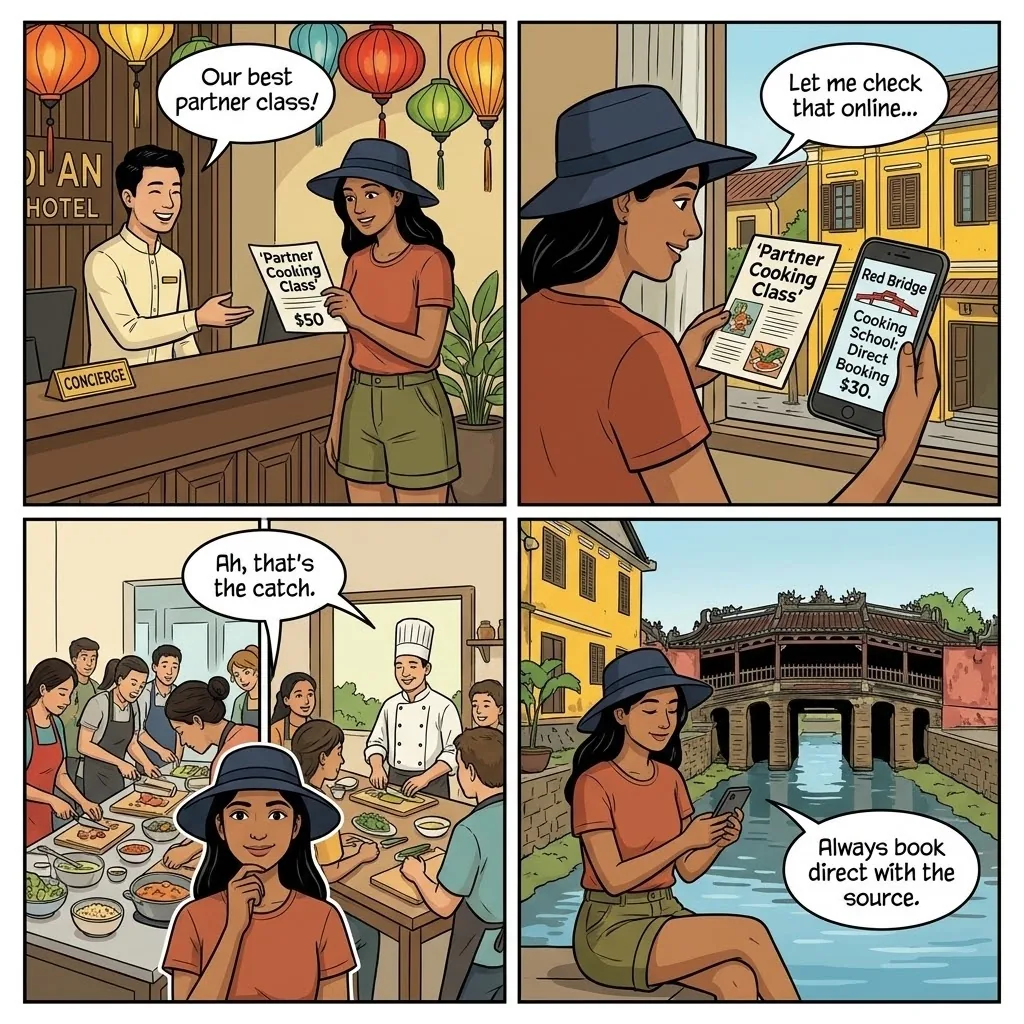
Hoi An hotel concierges and Ancient Town touts inflate cooking-class and day-tour prices 30–100% above direct-booking rates — Red Bridge/Morning Glory direct is $25–$40, Klook My Son is $20–$30, and 'partner' recommendations are the kickback engine.
Hoi An's cooking-class economy and Cham Island/My Son day-trip bookings have a specific kickback-and-overcharge pattern. One traveler-community account names the volume bluntly: 'Totally tiring — scam after scam.' Kickback-driven recommendations from hotels and Ancient Town touts inflate prices 30–100% above direct-booking rates, and another adds: 'Feels like the motto is cram them in.' Commercialized tour volume is the engine — every booking taken via a partner channel funds the next round.
The variants follow a consistent structure. A hotel concierge recommends a 'partner' cooking class at $50/person when the same venue's direct rate is $30. An Ancient Town tout offers a 'discount cooking class' at $35 but quietly substitutes a lower-quality operator. A 'My Son temples day trip' gets quoted at $60 per person via the hotel when Klook or GetYourGuide direct is $25. A 'Cham Island snorkeling day trip' is $80 via tout when the An Bang jetty direct rate is $45. Online bookings via unfamiliar aggregator sites add another 50% on top. The shop you're physically standing in always charges more than the operator's own website.
For older travelers considering a Hoi An cooking class or day tour, the protective playbook starts with the booking channel. Book cooking classes directly via the venue's own website — Red Bridge Cooking School, Morning Glory Cooking School, and Vy's Market Restaurant Cooking Class are the most community-recommended at $25–$40 per person — and refuse hotel concierge 'partner' recommendations and Ancient Town tout offers outright. For My Son temples, book via Klook or GetYourGuide at $20–$30 for a half-day with guide. For Cham Island snorkeling, book via Klook or direct at the An Bang Beach jetty at $40–$55 per person. Verify any online booking is via a platform with cancellation protection (Klook, GetYourGuide, Viator) — never pay by wire transfer.
Red Flags
- Hotel concierge pushes a 'partner cooking class' at $50+ per person
- Ancient Town tout offers 'discount' cooking class at $30–$35
- 'My Son day trip' quoted at $60+ via hotel or tout
- Booking via unfamiliar aggregator website asking for wire transfer
- Online booking with no cancellation protection
How to Avoid
- Book cooking classes DIRECT: Red Bridge, Morning Glory, Vy's Market ($25–$40/person).
- For My Son temples, book via Klook/GetYourGuide ($20–$30 half-day).
- For Cham Island snorkeling, book Klook or An Bang jetty direct ($40–$55).
- Refuse hotel 'partner' recommendations and Ancient Town touts.
- Only use platforms with cancellation protection (Klook, GetYourGuide, Viator) — never wire transfer.

Hoi An bicycle and motorbike rentals take cash or passport deposits, then claim 'scratch damage,' 'helmet damage,' or 'fuel shortage' at return to retain the deposit — even hotel-provided 'free bicycles' produce 300K+ VND damage charges at checkout.
Hoi An's bike-rental economy serves the daily commute to An Bang Beach, 5 km east of Ancient Town. The scam: rental shops take a 'deposit' (cash, passport, or both) and at return claim minor scratches, tire issues, or 'helmet damage' to retain it. The rental-plus-police-shakedown combination is documented — when a tourist disputes the charge, the operator threatens to call police, and the operator's local relationships usually win the next 30 minutes.
The variants are predictable. A bicycle rental shop takes a 200K VND deposit, claims 'scratch damage' at return, and demands 150K+ VND. A passport gets taken as deposit then withheld until an additional 'cleaning fee' is paid. A motorbike rental at $5–$10/day claims 'helmet damage' or 'fuel shortage' at return. Even hotel-provided 'free bicycles' generate 300K+ VND charges at checkout for damage that wasn't documented at handover. One traveler captured the broader regional pattern: 'It's not a scam — every time we travel to the islands in Thailand they take passports as deposit.' That's true across Southeast Asia, but Hoi An is where the passport-retention concern reliably bites.
For older travelers, the practical defense lives in documentation and choice of operator. Don't leave your passport as a deposit — offer cash only (200K VND is standard) — photograph the bike or motorbike from all angles before riding away, and at return video the vehicle showing no new damage. Use hotel-provided bicycles where possible; most 3–4 star Hoi An hotels include them free with the stay. If renting independently, use established operators (Mr. Hai, The Pedal Collective, Long Life Bikes) with clear written policies. For motorbikes, only use Motorvina- or Tigit-quality operators with English paperwork. If the shop claims damage you didn't cause, dispute with photographic evidence and contact Hoi An Tourist Police (Hoang Dieu Street, +84 235 3861 234) if the operator escalates.
Red Flags
- Rental shop demands passport as deposit (never leave your passport)
- Deposit over 500K VND for a bicycle (200K is standard)
- No written rental agreement or receipt offered
- Shop doesn't offer walk-around inspection before you ride away
- At return, shop claims minor scratches you didn't cause
How to Avoid
- Use hotel-provided bicycles where possible (most 3-4 star Hoi An hotels include them).
- For independent rental, use Mr. Hai, The Pedal Collective, or Long Life Bikes.
- Don't leave passport as deposit — cash deposit 200K VND is standard.
- Photograph bike from all angles BEFORE riding away.
- At return, video the bike showing no new damage.
🆘 What to Do If You Get Scammed
📋 File a Police Report
Go to the nearest Vietnamese Police (Công An) station. Call 113. Get an official crime report — you'll need this for insurance claims. You can also report online at hanoi.gov.vn.
💳 Cancel Your Cards
Call your bank immediately. Most have 24/7 numbers on the back of the card (keep a photo saved separately). Block any suspicious transactions before the thieves use your details.
🛂 Lost Passport?
Contact your nearest embassy or consulate. The US Embassy is at 7 Lang Ha Street, Ba Dinh District, Hanoi. For emergencies: +84 24 3850-5000.
📱 Track Your Device
If your phone was stolen, use Find My (iPhone) or Find My Device (Android) from another device. Don't confront thieves yourself — share the location with police instead.
Frequently Asked Questions
You just read 6 scams in Hoi An. The book has 60 more across 11 Vietnamese destinations.
Hanoi's Noi Bai Airport fake-Grab driver. Ho Chi Minh City's Bui Vien 4-million-VND bar extortion. Hoi An's tailor-shop markup and fake-monk lantern-boat circuit. Ha Long Bay's off-platform cruise-booking fraud. Every documented Vietnam scam — with the exact scripts, red flags, and Vietnamese phrases that shut each one down. Drawn from Tuoi Tre, VnExpress, Thanh Nien, VietnamPlus, and VNAT tourist-assistance records.
- 66 documented scams across Hanoi, HCMC, Hoi An, Ha Long Bay & 7 more destinations
- A Vietnamese exit-phrase card you can screenshot to your phone
- Updated annually — buy once, re-download future editions free
- Readable in one flight — $4.99 on Amazon Kindle