
Key Takeaways
- The #1 reported scam is the Kampala Boda-Boda Ambush Diversion.
- 3 of 6 scams are rated high risk.
- Use app-based ride services (Uber, Bolt) instead of unmarked taxis — always confirm the fare before departure.
- Never accept unsolicited offers from strangers near tourist sites in Kampala.
⚡ Quick Safety Tips
- Keep phones and valuables in secure pockets when in crowded areas.
- Use only licensed taxis or app-based ride services.
- Book tours and tickets through verified operators with online reviews.
- Keep a copy of your passport separate from the original.
Jump to a Scam
The 6 Scams
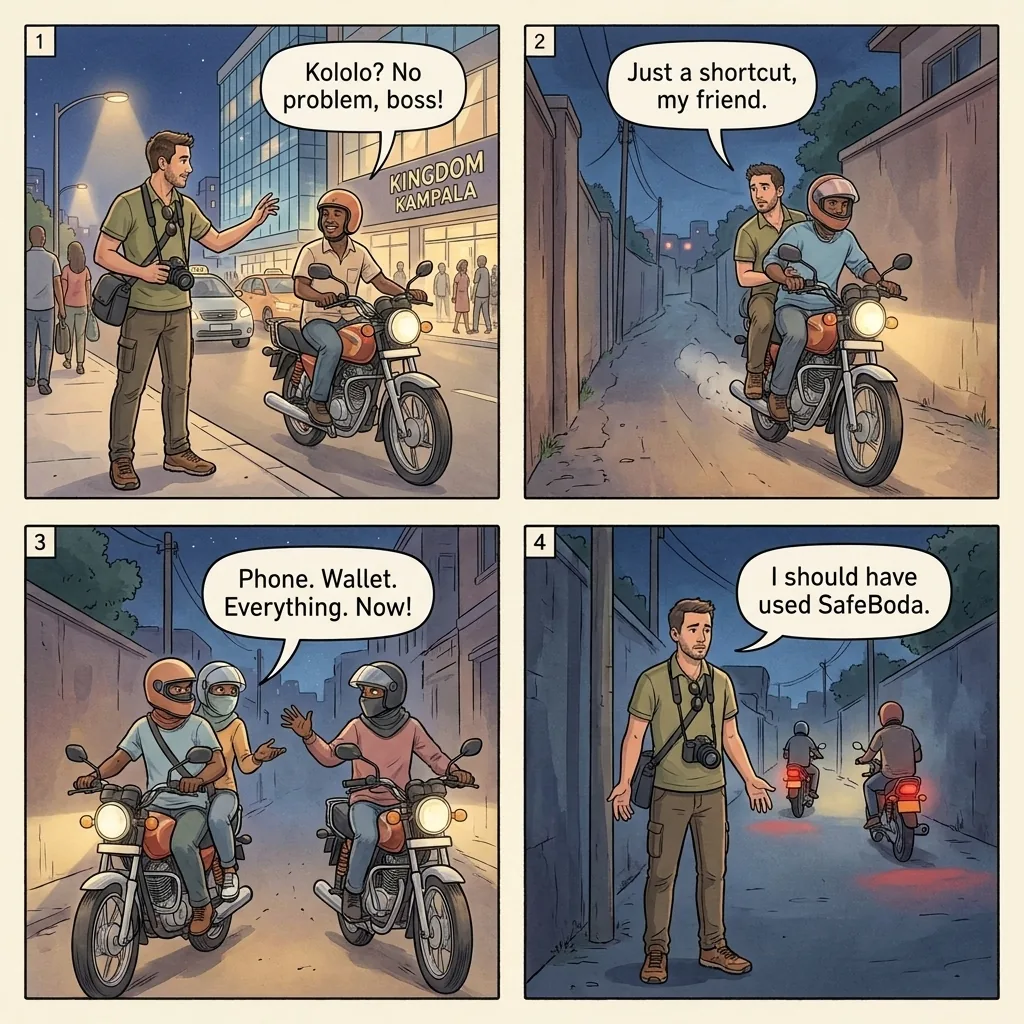
You flag down a boda-boda (motorcycle taxi) in central Kampala at 9 p.m. for the short ride from your hotel near the Kingdom Kampala mall to a restaurant in Kololo.
The driver agrees on the fare — 10,000 UGX (about $2.70) — and you climb on the back. The first few minutes are normal: down Yusuf Lule Road, past the Sheraton, the air warm and the traffic thinning. Then he turns left at a junction you do not recognize and accelerates onto a quieter street through Kisenyi. The lighting drops sharply. He says he is taking a 'shortcut to avoid traffic.' You ask him to turn around. He doesn't.
Two minutes later, a second motorcycle pulls alongside in a quiet residential block. Both riders, masked or with scarves up, demand your phone, your wallet, and your bag at speed. Some operators carry knives or claim a weapon under the jacket. The encounter lasts perhaps ninety seconds. They take what you have, both motorcycles peel away in opposite directions, and you are left standing alone in an unfamiliar Kampala neighborhood after dark.
Boda-boda muggings of foreign nationals are documented by the U.K. Foreign Office Uganda travel advice, the U.S. Embassy in Kampala's safety advisories, Reddit, and Uganda Police Force materials. The pattern is most aggressive on the routes through Kisenyi, Katwe, and Bwaise — neighborhoods that are perfectly safe by day but offer dim, quiet streets that work for a quick ambush after dark. Some riders also stage 'mechanical trouble' on isolated stretches while accomplices close in from behind.
The cleanest fix is to skip random boda-bodas entirely. SafeBoda is the dominant ride-hailing app for boda-bodas in Kampala — drivers are vetted, ID-checked, GPS-tracked, and fares are set in-app. Uber Boda also operates with similar safety features. Both are inexpensive (a typical central Kampala ride costs UGX 5,000–15,000 in-app) and remove the entire ambush surface. After dark, switching to a 'special hire' (enclosed taxi) booked through your hotel is even safer.
Use SafeBoda or Uber Boda for every motorcycle-taxi ride in Kampala — never flag a random boda on the street, especially after dark. Share your live trip location with someone using the app's safety feature. Keep phones and valuables in a zipped front pocket, never in your hands during the ride. After dark, switch to enclosed special-hire taxis booked through your hotel; the boda-boda risk-premium is not worth the small price difference. If the route deviates from your destination, demand to stop in a populated area immediately. If ambushed, comply, do not resist, and dial 999 (Uganda Police) or 112 (Emergency).
Red Flags
- Driver takes an unexpected route through unfamiliar neighborhoods
- Another motorcycle appears to follow or ride alongside you
- Driver suggests a shortcut through a quiet or poorly lit area
- The boda-boda has no visible registration or identification
- Driver seems to be communicating with someone by phone during the ride
How to Avoid
- Use ride-hailing apps like SafeBoda or Uber instead of random boda-bodas.
- Share your live trip location with a friend using the app's safety features.
- Avoid boda-bodas after dark entirely -- use enclosed taxis or special hires.
- Keep phones and valuables in a secure front pocket, not your hands.
- If the route seems wrong, insist on stopping in a populated area immediately.
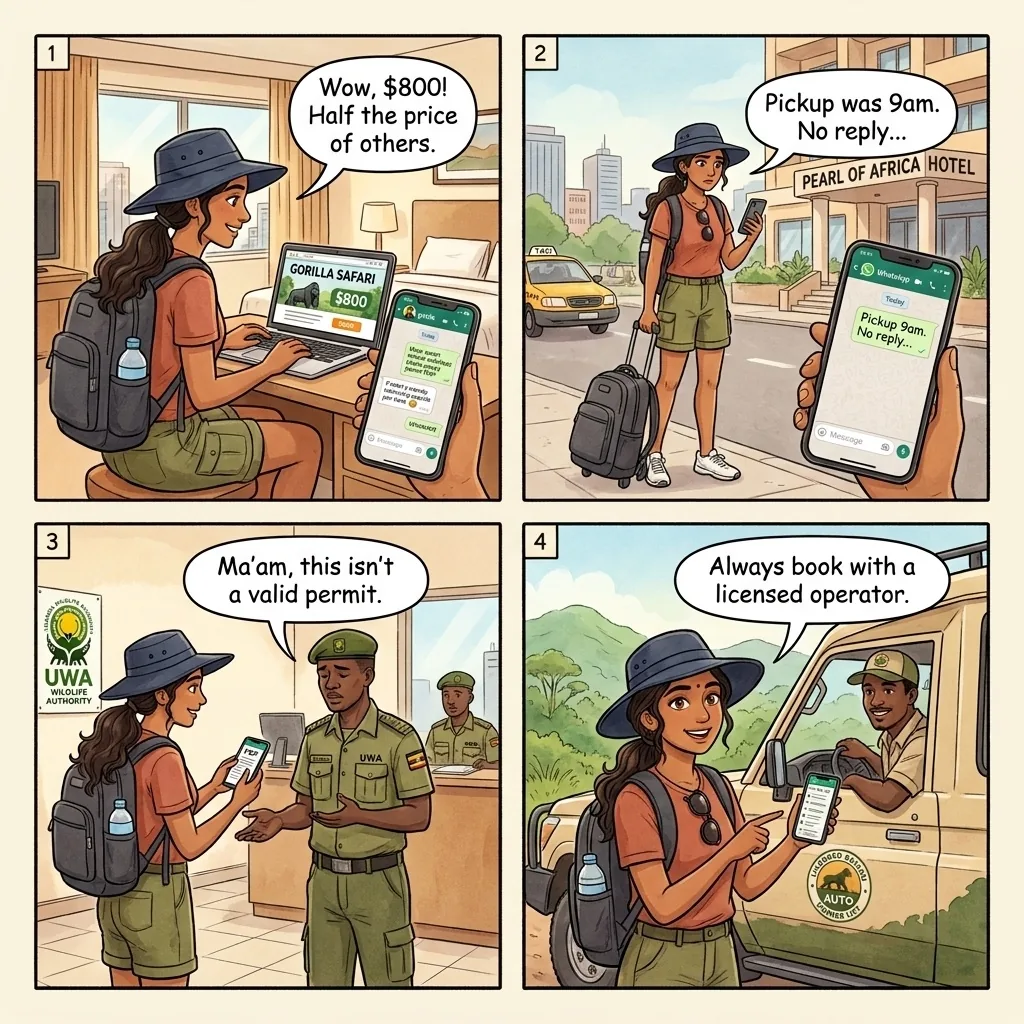
You find an incredible deal online for a gorilla-trekking safari to Bwindi Impenetrable Forest — $800 when established operators are charging $2,000+ for the equivalent three-day package.
The website looks professional: stolen photos of silverbacks from real safari operators, fake TripAdvisor badges, an AUTO (Association of Uganda Tour Operators) logo in the footer, a polished 'About' page claiming twenty years in business. You message the operator on WhatsApp; the reply is fluent and friendly. They ask for full payment by wire transfer to a U.S. or U.K. bank account 'because card processing in Uganda is unreliable.' You wire $800 and receive a confirmation PDF.
When you land in Entebbe and message the operator to confirm pickup, the WhatsApp number is no longer responding. The 'office' near Speke Hotel that the email mentioned does not exist when you arrive. Or — slightly more common — your guide arrives at your hotel, claims he never received the wire payment, and demands cash to do the trip. The vehicle that does arrive is uninsured, the driver has no certified guide credentials, and the gorilla permit he hands you is fake — Uganda Wildlife Authority issues only ninety-six permits per day across the habituated groups, and your number does not match any UWA record.
The Uganda fake-safari pattern is documented across Reddit, the Uganda Wildlife Authority's consumer-protection page, the long-running TripAdvisor Uganda forum, and the U.S. Embassy in Kampala's traveler advisories. Specific named offenders rotate (Volvo Safaris, Azas Safaris, and others have been documented in past Reddit threads), but the structure is consistent: an unusually low quote, wire-transfer-only payment, no verifiable AUTO membership number, no physical office, and stolen photos lifted from real operators' websites.
A second variation involves cloned email addresses. Operators register domains that differ from a reputable safari company's by a single character (volcanoesafarisuganda.com instead of volcanoessafaris.com) and intercept booking inquiries. Travelers who think they are dealing with the legitimate operator are actually corresponding with a clone, and the wire transfer goes to the wrong account.
Book Uganda safaris and gorilla permits only through verified AUTO members listed at auto.or.ug, and pay by credit card for chargeback protection — never wire transfer. The Uganda Wildlife Authority sells gorilla permits directly at $700 each (gorilla) or $200 (chimpanzee) through ugandawildlife.org; legitimate three-day Bwindi packages from reputable operators run $1,800–2,500 per person. Verify the operator's AUTO membership number directly with the association, cross-check the domain in the email signature against the website, and never trust a 'special discount' below the established rate. If you have already paid a fake operator, dispute via your card issuer (if applicable) and report to UWA at +256 414 355 000 and to the Uganda Tourism Board.
Red Flags
- Price significantly below market rate for gorilla permits alone ($700 each)
- Payment by wire transfer only with no credit card option
- Website uses stock photos or images stolen from legitimate operators
- Company displays AUTO (Association of Ugandan Tour Operators) logo but isn't actually a member
- No verifiable physical office address in Kampala
How to Avoid
- Book gorilla permits directly through the Uganda Wildlife Authority (UWA).
- Verify operators on SafariBookings.com which has authenticated reviews.
- Pay with credit card for chargeback protection -- never wire transfer.
- Confirm AUTO membership directly with the association before booking.
- Cross-reference the operator's email domain with their official website.
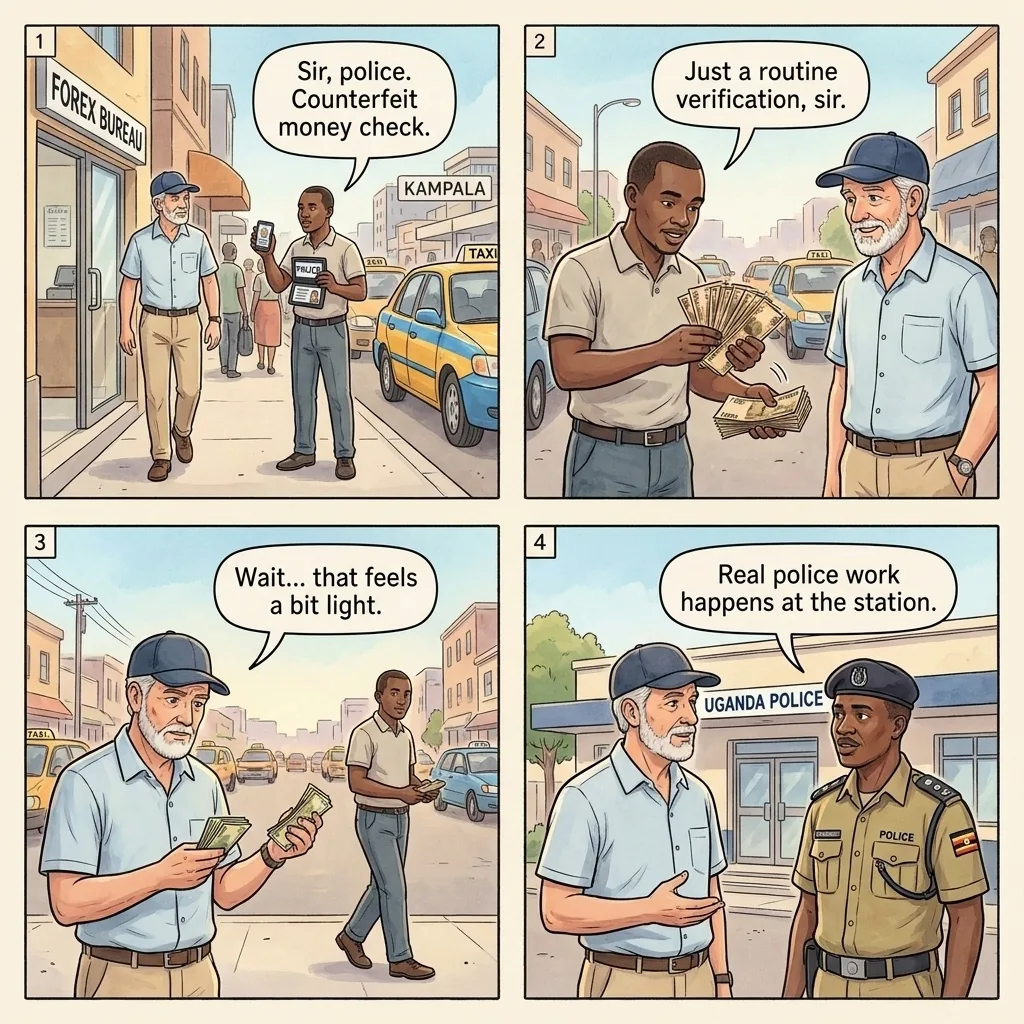
You walk out of a forex bureau on Kampala Road after exchanging $200 for Ugandan shillings, and a man in plain clothes steps into your path with a small leather wallet that flips open to show what looks like a Uganda Police Force ID.
He explains in calm, professional English that there has been a recent wave of counterfeit U.S. dollars and Ugandan shillings circulating in the area, and that he needs to 'verify' your cash as part of an active investigation. The badge flips closed before you can read the unit name. He gestures expectantly at your wallet. A second man stands a few meters back, watching.
If you hand over your bills for inspection, he fans them out professionally, holds each note up to the light as if checking watermarks, and during the rapid examination palms two or three of the largest notes before handing the stack back to you. The whole sequence takes thirty seconds. By the time you walk on, anywhere from UGX 200,000 to UGX 1,500,000 ($55–$400) is gone — slipped into his pocket during the 'inspection' by a hand kept low and out of your line of sight.
The Kampala fake-police money check is documented across Reddit, the U.S. Embassy in Kampala's safety advisories, the U.K. Foreign Office Uganda travel advice, and Uganda Police Force consumer-protection materials. Real Uganda Police Force officers do not conduct random currency checks on tourists in the street; any verification of suspect notes happens at a station or at a Bank of Uganda counter, with formal documentation. The impersonators target the Kampala Road forex strip specifically because tourists carrying fresh shillings are the perfect mark.
A more aggressive variation involves the 'arrest' threat. If you refuse to show your money, the impersonator threatens to arrest you 'for suspicion of carrying counterfeit currency' and demands a cash 'fine' on the spot to make the problem go away. The fines start at UGX 100,000 and grow to whatever cash you have visible. Real UPF officers do not collect cash fines on the street, and any genuine arrest leads to a station, not a sidewalk negotiation.
Refuse any plain-clothes 'police' currency-verification request on Kampala Road, Nasser Road, or near forex bureaus — real UPF officers do not do this. Ask politely but firmly to see formal ID with a name, badge number, and unit, and offer to walk together to the nearest UPF station to verify; if they walk away when you propose this, the impersonation is confirmed. Never hand over your wallet or cash on the street, regardless of the framing. Carry only what you need; keep the rest in your hotel safe. If pressured aggressively, dial 999 (UPF) or 112 (Emergency) and walk into the nearest open business.
Red Flags
- Plain-clothes 'officer' approaches you near a bank or forex bureau
- They demand to see and handle your cash for 'verification'
- No uniformed officers present to corroborate the interaction
- Badge or ID is flashed quickly and not presented for inspection
- They threaten arrest or detention if you don't comply
How to Avoid
- Real police do not conduct random currency checks -- refuse and walk to a public area.
- Ask to see official identification and offer to accompany them to the nearest police station.
- Never hand your money to anyone on the street for any reason.
- Keep your cash distributed in multiple hidden pockets and a money belt.
- If threatened, loudly attract attention from passersby -- scammers avoid scenes.
Like what you're reading? Get a full Kampala itinerary with safety tips built in.
Browse travel-safety books →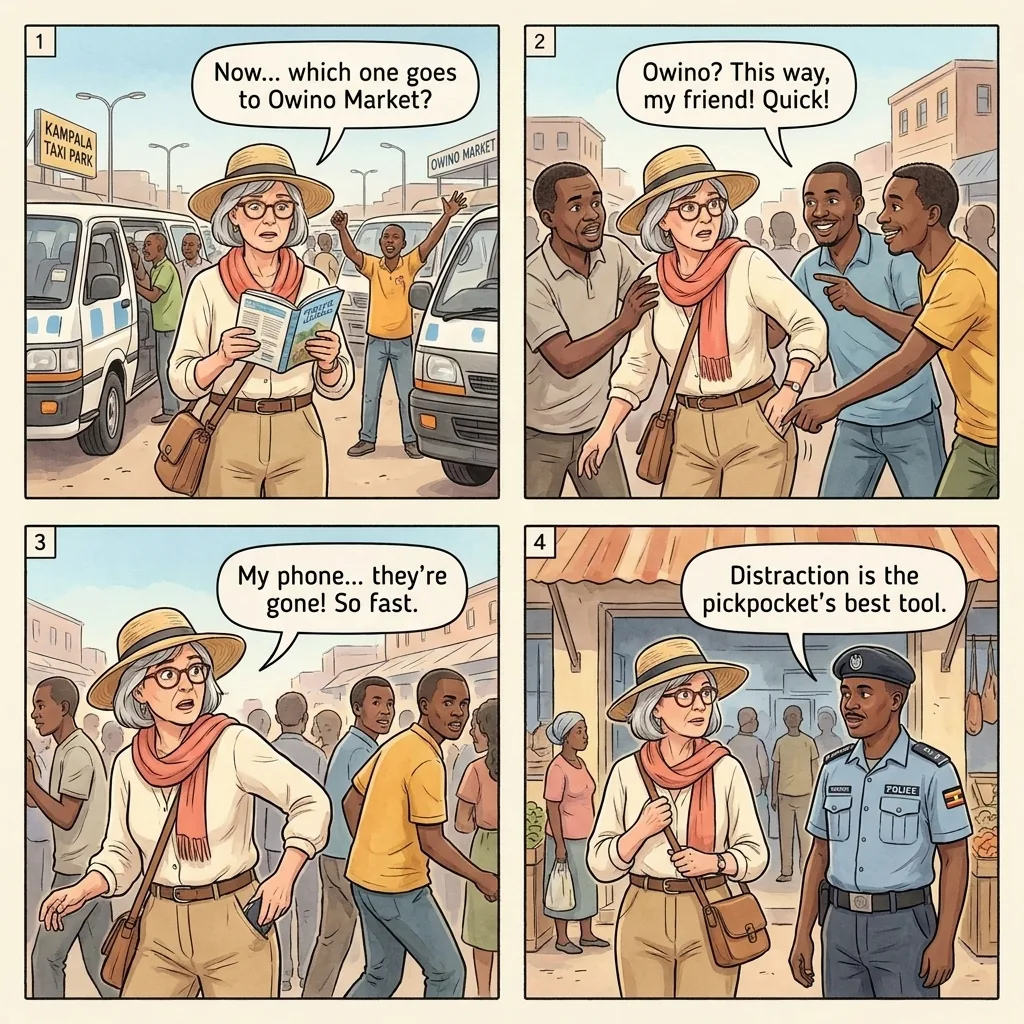
You venture into Kampala's chaotic Old Taxi Park to catch a matatu (shared minibus) toward the Owino Market for a morning of textile shopping.
The park is a teeming mass of hundreds of white minibuses crammed at impossible angles, touts shouting destination names — 'Wandegeya, Wandegeya!' 'Ntinda, Ntinda!' — and bodies pressing in from every direction. The sensory overload is part of the experience and part of the trap. As you try to read the destination plates and figure out which matatu goes your way, you become an obvious foreigner in a sea of moving locals.
In this controlled chaos, organized pickpocket teams work seamlessly. One person jostles you firmly from one side, another approaches from the front asking 'where are you going, my friend?' while gesturing toward a matatu, and a third — whom you have not noticed at all — lifts your phone from your back pocket or unzips your daypack from behind. The whole sequence takes maybe four seconds. By the time the helpful 'where are you going' man melts into the crowd, the lift is already across the park.
The Old Taxi Park pickpocket pattern is documented across Reddit, the long-running TripAdvisor Kampala forum, and Uganda Police Force materials. The park sees the highest pickpocket density in Kampala, with Owino Market right next door running the same crews. A widely-circulated Reddit thread described one victim whose laptop was replaced with bricks of similar weight inside her daypack during a matatu ride — she did not notice the swap until she got off the bus and her pack felt 'wrong.'
A second variation involves matatu touts who insist on carrying your bag 'to help you find the right minibus' and either lift contents during the walk or simply walk away with the entire bag once you are distracted by the destination negotiation. The same crews work the boarding queues for matatus heading to Entebbe Airport, where tourists with luggage are the highest-margin targets.
Wear a money belt under your clothes for cash and cards at the Old Taxi Park, and keep your phone in a zipped front pocket — never in your hand, never in a back pocket, never in an open daypack. Decline all 'help' from touts; carry your own bag with the strap across your front. Use SafeBoda or Uber instead of navigating the Old Taxi Park if your trip allows; the cost difference is small and the pickpocket risk drops to near-zero. If you must use matatus, keep bags on your lap with straps wrapped around your arm. If you are pickpocketed, dial 999 (UPF) and report at the Central Police Station on Buganda Road for an insurance-grade report.
Red Flags
- Strangers crowd your personal space beyond what the crowd requires
- Someone asks where you're going while physically touching you
- A tout insists on carrying your bag to 'help' you find the right matatu
- You feel hands near your pockets or bag zippers during the commotion
- Your bag feels lighter or differently balanced than before
How to Avoid
- Wear a money belt under your clothes for cash and cards.
- Keep your phone in a zipped front pocket, never in your hand.
- Use ride-hailing apps instead of navigating the Old Taxi Park.
- If you must use matatus, keep bags on your lap with straps wrapped around your arm.
- Travel with a local friend who knows the routes and can spot trouble.
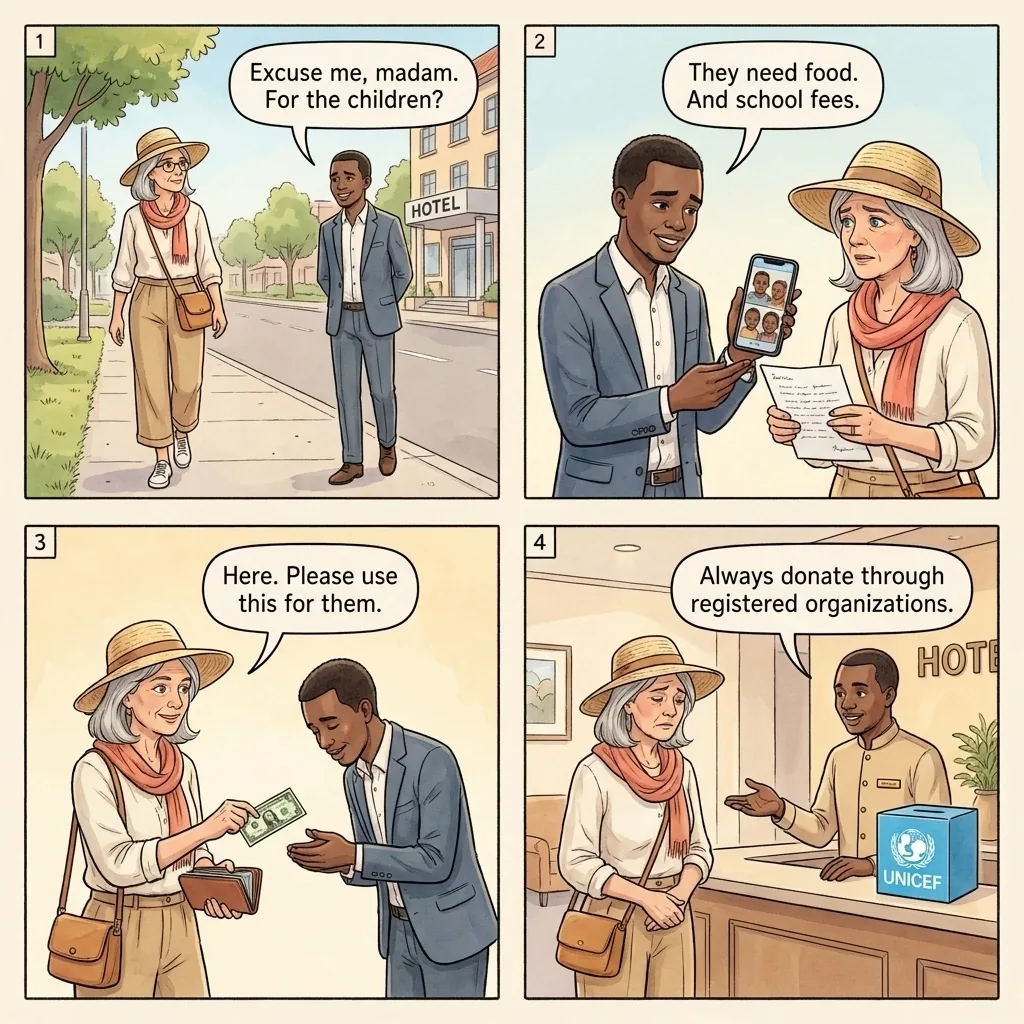
A well-spoken young man in a clean shirt approaches you outside your hotel in Kololo, introduces himself, and shows you a handful of heartbreaking photos of children in worn clothes on his phone.
He explains that he runs a small orphanage in Bwaise — twenty-three children, most of them HIV orphans whose parents died from AIDS — and that the orphanage desperately needs donations for school fees, food, and medicine. He has a handwritten letter 'from the children' addressed to 'kind tourists,' a small printed pamphlet, and offers to take you to visit the orphanage personally. The pitch is calibrated to be impossible to refuse without feeling like a bad person.
If you donate cash on the spot ($20–100 is the typical ask) or follow him to the 'orphanage,' the outcome varies. Some operations are pure fraud — there is no orphanage, the photos are stolen from real charities, and the cash goes straight into his pocket. Other operations do exist as institutions but are kept deliberately under-resourced to extract maximum tourist sympathy and donation, with most of the money flowing to organizers rather than to children. UNICEF, Save the Children, and the Uganda NGO Bureau have all documented this pattern.
The deeper harm is structural. UNICEF Uganda's 2018 report estimated that more than 80% of the children living in Ugandan residential 'orphanages' have at least one living parent — many were paid or pressured to surrender their children to the institution because tourist donations are more lucrative than agricultural income. The institutions are kept poor enough to generate visitor sympathy, and the children are coached to perform sadness on cue.
The harm to the children themselves is well-evidenced. Repeated separations from short-stay visitors damage attachment formation; the photos visitors post to Instagram travel back to predators who use orphanage location data to identify accessible children; and 'volunteer visits' fund the economic engine that keeps children inside institutions rather than with their families. Even well-intentioned support causes harm.
Never give cash to street solicitors claiming to represent orphanages in Kampala — and never visit residential orphanages on a tourist basis. UNICEF, Save the Children, ChildSafe, and the Uganda NGO Bureau are unanimous that orphanage tourism causes harm even when intentions are good. If you want to support Ugandan children, donate directly to vetted family-strengthening organizations: Children of Hope Uganda, Reach Up Uganda, or Compassion International. Look up the NGO's registration number on the Uganda NGO Bureau (ngobureau.go.ug) before donating. Report aggressive 'orphanage' solicitors to the Uganda NGO Bureau or dial 999.
Red Flags
- Emotional appeal with photos of children in distressing conditions
- Handwritten letters supposedly from orphans addressed to tourists
- Cash-only donations with no registered charity number or receipt
- They approach tourists specifically near upscale hotels
- Cannot provide verifiable registration with the government or a known NGO
How to Avoid
- Donate only through established organizations like UNICEF or verified local NGOs.
- Ask for the orphanage's government registration number and verify it independently.
- Never give cash on the street to anyone claiming to represent a charity.
- If you want to help, research legitimate organizations before your trip.
- Report suspected fraudulent charities to the Uganda NGO Bureau.
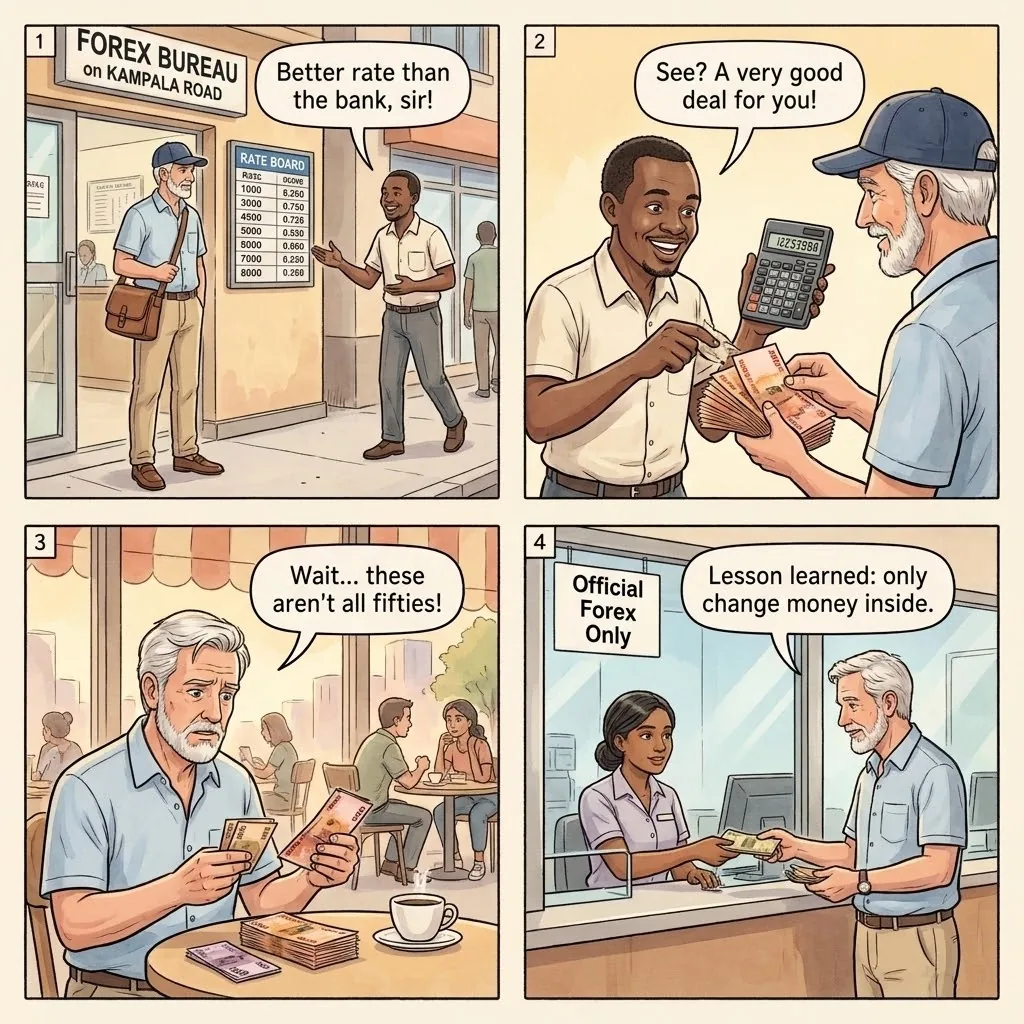
You need Ugandan shillings on Kampala Road and a man standing just outside a forex bureau offers a noticeably better rate than the posted board inside the shop.
He says he is a forex agent who can give you a better deal off-counter, fans out a thick stack of UGX notes, and quotes a rate maybe 5% better than the bureau's posted rate. You hand him $200 USD. He punches numbers into his own calculator, shows you the result on the screen, and counts out a stack of UGX in a rapid flutter. The total looks roughly right, you slide it into your wallet, and walk on with what you think is about UGX 750,000.
Back at your hotel you actually count the bills. The total is closer to UGX 450,000 — about UGX 300,000 short, roughly $80 lost. The rapid-fan count masked a stack heavily padded with UGX 1,000 and 5,000 notes that look almost identical to UGX 10,000 and 50,000 notes in the same orange-pink color scheme. The 'better rate' on his calculator was real, but the math after the rate was applied to a partially counterfeit/short stack was the actual play.
The Kampala Road street-forex sleight pattern is documented across Reddit, the Bank of Uganda's consumer-protection materials, and the U.K. Foreign Office Uganda travel advice. Operators outside the legitimate forex bureaus on Kampala Road specifically target tourists who are unfamiliar with the different banknote denominations. The Ugandan shilling has multiple denominations (1,000, 5,000, 10,000, 20,000, 50,000) that look broadly similar in color and size, and a fast count can hide a 50,000-shilling short.
A second variation slips outright counterfeit notes into the stack — particularly older UGX 50,000 notes (the largest common denomination) that have been retired or redesigned but still circulate at the margins. Real forex bureaus give you bills you can verify, with proper receipts; street operators give you a stack and a smile, no receipt, and no recourse.
Exchange currency only inside authorized forex bureaus on Kampala Road or at major bank branches (Stanbic Bank, Centenary Bank, Equity Bank) — never with anyone standing outside on the street, regardless of how legitimate the rate sounds. Use bank ATMs (Stanbic, Centenary, Equity) for the most reliable rates. Familiarize yourself with all UGX denominations and their colors before arriving. At any forex counter, count every note slowly at the counter before walking away. If you receive counterfeits or are short-changed, dial 999 (UPF) and report to the Bank of Uganda at +256 414 258 441.
Red Flags
- Someone outside a forex bureau offers you a better rate
- Rapid counting speed designed to prevent you from verifying
- They use their own calculator rather than letting you check the math
- Lower-denomination notes mixed in that look similar to higher ones
- Exchange happens quickly with social pressure to not recount
How to Avoid
- Only exchange money inside authorized forex bureaus -- never on the street.
- Use bank ATMs for the most reliable exchange rates.
- Familiarize yourself with Ugandan banknote denominations before arriving.
- Always recount money slowly and carefully before walking away.
- If using a forex bureau, count your money at the counter before leaving.
🆘 What to Do If You Get Scammed
📋 File a Police Report
Go to the nearest Uganda Police Force station. Call 999 (Police) or 112 (Emergency). Get an official crime report — you'll need this for insurance claims. You can also report online at upf.go.ug.
💳 Cancel Your Cards
Call your bank immediately. Most have 24/7 numbers on the back of the card (keep a photo saved separately). Block any suspicious transactions before the thieves use your details.
🛂 Lost Passport?
Contact the US Embassy in Kampala at 1577 Ggaba Road, Kampala. For emergencies: +256 414-259-791.
📱 Track Your Device
If your phone was stolen, use Find My (iPhone) or Find My Device (Android) from another device. Don't confront thieves yourself — share the location with police instead.
Frequently Asked Questions
You just read 6 scams in Kampala. The full Travel Safety Series has 780+ more across 20+ countries.
Tokyo's Kabukichō ¥130,000 bar trap. Rome's gladiator photo extortion. Paris's gold-ring trick. Bali's ATM skimmer scams. Bangkok's grand-palace closure ruse. Every documented scam across 20+ destinations — with the exact scripts, red flags, and local-language phrases that shut each one down. Drawn from Reddit traveler reports, embassy advisories, and consumer-protection cases.
- 780+ documented scams across Tokyo, Rome, Paris, Bali, Bangkok, Rio & 100+ more cities
- 20+ countries covered, with country-by-country phrase cards for every destination
- Updated annually — buy once, re-download future editions free
- All titles $4.99 each on Amazon Kindle