
Key Takeaways
- The #1 reported scam is the Kigali Fake Gorilla-Permit Agent.
- 2 of 6 scams are rated high risk.
- Use app-based ride services (Uber, Bolt) instead of unmarked taxis — always confirm the fare before departure.
- Never accept unsolicited offers from strangers near tourist sites in Kigali.
⚡ Quick Safety Tips
- Keep phones and valuables in secure pockets when in crowded areas.
- Use only licensed taxis or app-based ride services.
- Book tours and tickets through verified operators with online reviews.
- Keep a copy of your passport separate from the original.
Jump to a Scam
The 6 Scams
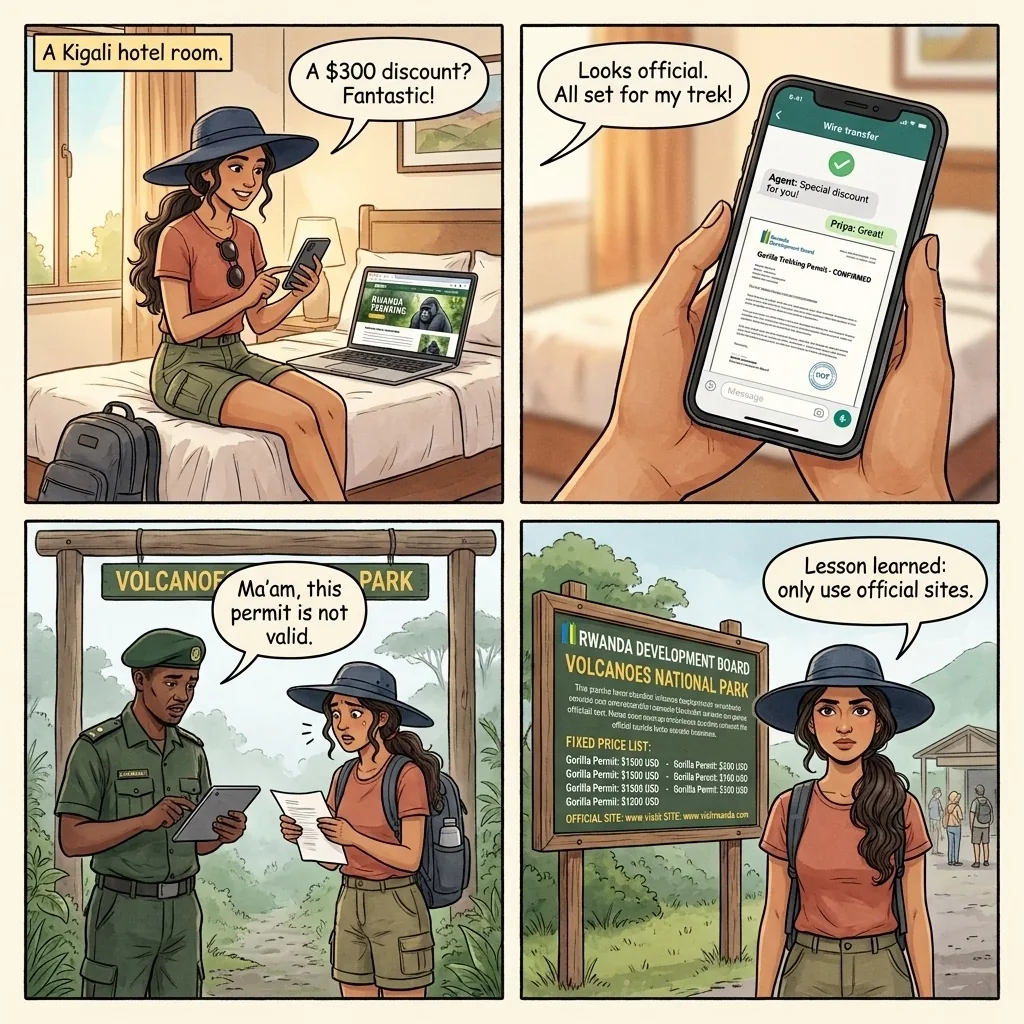
You are planning the bucket-list trip to see Rwanda's mountain gorillas and find an agent online — or near your hotel in Kigali — offering permits at $1,200 instead of the official $1,500 USD price.
The discount feels reasonable. You message the agent on WhatsApp, he responds within minutes with professional photos of past treks and a PDF brochure of his 'company,' and asks for a wire transfer of $1,200 plus a $50 'processing fee' to lock in the date. He sends a permit confirmation as a PDF — Rwanda Development Board logo, official-looking serial number, your name and date in proper formatting. You book your flight to Kigali feeling like you have just secured one of the world's most prized wildlife experiences.
On trek day at Volcanoes National Park headquarters in Kinigi, you hand the printed PDF to the ranger checking permits at the gate. He scans it, pauses, scans it again. The permit number is not in the RDB system. The serial format is correct but the underlying record does not exist. The ranger turns the page over with the polite resignation of someone who has seen this several times this season. The agent's WhatsApp number, when you check, is no longer responding.
The Rwanda fake-gorilla-permit pattern is documented across Reddit, the long-running TripAdvisor Rwanda forum, and the Rwanda Development Board's own consumer-protection materials. A widely-circulated Tripadvisor thread documents a scammer named 'Patience' who collected thousands from multiple tourists in 2023–2024 alone. The scam runs at scale because gorilla permits are scarce (Rwanda issues only 96 per day across 12 habituated groups), expensive enough to make discounts feel meaningful, and bookable months in advance — perfect conditions for advance-fee fraud.
Legitimate gorilla permits are sold only through two channels: the Rwanda Development Board (RDB) directly via irembo.gov.rw, or RDB-licensed operators with verifiable license numbers. Reputable operators (Volcanoes Safaris, Wilderness Safaris, Thousand Hills Africa, Primate Safaris) maintain offices, pay by credit card, and provide bookings under your real passport name in the RDB system. Anyone asking for a wire transfer or cash, offering a price below $1,500, or operating only via WhatsApp is a warning sign.
Book gorilla permits only through the official Rwanda Development Board portal at irembo.gov.rw or through a verified RDB-licensed operator from the official licensed-operators list (rdb.rw). Pay by credit card for chargeback protection, never wire transfer or cash. The official permit price is exactly $1,500 USD per person — there are no legitimate discounts, no 'special rates,' and no advance-fee deals. Verify the operator's RDB license number independently before sending any money. If you have already paid a fake agent, dispute via your card issuer and report to the RDB at +250 252 576 514 and to the Rwanda National Police at 113.
Red Flags
- Permit price below the official $1,500 USD
- Agent demands wire transfer or cash only -- no credit card option
- No verifiable office address or RDB license number
- Unsolicited messages on WhatsApp or social media offering deals
- Agent cannot provide a verifiable booking reference from RDB
How to Avoid
- Book permits only through the Rwanda Development Board (irembo.gov.rw) or RDB-licensed operators.
- Verify the tour operator on the official RDB licensed operators list.
- Pay by credit card for chargeback protection.
- Be suspicious of any price below $1,500 -- there are no legitimate discounts.
- Ask for the operator's RDB license number and verify it independently.
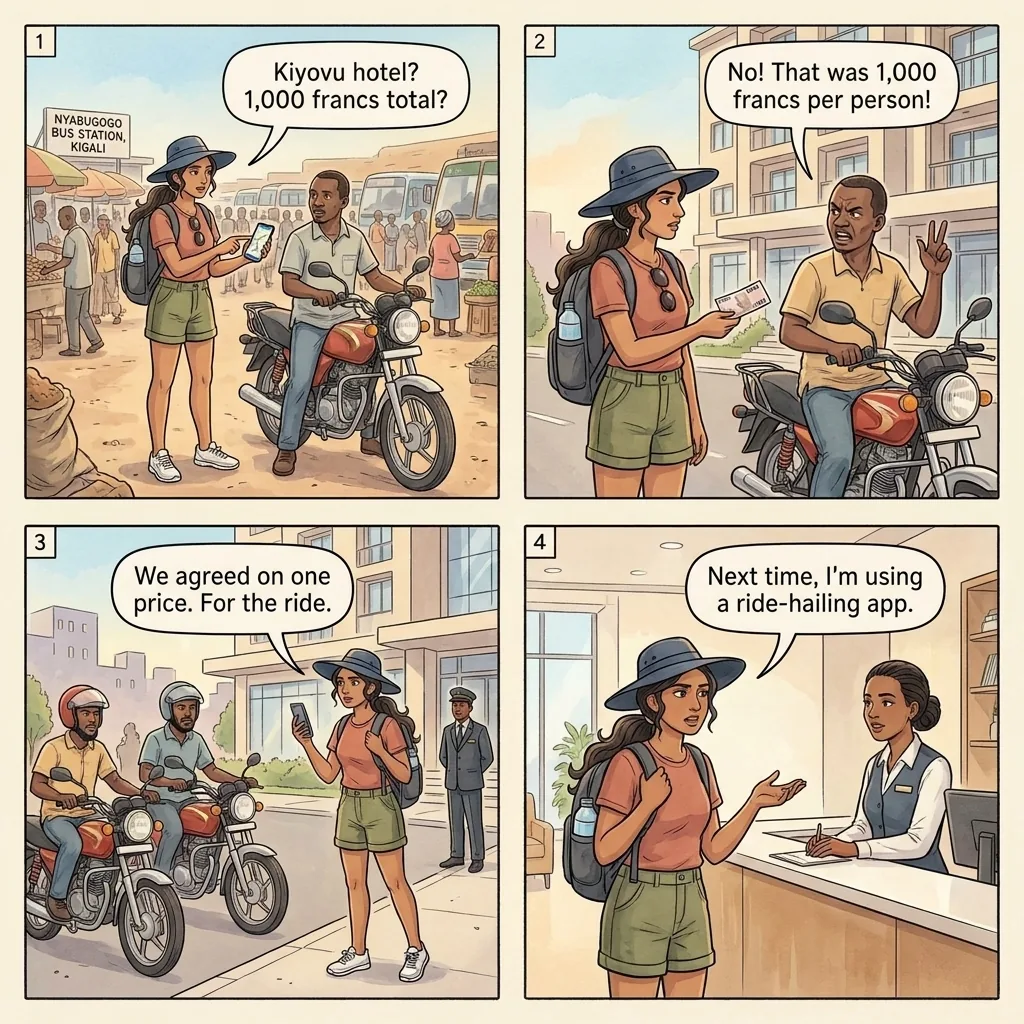
You hop on a motorcycle taxi near Nyabugogo Bus Station for the short ride to your hotel in Kiyovu, the driver agrees on 1,000 RWF (about $0.80) when you ask 'how much?' before mounting.
The ride takes ten minutes, the driver weaves expertly through Kigali's hilly traffic, and you pull up at your hotel feeling pleased with the local-style transport. You hand over a 1,000-franc note. The driver shakes his head and says no — the agreed fare was 1,000 RWF per person, or per kilometer, depending on how he frames it. He demands 3,000–5,000 RWF total.
When you protest that you agreed on a single 1,000-franc fare, his voice rises sharply. He calls over to other moto drivers nearby. Two of them drift over to the curb with hands on hips. The hotel doorman appears in the doorway watching but does not intervene. Most travelers, faced with a curbside argument in front of a hotel they want to walk into, hand over the inflated amount to disengage and head inside.
The Kigali moto-taxi 'per person' fare-inflation pattern is documented across Reddit, the TripAdvisor Kigali forum, and the Rwanda Tourism Board's consumer-protection page. Drivers around Nyabugogo Bus Station, the Kiyovu hotel district, and the Kigali Convention Centre approach routinely attempt this with foreign passengers, calibrated to the moment after the ride is over and walking away feels socially harder. Most rides within central Kigali should cost 500–2,000 RWF total, with longer cross-town rides up to 3,000 RWF.
The Kigali government has pushed for smart meters and the Yego Moto app, which provides metered, transparent pricing with GPS tracking. Yego is the cleanest defense — fare is set by the app before the ride starts, payment can be cashless, and the driver is rated. The app coverage is good in central Kigali, weaker in outer neighborhoods. The roadside flag-down moto remains the cheaper option but invites the per-person fare reveal at the end.
Use the Yego Moto app for metered, transparent pricing — fare is set in-app before the ride and the driver is rated. If you flag down a moto on the street, state the total fare clearly out loud and; reports confirm 'total, for whole trip, not per person' (or write the number on your phone and show it). Carry exact change so there is no dispute over big bills. Most central Kigali rides cost 500–2,000 RWF; refuse anything over 3,000 RWF for a normal in-town ride. If a driver insists on inflated payment, photograph the moto plate and report it to Rwanda National Police on 113.
Red Flags
- Driver doesn't confirm the total price before departing
- Claiming the agreed price was 'per person' or 'per kilometer' at the end
- Raising voice or calling others over to pressure you
- Refusing to use the Yego Moto app for metered fares
- Targeting foreign-looking passengers at busy transport hubs
How to Avoid
- Use the Yego Moto app for metered, transparent pricing.
- State the total fare clearly before putting on the helmet.
- Carry exact change so there's no dispute.
- Write down the agreed fare on your phone and show it if disputed.
- Most rides within central Kigali should cost 500-2,000 RWF.
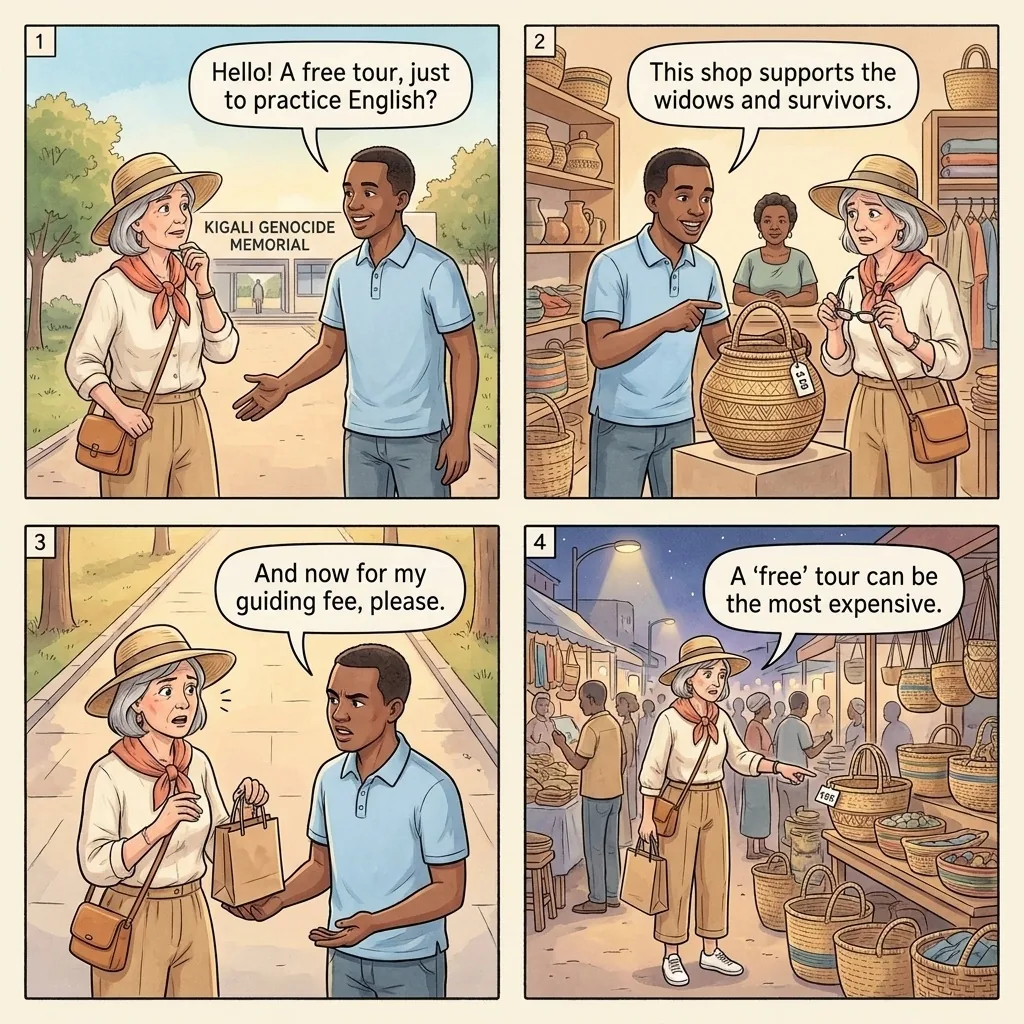
You arrive at the Kigali Genocide Memorial in Gisozi for the morning visit, walk through the gate, and a well-spoken young man in a clean polo shirt approaches with a smile and an offer.
He says he is a university student practicing English and would like to show you around for free — no charge, just for the chance to chat with a foreign visitor. He has the right tone for the site: solemn, knowledgeable, respectful. He walks you through the exhibits at a steady pace, points out details you might miss, and answers questions thoughtfully. The encounter feels like a small act of kindness from a young Rwandan who genuinely wants to share his country's story.
After the memorial visit, as you head back toward your taxi, he steers you to a 'cooperative craft shop' just down the road from the memorial — he says it supports widows and survivors. Inside, he stays close while a shopkeeper presents woven baskets, soapstone carvings, and traditional umuboro masks at prices roughly two to three times what the same items go for at Kimironko Market. You feel obligated to buy something. As you walk out, the young man holds out his hand and asks for $20–50 for the 'guiding services.'
The pattern is documented across Reddit, the TripAdvisor Rwanda forum, and Rwanda Tourism Board materials. The 'free tour' framing is the entire trap — there was never a 'free' anything. The guide earns 10–25% commission from the partner craft shop on every purchase plus the closing 'guiding fee' on the way out. Variants run at Kimironko Market where 'helpers' insist on accompanying you through the stalls, then block you at the exit demanding payment.
The legitimate alternative is structural. The Kigali Genocide Memorial offers free, professional audio guides at the entrance — they are excellent and culturally calibrated, and require no human escort. Genuine Rwandan craft shops (Caplaki Crafts Village, Kimironko Market itself if you go in confidently, Umutima Crafts) operate without commission-paid escorts and are bookable through any hotel. Real licensed guides wear visible Rwanda Tourism Authority badges with photo and license number.
Use the Kigali Genocide Memorial's free audio guide — it is excellent and the right way to experience the site. Politely decline unsolicited 'free tour' offers from anyone without a Rwanda Tourism Authority badge: 'I prefer to explore alone, thank you.' If you want a guide, hire one through your hotel's tour desk or a licensed agency. At Kimironko Market, walk in confidently and browse independently. For Rwandan crafts, visit Caplaki Crafts Village (a government-supported cooperative) where prices are clearly marked. If a self-appointed guide pressures you for payment, refuse and walk to the memorial security desk.
Red Flags
- Unsolicited offer of a 'free' tour or help navigating a market
- Claims to be a student, volunteer, or memorial worker without ID
- Tour inevitably ends at a specific craft or souvenir shop
- Growing insistence and guilt-tripping when you try to part ways
- No official badge or affiliation with the site
How to Avoid
- The Genocide Memorial has its own free audio guides -- use those.
- Politely decline unsolicited guide offers with 'I prefer to explore alone.'
- If you want a guide, hire one from your hotel or a licensed agency.
- At Kimironko Market, enter confidently and browse independently.
- Agree on a price in advance if you do accept help.
Like what you're reading? Get a full Kigali itinerary with safety tips built in.
Browse travel-safety books →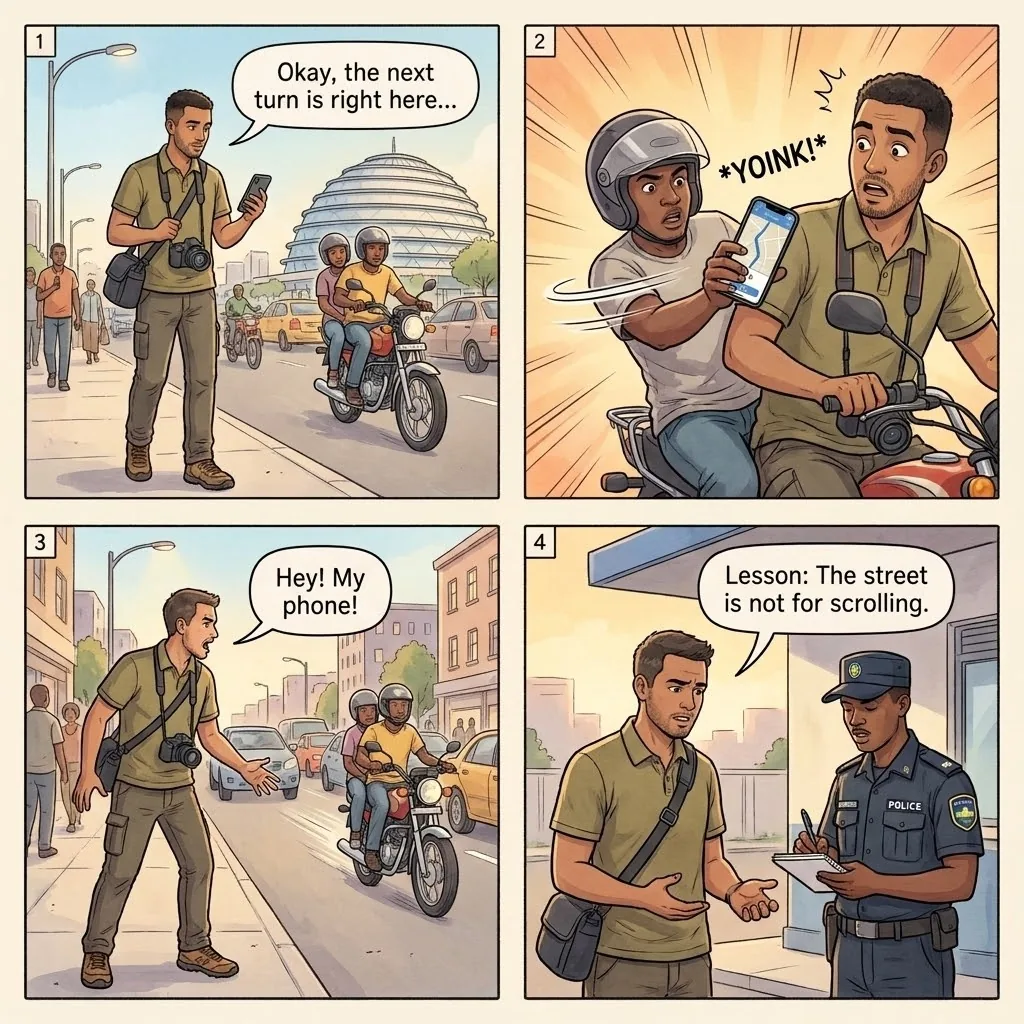
You walk along KN 4 Avenue toward downtown Kigali in the late afternoon, holding your phone in your hand while you check Google Maps for the next turn, and a motorcycle with two riders is approaching from behind in the slow-moving traffic.
As they pass you on your right, the rear passenger reaches out and snatches the phone from your hand in a single fluid motion. The grab is so fast it does not register as theft for a full second — your hand is suddenly empty, and the moto is already weaving around the next car twenty meters down the road. By the time you process what happened, both rider and passenger have disappeared into the traffic flow.
Rwanda National Police report phone-snatching incidents almost daily in central Kigali, with two-rider moto teams specifically targeting pedestrians using phones along the main roads. A 2022 RNP crackdown arrested twelve people operating a phone-theft ring that changed IMEI numbers on stolen devices and resold them through a network in Nyabugogo Market. Despite the crackdown, the pattern persists — the snatch-and-go is fast, low-risk for the thief, and a smartphone resells for $200–400 even after IMEI swapping.
The deeper risk is not the device cost but the unlocked screen at the moment of the snatch. A snatched iPhone or Android with an active session can be used in seconds to push WhatsApp messages to your contacts asking for money, transfer funds via banking apps, change your Apple ID password, and lock you out of iCloud. Professional crews drain banking apps in minutes; the phone itself is often abandoned afterward once the data is harvested.
A second variation involves a moto that slows down beside you while a man on foot bumps you toward the road — the bump distracts you long enough for the moto passenger to grab the phone. The Kiyovu hotel district, Nyamirambo's main strip, and the KN 4 Avenue corridor are the consistent hotspots, particularly during late-afternoon rush hour when traffic is heavy enough for slow-moving motos to maneuver close to the sidewalk.
Step into a shop or turn your back to the road when you need to use your phone in central Kigali — never use it while walking near traffic. Carry your phone in a zipped front pocket and use a phone lanyard or wrist strap when out, especially in Kiyovu, Nyamirambo, and along KN 4. Walk on the side of the sidewalk farthest from traffic, set your screen-lock to under 30 seconds, and require Face ID for banking apps so a snatched phone cannot transact. If you are snatched, dial 112 (Emergency) or 113 (RNP), remote-wipe via iCloud or Google immediately, and report to the nearest RNP station for an insurance-grade report.
Red Flags
- Motorcycle slowing down near you while you hold your phone
- Two riders on one moto with the passenger's hands free
- Walking close to the road edge while using your phone
- Areas with heavy moto traffic and narrow sidewalks
- Someone on foot suddenly bumping you toward the road
How to Avoid
- Step into a shop or turn your back to the road when using your phone.
- Carry your phone in a zipped pocket, not in your hand.
- Walk on the side of the sidewalk farthest from traffic.
- Use a phone lanyard or wrist strap as a deterrent.
- Be especially alert near busy intersections in Kiyovu and Nyamirambo.
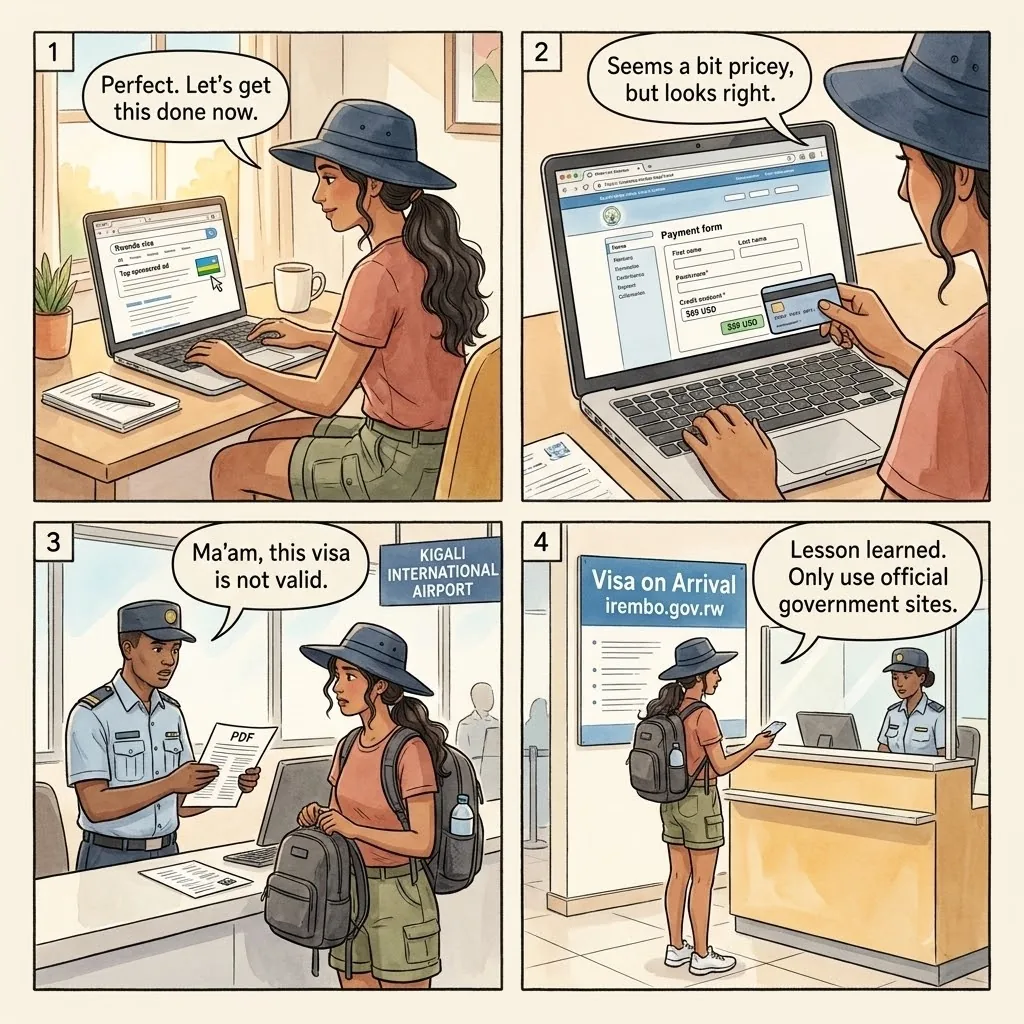
You search Google for 'Rwanda visa' the week before your flight, click the first result that has a Rwandan flag and 'gov' in the URL, and start filling in the eVisa form on what looks like the official Directorate of Immigration page.
The form asks for your full passport details, a passport scan upload, your photo, your travel dates, and your hotel address in Kigali. The fee at checkout is $89, sometimes $129 — close enough to a 'normal' visa fee that you assume the official Rwandan eVisa runs around there. You pay by credit card, the page returns a confirmation number, and a PDF arrives by email a few hours later that looks like an official Rwandan eVisa with all the right stamps and serial numbers.
You arrive at Kigali International Airport with the printed PDF. The immigration officer scans it, frowns, scans it again, and tells you the document is not in the Directorate of Immigration's system. The site you used was a lookalike — a third-party aggregator that may have filed a real visa application on your behalf at the official site (sometimes), pocketed the $59 difference, and given you a PDF that may or may not match a real RDB record. In worse cases, the site is pure fraud and your visa was never filed at all.
The Rwanda eVisa lookalike pattern is documented across Reddit, the long-running TripAdvisor Rwanda forum, and the Rwanda Directorate of Immigration's own consumer-protection page. The scam survives because Google's paid search results consistently surface aggregator sites above the actual government domain, and the lookalikes have refined their UX to feel official — flag, fonts, formal language, even fake 'verify' buttons. The official Rwandan visa fee is exactly $30 USD for a single-entry tourist visa.
The data side is the bigger long-term cost. Even when the visa eventually works at the airport, you have just handed full passport details and a high-resolution scan to an unknown third party — feedstock for identity fraud and downstream phishing. The official Rwandan eVisa portal is exactly irembo.gov.rw and nothing else; visa-on-arrival is also available for most nationalities at $50 USD paid in cash at the immigration counter.
Type irembo.gov.rw directly into your browser — never click a Google sponsored result for 'Rwanda visa,' as the top ads are almost always aggregators or lookalikes. The official single-entry tourist visa fee is exactly $30 USD on the irembo.gov.rw portal, paid by credit card. Bookmark the URL before your trip, take a screenshot of the official confirmation, and never upload a passport scan to a non-.gov.rw URL. If you have already paid a lookalike, dispute the charge with your card issuer immediately and assume your passport details may be compromised — monitor for fraud and consider notifying your home country's identity-theft service.
Red Flags
- Visa fee significantly above the official $30 USD
- URL that doesn't end in.gov.rw
- Slick website with paid Google ads pushing it above official results
- Requests for unnecessary personal documents beyond passport and photo
- No clear connection to the Rwandan Directorate of Immigration
How to Avoid
- Apply only through the official irembo.gov.rw portal.
- The official single-entry tourist visa costs exactly $30 USD.
- Type the URL directly rather than clicking search results.
- Check the Rwandan embassy website for the correct visa link.
- Report fake visa sites to Rwanda's immigration authority.
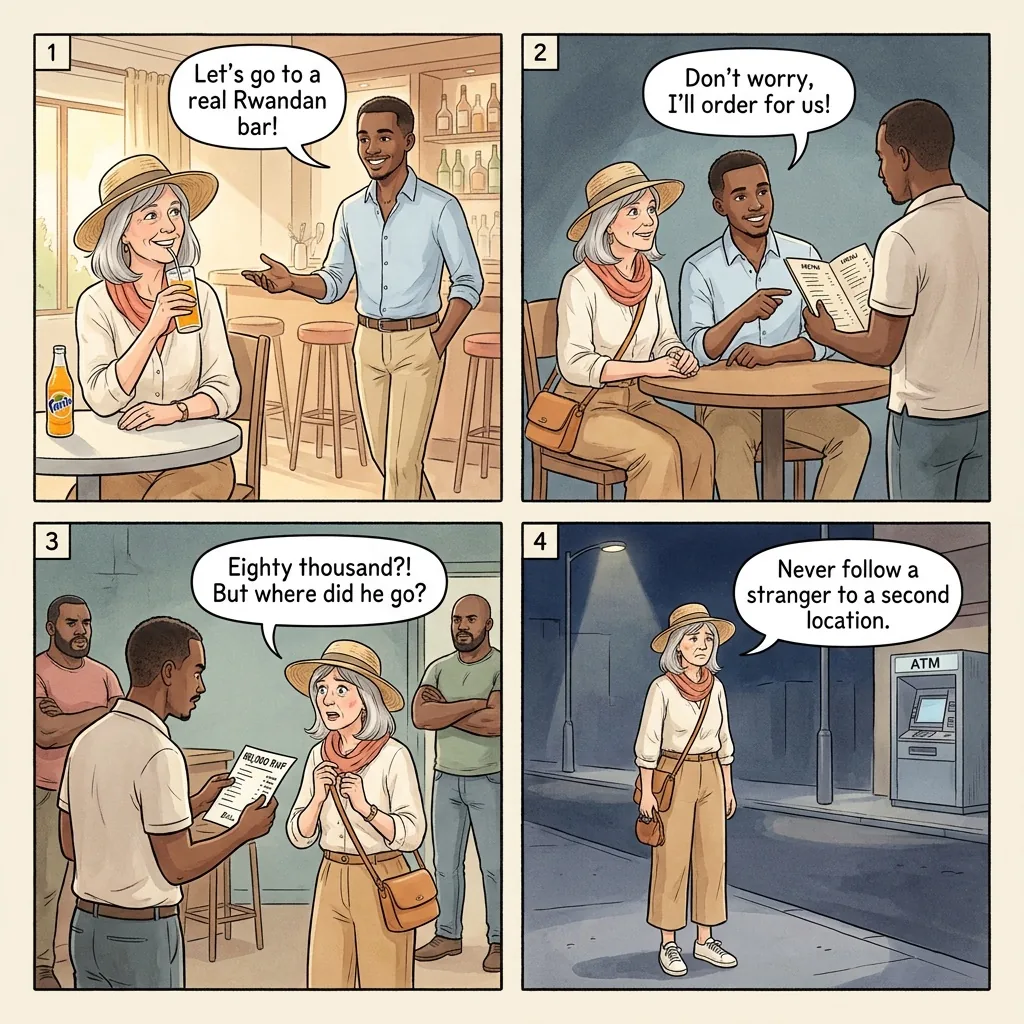
You meet a friendly young Rwandan at your hotel bar in Kiyovu who introduces himself, asks where you are from, and after twenty minutes of conversation suggests heading to a 'great spot' nearby in Kimihurura — locals only, much better than the tourist places.
He is warm, fluent in English, and the conversation feels easy. You agree to one drink at the recommended place. A short moto ride or taxi later, you arrive at a small bar down a side street with no obvious branding, dim lighting, and a couple of friends of his already at a table. The bartender greets him by name. He orders a round in Kinyarwanda, the drinks arrive in stylish glasses, and the night unfolds — more drinks, a plate of brochettes, music, more rounds.
When the bill arrives, the total is 80,000 RWF (about $65) — five to ten times what the same drinks and food should cost at a normal Kigali bar. Your new friend has conveniently vanished to the bathroom and is not returning, or he sheepishly admits he forgot his wallet at home. If you protest, two large men at the door — security in name, bouncers in practice — block the exit. The bartender suggests the ATM around the corner.
The Kimihurura friendly-local bar-bill ambush is documented across Reddit, the TripAdvisor Kigali forum, and the U.S. Embassy in Kigali's traveler-safety advisories. The pattern follows the same playbook as the Budapest and Krakow honey-trap variants in this guide — friendly stranger, specific unmarked bar, no transparent pricing, drinks brought before ordering, bouncers blocking the exit — and the venues themselves rotate frequently to stay ahead of complaints. Kimihurura's quieter side streets are the densest concentration; Kiyovu and Remera see secondary incidents.
Real Kigali nightlife is genuinely good and not subtle about pricing. Pili Pili (the rooftop in Kacyiru), Sundowner (the long-running expat-friendly bar), Heaven (Kiyovu), and Repub Lounge all have visible printed menus, fair pricing, and reputations to protect. Anywhere with no menu and a 'friendly local' as the introduction is by definition not a real Kigali bar.
Choose your own bars in Kigali — never follow strangers, however friendly, to a specific bar in Kimihurura, Kiyovu, or Remera. Stick to named, well-reviewed places (Pili Pili, Sundowner, Heaven, Repub Lounge) with visible printed menus and fair pricing. Pay for each round as it is served rather than running a tab, and refuse any drink that arrives without an explicit order. If you are handed an inflated bill, refuse to pay it, demand the police be called (dial 113 — the bar bluffs about police; the RNP actually side with victims), and stay calm. Save the U.S. Embassy Kigali line on your phone (+250 252 596 400) and never withdraw cash under bouncer pressure.
Red Flags
- New acquaintance insisting on a specific bar you've never heard of
- No prices visible on the menu or menu only in Kinyarwanda
- Bill arrives with items you didn't order
- Your companion suddenly can't pay or disappears
- Security present who seem aligned with the bar staff
How to Avoid
- Choose your own bars -- don't follow strangers to unfamiliar venues.
- Check prices on the menu before ordering anything.
- Keep a running tally of what you've ordered and approximate costs.
- Carry only what you're willing to spend for the evening.
- Go out with other travelers from your hostel rather than strangers.
🆘 What to Do If You Get Scammed
📋 File a Police Report
Go to the nearest Rwanda National Police station. Call 112 (Emergency) or 113 (Police). Get an official crime report — you'll need this for insurance claims. You can also report online at police.gov.rw.
💳 Cancel Your Cards
Call your bank immediately. Most have 24/7 numbers on the back of the card (keep a photo saved separately). Block any suspicious transactions before the thieves use your details.
🛂 Lost Passport?
Contact the US Embassy in Kigali at 2657 Avenue de la Gendarmerie, Kacyiru, Kigali. For emergencies: +250 252-596-400.
📱 Track Your Device
If your phone was stolen, use Find My (iPhone) or Find My Device (Android) from another device. Don't confront thieves yourself — share the location with police instead.
Frequently Asked Questions
You just read 6 scams in Kigali. The full Travel Safety Series has 780+ more across 20+ countries.
Tokyo's Kabukichō ¥130,000 bar trap. Rome's gladiator photo extortion. Paris's gold-ring trick. Bali's ATM skimmer scams. Bangkok's grand-palace closure ruse. Every documented scam across 20+ destinations — with the exact scripts, red flags, and local-language phrases that shut each one down. Drawn from Reddit traveler reports, embassy advisories, and consumer-protection cases.
- 780+ documented scams across Tokyo, Rome, Paris, Bali, Bangkok, Rio & 100+ more cities
- 20+ countries covered, with country-by-country phrase cards for every destination
- Updated annually — buy once, re-download future editions free
- All titles $4.99 each on Amazon Kindle