
Key Takeaways
- The #1 reported scam is the Cairo Road Street Money-Changer Paper-Filler Bundle.
- 3 of 6 scams are rated high risk.
- Use app-based ride services (Uber, Bolt) instead of unmarked taxis — always confirm the fare before departure.
- Never accept unsolicited offers from strangers near tourist sites in Lusaka.
⚡ Quick Safety Tips
- Keep phones and valuables in secure pockets when in crowded areas.
- Use only licensed taxis or app-based ride services.
- Book tours and tickets through verified operators with online reviews.
- Keep a copy of your passport separate from the original.
Jump to a Scam
- High The Cairo Road Street Money-Changer Paper-Filler Bundle
- Medium The Lusaka Fake-Official 'Tourism Fee' Shakedown
- High The Lusaka Hotel-Lobby Gemstone Business Pitch
- Medium The Intercity Bus Terminus Luggage-Tout Hustle
- High The Lusaka Follow-from-the-Bank Robbery
- Low The Lusaka Friendly-Stranger Commission-Guide Tour
The 6 Scams
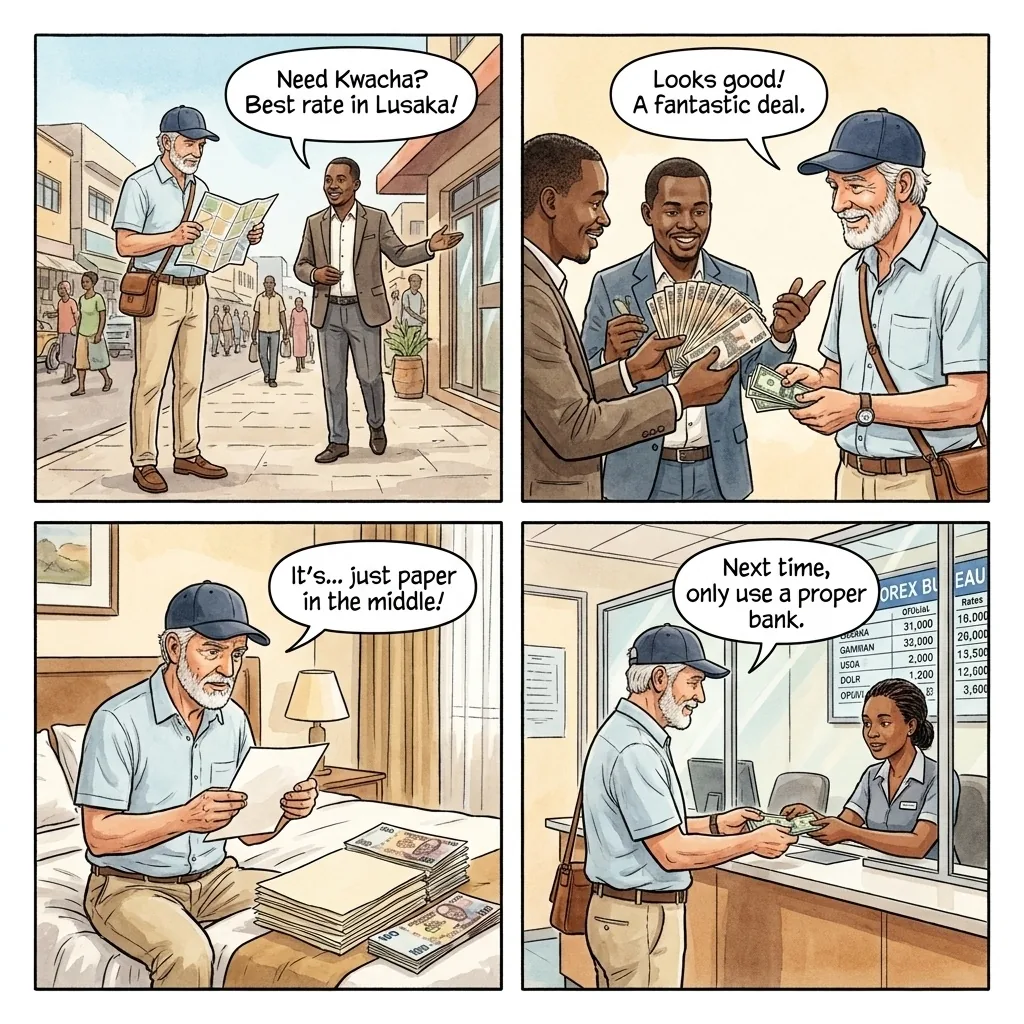
It's an afternoon on Cairo Road in central Lusaka, you need to convert USD $200 into Zambian kwacha for the next few days, and a group of three men offers an exchange rate 12% better than the banks.
They walk you a few steps off the main pavement, fan out an impressively thick bundle of ZMW notes — what looks like ZMW 5,200 in a stack of 100s — and count it in front of you, fanning the bills so you can see the count. Everything looks right. You hand over your USD; the leader hands you the bundle; the three men disperse quickly into the Cairo Road foot traffic.
Back at the hotel, you recount the bundle on the bed. The top and bottom of the stack are real ZMW 100 notes; the middle of the bundle is blank paper cut to bill size, with a few low-denomination ZMW 5 notes layered to mask the substitution. Of the ZMW 5,200 you thought you received, perhaps ZMW 1,800 is real money. The shortfall is roughly USD $130 of the original $200 exchange. As travelers report across Reddit, the TripAdvisor Lusaka forum, the Lonely Planet Africa thorntree, the World Nomads Zambia safety guide, and the U.K. Foreign Office Zambia travel advice, the Cairo Road money-changer paper-filler bundle is the highest-stakes Lusaka tourist financial fraud.
The mechanism uses three structural failures: an exchange rate offered 10–15% better than banks (the bait), a fast fan-out count that looks legitimate but doesn't actually verify the middle of the bundle, and a paper-fill substitution that the customer doesn't discover until later. The variants include using torn or expired notes mixed into the bundle, and using counterfeit ZMW 100 notes for the visible top-and-bottom layer. Some operators will become physically aggressive if you try to recount on the spot, which is why the operation moves you off the main pavement before the exchange.
The legitimate Lusaka exchange options are well-developed. The major Zambian banks (Stanbic Bank, Standard Chartered Zambia, Zanaco, Absa Bank Zambia) all have central Lusaka branches with posted rates. ATMs at these branches dispense kwacha at near-interbank rates with a small foreign-card fee. Authorised forex bureaus inside Manda Hill Shopping Centre, East Park Mall, and the major hotel lobbies run rates within 2–4% of the bank rate. The 10–15% gap that street operators offer is precisely the cost of the paper-filler risk.
Exchange currency only at Lusaka banks (Stanbic, Standard Chartered Zambia, Zanaco, Absa) or at authorised forex bureaus inside Manda Hill, East Park Mall, or major hotel lobbies. Use ATMs at bank branches for clean kwacha. NEVER engage with street money-changers on Cairo Road or near Kulima Tower no matter how attractive the rate; the 10–15% rate gap is precisely the cost of the paper-filler-bundle risk. If you must take cash from a non-bank source, count every note slowly in front of the changer, check each note for watermark and texture, and never accept a rubber-banded or pre-bundled stack. Carry small USD bills (clean, recent series) for emergency exchange and minimise the volume of cash you ever exchange in one transaction. Emergency: 991 (Police) or 999 (general); the U.S. Embassy in Lusaka is at +260 211 357 000.
Red Flags
- Group of men approaching you specifically to offer currency exchange
- Exchange rate significantly better than bank or bureau rates
- They count rapidly and bundle notes tightly before handing them over
- Resistance or aggression if you try to recount the money on the spot
- They operate in the open near legitimate exchanges to appear credible
How to Avoid
- Only exchange money at banks or authorized forex bureaus.
- Use ATMs inside bank branches for the safest exchange.
- Never engage with street money changers regardless of the rate offered.
- If you must exchange cash, count every note carefully before leaving the counter.
- Carry small USD denominations for emergencies rather than exchanging large amounts.
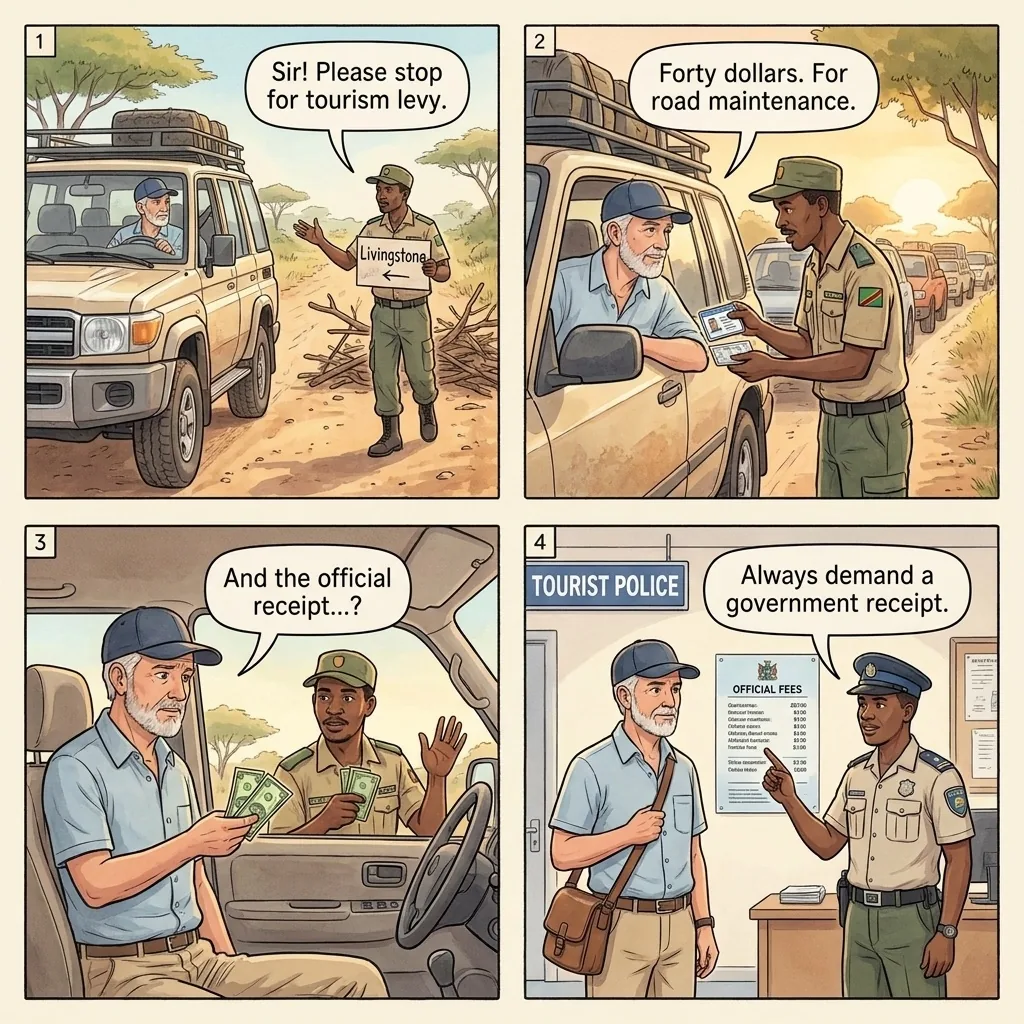
It's the morning of your road trip from Lusaka to Livingstone, you've stopped at what looks like a checkpoint between Mazabuka and Choma, and an 'official' in a partial uniform demands a 'tourism road levy' of USD $40.
He waves a laminated card that he says is a Ministry of Tourism authorisation. He explains the levy is for road maintenance and tourism-infrastructure funding. When you ask for an official receipt, he says the receipt printer is broken at this checkpoint and you'll receive one at the next government office. He looks impatient. Cars are queueing behind you. You pay the $40 in cash, drive on, and never receive any receipt or follow-up paperwork.
The Lusaka fake-official 'tourism fee' shakedown is documented across Zambian rural roads, border crossings, and even within central Lusaka government offices. Low-paid uniformed personnel — sometimes legitimate police, sometimes complete fakers in partial uniforms — invent fees that don't exist on any official Zambian government schedule, target tourists who don't know the legitimate fee structure, and pocket the cash without any receipt trail. As travelers report across Reddit, the TripAdvisor Lusaka forum, the Lonely Planet Africa thorntree, the World Nomads Zambia safety guide, and the U.S. State Department Zambia country information, the fake-official shakedown is one of the most-encountered moderate-cost frictions in Zambia.
The mechanism uses three structural failures: a uniform or pseudo-uniform that creates apparent authority, a 'fee' that sounds plausible (transit levy, tourism contribution, processing surcharge, road maintenance), and a 'receipt unavailable' framing that bypasses the documentation that would expose the fraud. The fee names rotate to keep ahead of word-of-mouth. The amounts are calibrated at USD $20–60 — high enough to be meaningful, low enough that paying-and-leaving feels rational versus a confrontation in a remote location.
The legitimate Zambian government fee structure is documented and published. The Zambia Tourism Agency website (zambiatourism.com) lists all genuine tourist fees. Border-crossing visa fees are paid at official immigration counters with computer-generated receipts. Road tolls in Zambia are collected at marked toll plazas with electronic ticketing. Anyone demanding cash payment without a printed receipt is, by definition, operating outside the official system.
Always insist on an official printed receipt before paying any 'government fee' in Zambia — this is the single defence that makes most fake-official shakedowns disappear. Research required visa, entry, and road-toll fees on the Zambia Tourism Agency website (zambiatourism.com) before traveling so you know the legitimate fee schedule. Anyone claiming the receipt printer is 'broken' or that 'receipts aren't available right now' is running the shakedown — politely insist on documentation, note the person's name and badge number, and the operator usually backs down. If they persist, ask to be escorted to the nearest official Zambian Police station to verify; real officers will go, fakers will not. Pay by card if accepted (almost never accepted on these fake fees, which is itself a tell). Emergency: 991 (Zambian Police), 999 (general); the U.S. Embassy in Lusaka is at +260 211 357 000.
Red Flags
- Fee is not listed on any official government schedule
- Cannot or will not provide an official receipt
- Payment is demanded in cash only
- The 'official' becomes flustered when you insist on documentation
- Amount seems arbitrary and not a round official figure
How to Avoid
- Always insist on an official receipt before paying any government fee.
- Research required fees and visa costs before entering Zambia.
- Politely insisting on a receipt usually makes scammers back down.
- Note the person's name and office number if they persist.
- Contact your embassy if someone in authority demands suspicious payments.
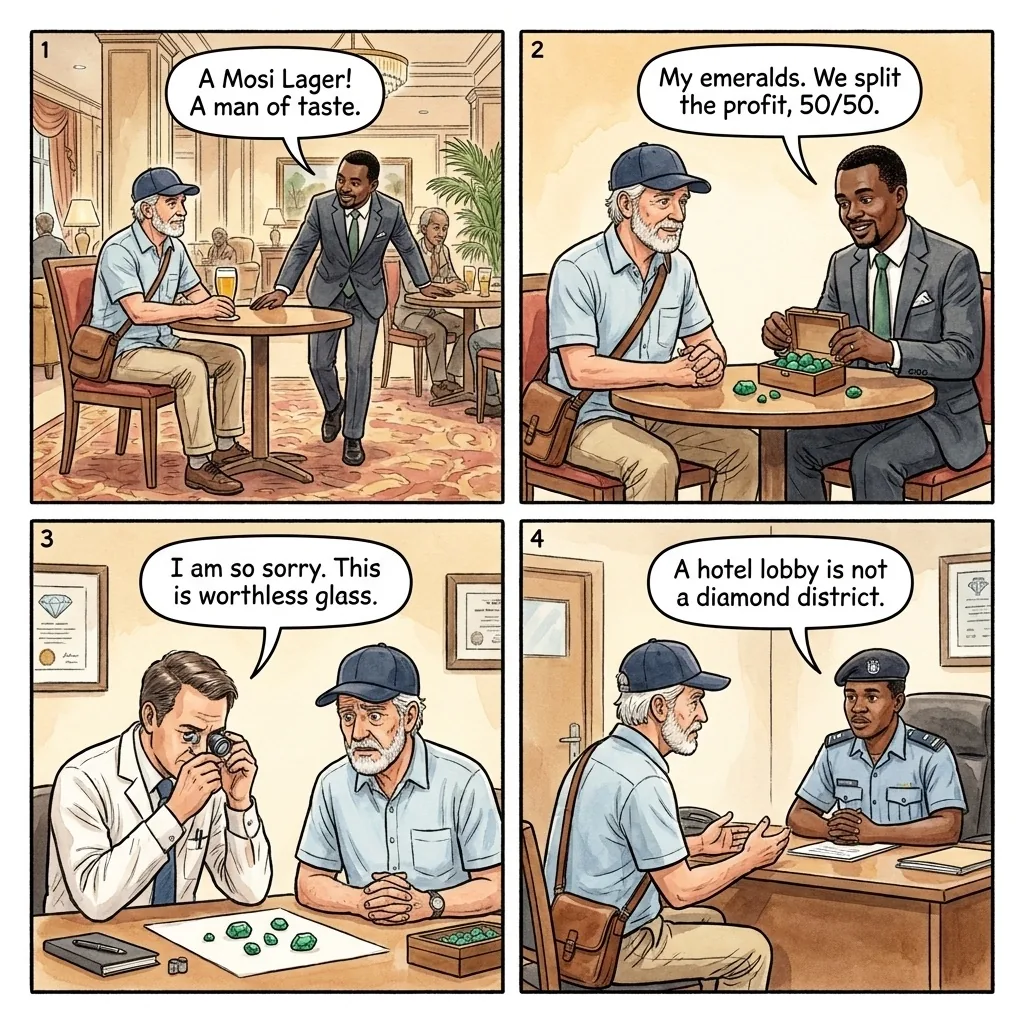
It's an evening at the Pamodzi Hotel lobby restaurant in central Lusaka, you're having a glass of wine after a day of business meetings, and a well-dressed Zambian man at the next table strikes up a friendly conversation about your trip.
After fifteen minutes of pleasant chat, he mentions casually that he runs a gemstone-and-gold export business — Zambian emeralds from the Kafubu and Lufwanyama mines, sometimes Lake Mweru tanzanite, sometimes gold from local artisanal sources. He says he buys at the mine for one-tenth of the international wholesale price and sells in Dubai or Antwerp. He offers to introduce you to his trusted dealer the next afternoon, and to 'split the profits 50/50' on a small starter purchase of $5,000–$15,000.
The 'dealer' is a confederate. The gems are worthless glass or synthetic stones with the right approximate colour and weight; the 'gold' is gold-plated brass or pyrite. The Zambia Police have arrested multiple individuals running this scam, including a 2023 case involving USD $105,000 in fake gold sold to a South African businessman who had been recruited at a Lusaka hotel lobby. As travelers report across Reddit, the TripAdvisor Lusaka forum, the U.K. Foreign Office Zambia travel advice, the U.S. Department of State Zambia country information, and Zambian Police press releases, the gemstone-and-gold pitch is the highest-dollar Lusaka tourist fraud category.
The mechanism is structural. The pitch starts with an unsolicited friendly conversation in a high-end venue (Pamodzi, Taj Pamodzi, Radisson Blu, Latitude 15) where the customer's apparent affluence signals ability to pay. The 'profit-share' framing makes the customer feel like a participant in a deal rather than a buyer of gems, which short-circuits the standard skepticism about precious-stone purchases. The 'urgency' framing ('the dealer is leaving for Dubai tomorrow') prevents independent verification. The cash demand is calibrated at USD $5,000–$15,000 — high enough to be meaningful, low enough that the buyer can self-rationalise the risk.
The legitimate Zambian gemstone-export economy is real and significant. Zambia is the world's second-largest emerald producer (after Colombia). But the legitimate trade happens through licensed exporters with Ministry of Mines documentation, certified gemological-lab paperwork (GIA, AGS, or the Gemological Institute of Zambia), and registered Antwerp or Dubai buyers. None of it happens by recruitment in hotel-lobby cafés.
Decline ALL hotel-lobby business pitches in Lusaka involving gemstones, emeralds, gold, tanzanite, or any precious-mineral 'opportunity' — the entire mechanism is a calibrated fraud. Genuine Zambian gemstone purchases happen through licensed exporters with Ministry of Mines documentation, certified gemological-lab paperwork, and registered international buyers. Decline 'profit-share' framings; decline 'introduce you to my dealer'; decline 'urgency' pitches. If you have a legitimate interest in Zambian gemstones, contact the Gemological Institute of Zambia or the Ministry of Mines directly for authorised dealer introductions. Anyone approaching you unsolicited at a Lusaka hotel lobby with a gem business proposition is running fraud. Emergency: 991 (Zambian Police); the U.S. Embassy in Lusaka is at +260 211 357 000.
Red Flags
- Stranger in hotel lobby brings up gemstones or gold in casual conversation
- Claims of extraordinary profit margins on local precious stones
- Offers to take you to a 'trusted dealer' he personally knows
- Deal requires immediate cash payment with no time for independent appraisal
- Stones or gold cannot be independently verified before purchase
How to Avoid
- Never buy gemstones or gold from anyone you meet casually.
- Legitimate gem dealers do not recruit buyers in hotel lobbies.
- If interested in Zambian gems, use certified dealers with verifiable credentials.
- Any business proposition from a stranger should be treated as a scam.
- Research shows this exact scam has led to arrests and losses exceeding $100,000.
Like what you're reading? Get a full Lusaka itinerary with safety tips built in.
Browse travel-safety books →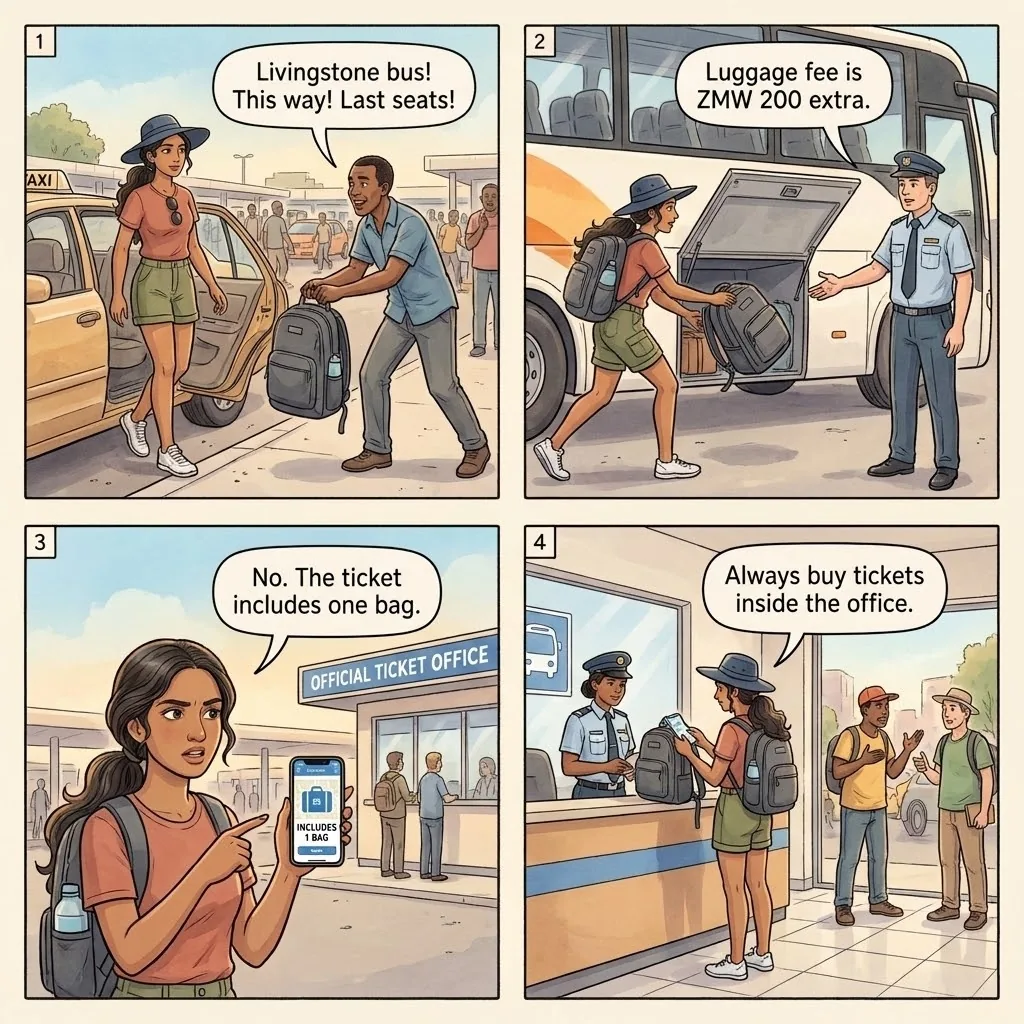
You arrive at Lusaka's Intercity Bus Terminus on Dedan Kimathi Road for the eight-hour journey to Livingstone or the longer haul to Chipata, and the moment you step out of your taxi a swarm of touts grabs at your luggage.
The loudest of them already has your largest bag in his hands and is walking you toward what he says is the 'best bus company,' shouting that the rival operators are 'all full' and 'broken down today.' He gestures toward a coach where the conductor is loading luggage into the cargo hold. Within sixty seconds, your bags are in the hold and the conductor is asking for ZMW 200 — about USD $9 — as a 'luggage fee' on top of the ZMW 250 bus ticket. The legitimate luggage allowance is included in the ticket price; the fee is fabricated.
The Lusaka Intercity Bus Terminus tout-and-luggage-hustle is one of the most-encountered Zambia tourist frictions. The TripAdvisor Lusaka forum describes the terminus as 'unpleasant by day and horrible at night,' with touts acting as self-appointed agents who charge whatever they can extract for bags. Some travelers report worse outcomes: items disappearing from luggage in unattended cargo holds, bags loaded onto the wrong bus, and the operator demanding a higher 'fee' to retrieve them. As travelers report across Reddit, the TripAdvisor Lusaka forum, the Lonely Planet Africa thorntree, the U.K. Foreign Office Zambia travel advice, and Power Tools Bus Service consumer logs, this is the friction tourists most commonly encounter on Zambian intercity travel.
The legitimate Zambian intercity bus operators are real and well-priced. Power Tools, Mazhandu Family Bus, and Shalom Bus Services all run online booking, fixed pricing including standard luggage, and reliable schedules. Mazhandu and Power Tools both have apps and websites where tickets can be pre-booked with QR codes, eliminating the touts-at-the-station interaction entirely. The 'rival operators are full' framing is a tell — the real operators have published schedules and online seat availability that the customer can verify in advance.
The structural defences are concrete. Pre-book intercity bus tickets online through Mazhandu, Power Tools, or Shalom (websites and apps available); arrive at the terminus with the QR code on your phone and walk past the touts directly to the operator's loading bay. Never let any tout touch your bags before a price is agreed. Refuse 'luggage fees' beyond what's printed on the ticket — most legitimate Zambian intercity operators include standard luggage in the fare. Keep valuables in a daypack you carry onto the bus; checked items in the cargo hold can disappear. Arrive during daylight hours and allow extra time so you're not rushed into the tout interaction.
Pre-book Zambian intercity bus tickets online through Mazhandu Family Bus, Power Tools, or Shalom Bus Services (websites and apps available); arrive with the QR code on your phone and walk past the touts directly to the operator's loading bay. Never let any tout touch your bags before a price is agreed in writing. Refuse 'luggage fees' beyond what's printed on the ticket — most legitimate Zambian operators include standard luggage. Keep valuables in a daypack you carry onto the bus; checked items in the cargo hold can disappear. Arrive during daylight hours so you're not rushed into the tout interaction. If a tout grabs your bag, raise your voice and refuse the engagement; legitimate operators have staff who will intervene. Emergency: 991 (Zambian Police).
Red Flags
- Touts physically grab your bags and start walking without your agreement
- Claims that rival bus companies are full or canceled
- Luggage fees not mentioned until bags are already loaded
- No official receipt for luggage charges
- Tout insists you must decide immediately or miss the bus
How to Avoid
- Research bus companies and book tickets online before arriving at the station.
- Never let anyone carry your bags without explicit agreement on cost.
- Keep valuables in a carry-on bag you hold with you on the bus.
- Insist on a receipt for any luggage fees and compare with official rates.
- Arrive during daylight and allow extra time to avoid being rushed.
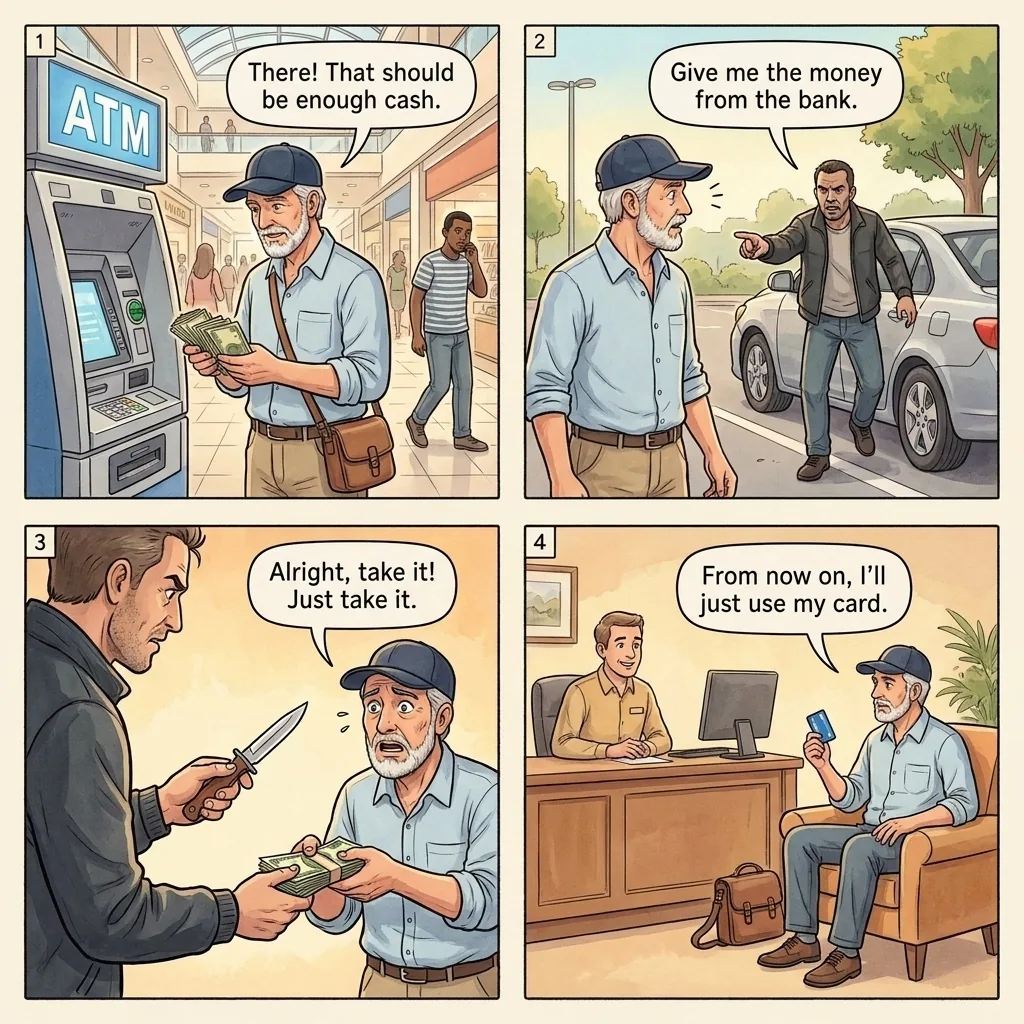
It's a Wednesday afternoon, you've withdrawn ZMW 8,000 (about USD $360) from a bank ATM at Manda Hill Shopping Centre, you've pocketed the cash and walked back toward the parking lot — and within twenty minutes someone has followed you to a quieter side street and demanded the money at knifepoint.
The robbery doesn't happen at the ATM itself, where security cameras and witnesses provide deterrence. It happens 200–500 metres later, after the person watching the ATM has handed off the target to a confederate or has identified you as carrying significant cash. The strike happens at the moment you've moved into a parking-lot section without other people, a side street, or the entrance to your guesthouse. The weapon is typically a knife or machete; sometimes a firearm. The demand is for the cash you just withdrew.
The Lusaka follow-from-the-bank robbery is documented across Reddit, the TripAdvisor Lusaka forum, the Lonely Planet Africa thorntree, the U.K. Foreign Office Zambia travel advice, the U.S. Department of State Zambia country information page, and Zambian Police press releases. The U.S. State Department specifically warns U.S. citizens that 'criminals in Lusaka have been known to follow foreigners from banks, hotels, bars, and restaurants and rob them in isolated locations' — this is the highest-stakes Lusaka tourist crime.
The targeting is deliberate. The operators station themselves outside major Lusaka banks (Cairo Road, Manda Hill, Arcades, Kabulonga) and in hotel lobbies, identify foreign visitors making meaningful cash withdrawals, and follow at a distance until the target is in an isolated location. The mechanism extends to identifying targets at hotels and restaurants — the operators sometimes wait outside an upmarket Lusaka venue for foreigners leaving with visible jewellery, expensive bags, or other affluence indicators, then follow them home or to their car park.
The structural defences are concrete. Use ATMs only inside bank branches during business hours. Withdraw small amounts more often rather than carrying large cash. Pocket cash discreetly out of sight before stepping outside the bank — never count or organise cash on the street. Take a taxi DIRECTLY from the bank to your accommodation rather than walking, even short distances. Vary your routine so the operators can't predict your withdrawal pattern. Be aware of anyone who appears to follow you after a withdrawal — if you suspect a tail, walk into another bank, hotel lobby, or large restaurant rather than continuing toward your destination.
Use ATMs ONLY inside Lusaka bank branches during business hours — Stanbic, Standard Chartered Zambia, Zanaco, Absa all have central-Lusaka branches. Withdraw small amounts more often (ZMW 2,000 maximum at a time); never count or organise cash on the street; pocket discreetly out of sight before exiting the bank. Take a taxi DIRECTLY from the bank to your accommodation rather than walking, even short distances. Vary your routine so operators can't predict your withdrawal pattern. If you suspect a tail after a withdrawal, walk into another bank, hotel lobby, or large restaurant rather than continuing toward your destination. If robbed, comply with the demand — the cash is replaceable; resistance is not. Emergency: 991 (Zambian Police), 999 (general); the U.S. Embassy in Lusaka is at +260 211 357 000.
Red Flags
- Someone loitering near the ATM who isn't using it
- A person or vehicle that seems to follow you after leaving the bank
- The same face appearing in your peripheral vision at multiple locations
- Someone asking if you need help or directions right after you pocket cash
- Motorcycle riders lingering near bank exits
How to Avoid
- Use ATMs inside bank branches during business hours only.
- Withdraw small amounts and pocket cash discreetly.
- Take a taxi directly from the bank rather than walking.
- Be aware of anyone who appears to follow you after a withdrawal.
- Vary your routine -- don't use the same ATM at the same time regularly.
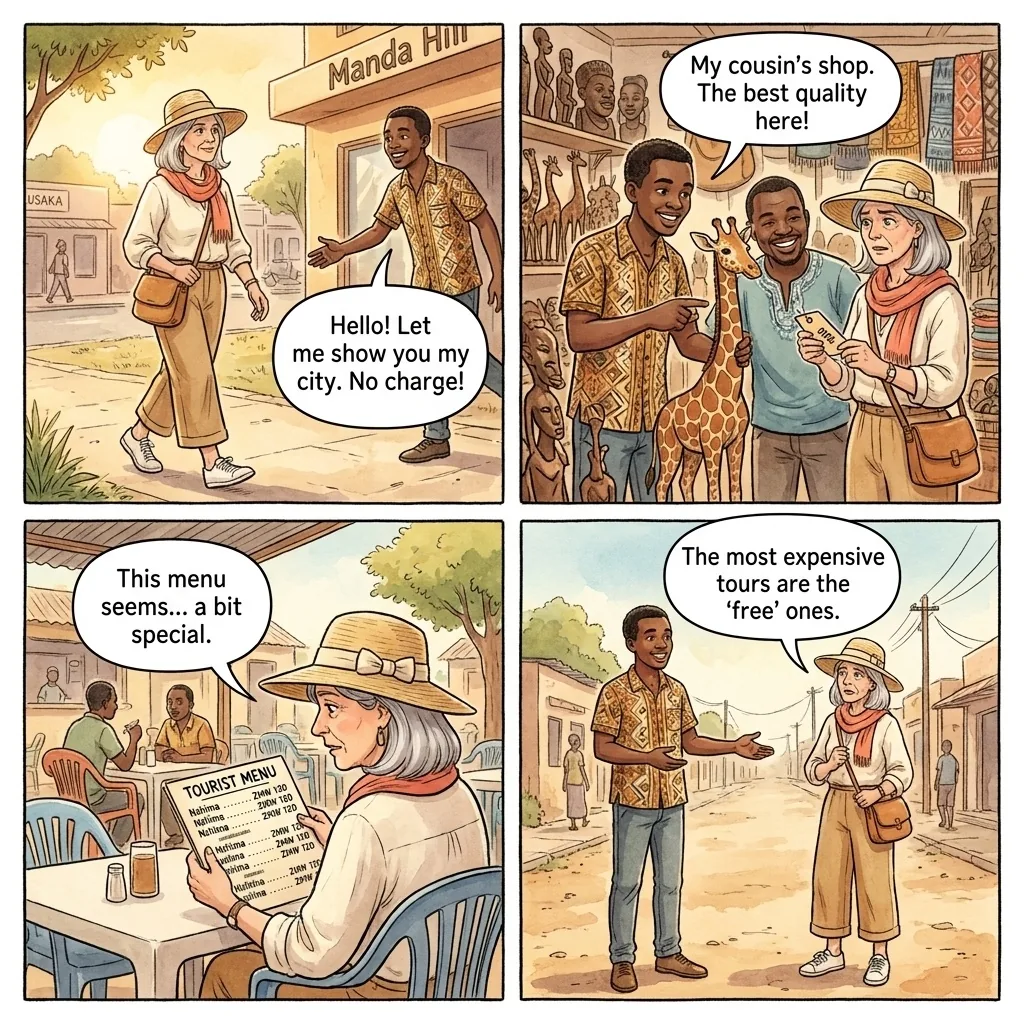
It's a Saturday morning, you're walking from Manda Hill toward central Lusaka, and a friendly young Zambian man strikes up a conversation about your trip and offers to show you around the city.
He says he's a part-time student and a 'tourism volunteer,' and he won't charge anything — just wants to practice his English. The walk that follows is genuinely pleasant for the first thirty minutes. Then the 'tour' settles into a rhythm of carefully-chosen stops: a craft shop where his cousin works (everything triple normal Lusaka price), a restaurant with a 'tourist menu' (the same nshima-and-relish that locals eat for ZMW 40 priced at ZMW 120), a 'cultural centre' where the entrance fee is ZMW 200 (the actual local price is ZMW 50). At the end, your 'volunteer' guide expects a generous tip — ZMW 200–500 — for his time.
The Lusaka commission-guide tour uses three structural failures: the 'free' framing as a low-friction conversion mechanic, the personal-relationship framing at every stop ('my cousin's shop,' 'my friend's restaurant') that makes inflated prices feel like personal-favour pricing, and the closing-tip ask that doubles the customer's spend on the day. As travelers report across Reddit, the TripAdvisor Lusaka forum, and the Lonely Planet Africa thorntree, while some of these informal 'guides' are harmless friendly Zambians genuinely curious about visitors, others run a calibrated commission economy — and a small fraction steer tourists toward unsafe areas or set up the conditions for the follow-from-the-bank robbery covered earlier.
The legitimate Lusaka tour-guide ecosystem is real and well-documented. The Zambia Tourism Agency licenses tour operators with documented itineraries and posted prices. Most major Lusaka hotels offer 'city tour' packages with vetted licensed guides at fair-market rates. The Lusaka National Museum, the Henry Tayali Visual Arts Centre, and the Sunday market at Arcades all have established legitimate experiences that don't require a 'volunteer guide' to access.
The structural defences are clear. Politely decline unsolicited 'free guide' offers from strangers in Lusaka — a polite firm 'no thank you, I'm exploring on my own' ends most attempts. If you do want a guided experience, book through your hotel concierge or directly through Zambia Tourism Agency-licensed operators. For shopping, compare prices at multiple shops and verify against Manda Hill mall pricing for any meaningful purchase. Don't follow strangers to 'cultural centres' or 'special spots' that aren't on Google Maps with documented reviews. If a 'volunteer guide' interaction shifts into commission shopping, end it; you have no obligation to continue.
Decline unsolicited 'free guide' or 'volunteer tour' offers from strangers in Lusaka with a polite firm 'no thank you, I'm exploring on my own' — most attempts end within seconds. If you want a guided Lusaka experience, book through your hotel concierge or directly through Zambia Tourism Agency-licensed operators. For shopping, compare prices at multiple shops and verify against Manda Hill mall pricing for any meaningful purchase; refuse 'my cousin's shop' framings. Don't follow strangers to 'cultural centres' or 'special spots' that aren't on Google Maps with documented reviews. If a guide interaction shifts into commission shopping, end it; you have no obligation to tip an unsolicited 'volunteer.' Emergency: 991 (Zambian Police).
Red Flags
- Stranger offers free guidance without being asked
- They have a specific list of places they want to take you
- Every suggested stop involves spending money
- Vendor at each stop seems to know your guide personally
- Prices at recommended shops are noticeably higher than elsewhere
How to Avoid
- Politely decline unsolicited tour offers from strangers.
- If you want a guide, book through your hotel or a verified tour agency.
- Compare prices at recommended shops with prices elsewhere before buying.
- Set clear boundaries about where you want to go and your budget.
- Trust your instincts -- if the guidance feels like a sales pitch, it is.
🆘 What to Do If You Get Scammed
📋 File a Police Report
Go to the nearest Zambia Police Service station. Call 999 (Police) or 991 (Ambulance). Get an official crime report — you'll need this for insurance claims. You can also report online at zambiapolice.gov.zm.
💳 Cancel Your Cards
Call your bank immediately. Most have 24/7 numbers on the back of the card (keep a photo saved separately). Block any suspicious transactions before the thieves use your details.
🛂 Lost Passport?
Contact the US Embassy in Lusaka at Eastern End of Kabulonga Road, Ibex Hill, Lusaka. For emergencies: +260 211-357-000.
📱 Track Your Device
If your phone was stolen, use Find My (iPhone) or Find My Device (Android) from another device. Don't confront thieves yourself — share the location with police instead.
Frequently Asked Questions
You just read 6 scams in Lusaka. The full Travel Safety Series has 780+ more across 20+ countries.
Tokyo's Kabukichō ¥130,000 bar trap. Rome's gladiator photo extortion. Paris's gold-ring trick. Bali's ATM skimmer scams. Bangkok's grand-palace closure ruse. Every documented scam across 20+ destinations — with the exact scripts, red flags, and local-language phrases that shut each one down. Drawn from Reddit traveler reports, embassy advisories, and consumer-protection cases.
- 780+ documented scams across Tokyo, Rome, Paris, Bali, Bangkok, Rio & 100+ more cities
- 20+ countries covered, with country-by-country phrase cards for every destination
- Updated annually — buy once, re-download future editions free
- All titles $4.99 each on Amazon Kindle