
Key Takeaways
- The #1 reported scam is the Maldives Liveaboard Booking Vanish.
- 3 of 6 scams are rated high risk.
- Use app-based ride services (Uber) or official metered taxis instead of unmarked vehicles.
- Never accept unsolicited offers from strangers near tourist sites in Maldives.
⚡ Quick Safety Tips
- Keep phones and valuables in secure pockets when in crowded areas.
- Use only licensed taxis or app-based ride services.
- Book tours and tickets through verified operators with online reviews.
- Keep a copy of your passport separate from the original.
Jump to a Scam
The 6 Scams
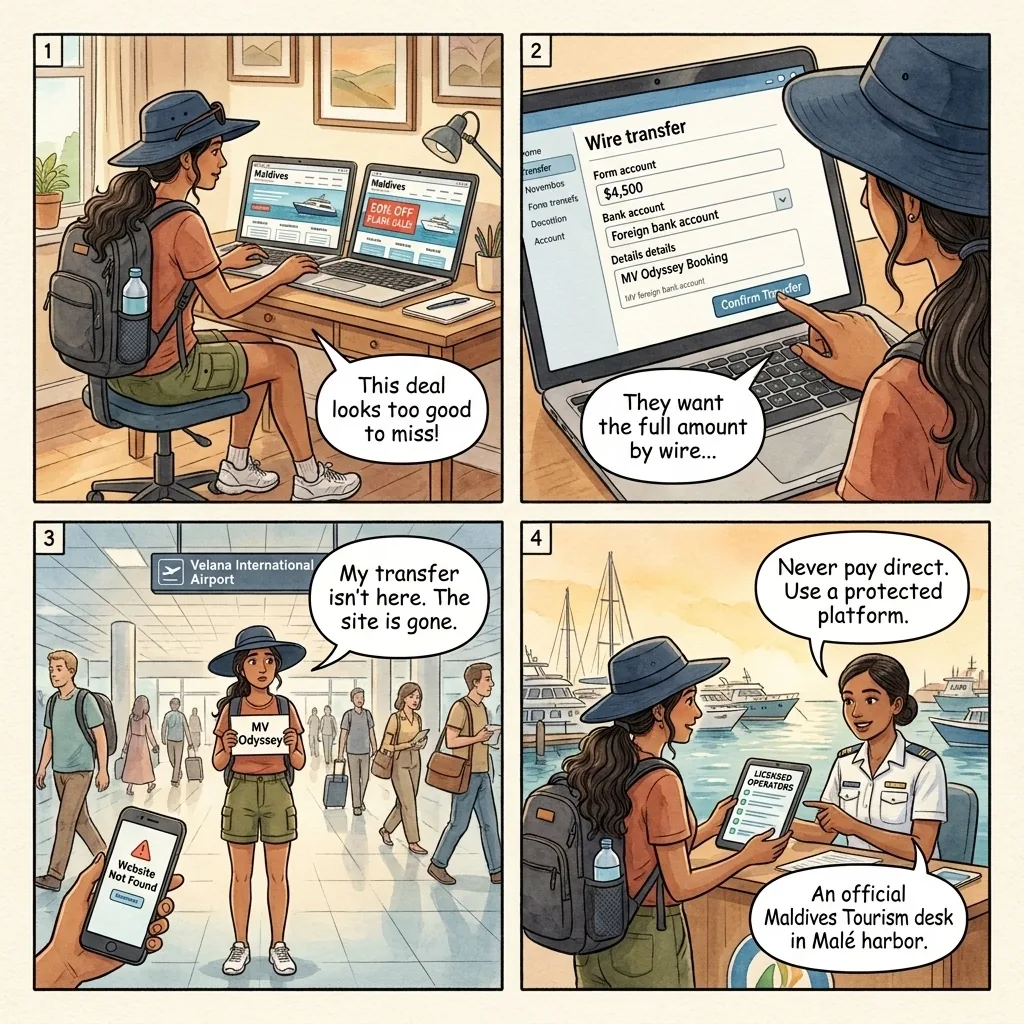
A liveaboard website at 30–50% below LiveAboard.com prices collects $2,000–$8,000 wire-transfer payment for a week-long cruise — at least 88 Russian and German tourists were stranded in a single November 2013 scam, and the pattern repeats yearly per The Maldives Independent.
The Maldives Independent reported that dozens of tourists are stranded each year in the Maldives by liveaboard booking scams, with the problem harming the country's international reputation. Scammers create fraudulent websites that copy legitimate liveaboard operators, collect full payment ($2,000–$8,000 per person for a week-long cruise), and then disappear. At least 88 Russian and German tourists were stranded in November 2013 after a single scam operation.
The Minivan News archive documented how a Hong Kong-based tour operator reported that Poseidon Tours stranded several guests 'desperately in Male without any excuse' in 2012. The Before You Go Travels 2026 Maldives guide describes a variation where scammers sell holidays on luxury cruisers at attractive prices, but when tourists arrive, they are transferred to low-grade boats that bear no resemblance to the advertised vessel.
Some websites clone legitimate operators, using the same boat photos and names but routing payments to different bank accounts. The clone is sophisticated: identical layout, identical fleet imagery, slightly different domain name (luxuryliveaboard-maldives.com vs the real operator's domain). Google Search Console rankings often place the clone above the real site for several weeks before the legitimate operator notices.
The GoDigit Maldives scam guide confirms that these fraudulent sites often rank well in Google searches because scammers invest in SEO. Websites like theonlineholidays.com and allinoneasia.com were specifically named as fraudulent operators that collect bookings and payments but never pay the actual hotels or boat owners, leaving tourists stranded at Male's Velana International Airport with no accommodation or transport.
The defensive move is to book liveaboards only through established aggregators (LiveAboard.com, PADI Travel, Dive The World) that vet operators and offer booking protection — never via wire transfer to a website you found through Google Ads. Verify the operator is registered with the Maldives Ministry of Tourism at tourism.gov.mv before paying. Pay by credit card for chargeback protection. Contact the boat operator directly using phone numbers found independently. Police: 119. Tourist Police: 1581.
Red Flags
- The website offers liveaboard cruises at 30-50% below prices listed on established platforms like LiveAboard.com or Dive The World
- Payment is requested via bank wire transfer rather than credit card through a secure booking platform
- The website has no verifiable physical address in the Maldives, no local phone number, or only a WhatsApp contact
- Reviews on the website itself are glowing, but the operator has no TripAdvisor, Google, or Trustpilot presence
- The operator pressures you to book immediately with a 'limited availability' or 'flash sale' urgency
How to Avoid
- Book liveaboards only through established aggregators like LiveAboard.com, PADI Travel, or Dive The World that vet operators and offer booking protection.
- Verify the operator is registered with the Maldives Ministry of Tourism at tourism.gov.mv before paying any deposit.
- Pay by credit card for chargeback protection; never wire funds or use cryptocurrency for travel bookings.
- Cross-reference the boat name and photos across multiple independent review sites to confirm the vessel exists and matches descriptions.
- Contact the boat operator directly using phone numbers found independently (not from the booking site) to confirm your reservation exists.
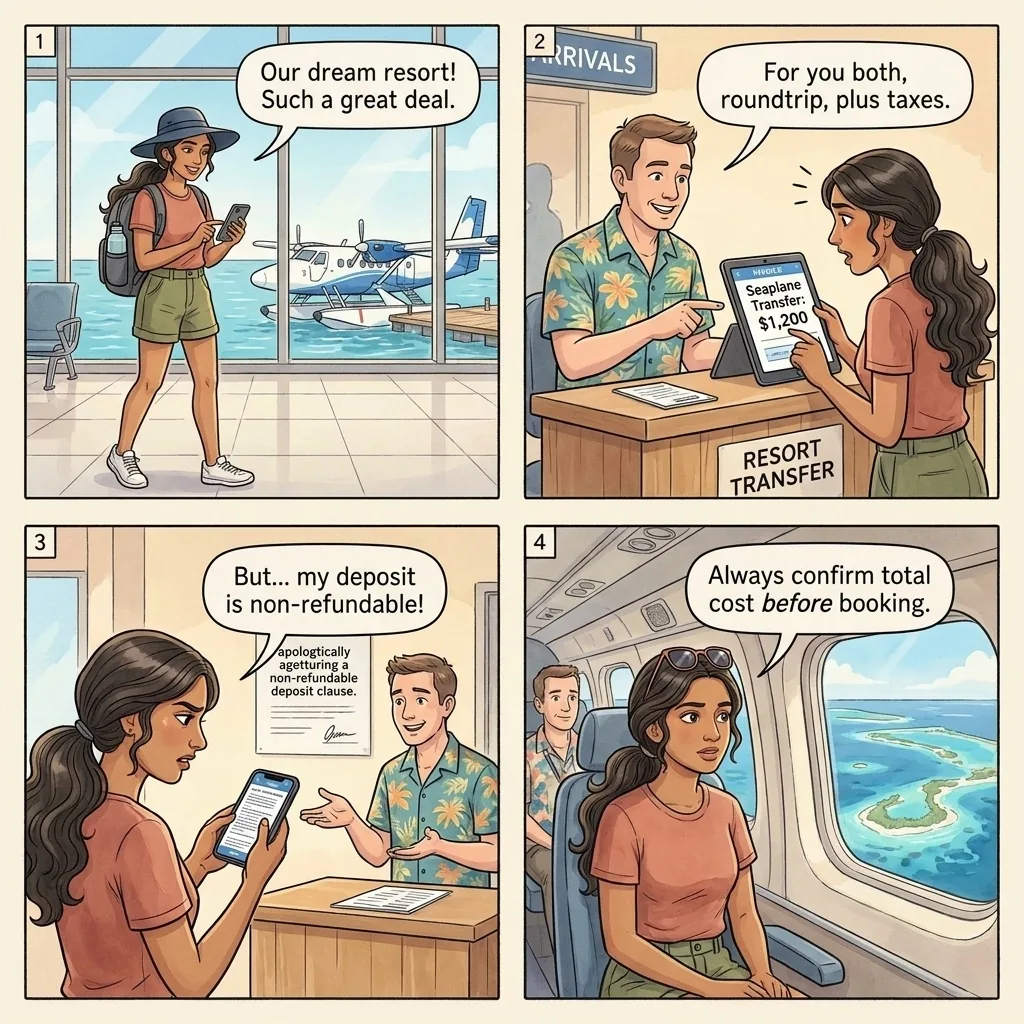
A Maldives resort lists $500/night and stays silent on transfers — the seaplane is $290–$700 per person roundtrip (some up to $900), VAT adds 16%, service charge 10%, Green Tax $6/night, and night arrivals require a mandatory $100–$200 Male hotel before sunrise seaplane departure.
TripAdvisor's Maldives forum features an extensive thread titled 'Don't want to pay high transfer fees' where travelers express shock at transfer costs that were not clearly communicated before booking. Seaplane transfers range from $290 to $700 per person roundtrip, with some luxury resorts charging up to $900. A separate thread titled 'Question re: Seaplanes - Scam?' captures the confusion many first-time visitors feel when quoted $1,000+ for a couple's roundtrip transfer on top of already expensive resort rates.
The Points Guy's comprehensive guide to Maldives resort transfer fees documents that some resorts bury transfer costs in fine print or omit them entirely from headline pricing. The disclosure happens only after the deposit is paid, by which point cancellation forfeits 30–50% of the booking value.
The Voyager Guru blog's 'Hidden Costs of a Maldives Trip' reveals that taxes alone add 25%+ to every charge: 16% VAT on all goods and services, a mandatory 10% service charge on dining and spa treatments, and a $6 per-night Green Tax per person. A $500/night resort actually costs $650+ per night after these mandatory additions.
The This Island Life transfer guide warns that resorts accessible only by seaplane have specific operating hours (sunrise to sunset), meaning if your international flight arrives at night, you must pay for a mandatory hotel night in Male ($100–$200) before your seaplane the next morning. This additional cost is rarely disclosed during booking.
The defensive move is to email the resort directly before booking and ask for the total cost including transfers, 16% VAT, 10% service charge, $6/night Green Tax, and any mandatory meal plans — get the full number in writing. Choose North or South Male Atoll resorts for $100–$250 speedboat transfers vs $400–$900 seaplanes. Book international flights arriving before 2 PM to avoid mandatory Male overnight. Consider Maafushi or Thulusdhoo guesthouses ($25–$40 transfer). Tourist Police: 1581.
Red Flags
- The resort's headline nightly rate does not mention transfer costs, taxes, or service charges anywhere on the booking page
- The booking confirmation says 'transfer cost to be confirmed' rather than providing a fixed price
- Your international flight arrives after 3:30 PM and the resort has not mentioned a mandatory overnight in Male
- The resort is on a distant atoll requiring a seaplane but the total price seems comparable to resorts near Male accessible by speedboat
- The 'all-inclusive' package does not specify whether transfers, excursions, and taxes are included
How to Avoid
- Before booking any resort, email them directly asking for the total cost including transfers, taxes (16% VAT + 10% service charge), Green Tax, and any mandatory meal plans.
- Choose resorts in North or South Male Atoll for speedboat transfers ($100-250 roundtrip) instead of distant atolls requiring seaplanes ($400-900 roundtrip).
- Book international flights arriving before 2 PM to avoid the mandatory overnight in Male; seaplanes do not fly after sunset.
- Compare total costs (room + transfer + taxes) rather than nightly rates; a cheaper-per-night distant resort can cost more overall than a pricier nearby one.
- Consider guesthouses on local islands (Maafushi, Thulusdhoo) where speedboat transfers from Male cost $25-40 per person.
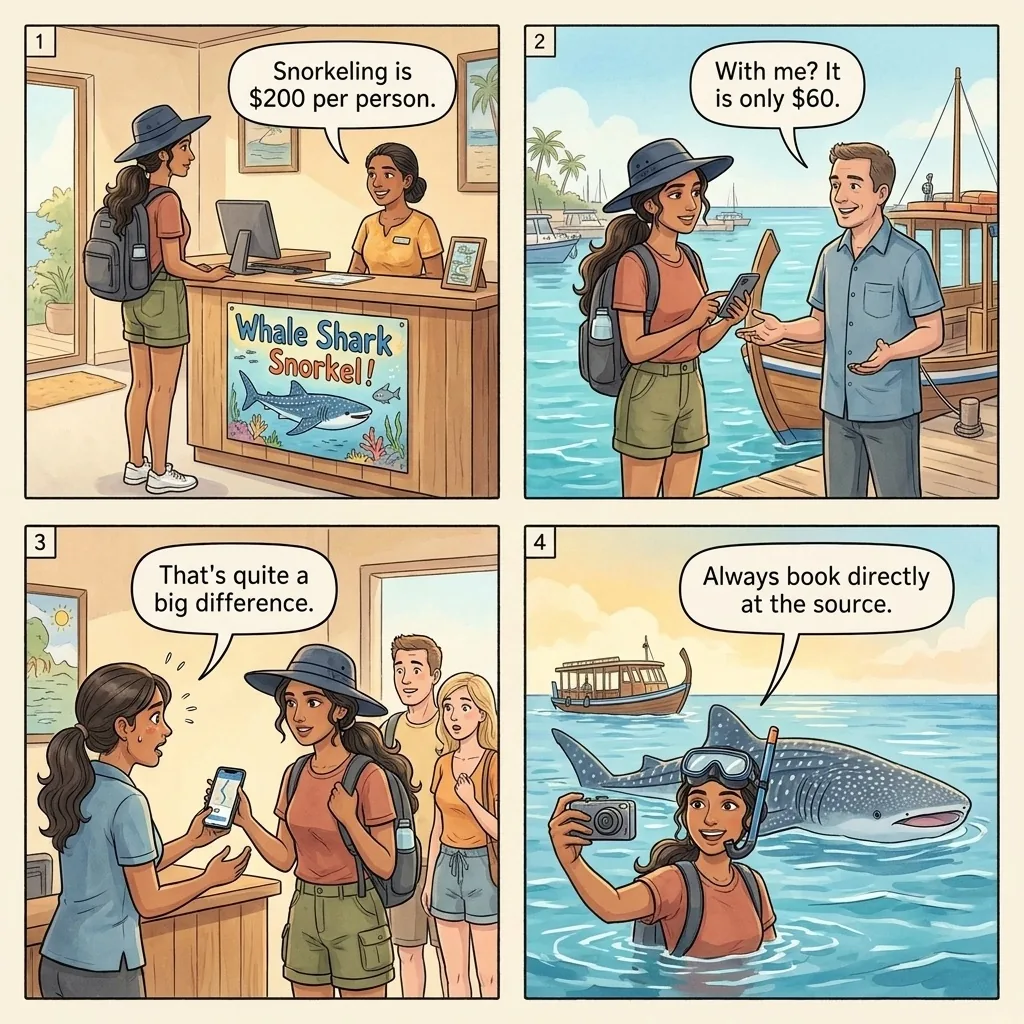
A Maafushi guesthouse quotes $80 for a dolphin cruise — the same boat captain at the harbor charges $30–$40 directly. Resort excursion desks mark up 100–300% (whale-shark snorkel: $60 independent, $200–$300 through resort), with surprise life-jacket and 'rescue insurance' fees added at the dock.
The Before You Go Travels 2026 Maldives guide documents aggressive upselling at both resorts and local-island guesthouses. Guesthouses on popular local islands like Maafushi and Dhigurah quote snorkeling, dolphin watching, and sandbank excursions at prices significantly above what independent boat operators on the same island charge. A dolphin cruise quoted at $80 per person through a guesthouse can be booked directly with boat captains at the harbor for $30–$40.
The GoDigit Maldives scam guide reveals hidden fee structures on excursions: some trips include surprise charges for life-jacket rentals ($5–$10), 'rescue insurance' fees ($15), or competency test charges for basic activities like paddleboarding ($20). The Wiki For Travel Maldives guide warns that resort excursion desks mark up activities by 100–300% compared to local operators, with a whale-shark snorkeling trip that costs $60–$80 independently priced at $200–$300 through the resort.
The harbor-direct vs guesthouse-desk gap is a kickback economy: the guesthouse takes 30–50% of every excursion booking, and the boat captain absorbs the rest. By walking 200 m to the harbor, you cut out the kickback layer and pay the captain his real price directly. Most captains speak enough English to negotiate, and most accept cash on the dock.
The Voyager Guru hidden-costs guide warns about resort minibar and dining markups: a cocktail at a resort bar costs $15–$25, a bottle of water $5–$8, and a basic dinner $80–$150 per person. Some resorts that advertise 'all-inclusive' packages limit drinks to house brands and exclude premium spirits, specialty restaurants, and spa treatments, despite the implication that everything is included.
The defensive move is to walk to the harbor on local islands and negotiate excursions directly with boat captains — prices are typically 40–60% of guesthouse quotes. Get a written breakdown of all excursion inclusions before paying. For resort stays, request a detailed all-inclusive inclusions list before booking. Book through TripAdvisor or GetYourGuide with verified pricing. Bring your own snorkel gear and reef-safe sunscreen. Tourist Police: 1581.
Red Flags
- The guesthouse or resort insists their excursion is the only option and discourages you from booking independently
- The excursion price does not include equipment rental, insurance, or other fees that are added at the dock
- A 'free' snorkeling trip requires mandatory purchases of photos, videos, or equipment at inflated prices
- The resort's 'all-inclusive' rate excludes premium drinks, specific restaurants, water sports, and spa services
- There is no written confirmation of what the excursion price includes before you pay
How to Avoid
- On local islands, walk to the harbor and negotiate directly with boat captains for excursions; prices are typically 40-60% of guesthouse quotes.
- Get a written breakdown of all excursion inclusions (equipment, fuel, lunch, snacks) before paying, and confirm there are no surprise fees.
- For resort stays, request a detailed menu of all-inclusive inclusions before booking to understand exactly what is and is not covered.
- Book excursions through TripAdvisor or GetYourGuide with reviews that confirm the total price and what is included.
- Bring your own snorkel gear and reef-safe sunscreen to avoid inflated equipment rental charges.
Like what you're reading? Get a full Maldives itinerary with safety tips built in.
Browse travel-safety books →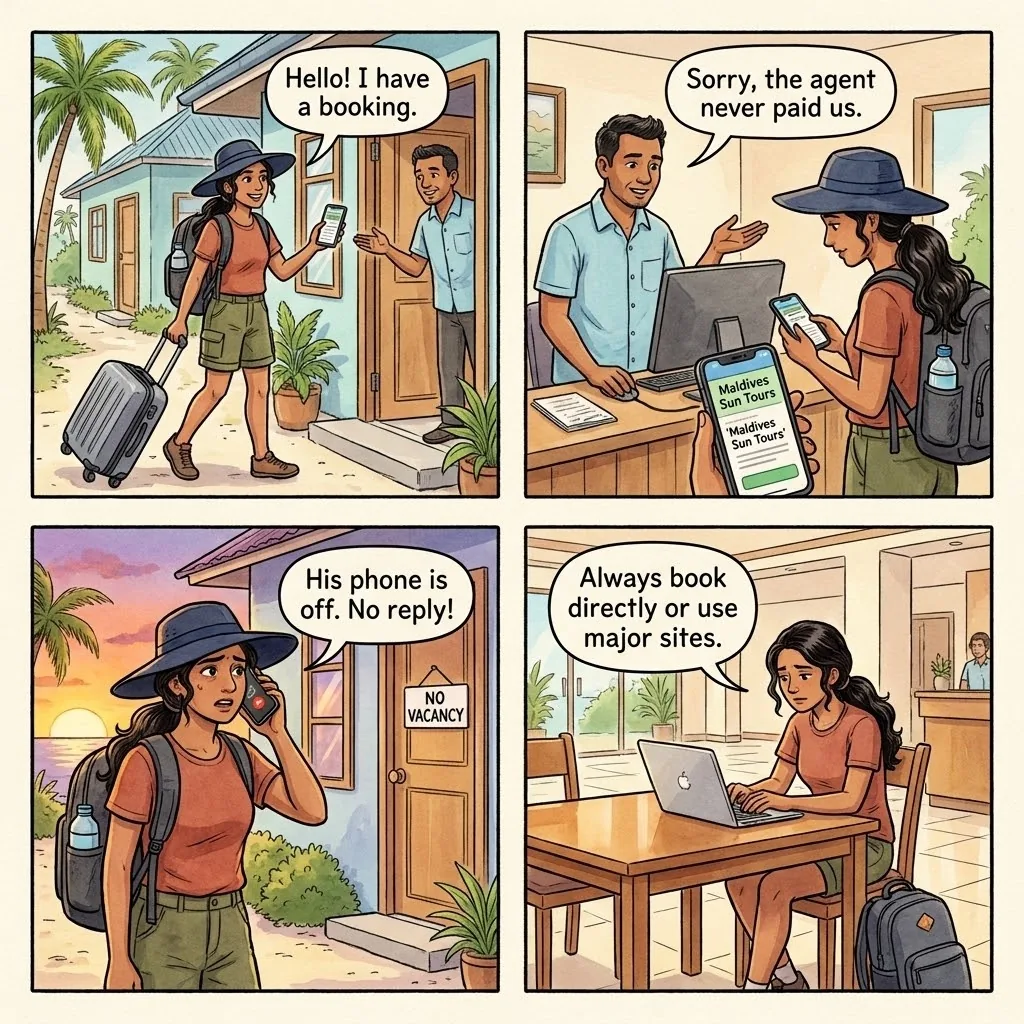
A Hulhumale agent (UI Maldives, Oey Joy Maldives, etc.) takes full payment for a guesthouse, makes a dummy booking, never pays the property — you arrive at the door and the guesthouse has no record of you. Local islands are full in peak season; you sleep at the airport.
TripAdvisor's Maldives forum features a review titled 'SCAM... FRAUD TOUR OPERATOR IN MALDIVES' about UI Maldives in Hulhumale, where a traveler arrived to find their pre-paid booking did not exist. The Before You Go Travels guide confirms this as a systematic pattern: fraudulent operators create attractive listings on booking platforms, collect full payment, then either provide a drastically inferior room or have no room at all.
The Never Ending Footsteps blog published a detailed account titled 'Scammed in Guraidhoo' describing a guesthouse owner who advertised beachfront rooms with ocean views but provided a windowless room with mold-covered walls, refusing any refund. The bait-and-switch is choreographed: photos in the listing are real photos of rooms that exist somewhere, just not the one you'll be assigned.
The TripAdvisor thread about Oey Joy Maldives documents a local agent who took full payment from multiple customers, made dummy bookings at resorts, and never paid the resorts. Travelers arrived to find no reservation, no accommodation, and no recourse. The agent stopped responding to all communication after collecting payment, and Oey Joy itself disappeared from booking platforms shortly after.
The GoDigit scam guide notes that budget travelers on local islands are the most vulnerable, as the desire to experience the Maldives affordably leads them to book through unverified agents offering suspiciously cheap packages. Local islands have limited accommodation, so arriving without a confirmed booking can leave you stranded with no alternatives, especially during peak season (December–April).
The defensive move is to book only through major platforms (Booking.com, Agoda, Airbnb) with verified listings and refund protection — never via direct bank transfer to a local agent. Cross-reference the guesthouse address on Google Maps to verify it exists. Read TripAdvisor reviews specifically checking for bait-and-switch complaints. Pay by credit card for chargeback protection. Confirm your booking directly with the guesthouse via email before arrival using contacts found independently. Tourist Police: 1581.
Red Flags
- The guesthouse price is significantly below other properties in the same area and category on Booking.com
- The host insists on direct bank transfer rather than booking through Booking.com, Airbnb, or Agoda with platform protection
- Photos show a luxury beachfront property but the location is on a local island where such properties do not exist
- The agent or host has few verified reviews, or reviews appear generic and posted within a short time period
- Communication becomes slow or stops after payment is made
How to Avoid
- Book only through major platforms (Booking.com, Agoda, Airbnb) that offer verified listings and refund protection.
- Cross-reference the guesthouse address on Google Maps to verify it exists and matches the listed island and location.
- Read TripAdvisor reviews specifically checking for bait-and-switch complaints; filter for recent 1-star reviews mentioning different rooms than advertised.
- Pay by credit card for chargeback protection and never send money via wire transfer or Western Union.
- Confirm your booking directly with the guesthouse via email or phone before arrival, using contact info found independently.
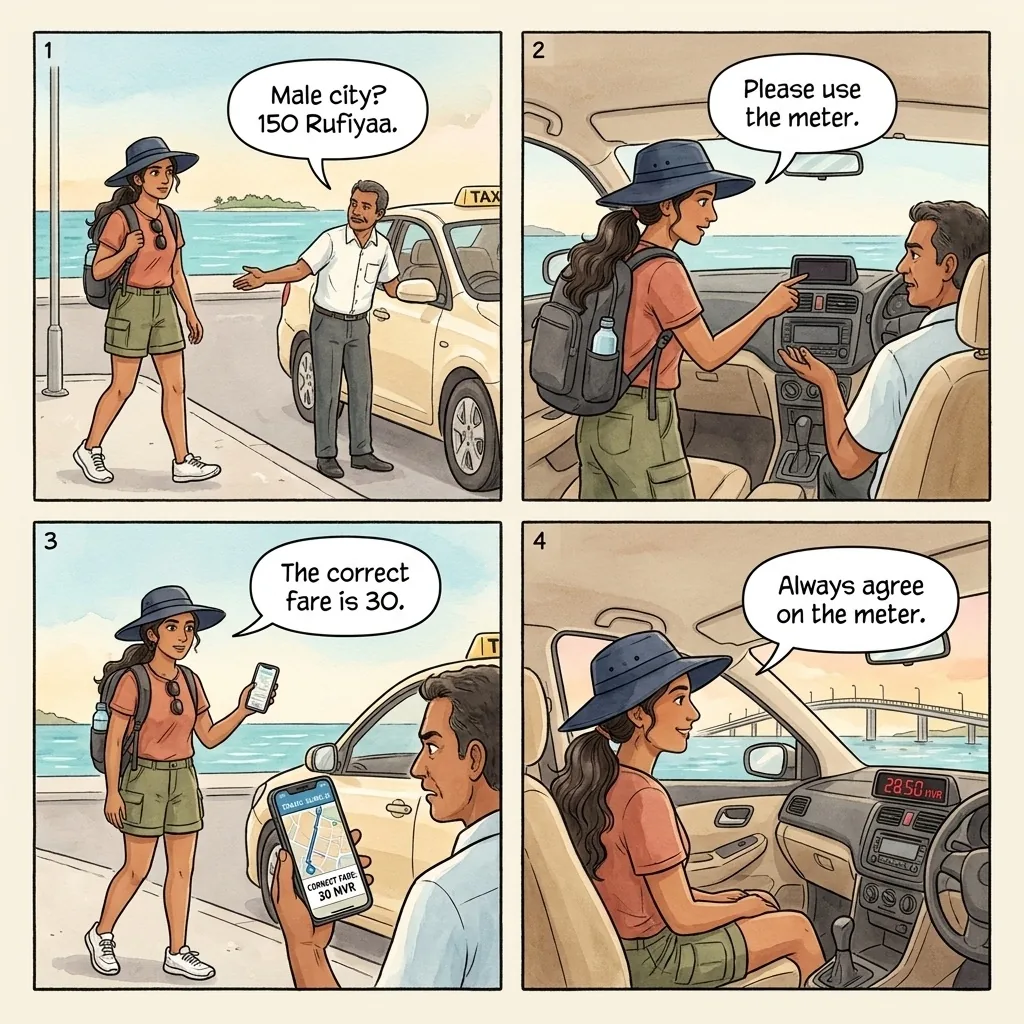
A Male taxi driver doesn't turn on the meter and quotes 100–200 MVR ($6.50–$13) for a trip that should be 25–30 MVR ($1.60–$2) in a 5.8 km city. Independent speedboat 'captains' at Male harbor quote $50–$100 for transfers the public MTCC ferry runs at $20–$30.
The GoDigit Maldives tourist scam guide documents that taxi drivers in Male purposely do not turn on meters and overcharge travelers, driving longer routes to inflate fares for a city that is only 5.8 km long. The before-arrival cost of a taxi from the airport to Male ferry terminal should be 25–30 MVR ($1.60–$2), but tourists regularly report being charged 100–200 MVR ($6.50–$13).
The circuitous-route variant is the harder mechanic: even with the meter on, drivers can take the long way through Male's narrow streets, doubling a 5-minute trip into a 15-minute one. The fare reads 'correct' on the meter but reflects three times the actual distance.
The Wiki For Travel Maldives guide describes a group scam variant: at bars or restaurants in Hulhumale, groups of locals approach tourists, order food and drinks, and later pressure the tourist to pay for everyone. The bill for the group can reach 1,000–2,000 MVR ($65–$130), with the locals becoming aggressive if the tourist refuses.
The One Vasco Blog safety guide notes that transport scams extend to speedboat transfers between Male and nearby islands. Independent speedboat operators at the Male harbor may quote $50–$100 for transfers that cost $20–$30 on the public MTCC ferry. They exploit tourists unfamiliar with the ferry schedule and routes, implying that the public ferry is 'dangerous' or 'unreliable' to justify the premium.
The defensive move is to insist on the meter for all Male taxi rides (starting fare 25 MVR plus per-km), use the airport taxi counter for fixed-rate fares, and check MTCC public-ferry schedules at mtcc.com.mv before accepting any private boat quote. Take the public ferry between Male and Hulhumale or the airport island ($1–$2). Never split bills with strangers at restaurants. Police: 119. Tourist Police: 1581.
Red Flags
- The taxi driver claims the meter is broken or suggests a flat rate significantly above 30 MVR for a Male city center trip
- A speedboat operator at the harbor dismisses the public ferry as unsafe and insists you must take their private boat
- A group of friendly locals at a bar wants you to join them and insists on ordering for the table
- The driver takes a circuitous route through Male's narrow streets rather than the direct coastal road
- Transport costs are only quoted verbally with no written receipt or confirmation
How to Avoid
- Insist on the meter for all Male taxi rides; the starting fare is 25 MVR plus per-kilometer charges.
- Use the airport taxi counter where fixed-rate tickets are sold for standard destinations rather than negotiating with individual drivers.
- Take the public ferry between Male and Hulhumale or the airport island ($1-2); departures are frequent and safe.
- For inter-island speedboats, check MTCC (Maldives Transport) public ferry schedules at mtcc.com.mv before accepting private boat quotes.
- Never split bills with strangers at restaurants; politely decline invitations from people you just met to join their table.
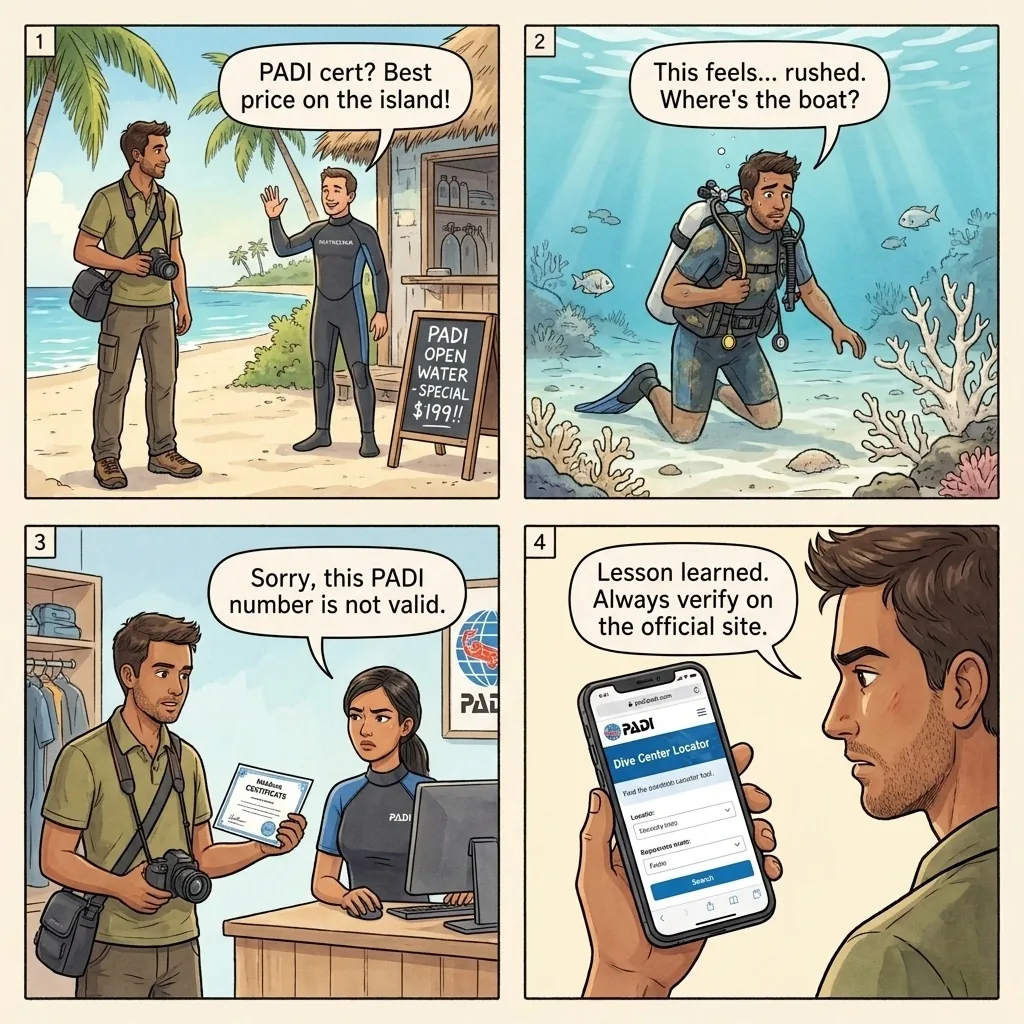
A Maafushi dive center offers PADI Open Water at $150–$200 — half the standard $450–$650 rate — using worn equipment, skipping open-water training dives, and issuing certs that aren't actually registered with PADI. Travelers later find their PADI numbers invalid when diving elsewhere.
The One Vasco Blog safety guide for the Maldives warns about unlicensed dive operators on local islands who offer PADI certification courses at $150–$200, roughly half the standard $350–$500 rate. These operators cut corners on safety: using poorly maintained equipment, skipping required open-water training dives, and issuing certificates that are not actually registered with PADI.
Several travel forums document cases where tourists who completed cheap certification courses discovered their PADI numbers were invalid when trying to dive elsewhere — the certificate is a printed sheet that looks legitimate but produces no result when checked against PADI's central registry. The financial cost is a re-certification fee at home; the safety cost is having dived to depth with inadequate training.
The Before You Go Travels guide warns of excursion operators with no insurance coverage, meaning tourists are fully liable for any accidents. Some snorkeling trips take tourists to areas with strong currents without proper safety briefings or life vests. The Maldives Independent reported on the tourism ministry's efforts to crack down on unlicensed operators following several drowning incidents.
A PADI-certified Maldives diving instructor documented on travel forums that legitimate dive centers in the Maldives are registered with the Maldives Ministry of Tourism and display their license prominently. The standard cost for a PADI Open Water course in the Maldives is $450–$650, and any offer significantly below this likely involves corners being cut on safety, equipment maintenance, or certification authenticity.
The defensive move is to verify any dive center's PADI affiliation by searching at padi.com/dive-shops before booking, and check Ministry of Tourism registration at tourism.gov.mv. Inspect equipment before diving and refuse anything that appears worn or improperly maintained. Ensure the instructor briefs you on emergency procedures, currents, and marine life hazards before every dive. Consider completing your PADI certification at home and using Maldives dive centers only for fun dives. Tourist Police: 1581. Ambulance: 102.
Red Flags
- The dive center offers PADI certification at prices 50% or more below the standard $450-650 rate
- Equipment appears old, damaged, or poorly maintained with visible wear on regulators and BCDs
- The instructor cannot show a current PADI instructor license with a verifiable number
- The course skips pool training or reduces the number of open-water dives below the PADI-required four
- There is no visible tourism ministry license displayed at the dive center
How to Avoid
- Verify any dive center's PADI affiliation by searching at padi.com/dive-shops before booking.
- Check that the dive center is registered with the Maldives Ministry of Tourism at tourism.gov.mv.
- Inspect equipment before diving and refuse to use anything that appears worn, cracked, or improperly maintained.
- Ensure the instructor briefs you on emergency procedures, currents, and marine life hazards before every dive.
- Consider completing your PADI certification at home and using Maldives dive centers only for fun dives, which are cheaper and let you verify equipment quality without financial pressure.
🆘 What to Do If You Get Scammed
📋 File a Police Report
Go to the nearest Maldives Police Service station. Call 119 (Emergency) or 1581 (Tourist Police). The main police HQ is at Shaheed Hussain Adam Building, Hilaalee Magu, Male. Get an official crime report — you'll need this for insurance claims.
💳 Cancel Your Cards
Call your bank immediately. Most have 24/7 numbers on the back of the card (keep a photo saved separately). Block any suspicious transactions before the thieves use your details.
🛂 Lost Passport?
Contact your nearest embassy or consulate. The US Embassy is at 33 Nine Elms Lane, London SW11 7US. For emergencies: +44 20 7499 9000.
📱 Track Your Device
If your phone was stolen, use Find My (iPhone) or Find My Device (Android) from another device. Don't confront thieves yourself — share the location with police instead.
Frequently Asked Questions
You just read 6 scams in Maldives. The full Travel Safety Series has 780+ more across 20+ countries.
Tokyo's Kabukichō ¥130,000 bar trap. Rome's gladiator photo extortion. Paris's gold-ring trick. Bali's ATM skimmer scams. Bangkok's grand-palace closure ruse. Every documented scam across 20+ destinations — with the exact scripts, red flags, and local-language phrases that shut each one down. Drawn from Reddit traveler reports, embassy advisories, and consumer-protection cases.
- 780+ documented scams across Tokyo, Rome, Paris, Bali, Bangkok, Rio & 100+ more cities
- 20+ countries covered, with country-by-country phrase cards for every destination
- Updated annually — buy once, re-download future editions free
- All titles $4.99 each on Amazon Kindle