
Key Takeaways
- The #1 reported scam is the Keflavik Airport Unlicensed-Taxi Markup.
- 2 of 6 scams are rated high risk.
- Use app-based ride services (Uber, Bolt) or official metered taxis instead of unmarked vehicles.
- Never accept unsolicited offers from strangers near tourist sites in Reykjavik.
⚡ Quick Safety Tips
- Book Northern Lights tours and glacier excursions only through operators with verifiable reviews — some budget operators cancel without refunds.
- Car rental damage scams are common — photograph your rental from every angle before driving off and decline unnecessary insurance upsells.
- Restaurants in central Reykjavik are legitimately expensive (not a scam), but 10-101 Reykjavik and Hlemmur Mathöll food hall offer better value.
- Don't leave valuables visible in rental cars at tourist stops — car break-ins at remote sites like Seljalandsfoss happen despite Iceland's low crime rate.
Jump to a Scam
The 6 Scams
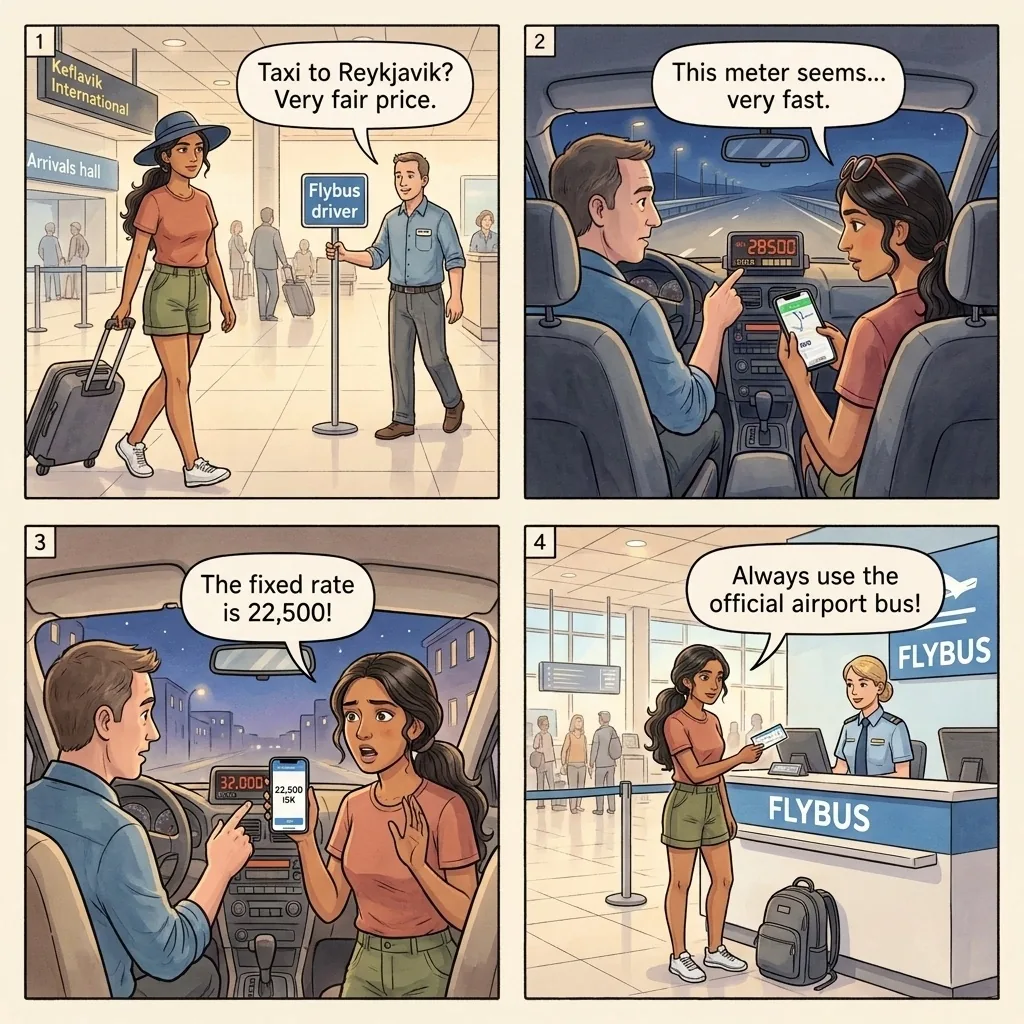
It's an evening flight into Keflavik, you've cleared customs after a transatlantic redeye, and a driver approaches you in the arrivals hall offering a 'taxi to Reykjavik' for what sounds like a reasonable rate.
He doesn't quote a specific number up front — he says 'metered, very fair' — and walks you to a sedan parked outside the terminal. Forty-five minutes later at your central Reykjavik hotel, the fare on the meter reads ISK 32,000 — about USD $230. The legitimate fixed-rate Keflavik-to-Reykjavik fare on a regulated Hreyfill or BSR taxi is ISK 22,500 for up to 4 passengers (about USD $160), and the Flybus shuttle service runs the same route for ISK 3,999 per person (USD $28).
The Iceland taxi market has been deregulated since 2021, which has allowed a wave of less-established operators to enter the airport-pickup market alongside the well-known Hreyfill, BSR, and Borgarbílar fleets. The newer entrants don't always run reliable meter-rate pricing; some explicitly target the Keflavik arrivals hall for tourists who don't know the legitimate fixed-rate. Iceland has no Uber or comparable rideshare app, so the on-the-ground options at Keflavik are: the Flybus shuttle (cheapest, regulated, runs every 35 minutes), a regulated Hreyfill or BSR taxi at the fixed ISK 22,500 rate, or the deregulated cab market which can run anywhere from ISK 22,000 to ISK 35,000+ depending on the operator. As travelers report across Reddit, the TripAdvisor Reykjavik forum, the Lonely Planet Iceland thorntree, and Iceland Tourism Board consumer alerts, the airport taxi markup is one of the most-reported tourist frictions.
The structural giveaways are visible at the kerb. A driver who approaches you inside the terminal rather than waiting at the official rank. No company markings or visible meter in the vehicle. A 'metered, very fair' framing without a specific dollar quote. Quotes per-person rather than per-journey (a four-person family pays four times the actual rate under this framing). The defence is to skip the kerb-pickup entirely.
The Flybus or Flybus+ shuttle is the legitimate baseline option for KEF-to-Reykjavik. Tickets bookable in advance at re.is or at the Flybus counter inside the terminal, ISK 3,999 per person, drops at the BSI bus terminal in Reykjavik with onward shuttle to most hotels. Reliable, regulated, frequent. For a private taxi, the regulated Hreyfill (+354 588 5522) and BSR (+354 561 0000) operators run the fixed ISK 22,500 fare on a per-vehicle basis (4 passengers max), bookable in advance.
Take the Flybus or Flybus+ shuttle from Keflavik to Reykjavik (ISK 3,999 per person, runs every 35 minutes, drops at BSI terminal with onward hotel shuttle) — bookable in advance at re.is. For a private taxi, pre-book Hreyfill (+354 588 5522) or BSR (+354 561 0000) at the regulated fixed ISK 22,500 fare for up to 4 passengers. Decline kerbside drivers in the arrivals hall who quote vague 'metered' fares without a specific number; the deregulated market can run 50%+ above the fixed-rate. Pay by credit card for chargeback options. Iceland has no Uber, so don't expect rideshare-style alternatives. Emergency: 112; the U.S. Embassy in Reykjavik is at +354 595 2200.
Red Flags
- Taxi driver approaches you inside the terminal rather than waiting at the rank
- No meter visible in the car
- Driver quotes a price per person rather than per journey
How to Avoid
- Book the official Flybus or Flybus+ shuttle in advance — far cheaper than a taxi.
- If taking a taxi, use only Hreyfill or BSR Taxi and confirm the fixed rate (22,500 ISK for a 4-seater as of 2025).
- Ask for the price before getting in and check the starting meter.
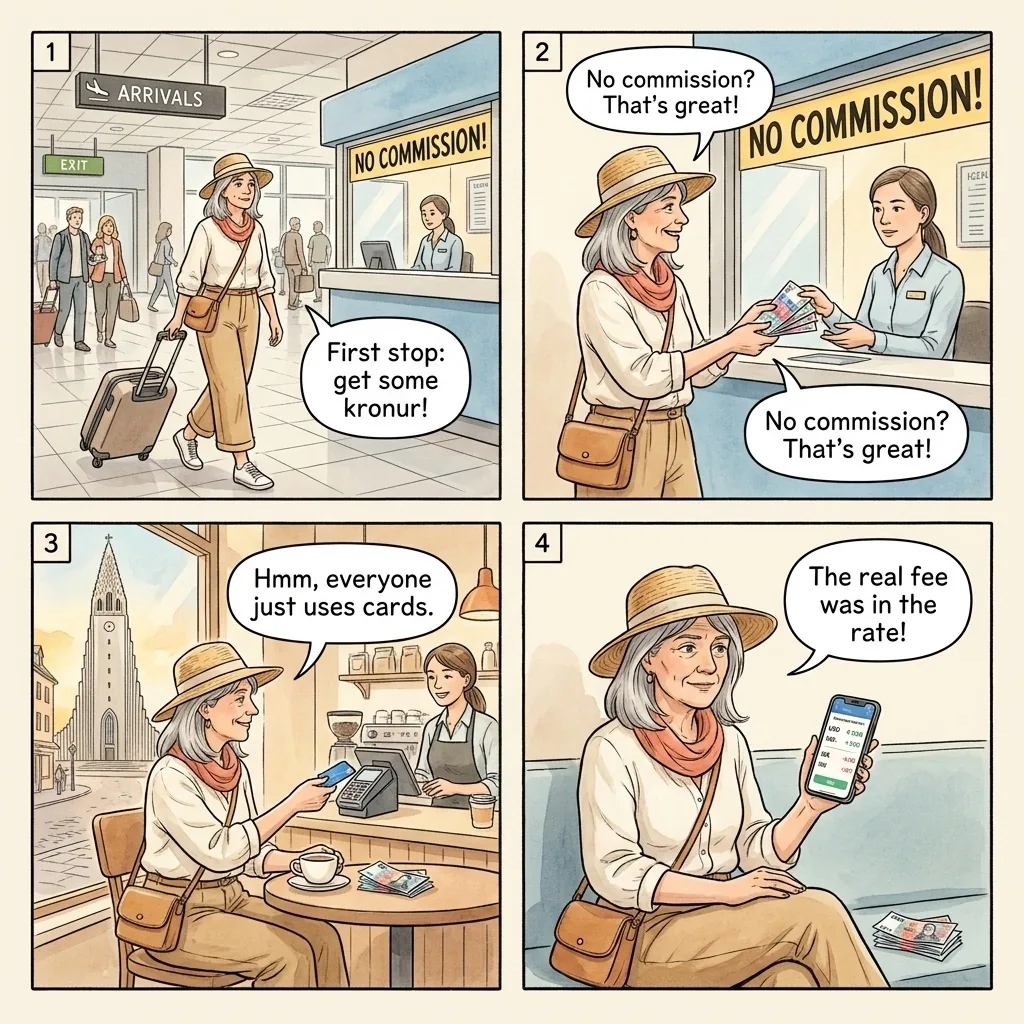
It's the morning your flight lands at Keflavik, you walk through customs into the arrivals hall, and the first thing you see is a brightly-lit currency-exchange booth offering 'NO COMMISSION!' on USD-to-ISK conversions.
You exchange $200 because you assume you need cash for the trip — taxi to the city, food, souvenirs, the standard travel-cash bundle. The headline rate looks competitive, no commission is displayed, and the transaction takes 90 seconds. You walk out with about ISK 24,000. Later, when you check the actual interbank rate against what you received, you realise the spread on the airport booth was 8–12% — your $200 was effectively converted at $0.92 of value. You've paid an invisible $16–24 fee for the convenience of arriving with kronur in hand.
Iceland is one of the most card-friendly countries in the world. Roughly 95% of all consumer transactions happen by card; bus fares, hot-dog stands, public toilets, parking meters, ferry tickets, museum entries, every restaurant in central Reykjavik — all accept Visa and Mastercard. The actual cash needs of a foreign visitor in Iceland are vanishingly small. As travelers report across Reddit, the TripAdvisor Reykjavik forum, the Lonely Planet Iceland thorntree, and the Central Bank of Iceland's published consumer guidance, the airport currency-exchange transaction is rarely necessary at all.
The 'no commission' framing is a misdirection. The exchange operators recover their margin entirely through the buy/sell spread — typically 6–12% wider at airport booths than at city banks or near-interbank rates via Wise/Revolut cards. The exchange is honest in the narrow sense that the rate is posted on the board, but the spread structure makes it the worst option available for any sum above $20–30 of emergency cash.
The defence is structural. Skip airport currency exchange entirely. Pay your Flybus or taxi fare by card; pay in-city restaurants, museums, and shops by card; if you need a small cash buffer for an emergency, withdraw ISK 5,000–10,000 from an ATM inside a Reykjavik bank branch (Landsbankinn, Íslandsbanki, Arion banki) at near-interbank rates. Decline Dynamic Currency Conversion (DCC) on every card payment — choose ISK at the terminal, not USD/EUR — to avoid an embedded 5–8% spread.
Skip the Keflavik airport currency-exchange booths entirely. Iceland is 95%+ cashless — pay your Flybus, taxi, restaurants, museums, and shops by card. If you need a small cash buffer, withdraw ISK 5,000–10,000 from an ATM inside a Reykjavik bank branch (Landsbankinn, Íslandsbanki, Arion banki) at near-interbank rates. Decline Dynamic Currency Conversion (DCC) on every card payment — always choose ISK at the terminal, not USD/EUR. A Wise or Revolut card runs at near-interbank rates everywhere in Iceland and removes the FX-spread issue entirely. Emergency: 112.
Red Flags
- Exchange booth is positioned right at arrivals for maximum convenience
- Rate displayed without commission or fees shown clearly
- Staff encourages large exchanges
How to Avoid
- Don't exchange currency at the airport — Iceland is 95%+ cashless and your card works everywhere.
- If you need cash, use an ATM inside the city at a bank branch (not airport kiosks).
- Always decline dynamic currency conversion on card payments.
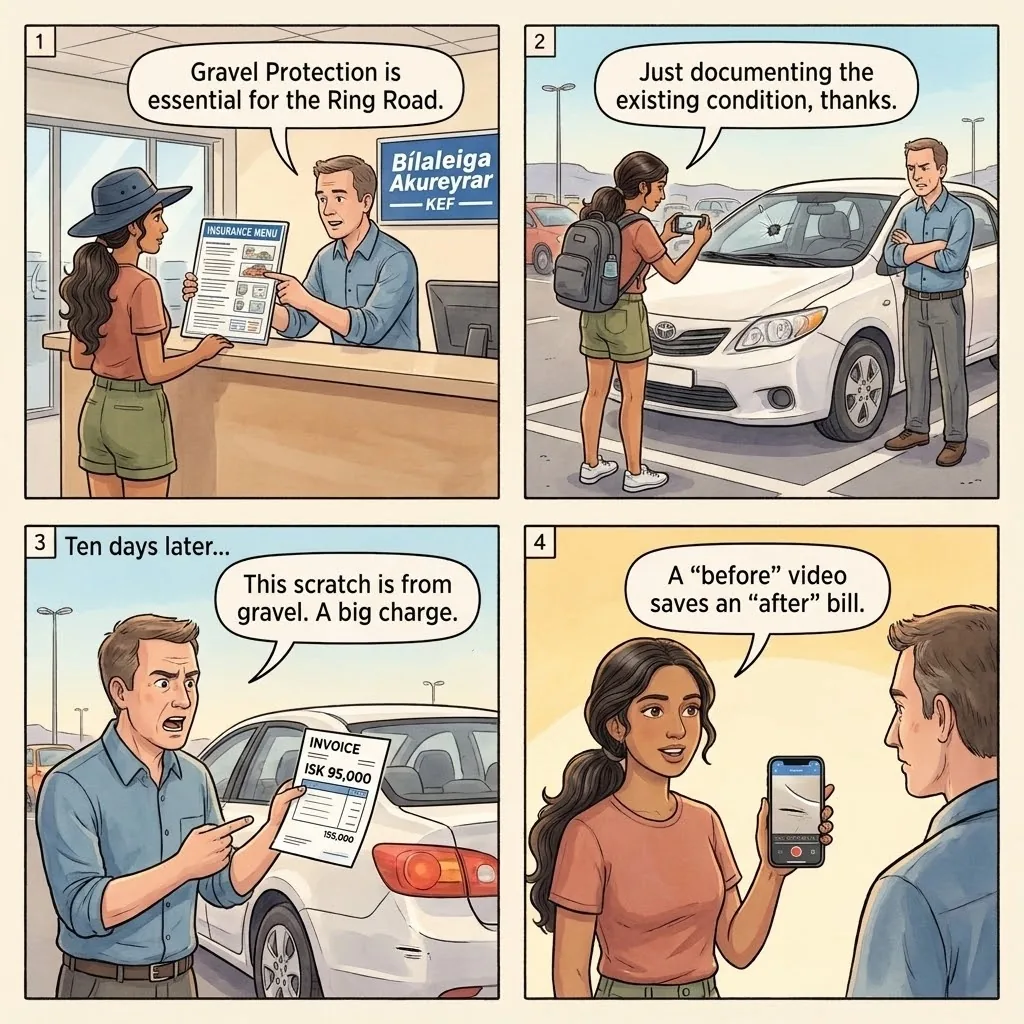
It's the morning of your Iceland Ring Road trip, you've just signed for a rental car at Keflavik, and the agent walks you through a layered insurance menu — Standard CDW, Super CDW, Gravel Protection, Sand-and-Ash Protection, Tire Protection.
The base CDW is included; Super CDW reduces the excess from ISK 350,000 to ISK 50,000 for ISK 4,000/day; Gravel Protection (which the agent emphasises is 'essential' for the Ring Road) is another ISK 2,500/day; Sand-and-Ash Protection is ISK 2,800/day; Tire Protection is ISK 1,500/day. The full bundle would add roughly ISK 11,000/day to a 10-day trip — about USD $750 on top of the rental cost. You decline Gravel and Sand-and-Ash because you weren't planning to go on the F-roads. The agent's expression suggests this is unwise.
Ten days later, on return, the agent walks the car carefully and finds a chip in the windshield, a tiny scratch on the front bumper, and a small dent on the rear quarter panel. None of these were photographed at pickup. The damage charge: ISK 95,000 (about USD $680). Because you declined Gravel Protection, the windshield chip is your full liability; because the bumper scratch happened 'on Iceland's gravel roads,' the standard CDW excess applies. The total is back-charged to your credit card.
The Iceland rental-car damage trap exploits the country's unusual road conditions — the Ring Road has stretches of loose gravel that genuinely do throw small stones, sandstorms in the south are real, and the Highland F-roads have tire and undercarriage hazards. The legitimate insurance products address real risks. The trap is the combination of (1) heavy upsell pressure on coverage that some travelers don't strictly need, (2) cursory pickup-time vehicle inspections that fail to document pre-existing damage, and (3) aggressive return-time damage-finding by agents who have economic incentive to bill back. As travelers report across Reddit, the TripAdvisor Iceland forum, the Lonely Planet thorntree, and the Iceland Consumer Agency's published rental-vehicle complaints, this is the highest-dollar Iceland tourist friction.
The structural defences are concrete. Film a slow, deliberate walkaround video of the entire vehicle at pickup and at return — every panel, the tires, the undercarriage, the windshield, the wheels — with a date-stamped phone. WhatsApp or email the videos to yourself for cloud-storage timestamps. Document the odometer and fuel gauge at both moments. Read the rental contract's fine print: standard CDW in Iceland does NOT cover gravel damage to the body or windshield; Gravel Protection is a separate product; you need to make an active decision rather than assume coverage. Use a credit card with strong rental-car coverage (Chase Sapphire Reserve, Amex Platinum, Capital One Venture X all offer primary collision coverage that often supersedes the rental's CDW upsell).
Film a slow, time-stamped walkaround video of the rental car at BOTH pickup and return — every panel, tires, undercarriage, windshield, wheels — and email/WhatsApp it to yourself for cloud-storage timestamps. Read the contract: standard Iceland CDW does NOT cover gravel damage; if you'll drive any gravel road (including parts of the Ring Road), Gravel Protection at ISK 2,500/day may be worthwhile. Use a credit card with primary rental-car collision coverage (Chase Sapphire Reserve, Amex Platinum, Capital One Venture X) which often supersedes the rental upsell. Get a written sign-off from the return agent confirming no new damage. If a damage claim arrives weeks after return, dispute with your card issuer using the timestamped video evidence. Emergency: 112; rental disputes: Iceland Consumer Agency (Neytendastofa) at +354 510 1100.
Red Flags
- Agent rushes through the vehicle inspection before you drive away
- Damage documentation is incomplete or done in poor lighting
- Agent pushes multiple overlapping insurance packages
How to Avoid
- Film every centimeter of the car before driving away — including tires, undercarriage, and roof.
- Email or WhatsApp the video to yourself as a timestamped record.
- Understand that standard SCDW in Iceland does NOT cover gravel damage — read the fine print.
Like what you're reading? Get a full Reykjavik itinerary with safety tips built in.
Browse travel-safety books →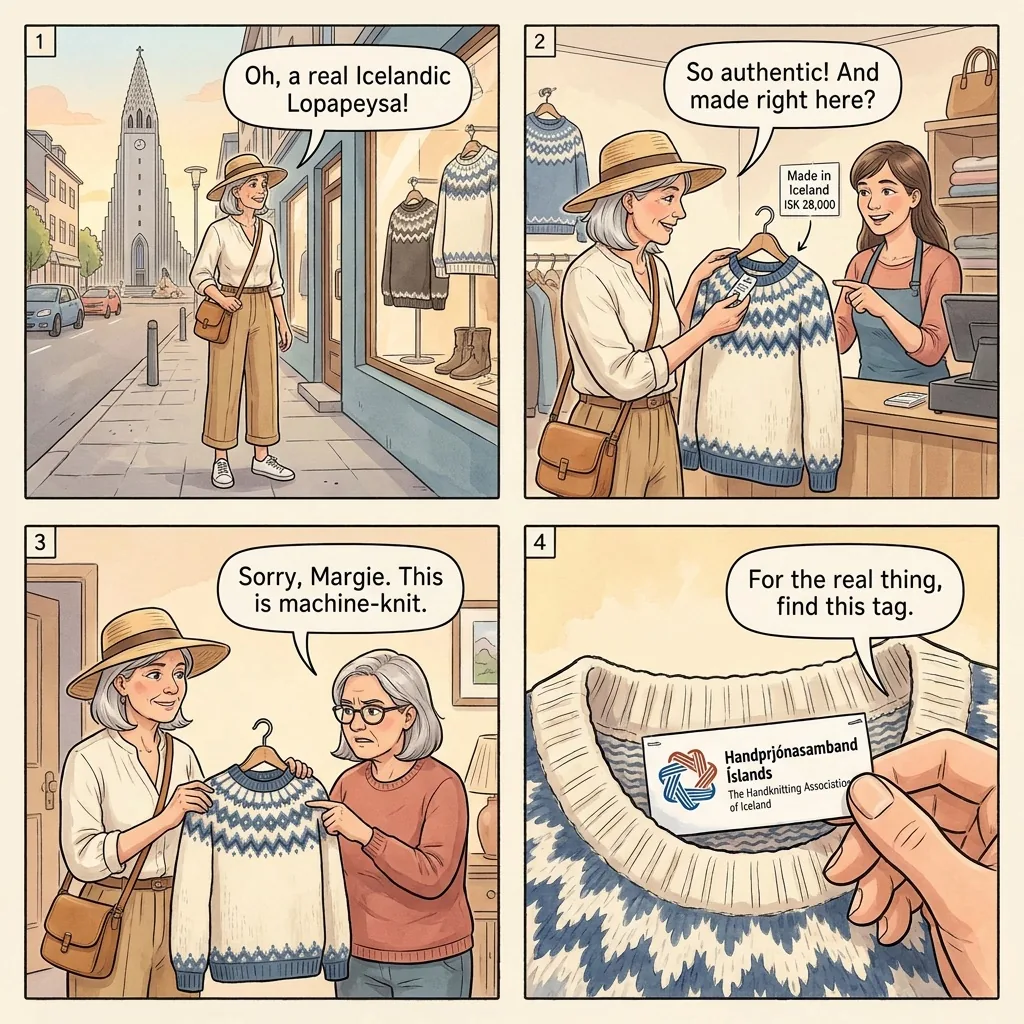
It's a Saturday afternoon on Laugavegur, you've fallen for the iconic Icelandic woolly Lopapeysa sweater displayed in a charming central Reykjavik shop window, and the price tag — ISK 28,000 (about USD $200) — feels reasonable for an 'authentic Icelandic handmade' souvenir.
The label says 'Made in Iceland.' You pay, feeling great about the authenticity. Back home a friend who knits looks at the sweater, runs a finger along the seams, checks the fibre against a swatch test, and tells you it was machine-knitted in China or Vietnam using a generic Nordic pattern stitched onto wool that isn't Icelandic at all. The 'Made in Iceland' tag was printed in Reykjavik and stitched onto the import; nothing about the actual sweater originated in Iceland.
A meaningful fraction of 'Lopapeysa' sweaters sold in central Reykjavik tourist shops are not handmade and not made of Icelandic wool. The Handknitting Association of Iceland (Handprjónasamband Íslands) — the certifying body for genuine Lopapeysa — has weighed in repeatedly on the import problem. Real Lopapeysa are knitted by hand by Association members from 100% Icelandic wool, take 30–60 hours per sweater, and retail at ISK 35,000–55,000 (USD $250–400). The cheaper machine-made imports from East Asia retail at ISK 15,000–28,000 with the 'Made in Iceland' label sometimes referring only to the final tag-and-packaging step. As travelers report across Reddit, the TripAdvisor Reykjavik forum, the Lonely Planet Iceland thorntree, and Iceland Tourism Board consumer alerts, this is the most-encountered Reykjavik retail-fraud category.
The structural giveaways are visible at the shop. Identical sweaters in dozens of sizes and colours on a rack — a real handknit operation produces small numbers of variant pieces, not stocked-in-volume identical SKUs. Machine-perfect pattern alignment with no minor knitter-handprint variations. A label that says 'Iceland' but not 'Handknit' or 'Handprjónað' or 'Handknitted in Iceland by [knitter name].' A price below ISK 30,000, which is below the legitimate minimum for genuine handknit Icelandic-wool sweaters. Shop staff who can't or won't tell you the knitter's name or the wool source.
The Handknitting Association's own retail outlet on Skólavörðustígur 19 sells certified handknit Lopapeysa with documented knitter names and 100% Icelandic wool, with prices clearly above the import range and quality clearly above. The Álafoss wool shop in Mosfellsbær (a 20-minute drive from Reykjavik) sells genuine Icelandic-wool sweaters direct from the source. These two are the gold-standard authenticity routes; central Laugavegur tourist shops require careful inspection.
Buy genuine Lopapeysa from the Handknitting Association of Iceland's retail outlet on Skólavörðustígur 19 (certified handknit, documented knitter, 100% Icelandic wool, ISK 35,000–55,000) or directly from Álafoss in Mosfellsbær. Avoid central-Laugavegur tourist-strip shops with stocked racks of identical sweaters in all sizes — that pattern indicates import sourcing. Look for the 'Handprjónað' (handknit) tag and the Association certification card; absence of either is a red flag. Real Lopapeysa have minor pattern asymmetries (handprint of the knitter); machine-perfect pattern alignment is an import giveaway. If the price is below ISK 30,000, the sweater is almost certainly not genuine handknit Icelandic-wool. Emergency: 112.
Red Flags
- Label says 'Iceland' without specifying 'Handmade' or '100% Icelandic wool'
- Price is suspiciously low for a hand-knitted item
- Shop sells dozens of identical sweaters in all sizes
How to Avoid
- Buy from the Handknitting Association of Iceland shop on Skólavörðustígur for guaranteed authenticity.
- Genuine Lopapeysa have slight imperfections — machine-perfect patterns are a red flag.
- Look for the 'Handmade in Iceland' certification tag.
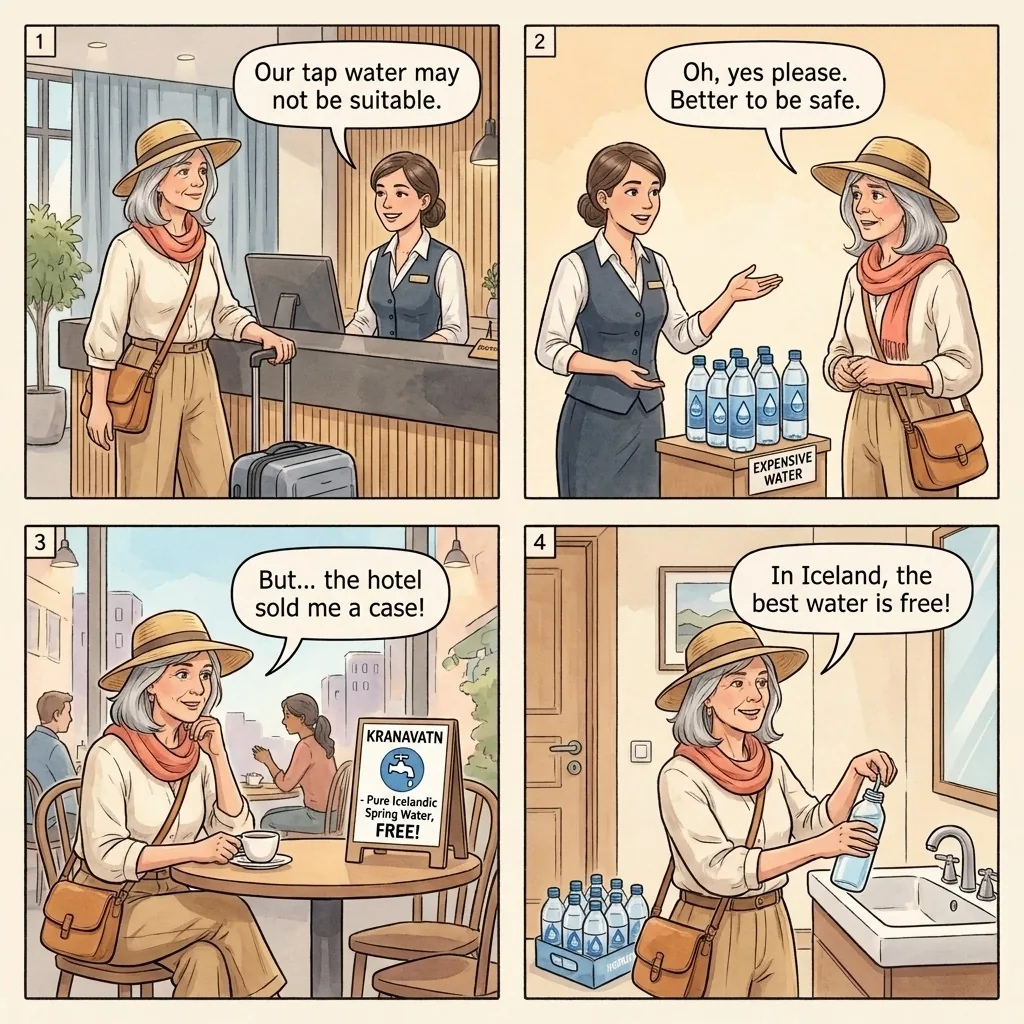
It's check-in afternoon at your Reykjavik boutique hotel, you've just signed for the room, and the front-desk receptionist mentions casually that the tap water 'might not be suitable for drinking' and offers to put a case of mineral water in your room for ISK 4,500.
You accept because you don't want to risk getting sick on day one of an expensive trip, the offer feels practical, and the upsell is gentle. Throughout your week in Iceland, you drink only the bottled water — and at the second restaurant, the third café, the fifth gas-station shop, you keep buying more. The week's bottled-water bill ends up at roughly ISK 12,000 (USD $85) for water you didn't need to buy at all.
Reykjavik's tap water is among the purest drinking water in the developed world. It comes directly from glacial springs through a minimally-treated municipal supply. The Reykjavik Water Authority has been recognised in Nordic and EU water-quality assessments as one of the highest-grade municipal-supply systems globally. The Icelandic Tourism Board, the Reykjavik Tourist Office, and every major Iceland travel guide explicitly recommend drinking tap water everywhere on the island. The 'tap water might not be suitable' framing some hotels use is a deliberate misdirection; one Reykjavik hotel owner was publicly identified in a 2018 Iceland Review investigation as running this exact upsell as a deliberate revenue stream.
The mechanism is structural. Water-as-a-product retails at high margin — a ISK 400 bottle at a hotel is paid by a tourist, the wholesale cost to the hotel is ISK 60, and the operator nets ISK 340 per bottle. A hotel can run an extra ISK 20,000–40,000 per room per week of stay through a soft 'tap water unsafe' upsell that requires no actual operational change. The cumulative damage on a typical Iceland trip lands at USD $50–150 per traveler, all of it avoidable.
The defence is informational. Tap water in Reykjavik, in every Icelandic town, in every gas-station bathroom, at every restaurant — is genuinely safe and excellent. Carry a reusable bottle and refill anywhere. The faint sulphur smell some travelers notice in hot tap water is hydrogen sulphide from the geothermal supply (cold tap water is unaffected); it is harmless but unfamiliar. Cold tap water is the default refill; if you object to the hot-tap sulphur note, just stick to cold tap.
Drink Reykjavik tap water freely — it is glacial spring water and among the purest municipal supplies on Earth. Decline hotel bottled-water 'safety' upsells at check-in (the framing is dishonest); refuse bottled water brought to restaurant tables without confirming the cost. Carry a reusable water bottle and refill at any tap, faucet, gas-station, or hotel-room sink in Iceland. The faint sulphur smell in hot tap water is geothermal hydrogen sulphide (harmless); cold tap water is unaffected and is the default refill. Iceland's tap is one of the simplest cost-savings on the trip — typically USD $50–150 over a week. Emergency: 112.
Red Flags
- Hotel proactively warns you against drinking tap water
- Restaurant brings bottled water to your table without asking
- Any establishment discouraging tap water in Iceland
How to Avoid
- Drink the tap water freely — it is genuinely exceptional.
- Bring a reusable water bottle and refill it everywhere.
- Politely decline bottled water in restaurants to avoid automatic charges.
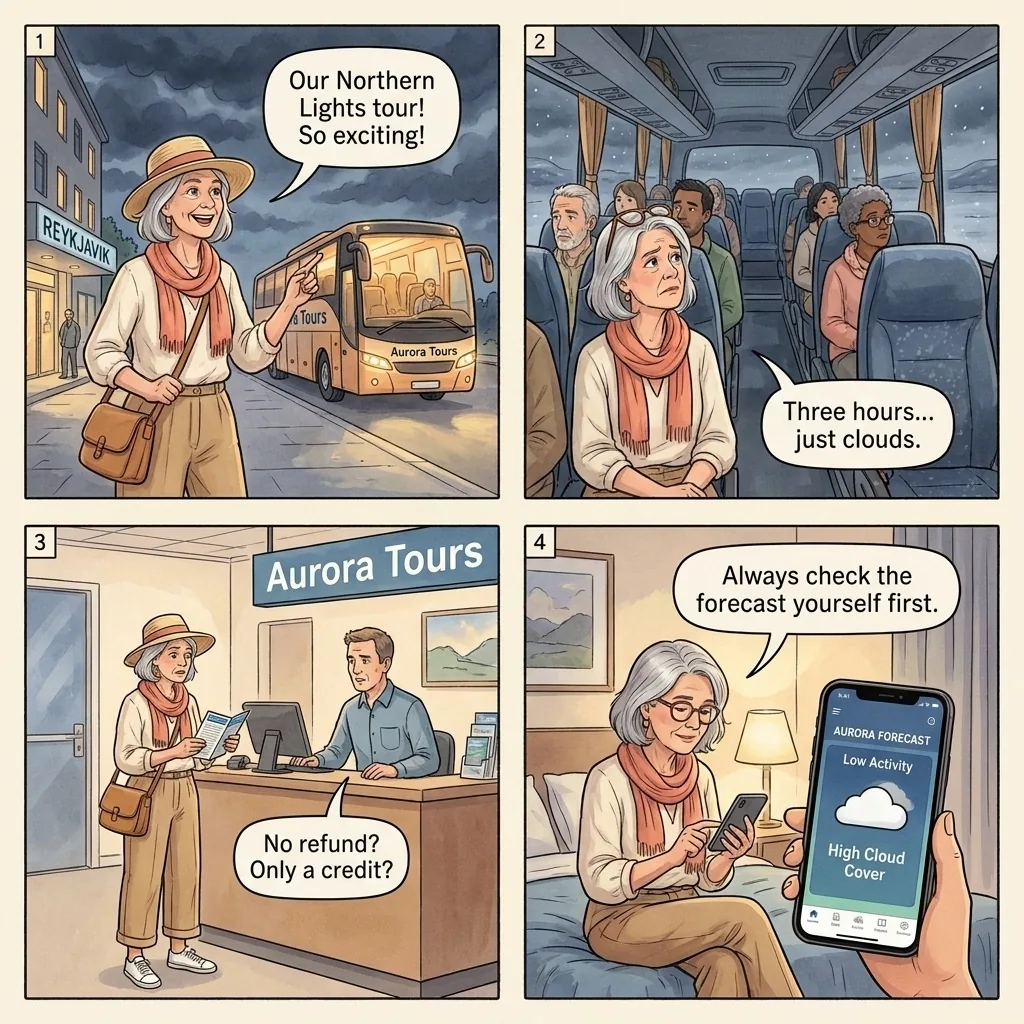
It's six weeks before your Iceland trip, you've booked an expensive Northern Lights bus tour for ISK 12,000 per person, and you're excited about the bucket-list aurora photo you've been imagining for months.
Your tour night arrives during your three-day Reykjavik visit. The bus picks you up at 8 p.m., drives an hour out of the city to a 'dark sky' viewpoint, and idles in a parking lot under heavy overcast clouds for two and a half hours. No auroras are visible — the cloud layer is total, the moon is invisible, the only light is the orange glow of Reykjavik on the southern horizon. The bus drives back to the city at 11:30 p.m. and drops you at your hotel.
When you ask the operator about a refund or a rebook, the contract's fine print appears: the tour only guarantees the attempt, not a sighting, and the refund policy offers only a partial credit toward another tour during your stay. Your remaining nights in Reykjavik are already booked with other plans; the credit expires when you fly home; you've effectively paid ISK 24,000 for two adults to sit in a parking lot. As travelers report across Reddit, the TripAdvisor Reykjavik forum, the Lonely Planet Iceland thorntree, and Iceland Tourism Board consumer alerts, the Northern Lights non-refund pattern is the most-reported tour-quality friction in Iceland.
The Northern Lights are a real phenomenon and the Reykjavik tour ecosystem is largely legitimate, but the rebook-credit-only policy structure varies widely between operators. The good operators — Reykjavik Excursions, Gray Line, Arctic Adventures — offer free unlimited rebooks during your stay if no auroras are visible, with full cash refund if you exhaust your stay without a sighting. The less-good operators offer only a partial rebook credit, with no cash refund option, and the credit only valid during the same trip. The Veður (Iceland Met Office) cloud-cover forecast and the aurora-activity index are both publicly available, so a tourist with a flexible night-of-tour booking and a check-the-forecast routine can substantially raise the odds of a sighting.
The structural defences are concrete. Book only operators with clearly published 'free unlimited rebook + full cash refund' policies in writing — Reykjavik Excursions and Gray Line both publish this. Check the Veður aurora forecast (en.vedur.is) yourself before booking the tour night; aim for nights with low cloud cover and aurora index 3+. Stay in Reykjavik for at least three nights to give the rebook policy meaningful runway. If your tour produces no sighting, immediately schedule the rebook for the next available aurora-favourable night within your stay rather than wait.
Book Northern Lights tours only with operators that publish a 'free unlimited rebook + full cash refund' policy in writing — Reykjavik Excursions, Gray Line, and Arctic Adventures all offer this; the lesser operators do not. Read the cancellation and refund clauses carefully before paying. Stay in Reykjavik at least three nights so the rebook policy has runway. Check the Veður aurora forecast (en.vedur.is) and the cloud-cover forecast yourself before scheduling the tour; aim for nights with low cloud and aurora index 3+. If your tour returns without a sighting, schedule the rebook immediately for the next favourable night. Pay by credit card so chargeback is available if the operator refuses an honest rebook or refund. Emergency: 112; Iceland Tourism Board complaints: +354 535 5500.
Red Flags
- Tour advertised with photos of incredible auroras but no guarantee clause mentioned
- Non-refundable deposit policy buried in terms
- Operator discourages you from checking the weather forecast yourself
How to Avoid
- Only book with operators who offer a free rebooking or full refund for cloudy nights.
- Check Veður (Icelandic Met Office) aurora forecasts yourself before booking.
- Read cancellation policy carefully — reputable operators always offer a rebook option.
🆘 What to Do If You Get Scammed
📋 File a Police Report
Go to the nearest Icelandic Police (Lögreglan) station. Call 112. Get an official crime report — you'll need this for insurance claims. You can also report online at logreglan.is.
💳 Cancel Your Cards
Call your bank immediately. Most have 24/7 numbers on the back of the card (keep a photo saved separately). Block any suspicious transactions before the thieves use your details.
🛂 Lost Passport?
Contact your nearest embassy or consulate. The US Embassy in Reykjavik is at Laufásvegur 21, 101 Reykjavik. For emergencies: +354 595-2200.
📱 Track Your Device
If your phone was stolen, use Find My (iPhone) or Find My Device (Android) from another device. Don't confront thieves yourself — share the location with police instead.
Frequently Asked Questions
You just read 6 scams in Reykjavik. The full Travel Safety Series has 780+ more across 20+ countries.
Tokyo's Kabukichō ¥130,000 bar trap. Rome's gladiator photo extortion. Paris's gold-ring trick. Bali's ATM skimmer scams. Bangkok's grand-palace closure ruse. Every documented scam across 20+ destinations — with the exact scripts, red flags, and local-language phrases that shut each one down. Drawn from Reddit traveler reports, embassy advisories, and consumer-protection cases.
- 780+ documented scams across Tokyo, Rome, Paris, Bali, Bangkok, Rio & 100+ more cities
- 20+ countries covered, with country-by-country phrase cards for every destination
- Updated annually — buy once, re-download future editions free
- All titles $4.99 each on Amazon Kindle