
Key Takeaways
- The #1 reported scam is the Lao Cai Station / Sapa Bus Transfer Fraud.
- 1 of 6 scams are rated high risk.
- Use official taxi ranks or local ride apps where available — always confirm the fare before departure.
- Never accept unsolicited offers from strangers near tourist sites in Sapa.
⚡ Quick Safety Tips
- Book Hanoi-Lao Cai train only at dsvn.vn, baolau.com, or 12go.asia, then Grab/Xanh SM for Lao Cai-Sapa; official/local reports document 2025 station-transfer fraud.
- Book trekking guides DIRECTLY (Sho +84 365 645 165, Mayland Trekking); skip hotel-concierge packages at $40-60.
- Refuse village 'family shop' pressure sales — buy Hmong textiles at Bac Ha Sunday Market for fair prices; verify 'silver' with magnet test (real silver is non-magnetic).
- For Fansipan cable car, buy direct at fansipanlegend.sunworld.vn (~800K VND) and check weather/status that morning documents closure fraud.
- In Sapa town, walking distance to most attractions is under 500m — electric cart rides should cost 10K-20K VND per ride; refuse 50K+ quotes.
Jump to a Scam
- High Lao Cai Station / Sapa Bus Transfer Fraud
- Medium Sapa Hmong Trekking Guide Kickback & Village Pressure
- Medium Sapa Hotel & Homestay Arrival 'Upgrade' Overcharge
- Medium Fansipan Cable Car Closures & Weather-Dependent Upsells
- Medium Sapa Electric Cart 'Local Driver' Overcharge
- Medium Sapa Village Shop & Handicraft Pressure Sales
The 6 Scams
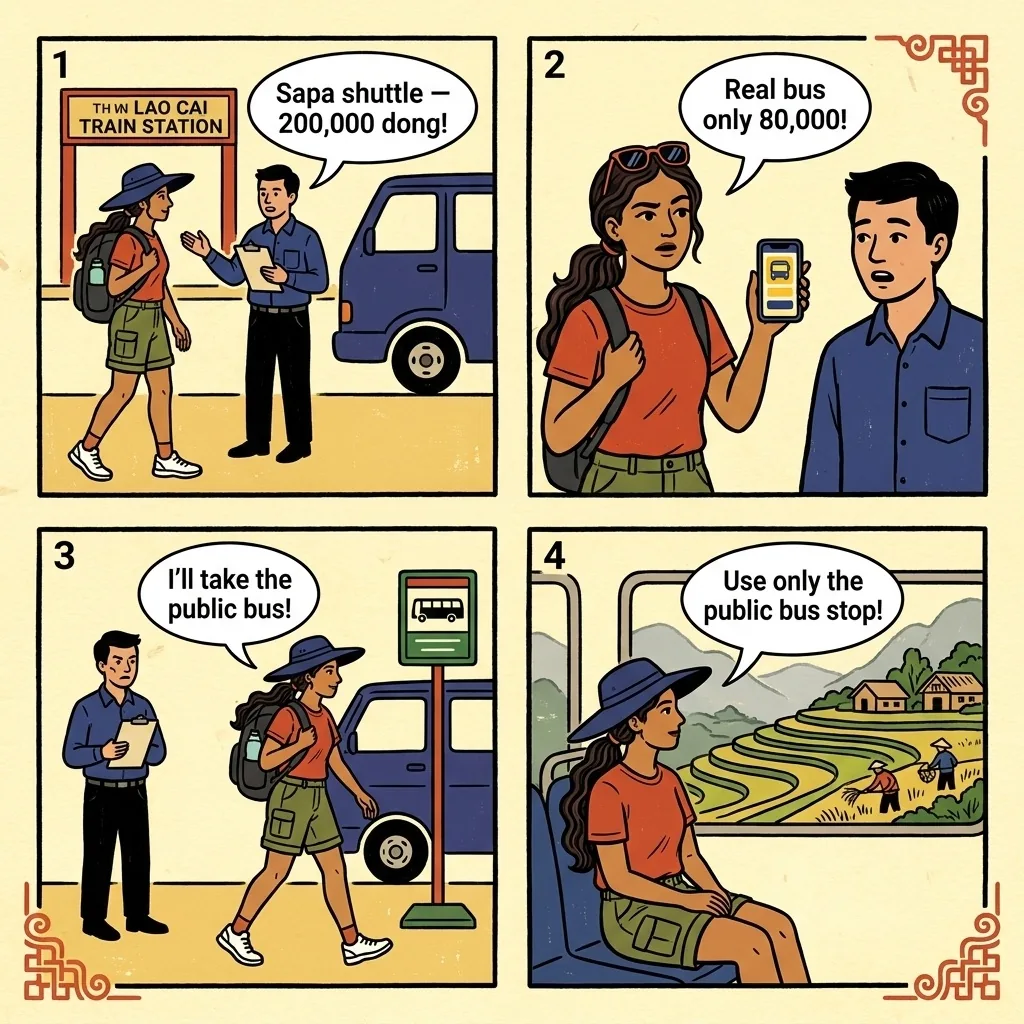
Hanoi Old Quarter 'Sapa package' tourist offices sell pre-paid Hanoi-Sapa bundles that exclude the actual Lao Cai-Sapa last-mile transfer (38 km), leaving travellers stuck at Lao Cai station where 'local drivers' claim to be the pre-paid operator and demand 'additional' 500K+ VND for what's a 150K–200K Grab or Xanh SM ride — 650K VND fraud cases are documented through 2025.
Sapa is reached from Hanoi via overnight train to Lao Cai station (8 hours, ending 38 km short of Sapa itself) or by direct shuttle bus through The Sinh Tourist or 12Go Asia. Both legitimate routes exist and work cleanly when booked through verified operators, but the Hanoi Old Quarter 'tourist office' ecosystem sits between travellers and the legitimate booking channels selling 'Sapa packages' that look comprehensive but exclude the last-mile Lao Cai-to-Sapa transfer. That excluded transfer is the lever for the most documented Sapa-arrival fraud, with first-person 2025 victim accounts naming 650,000 VND losses at Lao Cai station for transfers that never materialised.
The trap menu has four mechanics. Pre-paid Hanoi-Sapa 'packages' at Old Quarter tourist offices print impressive-looking itineraries that don't include the Lao Cai-Sapa segment — travellers arrive at Lao Cai expecting onward transport and find none. At Lao Cai station 'local drivers' claim to be the pre-paid operator and demand 'additional' 500K+ VND for the 38-km drive to Sapa, exploiting the impossible-to-verify question of whether the original package included this leg. Independent 'local driver' offers at the Lao Cai arrival platform quote 300K–500K VND for the Sapa transfer when Grab or Xanh SM apps cover the same route at 150K–200K. Shuttle bus tickets sold at Old Quarter 'tourist offices' regularly don't work at the actual bus pickup, leaving travellers stranded with paper tickets and no recourse. The Sinh Tourist URL spoofing variant is particularly damaging — multiple copycat sites mimic thesinhtourist.vn closely enough that travellers booking from Hanoi pay non-existent operators and arrive at Sapa with nothing.
For older travellers planning a Hanoi-to-Sapa trip, the defense is to book the train and the transfer separately through verified operators, not as a package. Book the Hanoi-Sapa train to Lao Cai via dsvn.vn, baolau.com, or 12go.asia, then book the Lao Cai-Sapa 38-km transfer separately via Grab or Xanh SM (150K–200K VND) or pre-arranged hotel transfer — for the shuttle alternative, book only via The Sinh Tourist at thesinhtourist.vn (verify the URL exactly, multiple copycats exist) or 12Go Asia at ~600K VND Hanoi-Sapa including transfer; refuse Hanoi Old Quarter 'tourist office' packages as kickback-and-markup, and at Lao Cai station refuse any driver claiming to be your pre-paid operator without verifying directly with the operator's own phone number. Grab and Xanh SM both operate in Sapa and Lao Cai with reliable supply — book the app on the train Wi-Fi before pulling into Lao Cai station so you have a confirmed driver waiting at arrival rather than fighting the curb queue. If you've been defrauded at an Old Quarter office, the cash is rarely recoverable but a Vietnamese tourism complaint at the Hanoi tourist information centre (Hoan Kiem district) creates a paper trail.
Red Flags
- Hanoi Old Quarter 'tourist office' package missing Lao Cai-Sapa last-mile transfer
- 'Local driver' at Lao Cai claiming to be your pre-paid operator with no verification
- Lao Cai-Sapa 'fixed price' quote of 400K+ VND (Grab rate is ~200K)
- Shuttle bus ticket sold at 'tourist office' that doesn't work at pickup
- Driver demands cash 'additional' payment on top of pre-paid package
How to Avoid
- Book Hanoi-Sapa train to Lao Cai via dsvn.vn, baolau.com, or 12go.asia.
- From Lao Cai to Sapa, use Grab or Xanh SM app (~200K VND, 38 km).
- Or book shuttle bus via The Sinh Tourist (thesinhtourist.vn — verify URL exactly).
- Skip Hanoi Old Quarter 'tourist office' packages — kickback-and-markup.
- At Lao Cai, Refuse drivers claiming to be pre-paid operator without verification.

Sapa village trekking has a documented kickback-to-shop pattern where 'free walking tours' lead through villages with every stop at a 'family shop' selling handicrafts at 3–5× fair prices, Hmong women 'follow' all-day treks then demand 200K–500K VND 'tip' as 'your guide,' and 'authentic Hmong lunch at village home' adds 200K+ VND 'family fee' at meal time — book trekking guides directly via community-recommended operators (Sho WhatsApp +84 365 645 165 or Mayland Trekking) at 500K–800K VND per day.
Sapa's main draw is the Hmong, Dao, and Tay village treks through the rice-terraced valleys around Cat Cat, Lao Chai, Ta Van, and Y Linh Ho. The legitimate trek economy works — community-recommended operators with named guides deliver genuine experiences with the ethnic-minority villages, and a real day trek with lunch and one to two village stops runs 500K–800K VND per person at 2025 rates. The scam economy that's grown alongside it operates through Hanoi Old Quarter package sales, Sapa town 'free walking tour' pitches, and informal women's-cooperative-style following on independent treks. The Hmong community's relationships with Sapa's tourism economy are complicated and produce both genuine and scammed experiences, with the difference often coming down to whether the tourist booked direct or got bundled through a kickback chain.
The trap menu has four recurring mechanics. The 'free walking tour from Sapa town' — a guide leads tourists through villages with every stop at a 'family shop' selling handicrafts at 3–5× fair prices, with the 'free' framing front-loading sales pressure that gets harder to refuse the longer the walk. The 'following women' variant — independent trekkers find multiple Hmong women joining their walk uninvited, then demanding 200K–500K VND 'tip' at the end for 'being your guide all day' regardless of whether the tourist asked for guidance. The 'authentic Hmong lunch' upcharge — a guide quotes lunch as included in the trek package, then a 'family fee' of 200K+ VND lands at the village home at meal time. The non-Hmong-guide-masquerading variant — a booked Hmong trek turns out to be led by a guide who isn't actually from the local community, delivering a generic walk rather than the cultural experience the booking promised.
For older travellers considering a Sapa trek, the defense is to book guides directly via community-vetted operators and to refuse uninvited followers from the first interaction. Book trekking guides directly via community-recommended operators — Sho on WhatsApp at +84 365 645 165 or Mayland Trekking — at the legitimate 2025 day-trek rate of 500K–800K VND per person with lunch and one to two villages, refusing every Hanoi Old Quarter 'Sapa trek package' as kickback-marked, every Sapa-town 'free walking tour' as front-loaded sales pressure, every village 'family shop' textile at 3–5× the Bac Ha Sunday Market fair price, and every uninvited Hmong woman 'following' your independent walk by saying 'không, cảm ơn' (no, thank you) firmly from the first interaction since agreeing to walk together after 30 minutes implies acceptance of the tip demand at the end. Buy textiles at the Bac Ha Sunday Market (2 hours from Sapa via tour) where prices are fixed and stamped rather than at village 'family shops' where the markup is 3–5×. If you want a lunch experience at a Hmong family home, confirm the price in writing before the meal — anything beyond 100K–150K VND per person is a tourist-trap upcharge. The right operators provide named guides with verifiable village affiliations; if you can't get the guide's name and village before booking, the trek is bundled and the kickback chain is real.
Red Flags
- 'Free walking tour' from Sapa town — every stop at a family shop
- Multiple Hmong women 'following' you all day uninvited
- 'Authentic Hmong lunch' at village home with 200K+ VND 'family fee'
- Trek booked through hotel at $40-60/person (direct rate is $20-30)
- Trek 'led by Hmong guide' turns out to be a non-Hmong Vietnamese guide
How to Avoid
- Book guides DIRECTLY via community-recommended operators (Sho, Mayland Trekking).
- Expected 2025 rate: 500K–800K VND per person day trek with lunch.
- Refuse village 'family shop' pressure sales — buy at Bac Ha Market for fair prices.
- Decline 'free walking tour' — front-loaded sales pressure.
- Politely decline following women from first interaction ('không, cảm ơn').
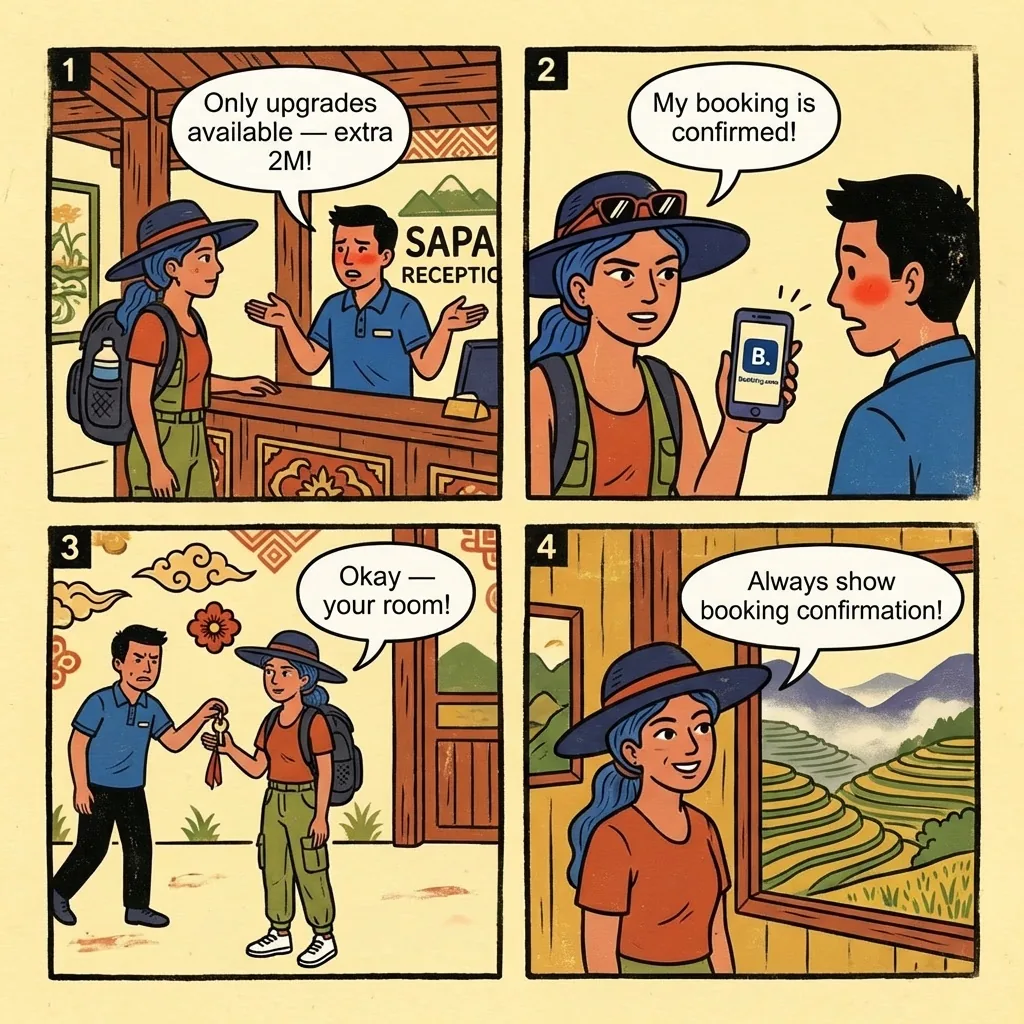
Sapa hotels and homestays run an arrival-time overcharge pattern where check-in staff claim 'Booking.com booking didn't transmit' and demand full cash payment at inflated rates, 'upgrade required' due to 'water issue' at 2–3× the booking rate, homestay 'family emergency' bait-and-switch to an inferior property, and 'free Lao Cai shuttle' that doesn't materialise — book only via Booking.com, Agoda, or Airbnb with platform-verified payment.
Sapa's hotel and homestay scene splits cleanly between named long-review-history properties (Hotel de la Coupole MGallery, Silk Path Grand Resort Sapa, Topas Ecolodge, Pao's Sapa Leisure Hotel, Sapa Relax Hotel & Spa) and a long tail of smaller homestays and budget hotels where arrival-time overcharge fraud is documented through 2025. The mechanic targets the 8-hour-overnight-train arrival fatigue: travellers reach Sapa via Lao Cai station around 6 AM, transfer 38 km up the mountain road, and arrive at their accommodation jet-lagged and looking for a bed. That fatigue window is when the staff at the smaller properties claim the platform booking 'didn't transmit' and demand cash payment again at an inflated rate, knowing most travellers default to paying rather than calling Booking.com support at 8 AM.
The scam variants run five plays. The 'Booking.com didn't transmit' play — at check-in, staff claim the platform booking didn't reach them and demand full cash payment, leaving the original platform charge on the card and extracting a second payment in cash. The 'upgrade required' play — staff cite a 'water issue' or 'maintenance problem' on your booked room and present an 'upgrade' at 2–3× the original rate as the only option. The homestay 'family emergency' bait-and-switch — your booked homestay claims a sudden family situation and 'helpfully' moves you to a partner property that turns out to be inferior at an inflated rate. The 'included breakfast not honoured' play — a booking that listed breakfast included produces a separate 100K–200K VND breakfast charge at the meal table. The 'free Lao Cai shuttle' play — the booking promised a free shuttle from the train station that doesn't materialise, forcing a last-minute paid transfer. All five rely on the traveller's reluctance to escalate at the moment of arrival fatigue.
For older travellers booking Sapa accommodation, the defense is platform-only payment, a screenshot of the booking, and zero cash re-payment at check-in. Book only via Booking.com, Agoda, or Airbnb with platform-verified card payment, photograph or screenshot the booking confirmation before leaving for Sapa, and at check-in refuse every 'Booking.com didn't transmit' cash re-payment demand by calling the platform's support line on speakerphone in the lobby and resolving the discrepancy on-site, refuse every 'upgrade required due to water issue' claim at 2–3× the booking rate by demanding the originally-booked room, refuse every homestay 'family emergency' bait-and-switch to a different property, and refuse every breakfast charge that contradicts the booking inclusion. Community-recommended Sapa hotels with verified long review histories — Hotel de la Coupole MGallery, Silk Path Grand Resort Sapa, Topas Ecolodge, Pao's Sapa Leisure Hotel, Sapa Relax Hotel & Spa — are the safer anchor for older travellers who want a clean check-in. If a 'free Lao Cai shuttle' was promised in the booking and doesn't materialise, the booking confirmation screenshot is enough evidence for the platform to issue a chargeback or compensation. Don't pay cash at check-in for any reason without first reaching the platform's support line.
Red Flags
- At check-in, hotel claims 'Booking.com booking didn't transmit'
- 'Upgrade required' at 2-3x booking rate ('your room has water issue')
- Homestay claims 'family emergency' and moves you to different property
- 'Free shuttle from Lao Cai' that doesn't materialise
- 'Included breakfast' not honored at check-in
How to Avoid
- Book ONLY via Booking.com, Agoda, or Airbnb with platform-verified payment.
- Photograph your booking confirmation BEFORE arriving.
- At check-in, Refuse cash re-payment — call platform support on speakerphone.
- Refuse 'upgrade required' at 2-3x — demand originally-booked room.
- Community-recommended: Hotel de la Coupole, Silk Path, Topas Ecolodge, Pao's Sapa.
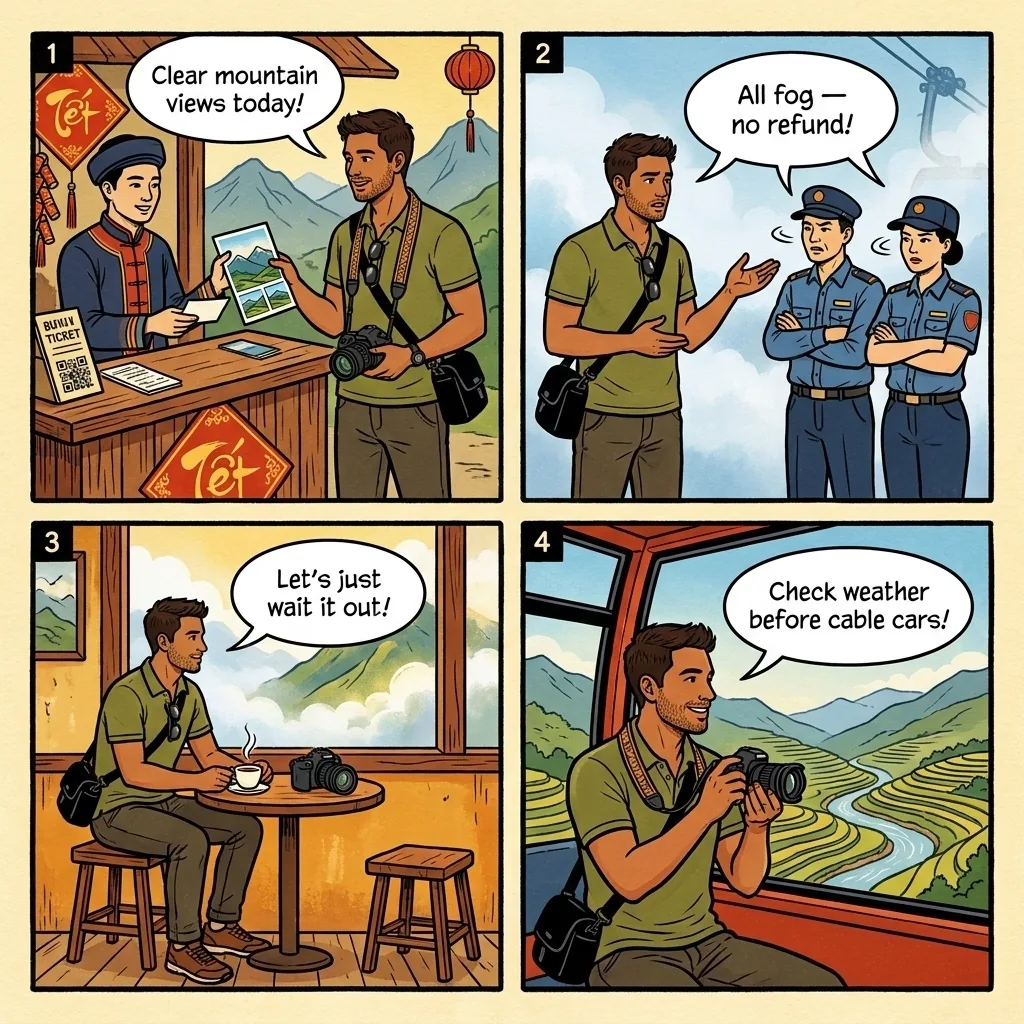
Fansipan cable-car-and-funicular tickets sold direct at fansipanlegend.sunworld.vn run ~800K VND adult, but hotel concierges sell 'Fansipan combo tours' at $40–$60 per person with no refund policy when the system closes for weather (Nov–Feb fog and wind reduce summit visibility to zero), and 'private tour to summit' upsells at $150+ deliver the same content as the direct ticket.
Fansipan is Vietnam's highest peak at 3,143 metres, served by a cable car plus funicular system that's Sapa's signature visitor attraction. The Sun World ticketing direct at fansipanlegend.sunworld.vn runs ~800K VND adult at 2025 rates and is the legitimate booking path. The system has extended closure periods and serious weather dependencies that hotel concierges and Sapa-town touts don't disclose when selling packages — heavy fog and wind between November and February regularly reduce summit visibility to zero, and the cable car closes for maintenance and weather without notice.
The trap menu has four mechanics. Hotel concierge 'Fansipan combo' tours at $40–$60 per person bundle cable car, funicular, and lunch with no refund policy when the system is closed for weather — travellers who pre-paid lose the entire fee. Sapa town centre touts pitch 'best rate' Fansipan tours that turn out to be low-value visits to the base station only, never reaching the cable car. 'Private tour to summit' upsells at $150+ per person deliver the same experience as the $35 direct ticket. The weather-closure variant is the most damaging: tours sold during November–February peak fog season produce no refund when the summit is invisible despite the cable car running, since the contract didn't include a visibility clause. Long-time community guidance is consistent that the legitimate experience is to buy the direct ticket and check status on the morning of the planned visit, with March–October the right window for reliable weather.
For older travellers planning Fansipan, the defense is to buy the direct ticket and check status the morning of the visit. Buy the Fansipan cable-car-and-funicular ticket directly at fansipanlegend.sunworld.vn (~800K VND adult, 2025) or at the Sapa station ticket counter, check Sapa weather and Fansipan operational status on the morning of the planned visit, visit between March and October for reliable summit visibility (skip November–February unless the morning forecast shows clear sky) — and refuse every hotel-concierge 'Fansipan combo tour' at $40–$60 per person with no weather-refund policy, every Sapa-town tout 'best rate' tour that visits the base station only, and every 'private tour to summit' upsell at $150+ as the same experience as the direct ticket. If the cable car is closed for weather or maintenance on your planned day, Sapa has multiple alternative day-trip options that don't require the cable car: Cat Cat village walk (1.5 km loop from town), the Lao Chai-Ta Van trek through rice terraces (4–6 hours), and Ham Rong Mountain Park (1.5 hours). Don't pre-pay any Fansipan package without a written weather-refund policy — if visibility is zero from fog or the cable car is closed, the legitimate operators issue refunds and the tour packages don't.
Red Flags
- Hotel concierge quotes 'Fansipan combo' at $40-60 without weather-refund policy
- Booking during Nov–Feb without checking Fansipan status that morning
- Tout at Sapa town offers 'best rate' Fansipan package with no direct-booking option
- 'Private tour to summit' at $150+ per person
- Tour operator refuses refund despite cable car closure
How to Avoid
- Buy cable car ticket DIRECT at fansipanlegend.sunworld.vn (~800K VND adult, 2025).
- Check Sapa weather and Fansipan status on visit morning.
- Visit Mar–Oct for reliable weather; skip Nov–Feb unless clear forecast.
- Refuse hotel-concierge combo tours at $40-60.
- If cable car closed: Cat Cat village, Lao Chai/Ta Van trek, Ham Rong Mountain alternatives.
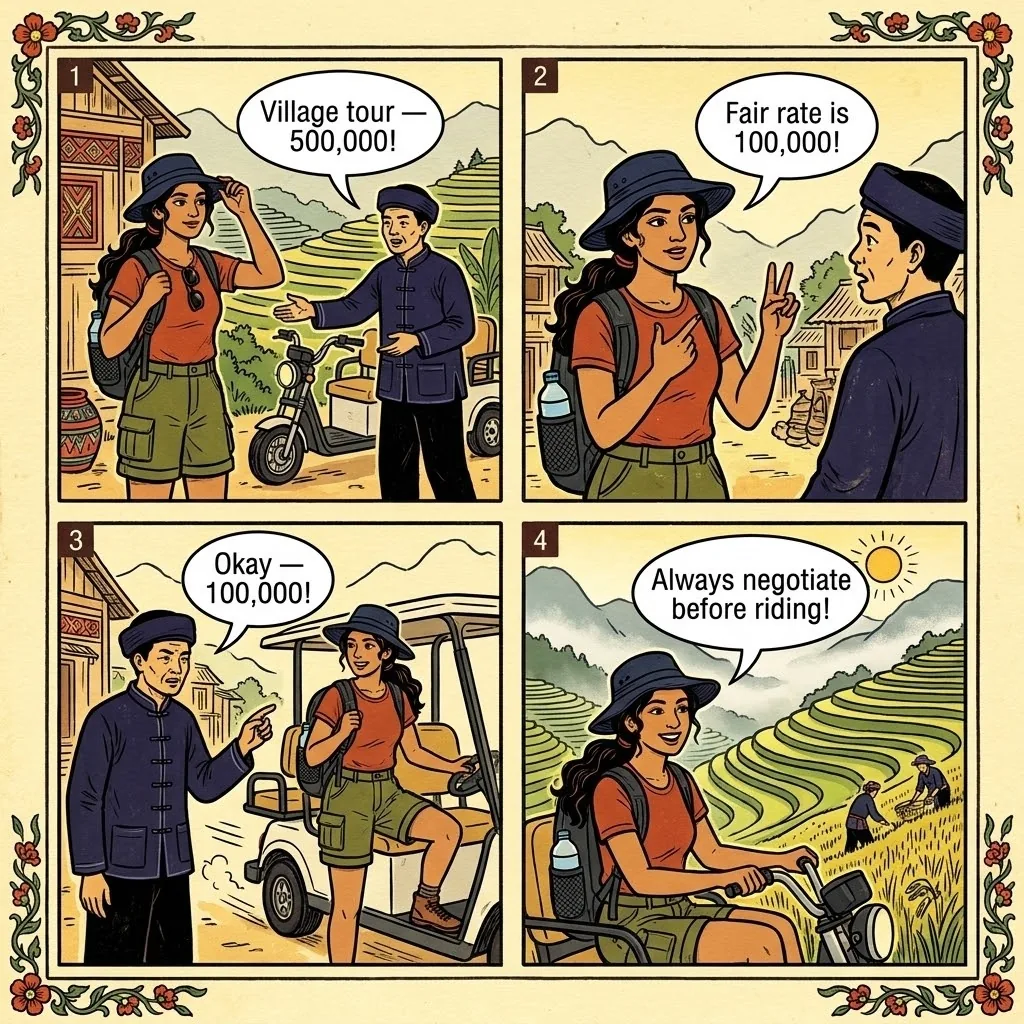
Sapa town's electric-cart drivers quote 50K VND for 500-metre rides that should cost 10K–20K, sell 'private tour' day-rates at 1M+ VND for village-to-village transfers that cost 200K via Grab, and stop mid-ride at 'family shops' to pressure handicraft purchases before continuing — Sapa town centre is walkable and Grab covers village transfers at fair rates.
Sapa town's narrow centre streets are served by small electric carts for last-mile transit, alongside Grab and Xanh SM ride-hail apps that cover both town and village-to-village runs at fair rates. The legitimate use case for an electric cart is a short hotel-to-restaurant or hotel-to-cable-car ride at 10K–20K VND, but the drivers hawk these aggressively to visibly foreign tourists at 3–5× fair rates, with one veteran traveller summarising the dynamic as 'they see you coming from a mile away.' The cart drivers also pivot to selling much larger 'private tour' day-rates and Sapa-area trip packages where the markup against legitimate operators (Grab apps, community-recommended trekking guides) is even steeper.
The trap menu has four recurring mechanics. The headline electric-cart short-ride overcharge — driver quotes 50K VND for a 500-metre Sapa-town ride that should cost 10K–20K. The 'private tour' day-rate inflation — drivers offer 1M+ VND per day for village-to-village transfers (Cat Cat, Ta Van, Lao Chai) that cost 200K via Grab per leg. The 'Santé' or 'mountain-village' trip package — quoted at $40–$60 per person for what's a 30-minute drive plus a base-station visit. The mid-ride 'family shop' detour — driver stops at a handicraft shop on the way to your destination and pressures a purchase before continuing the ride, with the implication that refusal extends or cancels the ride. Sapa town centre is small enough that most hotel-to-attraction distances are under 500 metres on foot, making the electric carts an unnecessary purchase entirely for travellers without mobility limitations.
For older travellers in Sapa town, the defense is to walk in town, use Grab between villages, and refuse mid-ride detours. Walk in Sapa town centre (most hotel-to-attraction distances are under 500 metres on foot); use Grab or Xanh SM for village-to-village transfers (Cat Cat, Ta Van, Lao Chai) at 150K–250K VND per trip or pre-arrange hotel transport — and refuse every electric-cart 50K+ VND quote for a Sapa-town short ride (legitimate is 10K–20K), every 1M+ VND 'private tour' day-rate against the Grab per-leg alternative, every $40–$60 'Santé mountain-village trip' upsell, and every mid-ride 'family shop' detour by politely declining and insisting on continuing to your booked destination. Legitimate Sapa guided day-trips via community-recommended operators (Sho on WhatsApp +84 365 645 165, Mayland Trekking) are $20–$30 per person — that's the right anchor for 'private tour' pricing rather than the 1M+ VND cart-driver day-rate. For mobility-limited older travellers, pre-book hotel transport via your accommodation rather than accepting street solicitation, since the in-house drivers operate at fixed published rates without the mid-ride detour pressure.
Red Flags
- Electric cart driver quotes 50K+ VND for a 500m ride
- 'Private tour' offer at 1M+ VND/day
- Driver stops mid-ride at 'family shop' with purchase pressure
- 'Local driver' approaches at hotel doorstep with unrequested tour offer
- 'Best rate' offer without any written price or receipt
How to Avoid
- Walk Sapa town center — most hotel-to-attraction distances under 500m.
- For village transfers, use Grab (150K-250K VND) or pre-arrange hotel transfer.
- Electric carts: refuse 50K+ quotes; fair rate is 10K-20K per short ride.
- Refuse 'private tour' at 1M+ VND/day — legitimate rate is $20-30 per person via community operators.
- If driver stops at 'family shop,' decline and insist on destination.
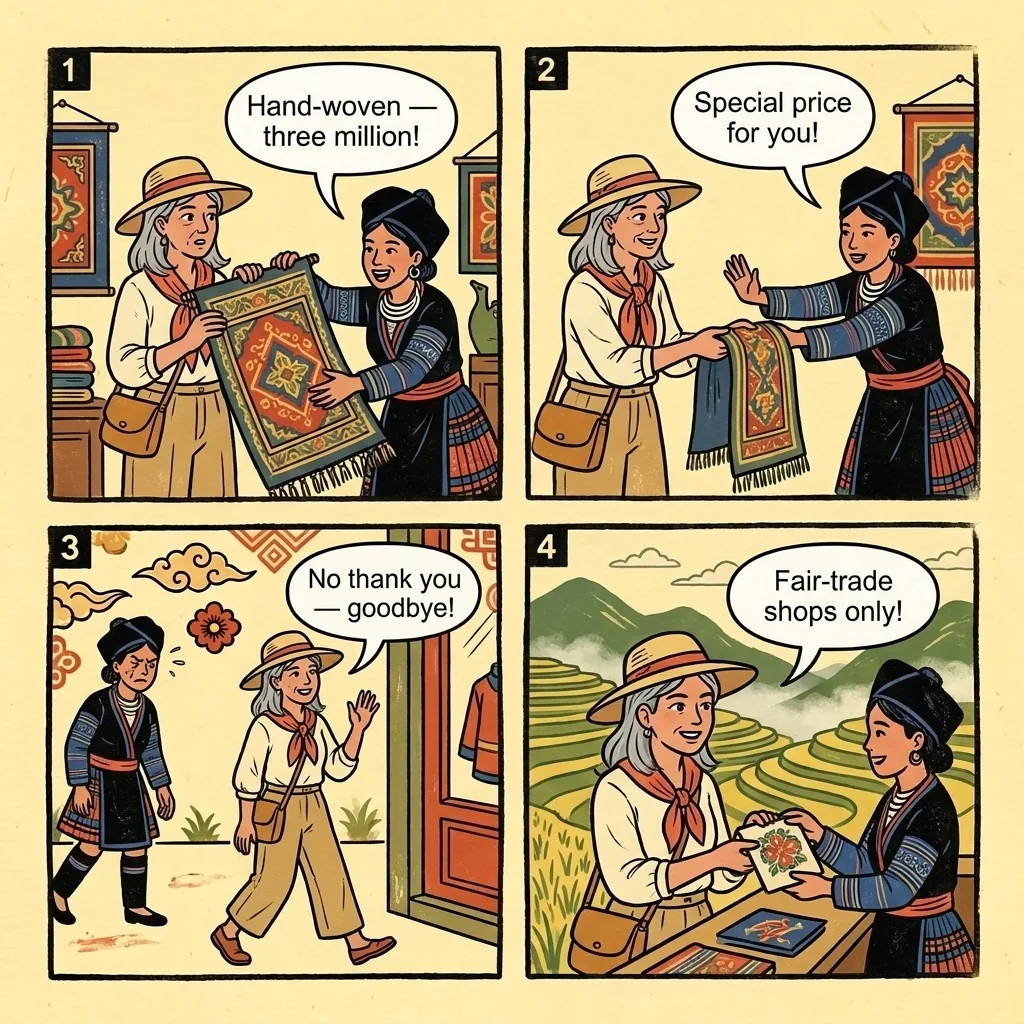
Sapa's village 'family shop' visits on trek routes price 'authentic Hmong textiles' at 1M–3M VND for items worth 100K–200K at Bac Ha Sunday Market, sell 'indigo-dyed traditional pieces' at 500K+ VND that are factory-dyed and made in Hanoi, charge 'silver jewelry' at 200K+ VND that fails the magnet test (real silver isn't magnetic), and demand 200K+ VND 'family lunch donations' or 'photo fees' for portraits — buy at Bac Ha Market or Indigo Cat / Sapa OChau cooperatives instead.
Sapa's ethnic-village handicraft economy is legitimately interesting and supports real Hmong, Dao, and Tay textile traditions, but the village 'family shop' visits on commercial trek routes operate a documented pressure-sales pattern that targets the trekking-tourist demographic. Authentic Hmong textiles, indigo-dyed traditional pieces, and silver jewelry are real categories with real local craftsmanship at fair prices — at the Bac Ha Sunday Market two hours from Sapa, at Indigo Cat in Sapa town, and at the Sapa OChau cooperative — but the same categories at 'family shop' stops on commercial trek routes run at three to fifteen times those fair prices with social-pressure mechanics designed to make refusal feel rude.
The trap menu has five recurring mechanics. The 'authentic Hmong textile' price inflation — village 'family shops' on trek routes price items at 1M–3M VND when the same pieces sell at 100K–200K at Bac Ha Sunday Market with stamped prices. The 'indigo-dyed traditional piece' counterfeit — items priced at 500K+ VND turn out to be factory-dyed pieces made in Hanoi rather than village-crafted, identifiable by uniform dye and machine stitching. The 'silver jewelry' alloy substitution — pieces priced at 200K+ VND fail the magnet test (real silver isn't magnetic; alloy is). The 'family home lunch donation' demand — a trek includes 'lunch at a Hmong family home' but a 200K+ VND 'donation' lands at the meal table. The 'photo fee' — trekkers taking portraits of women in traditional dress face 20K–50K demands per photo (which is fair if pre-agreed) inflated to 200K+ if the camera comes out without permission first. The community's documented coping strategy is leaving detailed Google reviews capturing the overcharge patterns at specific shops to warn future travellers.
For older travellers buying handicrafts in Sapa or visiting villages on a trek, the defense is to anchor purchases at fair-price markets and cooperatives and to verify silver with a magnet test before paying. Buy Hmong textiles at Bac Ha Sunday Market (2 hours from Sapa via tour, open-air with stamped fixed prices) or at the Indigo Cat shop in Sapa town or the Sapa OChau cooperative for verified fair-trade pricing — and refuse every village 'family shop' textile at 1M+ VND (fair is 100K–500K), every 'indigo-dyed traditional piece' at 500K+ VND that fails the visual hand-craft test, every 'silver jewelry' that doesn't pass a magnet test (real silver isn't magnetic), every 200K+ VND 'family lunch donation' demand at meal time, and every 200K+ VND 'photo fee' demanded after an unconsented portrait. For photos of local people in traditional dress, ask permission first with a simple 'chụp ảnh?' (photo?) and pay 20K–50K VND if the subject agrees — that's the fair voluntary rate. Eat lunch at Sapa town restaurants with posted prices rather than 'family home' lunches with vague pricing. The legitimate cooperatives (Indigo Cat, Sapa OChau) have transparent fair-trade pricing and the artisan provenance is verifiable; village 'family shops' on commercial trek routes have neither.
Red Flags
- Village 'family shop' quotes 1M–3M VND for traditional textile
- 'Indigo-dyed piece' at 500K+ VND with no craftsmanship evidence
- 'Silver jewelry' at 200K+ VND that attracts a magnet (alloy, not silver)
- 'Lunch at Hmong family home' with 200K+ VND 'donation' demanded
- 'Photo fee' demanded at village without agreement beforehand
How to Avoid
- Visit Bac Ha Sunday Market (2 hr from Sapa) for fixed-price handicrafts.
- Expected village prices: 100K-500K VND textile piece; 1M+ is tourist pricing.
- Verify 'silver' with magnet test (real silver is non-magnetic).
- Decline 'family lunch donations' — eat at Sapa town posted-price restaurants.
- Support fair-trade cooperatives: Indigo Cat (Sapa town), Sapa OChau.
🆘 What to Do If You Get Scammed
📋 File a Police Report
Go to the nearest Vietnamese Police (Công An) station. Call 113. Get an official crime report — you'll need this for insurance claims. You can also report online at hanoi.gov.vn.
💳 Cancel Your Cards
Call your bank immediately. Most have 24/7 numbers on the back of the card (keep a photo saved separately). Block any suspicious transactions before the thieves use your details.
🛂 Lost Passport?
Contact your nearest embassy or consulate. The US Embassy is at 7 Lang Ha Street, Ba Dinh District, Hanoi. For emergencies: +84 24 3850-5000.
📱 Track Your Device
If your phone was stolen, use Find My (iPhone) or Find My Device (Android) from another device. Don't confront thieves yourself — share the location with police instead.
Frequently Asked Questions
You just read 6 scams in Sapa. The book has 60 more across 11 Vietnamese destinations.
Hanoi's Noi Bai Airport fake-Grab driver. Ho Chi Minh City's Bui Vien 4-million-VND bar extortion. Hoi An's tailor-shop markup and fake-monk lantern-boat circuit. Ha Long Bay's off-platform cruise-booking fraud. Every documented Vietnam scam — with the exact scripts, red flags, and Vietnamese phrases that shut each one down. Drawn from Tuoi Tre, VnExpress, Thanh Nien, VietnamPlus, and VNAT tourist-assistance records.
- 66 documented scams across Hanoi, HCMC, Hoi An, Ha Long Bay & 7 more destinations
- A Vietnamese exit-phrase card you can screenshot to your phone
- Updated annually — buy once, re-download future editions free
- Readable in one flight — $4.99 on Amazon Kindle