Key Takeaways
- The #1 reported scam is the Sarajevo Airport Counterfeit-Change Curb Quote.
- 2 of 6 scams are rated high risk.
- Use app-based ride services (Uber, Bolt) or official metered taxis instead of unmarked vehicles.
- Never accept unsolicited offers from strangers near tourist sites in Sarajevo.
⚡ Quick Safety Tips
- Keep phones and valuables in secure pockets when in crowded areas.
- Use only licensed taxis or app-based ride services.
- Book tours and tickets through verified operators with online reviews.
- Keep a copy of your passport separate from the original.
Jump to a Scam
- High The Sarajevo Airport Counterfeit-Change Curb Quote
- High The Ferhadija Friendly-Stranger Bar Trap
- Low The Baščaršija Copper-Market Tourist Markup
- Medium The Ferhadija KM-vs-Euro Restaurant Switch
- Medium The Sniper Alley War-Tour Donation Pressure
- Medium The Sebilj Fountain Distraction Pickpocket
The 6 Scams
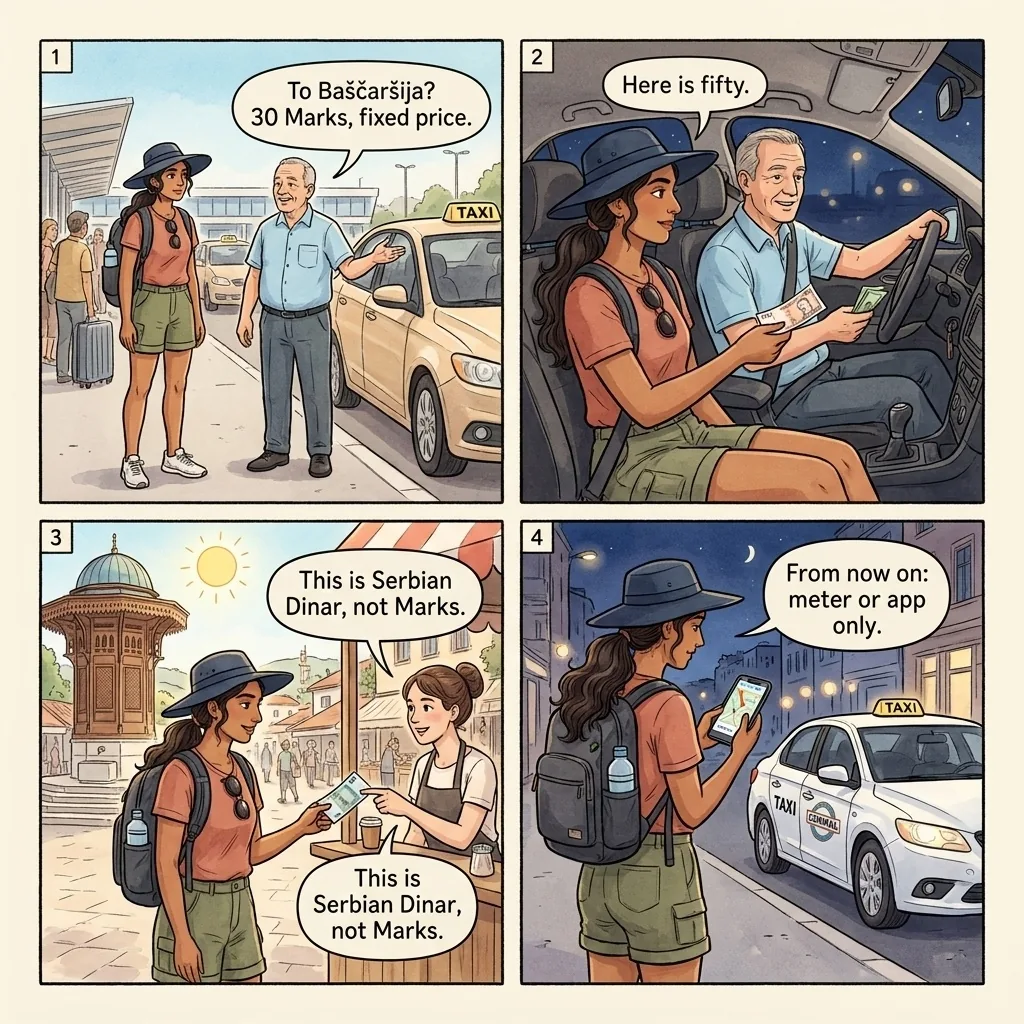
A driver at SJJ refuses the meter and quotes 30 KM to Baščaršija (double the metered 12–15 KM). You pay with a 50 KM note and get back what looks like a 20 KM bill — it's actually a 20 Serbian Dinar note (€0.17), passed in the dark cab where colors and size look close enough.
You arrive at Sarajevo Airport and take the first taxi in the queue. The driver doesn't turn on the meter, claiming it's 'a fixed price from the airport.' He quotes 30 KM (Bosnian Convertible Marks) for the trip to Baščaršija — roughly double the metered fare. You hand over a 50 KM note. He gives you change: what appears to be a 20 KM note. The next day at a cafe, the cashier rejects your note — it's actually a 20 Serbian Dinar bill, worth roughly €0.17. The colors and size are just similar enough to fool you in a dark taxi at night.
This specific scam — combining overcharging with counterfeit change using Serbian Dinar notes — is documented on TripAdvisor's Sarajevo forum in multiple threads. One thread titled 'Taxi Scam in Sarajevo' describes the exact scenario of receiving Serbian Dinar instead of Bosnian Marks. Another thread titled 'Warning: Sarajevo Taxi Co. at Sarajevo International Airport' has years of accumulated complaints about airport taxis refusing to use meters.
Travelers report fares of €20–€30 for a trip that should cost 10–12 KM on the meter. The Serbian Dinar swap is the more devious mechanic — the overcharge is bad, but the counterfeit change creates a second loss layer that you don't discover until hours or days later when a Sarajevo cashier rejects the note.
The solution recommended by multiple posters is to call a city-based taxi company like Red Taxi (Crveni Taxi), which has a stand near the airport and uses meters as standard practice. The metered fare from Sarajevo Airport to Baščaršija should be approximately 12–15 KM. Knowing the rough shape of legitimate KM notes (10, 20, 50, 100, 200) is your second-line defense — Bosnian Marks have prominent BiH crests; Dinar notes do not.
The defensive move is to call Red Taxi (Crveni Taxi: 1515) or another licensed city company from arrivals rather than taking the first cab in the queue, and insist the meter is running before the car moves — Bosnian law requires it. Familiarize yourself with KM note designs before arriving so you can spot Dinar swaps. Pay with exact change if possible, or verify change in good light before exiting. Pre-book hotel transfers (15–20 KM fixed). Police: 122. Emergency: 112.
Red Flags
- The driver does not switch on the meter or claims it is 'broken' or 'not used for airport runs'
- The quoted fare exceeds 15 KM to the city center — the metered rate should be 12-15 KM
- Change is given in dim lighting inside the taxi rather than in a well-lit area
- The bills in your change look slightly different from the KM notes you've seen before
- The driver is parked at the airport but is not from a recognized company like Red Taxi or Sarajevo Taxi
How to Avoid
- Call Red Taxi (Crveni Taxi) or another licensed city taxi company from the arrivals hall rather than taking the first taxi in the queue.
- Always insist the meter is running before the car moves — this is legally required in Bosnia.
- Familiarize yourself with Bosnian KM notes before arriving so you can distinguish them from Serbian Dinar.
- Pay with exact change if possible, or verify change carefully under a light before exiting the taxi.
- Pre-book airport transfers through your hotel, which typically costs 15-20 KM with transparent pricing.
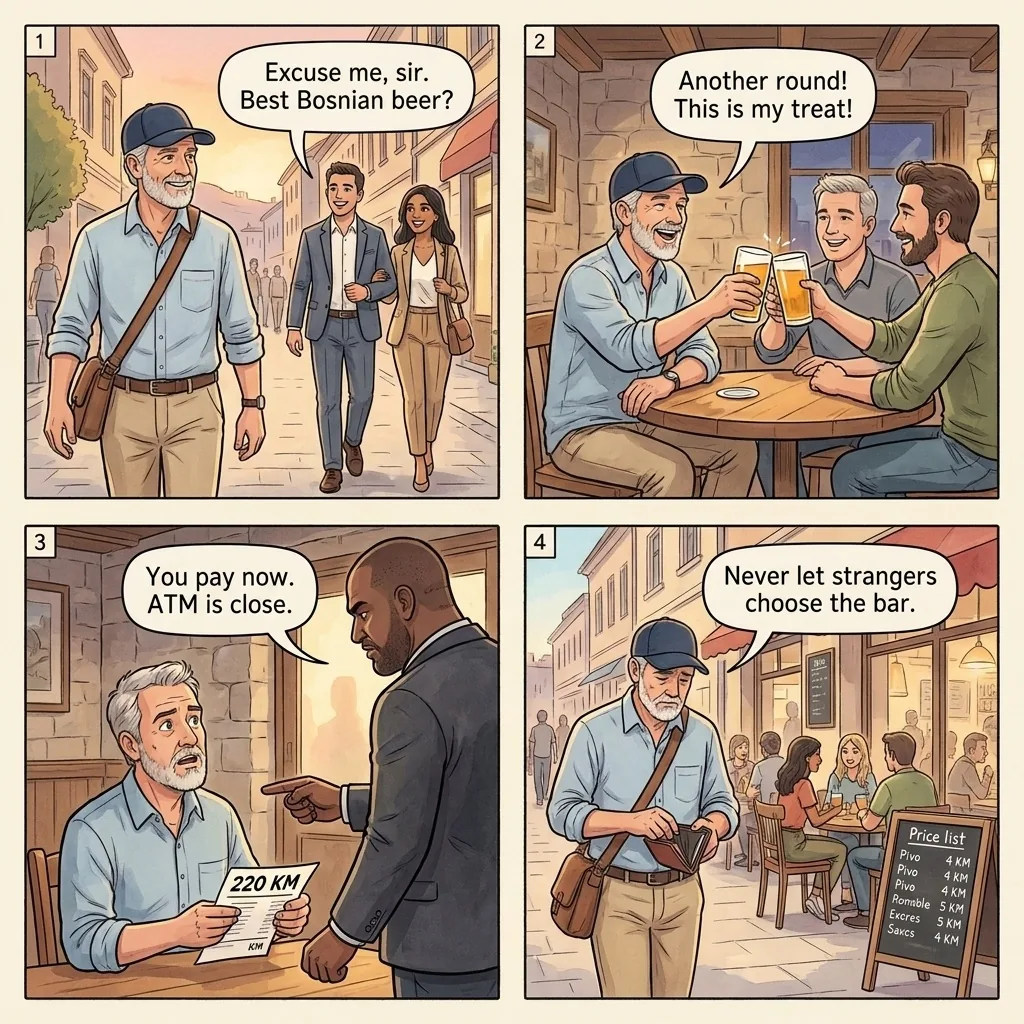
Two well-dressed English speakers on Ferhadija suggest a bar 'for the best Bosnian beer' — your bill arrives at 200+ KM for four or five drinks (legit bars charge 3–5 KM/beer), the 'friends' have already slipped out, and a doorman walks you to an ATM if you refuse.
You're walking through Sarajevo's center in the evening when two well-dressed, friendly people approach. They speak good English, ask where you're from, and after some pleasant conversation, suggest going to a bar they know for 'the best Bosnian beer.' The bar looks normal enough. You sit down, a few rounds are ordered, and the conversation flows. When the bill comes, it's 200 KM or more for what seemed like four or five drinks.
The 'friends' have already paid their separate bill and slipped away, or they claim they're short on cash. Bar staff become hostile if you challenge the bill, and a large doorman escorts you to an ATM to withdraw cash if you refuse to pay. The bouncer-to-ATM escalation is the trademark Eastern European bar-trap finishing move.
This bar-scam pattern is documented by Wiki For Travel's Sarajevo guide, World Nomads' Bosnia safety guide, and on Quora threads about Sarajevo scams. The scam relies on a partnership between the 'friendly locals' (who earn 30–50% commission) and the bar (which charges 5–10 times normal prices). The drinks you're served may be watered down or smaller than standard.
Sarajevo's legitimate bar scene is excellent and affordable — a beer typically costs 3–5 KM at honest establishments, and a full evening with multiple drinks rarely exceeds 30–40 KM per person. Anything over 100 KM for four or five drinks is structurally a scam, not a venue at the high end of Sarajevo's pricing.
The defensive move is to always choose your own bar — never follow strangers' suggestions, no matter how friendly they seem. Check the menu and prices before ordering your first drink. Pay as you go rather than running a tab. If the bill seems inflated, request an itemized breakdown and dispute any charges you cannot account for. If staff become threatening, call police on 122 rather than going to an ATM under duress. Emergency: 112.
Red Flags
- Strangers approach you in the evening and after brief chat suggest going to a specific bar they recommend
- The bar does not have visible menu prices or the menu has unusually high prices you notice too late
- Your new 'friends' order multiple rounds for the table without discussing costs
- When the bill arrives, it is dramatically higher than expected for the number of drinks consumed
- Staff become aggressive or a bouncer appears when you challenge the bill
How to Avoid
- Always choose your own bar — never follow strangers' suggestions, no matter how friendly they seem.
- Check the menu and prices before ordering your first drink.
- Pay as you go rather than running a tab at any unfamiliar establishment.
- If the bill seems inflated, request an itemized breakdown and dispute any charges you cannot account for.
- If staff become threatening, call the police (122) rather than going to an ATM under duress.
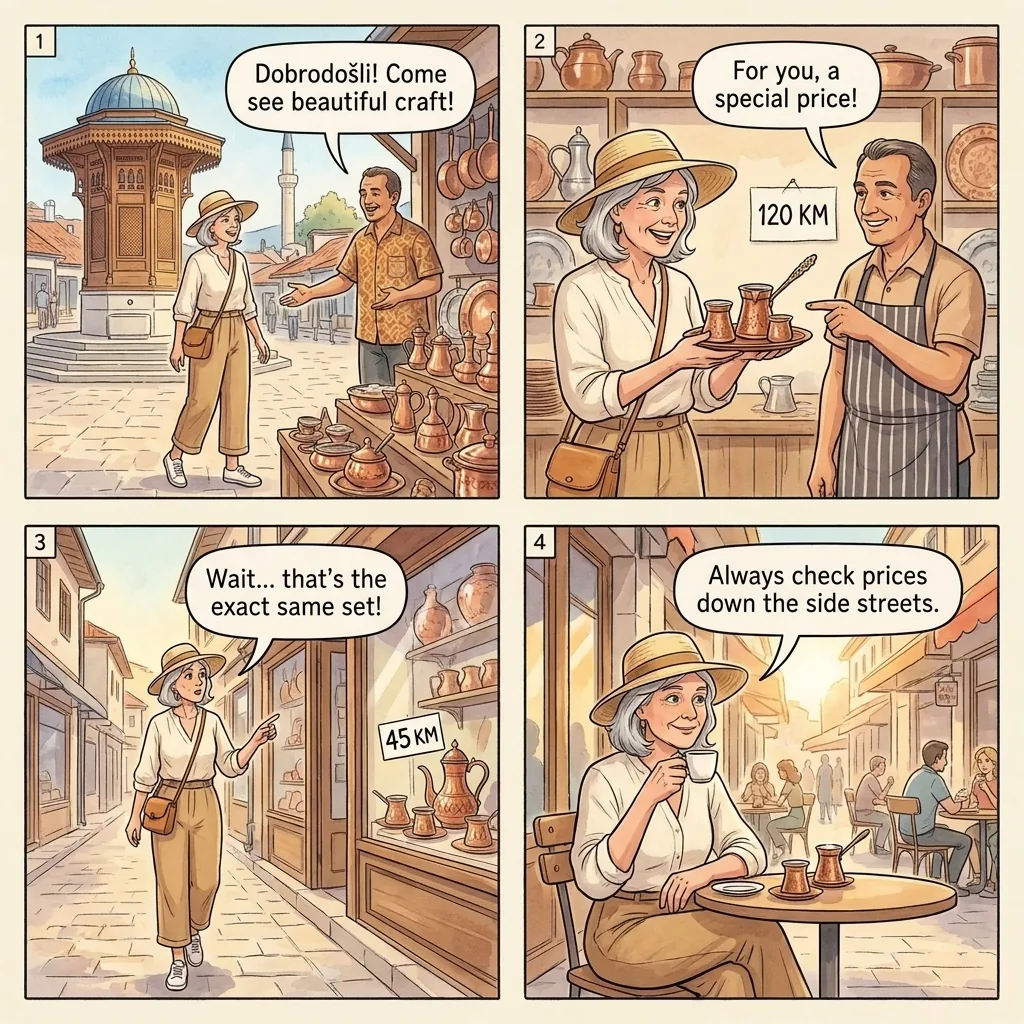
A copper coffee set near Baščaršija's Sebilj fountain is quoted at 120 KM — the identical set two doors down the side street costs 45 KM. The Sebilj-perimeter shops carry tourist markup; deeper in Kazandziluk the prices drop to fair.
You wander into Baščaršija, Sarajevo's beautiful Ottoman-era bazaar, and admire the hand-hammered copper coffee sets (dzevas), ornate plates, and bullet-casing art that the coppersmiths are famous for. A shop owner invites you in and demonstrates the craft. You fall in love with a traditional Bosnian coffee set and ask the price: 120 KM. At the shop two doors down, an identical set costs 45 KM. The quality difference is minimal — the price difference is entirely about which shops primarily serve tourists versus locals.
While not a 'scam' in the aggressive sense, the price differential in Baščaršija is significant and documented on TripAdvisor and travel blogs. The area around the Sebilj fountain (the wooden Ottoman fountain at the center of the square) has the highest tourist markup. As you walk deeper into the side streets of the bazaar, prices drop substantially for identical goods.
Bosnian Voyager's guide to Baščaršija notes that cash is king and that keeping small bills for quick purchases helps avoid the 'no change' problem where vendors round up. The 'no change' play is the secondary mechanic — a 35 KM item plus a 50 KM note plus 'sorry, no change' equals an effective 50 KM purchase, with the 15 KM rounded into the vendor's pocket.
The genuine artisan tradition in Baščaršija is worth supporting and the craftsmanship of the coppersmiths is real. The trick is just to compare prices before committing — Sebilj-fountain perimeter shops are not the only option, and the side streets two minutes' walk in carry the same goods made by the same families at the price locals pay.
The defensive move is to walk the full length of Kazandziluk and the surrounding streets before buying — compare prices at 3–4 shops, then choose. Shops deeper in the side streets typically have better prices for identical goods. Carry small bills in KM to pay exact amounts and avoid the 'no change' roundup. Haggling is acceptable and expected — start at 50–60% of the asking price and negotiate. Police: 122. Emergency: 112.
Red Flags
- The shop is directly adjacent to the Sebilj fountain or the main tourist photo spots
- No prices are displayed on items and the first quote seems substantially higher than similar items you've seen
- The shopkeeper focuses on your nationality rather than the quality or craftsmanship of the item
- You're told an item is 'one of a kind' when identical versions are visible in neighboring shops
- The vendor claims they have no change for large bills, rounding the price up significantly
How to Avoid
- Walk the full length of Kazandziluk and the surrounding streets before buying — compare prices at 3-4 shops.
- Shops deeper in the side streets off the main square typically have better prices for identical goods.
- Ask locals or your hotel staff what a fair price is for common souvenirs like copper coffee sets.
- Carry small bills in KM to pay exact amounts and avoid the 'no change' roundup.
- Haggling is acceptable and expected — start at 50-60% of the asking price and negotiate from there.
Like what you're reading? Get a full Sarajevo itinerary with safety tips built in.
Browse travel-safety books →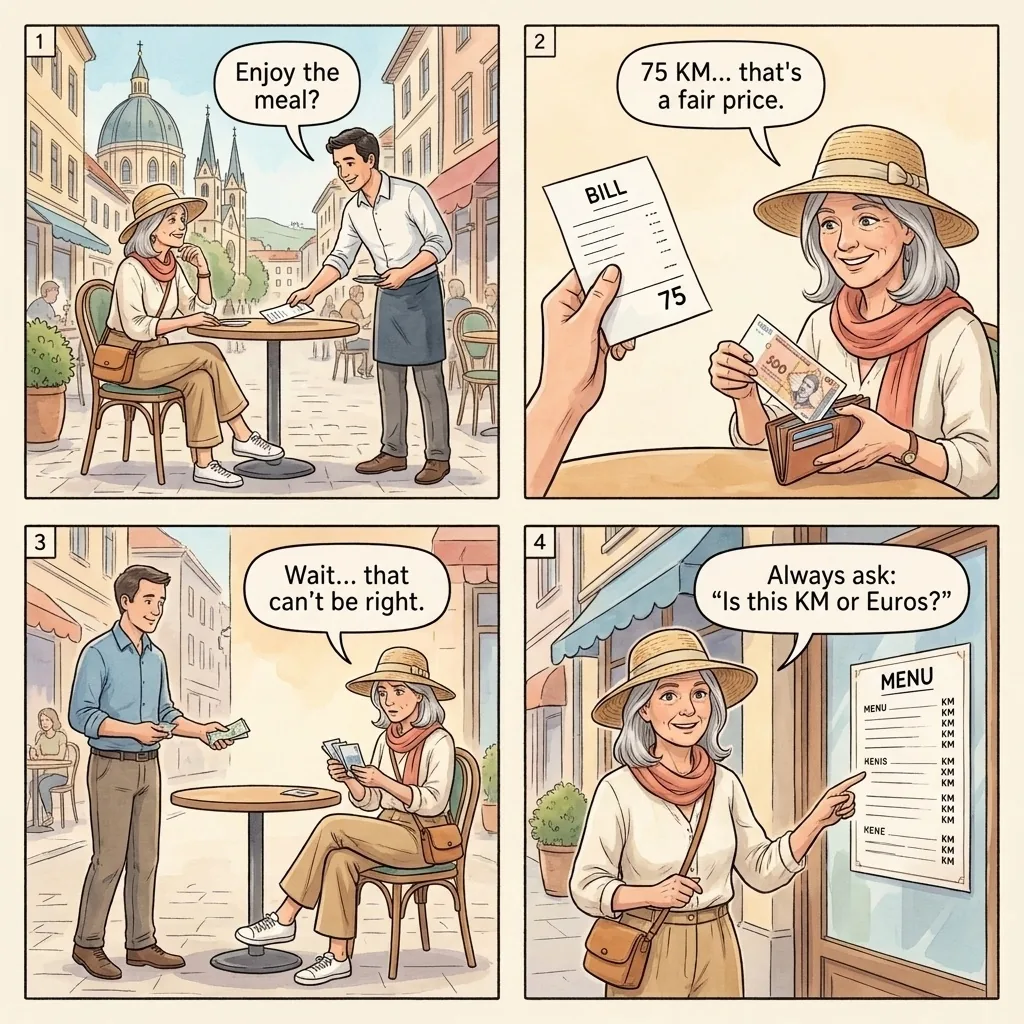
A Ferhadija restaurant bill shows '75' with no currency symbol — you assume KM (€38), pay with a 100 KM note, take 25 KM change. The bill was in euros: €75, nearly double the KM amount. Your KM payment was accepted at a deliberately bad rate.
You finish a pleasant dinner at a restaurant near the Latin Bridge and ask for the bill. It arrives showing '75,' but no currency symbol. You assume it's 75 KM (about €38). You pay with a 100 KM note and receive 25 KM change. Later, you realize the bill was actually in euros — €75, nearly double the KM amount. The restaurant accepted your KM payment at a terrible exchange rate, effectively pocketing the difference.
Bosnia uses the Convertible Mark (KM/BAM), which is pegged to the euro at 1.95583 KM per euro. Many tourist restaurants list prices in euros or display dual pricing, which creates confusion. The currency guide from ManorFX warns that airports and hotels offer poor exchange rates, and Wiki For Travel's Sarajevo guide notes that some restaurants exploit the KM/euro confusion to overcharge tourists who don't realize which currency the bill is in.
The missing-currency-symbol trick is the entire mechanic: a bill showing only '75' lets the tourist's assumption (KM) and the establishment's intent (EUR) diverge. When the customer hands over KM, the restaurant accepts it 'at the door' rate (often 2.5+ KM per EUR vs the official 1.95) and the difference vanishes into the till.
The fixed peg means the conversion is simple (roughly 2 KM = 1 euro), but you should always confirm which currency is being used before ordering. Restaurants legally must display prices in KM under Bosnian consumer-protection law, and any establishment that quotes only in euros is targeting tourists.
The defensive move is to always confirm whether menu prices are in KM or euros before ordering — ask explicitly if the menu doesn't specify, and pay only in Convertible Marks (KM) which is the legal tender. Remember the fixed rate: roughly 2 KM = 1 euro. Request change in KM only — refuse mixed-currency change. Exchange currency at licensed mjenjacnice (exchange offices) for competitive rates. Police: 122. Bosnian consumer protection (Tržišna inspekcija): +387 33 562-100.
Red Flags
- The menu displays prices without specifying the currency — KM, BAM, or EUR
- The restaurant prominently advertises that it 'accepts euros' while not displaying KM prices
- Your change is given in a mix of currencies, making it hard to verify the correct amount
- The bill total seems surprisingly high compared to what you'd expect for Bosnian food prices
- Staff quote prices verbally in euros when you ask but the menu is in KM
How to Avoid
- Always confirm whether prices are in KM or euros before ordering — ask explicitly if the menu doesn't specify.
- Pay in Convertible Marks (KM) whenever possible, as this is the legal tender and avoids conversion games.
- Remember the fixed rate: roughly 2 KM = 1 euro — use this to quickly verify bills.
- Request change in KM only — do not accept mixed-currency change.
- Exchange currency at licensed mjenjacnice (exchange offices) in the city for competitive rates rather than at restaurants or hotels.
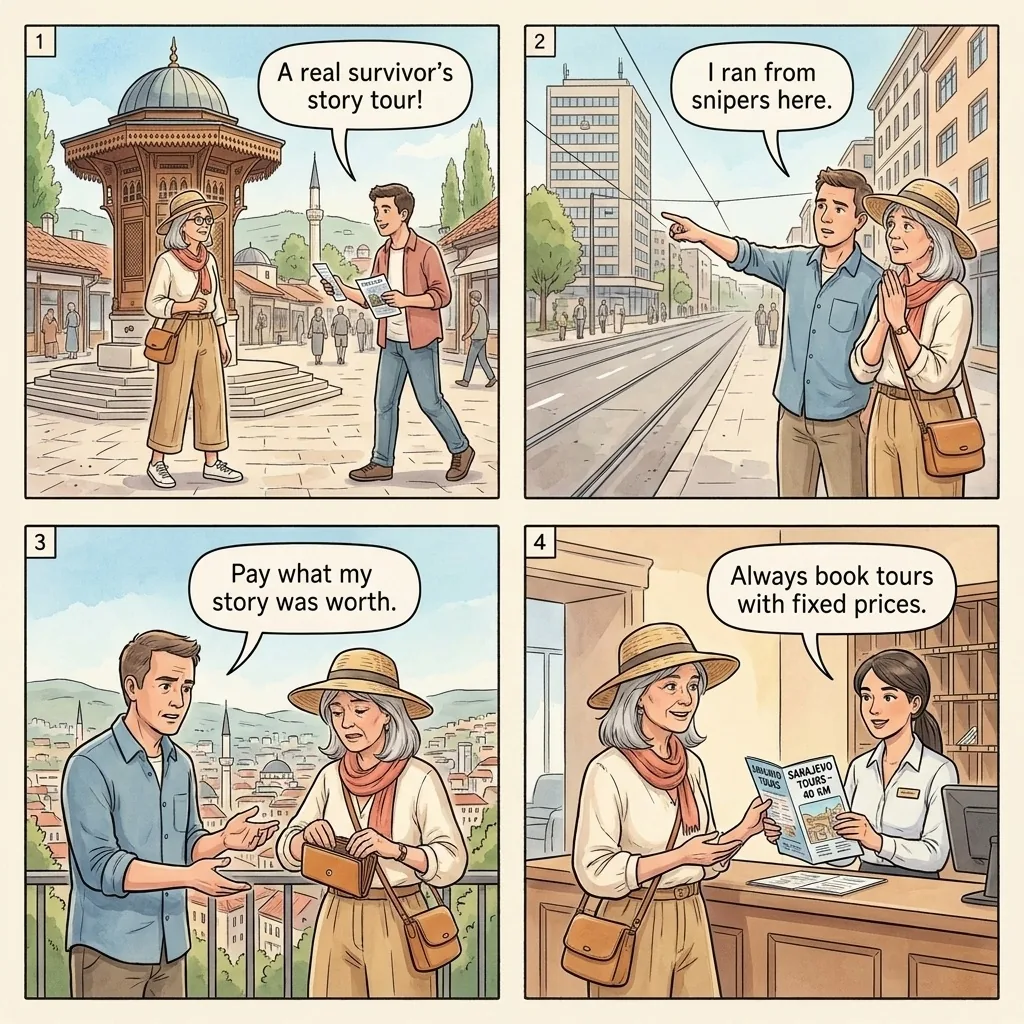
A street-flyer war tour near Baščaršija delivers three hours of emotionally-intense 'siege survivor' narration with no fixed price — at the end the guide asks you to 'pay what you feel the experience was worth.' Most pay 100–200 KM; legit tours cost 30–50 KM, and your 'survivor' guide was born after the war ended.
You book a Sarajevo war tour from a street flyer near Baščaršija. The guide meets you and launches into a deeply emotional personal account of surviving the siege. Over three hours, you visit the Tunnel Museum, Sniper Alley, and shelled buildings. The stories are moving and the guide seems to have lived through the 1992–1996 siege. At the end, there's no fixed price — instead, the guide asks you to 'pay what you feel the experience was worth.'
After three hours of emotional intensity, most people pay 100–200 KM. Later, you learn from your hotel that reputable war tours cost 30–50 KM per person and that your 'survivor' guide was actually born after the war ended (Sarajevo's siege ended in 1996, so anyone claiming first-hand survivor status now needs to be at least 30+ to be plausible).
This is documented on TripAdvisor and in the TravelSafe guide for Sarajevo. The scam exploits the genuine tragedy of the Sarajevo siege to create emotional pressure for excessive tipping. While many legitimate tour operators run excellent and fairly-priced war tours (Sarajevo War Tour, Funky Tours, and Insider are well-reviewed), unlicensed operators work the tourist areas offering unofficial tours with the 'pay what you feel' model designed to extract maximum payment through guilt.
The 'pay what you feel' framing is the entire trick: it's pitched as a generous, dignified pricing model, but it's calibrated to extract 3–5x what the same content would command on a fixed-price ticket. Three hours of emotionally-intense narration is engineered to make any tip below 50–100 KM feel disrespectful, regardless of what the actual market rate is.
The defensive move is to book war tours through established operators (Sarajevo War Tour, Funky Tours, Insider) with fixed prices and hundreds of online reviews — never from a street flyer. Confirm the total price per person before the tour begins; reputable tours cost 30–50 KM per person. Be wary of 'pay what you feel' models. Ask your hotel to recommend a specific licensed operator. Tourism complaints (Tržišna inspekcija): +387 33 562-100. Police: 122.
Red Flags
- The tour is offered via a street flyer or by someone approaching you on the street rather than through a licensed operator
- No fixed price is stated upfront — instead you're told to 'pay what you feel it's worth' after the tour
- The guide claims to be a personal survivor of the siege but looks too young (the siege ended in 1996)
- The emotional intensity seems calibrated to maximize your tip rather than educate
- The guide is not affiliated with any company visible on TripAdvisor or Google Reviews
How to Avoid
- Book war tours through established operators like Sarajevo War Tour, Funky Tours, or Insider, which have fixed prices and hundreds of reviews.
- Confirm the total price per person before the tour begins — reputable tours cost 30-50 KM per person.
- Check the guide's affiliation with a licensed tour company and read their online reviews.
- Be wary of 'pay what you feel' models, which are designed to exploit emotional response.
- Ask your hotel to recommend a specific tour operator rather than booking from street advertising.
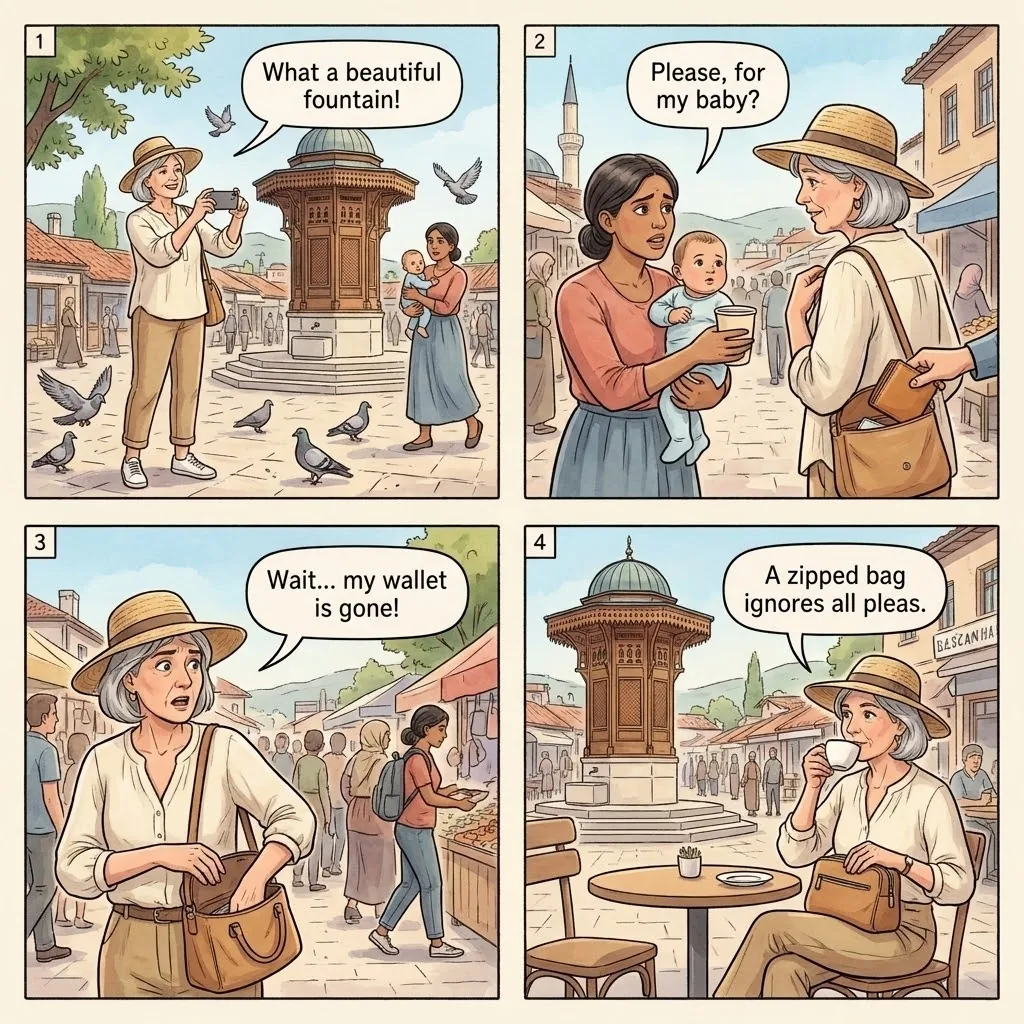
A woman with an infant approaches you photographing the Sebilj fountain holding out a cup — while your attention is on her, a second person lifts your wallet from behind. The child-swarm variant: 4–5 children surround you simultaneously, voices overlapping, and one set of hands works your pockets.
You're photographing the Sebilj fountain when a woman holding an infant approaches, holding out a cup and pleading for money. While your attention is focused on her — and your hands are busy with your camera or phone — a second person slips a hand into your jacket pocket or bag from behind. In another variation, a group of children surrounds you, hands extended and voices overlapping, creating a wall of distraction while one child's hands go through your pockets.
A TripAdvisor thread titled 'Begging on the streets, real or tourist scam?' in the Sarajevo forum discusses this phenomenon. World Nomads' Bosnia safety guide warns that 'small thefts like pickpocketing are most common in busy places and on public transportation,' with Baščaršija and tram lines cited as the primary risk areas.
The TravelSafe rating for Sarajevo notes that organized begging operations target tourists in the Old Town, with pickpocketing happening during the distraction. The team structure is consistent: one person holds your visual attention (the infant or the loudest child), one or two work your pockets and bag from positions you can't see, and a fourth waits 5–10 m away to receive any handed-off items.
Sarajevo is overall one of Europe's safer capital cities, and violent crime against tourists is extremely rare. The risk is almost entirely limited to opportunistic pickpocketing in crowded tourist areas — Baščaršija around the Sebilj, the tram stops on Ferhadija, and the cathedral approach. The infant-cup setup is the highest-volume variant because tourists hesitate to walk away from a person holding a baby.
The defensive move is to keep walking without stopping when approached by beggars — stopping makes you a target for the pickpocket on the other side. Wear bags zipped and cross-body in front, especially in Baščaršija and on trams. Keep phone and wallet in zipped front pockets, never back pockets or open bags. If children surround you, raise your voice firmly and step away quickly without engaging. Police: 122. Emergency: 112.
Red Flags
- A person with an infant approaches you at a tourist site while you're holding a camera or phone
- Multiple children surround you simultaneously with outstretched hands
- Someone tugs at your clothing or bag while another person engages you from the front
- You're in a dense crowd at the Sebilj fountain, on a tram, or at the main bus station
- The begging seems coordinated, with multiple people approaching tourists in rotation
How to Avoid
- Keep your bag zipped and worn cross-body in front, especially in Baščaršija and on trams.
- If approached by beggars, keep walking without stopping — stopping makes you a target for pickpockets.
- Keep your phone and wallet in zipped front pockets rather than back pockets or open bags.
- If children surround you, raise your voice firmly and step away quickly — do not engage.
- Be especially vigilant at the Sebilj fountain, on trams, and at bus/train stations.
🆘 What to Do If You Get Scammed
📋 File a Police Report
Go to the nearest Sarajevo Cantonal Police (MUP Kantona Sarajevo) station. Call 122 (Police) or 112 (Emergency). The main station is at La Benevolencije 16, Sarajevo. Get an official crime report — you'll need this for insurance claims.
💳 Cancel Your Cards
Call your bank immediately. Most have 24/7 numbers on the back of the card (keep a photo saved separately). Block any suspicious transactions before the thieves use your details.
🛂 Lost Passport?
Contact your nearest embassy or consulate. The US Embassy is at 33 Nine Elms Lane, London SW11 7US. For emergencies: +44 20 7499 9000.
📱 Track Your Device
If your phone was stolen, use Find My (iPhone) or Find My Device (Android) from another device. Don't confront thieves yourself — share the location with police instead.
Frequently Asked Questions
You just read 6 scams in Sarajevo. The full Travel Safety Series has 780+ more across 20+ countries.
Tokyo's Kabukichō ¥130,000 bar trap. Rome's gladiator photo extortion. Paris's gold-ring trick. Bali's ATM skimmer scams. Bangkok's grand-palace closure ruse. Every documented scam across 20+ destinations — with the exact scripts, red flags, and local-language phrases that shut each one down. Drawn from Reddit traveler reports, embassy advisories, and consumer-protection cases.
- 780+ documented scams across Tokyo, Rome, Paris, Bali, Bangkok, Rio & 100+ more cities
- 20+ countries covered, with country-by-country phrase cards for every destination
- Updated annually — buy once, re-download future editions free
- All titles $4.99 each on Amazon Kindle