
Key Takeaways
- The #1 reported scam is the Anse Volbert Beach-Boat Curieuse Scam.
- 3 of 6 scams are rated high risk.
- Use app-based ride services (Uber, Bolt) instead of unmarked taxis — always confirm the fare before departure.
- Never accept unsolicited offers from strangers near tourist sites in Seychelles.
⚡ Quick Safety Tips
- Seychelles is one of the safest destinations in Africa — violent crime against tourists is extremely rare, and most risks involve petty theft and tourist price inflation rather than scams or physical danger.
- Rent a car for the best value and flexibility — public buses on Mahé cost just 7 SCR per ride, and taxis are the most expensive (and least regulated) transport option.
- Always pay in Seychellois Rupees rather than euros or dollars — paying in foreign currency triggers unfavorable conversion rates that cost you 5-15% more.
- Book all excursions and accommodations through licensed operators or established platforms with buyer protection — never pay cash deposits to beach vendors for boat trips.
Jump to a Scam
The 6 Scams
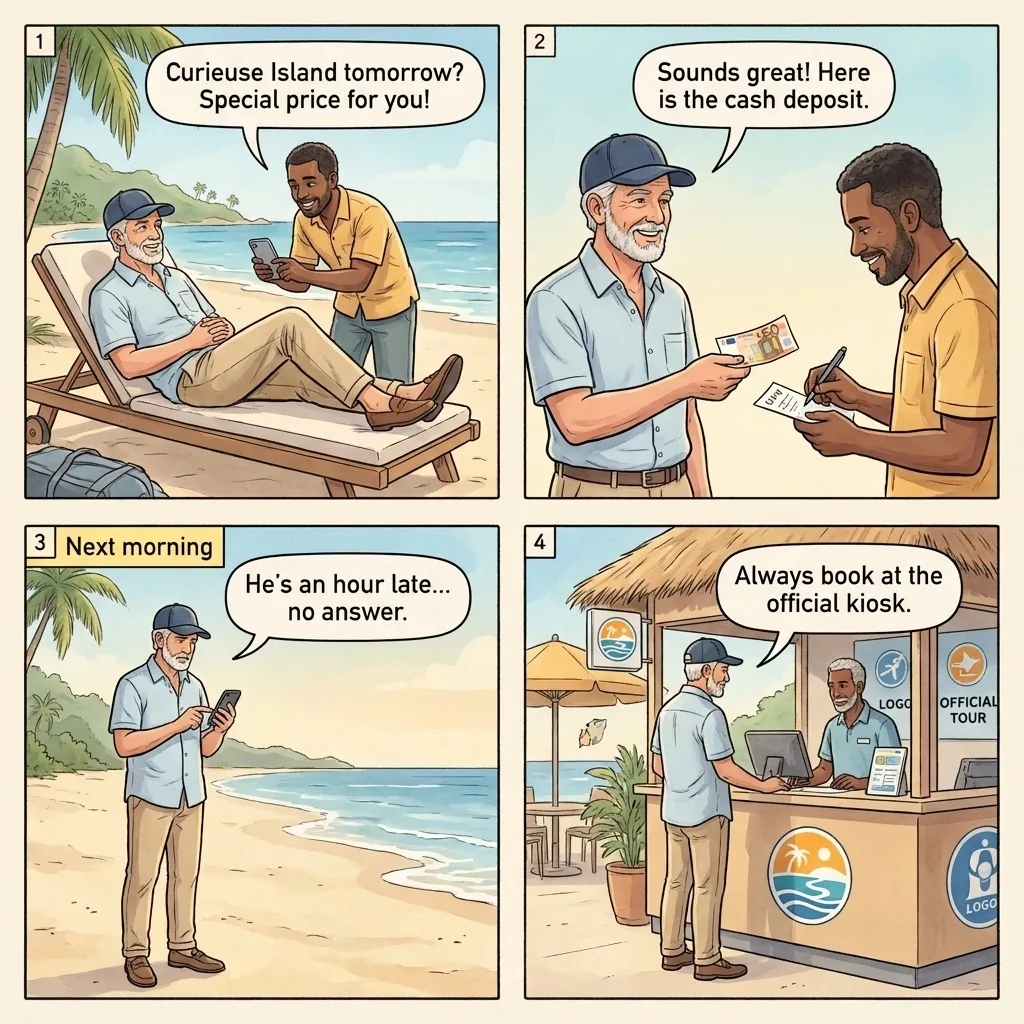
A charismatic man on Anse Volbert beach offers a full-day Curieuse Island trip for €100 per person — €50 less than licensed operators — and takes a €50 cash deposit; next morning no one shows up and the phone is dead.
You're relaxing on Anse Volbert beach in Praslin when a charismatic man approaches with photos on his phone showing beautiful boats, snorkeling at Curieuse Island, and giant tortoises. He introduces himself and offers a full-day island-hopping trip for €100 per person — significantly less than the €150–€200 most licensed operators charge. He asks for a cash deposit of €50 to 'secure your spot for tomorrow.' The next morning, nobody shows up. Your calls go unanswered.
TripAdvisor's Praslin Island forum has a dedicated thread titled 'Just a thank you to the person who posted about the JP scam' where travelers warned each other about a specific salesman in Anse Volbert who approached tourists on the beach to sell Curieuse Island trips, collected deposits, and then provided substandard service — arriving late with an undersized boat lacking proper safety equipment, being aggressive and rude.
A Facebook post from GoTravelYourWay went viral warning 'Beware: Taxi Scam in the Seychelles' with details about unlicensed operators targeting tourists. On La Digue, a similar scam involved someone charging $150 USD upfront for golf-cart transport to the beach, then demanding an additional $50 upon arrival. The pattern is identical across the three main islands.
The unlicensed-operator playbook combines a price below market rate, cash up front, and no paper trail. Even when the operator does show up, the boat is often dangerously undersized, uninsured, and lacking life jackets — meaning the financial scam is layered on top of a real safety risk. Curieuse Island legitimate trips run roughly €60–€80 per person through Mason's Travel, Creole Travel Services, and other registered operators.
The defensive move is to book excursions through your hotel, a licensed Seychelles Tourism Department operator with a physical office, or platforms like Viator and GetYourGuide with buyer protection. Verify the operator's Tourism Department registration before paying. Never pay full price upfront in cash — use a credit card or pay only a small deposit. Check TripAdvisor reviews for the specific operator by name. Police: 999. Tourism complaints: tourism.gov.sc.
Red Flags
- The operator approaches you on the beach rather than operating from a fixed office or licensed kiosk
- They show photos on a phone but have no website, business card, or verifiable online reviews
- The price is significantly below what hotels and licensed operators charge
- They demand full or substantial cash payment upfront with no receipt or booking confirmation
- They cannot provide a tourism operator license number or the name of their registered business
How to Avoid
- Book excursions through your hotel, a licensed tour operator with a physical office, or platforms like Viator and GetYourGuide.
- Verify the operator is registered with the Seychelles Tourism Department before paying anything.
- Never pay full price upfront in cash — use a credit card or pay a small deposit with the balance on the day.
- Check TripAdvisor reviews for the specific operator by name before committing to any trip.
- If booking on the beach, get a written receipt with the operator's full name, phone number, license number, and pickup time.
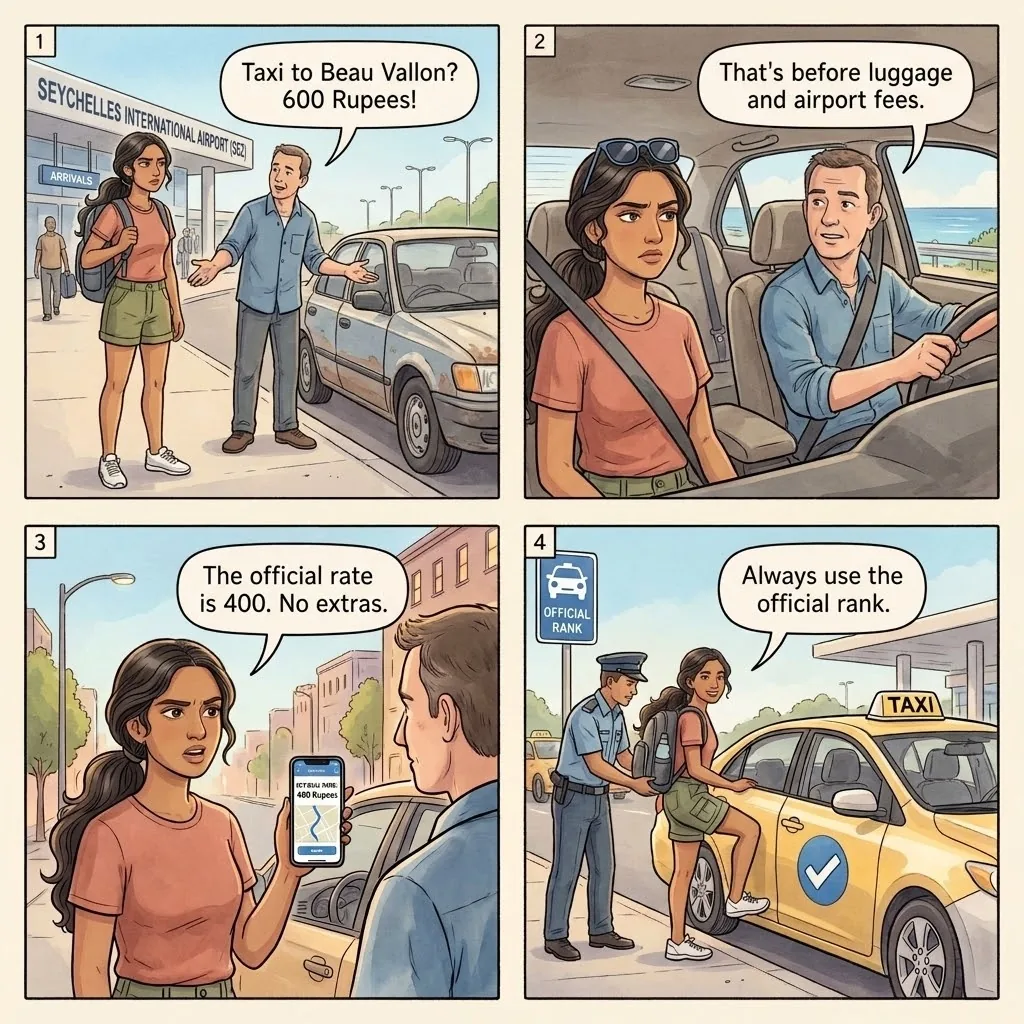
A driver at Mahé Airport quotes 600 SCR to Beau Vallon — the official rate is 400 SCR — then adds 'luggage' and 'airport surcharge' fees mid-journey to push the total to 800 SCR ($60) for a 30-minute drive.
You land at Seychelles International Airport and head to the taxi area. A man approaches saying he can take you to Beau Vallon Beach for 600 Seychellois Rupees. It sounds reasonable until you learn the official taxi fare should be around 400 SCR. But you're tired from flying and agree. Mid-journey, the driver mentions additional charges for luggage and 'airport surcharge,' pushing the total to 800 SCR — roughly $60 USD for a 30-minute drive.
Facebook's GoTravelYourWay posted a viral warning about a 'Taxi Scam in the Seychelles' involving unlicensed operators approaching tourists at the airport and ferry terminals. Welcome Pickups' Mahé guide advises tourists to 'ensure your driver resets the taximeter to the base fare before beginning your journey' and warns that 'if a taxi driver isn't using a taxi meter, be sure to discuss the cost in advance.'
Seychelles taxis do not universally use meters — fares are largely unregulated and negotiated, which creates an environment ripe for overcharging. Short cab rides commonly cost $50–$60 USD according to traveler reports on TripAdvisor; a beach coconut at the same time can cost $8 USD in tourist areas. The combined effect makes Seychelles one of the most expensive Indian Ocean destinations.
The mid-journey-surcharge variant is the harder mechanic: an initial fare gets agreed at the curb, then 'luggage,' 'airport,' or 'night-rate' charges appear once you're committed and there's no way to abort the trip. By the time you arrive at the destination, you've effectively been ratcheted up 50–100% with no recourse.
The defensive move is to ask your hotel to arrange a fixed-price airport transfer before you arrive — most resorts offer this for 600–900 SCR. If taking a curb taxi, agree on the total fare including all bags and passengers in writing before getting in. Renting a car (€40–€50/day) is the most economical way to explore Mahé and Praslin. The SPTC public bus on Mahé runs main routes for just 7 SCR per ride. Police: 999.
Red Flags
- A driver approaches you in the arrivals area rather than waiting at the official taxi rank
- No meter is running and the driver quotes a price without referencing any official tariff
- The driver adds surcharges mid-journey for luggage, airport fees, or night rates
- The vehicle lacks official taxi markings or identification
- The quoted price is significantly higher than what your hotel suggested the fare should be
How to Avoid
- Ask your hotel to arrange an airport transfer with a pre-agreed fixed price before you arrive.
- If taking a taxi, agree on the total fare including all bags and passengers before getting in the car.
- Rent a car for maximum flexibility — rates start from 40-50 EUR per day and it's the most economical way to explore Mahé and Praslin.
- Use the SPTC public bus on Mahé for just 7 SCR per ride — buses run frequently on main routes during the day.
- Ask your hotel concierge for the expected taxi fare to your destination so you have a baseline for negotiation.
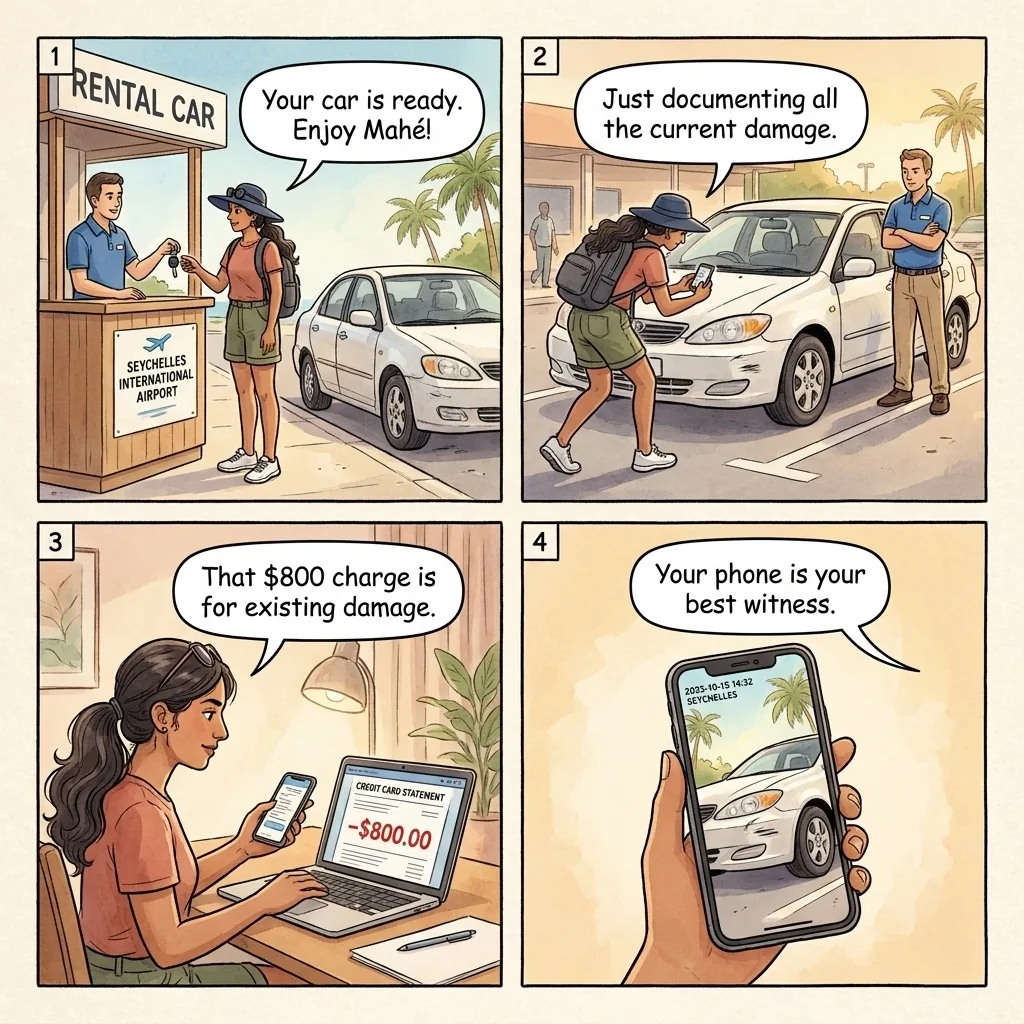
You rent a car on Mahé, return it undamaged after 3 days, and fly home — two days later your card is charged $800 for a 'dent' that was already there at pickup. All Seychelles rental agencies are local franchises, making dispute resolution difficult.
You rent a car on Mahé from a small local agency. The car arrives with bald tires, a messy interior, and a few existing scratches. You drive it carefully for three days, return it, and head to the airport. Two days later, your credit card is charged $800 for 'damage' you supposedly caused — a dent or scratch that was already there when you picked it up. The agency has your credit card details from the deposit hold, and disputing the charge from home is a nightmare.
One Mile at a Time travel blog documented a bad rental car experience in Seychelles, noting the poor condition of vehicles provided. Car Hire Seychelles blog dedicated a full post to 'What You Need to Know About Insurance,' warning that CDW/LDW waivers include very high excess charges — up to $5,000 for cars and $7,500 for motorhomes.
CoverTrip's guide on fighting rental car damage scams notes that 'all of the rental agencies in Seychelles are franchises, not corporate owned,' making dispute resolution more difficult than with major international brands. There is no central corporate office to escalate to; each franchise sets its own dispute process.
The combination of high excess deposits, deliberately poor vehicle condition at handover, and local franchise ownership creates a perfect environment for inflated damage claims. Travel forums consistently advise taking extensive photos and video of every panel, tire, interior surface, and existing scratch at pickup and dropoff with timestamps — without that evidence, you have no way to prove pre-existing damage.
The defensive move is to take time-stamped photos and video of every panel, tire, and interior surface at both pickup and dropoff, and insist on a detailed written condition report at pickup with the agent's signature acknowledging all existing damage. Purchase independent rental-car excess insurance from RentalCover.com before your trip. Dispute any unexpected charges with your credit card company within 60 days using your photos as evidence. Police: 999. Tourism complaints: tourism.gov.sc.
Red Flags
- The vehicle is delivered in poor condition with existing damage, bald tires, or mechanical issues
- The rental agreement has an extremely high excess/deductible — $3,000 to $5,000 is common
- The agent rushes you through the vehicle inspection or discourages you from documenting the car's condition
- No detailed condition report is provided at pickup listing all existing damage
- The rental company charges your card for damage days after you've returned the vehicle and left the country
How to Avoid
- Take extensive photos and video of every panel, tire, interior surface, and existing scratch at pickup — with timestamps.
- Insist on a detailed written condition report at pickup and have the agent sign off on all existing damage.
- Take additional photos at dropoff with the agent present and get written confirmation of the vehicle's condition.
- Purchase independent rental car excess insurance from providers like RentalCover.com before your trip.
- Dispute any unexpected charges with your credit card company within 60 days — keep all photos as evidence.
Like what you're reading? Get a full Seychelles itinerary with safety tips built in.
Browse travel-safety books →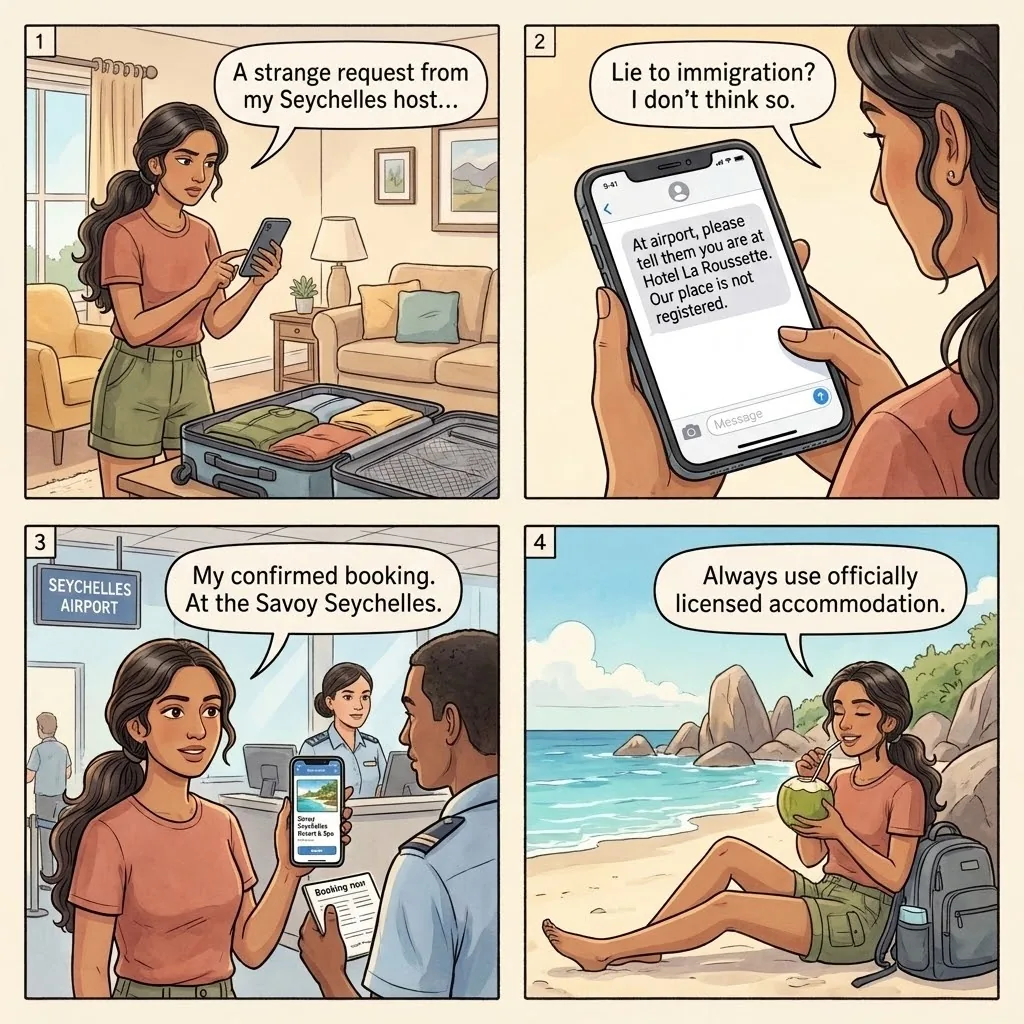
An Airbnb host in Seychelles asks you to tell airport immigration you're staying at a different (registered) hotel — their property isn't licensed with the Tourism Department, and if discovered you face forced last-minute bookings at €200+/night or denial of entry.
You book what looks like a charming local guesthouse through Airbnb on Mahé at a great price. The host messages you before your trip and asks you to tell immigration at the airport that you'll be staying at a specific hotel instead of their property. When you ask why, they explain their accommodation isn't officially registered with the Seychelles Tourism Department. You think it's a minor bureaucratic issue and agree.
At Seychelles airport immigration, officers ask where you're staying and check accommodation records. If they discover the discrepancy, you could be required to book an expensive last-minute hotel room right at the immigration counter. The 'minor' framing the host used is the trick: you're being asked to make a false declaration to a sovereign immigration authority on the host's behalf.
One traveler documented on Fearless Female Travels receiving a message from an Airbnb host in Seychelles telling them they 'had to lie to immigration about where they would be staying.' The traveler reported that Airbnb sided with the host on the dispute. Seychelles immigration requires proof of accommodation for entry, and staying at unregistered properties can technically violate visa conditions.
The risk is real: if your accommodation is found to be unapproved, you may face questioning, forced last-minute hotel bookings at airport prices (€200+/night), or in extreme cases denial of entry and being sent home on the next flight. The financial 'savings' of an unregistered Airbnb evaporate the moment immigration flags the booking.
The defensive move is to only book accommodation registered with the Seychelles Tourism Department — ask for the registration number before booking, and refuse any host who asks you to make false immigration declarations. Book through platforms with buyer protection (Airbnb, Booking.com) and keep all communication on the platform for chargeback leverage. Print your booking confirmation to show immigration officers. Police: 999. Seychelles Tourism Department: tourism.gov.sc.
Red Flags
- The host asks you to lie to immigration about your accommodation or name a different hotel
- The listing price is significantly below comparable properties in the area
- The host cannot provide a Seychelles Tourism Department registration number when asked
- Communication is only through messaging apps rather than through the booking platform
- The host asks for payment outside the booking platform to avoid fees
How to Avoid
- Only book accommodation that is registered with the Seychelles Tourism Department — ask for the registration number before booking.
- Book through platforms with buyer protection (Airbnb, Booking.com) and keep all communication on the platform.
- Never agree to lie to immigration — this could result in deportation or being banned from entry.
- Print your booking confirmation to show immigration officers at the airport as proof of accommodation.
- If an Airbnb host asks you to make false immigration declarations, report them to Airbnb and cancel the booking immediately.
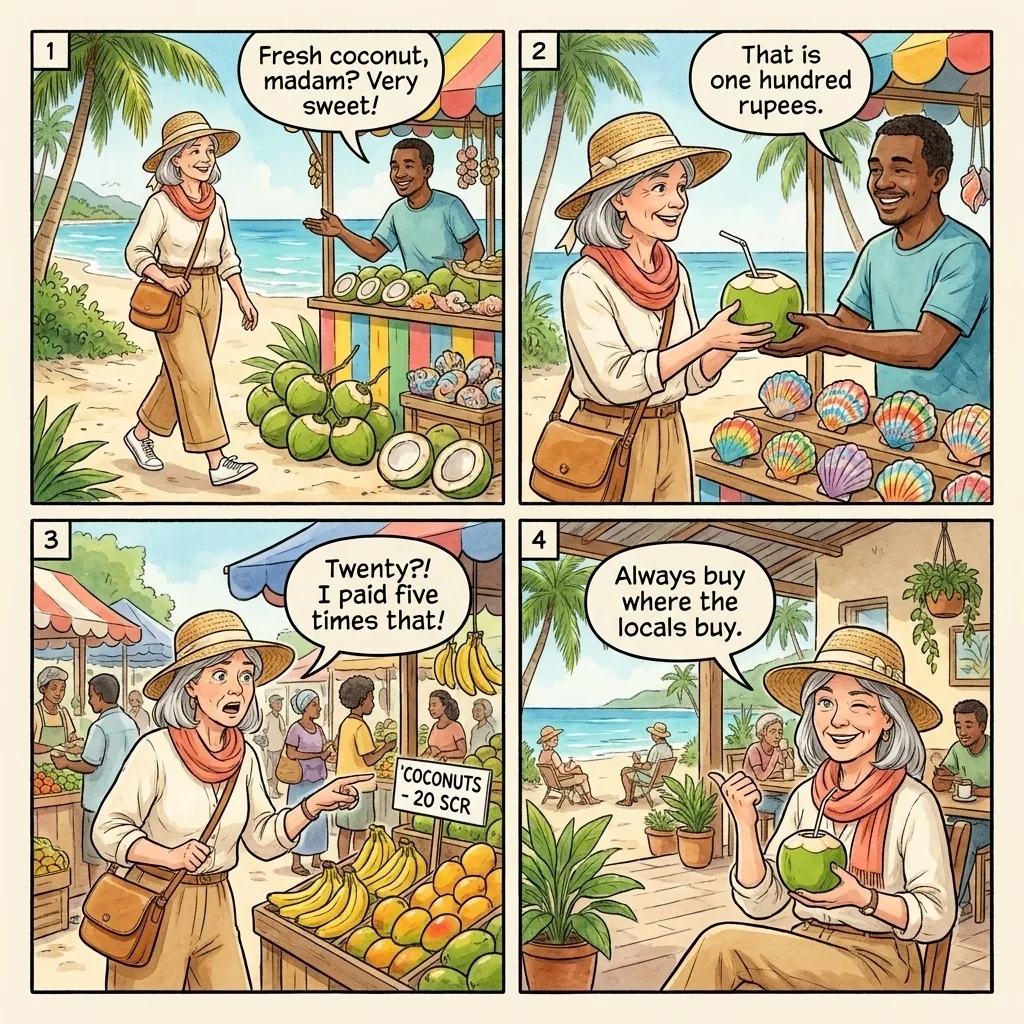
A Beau Vallon Beach vendor charges 100 SCR ($8) for a coconut that costs locals 15–20 SCR; painted shells run 300 SCR vs 50 SCR at Victoria Market. Beachfront markups run 100–300% for the same items.
You're at Beau Vallon Beach and stop at a vendor selling fresh coconuts. He cracks one open and hands it to you — 100 SCR, about $8 USD for a coconut that costs locals 15–20 SCR. You move on to the souvenir stalls where a painted coconut shell goes for 300 SCR and a simple shell necklace for 200 SCR. At the Victoria Market in town, the same shell necklace is 50 SCR.
The shopkeeper at Beau Vallon doubled the price for fruits when they saw you were a tourist — travelers report being charged 'double the usual price' simply for being foreign. The pricing isn't a mistake; it's a system. Local shoppers and tourists at the same stall in the same hour pay different rates, and the menu (when there is one) reflects the foreigner price.
Seychelles is an expensive destination by any measure, but the gap between tourist prices and local prices is significant. TripAdvisor's Seychelles forum thread 'Seychelles, the most disappointing island paradise!' features multiple travelers complaining about inflated prices. Inside Seychelles' money guide notes that 'in many hotels and restaurants you can pay in Euros but this costs more' — a hidden markup that effectively penalizes tourists who don't use the local Seychellois Rupee.
The Seyvillas shopping guide confirms Victoria Market is where locals shop and prices are fairer, while beach-front vendors near Beau Vallon and other tourist beaches charge premiums of 100–300% for the same items. The geographic split is straightforward: 5 km inland gets you fair pricing, 50 m onto the beach gets you double-to-triple.
The defensive move is to shop where locals shop — the Victoria Market for souvenirs and spices, STC or Deepam supermarkets for water and snacks, and small roadside stalls away from major beaches for fresh coconuts. Always pay in Seychellois Rupees rather than euros — paying in foreign currency costs more due to unfavorable conversion rates. Ask your hotel staff about fair prices for common items before heading to tourist beaches. Police: 999.
Red Flags
- Prices at beach stalls are not displayed and are quoted only after you show interest
- The vendor charges in euros or dollars rather than Seychellois Rupees — the conversion always favors them
- The same item is available at significantly lower prices at the Victoria Market or local shops
- A vendor follows you or becomes aggressive when you try to compare prices elsewhere
- Fresh produce like coconuts, fruits, or fish costs more than 3-4 times the supermarket price
How to Avoid
- Always pay in Seychellois Rupees rather than euros — paying in foreign currency costs more due to unfavorable conversion rates.
- Buy souvenirs at Victoria Market (Sir Selwyn Selwyn-Clarke Market) where locals shop and prices are more reasonable.
- Stock up on water, snacks, and basics at STC or Deepam supermarkets rather than beach vendors or hotel shops.
- Ask locals or your hotel staff about fair prices for common items before heading to tourist beaches.
- Exchange money at the airport bureau upon arrival for the best rates — avoid unauthorized money changers.
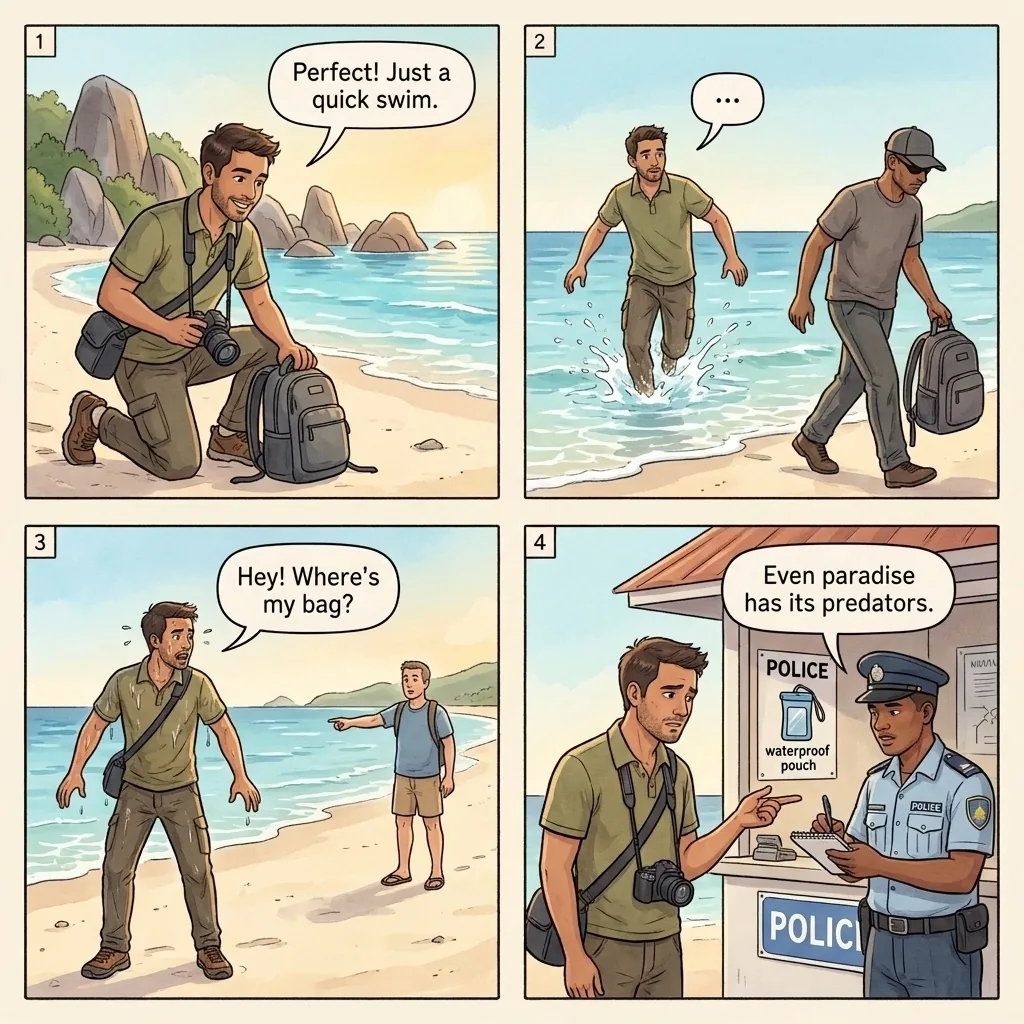
You set your bag on the sand at Beau Vallon while you swim — five minutes later it's gone with your phone, cash, and room key. Or at Victoria bus station someone bumps you from one side while an accomplice lifts your bag from the other.
You set your bag down on the sand at Beau Vallon Beach while you wade into the water for a quick swim. When you return five minutes later, your bag is gone — along with your phone, cash, and room key. A nearby sunbather says they saw someone casually pick it up and walk away. Alternatively, at the Victoria bus station, someone bumps into you from one side while an accomplice grabs your bag from the other.
Basic Planet's Seychelles safety guide notes that 'some scammers operate in groups where one member distracts tourists while others steal.' Anja on Adventure's 2026 Seychelles safety guide warns about petty theft at popular beach areas and transport hubs. While Seychelles has a relatively low crime rate, opportunity theft is the main risk for tourists.
The Victoria bus station and Mahé–Praslin ferry terminals are the most common locations for bag snatching because of crowds and the distraction of boarding. The bump-and-lift technique is two-person: one creates physical distraction, the other extracts the bag in 3–5 seconds. The mechanic exploits transit-window urgency where you don't want to lose your spot in line by chasing.
Beaches present a different risk pattern — valuables left unattended while swimming disappear quickly because the thief has 5–15 minutes of unmonitored access. The 'walking past casually' approach looks innocuous to nearby sunbathers because there's no struggle and no alarm. By the time you've toweled off, the thief is 200 m down the beach.
The defensive move is to never leave valuables unattended on the beach — use a waterproof phone pouch and carry your key card while swimming, and use a crossbody bag in crowded areas like the Victoria bus station and ferry terminals. Leave passport, extra cash, and non-essential electronics in your hotel safe. Travel with a companion who can watch your things while you swim, or ask your resort for a beach locker. Police: 999. Tourism complaints: tourism.gov.sc.
Red Flags
- You leave bags or valuables unattended on the beach while swimming — even for a few minutes
- Someone creates an unusual distraction near you in a crowded area like the bus station or market
- A stranger asks you to watch their things while they go get something — a tactic to make you feel safe leaving yours
- Someone bumps into you or blocks your path at a ferry terminal or bus station
- Your accommodation does not have a safe or secure storage for valuables
How to Avoid
- Never leave valuables unattended on the beach — use a waterproof phone pouch and carry your key card while swimming.
- Leave passport, extra cash, and non-essential electronics in your hotel safe.
- Use a crossbody bag or money belt in crowded areas like the Victoria bus station and ferry terminals.
- Travel with a companion who can watch your things while you swim, or ask your resort for a beach locker.
- If someone creates a distraction or bumps into you, immediately check your pockets and bags.
🆘 What to Do If You Get Scammed
📋 File a Police Report
Go to the nearest Seychelles Police Force station. Call 999 (Emergency) or 133 (Non-Emergency). The Central Police Station is at Revolution Avenue, Victoria. Get an official crime report — you'll need this for insurance claims.
💳 Cancel Your Cards
Call your bank immediately. Most have 24/7 numbers on the back of the card (keep a photo saved separately). Block any suspicious transactions before the thieves use your details.
🛂 Lost Passport?
The US Embassy in Mauritius covers Seychelles — emergencies: +230 202-4400. The UK High Commission Victoria is at Oliaji Trade Centre, Francis Rachel Street, Victoria (+248 4-283-666). Other nationalities: contact your country's mission accredited to Seychelles.
📱 Track Your Device
If your phone was stolen, use Find My (iPhone) or Find My Device (Android) from another device. Don't confront thieves yourself — share the location with police instead.
Frequently Asked Questions
You just read 6 scams in Seychelles. The full Travel Safety Series has 780+ more across 20+ countries.
Tokyo's Kabukichō ¥130,000 bar trap. Rome's gladiator photo extortion. Paris's gold-ring trick. Bali's ATM skimmer scams. Bangkok's grand-palace closure ruse. Every documented scam across 20+ destinations — with the exact scripts, red flags, and local-language phrases that shut each one down. Drawn from Reddit traveler reports, embassy advisories, and consumer-protection cases.
- 780+ documented scams across Tokyo, Rome, Paris, Bali, Bangkok, Rio & 100+ more cities
- 20+ countries covered, with country-by-country phrase cards for every destination
- Updated annually — buy once, re-download future editions free
- All titles $4.99 each on Amazon Kindle