
Key Takeaways
- The #1 reported scam is the Suva Sword-Carver Name-Hustle.
- 3 of 6 scams are rated high risk.
- Use app-based ride services (Uber) or official metered taxis instead of unmarked vehicles.
- Never accept unsolicited offers from strangers near tourist sites in Suva.
⚡ Quick Safety Tips
- Keep phones and valuables in secure pockets when in crowded areas.
- Use only licensed taxis or app-based ride services.
- Book tours and tickets through verified operators with online reviews.
- Keep a copy of your passport separate from the original.
Jump to a Scam
The 6 Scams
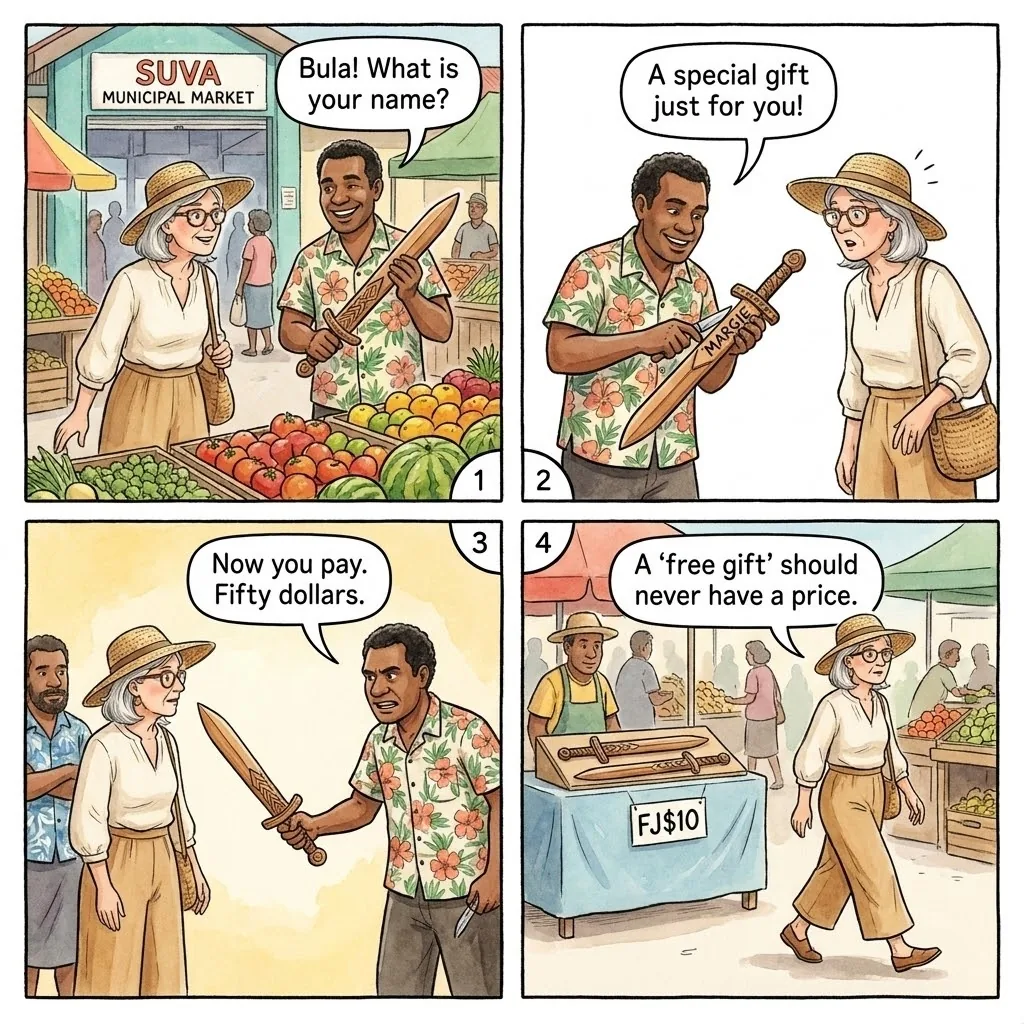
It's a Saturday morning at the Suva Municipal Market, you're browsing the produce and craft stalls, and a friendly Fijian man holding a wooden sword greets you with a warm 'bula!' and asks your name.
You answer politely. Before you can react, he's already pulled out a small carving knife and is etching your name into the wooden handle of the sword. The carving takes maybe ninety seconds. He smiles, hands you the sword, and asks for FJ$50 (about USD $22). The wood-and-pigment cost of the sword is roughly FJ$2; the legitimate market rate for the same piece without the personalisation is FJ$5–10. The 'name carving' is the hook to convert a low-cost item into a premium-price commitment.
If you refuse to pay, the carver gets visibly aggressive — voice raises, body posture changes, sometimes other vendors join in to support the demand. The social-pressure mechanic is calibrated to make refusal feel rude (you've already given your name; he's done 'work' for you; other people are watching). As travelers report across Reddit, the TripAdvisor Suva forum, the Lonely Planet Pacific thorntree, and Fiji Tourism Board consumer guidance, the sword-carver name-hustle is one of the most-encountered Suva tourist frictions and runs at both the Municipal Market and the Nadi tourist strip.
The mechanism is structural. The wooden swords (sai or war clubs) are real Fijian craft items at the FJ$5–10 retail rate at established craft markets like the Government Handicraft Centre or the MHCC Handicraft Centre. The hustle is not the product itself but the conversion of an unsolicited 'personalisation' into a five-to-ten times markup. The legitimate Fijian artisans at registered markets sell the same swords at posted prices with no name-carving framing.
The structural defence is verbal and immediate. Do not share your name with any street vendor in Suva or Nadi who is holding wood, paint, or any craft material — the question is the trap. If a carver starts working before you've agreed, walk away immediately; the social-pressure logic only works if you stay in the encounter. The legitimate price ceiling for a Fijian wooden sword is FJ$5–10 at established craft markets; refuse to pay above that for the street-cart variant. If a carver becomes aggressive, walk into the nearest Suva Police office (the Central Police Station is on Pratt Street near the market) — most operators disperse the moment a real police involvement is on the table.
Do NOT share your name with any street vendor in Suva or Nadi who is holding wood, a knife, or craft material — the name question is the entire trap. If a vendor starts carving before you agree, walk away immediately; the social pressure only works if you stay in the encounter. Buy Fijian wooden swords and craft items at registered markets — the Government Handicraft Centre on Stinson Parade or the MHCC Handicraft Centre — at posted prices (FJ$5–10 for a sword). Refuse to pay above FJ$10 for any street-cart variant. If a carver becomes aggressive, walk toward the Suva Central Police Station on Pratt Street — most operators disperse before you arrive. Emergency: 917 (Fiji Police) or 911 (general); the U.S. Embassy in Suva is at +679 331 4466.
Red Flags
- A stranger asks your name near a market or tourist area
- They begin carving or writing before you agree to anything
- The item appears cheap but the demand is disproportionately high
- They become aggressive or block your path when you try to leave
How to Avoid
- Never share your name with street vendors who are holding craft items.
- Walk away immediately if someone starts carving without your consent.
- A fair price for a small wood carving in Fiji is FJ$2-5, not FJ$50.
- Shop at established craft markets like the MHCC Handicraft Centre instead.
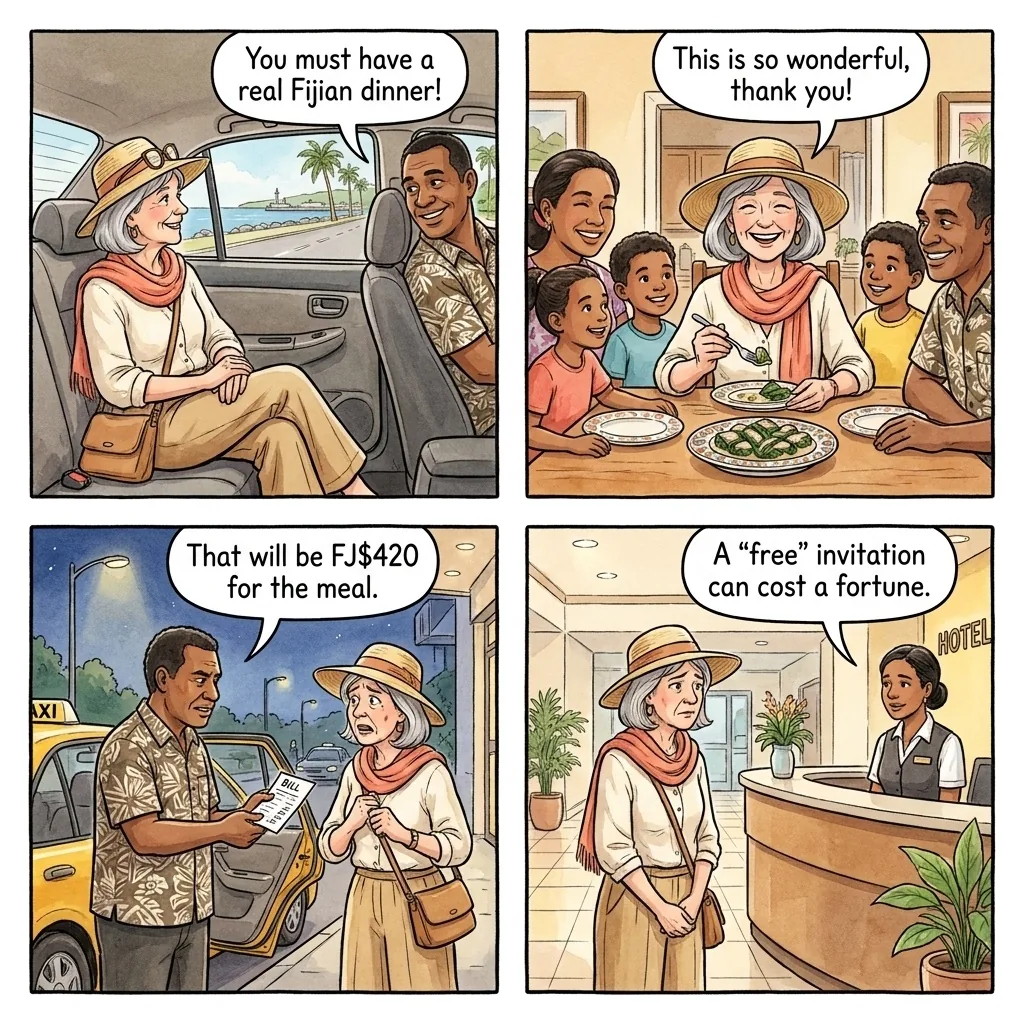
It's your second day in Suva, your taxi driver from Princes Wharf to your hotel along Victoria Parade is warm and chatty, asks about your trip and tells you about Fijian culture, and at the end of the ride he invites you and your partner to dinner at his family's home for a 'real Fijian experience.'
The invitation feels genuine. You agree because the cultural-immersion framing is exactly what travel guides celebrate. The next evening he picks you up, drives forty minutes to a small house in a Suva-suburb neighbourhood, and you sit down to a lovely meal of palusami, kokoda, and dalo with his wife, three children, and an aunt. The conversation is warm, the food is good, the kids are charming. After dinner, he drives you back to your hotel — and on arrival presents a bill of FJ$420 (about USD $185) for 'food cost and transport.'
The Suva taxi-driver family-dinner bill trap is a well-practised routine documented across Reddit, the TripAdvisor Suva forum, the Lonely Planet Pacific thorntree, and the U.K. Foreign Office Fiji travel advice. The hospitality is calculated; the family is sometimes real and sometimes hired; the bill is non-negotiable; the driver becomes threatening if you refuse to pay. The mechanism uses three structural failures: the cultural-immersion framing makes 'no' feel actively rude, the location (off the main strip, in a residential neighbourhood) puts the customer in a setting with no easy exit, and the cash demand at the closing of an evening 'gift' weaponises Fijian hospitality norms against the visitor.
The legitimate Fijian cultural-experience economy is real and well-developed. Fiji Tourism's Lovo Night experiences at the Pearl Resort, the Sigatoka Sand Dunes village stays, and the Likuri Island Resort cultural-night packages all offer real Fijian family-meal experiences with documented pricing — typically FJ$80–150 per person all-in, booked through your hotel concierge or directly. None of them require getting into a stranger's taxi for a forty-minute drive into the suburbs.
The structural defences are concrete. Politely decline dinner invitations from taxi drivers you've just met — the friendliness is calibrated, not spontaneous. If you genuinely want a Fijian family-meal experience, book through your hotel concierge or a registered cultural-tourism operator. Use only registered yellow taxis with permit numbers displayed; note the permit number for any taxi you take. If you find yourself in this scenario and a bill is presented, refuse to pay above FJ$50 (which is generous for a meal-and-transfer in Fiji), photograph the driver and the permit number, and walk into your hotel lobby — the hotel's bell staff will support you, and the driver disappears once any official involvement looks likely.
Politely decline dinner invitations from Suva taxi drivers you've just met — the warm cultural-immersion framing is the entire trap. If you genuinely want a Fijian family-meal experience, book through your hotel concierge or via a registered cultural-tourism operator (Pearl Resort Lovo Night, Sigatoka Sand Dunes village, Likuri Island) at documented prices. Use only registered yellow taxis with permit numbers displayed; note the permit number. If you've already accepted and a bill is presented, refuse to pay above FJ$50, photograph the driver and the permit number, walk into your hotel lobby and ask the staff to support you. Pay by card if accepted for chargeback options. Emergency: 917 (Fiji Police) or 911 (general); the U.S. Embassy in Suva is at +679 331 4466.
Red Flags
- A taxi driver you just met invites you to his home for dinner
- The invitation comes unprompted during your very first ride
- No price is ever mentioned for food or transport beforehand
- The driver seems overly interested in your travel plans and budget
How to Avoid
- Politely decline dinner invitations from taxi drivers you've just met.
- If you want an authentic Fijian meal experience, book through your hotel.
- Use registered taxi services and note the driver's ID number.
- Keep your hotel's number handy to call if you feel pressured.
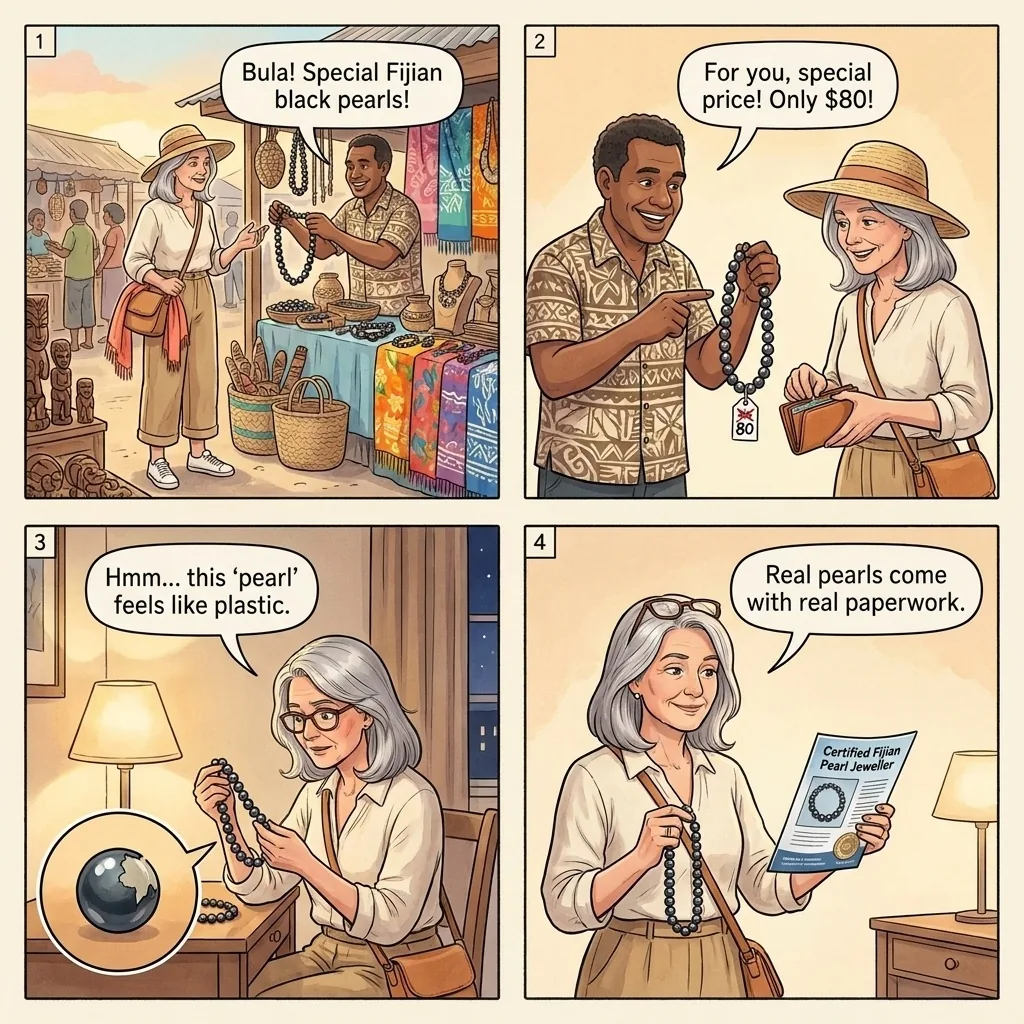
It's an afternoon at the Suva Municipal Market jewellery section, you've paused to admire a strand of dark iridescent beads, and a vendor with a wide 'bula!' smile holds up a shimmering necklace and tells you it's made from rare Fijian black pearls.
She quotes FJ$200, then drops to FJ$100 for the 'special price today,' then to FJ$80 if you 'buy two.' The Bula spirit and the warm conversation make the price feel like a deal. The colour and weight of the beads do feel sort of pearl-ish. You buy a strand for FJ$80 (about USD $35) feeling like you've got a real bargain. Back at the hotel, an honest look at the necklace under the room light reveals the iridescence is a thin lacquer over a plastic core; the 'pearls' are dyed plastic beads that wholesale at maybe FJ$3.
Real Fijian pearls — particularly the famous Fijian black pearls cultivated in the Savusavu region — are a legitimate and significant export industry, but the supply chain runs through certified dealers with documented gemological-lab paperwork. The pearls themselves start at FJ$500 per strand for the lowest-grade certified Fijian black pearls and run into thousands of dollars for top-grade strands. Anything sold at a Suva Municipal Market stall for under FJ$200 is, by definition, not a real Fijian pearl. As travelers report across Reddit, the TripAdvisor Suva forum, and Fiji Tourism Board consumer guidance, the market-stall fake-pearl vendor is a consistent low-grade Suva friction.
The legitimate Fijian pearl-buying ecosystem is well-developed. J Hunter Pearls operates Fijian-pearl retail showrooms in Savusavu, Nadi, and Suva (Tappoo City Mall) with documented certification, return policies, and prices that match international wholesale-plus-margin economics. Sea Hunter Pearls and Justin Hunter Pearls are sister operators with similar documentation. The Tappoo City Mall location in Suva is the easiest in-city access to certified Fijian pearls.
The structural defences are concrete. For real Fijian pearls, buy from J Hunter Pearls, Sea Hunter Pearls, or Justin Hunter Pearls at their certified retail locations (Tappoo City Mall in Suva is the central one). Real pearls feel warm to the touch, have slight surface irregularities visible under magnification, are heavy for their size, and produce a slight gritty sensation when rubbed gently against the teeth (the 'tooth test'). Plastic beads feel cool, are perfectly smooth, and are light. Refuse Bula-driven 'special price' bargaining for any item priced below FJ$500 that's claimed to be a real Fijian pearl — the price floor for certified product is well above that.
For real Fijian pearls (especially Fijian black pearls), buy from J Hunter Pearls, Sea Hunter Pearls, or Justin Hunter Pearls — certified retail locations include Tappoo City Mall in Suva, Savusavu showrooms, and Nadi airport boutiques. Real Fijian black pearls start at FJ$500 per strand for the lowest grade; anything sold at Suva Municipal Market for under FJ$200 is plastic. Real pearls feel warm to the touch, have slight surface irregularities, and produce a gritty sensation against teeth (the tooth test); plastic feels cool and is perfectly smooth. Refuse Bula-driven 'special price' bargaining on items claimed to be Fijian pearls below FJ$500. Pay by card for chargeback options. Emergency: 917 (Fiji Police).
Red Flags
- Vendor claims pearls are 'authentic Fijian black pearls' at a suspiciously low price
- No certification or paperwork accompanies the jewelry
- Aggressive use of the friendly Bula greeting to build false trust
- The vendor tries to create urgency with 'today only' pricing
How to Avoid
- Authentic Fiji pearls are sold through certified jewelers like J Hunter Pearls, not market stalls.
- Real black pearls are heavy, cool to the touch, and have slight surface irregularities.
- If the price seems too good for pearls, they're not real pearls.
- Buy souvenirs at reputable stores recommended by your resort or hotel.
Like what you're reading? Get a full Suva itinerary with safety tips built in.
Browse travel-safety books →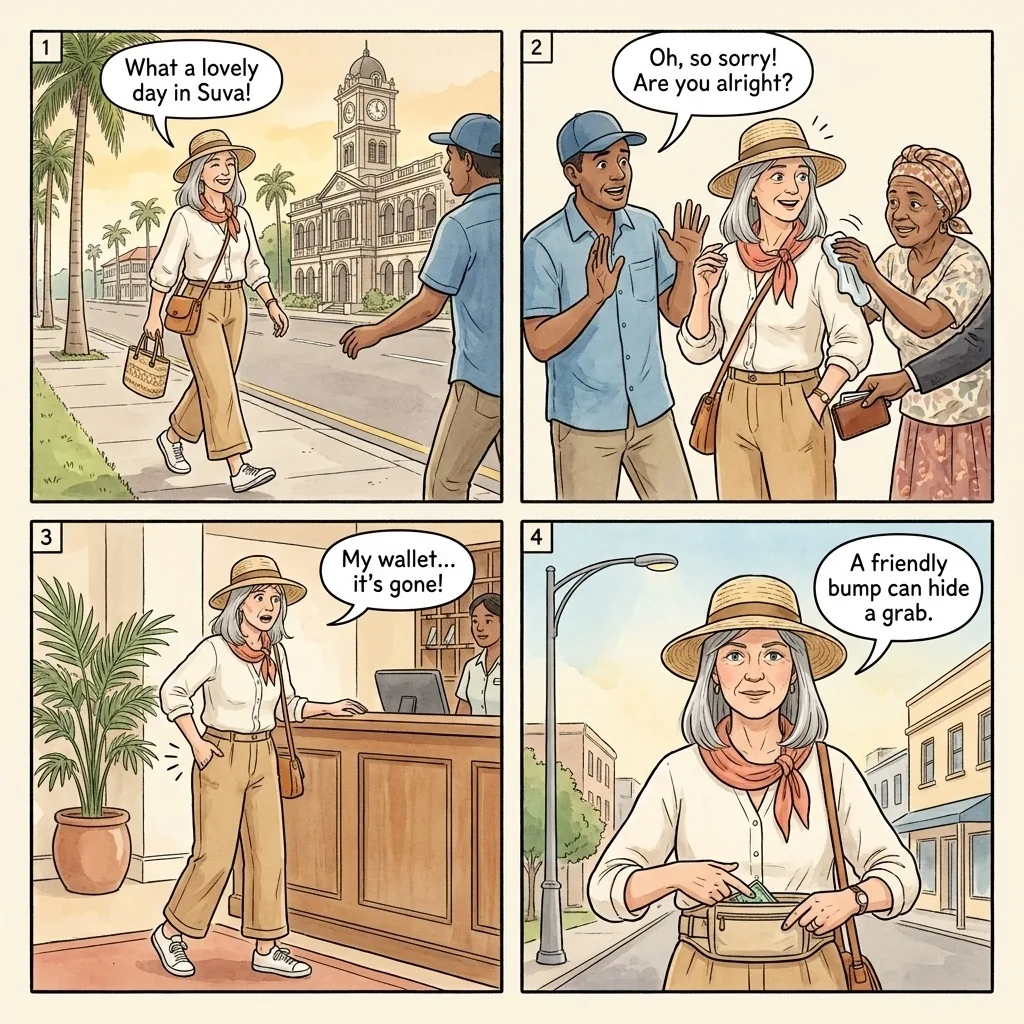
It's an afternoon along Victoria Parade in central Suva, you're walking back to your hotel from the Suva Municipal Market with a small souvenir bag, and someone bumps into you on the pavement near the Suva City Library.
They apologise profusely, brushing imaginary dust from your shoulder and gesturing concern. A second person — an older woman, often holding a child or a shopping bag — appears at your other elbow with similar apologies, offering tissues and helping you 'clean up' the spot where you've been bumped. Within ninety seconds, both have moved on with quick smiles. You continue toward your hotel and only at the lobby do you notice your wallet is missing from the back pocket.
The Victoria Parade distraction-theft is one of the most-reported Suva tourist crimes. The mechanism uses three coordinated roles: a bumper who creates the initial contact, a 'helper' who provides the apology-and-clean-up that occupies your attention at chest-height, and a third person who works your pockets at hip-height during the distraction. The 'spill' variant uses a small amount of food or liquid (sometimes a fake 'bird dropping' substance) to give the helper an excuse to handle your clothing. As travelers report across Reddit, the TripAdvisor Suva forum, and Fiji Police consumer alerts, the Victoria Parade distraction theft clusters at high-foot-traffic moments — cruise-ship arrival hours, lunch hours, late afternoon market peak.
The losses typically run FJ$100–500 in cash and cards from a pickpocket lift; the higher-end variants involve smartphones lifted from open bags, occasionally passports from outside-pocket carry. Recovery rates are very low — the operators rotate quickly, the cards are tested at a nearby ATM within minutes, and the wallet itself is dumped a few blocks away.
The structural defences are concrete. Carry valuables in a zipped cross-body bag worn IN FRONT of your body (not on your hip or back), so anyone reaching for it has to come into your direct line of sight. Keep wallet and phone in a front trouser pocket or interior jacket pocket — never a back pocket on Victoria Parade or near the Municipal Market. If someone bumps you, brushes you, or 'spills' something on you, do not let strangers help — step away to a doorway, clean it off yourself, and check your pockets immediately. Carry only the cash and one card you need for the day; leave the passport and bulk valuables in the hotel safe.
Carry valuables in a zipped cross-body bag worn IN FRONT of your body when walking Victoria Parade and near Suva Municipal Market — never a back pocket, never an open tote on your hip. Keep wallet and phone in a front trouser pocket or interior jacket pocket. If someone bumps you, brushes you, or 'spills' something on you, step away to a doorway and clean it off yourself — do NOT let strangers help. Carry only the cash and one card you need for the day; leave passport and bulk valuables in the hotel safe. Avoid walking alone on Victoria Parade after dark — the same operators run the same script with less crowd cover at off-hours. Emergency: 917 (Fiji Police) or 911 (general); the U.S. Embassy in Suva is at +679 331 4466.
Red Flags
- A stranger spills something on you or bumps into you in a crowded area
- Someone rushes to 'help' clean your clothes without being asked
- You notice someone standing unusually close to you from behind
- The 'accident' happens near a market or busy pedestrian zone
How to Avoid
- Use a cross-body bag with zippers facing your body.
- If someone spills on you, step away immediately and clean up yourself.
- Keep valuables in your hotel safe and carry only what you need.
- Avoid walking alone along Victoria Parade after dark.
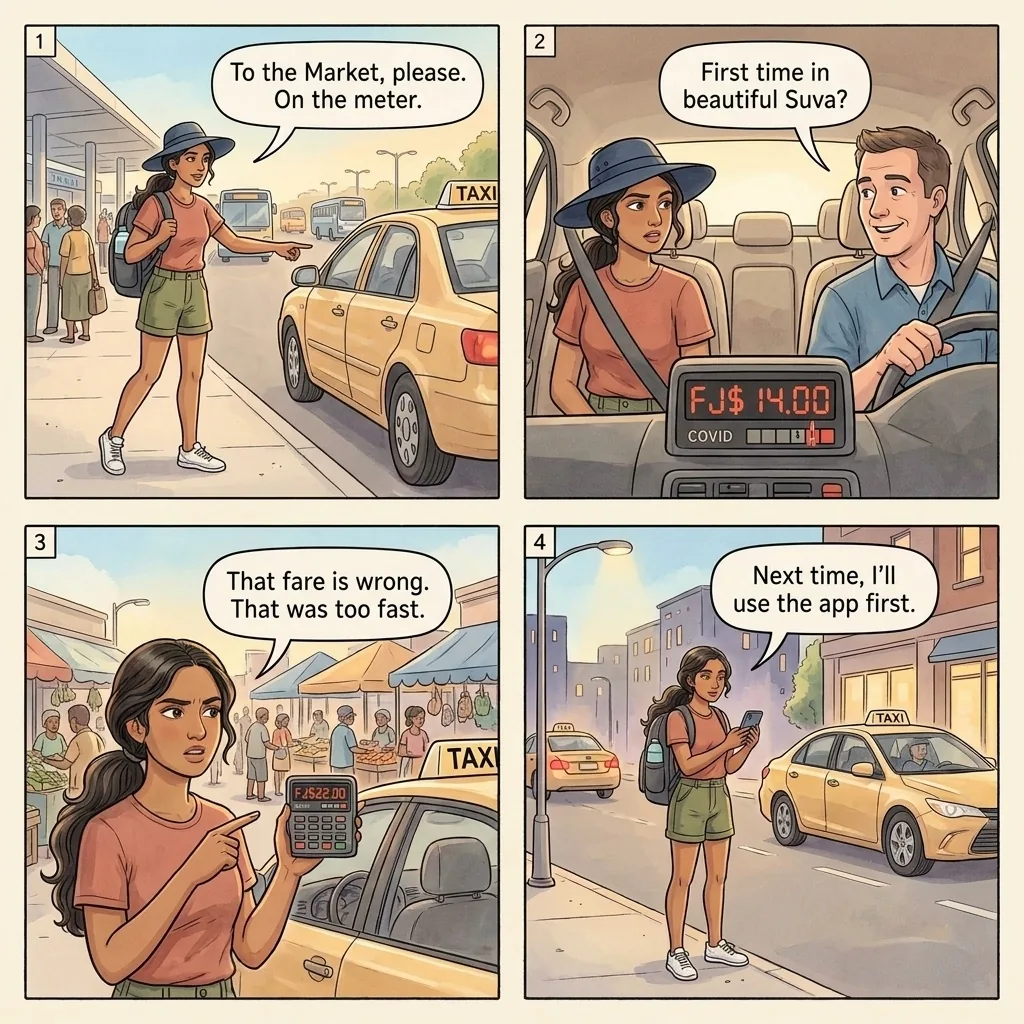
It's a Wednesday afternoon, you flag down a yellow taxi in central Suva for the ten-minute ride from your hotel to the Suva Municipal Market, and the driver seems pleasant — chats about the weather, asks about your trip.
He starts the meter, but it ticks roughly twice as fast as it should — by the time you reach the market, the meter reads FJ$20 for what should have been a FJ$5–7 ride. The variant version: the driver claims the meter is 'broken' and quotes a FJ$20 flat fare for the same trip, refusing to negotiate. Or he takes a deliberately winding route via Cumming Street and Pratt Street, adding ten minutes to a ride that should be five.
The Suva rigged-taxi-meter friction is documented across Reddit, the TripAdvisor Suva forum, and Fiji Land Transport Authority complaint logs. The mechanism uses three structural failures: meters that have been physically tampered with to tick faster than the regulated rate (the LTA-set Suva taxi base fare is FJ$1 plus FJ$0.40 per 100m, with a wait time of FJ$0.20/minute), 'broken meter' framings that bypass the regulated rate entirely, and route detours that legitimately extend the metered fare. The fair Suva taxi pricing for a 10-minute central-city ride is FJ$5–8; anything above FJ$10 for the same distance is the rig.
The legitimate Suva taxi ecosystem is real and reasonably priced. Registered yellow taxis with Land Transport Authority permit numbers visible on the dashboard run regulated meter rates. The Suva Yellow Cabs cooperative is the most-recommended provider; their drivers are licensed and the meters are typically in working order. Several major Suva hotels (Holiday Inn, Tanoa Plaza, Grand Pacific Hotel) operate hotel-dispatch taxi pools with verified drivers. Uber and Bolt do not operate in Fiji as of 2026; the radio-dispatch and hotel-pool options are the substitute for app-based rideshare.
The structural defences are concrete. Insist on the meter being turned on before the taxi moves; refuse 'broken meter' framings and either get out before the wheels turn or agree a fixed price (FJ$5–8 for central Suva trips) in writing. Use the Suva Yellow Cabs central dispatch (+679 312 211) or your hotel's dispatch service rather than hailing on the street. Note the LTA permit number on the dashboard — it's the leverage for any complaint. Carry small FJ notes (FJ$5, FJ$10) so you can pay only the agreed amount without depending on the driver's change. Reference Google Maps' route-time estimate as a sanity check on whether the driver is taking a sensible path.
Insist on the Suva taxi meter being turned on BEFORE the cab moves; refuse 'broken meter' framings and either get out or agree a fixed price (FJ$5–8 central Suva, FJ$15 to airport) in writing. Use Suva Yellow Cabs central dispatch (+679 312 211) or your hotel's dispatch service rather than hailing on the street. Note the LTA permit number visible on the dashboard. Carry small FJ$5 and FJ$10 notes so you can pay only the agreed amount. Reference Google Maps' route-time estimate as a sanity check on whether the driver is taking a sensible path. Tipping is not customary in Fiji — refuse 'tip for landmarks' demands. Emergency: 917 (Fiji Police); LTA Customer Care: +679 322 6800.
Red Flags
- The meter is 'broken' or the driver refuses to turn it on
- The driver takes an unusually long or winding route
- The fare seems much higher than expected for a short trip
- The driver demands a tip for unsolicited commentary during the ride
How to Avoid
- Always insist the meter is running before the taxi moves.
- Agree on a fare before getting in if the meter is genuinely broken.
- Ask your hotel reception for the approximate fare to your destination.
- Use registered yellow taxis and note the driver's permit number displayed on the dashboard.
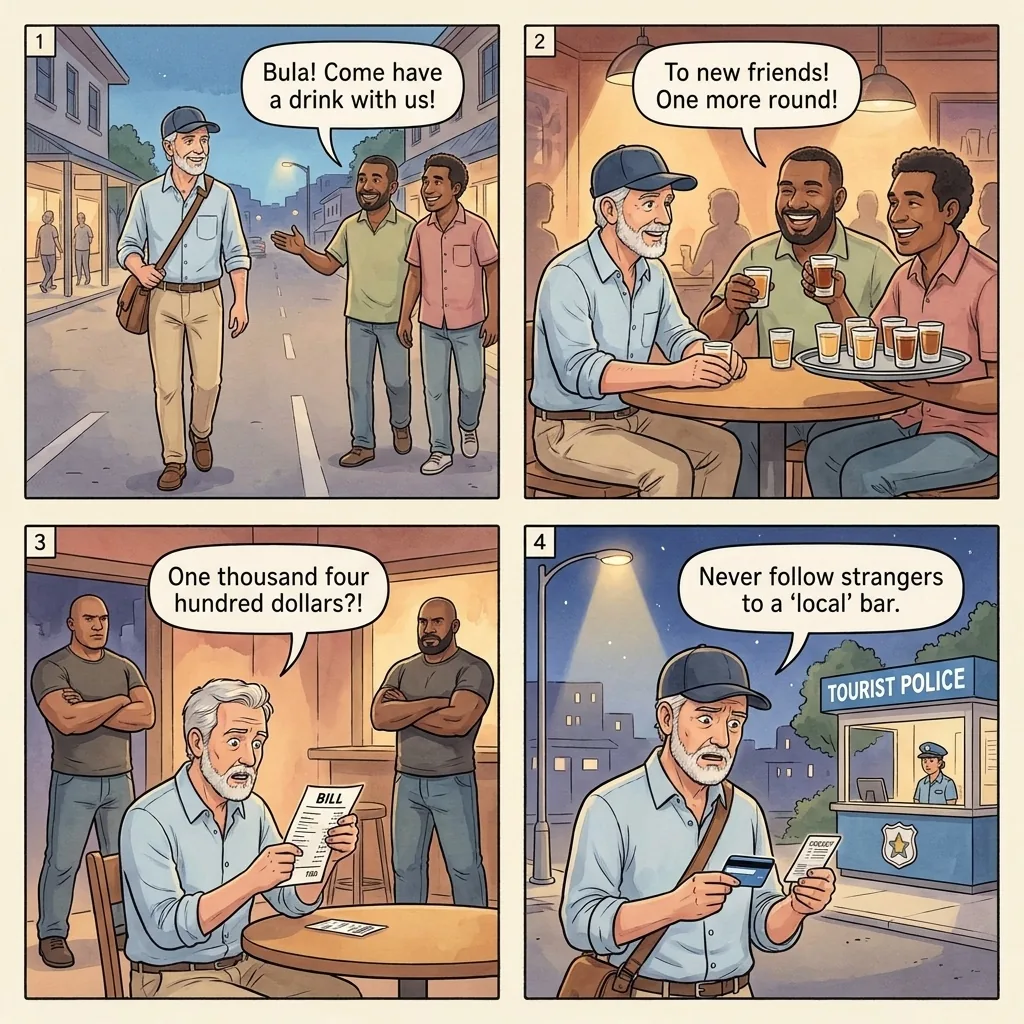
It's a Friday evening in downtown Suva, you're walking back from dinner, and two friendly Fijian locals strike up a conversation about your trip and invite you for drinks at 'a great local bar' a couple of blocks off Victoria Parade.
The bar is real-looking, the music is fine, the first round of beers is cheap (FJ$8 each, fair price). The locals chat warmly, suggest a round of shots, then another, then a third. After ninety minutes the closing bill drops and reads FJ$1,400 — about USD $620 — for what should have been a FJ$140 night. When you protest, two large bouncers materialise at the door, the credit-card terminal is on the table within thirty seconds, and the 'friendly locals' have quietly slipped out a side exit while contributing FJ$50 each as a 'token share' that the bar pretends is enough.
The Suva friendly-local bar-bill ambush is a documented variant of the bill-ambush pattern that runs across Pacific tourist capitals (Apia, Nadi, Port Vila, and Suva). The mechanism: the 'recruiter' is a paid operator who walks tourists from Victoria Parade to a confederate venue running unposted prices; the bar runs inflated drink prices on a 'menu' nobody shows the customer; the security cohort enforces payment by physical intimidation; the credit-card terminal extracts the inflated sum. As travelers report across Reddit, the TripAdvisor Suva forum, the U.K. Foreign Office Fiji travel advice, and the Fiji Police's published consumer alerts, this is the highest-stakes Suva nightlife scam.
The targeting is deliberate. The recruiters station themselves on Victoria Parade after dark — particularly during cruise-ship arrival nights and on weekends — and identify foreign men in groups of two or three with apparent affluence (good shoes, a watch, a daypack with electronics). The conversation establishes friendliness, the venue suggestion happens within ten minutes, and the bill ambush hits at the ninety-to-120-minute mark when the customers are sufficiently impaired to limit resistance.
The structural defences are concrete. Choose your own Suva nightlife venues from Google Maps reviews (4+ stars, 100+ reviews) — the Holiday Inn Suva bar, the Tanoa Plaza bar, Bad Dog Cafe, O'Reilly's Bar — never accept a venue suggestion from a stranger met on the street. Decline 'better bar' / 'local bar' / 'cheaper bar' framings — those are the entire mechanism. Ask for the drinks menu with prices BEFORE any drink is served; confirm the bill before each subsequent round. Refuse to sign any bill or authorise payment under duress. If a venue attempts an inflated bill ambush, do not pay; call 917 and walk into the nearest hotel lobby; dispute the card charge with your issuer immediately.
Choose your own Suva nightlife venues from Google Maps with 4+ stars and 100+ reviews (Holiday Inn Suva bar, Tanoa Plaza bar, Bad Dog Cafe, O'Reilly's Bar) — never accept an invitation from a stranger on Victoria Parade or downtown Suva. Decline 'better bar' / 'local bar' / 'cheaper bar' framings — those are the entire mechanism of the ambush. Ask for the drinks menu with prices BEFORE any drink is served; confirm the bill before each subsequent round. Refuse to sign any bill or authorise payment under duress. If a venue attempts a bill ambush, do not pay; call 917 (Fiji Police) and walk into the nearest hotel lobby; dispute the card charge with your issuer immediately. Emergency: 917 (Fiji Police) or 911 (general); the U.S. Embassy in Suva is at +679 331 4466.
Red Flags
- Strangers suggest going to a specific bar they 'know'
- Drink prices are not displayed or are vague
- The venue has bouncers who seem more like enforcers
- Your new friends order expensive rounds without discussing the cost
How to Avoid
- Choose your own bars — never go to one suggested by people you just met.
- Always check drink prices before ordering.
- Stick to well-known establishments recommended by your hotel.
- Avoid drinking heavily in unfamiliar venues, and never leave drinks unattended.
🆘 What to Do If You Get Scammed
📋 File a Police Report
Go to the nearest Fiji Police Force station. Call 917 (Police) or 911 (Emergency). Get an official crime report — you'll need this for insurance claims. You can also report online at police.gov.fj.
💳 Cancel Your Cards
Call your bank immediately. Most have 24/7 numbers on the back of the card (keep a photo saved separately). Block any suspicious transactions before the thieves use your details.
🛂 Lost Passport?
Contact the US Embassy in Suva at 158 Princes Road, Tamavua, Suva. For emergencies: +679 331-4466.
📱 Track Your Device
If your phone was stolen, use Find My (iPhone) or Find My Device (Android) from another device. Don't confront thieves yourself — share the location with police instead.
Frequently Asked Questions
You just read 6 scams in Suva. The full Travel Safety Series has 780+ more across 20+ countries.
Tokyo's Kabukichō ¥130,000 bar trap. Rome's gladiator photo extortion. Paris's gold-ring trick. Bali's ATM skimmer scams. Bangkok's grand-palace closure ruse. Every documented scam across 20+ destinations — with the exact scripts, red flags, and local-language phrases that shut each one down. Drawn from Reddit traveler reports, embassy advisories, and consumer-protection cases.
- 780+ documented scams across Tokyo, Rome, Paris, Bali, Bangkok, Rio & 100+ more cities
- 20+ countries covered, with country-by-country phrase cards for every destination
- Updated annually — buy once, re-download future editions free
- All titles $4.99 each on Amazon Kindle