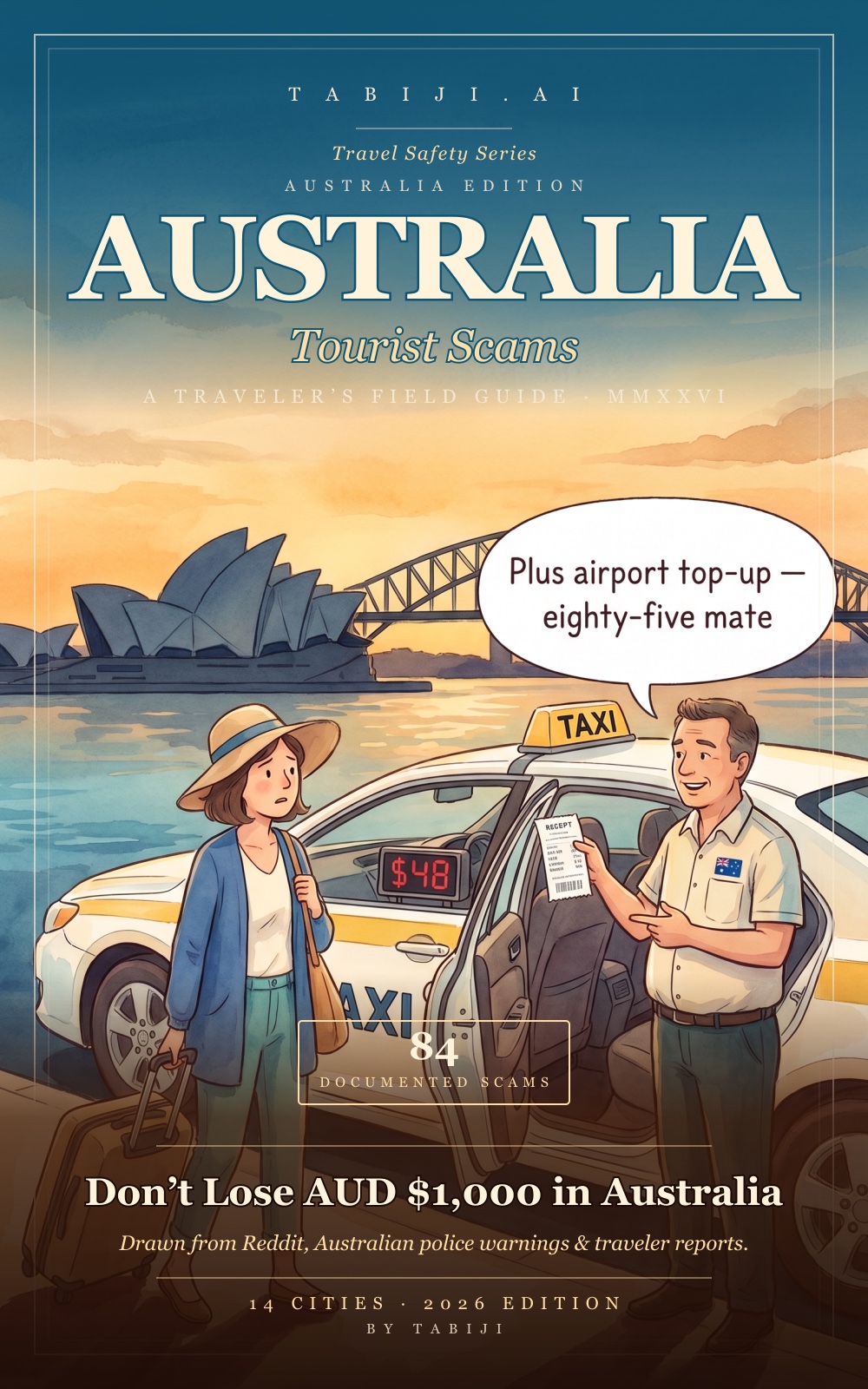
Key Takeaways
The most common ways tourists lose money in Sydney are taxi top-up scams at Sydney Airport (T1 arrivals), fake 'surge' pricing on Uber pickups, phantom short-stay rental listings that evaporate on arrival, and bag theft from the sand at Bondi. Sydney is genuinely safer than most global capitals for violent crime, but the financial scams above are persistent and well-documented across traveler threads in 2024–2026.
⚡ Quick Safety Tips
- Book an Uber, DiDi or Bolt BEFORE you leave the baggage hall at Sydney Airport — the T1 taxi rank has a persistent 'top-up' overcharging scam documented in a traveler report.
- Never hand your card to a taxi driver claiming the tap reader is broken — it is the card-mirroring scam flagged in traveler reports.
- Use Opal (or tap your contactless bank card) for every train, ferry and light-rail trip — always tap BOTH on and off or you'll be charged the max fare.
- At Bondi, Manly and Coogee, never leave a bag on the sand while you swim — use the beach lockers at Bondi Pavilion or take shifts with a travel partner.
- Only book short-stay rentals through Airbnb or Booking.com directly — off-platform bank transfers are the #1 way travelers lose four-figure sums in Sydney.
- Buy BridgeClimb, Opera House and Vivid Sydney tickets only from the official sites — any street offer of 'discount tickets' is counterfeit.
Jump to a Scam
The 6 Scams
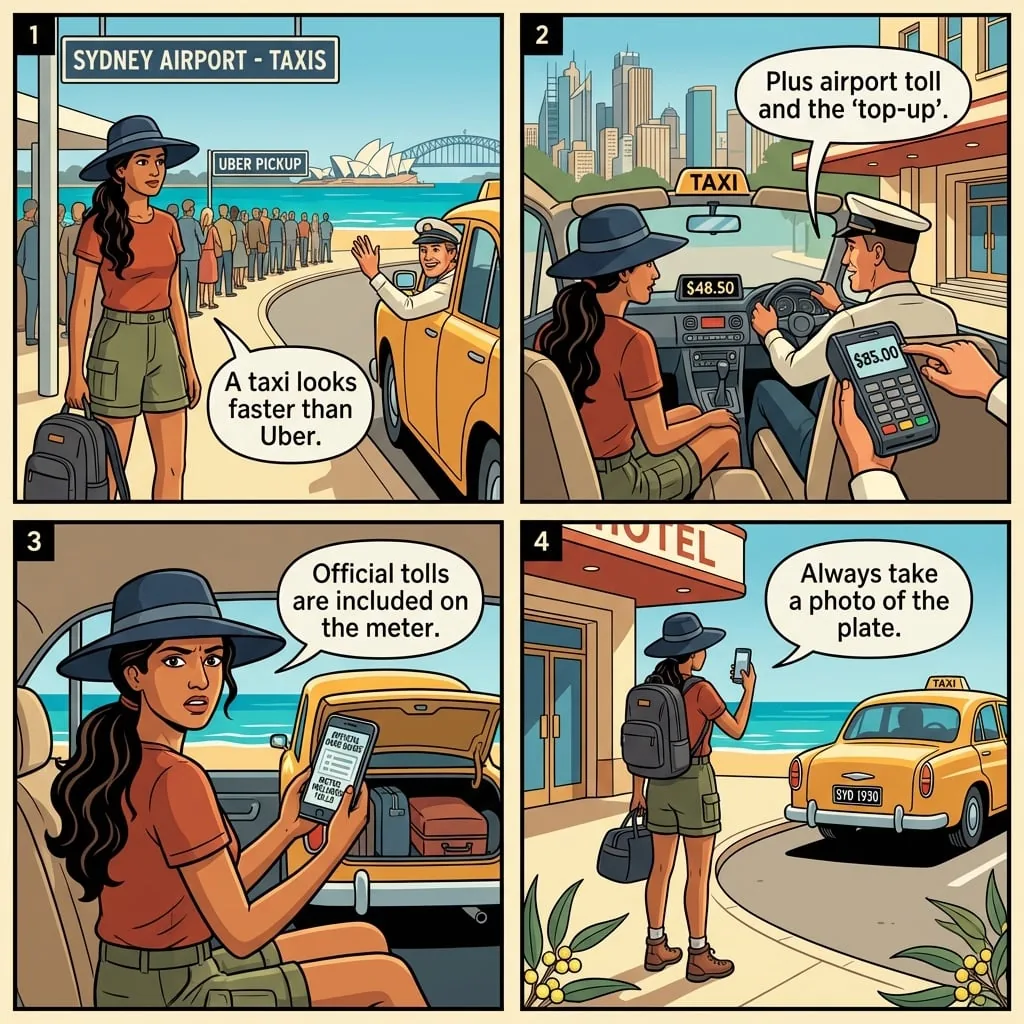
At the Sydney Airport taxi rank, the driver's meter shows a reasonable $48 for the trip into the CBD. But when you arrive, he points to a screen demanding $85, claiming a 'top up' for tolls or late-night fees. With your bags in the trunk, you pay.
The scam starts with a seemingly helpful driver waving you into their cab at the taxi rank, bypassing the longer queue for rideshares. The metered ride from Sydney Airport to the CBD seems normal, ticking up to a reasonable $48. But as you arrive, the driver points to the screen and announces a mandatory 'top up' for airport tolls or a late-night surcharge. Other variants include claiming 'the tolls aren't on the meter' — they are — or that the tap-to-pay terminal is broken, forcing you to swipe and risk having your card's magnetic stripe cloned.
Suddenly, the $48 fare inflates to $85, or in more extreme cases, a metered $80 ride doubles to a demand for $160 in cash. Drivers count on travelers being too jet-lagged and disoriented to argue, especially with their luggage locked in the boot. The pressure to just pay and end the confrontation is immense, and many tourists do, simply to retrieve their bags and get to their hotel after a long flight.
This behavior is a clear violation of regulations set by Transport for NSW, which mandate that the full metered fare is the maximum payable. The pattern of drivers at the Mascot rank demanding an extra $40-$60 'top up' is well-documented by locals and travelers alike (threads on Reddit detail the play-by-play). Your best defense is to avoid the taxi rank entirely. Use the Uber, DiDi, or Ola app from the airport's designated rideshare pickup zones where the fare is fixed before you ride — and if you must use a taxi, book via the 13cabs app to lock in the fare and create a digital trip record.
Red Flags
- Driver 'top ups' the metered fare at the end of the trip citing tolls, late rate or airport surcharge
- In-car card terminal is claimed to be broken — driver asks you to swipe instead of tap
- Taxi tout at T1 arrivals hustles you away from the Uber queue ('Uber is 40 minutes, I'm here now')
- Meter total and amount demanded differ by $10–$50
- Driver asks for cash 'because the card machine is down' after you've already agreed to pay by card
How to Avoid
- Pre-book Uber, DiDi or Bolt in-app before you clear customs — pickup is at the rideshare bay at T1.
- If you must take a taxi, use the 13cabs or Silver Service apps so the fare is app-calculated with a receipt.
- Insist on tap-to-pay at the in-car terminal and watch the terminal — never hand over your physical card.
- Screenshot the expected fare in Uber before arrival so you know what a legit price looks like (~$45–$60 CBD).
- If overcharged, pay under protest and file a chargeback with your bank — travelers report Amex disputes succeed.

At the Sydney Airport rideshare bay, your expected $55 Uber fare to Darlinghurst is quoted at $145, flagged as '2.7x surge' pricing. You accept the inflated fare, and the moment your ride is confirmed, the price for the next traveler immediately drops back to $55.
The scene plays out daily at the rideshare pickup bays for Sydney Airport's T1 and T2 terminals. You open your app for a ride to Darlinghurst, expecting a standard $55 fare, but the quote comes back at $145, flagged with a '2.7x surge' on a perfectly normal Tuesday afternoon. This is the airport's 'fake surge,' a coordinated effort where drivers circle the bays, decline low-fare requests, and wait for the system to escalate the price multiplier. Drivers can informally organize this delay because if no one accepts a ride within a certain range, the surge triggers automatically, turning a routine trip into an expensive trap.
Once the inflated price is on your screen, your fastest fix is to walk to the public bus stop at T1. From there, the 400 bus can take you to Mascot station on the T8 train line or to Bondi Junction. If you need a door-to-door ride, comparing the fare on DiDi or Bolt is a smart move, as they often have lower surges at the airport. Waiting ten minutes for the price to drop is another option, but if you accept the inflated quote, you have no chargeback recourse. As many travelers have noted, this behavior feels particularly devious when a normal taxi is often the cheaper, more reliable choice.
The practice exploits a loophole that regulated taxis don't have. The NSW Point to Point Transport Commission sets maximum fares for all rank and hail taxis, including a specific tariff for Sydney Airport trips. A standard, metered taxi from the official ranks at T1 or T2 to Darlinghurst has a regulated fare of $55–$65, which already includes the airport access fee. This provides a reliable price ceiling against which any rideshare 'surge' can be benchmarked (a pattern well-documented in Reddit threads from 2025 and earlier). Walk past the rideshare bay to the sheltered taxi rank and take a metered cab — the fare is regulated, and you'll be on your way in minutes.
Red Flags
- Uber quotes a fare 2–3× above the usual $45–$65 CBD range with no weather or event reason
- Surge multiplier fluctuates visibly every 30–60 seconds in the app
- Driver arrival ETA keeps resetting or drivers repeatedly cancel
- Drivers near you on the map who aren't accepting fares
- Price drops immediately after you accept — suggesting artificial scarcity
How to Avoid
- Compare Uber, DiDi and Bolt side-by-side before ordering — one is usually normally priced.
- Take the airport train from SYD Station (~$22, under 15 min to Central) if you're not jet-lagged.
- Bus 400 from outside the terminals runs to Bondi Junction for a few dollars.
- Wait 10 minutes and try again — surges often reset when drivers give up waiting.
- Pre-book a transfer through your hotel if you're arriving between 11pm–5am when surges are worst.
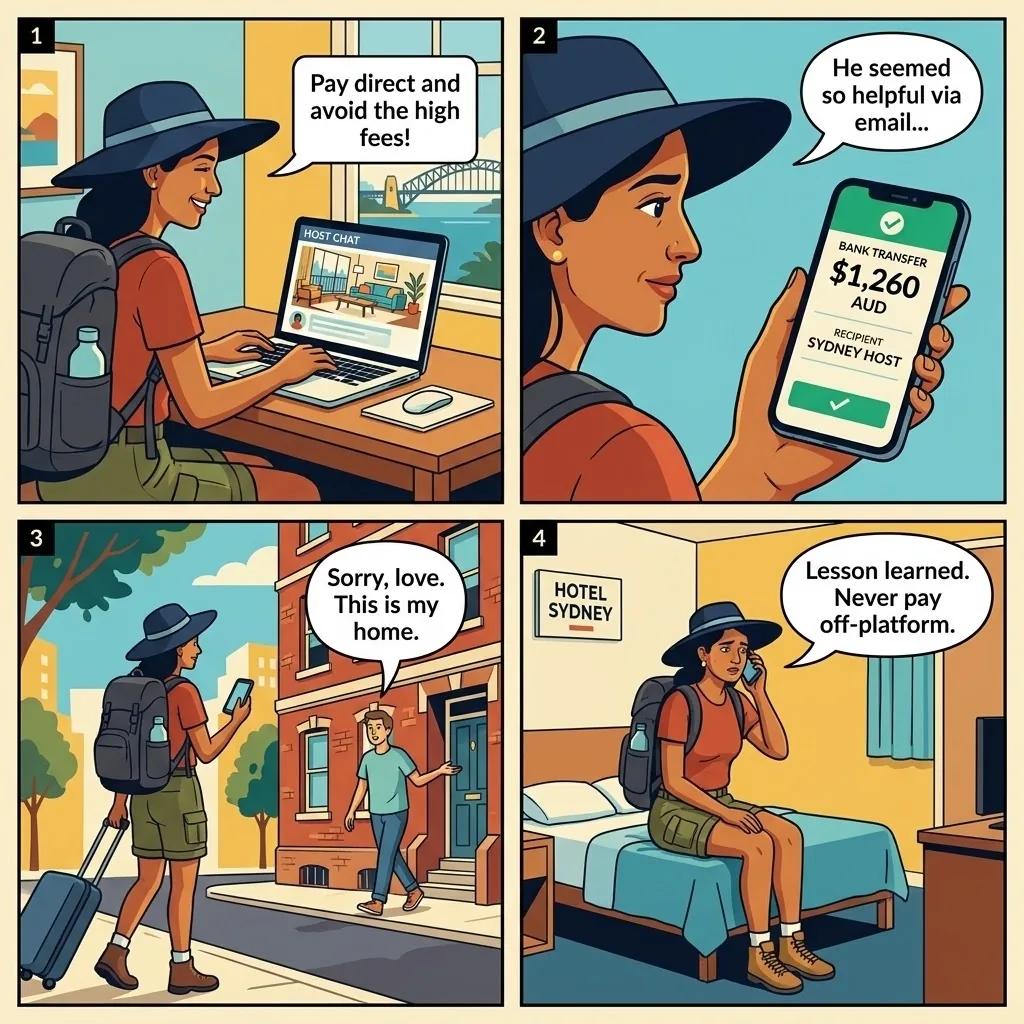
A Surry Hills studio appears on a rental site for $180/night. The host asks you to bank-transfer $1,260 AUD directly to 'avoid platform fees.' You send the money, arrive at the address, and discover the listing is fake — the real residents have no idea who you are.
The scam preys on high demand for rentals in popular Sydney neighborhoods. A beautiful studio in Surry Hills appears on what looks like Airbnb or Booking.com, but the 'host' quickly pushes you to email to 'save on platform fees.' Scammers build these phantom apartments by scraping photos from legitimate real estate sites, a tactic ABC News reported on in August 2024. One working-holiday traveler lost AUD $3,266 to a cloned booking site before even arriving in the country, and online forums (like Reddit) document travelers reporting the same fraudulent listings repeatedly with little effect.
The hook is set once you agree to pay off-platform. You make a direct bank transfer — say, $1,260 AUD for a week's stay — and the host confirms your booking. But when you arrive at the address, you find it's a real apartment whose residents have never heard of your host, who has now vanished. Paying outside the official system bypasses the platform's escrow protection, which holds your money until 24 hours after a successful check-in. If you realize you've been scammed, call your bank immediately; some Australian banks can recall a transfer if the funds haven't been withdrawn.
This is a widespread and organized operation. The ACCC's Scamwatch received over 8,600 reports of fake online listings in 2023, with accommodation scams clustering in desirable Sydney postcodes like 2026 (Bondi Beach) and 2010 (Surry Hills/Darlinghurst). As Fair Trading NSW warns, any 'landlord' asking for bond or rent before you've seen the property or signed a lease is a major red flag. Pay only by credit card through the official Airbnb or Booking.com platform — this provides chargeback rights and platform guarantees that a bank transfer does not.
Red Flags
- Host asks for bank transfer, Western Union, crypto or Zelle instead of payment through the platform
- Listing price is 30–50% below comparable Surry Hills / Bondi listings the same week
- Host refuses a 1-minute video call to show the apartment in real time
- Email signature has no ABN (Australian Business Number) and no business name
- 'Platform fees' are the stated reason to pay direct — Airbnb's fees are built into the displayed price
How to Avoid
- Only open airbnb.com or booking.com via the official app or a bookmarked URL — never a link in email.
- Pay only inside the platform — Airbnb, Booking.com and Stayz all hold funds in escrow.
- Reverse image search the listing photos in Google Images before booking.
- Check the listing has reviews from multiple guests in the past 12 months.
- If in doubt, phone the actual property via a number you find on Google Maps independently.
Like what you're reading? Get a full Sydney itinerary with safety tips built in.
Browse travel-safety books →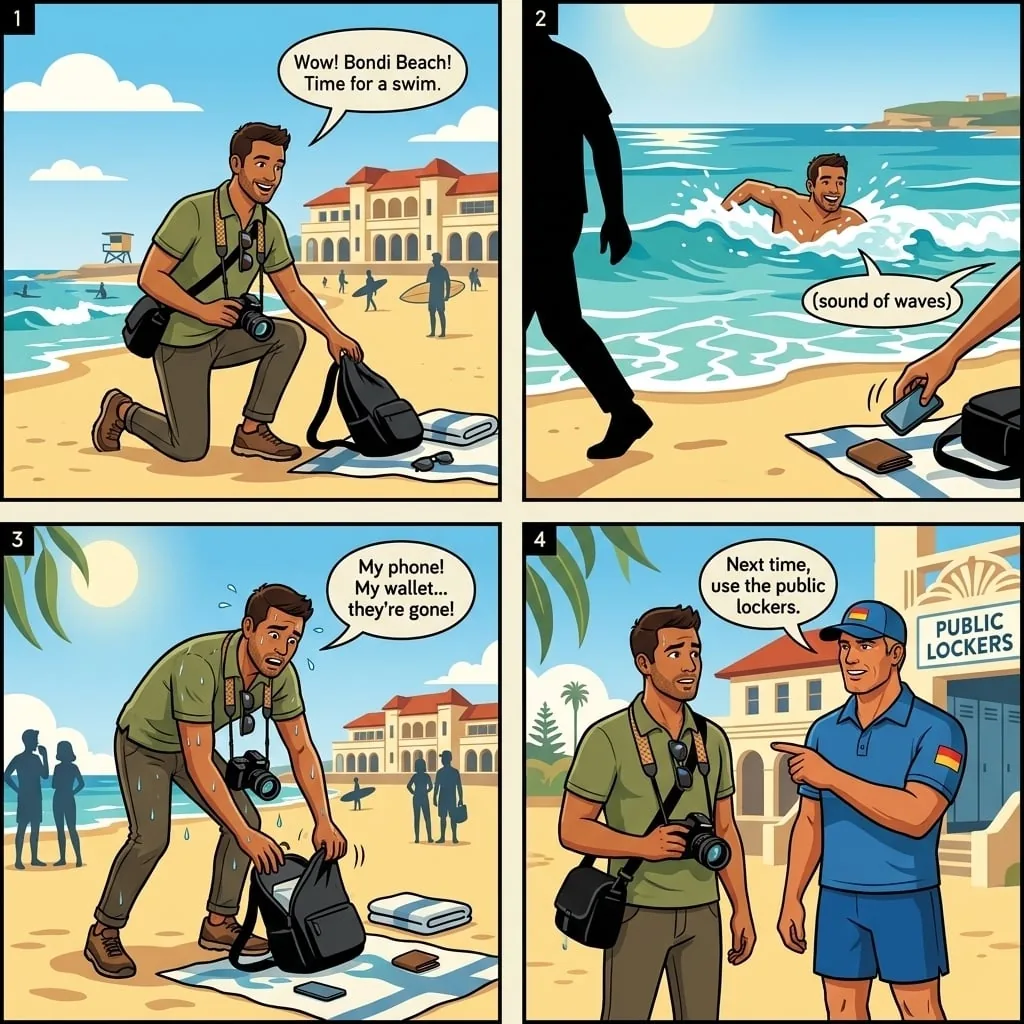
You've dreamed about swimming at Bondi your whole life. You walk down from the promenade, drop your backpack on a towel, leave your phone on top — 'Aussies are friendly, nobody steals' and go in for a swim. Fifteen minutes later your bag is still there, but the phone, wallet and passport inside are gone.
The scene is classic Sydney summer: you drop your backpack on a towel at Bondi, leave your phone on top, and run into the surf. The thief isn't a dramatic criminal; they're just another beachgoer walking along the towel line. In a single, fluid motion, they scoop your phone or wallet and keep walking, often while a friend is just meters away. One first-day visitor described having their bag stolen while a friend was nearby during a 'little longer swim.' The sheer scale of the beach on a busy day makes the theft almost risk-free.
Fifteen minutes later, you return from the water. Your bag is still there, but the phone, wallet, and passport inside are gone. By the time you realize what's happened, the thief has already blended into the thousands of people strolling along Campbell Parade, the main road behind the beach. The loss isn't just a phone; it's your keys, your cards, and your identification, derailing your entire trip.
This pattern plays out daily at popular Eastern Suburbs beaches like Bondi, Manly, and Coogee, particularly in the area between the Bondi Icebergs Club and the North Bondi RSL. Local forums (like Reddit) document dozens of near-identical thefts where a thief watches a swimmer, waits, and then strikes. The official advice from NSW Police is simple: don't make your bag an obvious target. Leave your passport in the hotel safe, bringing only one bank card and a photocopy of your ID. For anything you can't afford to lose, use the paid lockers at Bondi Pavilion, located opposite the main beach, for all valuables — a small locker costs around $8 for four hours, a large is $12.
Red Flags
- Someone loitering near the towel line who never goes in the water themselves
- Strangers asking to 'watch your stuff' while you swim — polite refusal is correct
- A bag or towel placed suspiciously close to yours after you arrive
- Groups of non-swimmers working the promenade end of the beach at busy times
- Anyone making small talk near your bag right before you go for a swim
How to Avoid
- Use the paid lockers at Bondi Pavilion, Manly Surf Club or Coogee Pavilion.
- Take a waterproof pouch (Aquapac, SealLine) into the water with phone, card and key.
- Go to the beach in shifts — one person stays with the bags at all times.
- Leave your passport in the hotel safe; carry a photocopy plus one bank card.
- Use a $20 drybag with a carabiner, not an obvious tourist backpack.
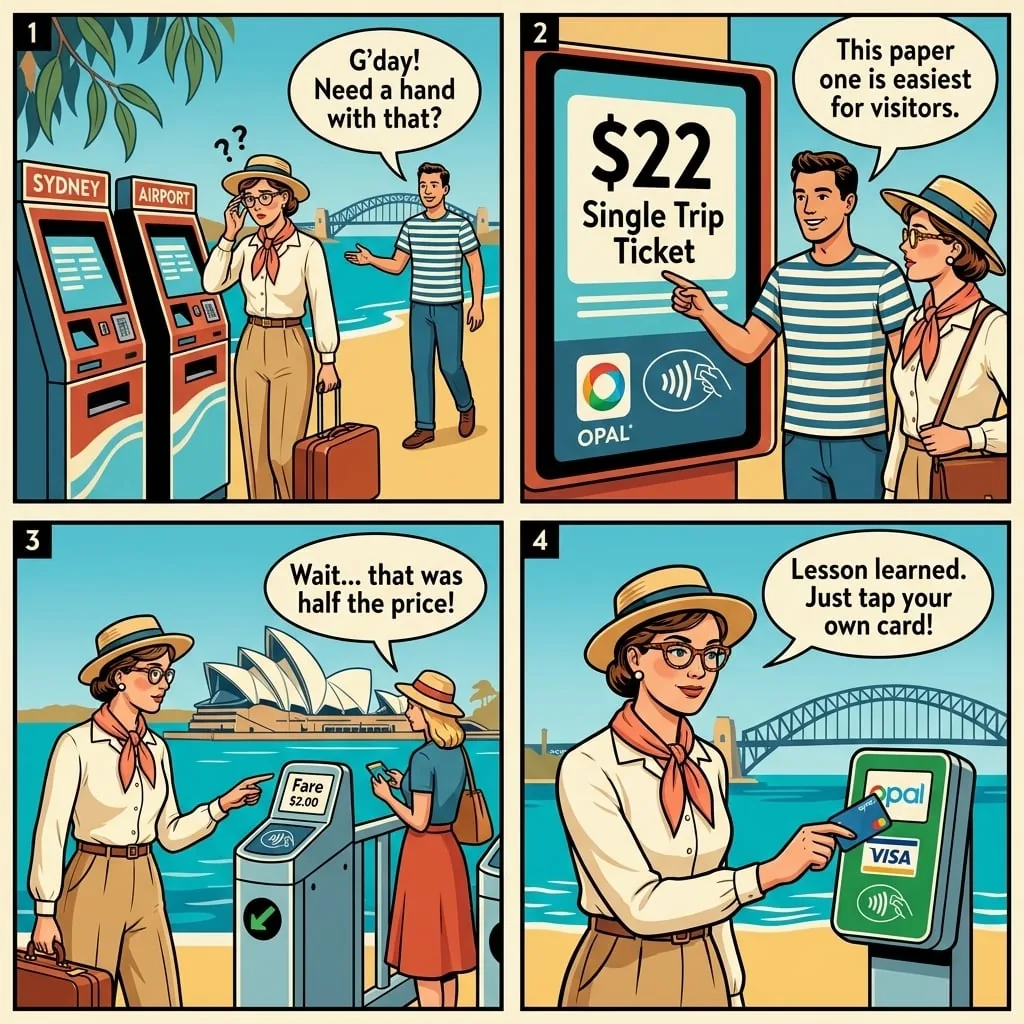
At a Sydney Airport ticket machine, a 'helpful' local steers you toward a $22 single-use paper ticket. The real fare is $15.94 with a contactless tap, and daily caps save you more. Following their advice can cost you an extra $60–$100 over a week.
You've just landed at Sydney Airport and head for the train. At the ticket machine, a 'helpful' local might steer you toward the single-use paper ticket for $22, calling it the 'easiest' option for tourists. You might also encounter this at major hubs like Central Station or Circular Quay, sometimes with an added request for a small 'service fee' for their 'help.' The bait is convenience, but the price is nearly double what you should be paying.
The trap closes when you realize that tapping your contactless bank card would have cost just $15.94 for the same airport trip. Over a week, choosing these paper tickets instead of using a capped Opal card or contactless payment can cost you an extra $60–$100. The system has other pitfalls: failing to tap off at the Manly or Watsons Bay ferry wharves can result in a maximum fare charge of over $17 for a one-way trip, and tapping on with a phone and card in the same case can lead to a double charge.
Transport for NSW, the state transit authority, publishes the full fare schedule, but the crucial details — like the lower Airport Station Access Fee for contactless users and the daily fare caps ($18.40 on weekdays, $8.40 on weekends) that paper tickets are ineligible for — are easy to miss. This confusion is well-documented, with locals on forums like Reddit regularly advising visitors to sidestep the machines entirely. Use a single contactless bank card or phone for all your trips and tap it directly on the reader — this ensures you automatically receive the daily and weekly fare caps and avoid the inflated cost of single-use paper tickets.
Red Flags
- Someone offers unsolicited 'help' at the Opal machines at Central, Museum or Airport stations
- You're about to buy multiple paper single-use tickets instead of using Opal or contactless
- You tap on a ferry but have no plan to tap off at Manly / Watsons Bay
- Your contactless card and Opal card are both in the same wallet near the reader
- Someone in plain clothes asks to 'inspect' your Opal card outside a ticketed zone
How to Avoid
- Tap on and off with your contactless bank card — it's automatic, no Opal card needed.
- If your card isn't contactless-compatible, buy an Opal card at any convenience store.
- Always tap both on AND off — this is the single most common mistake tourists make.
- Download the Opal Travel app to track your balance and trip history in real time.
- Request uniform ID from any 'inspector' Transport NSW staff wear clearly branded uniforms.
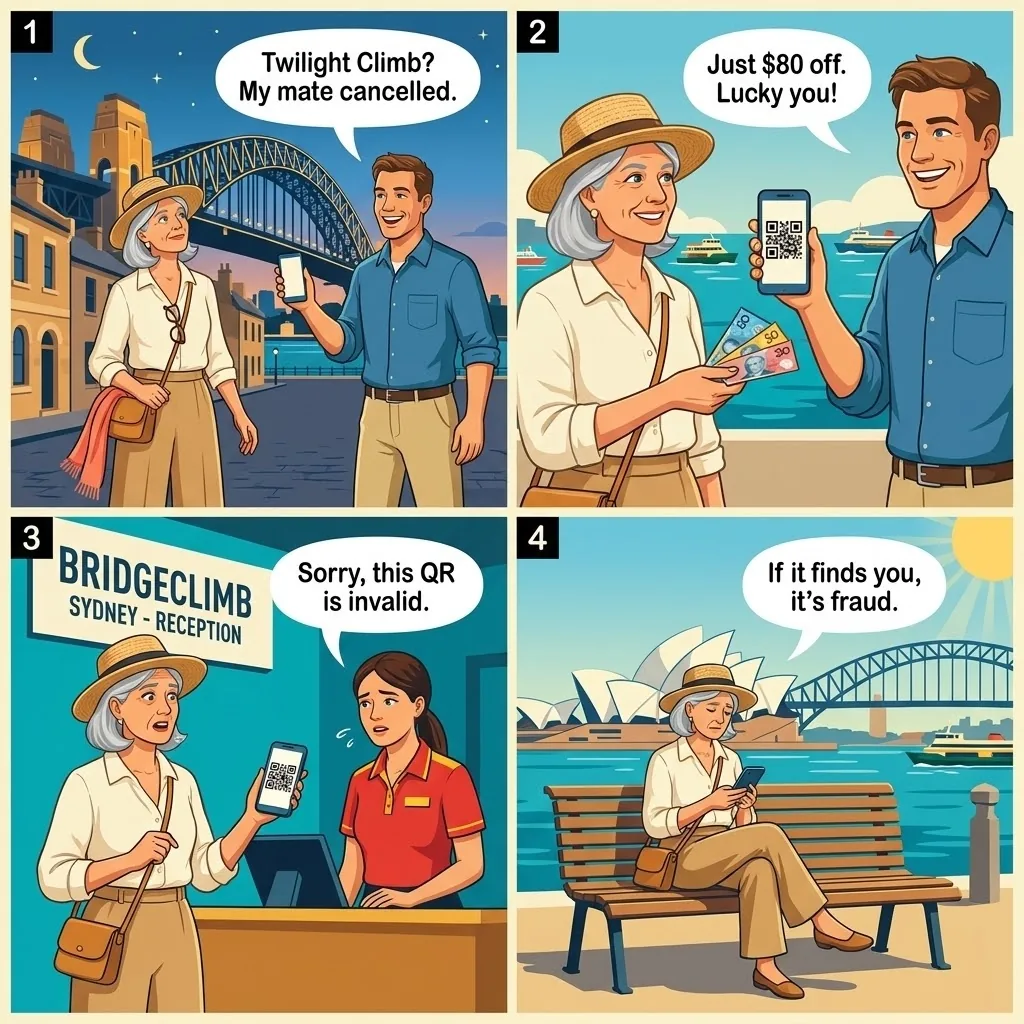
A man near Cumberland Street offers a last-minute BridgeClimb ticket for $80 off the usual $170–$335 price, claiming a tourist canceled. You pay cash, he sends a QR code, and disappears. At the reception desk, you discover the code is invalid and his number is disconnected.
During Vivid Sydney in May and June or the run-up to New Year's Eve fireworks, premium events sell out and ticket fraud explodes. Scammers prey on this demand on Facebook Marketplace, Gumtree, and via Instagram DMs, but also work the streets around Circular Quay. The offer is always for a sold-out or high-demand experience — a BridgeClimb, an Opera House performance, a premium harbor dinner cruise — at a steep discount because a 'tourist canceled' or they have a 'friend at the venue.'
The trap closes when you pay. Whether on the street or online, the seller will insist on a direct transfer or cash, sending you a QR code that looks legitimate. At the venue, you discover the ticket is a worthless fake. The seller's profile or number is now deleted. The only way to secure a legitimate spot is by booking 2–4 weeks in advance through official channels. Reputable hotel concierges may have agreements with operators that can save you a transparent 5–15%, but any stranger offering a last-minute deal is a red flag.
This is a well-documented pattern. NSW Fair Trading receives hundreds of complaints about ticket fraud each year, especially for events centered around the harbor. Under Australian Consumer Law, it's illegal to resell tickets for more than 10% above their original price — a rule that fraudulent sellers on Gumtree and Facebook Marketplace completely ignore. Book BridgeClimb Sydney only at bridgeclimb.com and Vivid Sydney events at vividsydney.com — there are no authorized third-party discount resellers for these premium experiences.
Red Flags
- Anyone on the street or social media offering 'discount' BridgeClimb / Opera House tickets
- Ticket delivered as a QR on WhatsApp, Telegram, or email rather than through the official confirmation
- Price is noticeably below the official site (bridgeclimb.com, sydneyoperahouse.com)
- Urgency: 'it's for tonight only' or 'I already canceled so I need to sell fast'
- Payment in cash or bank transfer — legitimate sellers accept Visa/Mastercard with buyer protection
How to Avoid
- Book BridgeClimb at bridgeclimb.com and Opera House events at sydneyoperahouse.com only.
- For Vivid Sydney, use the official vividsydney.com program and Opera House channels.
- Ignore any 'discount ticket' DM, Facebook ad or street offer — there are no legitimate resellers.
- Pay by credit card for chargeback protection — never bank transfer or cash for tickets.
- Ask your hotel concierge about genuine discount partnerships (they exist but require hotel booking).
🆘 What to Do If You Get Scammed
📋 File a Police Report
Go to the nearest NSW Police Force station. Call 000 (emergency) or 131 444 (non-emergency). Get an official crime report — you'll need this for insurance claims. You can also report online at police.nsw.gov.au.
💳 Cancel Your Cards
Call your bank immediately. Most have 24/7 numbers on the back of the card (keep a photo saved separately). Block any suspicious transactions before the thieves use your details.
🛂 Lost Passport?
Contact your nearest embassy or consulate. The US Consulate General in Sydney is at MLC Centre, Level 10, 19-29 Martin Place, Sydney NSW 2000 (+61 2-9373-9200). The UK Consulate-General is at Level 16, 1 Macquarie Place (+61 2-9247-7521). For Australian visa or scam reports, use Scamwatch at scamwatch.gov.au.
📱 Track Your Device
If your phone was stolen, use Find My (iPhone) or Find My Device (Android) from another device. Don't confront thieves yourself — share the location with police instead.